Saturday, December 17, 2016

BWorld 95, Manufacturing and electricity costs in Asia

* This is my article in BusinessWorld last December 06, 2016.


A country’s manufacturing sector is a good indicator of its degree of industrialization and prosperity. The sector provides most of the basic needs of the people, from consumer items like bread, shoes, mobile phones, and cars, to capital goods like tractors and bulldozers.

Aware of the sector’s important function, the Department of Trade and Industry (DTI), Board of Investments (BoI), with funding assistance from USAID and JICA, organized a big, two-day “Manufacturing Summit” last Nov. 28-29, at Shangri-La Makati.

Besides DTI Secretary Ramon Lopez, high profile speakers included Diosdado Banatao of Tallwood Venture Capital, Jaime Zobel de Ayala of Ayala Corp. and IMI, Roberto Batungbacal of Dow Chemical Pacific, Alpesh Patel of McKinsey, Lawrence Qua of Ionics EMS, and many more.

Currently, different sectors and groups conduct their own study of the degree of modernization and competitiveness of the Philippine manufacturing sector. But sometimes, these studies have conflicting results.

One study is made by Japan External Trade Organization (JETRO) in 2015, showing that the Philippines has one of the more affordable, more competitive markets to do manufacturing business.

Recent macroeconomic figures also show that the Philippines has one of the most dynamic, fast-growing economies in Asia and the rest of the world. And in industrial production, the country managed to have modest growth, not as high as those of Vietnam and China but not low or negative as experienced by Hong Kong and South Korea (see Table 1).

  
Among the important activities of the Manufacturing Summit was the breakout sessions into seven simultaneous workshops. I have attended two pre-summit consultations by the DTI in early November, on International trade policy and Free Trade Agreements (FDAs), and Competitive and Innovation industries. So during the breakout sessions, I attended the workshop on Physical infrastructure.

The focus of discussions were on streamlining and modernizing the roll-on roll-off (RORO) system that allows buses, trucks, and other vehicles to transport goods and people from Luzon to Visayas and Mindanao and vice versa, and solving the heavy traffic congestion in Metro Manila and other big cities in the country.

The subject of the Philippines’ high cost of energy and unstable power supply was brought up by the representative from the garments and textiles industry, saying that we have the second highest electricity rates in Asia making our manufacturing sector less competitive.

I followed this up and I said that aside from the distortions in energy taxation/royalties and bureaucratic processes that make power plants construction more lengthy and costly, subsidies to renewables will further exacerbate the high energy cost.

While the EPIRA (Electric Power Industry Reform Act) of 2001 promised cheaper energy because it allowed competition among more players in power generation, the RE (Renewable Energy) Act of 2008 promised expensive energy because of various subsidies to renewable firms, especially the feed in tariff (FIT) system.

Arangkada Philippines, a project of the Joint Foreign Chambers of the Philippines, also distributed its latest policy note on Manufacturing during the summit and proposed measures to improve the Philippines’ manufacturing competitiveness. No. 1 in their 10 recommendations is to “Address high cost of power through tax credits and discounts.”

Here is possibly the latest available data for comparative electricity prices in Asia. Meralco contracted the International Energy Consultants (IEC) to conduct the study (see Table 2).

  
Based on IEC data, the Philippines has the 3rd highest electricity prices among developed and emerging economies in Asia.

This isn’t really good news but it is somehow an improvement from “2nd highest” ranking we had a few years ago.

Consider that (a) the governments of Indonesia, Malaysia, Thailand, South Korea and Taiwan subsidize their energy sector while the Philippines along with Japan (Kansai), Hong Kong and Singapore do not have such arrangements. And (b) Meralco tariff rate decline from 2012 to 2016 was a significant 28%.

The huge price cut in Singapore is worth noting and the Philippines should learn from it.

Aside from low global oil prices from 2015 to 2016, Singapore: (a) has high dependence on cheaper fossil fuel (natural gas, 92% of total electricity output in 2013) and almost zero wind-solar that are expensive, (b) does not seem to have energy tax for its natural gas consumption, whereas the Philippines imposes a high royalty (an energy tax) on its domestic natural gas production from Malampaya, and (c) market-oriented operator, the National Electricity Market of Singapore (NEMS) that is 100% independent of government and hence, relatively free from political pressures and interventions.

All manufacturing and financial powerhouses in Asia have huge power generation capacities, four to twenty times per capita electricity consumption of the Philippines.

Having a dynamic manufacturing sector is a must for the country to provide more jobs, more locally produced, and assembled consumer and capital goods. So having cheaper electricity and huge generation capacity from baseload and stable power plants, not intermittent sources, will help the Philippines achieve its manufacturing and industrialization goals.


Bienvenido S. Oplas, Jr. is President of Minimal Government Thinkers and a Fellow of SEANET and Stratbase-ADRi.
------------

See also: 
BWorld 92, Climate action and Asian energy realities, November 19, 2016 
BWorld 93, ASEAN multinationals, December 02, 2016 
BWorld 94, Economic freedom, taxes and tariffs in Asia, December 17, 2016

Energy 85, Trump transition team questions for US DOE

I find the 74 questions sent by Mr. Trump's transition team to the current DOE leadership as frank and highly sensible. But there are many news reports attacking the letter and questions, saying they infringe on DOE scientists' independence, etc., and they cite only a few of those 74 questions.

Reposting below those questions as posted by Willis Escenbach, The DOE vs. Ugly Reality last December 10, 2016, also Willis' comments on some of them. Good work, Willis.
--------------

Questions for DOE

This memo, as you might expect, is replete with acronyms. “DOE” is the Department of Energy. Here are the memo questions and my comments.

1. Can you provide a list of all boards, councils, commissions, working groups, and FACAs [Federal Advisory Committees] currently active at the Department? For each, can you please provide members, meeting schedules, and authority (statutory or otherwise) under which they were created?

If I were at DOE, this first question would indeed set MY hair on fire. The easiest way to get rid of something is to show that it was not properly established … boom, it’s gone. As a businessman myself, this question shows me that the incoming people know their business, and that the first order of business is to jettison the useless lumber.

2. Can you provide a complete list of ARPA-E’s projects?

Critical information for an incoming team.

3 Can you provide a list of the Loan Program Office’s outstanding loans, including the parties responsible for paying the loan back, term of the loan, and objective of the loan?

4 Can you provide a list of applications for loans the LPO has received and the status of those applications?

5 Can you provide a full accounting of DOE liabilities associated with any loan or loan guarantee programs?

6 The Department recently announced the issuance of $4.5 billion in loan guarantees for electric vehicles (and perhaps associated infrastructure). Can you provide a status on this effort?

Transport Econ 19, On taxi fare contracting

This Christmas season, if you're in a hurry to an important meeting or Christmas party/reunion and wanting to get a taxi and no Uber or Grab car around, don't wait for the taxi driver to do "mangontrata" (contracting). Unahan nyo na, kayo na mangontrata and get a ride faster instead of standing long in the streets or be late to your meeting/party. Photos below I got from the web, none from my camera.


Why? At least 3 reasons...

1. Unlike employees, managers, those taxi (and jeepney) drivers don't have 13th month pay, Christmas bonus, etc. from their employers -- the taxi passengers. So giving them a tip through own kontrata is a way to give them extra income that can be counted as their 13th month pay.

2. Airlines, shipping lines can raise their fares during the holiday season. They have fare deregulation there. Land transpo including taxi don't have fare deregulation, they are stuck with existing rates. Buses too cannot raise their fare but they can adjust by packing in more passengers to increase their income, taxis cannot do that.

3. There is double standard in the taxi business. Airport taxis (white/Bayan ko and yellow) have high rates; their owners are cronies that is why the LTFRB allow them to charge higher. Giving a tip "by force" because of pangontrata is a way to allow those taxi drivers to earn more, bigger, during this season. The important thing is you reach your destination safely.

Market solution to some market problems. For me, I still take the bus or jeep, hehe. No fare surge, no haggling in fares, etc.

Here's what one of my friends used to do before Uber and Grab became famous. In a busy street where there are many people hailing a taxi, taxi drivers become selective, supplier's market. My friend would wave P200 or P300 bills, empty taxi chooses him first, driver rolls down the window and asks, "Sir/boss, san po kayo?" When my friend says the destination is not far, driver signs him to come in.

So, it's my friend who makes the pangontrata, not the taxi driver. Whatever money he waves, he gives it all, at least he reaches his destination faster. Both parties are happy, win-win formula :-) 


Not all taxi riders are employed, true. Some are employers themselves, nasira or coding lang ang kotse, hehe. Besides, one does this only in some rare instances where getting a taxi is difficult. And if indeed poor, better take the jeep or bus, no price surging, no fare contracting, just a bit inconvenient moving from one vehicle to the next.
------------------

See also:

BWorld 94, Economic freedom, taxes and tariffs in Asia

* This is my article in BusinessWorld last December 01, 2016.


Human prosperity is not possible if there is no economic freedom, if people do not have the freedom to own private property and have freedom to trade. Misery is the result if people live under political dictatorships and bear the effects of the state’s economic central planning.

These, among others, were the topics discussed in the two-day Economic Freedom Network Asia (EFN Asia) Conference 2016 last Nov. 22-23, 2016 at Dusit Hotel, Makati City. The event’s theme was “Economic freedom and human rights in business,” primarily sponsored by EFN Asia and the Friedrich Naumann Foundation for Freedom (FNF).

The event also launched the results of the Economic Freedom of the World (EFW) 2016 Report by Fraser Institute in Canada. The EFW index is measured by getting the scores (0 to 10, zero is totally unfree and 10 is full economic freedom) of countries covering five criteria: (1) Size of government, (2) Legal system and property rights, (3) Sound money, (4) Freedom to trade internationally, and (5) Regulation.

Countries with big governments and high taxes get low scores in the first measure while nations with highly corrupt legal systems and unstable property rights protection will receive low ratings in the second, and so on. The composite score of the five criteria covered is generated and countries are ranked from highest to lowest (see table).


The numbers on the right show the following.

One, for many years now, Hong Kong and Singapore are recognized as the two freest economies in the world. Their governments are strong in enforcing the rule of law and protecting property rights, have low income tax rates, zero or near-zero tariff rates. They may have many non-tariff barriers (NTBs) but that is for another paper.

Two, many ASEAN countries are in the middle tier in global ranks out of 157 countries covered. Outliers are Singapore which is high up there, and Vietnam and Myanmar which are among the bottom-ranking countries.

Three, the Philippines and other ASEAN countries’ score and global ranking do not significantly move up or down and I think there are flaws in the scoring made by Fraser. Here’s why.

In sub-area “Freedom to own foreign currency bank accounts,” the Philippines, Malaysia, Thailand, and Vietnam got 0 (out of 10). Similarly, these four countries also posted low scores in criteria 3, Sound Money. I think foreigners and foreign corporations can own forex bank accounts here in the Philippines, also in Malaysia, so why did Fraser give a score of 0?

In sub-area “Capital controls,” the Philippines, Malaysia, and Vietnam scored only 0.77 while Indonesia and Thailand scored 1.54 (again, out of 10) such that their scores under Area 4, Freedom to Trade Internationally, are again low.

Perhaps the capital control that Fraser refers here is the maximum amount of Pesos (about P10,000) and dollars ($10,000) that Filipinos and foreigners can bring in or out when they travel abroad. But many travelers hardly use big cash for their transactions, they use credit and debit cards. People can also send huge amounts of money anytime via banks or money couriers from abroad to the Philippines and vice versa, without capital control limits.

Since countries’ global ranks are separated only by one or two decimal places, significant low score in Areas 3 and 4 in this case would mean overall low score. As a result, the Philippines’ overall score of 7.01 made it rank 80th while Taiwan’s score of 7.65 made it ranked 23rd. A difference in score of 0.64 already spells a huge difference of 67 places in global ranking.

Fraser should either check its data properly or adjust the scoring.

Instead of 0 or 10 for “freedom to own forex account,” “capital control” and other sub-areas, it may adjust the score to 0 or 4 or 5. This will reduce the distortion in overall score and hence, in global ranking.

Nonetheless, Fraser is doing a good job in promoting the philosophy of economic freedom, free trade, rule of law, low taxes and limited government. Its annual EFW report is being cited in various international studies and helps guide civil society and corporate leaders, government and public policy makers in instituting reforms towards a freer, more prosperous world.


Bienvenido S. Oplas, Jr. is the head of Minimal Government Thinkers and a Fellow of SEANET. Both institutes are members of EFN Asia.
---------------

See also:
BWorld 91, Free trade means faster growth in manufacturing, November 14, 2016
BWorld 92, Climate action and Asian energy realities, November 19, 2016 
BWorld 93, ASEAN multinationals, December 02, 2016

Friday, December 16, 2016

Climate Tricks 58, Inability to disprove past global warming precedents

Whenever some people would insist on the anthropogenic or "man-made" global warming/climate change (CC), I ask these three questions.

1. Planet Earth is 4.6 billion years old, when was the time, what period, that there was NO climate change?

2. What was it like before this "man-made" warming/CC -- less rain, no rain, more rains? less flood, no flood, more floods? less snow, no snow, more snow?

3. Of the recent global warming from the mid-1800s to roughly the last decade, how much of it was man-made vs nature-made? 100-0? 80-20? 51-49?

Please cite scientific sources for all your answers above.

100% of all time, their answer is the sound of silence. Or they will put various links, various reasons and alibi, none of which answer directly any of the three questions.

Which shows that they are unsure, they do not really know, what they are talking about. I bet even the UN IPCC officials do not have clear answers to those questions.

Corollarily, I will ask them to disprove this chart among others, that there were no global warming, global cooling cycles in the past 5,000 years. Show that global warming is "unprecedented" or disprove those many global warming precedents. 


One friend posted in my fb wall this uncited statements:

“This record shows that the climate system varies naturally over a wide range of time scales. In general, climate changes prior to the Industrial Revolution in the 1700s can be explained by natural causes, such as changes in solar energy, volcanic eruptions, and natural changes in greenhouse gas (GHG) concentrations.[2]

Recent climate changes, however, cannot be explained by natural causes alone. Research indicates that natural causes do not explain most observed warming, especially warming since the mid-20th century. Rather, it is extremely likely that human activities have been the dominant cause of that warming.[2].”


I went back to the above questions and chart, and as expected, the answer is the sound of silence. He is a devout Catholic religionist, I advice him to stick to believing the words of the bible, not the words of Al Gore, the UN and many governments. I further adviced him that he's angry at various deception and corruption of the PH government, other governments, yet he believes, he embraces, the deception and corruption of the UN, etc. in the "man-made" warming/CC religion.

Meanwhile, another good chart, warming-cooling cycles in the past 450,000 years.

http://cdiac.ornl.gov/trends/temp/vostok/graphics/tempplot5.gif

Religion is based on faith. People do not need much those charts, graphs, tables, numbers, equations. They just close their eyes and have faith in a God or supreme being, and this is fine. It is a spiritual thing, a personal belief.

When people extend this behavior in the climate debate, they treat the anthropogenic cause as a religion. No charts, no numbers, to directly answer the three questions above. When shown with hard data that disprove their statements, they close their eyes to those "inconvenient" data and continue believing the religion spawned by the UN, Al Gore, et al. Which is roughly 5% climate science and 95% political science.

The UN and many governments should step out of heavily politicizing this issue. This is among the issues that reduces the credibility and integrity of the UN. It siphons much of its energy and resources away from performing its main purpose, its raison d'etre why it was created in 1945 -- to set international laws and enforce the rule of law among member-governments, especially in settling territorial disputes between and among countries.
--------------

See   also:

Friday, December 02, 2016

Energy 84, CCC's anti-coal, anti-fossil fuel lobbying

The Climate Change Commission (CCC) was created mainly to echo the UN FCCC agreements and lobbying. They may deny this of course but from its activities and advocacies, they point to this fact. Look at its target -- "Survive 1.5 C" -- referring to the UN target of targeted allowable global warming by 2100 compared to pre-industrial levels.


Some of more ridiculous documents by the UN FCCC project up to 7.5 C global warming by 2100. Wow. The modern warm period (from mid-1800s to 2000s) after the little ice age (LIA) produced a warming of only 1.0 F or 0.7 C in the planet. Plateau in overall global temperature, we are moving to a global cooling phase, actually.

Anyway, the CCC organized a “Forum on National Policy Review and Framework Development on Energy” last week November 22 at Sofitel Philippine Plaza, CCP Complex, Pasay City. A friend told me about this and CCC invited some energy players in the country.

The CCC launched the "National Policy Review (NPR) and Framework Development on Energy" last June 16, 2016. The November 22 Forum was part of a series of multi-stakeholder consultations to review the country’s energy policy and develop a policy framework on energy related to CCC Resolution No. 2016-001.

Get that, CCC plans to somehow duplicate if not overrule the DOE in setting the country's energy policy. The CCC is firm on anti-coal, anti-fossil fuel ideology while the DOE wants to increase the country's energy capacity from as many power sources as possible, coal + oil plants + nat gas included.

The next day, November 23, there was a big business conference also at Sofitel on how to "low carbon economy".


The CCC, along with the UN, Al Gore, WWF, etc. of course refer to CO2 in their "low carbon" scenario. The gas that we humans exhale, the gas that our pets and farm animals exhale, the gas that our crops, flowers and trees use to produce their own food via photosynthesis, has been declared as a pollutant gas, an "evil" gas by these groups and hence, must be controlled, restricted via more government regulations, prohibitions and taxation.


So reduce fossil fuel use in transportation, energy and industry. Really? The campaigners do not love their cars, frequent jet-setting to other countries that use fossil fuel 100%? They go to their offices and meetings on bicycles or skateboards or by walking, or hitching a ride with flying carpets or brooms? Enjoying the convenience of fossil fuel then lambasting it and still get lots of taxpayers money, cool.
-----------

Last October 21, Ateneo School of Government (ASoG) Reform Energy Project (REP) that also engages in implicit anti-coal campaign held a forum implicitly supporting natural gas.

REP's Project Director is Tony la Vina, who was also the former Dean of ASoG and a perennial PH climate negotiator for the past two decades, since Kyoto Protocol negotiations, I think.

Look at the other speakers aside from government (CCC, DOE, ERC), from Energy Development Corp. (EDC) and Shell, both pushing for more nat gas.

I support more nat gas plants in the country. I also support more coal plants, more diesel power as peak-load plants, more hydro, more geothermal. Even more variable or intermittent renewables like wind-solar.

What I do not and cannot support are subsidies like FIT or guaranteed price for 20 years for intermittent renewables, priority dispatch in the grid, RPS, other forms of favoritism and cronyism at the expense of energy consumers like you and me.

I also do not support the government setting the "right" mandatory energy mix. Like 30-30-30-10 for coal-nat gas-renewables-oil, respectively. The ones who should set the appropriate and dynamic energy mix should be the consumers, not the government or greeny lobbyists. 

Why? Because consumers would prefer cheaper, stable, available 24/7 (no blackout even for 1 minute) energy sources. If a firm goes bankrupt because of expensive monthly electricity bill, or its production is halted or damaged by on-off power supply and frequent blackouts, only they suffer the losses, not the government or the feel-good greeny lobbyists. 

If people really believe that there is grid price parity of renewables now, then there is little or zero need for (a) subsidies ala FIT, RPS, priority dispatch to the grid, and (b) state-mandated and coerced energy mix nationwide.
----------- 

See also:
Energy 81, Trump's climate and energy policies, November 12, 2016 
Energy 82, Jarius Bondoc on FIT for renewables, November 14, 2016 

Energy 83, The PEMC-NGCP Electricity Summit 2016, low ESSPs last October and high FIT-All next year, November 22, 2016

BWorld 93, ASEAN multinationals

* This is my article in BusinessWorld last November 23, 2016.


Until the 1980s, when people talk about multinational enterprises (MNEs) -- also known as multinational companies (MNCs) or transnational corporations (TNCs) -- they refer mostly to multinationals from the US, Canada, Europe, and Japan. Three decades after, that has significantly changed.
  
The rise of MNEs from developing and transition economies, especially those coming from China, Hong Kong, South Korea, Taiwan, Brazil, India, and several ASEAN countries become more prominent each year although multinationals from the industrial west remain very large and dominant.

This is consistent with global trade and capital liberalization where economies and sectors that show huge factor endowments and potentials for global growth attract both trade and investment flows. Developing countries with huge populations like China, India and the Philippines, and developing economies with highly skilled workers and innovative and aggressive companies like Hong Kong, Singapore and South Korea, are able to slowly put their MNEs in the global map.

The United Nations Conference on Trade and Development (UNCTAD) produces the World Investment Report (WIR). Its WIR 2016 disclosed the figures for 2014 of the world’s biggest nonfinancial MNEs, both in developed and developing countries.

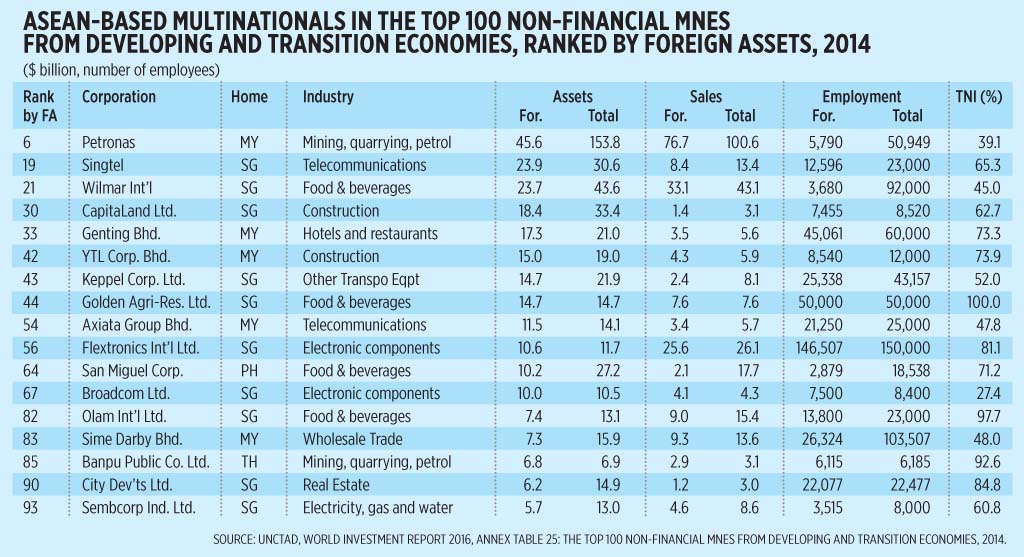
Below are the biggest MNEs from the ASEAN. The Transnationality Index (TNI) is calculated as the average of the three ratios: foreign assets (FA) to total assets, foreign sales to total sales, and foreign employment to total employment (see table).

  
There are at least two things that are prominent in the above table.

First, 17 ASEAN-based MNEs have made it to the top 100 MNEs from the developing world: 10 from Singapore, 5 from Malaysia, 1 each from Thailand and the Philippines. The TNI of these 17 companies are generally high, 11 of them have TNI of 60% or higher.

Second, San Miguel Corp. is dynamic enough to have plenty of branches and subsidiaries in the region and other parts of the world. It is indeed the #1 brand from the Philippines that has high regional footprint, and known even in some industrial economies in the west.

But there seems to be a mistake in the UNCTAD table, saying that SMC’s TNI is 71% when it looks like having only 30% or lower.

Other big MNEs from developing Asia are the following:

1. Hutchison Whampoa Ltd. (Hong Kong, Transport and storage) with FA of $91B.
2. Hon Hai Precision Industries (Taiwan, Electronic components) with FA of $73B.
3. China National Offshore Oil Corp. (China, Mining, quarrying and petroleum) with FA of $71B.
4. Samsung Electronics Co., Ltd. (South Korea, Communications equipment) with FA of $56B.
5. Tata Motors Ltd. (India, Motor Vehicles) with FA of $30B.

The subject of Philippine multinationals will be among the topics to be tackled in the coming BusinessWorld ASEAN Regional Forum this coming Nov. 24, 2016 at Conrad Hotel, SM MOA Complex. It is a regional conference with the involvement and sponsorship of many big corporations in the country.

Among the speakers will be CEOs and managers of big Philippine MNEs, and MNEs from abroad that are operating in the Philippines. This two-way exchange of ideas and experiences will be very productive for small and medium enterprises (SMEs) in the country that aspire to have regional footprints, and later barge into the continental and global list of successful and big MNEs.

After all, Facebook, YouTube, Twitter other big brands now were nonexistent until about 13 years ago. Endless innovation, consumer-friendliness and access to more markets abroad have allowed them to leapfrog from small start-ups to huge, multibillion-dollar global companies.


Bienvenido S. Oplas, Jr. is the president of Minimal Government Thinkers and a fellow of SEANET. Both institutes are members of the Economic Freedom Network (EFN) Asia.
-----------

See also:
BWorld 71, Free trade and higher income, July 11, 2016
BWorld 72, Economic integration and disruption, July 25, 2016 
BWorld 86, Philippine industrial policy, October 15, 2016
BWorld 91, Free trade means faster growth in manufacturing, November 14, 2016
BWorld 92, Climate action and Asian energy realities, November 19, 2016

Saturday, November 26, 2016

EFN Asia 63, Day 1 of Conference 2016

The Economic Freedom Network (EFN) Asia conference 2016 at Dusit Thani Hotel in Makati ended last Wednesday. Thanks again FNF and EFN for another wonderful conference.

Here are some tweets from #efnasia2016 and my own thoughts about the event.

Protection of human rights is part and parcel of EU policy – Walter van Hattum, EU Delegation to the Philippines.


It's a responsibilty of businesses to respect human rights... It is state duty to protect and defend human rights in its territory.

Nobody can seriously suggest that businesses can opt in and out of respecting human rights as they wish... There is legal obligation for businesses to respect HR.

Businesses should be as transparent as possible so they will be less likely to be attacked by false news. Business leaders are often uncomfortable explaining to the public how they work. It's understandable but unwise. -- Markus Leöning, former Himan Rights Commissioner in Germany.


Increasingly populist goverments a threat to human rights and economic freedom. The pendulum has swung as globalization has failed in its promises to those who have lost out in its benefits. Food for thought. -- Frank Largo

For me, among the important human rights of the people is freedom to choose in the market place, freedom to sell or not sell, freedom to buy or not buy. Political human rights like the right or freedom from theft (especially organized criminals), murders, prosecution and harassment, that is where the state should come in.

A minimal government focused on enforcing the rule of law, enforcing contracts between and among people, is consistent with economic freedom and human rights protection. That minimal govt should have no business creating and expanding lots of endless welfarist programs. Prosperity is not an entitlement or privilege. Lazy and irresponsible have no right to a prosperous life, they deserve poverty. Politically incorrect statement, as usual.

Rule of law means the law applies equally to unequal people. So the law should apply to both rich and poor people, to big/giant and small firms. A law or contract can be written, verbal, done by govt or private entities. Basic human rights then means that people have access to such equality before the law.

Below, Rainer Heufers moderating, with Wan Saiful Wan Jan, Peter Kompalla, Rishi Sher Singh, Dr. Manzoor Ahmad in the new panel.


People's definitions of human rights vary. What may be HR violations to some can also be another's sole income source... Definitions of human rights vary. What may be HR violations to some can be another's sole income source. -- Wan Saiful Wan Jan

Good point. Some westerners may consider temporary child labor as HR violation already but for some households, it is ok and necessary. If a sole family breadwinner is gone for instance, the young need to work to help sustain the family. Harsh but necessary.

Stakeholder values, not just shareholder values. -- Rishi Sher Singh

Barun Mitra tweets:

Business of business is indeed business! Inclusive of profitability for investors, benefit to consumers, add values to society.

Better protection of human rights, improved environmental quality, higher sense of justice, necessary social value additions.

Value added products, economic and social, become affordable with prosperity, and necessity in a free competitive market.

Implentating Rule of law carries cost, level of effective enforcement has to be affordable, economically socially politically. #EFNAsia2016

I think corporate branding will help global firms stay the course in HR and econ freedom protection, respecting #ruleOfLaw. Firms would dislike to be associated with bad products, bad services, bad corporate image. So they will try to be as transparent as possible, to be accountable to their products and practices. Transparency is good protection vs negative image/attacks.

Session 2 Panel speakers: H.E. Franz Jessen of EU, Dr. Lee Taekyu of KERI, and Atty. Arpee Santiago of Ateneo Human rights Center.


Govt and countries don't trade, individuals and businesses do. Govt negotiating trade treaties leading to anti-trade backlash.

Free trade is voluntary, so win win. Govt negotiations may liberalise trade, but legitimises govt in trade n economy, corruption.

Environment, labour or human rights standards in national trade treaties, focus on outcomes, give advantage to large, richer cos!

Society / govt benefit most if they adopt unilateral free trade. All politics is local, a local decision will minimise backlash. 

Govt negotiating trade, inevitably adopt export is good, import is bad outlook. Free trade is beneficial when govt has no role.

Access to internet can't be a "Right". Political rights are negative rights. Any +ive right paid for by others can't be a RIGHT.

TPP may be good agreement, but has lost legitimacy because govts. no longer carry credibility among large sections of people. -- Barun Mitra

As usual, I agree with Barun's ideas and observations: unilateral trade liberalization; countries and governments do not trade with each other, people do; so governments, national and multilateral, should step back from trade negotiations as much as possible. Let companies and people organizations negotiate with their suppliers and consumers abroad and keep prices low via low or zero tariff, minimal non-tariff barriers.
-------------

See also: EFN Asia 60, Conference 2014 in Hong Kong, part 5, April 03, 2016
EFN Asia 61, Panel on TPP at Jeju Forum 2016, June 14, 2016

EFN Asia 62, Program for Conference 2016, Manila, November 20, 2016