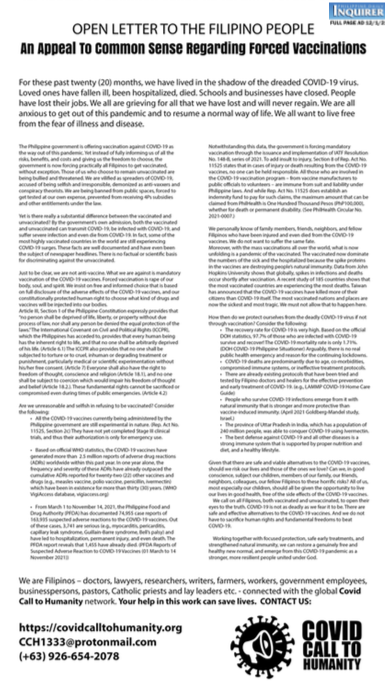
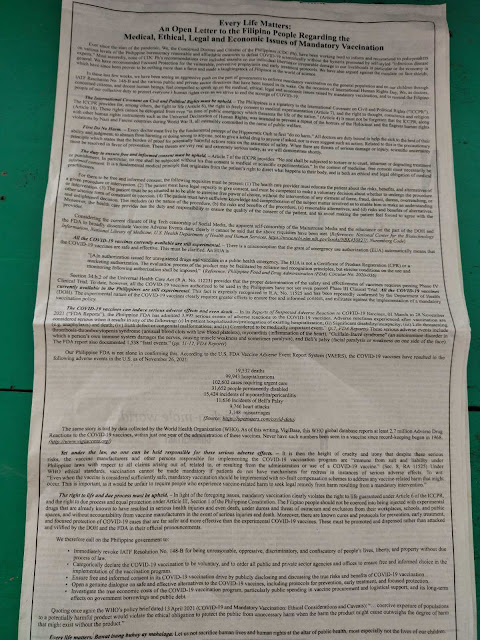
This is the longer draft (2,500+ words, 5 pages) that the Concerned Doctors and Citizens of the Philippines (CDC Ph) wanted to put up as its full-page ad last week December 10, this draft made in December 8. The doctors provided the data and arguments in I. Medical Argument, the head of CDC Ph Legal Volunteer Corps provided arguments in II and III, Ethical and Legal Arguments. I provided the data and arguments in IV. Economic Argument.
Nonetheless we opted to use the 2nd, shorter draft (1,700+ words),
Enjoy.
Enjoy.
------------
AN OPEN LETTER TO THE FILIPINO PEOPLE
The Medical, Ethical, Legal and Economic
Arguments Against Mandatory Vaccination
Since the start declaration of the pandemic two years ago, We, Concerned Doctors and Citizens of the Philippines (CDC Ph), have worked hard to inform and recommend to policymakers in various levels of Philippine bureaucracy reasonable measures to defeat COVID-19 scientifically without the hysteria promoted by self-styled “infectious disease experts” and certainly without assault to our individual liberties and irreparable damage to our livelihoods in particular and the economy in general. We have recommended focused protection for the vulnerable, preventive prophylaxis and early treatment protocols. We have argued against the un-scientific use of face shields, a farce and fiasco that has been proven true in its utter falsity.
Today, against even the declarations of the Secretary of Justice itself, we are seeing a creeping advent, in one form or another, of forced or mandatory vaccinations. It is, thus, our duty as to speak directly to the Filipino People and present the medical, ethical, legal and economic cases against mandatory vaccination.
I.
THE MEDICAL ARGUMENT
The Philippines’ very own Food and Drug Administration (FDA) (https://www.fda.gov.ph/) published its Reports of Suspected Adverse Reaction to COVID-19 Vaccines, 01 March to 28 November 2021 (“FDA Reports”) and admitted to 74,346 non-serious events and 3,995 serious events.
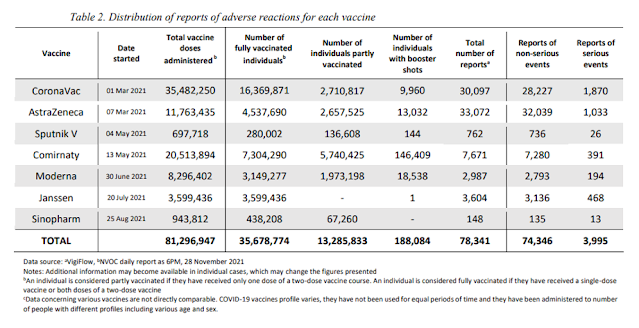
For the avoidance of doubt, “adverse reactions experienced after vaccination are considered serious when it resulted to any of the following criteria: (i) In-patient hospitalization/prolongation of existing hospitalization; (ii) Significant disability/incapacity; (iii) Life-threatening (e.g. anaphylaxis) and death; (iv) Birth defect or congenital malformations; and (v) Considered to be medically important event.” (p.7, FDA Reports)
It is comprehensive 20-page report that covers serious adverse events, to wit,
“Thrombosis-thrombocytopenia syndrome
“Thrombosis-thrombocytopenia syndrome (TTS) are cases of unusual blood clots with low blood platelets. Following cases of TTS from other countries, COVID-19 Vaccine AstraZeneca and Janssen COVID-19 Vaccine revised their label to include warnings related to thrombosis with thrombocytopenia, a very rare side effect following vaccination.” (p. 8, FDA Reports)
“Inflammation of the heart
“Myocarditis is an inflammation of the heart muscle that may present as chest pain, palpitations, arrhythmias, and/or symptoms of heart failure while pericarditis is an inflammation of the pericardial sac that surrounds the heart and fixes it to the mediastinum. Cases of myocarditis and pericarditis on the use of mRNA vaccine, such as Comirnaty and COVID-19 Vaccine Moderna, have been reported in many countries including the US, UK, Germany, and Israel. Most of the cases are young male.
“Guillain-Barré syndrome
“Guillain-Barré syndrome (GBS) is a rare, autoimmune disorder in which a person’s own immune system damages the nerves, causing muscle weakness and sometimes paralysis. An increased risk for GBS has been observed following vaccination with Janssen COVID-19 Vaccine in the US. .” (p. 10, FDA Reports)
“Bell’s palsy
“Bell’s palsy is a form of temporary facial paralysis or weakness on one side of the face. It results from dysfunction of facial nerve which directs the muscles on one side of the face. Cases have been reported in a number of people in Hong Kong, Canada, and UK on the use of CoronaVac, Comirnaty, and COVID-19 Vaccine Moderna. (pp. 10-11, FDA Reports)
“Vaccine deaths
“As of 28 November 2021, 1,538 fatal events were received. Reports of fatal events does not necessarily mean that the vaccine caused the events. Underlying conditions or pre-existing medical conditions causing fatal events are usually coincidental on the use of the vaccine. It is expected that reports of fatal events will rise as the vaccination program covers more people including those with undiagnosed illness, underlying comorbidities, and pre-existing medical conditions. The vaccinees reported to have fatal events were aged 13 years and above. The mean age of the fatal cases was 62.2 years. 66.32% (1,020) of the fatal cases were from age group 60 years and above, 23.15% (356) from age group of 40-59 years, 9.17% (141) from age group 18-39 years, 0.20% (3) from age group 12-17 years of age and 1.17% (18) were not identified to what age group they are classified.
(pp. 11-12, FDA Reports)
Our Philippine FDA is not alone in confirming this. “Established in 1990, the Vaccine Adverse Event Reporting System (VAERS) is a national early warning system to detect possible safety problems in U.S.-licensed vaccines. VAERS is co-managed by the Centers for Disease Control and Prevention (CDC) and the U.S. Food and Drug Administration (FDA). VAERS accepts and analyzes reports of adverse events (possible side effects) after a person has received a vaccination.” (https://openvaers.com/faq) As of 26 November 2021, it has reported on VAERS COVID Vaccine Adverse Event Reports ((https://openvaers.com/covid-data)), inter alia,
• Deaths – 19,532
• Hospitalizations – 99,943
• Urgent Care – 102,602
• Bell’s Palsy – 11,636
• Miscarriages – 3,148
• Hearth Attacks – 9,746
• Myocarditis/Pericarditis – 15,424
• Permanently Disabled – 31,652
The same story is being told by data from other medical/health organizations, including the World Health Organization (WHO).
“VigiAccess was launched by the WHO in 2015 to provide public access to information in VigiBase, the WHO global database of reported potential side effects of medicinal products. Side effects – known technically as adverse drug reactions (ADRs) and adverse events following immunization (AEFIs) – are reported by national pharmacovigilance centres or national drug regulatory authorities that are members of the WHO Programme for International Drug Monitoring (PIDM). WHO PIDM was created in 1968 to ensure the safer and more effective use of medicinal products.” (http://www.vigiaccess.org/) A search for “Covid-19 vaccine” retrieves 2,706,410 records of adverse drug reactions (ADR).
II.
THE ETHICAL ARGUMENT
Forcibly mandating COVID-19 vaccination, directly or through false choices, especially given the data on serious adverse events, including vaccine death, is unethical. It abrogates the fundamental medical principle of informed consent, which is both an ethical and legal obligation of medical practitioners and originates from the patient’s right to direct what happens to their body:
“Informed consent is the process in which a health care provider educates a patient about the risks, benefits, and alternatives of a given procedure or intervention. The patient must be competent to make a voluntary decision about whether to undergo the procedure or intervention. Informed consent is both an ethical and legal obligation of medical practitioners . . . and originates from the patient’s right to direct what happens to their body. Implicit in providing informed consent is an assessment of the patient’s understanding, rendering an actual recommendation, and documentation of the process. The Joint Commission requires documentation of all the elements of informed consent “in a form, progress notes or elsewhere in the record.” The following are the required elements for documentation of the informed consent discussion: (1) the nature of the procedure, (2) the risks and benefits and the procedure, (3) reasonable alternatives, (4) risks and benefits of alternatives, and (5) assessment of the patient's understanding of elements 1 through 4.
“It is the obligation of the provider to make it clear that the patient is participating in the decision-making process and avoid making the patient feel forced to agree to with the provider. The provider must make a recommendation and provide their reasoning for said recommendation.”
The above is quoted from the National Center for the Biotechnology Information, National Library of Medicine, U.S. Health Department of Health and Human Services. (https://www.ncbi.nlm.nih.gov/books/NBK430827/)
Moreover, although the COVID-19 vaccines are emergency use authorized, they are still experimental in use. Section 34.b.2 of the Universal Health Care Act (or R.A. No. 11223) provides that the proper determination of the safety and effectiveness of vaccines requires passing Phase IV Clinical Trial. However, to date, the COVID-19 vaccines authorized to be used have not yet even passed Phase III Clinical Trial. All the COVID-19 vaccines administered to date are merely administered under Emergency Use Authorization (EUA). Department of Health (DOH) went on record to confirm this state of affairs.
To buttress this point, Food and Drug Administration (FDA) Circular No. 2020-036 defines an EUA as,
“[A]n authorization issued for unregistered drugs and vaccines in a public health emergency. The EUA is not a Certificate of Product Registration (CPR) or a marketing authorization. The evaluation process of the product may be facilitated by reliance and recognition principles, but stricter conditions on the use and monitoring following authorization shall be imposed.”
Necessarily, the COVID-19 vaccines have not yet been approved for registration by the FDA. In the language of the FDA, “[s]tricter conditions on the use and monitoring” on the vaccines have yet to be implemented. Accordingly, the current regulatory status of authorized COVID-19 vaccines should moderate, temper and/or restrain any governmental measure, implementing an effectively mandatory vaccination policy.
Without such temperance and restraint, Covid Call for Humanity’s impassioned call for forcible vaccination to be looked as “rape” cannot be more apt and the violation against The Nuremberg Code (1947) covering Permissible Medical Experiments cannot be more brazen,
“The voluntary consent of the human subject is absolutely essential. This means that the person involved should have legal capacity to give consent; should be so situated as to be able to exercise free power of choice, without the intervention of any element of force, fraud, deceit, duress, overreaching, or other ulterior form of constraint or coercion; and should have sufficient knowledge and comprehension of the elements of the subject matter involved as to enable him to make an understanding and enlightened decision. This latter element requires that before the acceptance of an affirmative decision by the experimental subject there should be made known to him the nature, duration, and purpose of the experiment; the method and means by which it is to be conducted; all inconveniences and hazards reasonably to be expected; and the effects upon his health or person which may possibly come from his participation in the experiment.
“The duty and responsibility for ascertaining the quality of the consent rests upon each individual who initiates, directs, or engages in the experiment. It is a personal duty and responsibility which may not be delegated to another with impunity.”
III.
THE LEGAL ARGUMENT
Forcible vaccination, especially given the medical and scientific data and the ethical issues, clearly violates the due process clause and the right to equal protection as guaranteed under Section 1, Article III of the Philippine Constitution:
“Section 1. No person shall be deprived of life, liberty, or property without due process of law, nor shall any person be denied the equal protection of laws.”
Mandatory vaccination would violate Section 12 of Rep. Act No. 11525, as amended or the “COVID-19 Vaccination Program Act of 2021.” Section 12 of RA 11525 prohibits the imposition of vaccine cards as an additional mandatory requirement to employment.
“SEC. 12. COVID-19 Vaccination Card. – Subject to the provisions of Republic Act No. 10173 or the “Data Privacy Act of 2012”, the DOH shall issue a vaccine card to all persons vaccinated. To fast track the process, the DOH may delegate the processing and issuance of vaccine cards to LGUs and private entities xxx.
x x x
Provided, further, That the vaccine cards shall not be considered as an additional mandatory requirement for educational, employment and other similar government transaction purposes.
A vaccine card, which is proof of vaccination is only issued to a person once the same is vaccinated. If vaccine cards are prohibited as an additional mandatory requirement for employment, necessarily vaccination cannot be an additional mandatory requirement for employment.
In addition to violating the constitution and being contrary to enacted legislation, forced vaccination schemes violates non-derogable rights recognized under the International Covenant on Civil and Political Rights (“ICCPR”) to which the Philippines is a Contracting State. The ICCPR provides for, among others, the right to life (Article 6), the right to freely consent to medical experimentation (Article 7), the right to thought, conscience and religion, (Article 18), as follows:
“Article 6
“1. Every human being has the inherent right to life. This right shall be protected by law. No one shall be arbitrarily deprived of his life.
“Article 7
“No one shall be subjected to torture or to cruel, inhuman or degrading treatment or punishment. In particular, no one shall be subjected without his free consent to medical or scientific experimentation.
“Article 18
“1. Everyone shall have the right to freedom of thought, conscience and religion. This right shall include freedom to have or to adopt a religion or belief of his choice, and freedom, either individually or in community with others and in public or private, to manifest his religion or belief in worship, observance, practice and teaching.
“2. No one shall be subject to coercion which would impair his freedom to have or to adopt a religion or belief of his choice.”
IV.
THE ECONOMIC ARGUMENT
With the strict lockdown and business closures last year, the Philippines suffered its worst economic performance since World War II with a -9.6% GDP contraction in 2020. Explained another way, the country’s GDP size or level at constant 2018 prices was P18.26 Trillion in 2018, P19.38 Trillion in 2019, and shrank to P17.53 Trillion in 2020. Nearly P2 Trillion of domestic production of goods and services were lost last year.
Government revenues declined significantly because of so many business closures and job losses in the private sector. But government spending has increased significantly partly due to huge vaccine procurement plus logistical requirements in storage, transportation and handling of those vaccines, resulting in huge borrowings.
Our public debt/GDP ratio of 37.0% in 2019 shot up to 51.7% in 2020, and projected to further rise to 59% this year. This is among the biggest jump in debt/GDP ratio in Asia and the world in just two years.
Government borrowings to finance the deficit (revenues lower than expenditures) was P2.5 Trillion in 2020 or P208 Billion a month. Borrowings from January to October 2021 already stood at P2.47 Trillion or P247 Billion a month. Again partly because of huge procurement in mass vaccination plus 3rd booster shots for certain groups of people.
Data from the Bureau of Treasury showed that outstanding government debt was P7.73 Trillion in 2019, jumped to P9.80 trillion in 2020, and already at P11.97 as of October 2021. Explained another way, the government debt/GDP ratio was 39.6% in 2019, rose to 54.6% in 2020, and already at 63.1% in October 2021.
Huge public debt will require huge and high taxes because government does not know or intend to cut spending and subsidies to its many government corporations and agencies. Philippine taxpayers are doomed in the next few years.
Vaccine discrimination, an implicit form of mandatory vaccination and another form of continued lockdown on people mobility has contributed to higher inflation this year as production of goods and services are restricted by such lockdown and vaccine discrimination. The Philippines’ average inflation rate from January-October 2021 is high at 4.5%. Our ASEAN neighbors Indonesia, Thailand, Vietnam and Singapore have only 1.0% to 1.8%, Malaysia at 2.3%.
Huge public spending in vaccine procurement plus logistical support has contributed to huge new borrowings and high public debt stock. It also contributed to high inflation today due to restricted production and mobility of goods and services caused by continued lockdown and vaccine discrimination.
Maraming Salamat Po! God bless the Filipino People!
CONCERNED DOCTORS AND CITIZENS
OF THE PHILIPPINES
------------
See also:
Covid 59, Natural immunity vs vax immunity, November 04, 2021
Covid 60, The CDC Ph Covid Summit, Nov. 25, Vivere Hotel, Alabang, November 14, 2021
Covid 61, CCH and CDC Ph full page ads re mandatory vaccination, December 14, 2021.
Covid 59, Natural immunity vs vax immunity, November 04, 2021
Covid 60, The CDC Ph Covid Summit, Nov. 25, Vivere Hotel, Alabang, November 14, 2021
Covid 61, CCH and CDC Ph full page ads re mandatory vaccination, December 14, 2021.