Showing posts with label Pfizer. Show all posts

Thursday, September 22, 2011

Drug price control 17: Wikileaks on the planned Pfizer drugs withrawal

Where there is political and economic coercion by governments, there is also product and service non-availability or withrawal by the affected players and companies. The stronger the coercion, the plentier the amount of goods and services that are non-available in the market.

A clear example are the highly-repressive governments of North Korea, Myanmar, Venezuela, Congo and many other African countries. Private companies, especially multinationals, would hardly consider setting up businesses in those countries as the political threat of price control, product confiscation, raids and other forms of harassment are very clear and real. Contrast that with free trade economies like Hong Kong (unilateral free trade policy actually), where almost anything and everything is available from so many countries and territories.
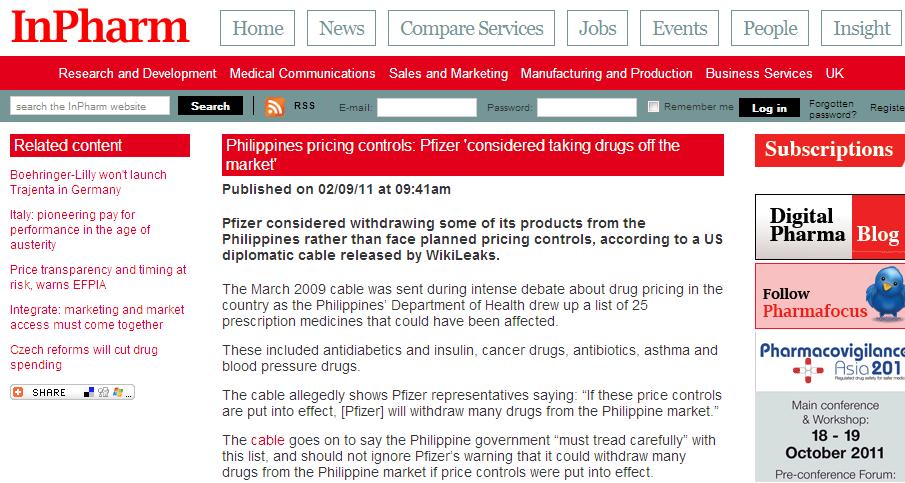
While searching google on "drug pricing", I saw this article from InPharm, Philippines pricing controls: Pfizer 'considered taking drugs off the market', dated September 2, 2011. It said,

Pfizer considered withdrawing some of its products from the Philippines rather than face planned pricing controls, according to a US diplomatic cable released by WikiLeaks.

The March 2009 cable was sent during intense debate about drug pricing in the country as the Philippines’ Department of Health drew up a list of 25 prescription medicines that could have been affected....

The article referred to a Wikileaks cable, PHILIPPINES CLOSER TO DRUG PRICE CONTROLS, so I visited the site.

It's about the supposed cable of then US Ambassador to the Philippines, Kristie Kenney (I follow her on twitter, and just 3 days ago, she mentioned me and replied to my tweet on the subject of Rule of Law :-)) to the US Secretary of State, dated March 5, 2009. The cable said,

1. Summary. The Philippine Department of Health has listed 34 prescription medications that will be subjected to price controls under the Cheaper Medicines Act (reftel) enacted last year. The main impetus for the rapid imposition of price controls came from advocacy groups and non-governmental organizations. Local representatives of international drug companies participated in consultations on maximum retail prices, but warn that some of the controlled prices are lower than the costs of making the drugs, which could force them to withdraw many drugs from the Philippine market. End summary...

4. We met with several directors of the Pharmaceutical and Health Association of the Philippines, the trade association of foreign drug companies, who noted that the main impetus for the rapid imposition of price controls came from advocacy groups and non-governmental organizations. While the Association acknowledged that it has been invited to consult with the Health Department, it also noted that some member companies had not participated. The Association is also concerned that the final list of drugs subject to price control may contain more than 25 medications.

5. In addition, the Association asserts that the Health Department has been pressuring companies to sell drugs in small packages that can retail for 100 pesos, or around USD 2, offering to
exempt such drugs from price controls. In many cases, this can amount to a handful of tablets needed for one cycle of a course of doses. Representatives of Pfizer warned us that for certain
antibiotics, small doses can promote antibiotic-resistant bacteria, and claimed that it is being pressed to sell antibiotics that currently cost over 1000 pesos for the 100-peso fixed price. Pfizer said that if these price controls are put into effect, it will withdraw many drugs from the Philippine market.

Comment
-------

6. The Philippine press has recently featured stories noting that drug prices have not fallen since the Cheaper Medicines Act came into effect, creating pressure for more immediate action from the government. However, the Philippine government must tread carefully and should not ignore Pfizer's warning that it could withdraw many drugs from the Philippine market if price controls are put into effect. Pfizer's withdrawal of medicines from Thailand following laws on compulsory licensing clearly demonstrates the risks. Post will continue to remind Health Department officials that expecting pharmaceutical companies to sell products for less than it costs to produce them could prove counterproductive.

Wow. I have read other Wikileaks cable release supposedly also from then US Ambassador Kenney about her opinion about now PNoy Aquino when the latter was still a Senator. There were questions about the validity and authenticity of those "cable leaks." So I will also not take the above cable leak as 100 percent true.

But assuming for the same of argument, that the above communication was indeed true, I will not be surprised of the wording of the former Ambassador. Pfizer as (or any other) US-based company that pays plenty of taxes to the US government, would naturally seek the assistance of its own government to talk to the host (Philippine) government when the policy of the latter will adversely affect its business. The same way that some Philippine-based company/ies sought the assistance of Philippine Congress and the Executive branch in crafting the Cheaper Medicines Law (RA 9502) and amended the Intellectual Property Code so that certain patent protection of innovator drugs by some multinational pharma companies can possibly be tweaked and dishonored via provisions on compulsory licensing, special CL, early working, exhaustion of rights and government use.

While I was a member of the DOH Advisory Council on Price Regulation (now it's called the DOH Advisory Council on Healthcare), the DOH body that was referred to by Ambassador Kenney, I was not aware of the first 3 Council meetings and consultations from January to April 2009. And that was the period stated in the above cable.

I started attending only on its 4th meeting in early June 2009. I have a long discussion of what transpired in the 4th and 5th meetings of the Council on June 2009, see my book, Health Choices and Responsibilities (published January 2011, 233 pages) and turn to pages 2-7, also pages 72-73.

Anyway, these issues are now water under the bridge. Pfizer did not withraw its innovator drugs that were hit by price control (Norvasc (amlodipine), Lipitor (atorvastatin) and Azithromycin (anti-biotic), what else) and opted to absorb the losses and resorted to deep cost-cutting measures including laying off a few hundred employees.

But what will not go away is the damage done by government intervention -- particularly the Philippine Senate, the Committee then headed by former Sen. Mar Roxas, the DOH then headed by former Sec. Francisco Duque, and the former President Gloria Macapagal Arroyo -- in drug pricing. As I wrote here in the past, price control is price dictatorship.

This damage to the business environment, at least in the health sector as far as foreign investment is concerned, is long-term. And the fact that the price control policy is still not lifted until now even if all the 3 main political personalities involved are no longer in their offices, makes the damage last longer.
-------

See also Part 16: More on Cong. Biron's Bill, September 01, 2011, and
Part 12: Blog posts on page 1 of Google, Yahoo and Bing, August 14, 2011

Thursday, May 26, 2011

Tobacco Tax 4: Finding the Optimum, Not Maximum Cigarette Tax

This afternoon, I attended a round-table discussion sponsored by the Alternative Health Cluster and 3CPNet, about tobacco regulation and taxation. Venue was the Oxfam-Manila office.

There are at least three taxes imposed on cigarettes and other tobacco products: excise tax, value added tax (VAT) and local government taxes. For imported cigars and cigarettes, there is a 4th tax, import tax and duty.

The "sin taxes" or taxes on "sin" products, aka "public bads", that people are talking about, that are being discussed in Congress, refer only to excise tax. Such tax measures do not include or touch the two or three other taxes on those products, namely the VAT, local government taxes, and import tax.

Currently, there are four tiers of taxes on cigarettes in the country. The cheapest brands are slapped with P2.70 per pack, and the premium, more expensive cigarettes are slapped with P28 per pack. This multi-tier tax rates is an opening for loopholes and will definitely invite cheating in tax payment, in connivance with government tax assessors and collectors, namely the BIR people.

The important tax reform in this sector therefore, is to introduce only one tier or one specific tax for all types and brands of cigarettes, from the cheapest to the most expensive ones. Two House Bills propose a P30 per pack flat rate.

I think this rate is a rational and optimal one. Some can propose that the tax should be "as high as possible", perhaps P500 or P1,000 per pack, in order to drastically drive people away from smoking. This is not going to happen. The higher the tax, the higher the incentive to cheat, to resort to smuggling. As long as the demand is there -- people who smoke even if they are fully aware that smoking is bad for their health -- supply will also be there. So higher tax rate, higher smuggling incidence, and more people will still be smoking with cheaper, smuggled cigarettes.

So we should be looking for that "optimum", not maximum, level of tobacco tax. A P30 or P40 per pack, flat rate, should be fine. It is considered as "optimal" because (1) it will help raise tax revenues for the government -- so that income tax cut, if not income tax abolition, can be introduced someday, and (b) it will not encourage more smuggling.

Being a non-smoker (I tried smoking in the past, but my tongue simply rejects it, so I have not finished smoking even a single stick of cigarette all my life), I have little or zero sympathy for smoking. But I also recognize that people own their lives. If they wish to smoke and smoke -- and over-drink, over-eat, over-sit, etc. -- it's up to them. Somehow they should know that such abuse of their body will attract some undesirable bacteria, virus or other diseases into their body soon.

Taxation and other forms of government regulation can only achieve so much. I would add that a tax-hungry government can actually be jumping with joy (but silently, of course) if there are more people smoking because that would mean more tax revenues. So government is not the best institution to rely on to tell people to control or quit smoking. Individuals and civil society groups campaigning for tobacco control should instead go straight to the public, approach schools and universities, public and private, to spread awareness to students that smoking is not good for their health and that it can be addicting. Cut the demand, and supply will soon be cut.
----

Last January 5, 2011, I wrote this:

Smokers, taxes and Pfizer

There is this interesting news report today in NYT, In Japan, Pfizer Is Short of Drug to Help Smokers. Japan's government imposed a tobacco tax hike law in December 2009, and its implementation would be in October 2010. A pack of cigarette in Japan was selling for 300 yen, about $3.60. By October 1, it jumped to over 400 yen, including 70 yen in taxes.

This tobacco tax hike plus various strict regulations and restrictions on smoking made thousands of Japanese smokers to consider quitting. It is estimated that some 130,000 Japanese die each year on average due to tobacco-related illnesses. Pfizer's Chantix was a blockbuster anti-smoking drug there. But not totally.

Prior to October 2010, Pfizer was selling the drug to about 70,000 patients a month. By September 2010, or a month before the tobacco tax hike, demand rose to 170,000 persons, and went much higher the next month. And Pfizer did not have enough supply for the huge increase in demand, resulting in many grumbling Japanese would-be-smoking-quitters.

There are two important factors why the Japanese government raised the tobacco tax, and would be raising it further in the near future. One is the high incidence of tobacco-related deaths among Japanese people. And two is the high budget deficit and high public debt that requires more tax revenues.

One may say that Pfizer is only capitalizing on the growing health consciousness of many people and the awareness to limit, if not quit, smoking. Well, that's how business works. Where there is a new demand, big or small, just supply it and make money from it.

Meanwhile, this is one of the few instances where government taxation can help promote public health.
------

See also:

Tobacco Tax 1: Telecom and Medicine Taxes Too, September 15, 2009 
Tobacco Tax 2: Higher Tax + Corruption = Lower Revenue, June 06, 2010
Tobacco Tax 3: When Supply is Killed But Demand Persists, November 15, 2010

Sunday, November 22, 2009

Huge drug firms laying off research staff

There was this news report last Thursday from Nature magazine.

http://www.nature.com/naturejobs/2009/091119/full/nj7271-375e.html

Published in Nature 462, 375 (18 November 2009) | 10.1038/nj7271-375e

Huge cuts by drug firms

R&D closure is the latest in a series of hits to drug companies.
Pfizer is closing 35% of its global research and development space, according to a 9 November announcement. The New York-based drug company, which employs 14,500 people in research and development worldwide, has said that R&D personnel cuts associated with the closures will make up a significant percentage of the 15% company-wide job cuts planned. Pfizer, which last month acquired US drugmaker Wyeth, has disclosed no further information and did not return phone calls by press time. In early November, US drugmaker Johnson & Johnson announced plans to lay off about 8,000, but did not reveal how the cuts would affect its R&D personnel.
------

I asked guys in our local health coalition here in Manila, including those who favor bigger government intervention in healthcare, "Is this a good or bad development?"

No comment so far from any of them. For some people who dislike global capitalism in general, and big multinational pharmaceutical companies in particular, this should be seen as a positive development. New tools or policy schemes like compulsory licensing (CL) and drug price control are meant mainly to hurt the big multinational pharmas, not the local pharma. For instance, in the current drug price control policy, not a single product by United Laboratories (Unilab) was included, although Unilab is the biggest pharma company in the country, with sales equivalent perhaps to the combined sales of 2nd-3rd and 4th biggest pharma firms (GSK, Pfizer, Wyeth).

So if the big pharma multinationals are hurting, like even their patented drugs in the country are covered by price control, and the laying off of more than 1/3 of their R&D staff, in the case of Pfizer, then those who oppose big multi pharma should rejoice. Their goal is to publicly hurt, if not obliterate from the global economy -- using various government restrictions and regulations -- the big pharmas that they accuse of making huge profit at the expense of poor patients.

But those people do not realize, or at least they do not recognize, that those big pharma are the ones that invest huge money in high risk medicine innovation. The often glorified local, generic pharma companies do not risk their money and resources on medicine innovation, despite the fact that people around the world are demanding more innovative, more revolutionary medicines and vaccines.


Meanwhile, the US Healthcare Bill is 2,074 Pages Long...


I was surprised to read this update from Grover Norquist's facebook status, regarding the US healthcare bill. He noted,

"A word search of Sen. Harry Reid’s 2,074-page Senate healthcare bill (H.R. 3590) reveals that the term “tax” is used 183 times, “taxable” is used 164 times."

2,074 pages for a single bill? I doubt if even 10 percent of all US legislators will have the patience to read all pages of that bill.

Well, I'm not American, and I don't know most of the nuances of that bill. It's just the 2,000+ pages length of that bill that confounds me.