Showing posts with label Higher taxes. Show all posts

Wednesday, August 09, 2017

Tax-tax-tax, Free-free-free

All government agencies, departments and bureaus, officials and their consultants, are tax-hungry. Health and housing sectors say "we need more money." Infra and agri sectors say "we need more money." LGUs and Police say "we need more money." Military and defense say "we need more money." Basic and tertiary education (DepEd, CHED, SUCs) say "we need more money" and "Free tuition for all students in public schools and universities."

Almost all of them are silent or explicit campaigners of tax-tax-tax pa more. There are dozens of alibi to justify tax greediness.

Among the 122 state universities and colleges (SUCs) in the Philippines that will give "free tuition" to all of their students, rich and poor alike:

Those who argue "Rechannel ______ (agency) budget to education" are daydreaming. All agencies have their own justifications and alibi that they need more money, so there is no way to significantly cut their budget and rechannel the money to free tuition for all SUCs.

Many NGOs have become government-funded orgs (GFOs). You see them among the campaigners, silent or vocal, of tax-tax-tax pa more.

This is a losing proposition now but I will say it nonetheless: NO to new or higher taxes, there are lots of existing ones already. NO to new expensive subsidies like this free tuition for all students (currently part-subsidies depending on family income of students) in SUCs. If one sees the cars in UP and many other SUCs, one will wonder why these students are getting subsidies. DBM's Sec. Diokno said this welfarist program alone will cost P100B/year.

Among the big casualties of free-free-free, or subsidize-subsidize-subsidize philosophy is the corruption of people's values. Less personal and parental responsibility, more state responsibility. So more parents will be doing pa-inom-inom, pa sugal-sugal, etc. Their children's education from elementary to university is no longer parental responsibility, state responsibility na. Healthcare, state responsibility too.

The number of free riders, irresponsible people and tax-hungry bureaucrats and consultants will increase. For any problem, their "solution" is more government. Then people complain of massive wastes, inefficiencies, robbery and plunder in government. As government expands, stupidity and irrationality expands.

"A government that's big enough to give you everything you want is also big enough to take everything you've got."

Friday, June 15, 2012

Fat-Free Econ 13: P2 Trillion of Election Spending and Taxes

This is my article today in TV5's news portal,
http://www.interaksyon.com/article/34803/fat-free-economics-p2-trillion-of-taxes-new-debts

The main preoccupation of governments almost anywhere is to spend-spend-spend, tax-tax-tax. Since tax revenues are often not enough, they resort to borrow-borrow-borrow. And a vicious cycle of over-spending and over-borrowing, of fiscal and governmental irresponsibility, is set into motion, acquiring its own life, sustained year after year, administration after administration.

This is seen in many countries in Europe, North and South America, and Asia, including the Philippines. Our government’s gross debt stands at 40 percent of GDP. While this looks bad, there is good news to it somehow, because it used to be 60 percent of GDP about a decade ago.

The PNoy administration has hinted that its proposed budget next year will reach P2 trillion, up from this year’s P1.82 trillion. This means the government will need nearly P2 trillion of taxes and fees from us, the difference to be sourced from new borrowings, what else.

Many of us would wish that with what is going on in Europe and the US - where a huge public debt burden is dragging the rest of the economy into financial uncertainty - the Philippine government should exercise fiscal restraint and limit spending to what existing revenues can support so that there will be little or no need to contract new debt

Our problem is that next year is another election year. Politicians in power, from national to local, would spend and spend just to buy and bribe votes, and worry about the spike in debts and possible tax hikes later. Such is the tragedy of governments and democracy.

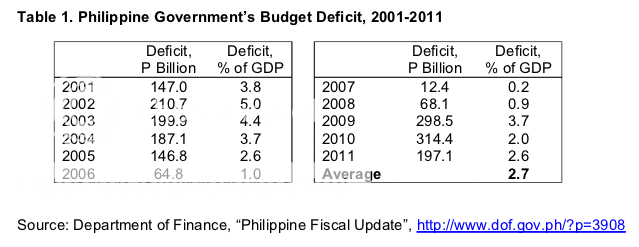
Below is the over-spending record of the national government over the past 11 years. Budget deficit means expenditures are larger than revenues, a typical attitude of living beyond one’s means and charging the difference to new borrowings.


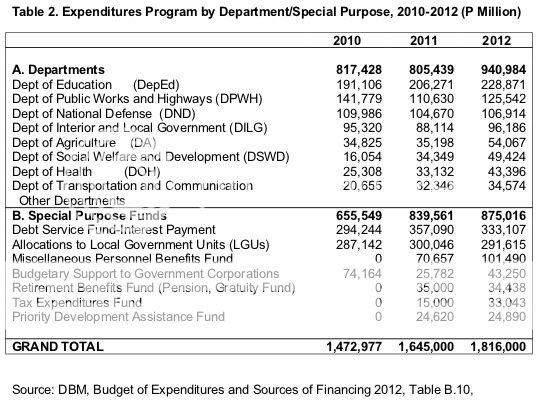
The main culprit for such overspending and the need for new borrowing, is government debt itself. Interest payment constitutes 20 percent of the annual budget. Here is a quick view of the biggest departments and expenditure items this year and the past two years.


DepEd, DPWH, DND and DILG, interest payments, internal revenue allocation of LGUs and various benefits to the million-plus national government personnel - they are the largest expenditure items this year.

Coming up very fast in terms of high growth in spending are DA, DOH and DSWD. When the local government code was enacted in 1991, these three agencies were among those whose several functions were devolved and decentralized to the LGUs. Thus, their share in national government spending has declined 20 percent 10 years ago. Recently though, there was a trend of “recentralization” as national government spending for these three departments has been rising fast.

The bulk of new spending in 2013 would include expanding the conditional cash transfer (CCT) program of the DSWD, from P34 billion this year to roughly P45 billion next year. The DSWD budget is projected to rise from P49 billion this year to P67 billion next year. Since the CCT is mainly a dole out program with some “conditionalities,” it is clearly a big tool for electioneering and legal vote-buying next year. The administration will of course object to the term “legal vote buying” but that’s what it really is.

More CCT actually means that previous government programs to "fight poverty" were ineffective or outright failures. Education and books for the poor, healthcare and medicines for the poor, housing and water for the poor, irrigation and credit for the poor, etc. These are supposed to have improved the condition of the poor, but they did not. So they invented this direct cash transfer to the poor. Soon with the RH billl, the government will also have condoms and IUD for the poor. What’s next, iPads for the poor?

Perhaps a big question to ask is, Is there room to retain, if not shrink, government spending in the next few years?

If the government is serious in controlling the burden of public debt and interest payments, the answer is “yes.” But since the government is not serious, or even dishonest in controlling the debt problem, its answer is “no.”

Many advocates of more and bigger government say that the Philippine government’s spending is actually “small” compared to many countries around the world, like its neighbors in Asia. See the numbers below.


What is wrong with the above numbers for the Philippines and other governments?

Our numbers represent only spending by the national government that are financed by taxes and mandatory fees. Spending by the local governments – barangays, cities/municipalities, and provinces – as well as spending by government corporations (PCSO, PAGCOR, etc.) are not included here.

If these expenditures are included, it is safe to estimate that overall and consolidated Philippine government spending would reach about 24 percent of GDP. That is not “small.” It comprises nearly one fourth of the total production of goods and services in the economy.

Reducing the fat in government spending and fiscal irresponsibility is a tough job to do and campaign for ordinary mortals (a.k.a. average taxpayers in the private sector). But we have to start somewhere. We need to help educate the public that more and bigger government spending, regulations, restrictions and taxation, are not good, are not productive. They siphon resources from private pockets and savings to politicians and bureaucrats’ spending whims.

Many social and economic services are better served and met by assigning more personal and parental responsibility to the people, not more government responsibility. The latter is a convenient excuse to justify endless government waste and greed. We have to learn to say “no” to such wasteful government advances and coercion somehow, somewhere.
--------

See also:
Fat-Free Econ 1: Macroeconomics for Micro Concerns, March 08, 2012
Fat-Free Econ 2: Determinants of Private Consumption Expenditures, March 14, 2012
Fat-Free Econ 11: GDP Growth and Private Sector Role, June 02, 2012
Fat-Free Econ 12: Privatizing PAGCOR, June 08, 2012


Fiscal irresponsibility 17: Cut Spending and Borrowing, September 19, 2011
Fiscal Irresponsibility 25: Spain Panic, More Eurozone Woes, June 06, 2012

Friday, April 01, 2011

Higher taxes next year?

(Note: this is my article for thelobyist.biz today)

Taxes are indirect way of government saying to the people, “Give me your money, I can spend it better for you than you yourself.” So the higher the tax rates and the plentier the number of taxes, the higher is the level of distrust of government to the personal discretion of the people to do what they think is good for themselves.

The painting on the wall is becoming louder and louder with each passing day. The Philippine government needs more money to finance the following: (1) More money to chieve the Millennium Development Goals (MDGs), especially on MDG 2, basic education for all. (b) More money for the conditional cash transfer (CCT), especially paying the new loans from the WB and ADB for this program alone. (c) More money for universal healthcare (UHC). (d) More money for housing for the poor. (e) More money for AFP and PNP modernization. (f) More money to fight man-made warming and climate change. (g) More money to control high population growth via the proposed RH bill.

All sorts of justifications and alibi are flying left and right with one central message: the government wants more money to be confiscated from the citizens, so that the government can spend more for the citizens. Say that again?

Sometime last February this year, former NEDA Director General and former UPSE Dean Philip Medalla, presented a paper at the Bangko Sentral ng Pilipinas (BSP) on fiscal policy and mentioned that we may have to accept the reality of more taxes in the near future. I questioned him on that during the open forum, see Cut income tax movement, part 1.

And sometime in January or February this year, the government economic think tank, Philippine Institute for Development Studies (PIDS) also produced a paper that in order to attain the MDGs, there is a need to hike taxes. I criticized that PIDS paper in MDGs, taxes and PIDS.

Today, there is a news in BWorld, Government working on new tax measures. The report was referring to the DOF plan to work on the proposal by former DBM Secretary and UPSE faculty member, Benjamin Diokno, to raise taxes on 3 areas: (a) raise the excise tax on cigarettes and liquor; (b) raise VAT from 12% to 15% in exchange for a cut in income tax; and (c) raise the real property tax (RPT).

Personally, I favor the first two proposals of Dr. Diokno who was my former professor two times (undergrad and graduate) at the UPSE. Raising taxes on tobacco and alcohol products I think, is long overdue. Since the government thinks – which I disagree – that healthcare is not much personal responsibility but government responsibility, then people can over-drink, over-smoke, over-eat, over-fight, etc. and when their lungs, liver, heart and other internal organs are dilapidated, they can run to the government to demand that “health is a right.” So government should raise lots of money from tobacco and alcohol products to finance its massive healthcare spending.

On raising VAT and cutting income tax, my favorite formula is a rise in VAT from 12 to 15 percent, in exchange for an income tax rate, both corporate and personal, between zero to 10 percent flat. This need not be attained within the next five years or so. A transition period of declining income tax rate from an initial flat 18 percent (again, both corporate and personal income tax) down to flat 15 percent after say five years, down to flat 10 percent after another five to ten years, ultimately to zero, or the abolition of income tax.

I have discussed the merits and advantages of raising consumption-based taxes like VAT, excise tax and entertainment tax, in exchange for drastic cut and ultimate abolition of income tax, in the above article on Cut income tax movement, part 1.

The increase in RPT is something that I think is not wise. Government should not tax, or slap only low tax, on productive land and areas. It should instead tax idle and unproductive land. An area that is full of buildings, malls, offices and houses means thousands of jobs are created there. When people have jobs, they are not likely to run to government to ask for welfare and subsidy. Developed areas also tend to be self-reliant. Malls, commercial business districts (CBDs) and residential villages usually have their own street lighting, garbage collection, road construction and maintenance, private security, so that their demand from local government for those services is minimal if not zero.

Taxing idle lands and areas is a clear message to the owners of those lands that “Your area is not creating jobs, better pay up taxes or sell your land to other people who can make it productive and create more jobs.”

Government is coercion and is financed only by coercion, taxes and other mandatory fees and contributions. Let the coercion be kept to the minimum.

Wednesday, June 28, 2006

Welfarism 5: Germany's Tax Hikes

Three weeks ago, May 12, I wrote this:

The government of Chancellor Angela Merkel found a solution to address Germany's financial needs to retain its expensive welfarism programs while avoiding budget deficit of 3 percent of GDP or higher -- by raising VAT from 16 percent to 19 percent. Taxpayers in the private sector naturally, raised howl as their money will buy less since the government will siphon off nearly 1/5 of the retail prices of the goods and services that they will consume. They protest, and rightly so, that their government has deemed it more important to raise already high taxes, than cut expenditures and pursue painful but necessary reforms in social security and the labor market.

The projected increase in government revenue from such 3 percentage point increase in VAT would be E8.1B ($10B) this year.

In addition, the government will also scrap selected tax rebates for individuals and introduce a 3 percentage-point top-up tax for high earners. In effect, this package of "tax reforms" is a double whammy of hikes in both income tax and consumption tax! Boy, if you're a politician and a high level government bureaucrat, what more can you ask? You got most of the money you want, forcibly taken away from the pockets of citizens, and spend that money on whatever programs you have in mind. From retaining if not expanding the already expensive welfare programs, to paying off large debts (principal + interest) accummulated through the years again, to finance the elaborate domestic welfarism and external military and foreign aid expenditures.

* But on the EU front, Ms. Merkel proposed slashing EU legislation by 25 percent in an effort to shrink the EU bureaucracy and encourage entrepreneurship (www.ft.com, May 11, 2006, "Germany proposes cutting EU laws by 25%", by Bertrand Benoit).
------

Ms. Merkel ran on promises of more competition, smaller bureaucracy and tax cuts. Eight months into the office and she has already hiked VAT from 16 to 19 percent, effective January next year. In the works is another tax hike, possibly in income tax.

Why the double-whammy of tax hikes? You bet it, to finance welfare hikes. The new plan is to spur birth rate, to arrest the "greying" of the population, and encourage working women to have a family then return to work. This will necessitate expanding the already expensive and bureaucratic health care system, to cover children that would cost from €16 to €25 billion, or $20 to $31 billion.

Currently, around 90 percent of German adults are insured through 250 health care insurance companies, a system that eats up money with little accountability. Patients in the public system do not receive bills. Instead, the doctor is reimbursed through the patient's public insurance company. Conversely, in the private health insurance system, patients receive a bill that meticulously records the cost of each treatment.

Again this is another kind of "social engineering" by the politicians and the dominant political parties. They did some social engineering in the past, something that discouraged people from having bigger families, or from having a family in the first place. So, this new round of social engineering is to reverse that, to encourage people to have more babies, so that those children will work someday to finance the unfunded social security and health care currently enjoyed by their grandparents, and in a few years to be enjoyed by their parents.

If falling birth rate, and expensive, bureaucratic public health care are the problems, then I think new round of tax hikes and more welfare are not the answers. Instead, the government should (a) loosen the welfare system and cut taxes, allow individuals and households to assume greater responsibility for their families, from education to housing and health care. And government should (b) relax entry of migrants from other countries when demand for them by households and the citizens increased. How would these twin moves help encourage bigger families?

When parents have bigger disposable income and immigration is relaxed, they will hire nannies and domestic workers from abroad who will help them take care of their kids and the house while the couple is working and partying sometimes.

I have a German friend, a lawyer, who married a beautiful Filipina, also a friend, and they live south of Munich. They have a handsome son with a good Euro-Asian features (white skin, black eyes, and so on). Their son is a bit sickly sometimes, and the wife can possibly work if she wants to. So I asked my German friend why they will not hire a Filipina nanny to help them with the kids and household work. After all, the wife can find someone in the Philippines whom they can trust very well, and the pay is not expensive. My German friend said, "No Nonoy, it's very expensive to hire a nanny here. I can pay for her monthly pay, but I will also have to pay for her health insurance, social security insurance, unemployment insurance, and many other government-required insurance and welfare programs." Well, not to mention the difficulty of getting a work visa in Germany.

Germany's welfare vs. tax woes is a good case to watch for those in many poor countries. Many of our politicians, NGO and labor leaders, academics and media people, some businessmen, and foreign aid staff and consultants, "envy" the extensive welfare system of Germany and many European countries. They want to replicate many of those system in their respective poor countries, to "fight poverty". And so they are all one in justifying high and multiple taxes, especially in "taxing the rich", so the poor can be given generous welfare, from free education (elementary to university) to free hospitalization, and so on.

I say to them: don't arrogate personal responsibilities to the "collective"; don't assign parental responsibilities to government responsibilities; and don't confiscate parents' incomes for government and politicians' funding.

Related story, see http://www.iht.com/articles/2006/06/27/news/germany.php

* See also:
Welfarism 1: Dependence vs. Individual Responsibility, October 17, 2005
Welfarism 2: France Riots, Taxes in Welfare States, November 17, 2005
Welfarism 3: Spiraling Costs and Rent-Seeking, April 21, 2006
Welfarism 4: Italy's Fiscal Woes, Kid Glove to Criminals, May 29, 2006

Thursday, November 17, 2005

Welfarism 2: France Riots, Taxes in Welfare States

From my readings of the 3-weeks riots in France, the usually-mentioned culprit for the anger by the rioters are: (a) the police's racism, arrogance and brutality to immigrants of African and Arab/North African origin; (b) high unemployment among immigrants, up to 40% or 4x the national average of 10% (and France has this 10% average unemployment rate for the last 30 years or more!), and (c) bad social conditions (housing, discrimination in work if ever employed, and so on).

The problem with the French police is an issue that can be addressed by Interior Minister Sarkozy and the police chiefs. The problem on unemployment and social discrimination I think, can be rooted to a "crisis of welfarism", of high expectations of welfare, and continuing disappointment of high taxes and over-regulation of business to maintain welfarism. This is a problem that has finally caught up with France, could spread to other European welfare states. Though France's situation is more unique and pronounce by virtue of its being a strong colonial power in the past.

France colonized dozens of countries in Africa; it even had colonies in Asia before -- Vietnam, Laos, Cambodia. When colonization officially ended, tens, hundreds of thousands from each of its former colonies went to France (especially the fallen rulers?). The migrants settled in France, produced offsprings who are France-born, expecting that they be entitled to the same welfare benefits as the "real" French, them white people with blue eyes, unlike them darker skin with black eyes and kinky hair.

But France's welfarism is already overstretched. Its budget deficit always exceeds 3% of GDP every year, a problem it shares with Germany and Italy and which angers many smaller countries in the EU who struggle hard to keep their budget deficit below 3% of GDP. France's public debt comprises 66% (or 2/3) of its GDP as of 2004 (data from IMF, World Economic Outlook 2005). And the unfunded liabilities of the social security system is estimated to be around 200 percent of GDP. The expenditures for public welfare, farm subsidies and other services always exceed tax collections and other revenues. And rightly so since France's taxes are among the highest in the world. Top marginal income tax rate is 48 percent, add in payroll taxes and productive citizens pay as much as 65 percent of their income in taxes. Who's happy surrendering 2/3 of his/her monthly income to the government? The top corporate tax rate is 34 percent and value-added tax (VAT) is around 20 percent.

A Frenchman friend told me that while many productive French people are leaving France, went to UK, US, Eastern Europe, other smaller-taxes economies (well, at least compared to those in continental European countries), the population of its welfare-dependent citizens and migrants continue.

Another problem of welfarism is over-regulation of labor laws, business and entrepreneurship. To hire employees means: (a) lots of additional fees to pay (workers' health insurance, unemployment insurance, etc.); (b) workweek is only 35 hours; (c) mandatory paid vacation leave is 5 weeks; (d) family and maternity leave is 36 weeks; and (e) it's very difficult and bureaucratic to lay off or fire employees. If you are an entrepreneur and faced with such rigid labor laws, while business and personal taxes are high, why hire more people? Better do it yourself, or move your shop or factory to Eastern Europe or Asia or the US where taxes are smaller and labor laws are less rigid. This largely explains for the high unemployment in France, Germany, Belgium, Spain, Italy, other European countries.

So, the cycle of high expectations of welfare and disappointment with high and multiple taxes and rigid labor laws is a trap that sustains discrimination and high unemployment. Now, if my hypothesis (ie, being a hypothesis, subject to test by facts and counter hypothesis and theories) that this is a "crisis of welfarism", then the current riots is one slam-dunk proof against socialism-inspired policies of the French government. The free-market system of less government intervention, less bureaucracy, less taxes, more entrepreneurship and more individual responsibility, is an old idea that continues to elude the political leadership of France and many welfarist countries.

The upcoming WTO Ministerial meeting in Hong Kong could be one opportunity for the high welfare, high agricultural protectionism countries, to slowly go back to the free market system. Simply slashing high farm subsidies, and slashing the high taxes that finance such huge farm subsidies, would provide justice not only to the over-taxed citizens of rich countries, but also to the farmers and agri-business enterprises in poorer countries.

From someone in a poorer country (the Philippines) writing about these things, some people in rich countries might train the gun back and say, "now, look who's talking!" But precisely the main reason why our country is poor, is because of the same high government interventionism, high and multiple taxation, over-regulation of labor laws and entrepreneurship, that many of our people are poor and unemployed.

Taxes in Welfare States

Many people, ordinary citizens and government leaders alike, in the poorer countries, envy the "free education, free hospitalization, long paid vacations, generous unemployment benefits,..." of many welfare states of Europe and other rich economies. I don't know if they also realize that maintaining a welfare state is very expensive for the taxpayers. After all, government has nothing to give to people except what it takes from other people.

Below are some data I got from the IMF's Government Finance Statistics (GFS) Yearbook 2004. Revenue = taxes + social contributions + other revenues (fees, charges) and grants. The taxes (various forms of income and consumption taxes) comprise between 1/2 to 2/3 of government revenues. Many of these fees and charges are not called as taxes because they are only created by administrative orders, not by the legislature or the Parliament. Nevertheless, whether they are called taxes or non-taxes fees and charges, they have one thing in common: they are mandatory and compulsory payment to the government.

General Government Revenue as % of Gross Domestic Product (GDP), 2003 (unless specified):

1. Denmark, 59.3% (of which taxes, 47.1%)
2. Sweden, 58% (taxes 35.2%)
3. Norway, 57.3%
4. Finland, 52.9%
5. Austria, 50.8% (2002)
6. Belgium, 50.5%
7. France, 50.4%
8. Luxembourg, 46.6%
9. Italy, 46.1% (2000)
10. Netherlands, 45.7%

11. Germany, 45.0%
12. Iceland, 44.8% (2002)
13. Portugal, 41.7% (2001)
14. Canada, 40.8%
15. United Kingdom, 40.1%
16. Spain, 39.9% (2002)
17. Switzerland, 37.5% (2001)
18, Australia, 36.8%
19. United States, 31.8% (taxes 18.7%)

Some Asian economies:

1. Hong Kong, 15.3% (2002)
2. Thailand, 20.9%
3. Malaysia, 26.3%

Note from the above numbers that the US' welfare system is less taxing than those in Europe. In fact, the US' government revenues as % of GDP is nearly 1/2 of those in Denmark, Sweden and Norway. This partly explains why the US attracts more entrepreneurial people from many parts of the world, than Europe. But many Asian and Eastern European countries with smaller taxes and lesser government regulations are attracting more and more professionals and investors from both North America and Western Europe.

* See also: Welfarism 1: Dependence vs. Individual Responsibility, October 17, 2005