Showing posts with label fat-free economics. Show all posts

Tuesday, June 04, 2013

Fat Free Econ 43: On the Philippines' Fast Economic Growth

* This is my article last Sunday in interaksyon.com.
---------

If the 6.8 percent GDP growth in the first quarter of 2012 struck some as incredible, then imagine what they must be saying now about the 7.8 percent expansion in the first three months of this year. Suspending disbelief for a moment, the major contributors to this year’s growth feat have been encircled in the tables below.

Table 1. Sectoral Growth of Philippine Gross Domestic Product (GDP), 1stQuarter 2013, in Percent


Source: NSCB presentation

The main contributor remains the service sector, particularly finance (which includes the stock market) and public administration.

A government moratorium on new permits has punched a deep hole in the mining sector, resulting in its deep output contraction. But this didn’t prevent the industry sector from turning in high growth. And what were responsible for this? First is construction, both government and private sector.

The big number of cranes on tall structures that work day and night in many parts of Metro Manila and in other big cities in the provinces are a testament to fast growth in private construction.

Some people argue that the growth was not impressive because it was driven by election-related spending. How true is this claim? Let us check the numbers.

Table 2. Philippine GDP at Constant Prices , 1st Quarter, In Billion Pesos


Source: NSCB Statistics

Of the past five election years marked in red, growth was indeed high in four of them. In 2001 though, the political instability that accompanied the downfall of then President Joseph Estrada slowed down economic activity.

An election is not only about high spending by the government to support the administration candidates, but also huge private spending by the candidates, their supporters and families/clans. Thus, suppressed spending in previous quarters would surface as high spending in the first and second quarters of an election year.

So assuming that the country’s GDP growth in the first quarter of this year was “over-rated, exaggerated, meaningless,” wouldn’t this show up when we stack our performance against that of other countries? Let’s see the data in the table below.

Table 3. GDP Growth of Selected Countries in 1st Quarter 2013, in Percent


Source: The Economist, June 1st 2013, Output, Prices and Jobs

All the developed and “tiger economies” of East Asia – Japan, South Korea, Taiwan, Hong Kong and Singapore – grew ever so slowly. But at least they escaped the contraction that has befallen European economies. The entire Euro area has an average of -1 percent change in output in the first quarter of this year.

The current global economic condition and short-term outlook is not good. Slow growth in the US, Japan and other Asian tigers, and contraction in Europe. The emerging economies of Asia, including the Philippines, are showing promising growth.

There is one notable factor for the rather fast growth of these Asian emerging economies -- China, India, Indonesia, Philippines, Thailand and Vietnam -- they all have high population growth rates. Pakistan has yet to release its first-quarter GDP data, but its 2012 growth was 4.2 percent, comparable to that of Malaysia.

As for those countries where growth has slowed or the economy has contracted, they have one thing in common: greying populations. Public spending is high for healthcare, pension and other services for the big number of senior citizens relative to their total population. Many of such spending is not covered by domestic revenues, so those governments keep borrowing huge amounts of money, which negatively affect their overall fiscal condition amid high interest payments, which is passed on to the rest of the economy in the form of a low or even negative business outlook.
----------------

See also:

Thursday, August 30, 2012

Fat-Free Econ 22: Three Years of Drug Price Control Policy

* This is my article yesterday in TV5's news portal,
http://www.interaksyon.com/business/41795/fat-free-economics-three-years-of-drug-price-control-policy
---------

The drug price control policy turned three years old in mid-August. The Maximum Retail Price or MRP was imposed through Executive Order No. 821 and Advisory Council Resolution 2009-001 - both issued in July 2009 and took effect August 16, 2009.

The imposition was driven by a political emergency and not a health emergency, as the Presidential and local elections were just nine months away back then.

Prevailing drug prices data at that time contradicted the necessity of imposing price regulation. Competition among various brands from different drug manufacturers and drugstores was healthy at that time, such that consumers had various options for their needs.

Three examples of drugs are given below. Data came from Tomas Marcelo “Beau” Agana, who is president of the Philippine Chamber of Pharmaceutical Industry. Beau prepared a PowerPoint for the public hearing of the Congressional Oversight Committee on Republic Act No. 9502 last May at the Senate. But due to limited time, Beau was unable to present it. The event became a “public speaking” -instead of a public hearing - by Rep. Ferjenel Biron and Sen. Manny Villar, as both were pushing their respective bills creating a new bureaucratic layer, the Drug Price Regulation Board.

First is amlodipine, an anti-hypertension drug. While the leading brand, Norvasc by Pfizer, was selling for around P38 for the 5 milligram tablet, similar drugs were selling for P25, P15, P11 and P10. Consumers had choices, but the politics of envy centered on Norvasc. So their solution was more politics, more government coercion.


Source: Agana, May 2012. Primary data for the second chart - prices of different brands - is from the Drugstore Survey, March 2012.

Beau showed that for the average retail price for various brands of amlodipine, Philippine prices were cheaper than those in Indonesia, but more expensive than those in Malaysia, Singapore, Taiwan and Thailand.

Now consider this: some countries - such as Malaysia - do not slap taxes on medicines. Philippine taxes on medicines include an import tax of 3-5 percent and value-added tax of 12 percent - all of which result in a 15 percent price spike. If other taxes and fees are included - local taxes and fees and Food and Drug Authority fees - the government share could rise up to 20 percent of the retail price.

Then there are indirect taxes on medicines, namely the corporate income tax and the mandatory social security contributions by drug manufacturers, wholesalers and importers, and drugstores. Those taxes and fees, direct and indirect, are passed on to consumers.

Thus, the price difference of amlodipine between the Philippines and Malaysia could pretty much approximate the difference in tax treatment they both applied (or not applied) on medicines and on corporations: 12 percent VAT in the Philippines vs. zero in Malaysia; and 32 percent CIT in the Philippines vs. 20 percent for the first RM 500,000 and 28 percent on the balance.

Second case is co-amoxiclav, an anti-infection drug. Before the MRP policy three years ago, the leading brand, Augmentin by GSK was selling for nearly P83 for the 625 milligram bottle. But consumers had other options that were selling for only P59, P47, or P35.


Comparing again with some Asian countries, drug prices here for co-amoxiclav were similar with those in Indonesia and Thailand. The price difference with Malaysia because of a different tax treatment appears to explain why they are cheaper in Malaysia.

Comparing with prices in Singapore, VAT in the city-state stands at only 5 percent and CIT at 17 percent, or almost half that in the Philippines.

The third case is simvastatin, a drug against high cholesterol and certain cardiovascular diseases. See the different prices for different brands.


And here are other drugs and their respective price ranges. Again, basic data is from the Drugstore Survey, March 2012.


The bottomline for all these data is clear: there is competition, there are various options for the consumers, and therefore government intervention in drug price setting was unnecessary and unjustified. Only then Senator Mar Roxas (who pushed for the policy in the Senate) and then President Gloria Arroyo knew why the MRP was imposed.

When the MRP was being cooked and debated, Roxas was desperate to raise his low approval rating for the May 2010 Presidential elections, while Arroyo signed the EO to steal the show from him. Then Health Secretary Francisco Duque was also looking at the possibility of running for the Senate, but did not push through with the plan because of the Arroyo administration's poor showing in surveys.

In short, the MRP imposition in August 2009 was a political gimmick for political ends by politicians looking at the elections just nine months away. While their political horizon was short term, the social and economic damage was long term. EO 821 has no sunset provision.

A year after the MRP was imposed, the key sponsors of the policy had dropped the drug sector like a hot potato: Arroyo won a congressional seat, Roxas was appointed transport and communications secretary, and Duque was appointed head of the Civil Service Commission.

Two weeks ago, I attended the emergency meeting of the DOH Advisory Council for RA 9502, the Cheaper Medicines Law, and the important question requiring an answer was: What should the DOH do, to deal with repeated if not rising cases of water-borne diseases like leptospirosis due to flooding? Should the government impose another round of MRP on drugs used to treat those diseases?

Luckily the lesson of the past three years of MRP is clear in the minds of the Advisory Council members. Competition among different brands and drugstores provides the poor some access to cheap drugs, whereas price control has upset the market for the same.

Below is data presented during the said meeting. The drug against leptospirosis, doxycycline, has various brands with a wide price range. The prices are in pesos per 100 milligram capsule.


So consumers have the option of buying at P169, P74, P49, P5 or P2. Furthermore, many drugs against diseases that arise during calamities are given away not only at low prices, but sometimes for free through donations from various civil society and charitable organizations like the Red Cross, Rotary, Mason, Lions, JCI, etc. The DOH also has its own stock of medicines for distribution to the poor.

Competition, not more government coercion. Deregulation, not more government regulation and taxation. The public and the politicians would be better off if they will heed this simple lesson from the three years of drug price control.
--------

See also:
Drug Price Control 25: Top 10 Articles on Google Search, April 03, 2012
Drug Price Control 26: Conflict of Interest in Drug Price Regulation Legislation, May 13, 2012
Drug Price Control 27: Letter to Sen. Pia Cayetano, May 15, 2012
Drug Price Control 28: On Cong. Biron and Sen. Villar Bills, July 14, 2012
Drug Price Control 29: MRP Attempt Over Anti-Leptospirosis Drug, August 16, 2012 

Fat-Free Econ 8: Drug Price Regulation is Wrong, May 04, 2012
Fat-Free Econ 9: Drug Pricing Bureaucracy is Not Cool, May 11, 2012
Fat-Free Econ 18: Healthcare Corruption and Physician Entanglement, July 30, 2012

Thursday, June 21, 2012

Fat-Free Econ 14: Traffic, Car-pooling and LTFRB

This is my article today in TV5's news portal,
http://www.interaksyon.com/article/35395/fat-free-economics-traffic-car-pooling-and-ltfrb
---------

Traffic congestion is an engineering problem with an engineering solution, or a market problem with market solution. Government regulation needs to be kept to the minimum as it often creates more problems than solutions.

One major cause of traffic congestion is the big volume of private vehicles on the roads. And one major reason why people drive their cars in going to work or bringing their kids to school, is because the public transport system is inefficient in many places. If one will take three to four rides from house to office, and take the same number of transfers going back home, many people who have cars would rather drive their vehicles than endure such inconvenience and high fare costs.

One transport innovation that was invented in many private elementary and high schools is car-pooling via school bus or vans. These well-marked vans, accredited by the government and the private schools, would pick up young students from their house to their school and back. It frees the parents and guardians of precious time, fuel and car maintenance in driving the kids to school and back. The kids are also able to socialize with each other inside the vans.

This system can apply to university students and working people. House-to-house pick up of passengers and bring them to a few drop-off points near their universities or offices.

Presently, the government, through the Land Transportation Franchising and Regulatory Board does not recognize or approve this scheme The closest scheme that they allow is the garage-to-terminal or terminal-to-terminal system. This means that people who live in gated villages or in faraway subdivisions, still need to be brought to the buses’ or vans’ terminal by car, tricycle or jeepney.

If the school bus type of car-pooling will be applied, many university students and working people will not be driving their cars or motorcycles everyday. If car-pooling is made more convenient, then many people will gladly leave their cars at home and just sleep or do something else while inside the vans. And road congestion, parking congestion, will be significantly reduced. They can use their cars on weekends or in evening activities.

This new scheme will require new changes on the public transportation system. One, transport branding (bus or van line A, B, C, etc.) will be encouraged and these companies will become more transparent and more accountable to their passengers and clients, as well as to government law enforcement agencies.

Two, route monopoly and oligopoly – by tricycles, trisikad/kuliglig, jeepneys and buses – as assigned by the LTFRB - and the municipal/city government in the case of tricycles – will be disbanded.

Three, fare regulation will be abolished too. Competing brands or bus/van lines will offer good quality units at reasonable fares in order to attract more clients. There will be no need for the government to mandate certain fares as the passengers themselves will decide which bus/van line will offer them the cheapest or more reasonable fares based on certain quality of services (new vans, wider seats and legroom, etc.).

Four, the procedures, taxes and fees to get a bus/van line franchise should be kept to the minimum. Offering a service to the public like car-pooling is not a criminal activity and hence, should not be penalized with circuitous processes, multiple taxes and fees, and bureaucratic red tape.

It is possible that certain public transportation modes (tricycles and jeepneys), the LTFRB and local government units, will not support this scheme, at least initially. People are rational; if demand for tricycles and jeepneys will decline while demand for vans and buses will increase, then operators will get those vans and join the competition.

It is the LTFRB that will most likely offer the stiff opposition because their regulatory powers to (a) give franchise to individual jeepneys and vans, (b) set route monopoly or oligopoly, and (c) set fares will be diluted if not abolished.

Fare setting should be depoliticized and debureaucratized. Companies that offer better services like more modern and more comfortable vehicles, more courteous drivers and fare collectors, drivers who obey traffic rules and have minimal to zero involvement in major accidents, can charge higher fares. Those who have older and less comfortable vehicles can charge lower fares.

The commuting public, support groups like NGOs, media and local politicians, can convince the LTFRB and LGU bureaucracies, to drop their opposition. The scheme is working well for private school car-pooling, it can work in car-pooling for working people and university students.

This does not mean zero role for the government transportation agencies like the LTFRB and DOTC. If public transportation providers violate their contracts with their passengers – say hiring reckless drivers or not maintaining their vehicles in good condition, resulting in some major accidents causing injuries if not death to passengers – government comes in to enforce contracts, to promulgate the rule of law.

Public transportation is a “contract” between passengers and public utility operators and drivers. Those that offer bad service (including frequent incidence of passenger hold-up) or unreasonable fares will lose their passengers and they will go bankrupt naturally. Those that offer good and safe service even at higher fares will keep their passengers and their business will naturally expand.

Less government intervention and monopolization, and more economic freedom, more competition among private enterprises, is the best way to lessen traffic and pollution.
--------

See also:
Transport Econ 1: Public Transpo Regulation, December 19, 2007
Transport Econ 2: Small-Scale Monopolies, April 22, 2010
Transport Econ 4: Tricycles, November 15, 2010

Friday, June 15, 2012

Fat-Free Econ 13: P2 Trillion of Election Spending and Taxes

This is my article today in TV5's news portal,
http://www.interaksyon.com/article/34803/fat-free-economics-p2-trillion-of-taxes-new-debts

The main preoccupation of governments almost anywhere is to spend-spend-spend, tax-tax-tax. Since tax revenues are often not enough, they resort to borrow-borrow-borrow. And a vicious cycle of over-spending and over-borrowing, of fiscal and governmental irresponsibility, is set into motion, acquiring its own life, sustained year after year, administration after administration.

This is seen in many countries in Europe, North and South America, and Asia, including the Philippines. Our government’s gross debt stands at 40 percent of GDP. While this looks bad, there is good news to it somehow, because it used to be 60 percent of GDP about a decade ago.

The PNoy administration has hinted that its proposed budget next year will reach P2 trillion, up from this year’s P1.82 trillion. This means the government will need nearly P2 trillion of taxes and fees from us, the difference to be sourced from new borrowings, what else.

Many of us would wish that with what is going on in Europe and the US - where a huge public debt burden is dragging the rest of the economy into financial uncertainty - the Philippine government should exercise fiscal restraint and limit spending to what existing revenues can support so that there will be little or no need to contract new debt

Our problem is that next year is another election year. Politicians in power, from national to local, would spend and spend just to buy and bribe votes, and worry about the spike in debts and possible tax hikes later. Such is the tragedy of governments and democracy.

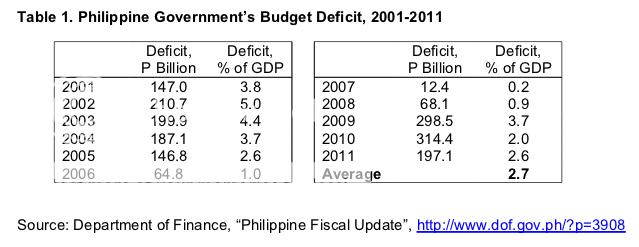
Below is the over-spending record of the national government over the past 11 years. Budget deficit means expenditures are larger than revenues, a typical attitude of living beyond one’s means and charging the difference to new borrowings.


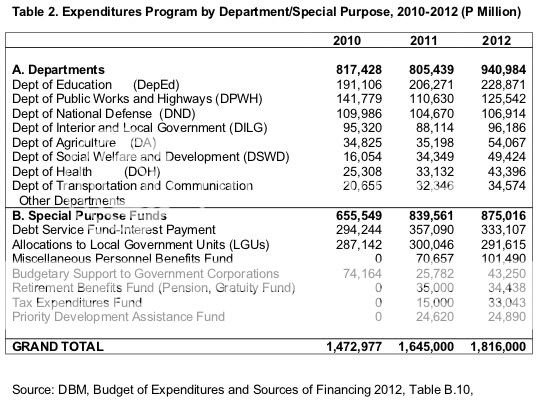
The main culprit for such overspending and the need for new borrowing, is government debt itself. Interest payment constitutes 20 percent of the annual budget. Here is a quick view of the biggest departments and expenditure items this year and the past two years.


DepEd, DPWH, DND and DILG, interest payments, internal revenue allocation of LGUs and various benefits to the million-plus national government personnel - they are the largest expenditure items this year.

Coming up very fast in terms of high growth in spending are DA, DOH and DSWD. When the local government code was enacted in 1991, these three agencies were among those whose several functions were devolved and decentralized to the LGUs. Thus, their share in national government spending has declined 20 percent 10 years ago. Recently though, there was a trend of “recentralization” as national government spending for these three departments has been rising fast.

The bulk of new spending in 2013 would include expanding the conditional cash transfer (CCT) program of the DSWD, from P34 billion this year to roughly P45 billion next year. The DSWD budget is projected to rise from P49 billion this year to P67 billion next year. Since the CCT is mainly a dole out program with some “conditionalities,” it is clearly a big tool for electioneering and legal vote-buying next year. The administration will of course object to the term “legal vote buying” but that’s what it really is.

More CCT actually means that previous government programs to "fight poverty" were ineffective or outright failures. Education and books for the poor, healthcare and medicines for the poor, housing and water for the poor, irrigation and credit for the poor, etc. These are supposed to have improved the condition of the poor, but they did not. So they invented this direct cash transfer to the poor. Soon with the RH billl, the government will also have condoms and IUD for the poor. What’s next, iPads for the poor?

Perhaps a big question to ask is, Is there room to retain, if not shrink, government spending in the next few years?

If the government is serious in controlling the burden of public debt and interest payments, the answer is “yes.” But since the government is not serious, or even dishonest in controlling the debt problem, its answer is “no.”

Many advocates of more and bigger government say that the Philippine government’s spending is actually “small” compared to many countries around the world, like its neighbors in Asia. See the numbers below.


What is wrong with the above numbers for the Philippines and other governments?

Our numbers represent only spending by the national government that are financed by taxes and mandatory fees. Spending by the local governments – barangays, cities/municipalities, and provinces – as well as spending by government corporations (PCSO, PAGCOR, etc.) are not included here.

If these expenditures are included, it is safe to estimate that overall and consolidated Philippine government spending would reach about 24 percent of GDP. That is not “small.” It comprises nearly one fourth of the total production of goods and services in the economy.

Reducing the fat in government spending and fiscal irresponsibility is a tough job to do and campaign for ordinary mortals (a.k.a. average taxpayers in the private sector). But we have to start somewhere. We need to help educate the public that more and bigger government spending, regulations, restrictions and taxation, are not good, are not productive. They siphon resources from private pockets and savings to politicians and bureaucrats’ spending whims.

Many social and economic services are better served and met by assigning more personal and parental responsibility to the people, not more government responsibility. The latter is a convenient excuse to justify endless government waste and greed. We have to learn to say “no” to such wasteful government advances and coercion somehow, somewhere.
--------

See also:
Fat-Free Econ 1: Macroeconomics for Micro Concerns, March 08, 2012
Fat-Free Econ 2: Determinants of Private Consumption Expenditures, March 14, 2012
Fat-Free Econ 11: GDP Growth and Private Sector Role, June 02, 2012
Fat-Free Econ 12: Privatizing PAGCOR, June 08, 2012


Fiscal irresponsibility 17: Cut Spending and Borrowing, September 19, 2011
Fiscal Irresponsibility 25: Spain Panic, More Eurozone Woes, June 06, 2012

Friday, May 04, 2012

Fat-Free Econ 8: Drug Price Regulation is Wrong

This is my article today in TV5's news portal.

I sent this to two Senators who authored a Senate Bill creating the Drug Price Regulatory Board. See my email to them after this article.

http://www.interaksyon.com/article/31003/fat-free-economics-the-folly-of-drug-price-regulation

FAT-FREE ECONOMICS: The folly of drug price regulation


Government regulation and control of the price of something that it has not produced or manufactured is wrong and parasitic. Drugs are "expensive" because of government taxes and fees slapped on the product and the producer as well as the seller.

The current drug price control policy will turn three years old in August. There are many indicators showing the policy is a failure in its stated goal of making certain drugs affordable to the poor.

Now some legislators want to compound the folly by creating a new layer of bureaucracy called the Drug Price Regulatory Board (DPRB) under the Department of Health (DOH).

Why is drug price control or regulation wrong? Here's why:

1. The policy contradicted, if not defeated, the goals of the Generics Act of 1988. That law was successful in promoting cheaper generics, off-patent drugs to the public. The drug price control policy however, encouraged people to shift back to the branded and innovator drugs made by multinational pharmaceutical companies as they have been coerced by the government to slash prices by 50 percent.

2. The policy benefited the rich and upper middle class who would be buying those drugs whether their price remained at prevailing or discounted levels. Many if not all of the 22 drug molecules that were covered by the policy have cheaper, off-patent competing drugs already available. The poor were patronizing the off-patent drugs, which are still cheaper than branded drugs even if their prices were slashed by half.

3. The policy has adversely affected many local generic manufacturers. If they were selling their drug at P8 per tablet vs. the multinationals’ P15, the locals would make enough profit as the poor will patronize their products because of the big price differential.

After the price control, the P15 becomes P7.50 and the local generics manufacturers now have the “more expensive” drugs. If they have enough leeway to further bring down their price to only P4 or lower without sacrificing the quality and safety of their drugs, fine. But if they do not have enough leeway, then they will be forced to pull out their drugs rather than sell at a loss. Or worse, simply close down if the affected drugs are the main products of that generic manufacturer.

4. The policy has introduced business uncertainty. Someone with a really innovative, creative and revolutionary product like a disease-killer drug, might hesitate bringing their products to the Philippines knowing that the politics of envy can hit them anytime.

5. Price control simply means price dictatorship. The government is dictating to the industry regardless of the cost of production and marketing, the cost of taxes and fees. Those companies must sell their products at a level that was set and dictated by the government. Otherwise, they will be penalized.

6. The policy did not recognize that government taxation of medicines - three- to five percent import tax, plus 12 percent value-added tax and local government taxes - is partly to blame for expansive medicine.

7. Competition among more drug manufacturers, drug retailers and pharmacies is the best price regulator, not more government regulation and coercion.

In this regard, the creation of the DPRB is also wrong for at least two reasons:

1. It will add another layer of bureaucracy in the government, which will require another set of budgetary allocation each year. With a P300 billion annual budget deficit, the government should think of how to reduce spending and eradicate the need for more borrowings.

2. The DOH Advisory Council on Price Regulation, the body that deliberated the implementation and monitoring of the price control since mid-August 2009, has been transformed into the Advisory Council for Healthcare because there is general recognition by the Council members, including the federation of local generic manufacturers, the Philippine Chamber of Pharmaceutical Industry (PCPI), that price control did not work.

The Advisory Council is not a permanent body although it may have permanent members. Thus it is easy to transform itself and focus its discussions and energy on more important issues like universal healthcare, not just drug pricing. A permanent drug regulation body will only become a white elephant implementing and monitoring a bad policy.
--------

from: Nonoy Oplas minimalgovernment@gmail.com
to: "Sen. Manny Villar" <mb_villar@yahoo.com>,
 "Sen. Villar" <mbv_secretariat@yahoo.com>,
 "Sen. Loren Legarda" <loren@lorenlegarda.com.ph>
date: Fri, May 4, 2012 at 2:03 PM
subject: On your SB, Drug Price Regulatory Board


Dear Sen. Villar and Sen. Legarda,

I have read from the news that you have authored a bill creating a new office called the Drug Price Regulatory Board. I think that  proposal is not wise. May I share with you my article today why price control/regulation is wrong, and why creating a new bureaucracy for this policy is equally wrong.

Should you have a Senate Committee Hearing on the said subject, kindly inform me and I would like to attend and verbalize this position. 

Thank you very much.

Sincerely yours,


Bienvenido "Nonoy" Oplas, Jr.
President, Minimal Government Thinkers, Inc.
http://funwithgovernment.blogspot.com
---------


FAT-FREE ECONOMICS: The folly of drug price regulation


Government regulation and control of the price of something that it has not produced or manufactured is wrong and parasitic....
--------

See also:
Drug price control 18: Wikileaks and former US Amb. Kenney on price control, September 28, 2011
Drug Price Control 19: Why is the Policy not Withrawn Yet, November 08, 2011
Drug Price Control 20: Competition, not Price Regulation, November 10, 2011
Drug Price Control 21: Illegalities in the Implementation of the Policy, November 14, 2011
Drug Price Control 22: Comparing Prices of Drugs, Diagnostic Tests, PFs, December 24, 2011.
Drug Price Control 23: Greece's Pharmacy Nightmares, January 13, 2011
Drug Price Control 24: Forcing Drug Firms to Report Payment to Doctors, January 24, 2012
Drug Price Control 25: Top 10 Articles on Google Search, April 03, 2012

Thursday, April 19, 2012

Fat-Free Econ 7: Why We Need Nuclear Power Plants

(This is my article today in TV5's news portal,
http://www.interaksyon.com/article/29808/fat-free-economics-brownouts-expensive-electricity-and-nuclear-power)

To have no electricity for whatever reason – failure in power generation, transmission and distribution – is terrible. Thus, various sources of electricity, renewable or otherwise, fossil fuel or otherwise, should be explored.

Last week, a "Power Summit" in Davao highlighted the supply constraints in Mindanao. Among the alternative power sources that were proposed by some sectors was nuclear energy.

Many of the sources of public fear about nuclear power are more fiction than reality. These include: (1) nuclear power is highly dangerous to human lives, resulting in thousands of deaths in case of a meltdown; and (2) many countries around the world shun nuclear power because of the high risks involved.

On the first fear, nuclear power actually has the least casualties compared with all other energy sources. Death or contamination from nuclear plants is lower than death from road accidents or from smoking-reIated diseases.

The worst accident was in Chernobyl, Russia in 1986. After that, no major nuclear accident occurred. Even the Three Mile Island accident in the US produced zero casualties. The Fukushima accident last year after the huge earthquake-tsunami in Japan resulted in very few, if any, casualties.

The second fear has no basis. Asia’s biggest economies - China, Japan, India and South Korea have nuclear power reactors. As of April 2012, the number of reactors operable, reactors under construction, planned reactors, and proposed reactors of these countries are 15, 26, 51 and 129, respectively, for China; 2, 7, 16 and 40 for India; 51, 2, 10 and 5 for Japan; and 23, 3, 6, and 0 for South Korea.

Our neighbors Vietnam, Thailand, Indonesia and Malaysia have two or more proposed reactors and would have these ready soon. And this could be a shocker for some people: petroleum giant Saudi Arabia is proposing 16 nuclear reactors.

One fear about reviving nuclear power in the Philippines is securing those reactors from terrorists. But should a nuclear plant be built in Mindanao, it should be in relatively safer places like Davao or Misamis Oriental, obviously not Basilan, Cotabato or Sulu. I also think that it is standard operating procedure that the walls of any nuclear reactor are super-strong. Not even bazooka or tank shells can penetrate them.

We need to explore more power sources, especially those that do not need taxpayers’ subsidies to make them affordable. Let more power plants from more companies come in and let the players compete with each other in producing stable, more affordable electricity.
-------

Meanwhile, here are the two tables that were not accommodated in the article due to space constraints:


Table 2. Nuclear Reactors as of April 2012, Selected Countries


source: World Nuclear Association,  http://www.world-nuclear.org/info/reactors.html
-------

See also:
Fat-Free Econ 1: Macroeconomics for Micro Concerns, March 08, 2012
Fat-Free Econ 3: Mining and Environmentalism, March 15, 2012
Fat-Free Econ 4: Unemployment, Good and Bad News, March 22, 2012
Fat-Free Econ 5: Property Rights and Policy Lefts, April 04, 2012
Fat-Free Econ 6: Foreign Aid and Tricycles, April 14, 2012

Wednesday, April 04, 2012

Fat-Free Econ 5: Property Rights and Policy Lefts

Note: This is my article today in TV5's news portal,
http://www.interaksyon.com/article/28670/fat-free-economics-property-rights-policy-lefts

FAT FREE ECONOMICS: Property rights, policy lefts
04-Apr-12, 4:58 PM | Nonoy Oplas

Protection of private property rights and promulgation of the rule of law are the cornerstones of peace and order in society. Remove such property rights and society can quickly degenerate into chaos and disorder. For instance, if your house or car is also somebody else’s house and car, then they can take and occupy it anytime, anywhere.

There is one free market think tank, the Property Rights Alliance (PRA) based in Washington DC that conducts an annual study of how governments in the selected countries promulgate the rule of law and protect property rights. This annual report is called the International Property Rights Index (IPRI).

The study gives a particular score, then ranks those countries globally based on three major factors: (1) Legal And Political Environment, which includes judicial independence, rule of law, control of corruption and political stability; (2) Physical Property Rights, which include protection of such rights, registering property and access to loans; and (3) Intellectual Property Rights, which include protection of IPRs, such as patents and copyrights.

Our think tank here in Manila, Minimal Government Thinkers Inc. is among the nearly 70 independent and free market institutes, and the only Philippine-based think tank, that co-sponsored the publication of this annual study.

The 2012 Report has been released this week. Please note that while it was released this year, the basis of comparison were 2010 to 2011 data. Of the 130 countries covered by the study, the top 10 positions were garnered by developed economies with small populations. The first five, in order, are Finland, Sweden, Norway, Singapore, and Switzerland. The next five are Denmark, Luxembourg, New Zealand, Netherlands and Canada.

The Philippines ranked 87th out of 130 countries. While it performed fairly in Physical Property and Intellectual Property protection, it performed badly in the Legal and Political Environment. The culprit is the political instability, the bad state of corruption in government, poor observance of the rule of law and lack of judicial independence.

The country’s global rank in previous IPRI reports were 74th out of 115 countries in 2009, 80th out of 125 countries in 2010, and 87th out of 129 countries in 2011. So there was no change in the Philippines’ global ranking this year and last year.

Aside from Singapore, other Asian economies that performed well in the IPRI 2012 Report were Hong Kong in 12th place; Japan, 15th; Taiwan, 21st; Malaysia, 36th; South Korea, 40th; China, 57th; India, 62nd; Thailand, 69th; Indonesia, 86th; and Vietnam, also at 87th place.

The continued low ranking of the Philippines does not look good. If we need to attract more investors, grow the economy and create jobs, we need to assure entrepreneurs and employees, the average folks, that the fruits of their hard work and persistence in life are properly respected and protected. One should not toil hard abroad or in this country to buy a modest house and lot, only to find out later that the land is also being claimed by other people, resulting in additional costs and emotional stress in going to the courts and law enforcement agencies.

Populist and left-leaning policies - such as protection to squatters who illegally occupy private lands and an agrarian reform program with no final deadline and timetable - result in uncertainties.

These plus the weak rule of law end up in weak property rights enforcement for certain properties. These things must change if we want to retain the pool of talented entrepreneurs, as well as attract foreign professionals and investors, to come to the country.

Category
Score
Global Rank
Regional Rank (AO)
Legal and Political Environment
3.4
108 of 130
16 of 19
Judicial Independence
6.2
46 of 130
8 of 19
Rule of Law
6.4
40 of 130
7 of 19
Control of Corruption
5.9
40 of 130
7 of 19
Political Stability
7
13 of 130
3 of 19
Physical Property Rights
5.8
76 of 130
16 of 19
Protection of Physical Property Rights
6.5
50 of 130
10 of 19
Registering Property
6.8
117 of 130
16 of 19
Access to Loans
3.9
64 of 130
15 of 19
Intellectual Property Rights
4.9
73 of 130
11 of 19
Protection of Intellectual Property Rights
5.3
54 of 130
12 of 19
Patent Protection
0
Copyright Piracy
6
27 of 130
6 of 19

----------

See also:
Property Rights 1: IPRI 2009 Report, March 02, 2009
Property Rights 2: IPRI 2010 Report, February 27, 2010
Property Rghts 3: IPRI 2011 Report, March 29, 2011

Fat-Free Econ 1: Macroeconomics for Micro Concerns, March 08, 2012
Fat-Free Econ 3: Mining and Environmentalism, March 15, 2012
Fat-Free Econ 4: Unemployment, Good and Bad News, March 22, 2012