Showing posts with label PAGASA. Show all posts

Thursday, July 09, 2015

Move School Opening to September

It has been raining since Saturday last week. Downpour in the morning, then the Sun showed up in the afternoon. The rains were back at night, until whole day of Sunday. Last Monday, it was cloudy but Mr. Sun would peep somehow. Later that day,  the rains are back, all afternoon classes have been suspended.

Last Tuesday, it was warm and sunny, there were classes, nice to see the Sun again for several hours. Then downpour by night, until yesterday whole day, and classes were suspended Metro Manila wide by the Department of Education (DepEd).

Last night, DepEd announced another class suspension for today. 

Here in Makati today, the rains have stopped since early morning perhaps. It was cloudy but not raining until about 8am, then rains on and off until noon time.

No typhoon signal today in these areas. DepEd decides on the basis of PAGASA weather forecast for the next 24 hours. 

There are two important issues here. One, DepEd should limit the scope of its power to suspend classes to public schools only, and leave the private schools to decide whether to have classes or not.

Two, DepEd should consider moving the school opening to September, instead of June.

Every year, rainy season in the country is June-October, and July-September are the wettest months with an average of about three storms per month. I remember in August 2013, for two weeks, my older daughter went to school for two days only. Four days per week, classes were suspended because of almost non-stop rains.
  
DepEd relies on forecasts by PAGASA, whose forecasts are not exactly accurate. In fairness to PAGASA though, I think no meteorological agency in the planet can give 90-100% accuracy of weather forecast for the next 12 hours.

But those meteorological agencies parrot the UN that they can forecast the climate with certainty, 80 or 100 years from now. They cannot forecast the weather with accuracy 12 hours ahead but they can forecast the climate 100 years from now?

Notice also "Mang Tany" Nathaniel Cruz, weatherman of GMA7 and former PAGASA weather forecaster. During the hot months of March-May, his reporting on temperature forecasts was mainly about the "init factor", which on average, are 4-9 degree C hotter than the projected maximum temperatire So a projected max temp the next day of 35 C, Mang Tany (and perhaps many other weathermen and women) would report 39-44 C. It's like Middle east summer. 

But they do not report "lamig factor" when it's rainy or typhoon season. Kasama kasi sa "man-made" warming religion ang reporting nila.

DepEd, please consider moving the school opening to September, not June. That way, there will be fewer class suspension. For now, even moderate rains, the tendency of DepEd and local governments is to cancel classes. Bondying na yon.

Meanwhile, another class suspension by DepEd for tomorrow. No typhoon signal anywhere in the country from PAGASA, storm "Falcon" is far out in the sea.

DepEd has lengthened basic and secondary education from 10 to 12 years. Then DepEd reduces education with frequent class suspensions. This whole week, it has suspended classes in 4 out of 5 days.

If DepEd keeps this practice of frequent class suspensions knowing that July-September are the wettest months and refuses to move school opening from June to September, then DepEd is among the major contributors of wastes in the country.
----------

See also:
Weekend Fun 39: Funny Photos in Manila Floods, August 12, 2012
Global Warming Hits the Philippines, Part 3, January 26, 2014 
Manila Flooding Torture, June 26, 2014 

PAGASA 4: On Unjustified Class Cancellations, July 15, 2014 
Flooding, Garbage and MMDA, October 03, 2014

Tuesday, July 15, 2014

PAGASA 4: On Unjustified Class Cancellations

Yesterday, I was upset that the Philippine Atmospheric Geophysical and Astronomical Services Administration (PAGASA) declared public storm warning signal (PSWS) #1 over Metro Manila at 11:45am, when it was sunny, thin clouds above. So pre-school afternoon classes have been cancelled. My younger daughter who was excited to go to her 12:30 – 3:30pm class was sad when I told her that classes have been cancelled.

The range of PAGASA warning was far out, signal #1 from Marinduque & Burias Islands south of M.Manila up to Tarlac and Pangasinan in the north. Tropical storm  “Rammasun” (local name “Glenda”) was still several hundreds of kilometres away from any Philippine island when the storm signal was declared. I could understand putting Marinduque, Batangas, Quezon under signal #1 at 11:45am, but not Metro Manila. There was no strong rain the whole day yesterday until evening, until this morning.

Below, PAGASA graphics as of 11 am today.


As of 11am yesterday, PAGASA said,

"Forecast Positions: Tropical Storm“GLENDA” is expected to be in the vicinity of Virac Catanduanes by tomorrow morning and at 240 km Northwest of Dagupan City by Wednesday morning."

So a landfall about 20 hours away, in Catanduanes island far away from Metro Manila, was far out to declare signal #1. PAGASA was being paranoid.

Also yesterday at its 3:02pm advisory, PAGASA said,
"Expect thunderstorm over Nueva Ecija, Metro Manila and other areas of Rizal in the next 2 hours."

By 5 pm, there was no thunderstorm in M.Manila. So even a forecast for the next two hours, PAGASA can be imprecised. One reason why people and meteorological agencies like PAGASA and others under the UN World Meteorological Organization (WMO) should stop claiming with certainty that global temperature will rise by 1 or 2 or even 4 C some 100 years from now.

Some friends suggested that it is a “no win situation” for PAGASA, especially if they do not declare a storm signal and it pours hard, they will be blamed by the public.

Rainfall amount as of 9:40pm last night. Zero rainfall nationwide, 10 hours after the "signal #1" warning.

My concern is the prolonged class cancellations. All classes from pre-school to high school have been suspended today in Metro Manila and surrounding provinces; and there was class cancellation yesterday afternoon. And possible class cancellations again tomorrow as the storm exits the country. Up to 2 ½ days cancellation.

Paranoia can cause damages like loss of productivity. Parents pay for school fees and schools don't hold classes because of some paranoid weather announcement.

Problem here, no one can hold PAGASA liable. It has no contract with anyone of us, so it breaks not a single contract, so no one can sue it or penalize it, like cut its annual funding. We have gotten used to government inefficiencies that one inefficiency after another becomes tolerable and even defensible. The usual solution is to give more tax money to an inefficient agency. "Ayy inefficient sila, kulang kasi sa pondo, dagdagan natin."

Below, a news headline from Philippine Star yesterday. 


If one has a big event, say a musical/rock concert, and PAGASA says there will be storm signal #2 or #3 on the day of the event, the organizer cancels the event two  or three days ahead, and the storm was not even of signal #1 strength, who can the organizer blame and possibly ask for compensation for the damage? Not PAGASA, it has no contract anyone in the country except Congress. Sorry na lang tayo pag palpak forecasting nila. Most likely they will get additional funding from Congress next year. A monopoly is rewarded, not penalized, for its inefficiency. If it is a private forecasting company, it will go bankrupt if it continues to provide false forecasts.

Again, weather and climate are highly uncertain and forecasts are highly unreliable the longer the projected period.  When some government agencies predict a global warming of 2 C or 3 or 4 C100 years from now, they can be practicing voodoo science to produce voodoo scare in the hearts and minds of the public. And the public can be easily hoodwinked to accept various environmental regulations, energy taxation and cronyism, huge climate loans, climate bureaucracies and frequent climate junkets.
--------------

See also: 
PAGASA Bureaucracy 1: On Temperature Data, July 14, 2011
PAGASA Bureaucracy 2: Deregulate Weather Forecasting, Privatize PAGASA, December 20, 2011.
PAGASA Bureaucracy 3: On Giving Local Names to Storms with International Names, August 20, 2012
Fat Free Econ 44: Deregulate Weather Forecasting, July 10, 2013

Climate Tricks 30: On the term "CC Denial/Denier", May 06, 2014
Climate Tricks 31: High Intolerance by the Alarmist Camp, May 14, 2014

Wednesday, July 10, 2013

Fat Free Econ 44: Deregulate Weather Forecasting

* This is my article today in interaksyon.com.
------------

This may sound like a “politically incorrect” statement so let me explain why.

One, there is no market failure in providing the service as the scientific and technical know-how to gather data and interpret them can be done by private enterprises. Weather forecasting need not be an exclusive function of the government.

There are several independent weather analysts in the country that often have better analysis than the Philippine Atmospheric Geophysical and Astronomical Services Administration (PAGASA), and they charge the public nothing. These guys get raw data from the meteorological agencies of Japan, Korea, Hong Kong, Taiwan, Hawaii/US, etc. They charge zero because they also get their raw information for free.

But once they charge for their services, private weather forecasting enterprises must produce value added over the free forecasts of those meteorological agencies of other countries. They must invest in modern equipment and tools, and get more trained meteorologists, oceanographers and climatologists to do more detailed analysis of short- and long-term trends in weather and climate.

Two, privatization would allow competition for more accurate, more detailed and industry-specific weather forecasting.  There is a business there. Among the major clients will be airlines, shipping lines, bus lines, hotels, beach resorts, mountain resorts, agri-business companies, event organizers, TV and radio stations, local governments, national government agencies (Air Transportation Office, MARINA, Coast Guard, Department of Agriculture, etc) and so on.

Since these companies and institutions are in for the long haul, they will be interested to see long-term perspectives on climate. Like how long will the current global cooling last, its effect on national, regional and global food production, tourism, public health and other economic and social sectors.

Three, privatization would put accountability to those forecasts. There will be a private contract between the forecasting service provider and its clients. If the latter made bad business decisions as a result of frequent false forecasts by the former, the forecasting company can be sued, it can go bankrupt and its officers can go to prison. To avoid this, forecasting companies will be forced to upgrade and modernize their tools and interpretation of raw data, and their information dissemination.

In the case of PAGASA, thousands of lives are lost, while billions of pesos of private property are damaged -- such was the case when Typhoon Sendong hit Mindanao two years ago -- because PAGASA failed to see the trajectory of the storm. Have PAGASA officials been sanctioned? Any failed or wrong analysis, or over-reaction (declaring an LPA immediately even if there is none) is a reason for PAGASA to say, "we need more money". So inefficiency is rewarded with more tax money.

PAGASA’s budget has risen through the years. It got P1.20 billion in 2011, followed by P1.28 B in 2012, and P1.46 B in 2013. The bulk of its budget is capital outlay, which means the purchase of more modern equipment and offices, followed by maintenance and other operating expenses then personnel services. The salaries and allowances of its personnel have also risen (see table below). 

Table 1. PAGASA Staff, 2012-2013


Source: DBM, Staffing Summary.

Private weather forecasting enterprises will be penalized if they make frequent bad forecasts. No tax money will be used to put them up or bail them out if they are inefficient. They are under pressure to provide more accurate, regular updates, hour by hour or even every 30 minutes in the case of severe weather disturbances. Each failure in forecast translates to financial losses, not to mention loss of reputation.

In the US, there are at least eight private weather forecasting companies that have private subscribers and make money. These are on top of US government meteorology agencies like the National Oceanic and Atmospheric Administration (NOAA)-National Weather Service (NWS) and the Joint Typhoon Warning Center (JTWC, Hawaii). These private services are as follows:

- AccuWeather, www.accuweather.com
- CustomWeather, www.customweather.com
- The Weather Channel, www.weather.com
- Schneider Electric (formerly DTN Meteorlogix), http://www.schneider-electric.com
- Forecast Advisor, www.forecastadvisor.com
- My Forecast, http://www.myforecast.com
- Weather Bell, http://www.weatherbell.com

In UK, I know of one solar physicist in London, Piers Corbyn, who owns a private weather forecasting company, Weather Action. And he often beats the UK Meteorology Office in predicting weather three months or one year ahead. He uses Solar Weather Technique (SWT) in making his predictions, and he gets many subscribers. 

Aside from the above reasons, I have a few personal reasons why I want to see a deregulated weather forecasting system in the country, and even a privatized PAGASA.

One, when I got married in Iloilo City several years ago, my siblings and nieces from the nearby island of Negros Occidental were unable to attend. PAGASA foisted signal no. 2 in Region 6, so the Coast Guard prevented all inter-island boats from plying the Iloilo-Bacolod route. But my sister and brother said there was not even rain in Bacolod that day, cloudy but no rain or strong wind. The same in Iloilo.

Ordinary folks can only complain of PAGASA's inefficiency but beyond that, there is nothing we can do. We cannot terminate PAGASA funding nor sue it as there is no direct and explicit contract between the public and that agency. Some people would even say, "Oh, PAGASA made lousy analysis again. Perhaps they need more money, Congress and DBM should give them more money." There is no accountability for a monopoly.

Two, I have long wanted to compare the country's temperature data. For instance, I want to know how June 2013’s average temperature was compared to the same month in earlier years. This data is unavailable in the PAGASA website, nor can it be requested for free. The data is for sale, and one must go to their office in Quezon City, pay and get the official receipt, and wait for about a week to get the data. We taxpayers give them money for their annual operation, and we have to pay them again to get data.

PAGASA will benefit if there are many private weather forecasting companies in the country as it will be forced to be on its toes and so provide more accurate short- and long-term perspectives in weather and climate.
--------------

See also:

Monday, December 31, 2012

CSOs and State 17: UP Pahinungod and Typhoon Victims in Mindanao


The main characteristic of "civil society organizations" (CSOs) is volunteerism. In contrast, the main characteristic of government and the state is coercion. This makes the two rather a substitute, not complement, for each other.  There are several instances where they collaborate with each other, and that's because government agencies, from local to national, are so many that CSOs and other volunteer individuals have to work with them to minimize duplication of certain functions.

Civil society is a state of society where citizens are mature and responsible enough to run their own lives and that of their communities with minimum coercion, restrictions, regulations and prohibitions. So in cases of calamities for instance, solidarity with the affected people and communities is instant and spontaneous. There is volunteerism in almost everywhere, the willingness to help, without being told or being coerced by a strong force under threats of penalties if no one will help, is there.

Below is an account by a physician from UP, during the UP Pahinungod assistance to victims of typhoon Bophia, locally named "Pablo" by PAGASA. A friend from "Taga UP Diliman ka kung" (TUPDKK), Dr. Elaine Nisperos, shared this in my facebook wall. I like the story, hence reposting it here.

On a side note, the Philippines is the only country in the world that gives local names to tropical storms with international names already. Countries in western Pacific including the Philippines contribute two names a year to international storms yet to come, for easier identification. So names that were given by PAGASA can be used internationally and yet when those storms enter the Philippines area of responsibility (PAR), PAGASA ignores these international names and use local names, which I think were names of children of PAGASA officials, or kids of their friends or relatives. Really unnecessary. But I digress...
-----------

“WELCOME PABLO PARAISO”
by Dr. Digie Talens

On the night of December 4, 2012 Davao Oriental and Compostela Valley were ravaged by the strong winds of Super typhoon Pablo. In the darkness, families were awakened as the strong winds carried their roofs, and shook their homes. In some areas, flood waters rose without warning while in others, the wet soil gave way and fell upon people’s homes. Glass breaking, walls collapsing, one can only imagine the horrors as the families groped their way in the wet dark night. Parents used their bodies to shield their children from falling debris as moans and cries from helpless victims are heard through the night. The winds were relentless even as the first light of dawn showed a glimpse of roofs flying, branches falling and homes breaking apart.

Hundreds perished in those few hours. To those left behind, heartache and despair await. 

As news of the devastation reached Manila, my husband, as the director of UP Ugnayan ng Pahinungod (which is Cebuano for “offering”), and chairman of the disaster response of UP Manila, started to mobilize his staff to see how the UP system can extend some help to our countrymen. He is not alone in his altruism. His office was soon deluged with inquiries from the UP Manila Chancellor, UPPGH Director and the UP Padayon Group, as to what they could do to help.

The Ugnayan ng Pahinungod, being the volunteer arm of the UP Manila for various outreach projects (including medical missions), immediately contacted the Local Government Units (LGU) of the affected area. On initial consultation with the Office of the Governor of the Compostela Valley to determine the type of help that UP volunteers can render, nothing specific was determined. To be able to promptly and effectively use the limited resources that the UP System can acquire, a more detailed plan had to be established so, the UP Alumni in Davao were mobilized to give a more accurate view of the situation. Soon, the remote area of San Isidro in Baganga, Davao Oriental was identified.

The task of getting funds for the relief distribution and medical mission did not prove too difficult. On Dec. 6, in a Christmas party of UPCM batch 85, the class decided to donate part of their fund so that UP Pahinungod can immediately set their plans into action. Some batchmates added more money from their own pockets. 

Pledges soon came pouring in from both domestic and foreign sources. The problem was it took too long to convert the pledges to cash. The batch 85 donation was instrumental in bringing relief early to the families in the affected area. 
A team of 3 doctors, an EMT, an information officer and the mission coordinator (also a dentist) from Manila, met up with UPCM alumni in Davao City. The latter facilitated the search for a place for the team to stay, transportation from Davao City to the affected area and coordination with the locals. 

Baganga was allegedly a 6 hour drive from Davao City but with difficult roads, it turned out to be at least 8 hours from the city. As the team travelled to their destination, the devastation revealed itself to them.

Hectares of land, once filled with towering coconut trees that provided a livelihood for the families are reduced to a wasteland of uprooted trees strewn like matchsticks on the ground. Vast banana plantations just recently filled with fruits ready for harvest, are barren now, comically appearing to have had a haircut done by a crazed barber. The beautiful green mountain has been replaced by a big brown mound. 

The road although still passable, is filled with pieces of glass, nails and debris from the houses and buildings destroyed by the storm. Many tires have been ripped by this debris, making access to the municipalities difficult. Along the road, families have made make-shift shelters, with materials gathered from their uninhabitable homes. 

The school, stadium and the municipal center were in shambles. Even large houses were roofless and most were abandoned. According to the locals, those with relatives elsewhere were gone. Only those with no other option were left to rely on the relief goods and help that outsiders can offer. 

The team was housed in a relatively large house owned by a local engineer. They were given two rooms whose roof was spared by the storm. Another volunteer group, Balsa Mindanao, joined them at the house. The latter group was given the living room, dining room, and basement to “camp in” but as rain fell once again on San Isidro, the UP team had to share their space with the Balsa Mindanao group and their soaked belongings.

Ironically, the rain continued but there was not enough usable water. The only source of water was a “sapa” a few minutes away from the house. Bathing was a luxury even the UP team could not afford. 


The UP team, brought with them food and drinking water. They had enough for the few days they would be staying but the supply of food in the area is very limited. They have been briefed by their local contacts and the Balsa Mindanao group to resist the urge to give their food to the (once proud) people now begging for some relief from their hunger. 

In a lot that has been cleared of debris, tables, benches, and tarpaulins attached to wooden posts were set up to form the clinic. Medical supplies were gathered in tables that served as the “pharmacy”. The UP team worked hand in hand with the Balsa Mindanao group. Patients were seen and treated with their families. The air was heavy with the pain of loss but there were smiles as wounds were treated, and food and medicine were distributed. Before dark, 576 patients were seen and treated by 4 doctors, close to 500 families were given relief goods as well as medical advice. Still, this was not enough. 

The families have lost their loved ones, their homes and their source of livelihood. In the midst of this despair, the people need some glimmer of hope. Perhaps when others see their plight, people will reach out to help them. Perhaps, the government will finally get organized and provide them with the basic services that are non-existent at this point. From the initial out pouring of pledges from various sectors, we know that there is no shortage of generosity. If only the donations and relief goods would reach the people that need them the most. 

The Ugnayan ng Pahinungod is planning another relief and medical mission to this area on the second week of January. Volunteers and donations are most welcome.
-----------


Monday, August 20, 2012

PAGASA Bureaucracy 3: On Giving Local Names to Storms with International Names

I have been wondering before, so I asked PAGASA via twitter, why do they have to give local names to storms with international names already? It only creates some confusion for people here who track the storms'  movement from the SCS/WPS or Pacific Ocean to the Philippines to Hong Kong or Taiwan, Vietnam, China, Korea, or Japan.

I asked PAGASA about it, zero reply. See here,
PAGASA Bureaucracy 1: On Temperature Data, July 14, 2011.

Today, I saw Dr. Mahar Lagmay's tweets and since he's a friend in UP and he seems to be working for PAGASA's NOAH project, I asked him the same question. Here is our conversation between 8:30 to 9:45am today. A friend also from UP, Leo Venezuela, joined the conversation.
---------

Mahar Lagmay ‏@nababaha
Latest satellite image in the Project NOAH website. http://pic.twitter.com/ytxRVgrc

Nonoy Oplas ‏@Noysky
@nababaha Can PAGASA stop giving local names to storms w/ intl name already? It adds confusion to people who track d storm across countries

Leo Venezuela™ ‏@levenezu
@Noysky - is this all in the name of misplaced nationalism?

Nonoy Oplas ‏@Noysky
@levenezu @nababaha Not abt nationalism, I think PAGASA guys put names of thr kids frnds as storms local name. Old practice, shd discontinue

Leo Venezuela™ ‏@levenezu
@Noysky @nababaha - That's such crapola if indeed true. Terrible.

Leo Venezuela™ ‏@levenezu
@Noysky @nababaha - Even worse actually if true. The local meteorologists will be the laughing stock of their foreign peers.

Mahar Lagmay ‏@nababaha
@Noysky @levenezu Nonoy and Leo, please stop.

Nonoy Oplas ‏@Noysky
@levenezu @nababaha I see no reason why PAGASA give local names except nepotism. Intl media & meteorological agencies only use intl names.

Leo Venezuela™ ‏@levenezu
@nababaha @Noysky -But what is indeed PAGASA's rationale for giving local names?

Nonoy Oplas ‏@Noysky
@nababaha @levenezu I asked PAGASA about it before several times, they give zero answer. Perhaps you can, but you want us to stop asking?

Leo Venezuela™ ‏@levenezu
@nababaha @Noysky -Mahar, that is very unfair for you to ask us to stop when what we ask are legitimate questions.

Nonoy Oplas ‏@Noysky
@levenezu @nababaha PAGASA and Mahar napipikon? Not good. We are asking a legitimate Q, give a good answer. Gobyerno gusto pat d back lang?

Leo Venezuela™ ‏@levenezu
@Noysky @nababaha -There's a new tropical storm with IGME as the local name. What process went into giving it that name?

Leo Venezuela™ ‏@levenezu
@Noysky @nababaha -That shouldn't be a national security concern naman 'di ba? Also, we are taxpayers.

Nonoy Oplas ‏@Noysky
@levenezu @nababaha When my friend in HK talked abt big typhoon coming, I had to search d web if "Helen" & "Kai tak" were d same. They were.

Mahar Lagmay ‏@nababaha
You are entitled to your opinions but please exclude my name from your conversation.

Leo Venezuela™ ‏@levenezu
@Noysky @nababaha - Mahar, we taxpayers are waiting for your answer. Ok nga dito sa Twitter, your answer will reach a large audience.

Leo Venezuela™ ‏@levenezu
@nababaha @noysky - They are legitimate questions. They involve your agency.

Nonoy Oplas ‏@Noysky
@nababaha @levenezu Only asking a valid Q that PAGASA itself does not answer. Is it nepotism or what? If you cant give an answer just say it

Leo Venezuela™ ‏@levenezu
@Noysky @nababaha - Do you want us to ask now or in #Congress when we ask our representatives to ask you themselves?

Leo Venezuela™ ‏@levenezu
@nababaha @noysky -It's the process and not the name. So why not simplify things and just adopt the int'l name for tropical storms?

Mahar Lagmay ‏@nababaha
The answer is there are a lot more important concerns now than wanting to change a name from Filipino to English.

Leo Venezuela™ ‏@levenezu
@nababaha @noysky -You don't need to come up with a name in English. All you need to do is use the int'l name. Simplifies everything.

Nonoy Oplas ‏@Noysky
@nababaha @levenezu At least Mahar answered, PAGASA never. You don't need to create any Filipino name, just use existing storms' intl names.

Nonoy Oplas ‏@Noysky
@nababaha @levenezu My hypothesis confirmed. PAGASA giving local name to storms w intl name only for nepotism purpose. But add pub confusion

Leo Venezuela™ ‏@levenezu
@Noysky @nababaha - Good luck then in PAGASA's next budget hearing.

Nonoy Oplas ‏@Noysky
@levenezu @nababaha Maybe some Congressmen kids' names were used as storms' local names by PAGASA, and the latter get their budget request?
-----------

No further tweets and conversation after that. I was just wondering why Mahar could be pikon when asked that simple question, although he answered later.

See also: PAGASA Bureaucracy 2: Deregulate Weather Forecasting, Privatize PAGASA, December 20, 2011.

Thursday, December 29, 2011

Climate Stupidity 25: Wetter or Drier, We Send them More Money

I brought my family once again to my birthplace -- Lag-asan, Cadiz City, Negros Occidental -- last December 26-28, this week. When we took the boat last December 26, Supercat, the biggest of the 3 fast craft companies that ply the Iloilo-Bacolod route, would be tossed partially by the rough sea. Many passengers including my wife, vomited. That day, Iloilo and Negros were dark with thick rain clouds above.

Rains started falling around 3pm, got stronger by 6pm and did not stop until the next day around 8 am, or at least 14 hours of non stop rains.

This is the sight the next day, December 27, in a low lying area just about a hundred meters from the house of my parents. My daughter's nanny in Manila who was also on a vacation with us, lives in one of these houses. They said that they experience this kind of flooding from time to time, about 5x last year, and about once this year.

The river swelled from a big volume of rainwater from the mountains, plus the fact that the river's width is shrinking due to thick vegetation of nipa. My elder daughter did not like watching a flood, she did not want to get out of my back. My younger daughter is being carried by her nanny here.


And one more bad news: we have a full day power outage that day. It was cold, fine, no need for an electric fan. But it was also dark as the thick clouds were still around even if the rains have stopped. Power resumed around 6pm. We watched the news on tv. Turned out that the whole Visayas, from regions 6 to 9, were affected by the heavy rains with many cities flooded. And it extended further south to Mindanao.

Yesterday, I saw this weird news headline with some idiotic pronouncements from Philippine government climate and weather officials:


Tuesday, December 20, 2011

PAGASA Bureaucracy 2: Deregulate Weather Forecasting, Privatize PAGASA

Last July 23, 2010, I wrote this:

(This is my article for "People's Brigada News" weekend tabloid, http://peoplesbrigadanews.com/wpress/index.php)

The Philippine Atmospheric, Geophysical and Astronomical Services Administration (PAGASA) is the monopoly weather forecasting body in this country. Among its catastrophic forecasts were those of super-typhoons “Ondoy” (international name “Ketsana”) and “Pepeng” (“Parma”) last year, and typhoon “Basyang” (“Conson”) middle of this month.

In other cases though, PAGASA would exaggerate its forecast, forcing the public and the local governments to make over-cautious preparations, like suspending inter-island shipping and plane flights, only to see mild rains and wind.

When I got married several years ago in Iloilo, my siblings and cousins from Negros Occidental were not able to attend. The Coast Guard did not allow inter-island travel between Bacolod and Iloilo (just one hour by boat) because PAGASA said storm signal no. 2 was up in that region, even when it was sunny and the wind has pacified.

Weather forecasting need not be an exclusive function of the government. The scientific and technical know-how to gather data and interpret them can be done by private enterprises. Private corporations now have capacities to send their own satellites into space to provide telecommunications and other services to the public.

Government weather forecasting bodies like PAGASA do not get penalized for their catastrophic failures in doing their job. No one was fired in PAGASA, its budget was never cut, and each failure in weather forecasting is even used as additional excuse to demand more tax money to further “improve” the agency.

Private weather forecasting enterprises though, will get heavy penalty if they make bad forecasts consistently. There is no tax money to put them up, no tax money to bail them out if they are constantly inefficient. They are under pressure to provide the most accurate, the most updated, hour by hour monitoring, of severe weather disturbances, for their clients.

Weather forecasting in the country should be deregulated and private companies should be allowed and encouraged to enter the market. PAGASA can either be privatized, or be subjected to certain penalties like firing its key officials and shrinking its budget the next year, if it remains a lousy agency. Persistent lousiness and persistent reduction of its budget should ultimately result in its abolition or privatization.

A friend wrote a good post in his blog, “Privatize PAGASA or open weather forecasting to competition”, http://prudentinvestornewsletters.blogspot.com/2010/07/privatize-pag-asa-or-open-weather.html
-------

Monday, December 19, 2011

Typhoon Washi ("Sendong") in Pictures

Typhoon Washi (local name "Sendong") has killed more than 700 people in Mindanao over the weekend. The number of fatality is rising by the day as many of those previously reported as missing were seen later as corpses. Really terrible scenes. Pictures below are from Taptap Abellanosa's facebook photos


Meanwhile, a blogger from typhoonk.com posted in The Anatomy of Murder: Tropical Storm Sendong/Washi that the typhoon was hardly a "surprise" as its existence and direction was tracked by various meteorological organizations abroad including NOAA of the US government for several days even before it made landfall in Mindanao, particularly in Surigao del Sur.

Washi's direction, speed, rainfall amount, estimated diameter, etc. were well known days before it hit the cities of Cagayan de Oro and Iligan, and other provinces of Mindanao.


Later on, the country's weather bureau PAGASA, and the National Disaster Risk Reduction and Management Council (NDRRMC) expressed surprise at the magnitude of the catastrophe as dozens immediately drowned and died that night of December 16.

I posted in my fb wall this morning, "One more proof why govt bureaucracies like NDRRMC, PAGASA and some LGUs are high on budget but low on intelligence. A typhoon that was observed and monitored daily even one week before landfall, caught them 'by surprise'?".

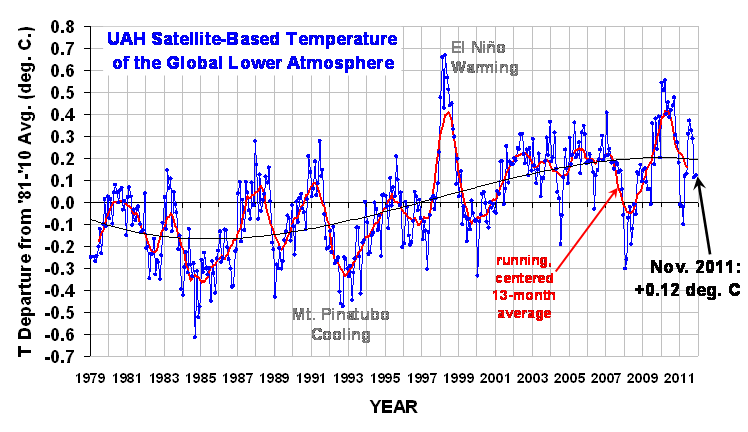
Meanwhile, here's the global air/tropospheric temperature anomaly for November 2011. Data from Dr. Roy Spencer,


UAH Global Temperature Update for Nov. 2011: +0.12 deg. C

December 15th, 2011
The global average lower tropospheric temperature anomaly for November, 2011 remained about the same as last month, at +0.12 deg. C (click on the image for the full-size version):

The 3rd order polynomial fit to the data (courtesy of Excel) is for entertainment purposes only, and should not be construed as having any predictive value whatsoever.
Here are this year’s monthly stats:

YR MON GLOBAL NH SH TROPICS
2011 1 -0.010 -0.055 0.036 -0.372
2011 2 -0.020 -0.042 0.002 -0.348
2011 3 -0.101 -0.073 -0.128 -0.342
2011 4 +0.117 +0.195 +0.039 -0.229
2011 5 +0.133 +0.145 +0.121 -0.043
2011 6 +0.315 +0.379 +0.250 +0.233
2011 7 +0.374 +0.344 +0.404 +0.204
2011 8 +0.327 +0.321 +0.332 +0.155
2011 9 +0.289 +0.304 +0.274 +0.178
2011 10 +0.116 +0.169 +0.062 -0.054
2011 11 +0.123 +0.075 +0.170 +0.024
Since last month I predicted another temperature fall for November, which did not occur, I will admit that I should have followed my own advice: don’t try predicting the future based upon the daily temperature updates posted at the Discover website.
--------


And here is the latest forecast (as of yesterday, December 18) for the on-going La Nina. It's projected to last until probably end-2012, and even longer. One more year, or even longer, of more rains. I will not be surprised if we will have another "Year without summer" like in 2009 where even the supposedly peak dry months of April-May have become wet months.
--------

See also:
Australia floods, January 13, 2011
Typhoon Nesat ("Pedring") in pictures, September 28, 2011
Thailand flooding, October 2011, October 15, 2011
Climate stupidity 20: Deep cooling, Vietnam flood, October 18, 2011
Thailand flooding, October 2011 (part 2), October 27, 2011

Thursday, July 14, 2011

PAGASA Bureaucracy 1: On Temperature Data

I'm following PAGASA, the Philippine government's weather bureau, on twitter. This morning, I was commenting to their tweets:

(Around 10am, July 14, 2011)

dost_pagasa PAGASA-DOST
FYI: Ma-On means horse saddle..this name came from the Hong Kong

Noysky Nonoy Oplas
@dost_pagasa Why does PAGASA keep a diff. local name for storms w/ intl name already? They add to confusion, espec when analyzng past storms

dost_pagasa PAGASA-DOST
we use local names if the tropical cyclone is inside the Philippine Area of Responsibility (PAR).

Noysky Nonoy Oplas
@dost_pagasa What's the reason for having 2 names, int'l & local, for storms or cyclones that enter PAR? Why not just adopt the intl name?

(After about 30 minutes...)

dost_pagasa PAGASA-DOST
Ma-On is still outside of the Philippine Area of Responsibilty (PAR). if this typhoon enters the PAR on Sunday, we call it "Hanna"

Noysky Nonoy Oplas
@dost_pagasa Lesson: keep asking PAGASA why they give 2nd name to cyclones that enter PAR, they wont answer. They give u d local name. cool.

Noysky Nonoy Oplas
@dost_pagasa Next question to PAGASA: Why are past temp data, say past week, months or yrs not available in your website? You sell the data?

(after about 10 minutes...)

dost_pagasa PAGASA-DOST
Typhoon "Ma-On" is still far away from the country and around 2400 km east of Extreme Northern Luzon.

Just like many govequrnment bureaucracies, if they do not like your questions, you get zero response from them. Tney just want your tax money perhaps. Now, if we want some data that they are paid by our tax money to generate, they say, "Sorry, data not freely available. You pay per sector, per year."

PAGASA, sikat Pag Uso ang bagyo. Yeebah!
----------

Last April 10, 2011, I wrote this:

Average monthly temperatures, Philippines

Yesterday, it rained here in Manila and surrounding areas. It has been cloudy since last month and, well, since the past few months even after the regular rainy season is supposed to have ended last October or November. I like it when it rains these months. April-May are the hottest months of the year, so if we have cloudy sky almost everyday, and even rains in April, it's cool.

I wanted to know what's the average monthly temperature for some Philippines cities like Manila. The government agency that has the mandate to keep and give such data is PAGASA. If you go to their website, this is what they will give you.

No historical data, like average temprature last month or monthly or yearly; only the temperature range today. Why? Because PAGASA is selling those information to the public. Something like P36 per sector per year. So if you want to know what was the maximum temperature per month, minimum temperate per month, average temperature per month, that's 3 sectors (max, min, and average temps) or P36 x 3 = P108 per year. If you want to get data for the past 10 years, that would set you back P1,080.

But such data are available in other websites for free, and those websites do not get a single centavo from us Philippine taxpayers. PAGASA gets several hundred million pesos per year of taxpayers' money.

Here's average monthly temperature data for Manila from Euroweather. Data is very simple, showing April-May having the highest average temperatures at 29 and 30 C, respectively.

And this one's from Students of the world. It shows the average monthly temperatures (in red) and rainfall (in blue) in Manila. The basic source of data is not shown though.

This one is from World Weather and Climate Information. The charts are easy to read, showing the maximum and minimum temperatures per month in Manila, also the average monthly precipitation.

This one may look complicated, but it shows all the important monthly data -- maximum, minimum, average temperatures, rainfall, wind speed, and so on. Cool!

It's from the Climatetemp info.

Finally, another good table showing max, min and mean or average temperatures per month. Coldest months are December-January with average temp of 26C, hottest months are April-May with average temp of 29 C. Also the figures for average precipitation per month.

Data is from the Weather Channel.

PAGASA is getting money from the public twice -- from the regular annual budgetary appropriations, and for each data given and sold to the public. Other government agencies and offices of course, get those data for free.

PAGASA is also part of the anthropogenic global warming (AGW) camp. The past century's warming was "man-made." Natural climate cycles are also called "man-made climate change". It is easy to peddle these fictions and imaginary stories if one does not show objective climate data of warming-cooling-warming-cooling cycles in the past.

In the case of PAGASA, it does not even give data of average temperature range for the past few months and years. One has to write to them to request for the info, go to their office in Quezon City to pay a fee, then wait for several days before they send you the data. It is bureaucratic, it is costly, it is time-consuming. Simply inefficient.
-------

See related articles here,

Deregulate weather forecasting, privatize PAGASA

Privatize PAGASA, part 2

Wednesday, December 02, 2009

Warming Hysteria: Kyoto Protocol and Climategate

A good friend of mine asked me what's wrong with the Kyoto Protocol (KP) and the forthcoming Copenhagen meeting (to start next week) projected to produce a sort of KP Part II in binding environmental commitments. He does not see such international environmental regulations restrict economic freedom and individual liberty.

For me, the main problem with KP and soon, the planned Copenhagen agreement, is the extent of new environmental regulations, energy rationing, carbon taxation, carbon cap and trade, carbon tariff and eco-protectionism. In short, an expanded ecological central planning.

The science behind anthropogenic global warming (AGW) is highly questionable, if not discredited. The current "climategate" scandal is one proof that the AGW claim is not even a theory because of the presence of so many contrary data and facts that do not conform with the predictive capacity of the "theory". Thus, imposing those carbon emission restrictions and regulations based on suspicious, heavily debated, if not wrong science, is wrong.

About clean development mechanisms (CDMs), certified emission reduction (CERs) and related schemes for carbon mitigation, these are among the offshoot of carbon rent-seeking. Consider the following examples.

Philippine Airlines (PAL), Cebu Pacific airline, Superferry shipping line, Victory bus line, San Miguel Corp., for instance, will be assigned a carbon cap by the DENR or a new climate bureaucracy by the Philippine government, say at X tons per year starting 2010. Then such climate or carbon control agency will declare,

"You PAL (or Cebu Pacific or Superferry, etc.), your carbon emission cap by 2015 will be reduced to (X - 10%); by 2020, it will further be reduced to (X-20%); by 2030, it will be further reduced to (X - 30%), and so on." 

So as the number of airplanes of an airline company, or the number of boats of a shipping company, the number of buses of a bus company, etc. are increasing because the population and passengers are rising and people are driving less too, the emission from these corporations will be rising. 

So you have a situation of rising emission from these companies but the cap given by government is reducing. What will these airline, shipping line, bus line and other companies do? One is invest in emission-reduction technologies to be put in the engines of their airplanes, boats, vehicles, and other machineries. If this is not technologically possible, or very expensive to do, another option is to buy carbon credits from some companies, whether in the Philippines or abroad, that sell extra carbon offsets (say from a solar power plant or wind power farm). 

As carbon caps across the world are declining, the number of companies seeking to buy carbon credits expanding, the price of carbon credits naturally will rise. The price of carbon per ton will rise. So those airlines, shipping lines, hotel and restaurant chains, bus lines, vehicle manufacturers, etc. will be passing on the extra cost of higher carbon credits to their consumers, to their passengers, to the public.

CDM sounds "clean" in theory if the AGW science is absolutely correct. But in reality, such mechanisms contribute to higher prices, both of energy and consumer items. Lots of reports that such cap and trade system as CDM has resulted in job losses and company closure, in Europe. The value of carbon trading was $128 billion in 2008 alone, and those do not include companies in the US as the US government is not a signatory to the KP.

At home, some political families were said to have made big money with the mandatory Ethanol 10% (E10) and biodisel 5% (B5) provisions. They capitalized on the carbon restrictions, that all petroleum companies in the country, big and small, will be forced to buy from them. Of course there is a related issue of agricultural lands previously planted to food crops have now been converted to fuel crops, contributing to the recent and continuing food price inflation.

A poor household will soon face higher electricity bill as "non-clean" but cheap energy sources like coal will be slapped with high carbon taxes. A poor and middle class family will soon face higher bus fares, higher airfares and boat fares, because of those carbon caps and trade and related CDMs.

So those supposedly "market-based" instruments to drastically cut carbon emission in the atmosphere like CDM and CER, are actually very distortionary of the market economy. Banks, carbon traders and other private and government bodies that live off implementing and monitoring those schemes become the new carbon rent-seekers. They produce not a single kilo of food, transport not a single passenger, or produce not a single kwh of electricity, but they make big money, hundreds of billions of dollars of carbon traded money every year.


My friend suggested that Kyoto Protocol (KP) is an application of the polluter-pay principle. He also suggested that most developing countries, or Annex II countries, are not obliged by KP to make drastic carbon emission cuts.

I think he is right that for now, developing countries like the Philippines are not obliged to make deep emission cuts. But it's just a matter of time. When KP was sealed in 2005 I think, China, India, Brazil, Indonesia, S. Africa, Mexico, etc. were just innocent countries. Now in the Copenhagen meeting, there are direct cap being expected, if not imposed, on them, especially China. In addition, some rich countries are threatening that developing but very big economies like China and INdia, should make their own deep emission cut, otherwise they will impose high carbon tariffs ("eco-protectionism") on their exports. And this makes implementation of the emission cut less transparent. Any rich country can slap different carbon tariffs for different countries, like +10% on top of existing tariff duties for Mexican exports, +15% for Chinese exports, etc.

So for the Philippines having 92 million people, the 12th biggest population in the world, it should be a matter of time and we will be given carbon cap by some international climate bureaucrats.

But even if there will be no carbon emission cap to be imposed on the Philippines and other poorer countries say, in the next 30 years, such economies will also suffer from low and anemic growth that will happen in rich countries. Why? Because the rich countries are the main buyers of our exports, the main employers of our outbound workers (the OFWs), among the main sources of in-bound foreign tourists and foreign investors.

Losing jobs as a result of restricting environmental and energy regulations in rich countries. Last month I read about the biggest aluminum plant in the US closing, going bankrupt. Why -- energy prices in the US becoming more and more expensive. Some states are more strict than the federal government in practically killing coal power plants (which supplies about 60 percent of all US energy needs).

I mentioned that coal is cheap energy source because I read that the per kwh cost of generating electricity from solar and wind power is 10x that from coal. At least in the US energy situation.

I also doubt that the Philippines will be able to sell substantial carbon credits to companies from rich countries because growing domestic demand for more power are often not enough. Whatever new power plants to be put up, from renewables like hydro and geothermal, will be snapped up by domestic industries and households, no credit to be left to foreign companies from abroad wanting to buy carbon credits.

Finally, we should visit and review some scientific literature on anthropogenic global warming (AGW) science, that it is highly debatable if not discredited, because all those carbon regulations are based from that "theory".
---------

On Climategate

Here's one online search even for fun:

Google "global warming", you get 9.8 million entries (as of this writing)
Then google "climategate", you get 13.4 million entries!
The former is 3 decades old, the latter is only 2 weeks old.

The latter is about the hacked emails, thousands of emails and documents at the Climate Research Unit (CRU) of the Univ. of East Anglia in Britain, where a number of warming scientists were emailing each other how they cheated on climate data to "hide the decline" in global temperature, how to hide or destroy climate data to escape UK's Freedom of Information law, how to kill and not publish scientific papers that question man-made warming in some scientific journals, and so on. 

These warming scientists and politicians that give them millions of dollars of climate research funds have one major goal: to scare the world of "impending environmental catastrophies" so that the world will accept their planned ecological central planning agenda.

The big problem of the UN, Al Gore and other warmers now, is that millions of people around the world have already known and read the climate data manipulation and bastardization of climate science. And these people are angry.
-------


A number of NGOs and institutes in the Philippines are pushing now the Freedom of Information (FOI) bill. It was passed in the House of Representatives, awaiting action at the Senate. MG Thinkers is among the 70+ institutes and NGOs that signed the FOI statement.

The UK has a Freedom of Information (FOI) law. In the "climategate" or climate scandal still on-going, a number of the hacked emails showed that the head of the Climate Research Unit (CRU), Dr. Phil Jones, was emailing other warming scientists, "don't let them know that UK has a FOI law" as a number of skeptical scientists were demanding certain climate data. In succeeding emails, Phil Jones later exhorted other scientists to "destroy" climate data before the skeptics would find and see them under the FOI law.

I myself have difficulty getting RP temperature data from PAGASA. I was emailing one official of the meteorology department, cc'd Nathaniel Cruz -- yes, the known and affable Tani Cruz -- and they won't reply to my email. They know my stand that I question man-made warming. Is this the reason?

So, go ahead with FOI bill in the Philippines. Time is very short for the Senate to act as the election campaign period is fast approaching. 

Liars and robbers in government hide from transparency and accountability because they are not obliged by the law to open up certain information to the public.