Showing posts with label UNCTAD. Show all posts

Friday, December 02, 2016

BWorld 93, ASEAN multinationals

* This is my article in BusinessWorld last November 23, 2016.


Until the 1980s, when people talk about multinational enterprises (MNEs) -- also known as multinational companies (MNCs) or transnational corporations (TNCs) -- they refer mostly to multinationals from the US, Canada, Europe, and Japan. Three decades after, that has significantly changed.
  
The rise of MNEs from developing and transition economies, especially those coming from China, Hong Kong, South Korea, Taiwan, Brazil, India, and several ASEAN countries become more prominent each year although multinationals from the industrial west remain very large and dominant.

This is consistent with global trade and capital liberalization where economies and sectors that show huge factor endowments and potentials for global growth attract both trade and investment flows. Developing countries with huge populations like China, India and the Philippines, and developing economies with highly skilled workers and innovative and aggressive companies like Hong Kong, Singapore and South Korea, are able to slowly put their MNEs in the global map.

The United Nations Conference on Trade and Development (UNCTAD) produces the World Investment Report (WIR). Its WIR 2016 disclosed the figures for 2014 of the world’s biggest nonfinancial MNEs, both in developed and developing countries.

Below are the biggest MNEs from the ASEAN. The Transnationality Index (TNI) is calculated as the average of the three ratios: foreign assets (FA) to total assets, foreign sales to total sales, and foreign employment to total employment (see table).
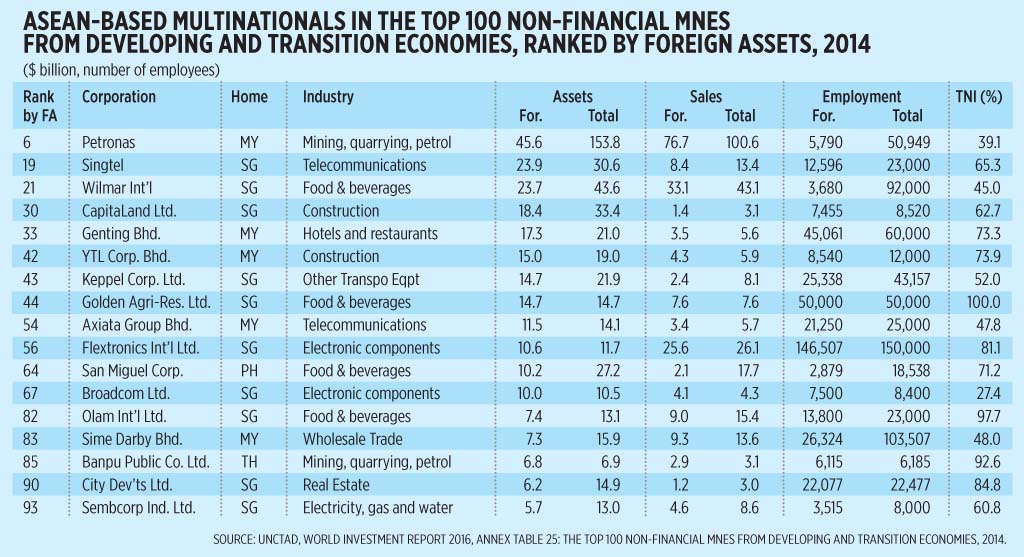
  
There are at least two things that are prominent in the above table.

First, 17 ASEAN-based MNEs have made it to the top 100 MNEs from the developing world: 10 from Singapore, 5 from Malaysia, 1 each from Thailand and the Philippines. The TNI of these 17 companies are generally high, 11 of them have TNI of 60% or higher.

Second, San Miguel Corp. is dynamic enough to have plenty of branches and subsidiaries in the region and other parts of the world. It is indeed the #1 brand from the Philippines that has high regional footprint, and known even in some industrial economies in the west.

But there seems to be a mistake in the UNCTAD table, saying that SMC’s TNI is 71% when it looks like having only 30% or lower.

Other big MNEs from developing Asia are the following:

1. Hutchison Whampoa Ltd. (Hong Kong, Transport and storage) with FA of $91B.
2. Hon Hai Precision Industries (Taiwan, Electronic components) with FA of $73B.
3. China National Offshore Oil Corp. (China, Mining, quarrying and petroleum) with FA of $71B.
4. Samsung Electronics Co., Ltd. (South Korea, Communications equipment) with FA of $56B.
5. Tata Motors Ltd. (India, Motor Vehicles) with FA of $30B.

The subject of Philippine multinationals will be among the topics to be tackled in the coming BusinessWorld ASEAN Regional Forum this coming Nov. 24, 2016 at Conrad Hotel, SM MOA Complex. It is a regional conference with the involvement and sponsorship of many big corporations in the country.

Among the speakers will be CEOs and managers of big Philippine MNEs, and MNEs from abroad that are operating in the Philippines. This two-way exchange of ideas and experiences will be very productive for small and medium enterprises (SMEs) in the country that aspire to have regional footprints, and later barge into the continental and global list of successful and big MNEs.

After all, Facebook, YouTube, Twitter other big brands now were nonexistent until about 13 years ago. Endless innovation, consumer-friendliness and access to more markets abroad have allowed them to leapfrog from small start-ups to huge, multibillion-dollar global companies.


Bienvenido S. Oplas, Jr. is the president of Minimal Government Thinkers and a fellow of SEANET. Both institutes are members of the Economic Freedom Network (EFN) Asia.
-----------

See also:
BWorld 71, Free trade and higher income, July 11, 2016
BWorld 72, Economic integration and disruption, July 25, 2016 
BWorld 86, Philippine industrial policy, October 15, 2016
BWorld 91, Free trade means faster growth in manufacturing, November 14, 2016
BWorld 92, Climate action and Asian energy realities, November 19, 2016

Sunday, November 08, 2015

Free Trade 56, Trade, investments and taxes in APEC countries

The Albert Del Rosario Institute (ADRi) has published my new paper, in time for the Asia Pacific Economic Cooperation (APEC) Summit this coming November 18-19 here in Manila. My special thanks to ADRi President, Prof. Dindo Manhit.


I put a number of tables in that paper, data sources from the World Bank, UN Conference on Trade and Development (UNCTAD), World Trade Organization (WTO), Alas Oplas & Co. CPAs (AOC), Bangko Sentral ng Pilipinas (BSP) and the Philippine Statistics Authority (PSA).


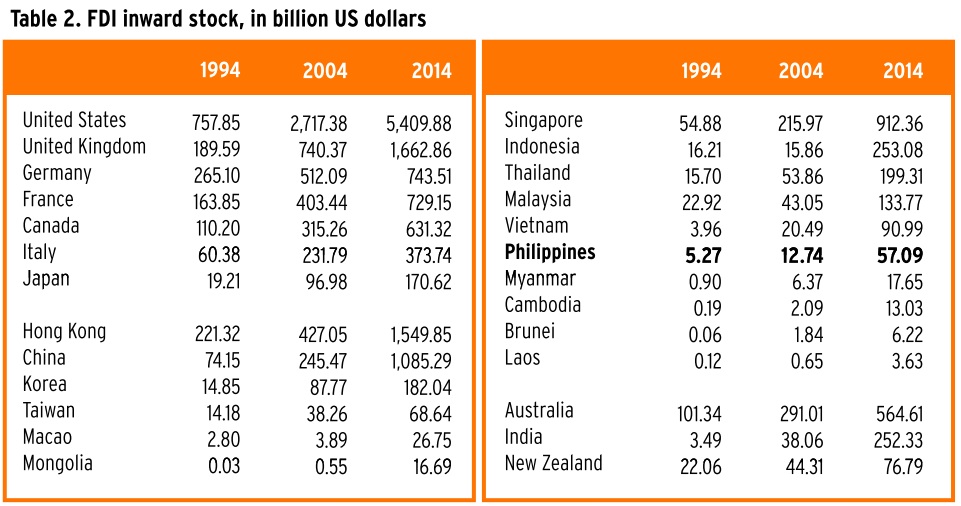
Foreign direct investments (FDI) inward stock is a good indicator of how much FDIs have accumulated in a country net of outflows through time.


FDI net inflows is a better indicator than plain inflows because a country may get huge amount of FDI inflows but also suffering from huge outflows so that the net inflow is actually negative. Like the US, Russia, Hong Kong, Taiwan, Japan, S. Korea and Malaysia, at least for the the years 2012-2014.

 APEC countries are marked red here.


Trade bureaucracies as a form of non-tariff barrier (NTB).


My Concluding notes

1. To have more trade and investments, governments should learn to step back from too many regulations and taxation. 

2. Corporate income and other taxes in the Philippines in particular should decline in the face of rising tax competition among ASEAN countries. 

3. Non-tariff barriers (NTBs) like import licensing and SPS measures should be relaxed and reduced. 

4. Global capitalism is about integration and competition, complementation and substitution, happening simultaneously. 

5. Markets in a competitive environment always result in innovation and business creativity. 

6. Governments should focus on their core and basic function – lay down fair rules for all players, be an impartial judge or referee in cases of disputes, protect private property ownership, enforce the rule of law, contracts between and among people.

The 12-pages paper is also posted in slideshare.
-----------

See also:

Saturday, August 22, 2015

Business 360-28, FDIs in South and East Asia

* This is my article in Business 360 magazine in Kathmandu, Nepal, August 2015.
---------

Foreign direct investments in South and East Asia

Foreign investments are among the key ingredients for developing countries to hasten their growth and development. Two prominent proof of this are small territories, small population, but big economies Hong Kong and Singapore. They started as very poor economies in the 1950s and 60s respectively and their openness to global trade and investments very early have allowed them to maximize the financial, technological and managerial resources that foreign businessmen and professionals could share.

There are two main avenues for foreign capital to enter an economy. Via foreign direct investments (FDIs) and via portfolio investments like the stock market.  Here we will discuss only FDIs and leave the latter to future topics in this column.

The UN Conference on Trade and Development (UNCTAD) has released the World Investment Report (WIR) 2015 in late June 2015. In the report are a number of very interesting data, some of which will be discussed here.

Cumulative values of FDI inward stock, net of capital outflows, is an important indicator of foreign investments in an economy. Here are the numbers.


South Asian economies overall were not able to maximize the potentials of FDIs all these years. India has the biggest FDI inward stock in the region, but comparing what it got with small population, small territories Hong Kong and  Singapore, the investments  it has attracted looked modest.

Nepal in particular needs to be more open to foreign investments considering the small amount it has attracted with just half-billion dollars as of 2014.

Socialist economies China and Vietnam that allowed certain degrees of economic freedom and the market system were able to maximize the potentials and benefits of FDIs. Vietnam’s FDI stock has expanded 23x in just two decades while China’s has expanded by 15x.

Other South East Asian economies were also able to expand their FDI stock rather fast. Aside from Vietnam’s 23x expansion, Singapore and Indonesia expanded 16x, Philippines 11x, and Thailand 9x.

We now check the value of FDI inflows over the last three years. The numbers for Afghanistan, Nepal and Bhutan are not good, the low values they got in 2012 further shrank in the next two years. Thus, the share of FDI as percent of gross domestic capital formation (GDCF) or simply total domestic investments, has been declining.

Bangladesh, Sri Lanka and Maldives have retained the average inflows per year while India and Pakistan have ramped up the FDIs they are attracting.


Some important lessons that South Asian economies can learn from their neighbors in North East and South East Asia would be the following.


One, being open to global trade and investments would mean being open to the various opportunities that  other economies in other parts of the planet can share. Global business is about integration and competition, about complementation and substitution. There are lessons to be learned, opportunities to be opened, so that business risks can be minimized and better handled.

Two, as shown in the numbers above, Hong Kong and Singapore are very good proof and examples that openness to global investments and trade can bring in more investments than one can imagine and hope for.

Three, there is a need to reverse the recent decline in FDI inflows especially in Nepal and Bhutan. More than high profit, foreign businessmen are concerned with the security of their investments, that these will  not be confiscated or nationalized even in periods of domestic political upheavals. Having the rule of law, respect of private property ownership, and ensuring the economic freedom of entrepreneurs, local or foreign, small or big, are important ingredients to attract investments, both foreign and local.
------------

See also:

Thursday, August 06, 2015

Investment Liberalization 2, G7 and East Asia economies

Mobility of investments and capital across islands, countries and continents is part of human nature. A country or island for instance with plenty of beautiful white sand beaches will naturally attract investors who will put up modern resorts and hotels, that will attract more visitors from other countries, giving lots of jobs and other business opportunities to the locals and new migrants.

The UN Conference on Trade and Development (UNCTAD) released in late June 2015 its World Investment Report (WIR) 2015. The annex tables of that report are found here.

My sister's auditing firm published the 2nd issue of its monthly Business and Economic Update last month. Among the contents of that report are the tables below, original global data are taken from the WIR 2015.

Here, it shows that from 2012-2014, there was consistent net outflows of foreign direct investments (FDIs) in the G7 except UK and partly, Canada. Then in Hong Kong, Taiwan, S. Korea and Malaysia. 

http://alasoplascpas.com/publication-economic-02-Net-Inflows-of-FDI.php 

Numbers below show the ratio of FDIs over gross fixed capital formation (GFCF) or simply domestic investments. It is interesting to see how Germany and Japan have very small share of FDIs. This somehow gives an idea of their investment protectionism policies.


The most open economies to global trade and investments, Hong Kong and Singapore, have the highest FDI share to total national investments.  And an FDI share of 2.5 to 14 percent seems to be the average, possibly a healthy mixture, including the 10.5 percent for the Philippines. 


Until 2012, the bulk of FDIs in the PH came from the US, HK and Japan. By 2013 until mid-2014, capital from the US withrew, from HK declined significantly, from Japan retained, and a surge of FDIs from British Virgin Island.

http://alasoplascpas.com/publication-economic-02-FDI...

In portfolio investments like the stock markets, Japan, China, India and Hong Kong received significant inflows while many in the ASEAN experienced net outflows overall except Vietnam.

In merchandise exports (X) as a share of their GDP, Hong Kong and Singapore are run-away leaders, followed by Vietnam, Malaysia and Thailand. In non-merchandise, services exports like tourism receipts, Macao is a clear leader because of its huge gaming and casino facilities.

Personal remittances by their nationals who are working abroad, India, China and the Philippines (and Mexico) are the world leaders. The Philippines is #1 in the ASEAN.

http://alasoplascpas.com/publication-economic-02-Global...

Meanwhile, from another source, these numbers are interesting. Until 2012, the US was a major source of FDIs in the ASEAN. By 2013, capital from the US declined significantly. Investments from Japan, intra-ASEAN, UK and Netherlands are big. 


Source: ASEAN Investment Report 2013-2014, http://www.asean.org/.../asean-unctad-launches-asean...

Favorite destination of FDIs in the ASEAN are the services and manufacturing sectors. Data also from the ASEAN IR 2013-2014.


The above numbers and figures are additional reminders that the Philippines need to amend its Constitution and remove protectionist provisions that restrict or limit the entry of foreign investments in some sectors, while outrightly banning/prohibiting FDIs in other sectors.

It is not wise that government dictates that these areas are only for local investors and those areas, foreign investors can be allowed. Investments, local or foreign, automatically creates local jobs. If Filipino workers are prevented from being hired by foreign  investors here because the latter are restricted or banned on certain sectors, then many Filipino workers are hired by foreign investors in foreign lands.
-----------

See also: 
Free Trade 35: EU-FNF Forum on 'FDI Engine for Job Growth', May 15, 2014 
BWorld 12, Investments, APEC and economic liberalization, July 25, 2015 

Investment liberalization, trends and lessons, July 26, 2015

Sunday, July 26, 2015

Investment liberalization, trends and lessons

Capital, like labor and technology, simply wants to be mobile across islands, provinces, countries and continents. They are like migratory birds and large fishes/mammals, they go to areas that are hospitable to them, allow them to survive and flourish.

Economies that are more open to global trade tend to attract more foreign direct investments (FDI), like Hong Kong and Singapore, but Japan has a different story.


Data is from UNCTAD, World Investment Report (WIR) 2015, http://www.unctad.org/fdistatistics. This table is from a paper produced by my sister's auditing firm. I will blog about it soon here.

Meanwhile, here are some reports and papers on the subject.

News from CNBC, June 29, 2015, Vietnam is liberalizing further its foreign  investments policy, except that
"The announcement gave few other details, although it said industries such as banking that are covered by separate rules would keep ownership limits at 30 percent." 

A paper from Econ. Research Institute for ASEAN and East Asia (ERIA) in 2008, "Investment Liberalization and Facilitation:..", 15 pages, http://www.eria.org/.../pdf/PDF%20No.1-2/No.1-2-part2-7.pdf

A new paper from ERIA, April 2015 by Dr. Pons Intal, "AEC Blueprint Implementation...", 27 pages, http://www.eria.org/ERIA-DP-2015-32.pdf

“In conclusion, it is worth noting that investment liberalization is only one of many factors that determine the investment attractiveness of a country, as we have seen. A number of them are also within the purview of the AEC. Thus, implementing those measures (e.g., regulatory improvement through the National Single Window) should  generate greater synergy between them and investment liberalization, which should result in an improved investment climate.”

And a good OECD paper in 1999, "Open Markets Matter...", 12 pages, http://www.oecd.org/trade/benefitlib/1948792.pdf

The major concerns of foreign investors in many countries, from a presentation by Dr. Rafaelita "Fita" Aldaba of PIDS then, 2012, "INVESTMENT FACILITATION AND LIBERALIZATION IN THE AEC: CHALLENGES FOR THE PHILIPPINES", http://aric.adb.org/.../Investment%20Facilitation%20and... 


Meanwhile, a note and  warning from this  article,


"billions of dollars of Chinese investment in countries such as Angola, Sudan, and Venezuela, which fare quite poorly in the pertinent international rankings. Moreover, there are numerous reports of Chinese companies paying bribes to secure a major port deal in Sri Lanka, to try to obtain a major broadband telecommunications deal in the Philippines, and to secure lucrative oil and gas opportunities in Kazakhstan...." July 26, 2015. http://thediplomat.com/.../chinese-outward-investment.../

Foreign investments should be liberalized. It is unfair for employees and those looking for new work that the number of investors and job creators in the domestic economy is limited and restricted mainly to local investors. What usually happens is that if they cannot be hired by foreign investors in the home country, they are hired by foreign investors in foreign countries through the process of migrant employment, like our OFWs. So there is no sense keeping the investment protectionism policy.
--------------

See also: 
Free Trade 35: EU-FNF Forum on 'FDI Engine for Job Growth', May 15, 2014 
BWorld 12, Investments, APEC and economic liberalization, July 25, 2015