Showing posts with label healthcare competition. Show all posts

Friday, February 22, 2013

Healthcare Competition 11: Postscript to the Filipino Horror Story

* This is my guest post today in antipinoy.com
-------------

Tuesday  this week, an article from the Inquirer, Filipino horror story, was circulated and shared in facebook and other social media.  It was written by Dr. Korina Ada D. Tanyu, 27, a pediatrics resident at the Philippine General Hospital (PGH).

It was indeed a heart breaking story about a five years old boy named Jamjam from a poor family in Cavite, who has been coughing for two months already, later losing weight and has  recurring fever. The mother brought him to the health center, the boy was given carbocisteine, the cough continued and he kept losing weight.

The nearest hospital to them is privately owned and the consultation fee is at least P500, aside from the costs of the lab tests. The nearest government hospital according to the author is in Manila, the PGH. After two months of this bad condition of the boy, the mother brought Jamjam to PGH. At first she was turned down because the hospital’s emergency quota of 60 new patients a day on top of old and returning patients has been reached. One doctor attended to Jamjam that day seeing his bad condition.

They found out that Jamjam has tuberculosis complicated with severe pneumonia; the infection has spread through his blood. When he was brought to the PGH, his condition was already very serious. After several attempts by the doctors and nurses at the ER resuscitating Jamjam that day, they failed. Jamjam died. A heart breaking story.

I commented at the walls of my friends who posted that story, that the main problem was the lack of health insurance by that poor family. The government barangay health centers are supposed to be the de facto health insurance for the poor because they can go there for free treatment, but the health center only gave the boy Carbocisteine, an anti-cough syrup without checking what caused the cough in the first place.

The barangay health centers should provide primary treatment. If they cannot handle the situation, say they suspect that there is a bigger cause to a symptom, they should refer the patient to government secondary or even tertiary facilities, like the municipal health center or a district or provincial hospital. It seems that the barangay health center did not do this job, and the government provincial hospital seems far from the family’s house.

When the parents endured for two months not to bring the child to a physician due to poverty, the disease has already mutated to something serious. Pneumonia is actually easy to treat, if detected early. Some anti-biotics plus regular hydration and good rest would usually allow a patient to recover from the disease. But if pneumonia has become severe, even hospital treatment can be too late.

There were discussions to increase really high the budget of the PGH and other DOH hospitals. This might help, and assuming that the government has no big public debt to grapple with. But the more cost-effective way to solve a similar case like this is to improve preventive healthcare through a reliable and competitive health insurance system for all households especially the poor. Health insurance especially for outpatient services should be deregulated.

PhilHealth card is often useless for outpatient services. One can use it only if he/she is already hospitalized, when the disease is already serious and the patient is about to die. For diseases like pneumonia or TB, patients can be treated at home provided that correct diagnosis and treatment is given. When the condition has become complicated, that is the time to bring the patient to a hospital for confinement.

Community (barangay or municipal level) or private health insurance in a deregulated environment where there are plenty of competing players, is the solution. Government can pay for the annual premium of the poor and the latter can look for a private or NGO health insurance provider, instead of maintaining inefficient or costly health centers. In the case of Jamjam, can the family complain of the barangay health center for just giving them Carbocisteine instead of referring them to a district or provincial hospital early enough?

Government healthcare monopolization and nationalization is wrong. In the food sector, there is no government restaurant or carinderia corporation, no government supermarket or talipapa, all such shops are private, and people are eating. Compare that in healthcare where there are about 40,000+ barangay health centers, hundreds of provincial, district and city government hospitals, dozens of DOH hospitals, dozens of hospitals from other agencies (AFP hospital, PNP hospital, Veterans hospital, UP-PGH, etc.), there are thousands of government pharmacies (Botika ng Barangay, Botika ng Bayan) there is drug price contro policyl, mandatory discount for senior citizens, there is government health insurance monopoly, etc.  And healthcare problems are expanding, not declining.

Repeated statement and plea of "not enough public spending on healthcare" is wrong. Maybe they can talk of "not enough PGH budget" as the story above has illustrated and that is true. But overall, nationwide, public healthcare is among the heavily budgeted, and most probably, heavily wasted sector.

There are lots of government spending on healthcare already via (1) DOH, P53 B this year alone, (2) PhilHealth with P100+ B in reserve funds alone, (3) LGUs, from provincial health centers and hospitals down to barangay health centers, (4) other agencies' spending like UP-PGH, AFP hospital, PNP hospital, etc. (5) Health spending by different agencies for their personnel and their respective dependents, and (6) PCSO and PAGCOR support, indirectly through LGUs’ and DOH hospitals (usually free ambulance, mobile clinics) or directly to patients in the form of hospitalization cover.

When I was working at the House of Representatives in the 1990s, our healthcare protection was OA. Consider this: (1) we have PhilHealth membership with huge employer (HOR) contribution, (2) we have private HMO, Intellicare at that time, I don’t know now, and HOR is paying for the annual premium of all employees, and (3) we have a medical and dental office right at the HOR with full time doctors, dentists and nurses, with free basic medicines, etc. All this spending for healthcare by the HOR for its officials and employees is not counted as “public health spending” but “legislative spending”.

So when the WHO, ADB, WB, UN, etc. would say that the Philippines’ health spending / GDP ratio is only 3% or so, they are wrong, the numerator they use – DOH spending, PhilHealth disbursement, estimated private sector spending, etc. – is understated. They miss health spending by all other government agencies, local to national, that are not included in the numerator.
---------

See also:
Healthcare Competition 8: Centralization vs. Deregulation of Healthcare, December 31, 2011
Healthcare Competition 9: Deregulate Further the Supply of Healthcare, August 25, 2012
Healthcare Monopoly 6: Cuba Socialism, January 14, 2013
Healthcare Competition 10: Alternatives to Government Health Monopoly, February 06, 2013

Wednesday, February 06, 2013

Healthcare Competition 10: Alternatives to Government Health Monopoly

* This is my article today in thelobbyist.biz 
-----------


Attaining universal health care (UHC) for all Filipinos is among the key social reform programs of the government. The recent passage of the Sin Tax law as well as the huge hike in the budget of the Department of Health (DOH) are  linked to covering as many poor people as possible in health insurance and hence, attain UHC.

I am in favor of achieving UHC based on two important premises.

One, everyone -- from newly born babies to the oldies in this country, employed or unemployed, married or unmarried -- should  have a health insurance. And that everyone should have his/her individual health card, not just the heads of family as currently practiced by the Philippine Health Insurance Corporation (PHIC or PhilHealth).

Two, UHC does not mean government monopoly of healthcare like PhilHealth. Competition among various healthcare providers – corporate health insurance firms, health NGOs, health cooperative, barangay or village health insurance, municipal or city health insurance, and so on – is possible and feasible.

In the few remaining days of Congress in session, many civil society organizations are pushing the passage of a bill expanding the powers of PhilHealth. I saw the signature campaign and I was not impressed by this bill, Senate Committee Report No. 49 or SB# 2849. It does not seem to have major value added to existing and recent developments.

First, the DOH budget has been rising by an average of P10 billion annually in recent years: P24.65 billion in 2010, P31.83 billion in 2011, P42.08 billion in 2012, P53.06 billion in 2013.

Second, the new Sin tax law is estimated to provide P31.35 billion for UHC this year alone, and about P154.56 billion by 2016 or P39 billion a year on average.  This is on top of regular appropriations for DOH allotted for UHC.

Third, there are increases in mandatory contributions to PhilHealth: (a) those in the formal sector, from 2.5 percent to 3.0 percent of salary; (b) the sponsored program and non-poor informal sector, from P1,200 to P2,400 per annum; and (c) for OFWs, from P900 to P1,200 per annum.

These three measures mean only one thing: more money for UHC every year and they are already in place and implemented even without a new law from Congress. So there is little, if any, value added by  proposed bills on PhilHealth.

Now, there are certain PhilHealth policies that limit or restrict the attainment of UHC itself. Among them are the following.

One, while immediate family members are supposedly automatic dependents of the head of family, there are several restrictions. Among those who can NOT be declared as dependents are:

a. unmarried non-working spouse, or working in the informal sector,
b. children who are above 18 years old, even if they are still studying, and
c. parents who are below 60 years old, even if they are jobless and just taking care of the grandchildren or a sick child. 

The above mentioned groups of people must get or pay their own PHIC membership.

Two, even if members have been religiously paying for many years, but they suddenly forgot or became unable to pay one or two months and thus have not fulfilled the "9 months straight payment" prior to hospitalization, they and their dependents immediately become ineligible for PHIC hospital reimbursement if suddenly one family member is hospitalized.

These technicalities partially defeat PhilHealth's goal of 'UHC for all". In statistics, PhilHealth reports  that they have covered as many Filipinos as possible, that they have covered 85 percent of the total Philippine population. But in reality,  PhilHealth wants to exclude as many people and hence, pay as few members as possible. 

If PhilHealth is serious in covering as many Filipinos as possible, it should remove those exclusions. How can they serve many people if they also exclude as many as possible from the benefit or hospitalization reimbursement system? It is somewhat puzzling why the PhilHealth Board and administrators have not thought of bridging that  service gap. They did not remedy this even though this problem did not happen yesterday or last year, but since PhilHealth was created in 1995 or 18 years ago.

It is also not true that PhilHealth has attained "85 percent UHC coverage” of the Philippine population, What they did in coming up with such conclusion is that they assume that all members have one or two dependents, so they made a two or three multiplier for each PHIC member.  This is wrong and not feasible as many members are young and unmarried, or married but have no kids yet, the older ones may have kids but already 18 years or older. See a longer discussion here, PhilHealth Watch 14: Not Yet 85 Percent Coverage.

Instead of healthcare nationalization and monopolization, we should have healthcare competition. One way to do this is for the DOH to issue a healthcare voucher for all people, say P5,000 per person per year. Thus, a household of four members, couple plus two kids regardless of age, will get a P20,000 per year healthcare voucher.

Let the households and the people choose where to get their health insurance. To private health insurance firm A or firm B, or to health NGO C or D, or to company insurance E or F, or to Barangay or village insurance G or H, or to municipal/city health insurance I or J, or remain with PhilHealth, and so on. 

In the food sector, there is no government restaurant or carinderia corporation, no government supermarket or talipapa, all such shops are private, and people are eating. People have options where to eat or buy cooked and uncooked food.

The same policy can apply in healthcare while government does not let go of its big role in public healthcare. Different healthcare providers, private or civil society or local governments or PhilHealth, are competing with each other to attract the public. The opportunists and greedy will lose clients, the efficient and service-oriented will attract lots of clients.

There are issues raised against private health insurance, that they promise high hospitalization coverage when in fact they pay only after the PhilHealth hospitalization coverage. This is true as these private firms charge lower premium to people who are PhilHealth members.

What the private health insurance providers usually give that PhilHealth does not give, are: (a) annual medical check up, a form of preventive healthcare, (b) dental services, (c) unlimited physician consultation for outpatient services, (d) free diagnostic tests for basic services when necessary, like chest X-ray, blood test, urine/stool lab test, and so on. In case of hospitalization, (e) additional payment after PhilHealth deduction in the total bill.

Where there is healthcare monopoly, options for the public is limited if not zero. Even if PhilHealth  services and health coverage are not good, people have to contribute to it monthly by force and coercion.

Certainly, competition among different healthcare providers is the way to ensure efficiency and non-costly healthcare delivery to the public.

--------

See also:
Healthcare Competition 6: United States, May 05, 2011
Healthcare Competition 7: Moral Hazards in Healthcare Subsidies, May 24, 2011
Healthcare Competition 8: Centralization vs. Deregulation of Healthcare, December 31, 2011
Healthcare Competition 9: Deregulate Further the Supply of Healthcare, August 25, 2012
Healthcare Monopoly 6: Cuba Socialism, January 14, 2013

Saturday, August 25, 2012

Healthcare Competition 9: Deregulate Further the Supply of Healthcare

This will be more of a discussion outline rather than a paper. I would appreciate readers' comments, especially in the two conceptual analysis that I am introducing below.

A. Consumers of Healthcare

Practically everyone, young and old, men and women, rich and poor.

B. Suppliers of Healthcare

1. National government:

   a. Department of Health (DOH) attached hospitals, NCPAM and other agencies; Botika ng Barangay (BnB)
   b: Philippine Health Insurance Corporation (PHIC or PhilHealth)
   c. UP-Philippine General Hospital (PGH) and other state universities offering health courses
   d. Department of National Defense's (DND) AFP Hospital and Veterans Hospital
   e. Department of the Interior and Local Government's (DILG) PNP Hospital
   f. Other Departments and government corporations providing occasional medical and dental missions.
     PCSO and PAGCOR provide limited hospitalization cover, give away ambulances, etc.

2. Local government units (LGUs)

  a. City hospitals (Ospital ng Maynila, Ospital ng Makati, Ospital ng Muntinlupa,...)
  b. Municipal hospitals
  c. Provincial hospitals
  d. Barangay health centers and rural health units (RHUs) under the city or municipal governments

3. Private companies and foundations

   a. Hospitals under a foundation (St. Lukes, Manila Doctors Hospital, Makati Medical Center, etc.)
   b. Other private hospitals, affiliated with the Private Hospitals Association of the Phils. Inc. (PHAPI)
   c. Health Maintenance Organizations (HMOs)
   d. Pharmaceutical companies, members of PHAP or PCPI
   e. Drugstores and pharmacies (Mercury, Watsons, The Generics, members of DSAP)
   f.  Big companies and offices, schools and universities, usually have their own small medical offices/services

4. Civil society organizations

   a. Various NGOs and charity organizations that directly provide health services (Botika Binhi, Alt-Health, PPF, etc.)
   b. Rotary Clubs, Lions Clubs, Mason, JCI, etc. that regularly sponsor medical and dental missions, vaccination projects
   c. Other NGOs, charity organizations, that indirectly provide health services, or do various healthcare policy advocacies

C. Concept 1: Current Financing of Healthcare

First, HC is divided into outpatient and in-patient or hospital confinement services. Financing for outpatient services are usually done via out of pocket (OOP) for those who have no private health insurance, the HMOs for those who have private health cards, LGU hospitals or LGU guarantees if patients are brought to a private hospital ER.

For hospital confinement, that is the main job of PhilHealth. But since its coverage is limited (eg, only P500 per day for hospital bed), the balance is to be shouldered by those mentioned above as financing the outpatient services. Other government agencies like DSWD, PCSO, also give limited cash cover for the balance.


Question: Is this an appropriate representation of the existing health financing system and schemes?

D. Concept 2: Supply and Demand of Healthcare

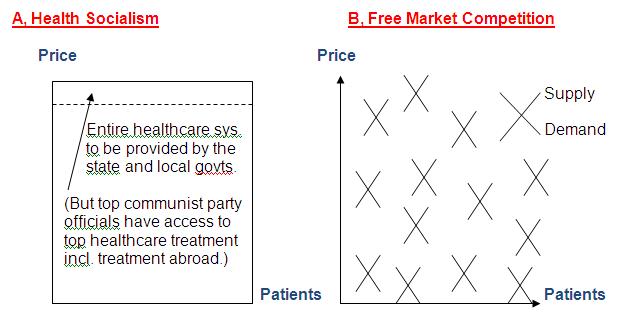
Some left-leaning groups and health NGOs are definitely calling for health socialism, that the national government, in coordination with LGUs, should provide free or highly subsidized HC services to the public, from outpatient to inpatient services because "health is a right, not a privilege." This is represented by the graph on the left.

Other groups, well a minority actually, like us in Minimal Government Thinkers and other free market-oriented groups and individuals, want to keep government role in HC to be focused on dealing with infectious or communicable diseases, pediatric diseases, children and adults with physical and mental limitations. The rest should be given free choices and options where to get their health insurance.


I believe in universal healthcare (UHC), that everyone should have some form of health insurance. But I do not believe that only the government, national and local as enumerated above, should provide that universal coverage.

Would greatly appreciate readers' comments at this stage.  Meanwhile, here's short but good paper from The Independent Institute,
Competition Based on Quality of Healthcare: Why Does Quality Rise in Free Markets and Decline with Government?
--------

See also:
Healthcare Competition 4: Solving Info Assymetry, September 08, 2010
Healthcare Competition 5: Thailand, September 24, 2010
Healthcare Competition 6: United States, May 05, 2011
Healthcare Competition 7: Moral Hazards in Healthcare Subsidies, May 24, 2011
Healthcare Competition 8: Centralization vs. Deregulation of Healthcare, December 31, 2011

PhilHealth Watch 11: Is PHIC an Insurance Company?, June 12, 2012
Socialized Healthcare 6: Student Debates, Charity Beds and UHC, August 22, 2012

Saturday, June 23, 2012

EMHN 1: Forum on Promoting Markets in Healthcare, IDEAS-Malaysia

* Note: I changed the title of this paper from the original "Healthcare Competition 9: Forum on Promoting Markets in Healthcare, IDEAS-Malaysia" as I will be writing more about the papers and activities of the Emerging Markets Health Network (EMHN) in the coming weeks and months. Thank you. *

There will be a good international forum/seminar on "Promoting Markets in Healthcare" this coming September. A good friend, the Executive Director of the Institute for Democracy and Economic Affairs (IDEAS), Wan Saiful Wan Jan, sent me this announcement below,
http://ideas.org.my/wp-content/uploads/2012/06/Healthcare-Policy-Training-Workshop-Description.pdf

Promoting markets in healthcare
One-Day Workshop for Asian Think Tanks
Saturday 8 September 2012, Penang, Malaysia

Hosted by IDEAS and Emerging Markets Health Network (EMHN)

Background

The popular view of healthcare is that it is a human right and a public good, and therefore should be both supplied and paid for by government, at no cost to the individual. For many commentators and policymakers, private provision of healthcare is seen as deeply inequitable and anti-poor.

As a result many governments in the region are attempting to strengthen and widen the public provision of healthcare, even though a large body of international evidence shows that this is far from the best way to provide healthcare.

This poses some challenging questions to free market policy researchers. To what extent does public provision of healthcare actually help the poor? How can private sector involvement in provision improve health outcomes for all, not just the rich? And what can be done to convince the public that liberalisation of the healthcare industry will benefit everyone, including the underprivileged?

This one day training workshop serves as:

1. a first step towards helping Asian researchers explore the issues and challenges around this topic, in order to better make the case for markets in healthcare

2. a networking platform
--------

It is definitely a good international forum and networking opportunity for think tank leaders and healthcare policy researchers who somehow believe that (a) while health is a right, health is also a (personal) responsibility, and (b) while there are market failures and problems to healthcare, there are also market solutions to such problems.

I am very happy that IDEAS has started this great initiative. Cheers Wan.
---------

See also:
Healthcare competition 1: Switzerland, August 28, 2010
Healthcare competition 2: Singapore, August 29, 2010
Healthcare competition 3: Hong Kong, September 02, 2010
Healthcare Competition 4: Solving Info Assymetry, September 08, 2010
Healthcare Competition 5: Thailand, September 24, 2010
Healthcare Competition 6: United States, May 05, 2011
Healthcare Competition 7: Moral Hazards in Healthcare Subsidies, May 24, 2011
Healthcare Competition 8: Centralization vs. Deregulation of Healthcare, December 31, 2011


Other health topics in this blog, most recent articles:


Lifestyle Diseases 20: On Nanny State and Obesity, June 20, 2012
Counterfeit Drugs 6: Online Drugs, US FDA and G8 on Fighting Fake Drugs, June 19, 2012
Health Transparency 9: DOH, Public Health Budget, June 18, 2012
PhilHealth Watch 11: Is PHIC an Insurance Company?, June 12, 2012
Drug Innovation 4: New Anti-Cancer Drugs, June 08, 2012
Drug Price Control 27: Letter to Sen. Pia Cayetano, May 15, 2012
Socialized Healthcare 4: On Health for All, May 02, 2012
Healthcare Monopoly 5: Canada, April 09, 2012 

Monday, April 09, 2012

Healthcare Monopoly 5: Canada

Before my discussion, a backtrack of what I wrote last August 28, 2010:

Canada's Healthcare Monopoly

Canada's "free healthcare" system is often envied here in the Philippines and many other developing countries. However, there are also a number of Canadians who fly to Manila and other cities in the developing world to seek quick medical treatment. So one may wonder why such things happen.

There is a good article recently, Why We’re Paying More For Health Care and Getting Less, by Mark Rovere and Brett Skinner, August 16, 2010, on Canada's healthcare system. Portions of the report here.

The Canadian Medical Association (CMA) recently published a paper about the worrisome condition of Canada’s health-care system. Its report concluded that the growth in government spending on health care is unsustainable, and that medicare is failing to provide adequate access to high-quality medical goods and services.... Yet a glaring omission in the CMA report was the lack of discussion about the root causes.... Canada’s health system failures are caused by the government’s monopoly over medical insurance, the centrally planned allocation of medical goods and services, and the lack of consumer exposure to the cost of using health care....

An annual Fraser Institute survey of Canadian physicians shows that in 2009, patients waited approximately 16.1 weeks from the time they obtained a referral from a general practitioner to the time they received treatment from a specialist.

Ultimately Canada should look to the Netherlands and Switzerland, two countries that have taken market-oriented health reforms even further. The Dutch and Swiss have universal coverage without government delivery of health insurance. Both countries combine a universal mandate to purchase private health insurance with public subsidies for low-income people so that all can afford to obtain coverage.

In a wikipedia discussion on Healthcare in Canada, one table showed the following:

1. Percent of health costs paid by Canada government, 70 percent.
2. Versus 81-82 percent by the governments of Japan, Sweden and UK, and
3. And only 45.4 percent paid by the US government.

Those figures are high, like 70 percent. This means that patients and/or their companies shell out only 30 percent (or less) for their health costs. For monopolists, the natural tendency is to jack up the price of their goods and services. The public, the patients, have nowhere else to turn to anyway.

Free market groups in Canada, like the Fraser Insitute, propose that they go to more market-oriented health reforms. Yes, they should.
----------

This story is repeated at the local governments level. Here's an article from The Globe and Mail,
http://www.theglobeandmail.com/news/opinions/jeffrey-simpson/the-fiscal-tyranny-of-health-care-ber-alles/article2348187/

Headshot of Jeffrey Simpson. - Headshot of Jeffrey Simpson. | Brigitte Bouvier/For The Globe and Mail

JEFFREY SIMPSON

The fiscal tyranny of health care über alles

JEFFREY SIMPSON | Columnist profile | E-mail
From Friday's Globe and Mail

... Sixty per cent of B.C.’s new spending over the next three years ($1.5-billion of $2.5-billion) will be for health care. As such, this budget is a template for what’s happening across Canada: health-care Ã¼ber alles.
What happens to every other department when health care takes so much? Budgets are either cut in absolute terms or in real terms – that is, after inflation. Those cuts are made even though the B.C. government is raising health-care premiums (a form of tax) so that they will bring in $360-million more in three years, and raising the corporate tax rate.
The drip-drip of health care spending Ã¼ber alles can be seen another way.
In the B.C. budget, a document shows government expenses since 2005-2006, then projected to 2014-2015, a period of nine fiscal years. During that period, health care spending will have risen at 4.9 per cent yearly (after inflation) compared to 3.3 per cent for education and 3.4 per cent for social services. That gap doesn’t seem like much in a year, but multiply that gap over nine years, and it yawns.
Nine years ago, health care was 38 per cent of B.C.’s operating expenses. At the end of the period, it will be 42.2 per cent, assuming the herculean restraint projected for the next three years. And while health care rises to 42.2 per cent, everything else falls as a share of provincial spending (except transportation). Per capita, health care rises from $2,950 to $4,106, whereas education rises from $2,124 to $2,510.
B.C. is lucky in one sense: It will have a budgetary surplus next year, in contrast to Ontario and Quebec. In those provinces, a much worse fiscal position intensifies pressure on spending – especially in Ontario, where the deficit is large and Premier Dalton McGuinty has ruled out tax increases.
B.C. does share Ontario’s goal of holding health care increases to 3 per cent a year, although Ontario commissioner Don Drummond recommends 2.5 per cent. Both provinces will have their hands full, because curbing public spending where providers defend their turf is exceptionally difficult.
Consider B.C.’s K-12 education budget: Enrolment of students is down, but costs are not.
Or consider its justice budget: There has been a 33-per-cent decline in provincial criminal court cases over the past six years. (Is the Harper government, with its “tough on crime” agenda, listening?) And yet, according to the budget, adult criminal justice costs have increased by 35 per cent despite “improvements and the implementation of a number of reform initiatives to increase efficiencies and alleviate pressures.”
Court cases down by a third; costs up by a third. Go figure.
One reason, the government says, is “the entrenched culture and the traditions of the system.” The same words could be used to describe the health care, K-12 and university systems, which explain in part why these are so hard to change and why efficiency gains, the panacea of reformers everywhere, are so difficult to achieve.
These B.C. trends were below the headlines, but they are apparent across the country. Health care eats up a larger share of budgets at the expense of other programs. Efficiency gains are sought everywhere but achieved with difficulty. Everywhere but Alberta, taxes have to pay for health care while balancing budgets.
----------

Uhh-ohh, note that tern, "entrenched culture and traditions of the system" of the bureaucracy. The cost to taxpayers is rising although the number of agency clients is declining. There is a natural tendency for the bureaucracy and a monopoly provider, in healthcare for instance, to keep costs high. And the public will have no choice but keep paying for the system via taxation and mandatory health contributions.

Healthcare monopolization is wrong. People should go for more choices, more options, more freedom, in healthcare.
----------

See also:
Healthcare Monopoly 1: France and Canada September 05, 2010
Healhcare Monopoly 2: United Kingdom, February 17, 2011
Healthcare Monopoly 3: China, July 20, 2011
Healthcare Monopoly 4: Taiwan's NHI, December 05, 2011


Healthcare competition 1: Switzerland, August 28, 2010

Monday, December 05, 2011

Healthcare Monopoly 4: Taiwan's NHI

The last presentation during the Conference of Generic Drugs in Asia (CGDA) 2011 held in Taiwan three weeks ago was made by Atty. Ivan Liu of YesChain Pharma Group, "To the Rescue of Taiwan NHI: Generic drug policy reformatted". Here are the main points that Ivan made:

Taiwan's National Health Insurance (NHI):
- launched in 1995 and has won international recognition since then
- covers 98 percent of Taiwan's 24 M population
- reimburses almost everything, including outpatient care, lab tests, prescription drugs, dental, TCM, day care for mentally ill, nursing home care, even magnetic resonance imaging (MRI) scan and organ transplant
- patients enjoy ready access to all levels of healthcare providers without suffering from wait lists seen in advanced countries

However, there are a number of problems and risks to NHI:
- explosive growth in reimbursement, from $6 B in 1995 to $18.7 B in 2011 (3x over 16 years)
- ratio of NHI reimbursement/GDP: 2.66 percent in 1995 to 3.9 percent in 2011
- with flat premium rate, yearly deficit warranted, $2 B loss accumulated since launching
- without change, NHI bankruptcy is guaranteed but politically not allowed


So the 2nd generation NHI was promulgated in January 2011: generate an extra $0.66 B annual income through broader based for premium calculation and 2 percent (hike) supplemental premium
- criticized for raising only income but downplaying wastes and non-essential reimbursements
- heavily attacked by employers and high income residents because they will pay the largest portion of premium increase.

Drug reimbursement policy is problematic:
- drug reimbursement in 2011 alone $4.7 B
- drugs/total reimbursement ratio is 25 percent, vs. OECD countries' average of only 15 percent
- 25 percent of dispensed drugs, virtually free upon filing prescriptions, wasted by patients (estimates by hospitals and pharmacies)
- more drugs dispensed means higher profit for big hospitals because
(a) they prefer branded to generic drugs,
(b) generics share only 20 percent of prescriptions while the same share 65 percent of all NHI reimbursed prescriptions
(c) fat margin as big hospitals exercised concerted procurement and big bargaining positions, get lowest drug prices while NHI reimbursement is fixed.
- thus, NHI as a social insurance acts like private insurance.

Ivan thinks the hike in premium is unnecessary -- if savings compared to the projected income increase of $0.66 B can be made:
- if NHI will reimburse branded drugs only at the price of generic drugs (of same active ingredients, dosage, form)

Ivan recommends the following for the Department of Health (DOH) and the big hospitals:
- Investigation Bureau, up to 5 years imprisonment for illegally benefitting a 3rd party (foreign pharma companies)
- Control Yuan has jurisdiction to designate corrective measures to DOH and impeach derelict government officials
- Fair Trade Commission (FTC) bans concerted action without prior approval, penalty up to $3 M
- Government Procurement Act prohibits big hospitals' concerted procurement singling out non-patented brand name drugs.


Over dinner that day (November 20, 2011), I sat next to Ivan and discussed with him my observations about his presentation as there was no more time for Q&A that afternoon. I said that it never fails, if you give something for free or at highly subsidized price, demand will always be larger than supply. The result where S > D is almost always a product or service deficit. That deficit has to be financed by the service provider -- in this case the Taiwan government -- through borrowings, what else.

He agreed. That is why the Taiwan government wants to raise the premium, which he and many others oppose. I go with his proposal: if wastes (by patients) and over-reimbursement (or over-pricing) by big hospitals and other healthcare providers can be controlled or at least minimized, the deficit can be addressed and erased and hence, there will be no need to raise the annual premium or subscription payment.

Aside from health, Ivan and I also discussed many other things, like intellectual property rights (IPR) but his specialization is on IT, not pharma IPR; political philosophy, bureaucracy, etc. Nice chat, Ivan, thanks.

So for me, here are the important lessons based on the Taiwan NHI:

1. Health insurance monopolization and nationalization almost always attracts wastes and inefficiencies. One important solution is to deregulate the health insurance sector, allow private health insurance to compete with government insurance, and do not force or coerce people to become members of the government NHI.

2. Healthcare competition will discourage and limit wastes and inefficiencies. If health insurance A will prioritize branded and expensive drugs and charge higher premium compared to health insurance B, C and D (the latter companies or groups prioritize cheaper generic drugs at lower premium), so be it.
-------

See also:

Healthcare competition 2: Singapore, August 29, 2010
Healthcare competition 3: Hong Kong, September 02, 2010
Healthcare Competition 5: Thailand, September 24, 2010
Healthcare Competition 6: United States, May 05, 2011 


PhilHealth Watch 7: Deregulate PhilSick, October 09, 2011

Wednesday, July 20, 2011

Healthcare Monopoly 3: China

There was a good article in BBC last weekend,


Middle class China turns to private health insurance
BBC, July 18, 2011


Middle class China turns to private health insurance


Over half of all healthcare in China is paid for by the consumers themselves
Healthcare - and how you pay for it - is one of life's big worries. In China few people have private health insurance but the market is growing.
Polly Deng is 30 and lives with her husband and her mother, Lu Xiao Dang, in Shanghai. Polly's mother has just returned home after a stay in hospital.
"She was in hospital for 12 days having an operation on her foot. It was a minor operation, so we hope she's going to be fully recovered within three months," she says.
The cost of Lu Xiao Dang' procedure was 5,000RMB ($773). The Chinese government's health insurance scheme paid for 60% of the cost of the operation.
She paid cash for the other 40% and will claim this against her additional private health insurance - although she does not know if she will be compensated for the full amount.
Polly picked up the health insurance habit from her mother. She belongs to the government's scheme, her company's scheme, and she has her own private cover.
Private health insurance is relatively new to China, but it's growing fast.
"Between the years 2000 and 2009 the average annual growth rate of the private health insurance market in China was around 27%. But what you have to remember is this is growth from a small base," says Brian Mi, General Manager in China for IMS Health, a medical market research company.
"It is only a tiny proportion of the population who have any kind of private cover, around 3.5% of the market spend on healthcare is paid for by private health insurance. Over 50% of all healthcare in China is paid for by the consumers themselves."
Private policy potential
Although the number of people with private healthcare policies may be small now, insurance companies see China as a country with huge potential. But there are obstacles to the development of private health products.
Dr Feng LiuDr Feng Liu: "Too much emphasis on selling the policies and not enough on processing the claims"
One of them is that in the Chinese health system, doctors get a small proportion of their salaries from the state, and have to raise the rest through their patients.
This means there is a high rate of drug over-prescription and diagnostic tests - the more you have, the more you pay. Some insurance companies are reluctant to get involved in a market where cost can be open-ended.
But Dr Feng Liu, the Chairman of the Financial Planning Standards Board of China, says insurance companies offering private health plans sometimes do not operate in the interests of their clients.
"People aren't used to buying health insurance, and sometimes companies encourage people to buy insurance they don't actually need. I think there is too much emphasis on selling the policies and not enough on processing the claims, which always seem to be delayed," he says.
'Healthy China'

Start Quote

The Chinese government is working on a whole raft of state health reforms. Its Healthy China programme was announced in 2008 with the aim of providing state health insurance for all of its 1.4 billion population by 2020.
Before China's economic reforms began in 1978, there used to be a system of near-universal government insurance cover.
With the move to a market economy, people paid much more for healthcare, one of the reasons why China became a great nation of savers. It is estimated people squirrel away more than 40% of their disposable earnings, some of which will be savings in case of a health emergency.
Although 90% of the population now have state health insurance, it only offers partial cover. Generally outpatient costs are not covered and only 60% of inpatient hospital bills are compensated.
To pay the excess, people use their savings or borrow from family. But there are also cases where families are plunged into poverty and desperation because they cannot afford health bills.
People may buy separate private health insurance to cover the excess cost of healthcare not covered by the state.
Critical illness
Polly Deng has bought a critical illness policy from private insurers, which covers killer diseases like cancer.
"Depending on the policy, critical illness cover costs around $500 a year. It's probably 20% of what people pay in Western countries, but healthcare is less costly in China," says Phuong Chung, Senior Vice-President at Manulife-Sinochem, an insurance company with nearly 15 years experience in the Chinese market.
"In the event of illness, it will pay out around twice your annual salary."
He says this kind of policy - together with life insurance - has become popular with middle class people.
"This reflects the fact that in China people are very good at saving for emergencies. Middle class people often have savings in their homes, bank deposits and equity investments. So the portion of their income they commit to insurance doesn't have to be so high."
With her level of health insurance cover, Polly Deng thinks she has made a good investment.
"When I was at the hospital visiting my mother, there were women there who had paid between 30,000 and 50,000RMB ($4,640 - 7,734) to get treatment for broken legs. It can be very expensive!"
"My friends don't really have a clue about insurance, and I don't want to push them into it. But one day they will understand that it's a good idea."
The opinions expressed are those of the contributors and not held by the BBC. The material is for general information only and does not constitute investment, tax, legal or any other form of advice. You should not rely on this information to make any investment decisions. Always obtain independent, professional advice for your own particular situation.
----------

A good friend of mine from London, author of several great articles on health policy, and editor of the book, Fighting the Diseases of Poverty, Philip Stevens, noted that "From where I'm sitting in the UK (where we've had 'universal' healthcare since 1946) I can't say I blame the Chinese middle class who buy private health insurance. As our populations age, such promises are going to become increasingly unaffordable as government systems struggle to cope with these generous committments."

The rise of private health insurance is happening in many Asian economies, I think. In the Philippines, almost all medium to big companies, and man national government agencies and big local governments, have private health insurance for their employees. The government-run national health insurance system, PhilHealth, has very limited services.

1. No off-patient service and reimbursement; one must be confined for at least 24 hours in a hospital before one can claim for reimbursement. So if one has a headache or fever and wants to see a physician, possibly undergo some diagnostic tests, get the doctor's advice and prescription then go home, PhilHealth is useless.

2. No annual medical check up. Annual check up is a useful, preventive healthcare. People undergo several tests while they are not sick, to determine the likely disease/s that will hit them in the futur, and so they can prepare or avoid lifestyles that can exaggerate the problem. And PhilHealth does not provide for this service.

3. The procedure for claims and reimbursement is time-consuming and bureaucratic. See for instance my earlier note, PhilHealth Watch 3: Bureaucracy and long lines

4. Being a government-operated system, it is prone to pressure by politicians. Like giving away free PhilHealth cards to certain political supporters of local and national politicians during election period.

In my case, I have been a member of the government-run health insurance system (first Medicare, it lost huge money, replaced by PhilHealth in 1995), been contributing to it since I started working around 1985, and NEVER ever benefited from it, because I was never hospitalized since around 1982. Thus, my (several) private health insurance cards which my past and current employers give me, is more useful.

The growing private health insurance system in China is understandable, and a lesson to ponder for us who live in non-socialist economies. Even a socialist government of China cannot provide full health socialism to its people. I think the same condition can be found in socialist Vietnam too.
--------

See also:
Healthcare Monopoly 1: France and Canada, September 06, 2010
Healhcare Monopoly 2: United Kingdom, February 17, 2011


Healthcare competition 1: Switzerland, August 28, 2010
Healthcare competition 2: Singapore, August 29, 2010
Healthcare competition 3: Hong Kong, September 02, 2010
Healthcare Competition 5: Thailand, September 24, 2010
Healthcare Competition 6: United States, May 05, 2011

Healthcare Competition 7: Moral Hazards in Healthcare Subsidies, May 24, 2011