Showing posts with label stockmarket. Show all posts

Friday, June 01, 2018

PH stockmarkets 2nd worst performing in the world in 2018

The PH Stock Exchange (PSE) is the 2nd worst performing stockmarket in the world this year (-12.4%) next to Turkey (-12.7%). Dutertenomics is lousy at encouraging more investments, good only at tax-tax-tax, loans-loans-loans especially from China.


Over the last 52 weeks, PSE is also the worst performing in the Asia Pacific. Over the last 3 years (May 2015 vs May 2018), PSE has contracted. The gains of the markets in the last year of the past administration has been erased by the first 2 years of the Duterte admin.

Data from wsj.com.

See also:
AsPac markets after the Korea Summit, April 30, 2018 
AsPac markets, PH and ID worst performing ytd, May 20, 2018

Tuesday, April 10, 2018

Ytd, PH stockmarket is the worst-performer in AsPac

The AsPac stockmarkets:

1. Today: everyone recovered, positive change except the PH's.
2. Full month: everyone has a bad month except India, but PH's decline is the biggest, -6.1%; 2nd biggest decline is CN Shanghai, -3.6%.
3. Year to date (ytd, from Jan 01 till today): PH has the biggest decline, -7.3%; 2nd biggest decline is JP Topix, -4.7%.

Yes, the PH investment environment is "improving", wow.


The Duterte government's assault on business and certain institutions is worsening.

1. Slapping high oil taxes on everyone under TRAIN then force all transpo companies -- jeepneys, UV express, taxi, buses, shipping lines, airlines -- to absorb all such hikes, they cannot raise their fares until now.

2. Closing an entire famous tourism island for 6 months with zero compensation for the affected businesses that were recognized, granted permits and paying taxes, fees, charges, etc by many govt agencies.

3. Threatening to close all mining companies within 6 months if they don't reforest mined-out (and actively-mined?) areas. Boracay contribution is only 0.1% of GDP, "very insignificant" according to NEDA bright boys. Mining contribution is 0.6% of GDP despite the closure and suspension of several companies by ex-Secretary "I believe I can fly."

4. Directly attacking the SC CJ and ordering her speedy impeachment. Executive and Legislative are one and the same in attacking the leadership of the Judiciary.

5. High inflation due to TRAIN 1, eroding the peso value of people's and private enterprises' income. And TRAIN 2 is coming soon. And 2nd round of oil tax hikes, coal tax hike, coming in January 2019.
------------


Friday, March 23, 2018

Ytd, PH stockmarket is 3rd poorest performer in AsPac

Year to date (Ytd), January 01 to March 23, 2018, PH stockmarkets 3rd poorest performing in Asia Pacific after Japan and Shenzhen, China.


Buddy-buddy Duterte-Xi Jinping in spooking investor sentiment.

PH markets cheap already? Maybe, maybe not enough yet given continuing political uncertainty pulling down investor confidence. Below 8,000 is breached, it might go down further to 7,800.

Unnecessary uncertainties must go -- forcing the resignation of the SC CJ, her impeachment moves in Congress. Cha-cha de federalism and TRAIN 2, TRAIN 3, etc are already big uncertainties for businesses.

A friend Patrick noted, “the market has been expensive for sometime...trading at the upper quintile of its historical P/E range. so it's "priceyness" was even there way, way before CJ issues, TRAIN, cha-cha or federalism were even an idea. As you may not know, markets can remain irrationally expensive for sometime then go on selloffs once the sentiment turns. I think the Trump trade war pushed the market over the edge as it's economic. Domestically the economy has very few problems. Also foreign funds are selling ahead of China being added to MSCI EM index so if I were a foreign PM, I'd sell the expensive markets like PH and prepare for the massive China inclusion.”

Latest inflation rate data for Asia dragons and emerging markets are there. Out of 13 countries, PH has 2nd highest inflation jump in Feb 2018 vs Dec 2017, +1.2 percentage points, 2nd only to HK which experienced an outlier jump of 3.1% infl in Feb 2018 vs only 1.7% in Dec. 2017, also in Jan. 2018.

Not included in this big jump in PH inflation rate are fare hike adjustments by jeepneys, taxi, truckers, bus lines, shipping lines, airlines, no thanks to tax-tax-tax de TRAIN.

This "close Boracay" drama of Malacanang is unnecessary. Outright demolition of illegal structures might suffice. Big and small hotels, local and foreign airlines, big and small travel agencies, big and small boat enterprises, all affected by "close Boracay" pronouncements.

About the so-called US "trade war", I think it is just sensational media term. For now it's trade positioning, no actual "war" of high tariff vs high tariff yet. At $2B+/day of US trade deficit, for many years, this was ok with Bush administration, then Obama 8 years of "hope and change" but not ok with Trump.


Thursday, March 15, 2018

BWorld 190, TRAIN, inflation and the stock market

* This is my column in BusinessWorld on February 22, 2018.


At first there were bureaucracies, endless subsidies, and new taxes; second were price hikes due to the new taxes; third, monetary control measures to minimize price hikes; and fourth, investment funds react to these monetary controls, especially regarding the exchange and interest rates.

That in a sense, is how a nonfinance researcher like me would attempt to connect the dots. The first and third actions are government interventions while second and fourth are market reactions to these interventions.

Since I am not a stock market analyst, I chose to attend the BusinessWorld Stockmarket Roundtable held Tuesday at Makati Shangri-La Hotel. After all, it was a good opportunity for researchers and investors to know more about the stock market.

There were four speakers that afternoon. Augusto “Gus” Cosio, Jr., president of First Metro Asset Management, Inc.; April Lynn Tan, vice-president and head of Research of COL Financial Group, Inc.; Justino “Jun” Calaycay, Jr., head of Research and Engagement Department of Philstocks Financial, Inc.; and Michael “Mike” Gerard Enriquez, chief Investment officer of Sunlife Financial.

Gus Cosio argued the following points, among others: (1) the TRAIN’s personal income tax cut will put more cash in the pockets of salaried people, good for current account, savings account (CASA); (2) rise in short-term interest rates are good for net interest margin (NIM) expansion; (3) rise in prices will raise demand for working capital; (4) decline in required reserves will reduce intermediation cost; (5) better macro growth means fewer troublesome loans; (6) never put all your hopes on one or two stocks and invest in a basket of stocks.

Mike Gerard Enriquez started being less optimistic and enumerated sources of potential disruptors in the stock markets: (1) faster hikes in US Federal rates and balance sheet reduction, (2) faster pace of peso depreciation, the worst-performing Asian currency at the moment, (3) higher inflation due to new taxes, (4) worsening current account deficit, and (5) risk in government implementation of reforms. Overall though he is optimistic and expressed the need to expand the number of listed companies at the PSE.

April Tan highlighted the following points, among others: (1) market correction in January was expected due to hike in US bond rates, (2) the correction was a good opportunity to accumulate stocks at more attractive valuations, (3) weaker peso and higher taxes are inflationary and can adversely affect consumer spending, (4) but inflation is not a long-term but a short-term issue, (5) historically, equity markets have gone up with higher rates, and (6) long-term economic prospects remain positive with favorable demographics, high remittances from OFWs and growing BPO sector.

Jun Calaycay discussed these considerations, among others: (1) the Bangko Sentral ng Pilipinas is expected to raise interest rates 1-2 times this year, (2) higher inflation from TRAIN is felt more by people on the ground, (3) despite these, Philippine economy will continue to expand, (4) good prospects this year are construction and allied services, power and energy sectors.

I learned several lessons, especially for a nonfinance guy like me. My concerns and research work are focused on government policies that distort the normal incentives system if markets are left more freely.

Encouraging more portfolio investments and foreign direct investments (FDI), more big infrastructure projects via integrated PPP and not “hybrid” PPP and without tax hikes à la TRAIN — all these took place during the past administration.

For instance, there was a big increase in the Philippine stock market capitalization in one decade, 3.5 times expansion in 2015 or 2016 level as against the 2006 level while other neighbors managed to expand less than 2 times. And the Philippines’ market capitalization was at the median level of 80+% of GDP, comparable to South Korea level (see table).


Inflationary pressures coming from tax hikes while retaining high tax rates elsewhere (VAT, corporate income tax/CIT, withholding tax, etc.) can adversely affect consumer spending, which, in turn can affect overall macroeconomic performance.

That is why the coming TRAIN 2 should aim for significant tax cuts in CIT and VAT while reducing the number of exemptions and tax holidays. A nontax-hungry TRAIN can tame inflation, stabilize the credit markets and expand the stock markets.
--------------

See also:

Friday, June 23, 2017

Asia stockmarkets the past year

Stockmarkets in Asia the past year until today. PH, ID, TH and MY, respectively. Is PDu30 inspiring to business or not? Data from http://markets.wsj.com/asia


CN's Shanghai, Shenzhen, HK, TW, respectively. Stocks sentiment in PH seems similar with CN. Could be one reason why Du30 loves Xi.


SG, JP, KR and IN, respectively. In these 11 economies, PH and CN are the laggards for the past 12 months. 


Investors see political and business instability in both CN and PH. Instability in the leadership of Xi and Du30, distrust in the lack of rule of law in these two countries.

Tuesday, June 20, 2017

US and China stockmarkets, huge divergence

One year until yesterday, US vs China stocks, below. 


What does this mean: that global investors have rising trust of the US economy but flat or rising distrust of the China economy? More trust in Trump policies but less trust in Xi policies?

I checked CNN and BBC's business sections, seems they did not make any report of this. NYT has one. https://www.nytimes.com/.../19reuters-usa-stocks.html...
CNN, BBC, NYT, others are among the top anti-Trump media outlets.

The report says it's the tech and health companies that were the main attractors,  http://www.foxbusiness.com/.../wall-st-hits-record-highs...

Then there's this news, "Oil falls to seven-month low on more signs of growing crude glut." This could mean that US shale producers are gaining the upperhand over OPEC countries, so back to low world oil prices. I'm waiting for sustained below $40/barrel in the coming few weeks or months. http://www.foxbusiness.com/.../oil-falls-to-seven-month...

I checked Hong Kong's Hang Seng index, while the China stocks are declining, HK's are rising, faster than the growth in US stocks actually. 


I am a non-finance guy so I asked several friends about this development, including my friend in HK, Andrew S. if this means that there is a growing divergence in investor trust between the economies of the mainland and the HK SAR.

Andrew offered a different perspective. He said that “Of the 10 biggest companies that make up the hang Seng index.  Probably less than 5% of their combined revenue/profit comes from Hong Kong.  The Hang Seng Index is of zero value as a reflection of HK's economy.”

I'm inclined to believe that the HK stock market has a positive, non-zero value to the overall HK economy because there is more rule of law, more policy stability in HK market than say, the PH or TH or ID or MY markets.

Mr. Trump has been making plenty of economic, fiscal, energy policies that almost reverse the 8-yrs policies of Mr. Obama. I am curious if Trump's policies were factored in positively by investors in the US stock market. Like the recent decline in world oil prices as reflection that Trump's energy policies are doing positively for the US. Shale oil frackers, coal producers, they are improving. And manufacturing, transport firms that are energy-intensive like airlines.

From a WSJ oped last week, June 15:

"Remember the “energy independence” preoccupation of not so long ago? The U.S. is now emerging as the world’s energy superpower and U.S. oil and gas exports are rebalancing global markets. More remarkable still, this dominance was achieved by private U.S. investment, innovation and trade—not Washington central planning.

Thanks largely to the domestic hydraulic fracturing revolution, the U.S. has been the world’s top natural gas producer since 2009, passing Russia, and the top producer of oil and petroleum hydrocarbons since 2014, passing Saudi Arabia."


Trump's reversal of Obama energy policies is a big contributor to this. More shale gas and oil, more coal, production and exports. To surpass Russia in gas production and surpass Saudi Arabia in oil production is one big achievement.

From the reports, biggest gainers yesterday were some pharma firms since Trump is trying to get rid of Obamacare. Like United Health Group, up 14.5% since Nov 6 2016.

Meanwhile, China's market is "very very expensive for a long while" according to another friend, Peter A. This means the bubble is slowly crashing already? Hard to predict because China's communist government will never allow Freedom of information, will hide the real data.

More globalization means more mobility of capital, labor and technology to markets worldwide that have more rule of law.

Wednesday, March 01, 2017

Trump's Joint Address at US Congress today

I watched US President Donald Trump's Joint Address in the US Congress today. There were lots of applause and frequent standing ovations, mostly from the Republican legislators. I know that many people, many friends included, hate this leader but he seems to deliver powerful messages that get through the hearts of many Americans.

He is stoking American nationalism to a high level. Whether this implies trade protectionism or not is a matter of debate, but he seems to be effectively stoking that #Americanspirit. Am not American nor do I live in the US so I cannot fathom these things well.

On the “rise once again of ultra-nationalism”, I think Obama did the same, stoke American nationalism with the slogan "Hope and change" for 8 years. But the unconventional style and messages of Trump seem to show that Obama failed to sustain his nationalism call with the voters.

My quick impressions of his speech:

1. He wants more government in defense and military, immigration and border control, rule of law.
2. He wants less government in healthcare (repeal and replace Obamacare), in regulations, bureaucracies and taxes.
3. Mix message in trade: less or zero export taxes but more bilateral engagement in trade.
4. In foreign aid (USAID, US contributions to UN, WB, ADB, etc.), I think there will be a shrinkage in funding in the next 4 years. He said,

"And we've spent trillions of dollars overseas, while our infrastructure at home has so badly crumbled.... Our military will be given the resources its brave warriors so richly deserve. Crumbling infrastructure will be replaced with new roads, bridges, tunnels, airports and railways..."

Being an advocate of less/minimal government, for me these pronouncements are good. Former President Ronald Reagan's ideals are somewhat revived?

"We have placed a hiring freeze on non-military and non-essential Federal workers.

We have begun to drain the swamp of government corruption by imposing a 5 year ban on lobbying by executive branch officials --- and a lifetime ban on becoming lobbyists for a foreign government.... reduce jobcrushing regulations, creating a deregulation task force inside of every Government agency; imposing a new rule which mandates that for every 1 new regulation, 2 old regulations must be eliminated; and stopping a regulation that threatens the future and livelihoods of our great coal miners....

My economic team is developing historic tax reform that will reduce the tax rate on our companies... massive tax relief for the middle class....

our slow and burdensome approval process at the Food and Drug Administration keeps too many advances, like the one that saved Megan's life, from reaching those in need. If we slash the restraints, not just at the FDA but across our Government, then we will be blessed with far more miracles like Megan."

Larry Reed of FEE made this good observation:

"Trump's economic nationalism (especially as it takes the form of tariffs and bullying companies about where they want to locate) is a big problem but he gave the best speech of his political career tonight. Certainly there were things a liberty lover should take issue with but I hope the good things he talked about are given praise, attention and encouragement. Deregulation. Hiring freeze. Getting rid of Obamacare. Gorsuch, etc."

Another friend and fellow BusinessWorld columnist Jemy Gatdula observed,

"damn fine speech. the best part about it is the litany of failures that the progressive policies wrought and seeing the democrats' reaction as it was being read to them. a boffo performance by a man just a month into his presidency."

Jemy added that he's far from being a Trump fan but he gives credit when it's due. Meanwhile, here are US stock market performance over the past 6 months ending yesterday. Business optimism is sustained by Trump? Charts from WSJ Markets.


 Am not really a fan of Trump but I like many of his policies -- on energy, deregulation, debureaucratism, tax cut, etc.

Friday, December 30, 2016

Asian stockmarkets and governments

One more day and it's Goodbye 2016, thanks for the blessings, lessons from whatever misery.

Meanwhile, when I posted my paper on the stockmarket in my fb wall, some anarchists and Duterte supporters came attacking it. Among their whines and complaints:

1. Less than 1% of the PH population invest on it or are even aware of it, the average person doesn't understand it nor does he feel the economic gains.

2. Stock market is a hit and run investment. It is a poker game. The health of poker game does not represent the overall health of economy.

3. The stock market is dominated by oligarchs who are protected from competition, you sink your money into it and the stock market will appear robust.

One may reason out those things but my paper simply compared the PH numbers with other Asian countries over the last 5, 10 years. The comparison with Du30 admin is only a side note because Thailand, other Asian economies that performed well over the past decade were able to sustain the upward movement of their stock market capitalization, the PH did not, most notably starting August 2016, went to the negative territory.

If PH stocks market expanded by only 1.5x after 10 years, there will be lots of noise and complains, that the oligarchs have prevented further devt of the local stock market. If it expanded 4x or more, the noise and complaints are still there. Perhaps if it expanded 8x, the noise and complaints will be even louder. Cool.

I  also there, "global capitalism is generally more generous to emerging economies like China, the Philippines, and Vietnam. Their previously highly repressed financial sector when liberalized has posted fast growth and expansion in a short period as one decade." Still no credit to global capitalism, perhaps people wait for global socialism to advance?

Hataw lang sila, for them, nothing is positive in this country. Cronyism or corruption or oligarchy or misery. cool. Contraction, zero growth, 4x growth, 10x growth, all the same. Pathetic minds.

Meanwhile, here's the last update from BusinessWorld about the PH stockmarket.


And the yearender stocks performance in the Asia Pacific. Four countries have fared poorly compared to their year-ago levels: China, Japan, Malaysia and PH. 


China is reeling from various internal/domestic problems like huge public debt, many rebel regions. Japan continues to face its old problems including a big greying population, huge domestic public debt, political problems of PM Abe. Malaysia continues to reel from a big corruption scandal related to 1MDB.

The Philippines is still adjusting from its big mouth and always cursing President, thousands of murders related to "drugs war", and so on.

S. Korea is also facing a big corruption problem by President Park but somehow its corporate sector is able to shake away the political uncertainties.

BWorld 98, Asian stock markets and the Duterte administration

* This is my article in BWEconomicForum last December 14, 2016.


The stock market is one of several indicators that show how an economy or a country is doing because it represents the inflow and outflow of investments, which are mainly driven by outlooks over the short and medium terms. It is also an indicator of how the rule of law is respected or trampled by a government in power.
During the BusinessWorld-PAL ASEAN Regional Forum last Nov. 24 held at Conrad Hotel, SM MOA Complex, among the sessions tackled was “Unity in Diversity: A Political-Economic Outlook.” The speakers were Department of Budget and Management (DBM) Secretary Benjamin E. Diokno, Asian Development Bank (ADB) Country Economist Aekapol Chiongvilaivan, and McKinsey Managing Partner Suraj Moraje, and Philippine Stock Exchange (PSE) President and CEO, Hans B. Sicat.
Mr. Sicat said that year to date (ytd), there has been net foreign buying of P17.6 billion or $373.6 million.

But in the period from Aug. 23 to Sept. 23 or one month straight, there was sustained net foreign sell off. The peso-dollar exchange rate also experienced significant depreciation from mid-September, touching the P47-to-a-dollar level and never looked back until it reached the near P50 level in late November.

This is bad news because the PSE was among the best performing stock markets in the region over the past decade.

The table shows the following:
One, in terms of expansion of stock market values in just one decade from 2005 to 2015, the best performing was China, which expanded by more than 20 times, the Philippines with more than six times, Vietnam with five and a half times, and Indonesia with 4.3 times.
Two, in terms of stock market capitalization as percent of gross domestic product in 2015, first is Hong Kong, second is Singapore, third and fourth are Taiwan and Malaysia.
And three, global capitalism is generally more generous to emerging economies like China, the Philippines, and Vietnam. Their previously highly repressed financial sector when liberalized has posted fast growth and expansion in a short period as one decade.
Let us now check another piece of data, the annual growth rate of stock markets of the same countries and economies over the past six years.
Meanwhile, we also need to recognize several facts:
One, the Philippines has the best performing stock market in the Asia Pacific over the past six years. Despite its warts and problems, the past administration has done something that really improved business confidence in the country.
Two, China, Taiwan, Singapore, and Vietnam have experienced roller-coaster rides in their equities markets.
Three, this year, though, especially the second half of the year, is particularly bad for the Philippines, from the best performing to badly performing over the past few months.
It seems the current administration in the Philippines is reversing the business confidence built over the past six years.
The new President’s disrespectful, crass, and vulgar assertions with his frequent “kill, murder, shoot” pronouncements could have contributed to the possible reversal in business confidence, at least in the stock market.
A more civilized President, an anti-drugs war with sufficient respect for human rights of the accused, an explicit disavowal of possible declaration of Martial Law and suspension of the writ of habeas corpus, and a business environment conducive to investors is badly needed.
Bienvenido S. Oplas, Jr. is the head of Minimal Government Thinkers and a SEANET Fellow.
------------

See also: 

BWorld 95, Manufacturing and electricity costs in Asia, December 17, 2016 
BWorld 96, Free trade means more investments and people mobility, December 19, 2016 
BWorld 97, Direction of trade of Asian economies, December 21, 2016

Saturday, November 12, 2016

Capital liberalization and stockmarket growth in Asia

The ADB released its "Key Indicators for Asia and the Pacific 2016" report nearly two weeks ago. I found these data interesting. These tables are cropped, I removed other countries and years to focus on these important economies in the region.

This is a good summary why the PH and TH, CN, JP and NZ, were among the best performing economies in stock market until last year. 

Another group of economies have maintained their high levels of stocks capitalization but in terms of growth and % share of GDP, they performed badly: SK, TW, ID, MY, SG and AU.


In terms of growth rates, overall there was fast recovery in 2010 for many economies after the global financial turmoil of 2008-09, then they tanked somehow. The PH and TH stocks' double-digit growth however, were sustained until 2013.


On interest rates, PH T-bill rates declined significantly, from almost 10% in 2000 to only 1.7% in 2015. Lending rates were also down, only 5+% for many economies.


These data show that capital liberalization pays off. Even in period of global financial squeezes, it is not wise for governments and central bankers to resort to capital controls because this will further squeeze and scare those investments that are still in the economy or planning to enter the economy. Capital dips and recoveries, investments up and down, are 100% part of the DNA of capital. Allow and protect, respect them. Soon they will come and stay for the long haul.
----------- 

See also: 

Saturday, July 18, 2015

BWorld 11, China's stockmarket and central planning

* This is my article in BusinessWorld Weekender yesterday.

HIGH DEBT, private and public, will always create financial turmoil, today or tomorrow. The ongoing fiscal drama in heavily indebted Greece will continue for many months to come, whether it will stay using the Euro or not. And recently, it was China’s turn with the recent near-crash of its stock markets in Shanghai and Shenzen, and partially affecting the markets in Hong Kong.

Unlike the markets in the US, Japan, UK, Germany and other democratic countries, the case of China will always be internally conflicting. It is a dictatorship that abhors political competition and yet it wants to mimic economies that allow market competition.

HIGH PUBLIC DEBT
Officially, China has a gross public debt/GDP ratio of only 41% in 2014, manageable and just slightly higher than the debt/GDP ratio of Taiwan and South Korea (38% and 36%, respectively). But China has more debt than what it will officially admit.

A report by McKinsey Global Institute recently said that China’s total borrowings (individuals + companies + local and central governments + state enterprises) was 282% of GDP in 2014. This is very high for a non-industrialized economy like China.

There is high-margin lending (borrowed funds for stocks investment), reaching $323 billion last month alone, invested in the stock market by many novice, first-time stock investors numbering in tens of thousands.

STOCK MARKET BUBBLE
From 2010-2014, China’s stock market capitalization/GDP ratio averaged only about 45%. By June 12 this year, it rose to almost 100%, showing a huge asset price bubble in the first half of this year.

In comparison, this ratio is mildly increasing in the US (around 140% in 2014) and Japan (nearly 100% in 2014) from 2011 up to the present. 

Figure 1 (from Bloomberg)


The bubble started last year when government media repeatedly announced that stocks were cheap, with the implicit understanding that the central planning authorities can control prices from falling. Millions of novice and first-time stock investors came in droves, China’s market capitalization tripled and reached $9.8 trillion, according to a Bloomberg report last June 30.

From 2011 to mid-2014, Shanghai’s price-to-earnings (P/E) ratio was only around 12. By late 2014-mid-2015, this rose to 26, more than double in less than one year.

BUBBLE CRASHED
Why did the bubble burst so suddenly? There are several explanations and hypotheses for this.

One is that China is experiencing a GDP growth slowdown of “only” 7% or less, compared to 9-12% per year for the last three decades or more. Two, some government stimulus programs to shield China from various global turmoil have to end. Three, finance also follows the law of gravity: the speed and height of price rise is somehow directly proportional to the speed and depth of price decline.

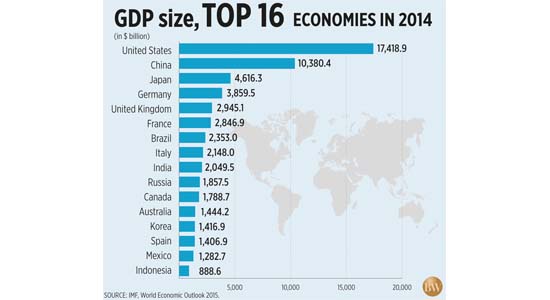
The magnitude of the stock price decline was $3.9 trillion, according to the Bloomberg China Market Cap index. That was equivalent to the GDP size of Germany, larger than the GDP sizes of UK or France or Brazil, and twice the GDP of Russia. 

Figure 2.

The bulk of China stock investors are the more than 90 million individuals who make up about 80% of the market, according to a survey of households.

The stocks crash was worse than the US property crisis in 2008-09, although in terms of global interconnection and contagion, the US financial turmoil last decade had a larger impact. Significant deterioration in the public debt of Greece, Spain, Portugal, Ireland, Cyprus, Italy, etc. occurred in 2009 and 2010, obviously a result of contagion from the US.

Compared to the Greece debt problem, this is much larger. Greece’s GDP size in 2014 was only $238 billion, and its total public debt was about $320 billion.

CENTRAL PLANNING FIGHTS BACK
China’s government responded with several measures. One, the central bank cut interest rates, hoping that more savings from the banks will go to the stocks market. Two, some stock traders and speculators were investigated with threats of prosecution for stock rumor mongering. Three, a number of planned initial public offerings (IPOs) were suspended. Four, outright stop in trading.

From Bloomberg reports:

“At least 1,301 companies have halted trading on mainland Chinese exchanges, locking up $2.6 trillion of shares, or about 40 percent of China’s market capitalization. The China Financial Futures Exchange raised margin requirements for sell orders on CSI 500 index futures, while the central bank will provide “ample liquidity” to the stock market. China Securities Finance Corp. said it will buy more shares of small- and mid-cap companies.” (July 8)

“Official measures to support shares became more extreme during the week as declines deepened. They include a ban on stockholders and executives from selling stakes in listed companies for six months, an order for companies to buy equities and an investigation by the nation’s public security bureau into short-selling.” (July 10)

LESSONS FOR SOUTHEAST ASIA
Emerging economies in the region like the Philippines can draw lessons from this latest episode in regional and global economics.

1 Moral hazards. When a central planning government rallied the public to invest in the market, many investors with little or zero experience in the market came believing they couldn’t lose money since the government is big enough to guarantee returns or bail them out later.

2 Adverse selection. Millions of new novice investors have picked up the wrong timing, at a time when fiscal uncertainty hounds the EU and China was experiencing growth slowdown. Adverse selection often results in adverse results.

3 Debts and uncertainty. As public and private debts become bigger and bigger, the economic uncertainty also becomes bigger. People will never know who can pay back and when, and who will default.

4 Corporate fundamentals. Investors should do hard analyses of the fundamentals of companies whose stocks they are buying, and not just wait for cues and pronouncements from government. It can be a case where as government intervenes more, it creates more panic and price volatility.

5 Central planning and central disappointment. Central planning cannot and will not cure and control everything, including stock price ups and downs, boom and bust. Central planning works mainly to postpone small busts to become huge busts and bursts. Authoritarianism can never be compatible with free markets.

6 Role of government. The state and its various agencies, from local governments to different regulatory agencies to monetary authorities, should focus on ensuring fair market rules rather than guaranteeing outcomes.

Bienvenido S. Oplas, Jr. heads a free market think tank in Manila, Minimal Government Thinkers, Inc., and is also a fellow of South East Asia Network for Development (SEANET), a regional center based in Kuala Lumpur advocating economic freedom in the region.
--------------

See also: 

Wednesday, October 15, 2014

Business 360 19: Investments and Inequality in Asia

* This is my article for this business magazine in Kathmandu, Nepal, October 2014 issue.
----------

Accumulated savings become investments. And these in turn expand economic output and create new jobs, or expand the productivity of those  who already have jobs. Such is the beauty of continued investments and savings accumulation.

In many recent social literatures though, including those coming from the multilateral institutions and foreign aid bodies, there is growing disapproval if not outright  contempt, of rising inequality within and among nations as they grow  faster, as they attract more investments and expand economic production. Thus, the repeated call for “inclusive growth”, previously called as “growth with equity” or “broad-based growth”.

To improve social equality within countries, some governments have erected various  restrictions to foreign  direct investments (FDIs). The Philippines for instance has that restriction in the 1986 Constitution itself, where in some sectors, foreign investments is totally prohibited while in some sectors, it is allowed up to 40 percent.

Such restrictions make some foreign investors find other ways to come in and do business. Like having local dummies, so foreign money is able to penetrate even  in sectors that is explicitly reserved for the local investors. But many foreign investors do not like that arrangement as it lacks transparency, and they cannot report to their shareholders and regulators in both home and host countries that they have invested in companies that are supposed to be 100 percent locally-owned.

The next route for foreign investors is via the stock market. Not all of such market capitalization is foreign-owned of course, there are also many local investors in each country. Here are the figures for major Asian economies.


Source: WB, World Development Indicators 2014, http://wdi.worldbank.org/table/5.4

North East Asia except N. Korea is generally developed. The economies there are able to attract plenty of domestic and foreign investments that create plenty of higher productivity jobs.

South East Asia generally are emerging economies, except Singapore which is already a developed economy, and the three catching up economies of Laos, Cambodia and Myanmar.

South Asia though remains not so friendly to the stock market system, except India. Nepal in particular is the least friendly or least attractive to investors in the stock market.

In terms of FDIs in South Asia, the levels remain very low on average, except for Maldives.

Figure 2. Average FDI Inflows to South Asia, 2000-2011, Percent of GDP


There is a need to encourage more investments, local and foreign, in stock market and FDIs, to Asian economies. Investments not only refer to money. They also include tools and machineries, technology and processes, research and development, managerial skills and marketing initiatives.

Social and economic  inequality is inevitable as people have different goals and ambitions in life, different network and exposure in business, use different technology and managerial styles. 

What is important is that opportunities should be available for the people so they can manage their lives and career. The business climate in Asian economies should become more friendly, more accommodating to investors, local and foreign. People can decide to be hardworking or lazy, be ambitious or complacent, if different jobs have become more available in their countries and communities.

The important subjects of growth and investments, inequality and justice, will  be discussed for two days this  coming November  6-7, 2014, during  the  Economic Freedom Network (EFN) Asia Conference 2014 to be held in  Hong  Kong. The event will be jointly-sponsored by the Friedrich Naumann Foundation for Freedom (FNF) and the Lion Rock Institute (LRI). FNF is a German political foundation spreading the ideas of (classical) liberalism, free market, human rights and rule of law while LRI is Hong Kong’s first free market think  tank.

This writer will attend this important conference. It is hoped that more participants from Nepal and South Asian nations will be able to come and hear the healthy and productive exchange of ideas and experiences among other participants from North- and South-East Asia, as well as their friends and network from  the US, Canada and Germany.
----------


Saturday, December 01, 2012

Fat-Free Econ 32: GDP Growth, Stockmarket and Rule of Law


This is my article yesterday in TV5's news portal,
http://www.interaksyon.com/business/49318/fat-free-economics--fearless-forecast-up-to-7-percent-growth-for-philippine-economy-in-4q
--------


The Philippines’ high third-quarter growth in its gross domestic product (GDP) is good news. In the six major economies within Asean, the Philippines with 7.1 percent trumped Indonesia, which grew 6.2 percent; Malaysia, 5.2 percent; Vietnam, 4.7 percent; Thailand, 3 percent; and Singapore, 0.3 percent. 

The question is, will this be sustained at least over the short run? Before answering this, let’s look at the sectoral composition of GDP to get an idea of their relative weights over the past several quarters.

The share of the agriculture, hunting, forestry and fishing (AHFF) sector continues to shrink, with only 10 percent of GDP. The industry (IND) sector also follows this trend but at a slower pace than AHFF. The manufacturing (MAN) sub-sector accounts for slightly higher than one-fifth of GDP.

It is the service sector (SER), particularly the trade and repair of various goods (TR) that continues to dominate the local economy. This implies that high growth in services, which constitute 58 percent of GDP, would mean faster overall GDP growth, even if there is slow growth in agriculture and industry.

Table 1 details the sectoral and sub-sectoral composition of GDP, where AF stands for the agriculture and forestry sub-sector; F, fishing; MQ, mining and quarrying; CNS, construction; EGWS, electricity, gas and water supply; TSC, transport, storage and communication; FI, financial intermediation; RERBA, real estate, renting and business activities; PAD, public administration and defense; and OS, other services.

sectoral


Source of basic data: National Statistical Coordination Board (NSCB).

Table 2 details growth by sector and sub-sector of the Philippine economy this year. Note the consistent drop in the share of fishing as well as of mining and quarrying this year.

The series of heavy flooding experienced in many provinces this year that damaged many aquaculture farms must have contributed to the shrinking in the fishery sub-sector. While the uncertainties in the mining sector, first with the major attacks by NPA rebels of several big mining companies in Mindanao, then the uncertainty over government policies contributed to the shrinking of this sub-sector.

growth


On a positive note, there was a huge jump in construction activities in the second and third quarters of the year, which significantly pulled up growth in the industry sector from 5.5 percent in the second quarter to 8.1 percent in the third quarter.

The consistent growth in the service sector plus its relative weight in the overall GDP is the main explanation why third-quarter GDP growth was high. Take note that the growth in all sub-sectors, except in public administration and defense, was consistent.

With this development, any fear of “boom and bust” in the short term is unwarranted. It is more of a modest boom at least in the next few quarters. The notable growth in the stock market points to a possibility that a 6-7 percent growth in the fourth quarter this year is in the cards.

Table 3. Stockmarket Growth in Asia, 2012

asian stocks

Source: Hans B. Sicat, The Philippines Stock Exchange Inc.: Regional Integration of Financial and Capital Markets in the ASEAN as presented at the 37th FAEA Annual Conference, November 29, 2012 held in PICC, Manila.

Things appear to be bright and sunny in the Philippine economy, at least in the short term. There are external factors that contributed to this development, particularly the high uncertainty in the business environment in both Europe and the US as a result of their huge public debt burden, resulting in some investors fleeing those markets, and putting their money in the Philippine economy.

Certain internal reforms towards promulgating the rule of law, more protection of private property rights, and a credible justice system should be continued and sustained so the Philippines can secure its future.
--------

See also:
Fat-Free Econ 28: Poverty, Planning and Populism, October 29, 2012
Fat-Free Econ 29: Anti-capitalism, Fanaticism and the Poor, November 13, 2012
Fat-Free Econ 30: BPOs and Obama, November 14, 2012

Sunday, November 13, 2011

Pilipinas Forum 20: Turbulence, Chaos Theory and the Stockmarket

Another long exchange here (12 pages) in pilipinasforum yahoogroups more than 9 years ago, on turbulence and chaos theory, applied to business and economics, the stockmarket especially. Enjoy!
---------


Turbulence, Chaos Theory and the Stockmarket
Feb 2002

Our friend Fidel Nemenzo sent me this one related to Dr. Muriel's lecture tomorrow evening at WSPC, AIM re. "the application of turbulence theory in stocks trading". Fidel obtained his PhD Math from Sophia U, Japan; he's the only number theorist in this country. He's teaching now at UP Diliman.
----------

Pards, mukhang interesting ang lecture ni Dr Muriel sa AIM. Dr Muriel is known for his ideas on turbulence, the nature of which is one of the main problems of chaos theory. One of the characters in Jurassic Park, Ian Malcolm, was a chaos mathematician. Jurassic Park was an example of a non-linear dynam ical system. Conventional (or the common-view) science (Newtonian) says that the physical world is a machine, governed by equations. If one knows these equations, and all the "initial conditions" in a a given system, just plug in these "conditions" into the equations and you can predict what happens to the system. This is what the creator of Jurassic Park believed: if you know all the "equations" what govern everything in Jurassic Park and the behavior of its creatures, plus the most accurate observations of the system, then you can predict everything that can possibly happen, and maintain control over it. Sabi ni Ian Malcolm mahirap yan, at halos impossibleng i-predict kung ano ang pwedeng mangyari. Chaos can arise out of the most "orderly" situations. Which is what happened.

The central goal of chaos theory is the study of systems that exhibit chaotic or "random" behavior. Parang may contradiction dito: the search for order within disorder. May tula si Wallace Stevens, " ... A violent order is disorder, and a great disorder is an order. These two things are one." This describes what happens in most natural systems. (Or even "social" systems, like a crowd. The most orderly crowd can metamorphose into an unruly mob in an instant, just as the perfect storm may just be over the horizon of the calmest sea.)

Another example of a "chaotic" system is the stock market, thus the growing interest in the mathematical theory of chaos among economists. Stock brokers and currency traders know that prices quoted in any financial market can change unpredictably. Huge volumes of money are made or lost in sudden bursts of activity. Classical mathematical models of finance cannot explain this behavior, for volatility is central to the behavior of financial markets. Which is why new explanations of market behavior are being sought using ideas from chaos theory. Or even fractals-- pero saka ko na lang ito i-e-explain.

The way fluid flows, or the behavior of a plume of smoke-- these contain both order and disorder. The term physicists use is turbulence-- which is chaotic and unpredictable. The study of turbulence is a key problem in physics. Conventional theories may be able to explain the smooth flow of water when the tap is turned on lightly. But nothing explains the turbulent flow of water when the tap is strong. Dr Muriel has proposed a theory which explains such behavior. I guess that's what he hopes to do in his AIM talk-- to shed some light on the volatility and unpredictability (turbulence!) of financial markets using his ideas on fluid flow. Both types of systems exhibit essentially the same activity. I can't go to the lecture; kwentuhan mo na lang ako.

- Fidel Nemenzo

Chaos theory may well become one of the most important theoretical fields in the 21st century (aside from relativity and quantum physics). I have been fascinated with how seemingly innocous changes in the initial conditions can have multiplier effects which are often complex and unpredictable. The most popular example is known as the "Butterfly Effect" in which the flapping of a butterfly's wings for example in Germany (I'm still in a thrall with the "butterfly" ending in "All Quiet on the Western Front" flick. Thanks Gina!) could cause miniscule atmospheric changes and which, given a time horizon could affect weather patterns in Pampanga. And think of how a very small change in testosterone level of an individual could trigger a nuclear war (ala Dr. Strangelove). So it could be like goodbye mankind, hello dinosaurs kind of thing.

Anyway, the latest experiment on the chaos theory involved sending a random signal to the Pioneer 10 spacecraft which is already in the edge of our solar system (before it will get blasted into smithereens by a Trekkie in the future, he he he). As Fidel pointed out, even the random dripping of a faucet has an order behind it. In other words, there's beauty in madness. or a method behind every madness.

- Glenn de Guzman