Showing posts with label Asia Liberty Forum. Show all posts

Saturday, February 24, 2018

BWorld 187, Asians’ freedom from high inflation and regulations

* This is my article in BusinessWorld on February 12, 2018.


“Bad times make good policy and good times make bad policy. If you want to introduce important reforms, wait for bad times and the politicians will listen to you.”
— Chatib Basri, former Indonesia Minister of Finance

That was among the important advice and reflections based on experience given by one of the keynote speakers in the recent Asia Liberty Forum (ALF) 2018 held in Mandarin Oriental Jakarta, Indonesia last Feb. 10-11. Dr. Basri spoke on “How to do Reform in an ‘Imperfect World’: The Case of Indonesia.”

The ALF is an annual liberty conference sponsored by the Atlas Foundation (US) and co-sponsored by other organizations and independent think tanks. In this year’s event, the local host and co-sponsor is the Center for Indonesian Policy Studies (CIPS), a great and dynamic free market think tank.

Dr. Basri is a friend since 2004 when I first attended the Economic Freedom Network (EFN) Asia Conference in Hong Kong in October 2004, sponsored by the Friedrich Naumann Foundation for Freedom (FNF) and co-sponsored by the Lion Rock Institute. I was impressed by his silent, cool, and reflective composure.

He became Finance Minister from May 2013 to October 2014 when the term of former Indonesian president Susilo Bambang Yudhoyono was completed. Upon his appointment, at least one Indonesian newspaper headlined “Free marketer becomes Finance Minister.”

He started his presentation with this quote from Jean Claude-Juncker, EU President:

“We all know what to do, we just don’t know how to get re-elected after we’ve done it.”

Other statements he made in the ALF2018 were:

“One reason Indonesians are religious is because of the Government. You submit your business application to the Government, then pray to God.”

“We failed to explain the benefits of free trade to the people. The success of Asia was the success story of globalization.”

“When political power is not favorable and limited, create a success story which enables the people to see and experience positive changes, pick one that is easy to implement but the marginal gain is high, then move to more complex reforms.”

“To help the poor, Indonesia liberalised rice imports. Prices fell.”

Another keynote speaker in day 1 was Suraj Vaidya, Chairman of the South Asian Association for Regional Cooperation (SAARC) Chamber of Commerce, also Chairman of the Samriddhi Prosperity Foundation in Nepal.

Mr. Vaidja quoted Frederic Bastiat’s famous line, “If goods cannot cross borders, soldiers will.”

That statement was true in the past, remains true in the present, and will be true in the future. Trade is the best global peace maker since people and goods crossing borders create goodwill among societies, discouraging criminals, terrorists, and prohibited substances.

Both Dr. Basri (introduced and interviewed by Rainer Heufers, CIPS executive director) and Mr. Vaidja (introduced and interviewed by Ronald Meinardus, FNF Regional director for South Asia) mentioned the role of free trade and free markets in fighting high inflation many goods and services that are unaffordable to the poor.

And this brings us to the issue of controlling high inflation in the continent.

Data from the last 12 years show that average inflation rate has been declining.

For the ASEAN 8 for instance, it went down from 7% in 2006-2010 average to 4% in 2011-2015 average, and only 2.4% in 2016 but slightly went up to 2.9% in 2017 (see table).
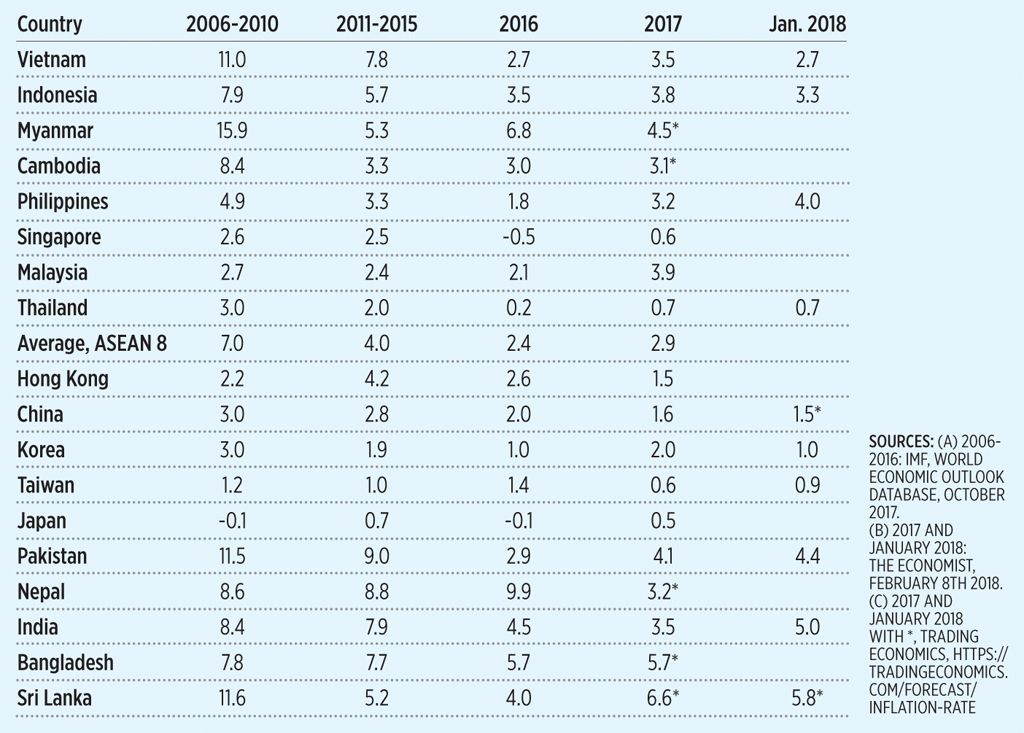


The rise in average prices in 2017 was partly due to the rise in world oil prices.

For instance, the West Texas Intermediate (WTI), a grade of crude oil used as a benchmark for pricing, went up from $43/barrel in 2016 to $51/barrel in 2017.

For the Philippines however, there was a spike in consumer prices in January 2018. From 3.3% in both November and December 2017, it went up to 4%.

Other countries with available data showed a decline in prices by January 2018 except in India (was already 5.2% in December 2017), Pakistan (4.6% in December 2017) and Taiwan (1.2% in December 2017).

So the Philippines is the “outlier” here, experiencing higher inflation when most neighbors have declining prices. Why?

The most proximate explanation is the TRAIN law signed in December 2017. While there is a decline in personal income tax rates, there are tax hikes in oil products, sugar tax, among others.

The Philippines is entering a period of increasing government intervention, taxation, and regulation. This is not good for the people and private enterprises.
 -------------

See also:

Friday, February 16, 2018

ALF 10, Conference 2018 in Jakarta, Indonesia

The Asia Liberty Forum (ALF) 2018 conference ended successfully last week. Venue is the beautiful Mandarin Oriental Jakarta, the hotel is facing the Jakarta Central circle, Thamrin. Plenty of participants from many countries. Hats off to Atlas and the Center for Indonesian Policy Studies (CIPS).


Opening remarks on Day 1 was given by Atlas President and CEO, Brad Lips (below) then Saidah Sakwan, Chairperson of CIPS.


Then the Cornerstone Talks with six speakers. From left: Amartuvshin Dorj (Mises-Mongolia),
Hizkia Respatiadi (CIPS), Eunhee Park (Teach North Korean Refugees/TNKR, S. Korea), Nila Tanzil (Taman Bacaan Pelangi, Indonesia), Terry Kibbe (Free the People, USA) as moderator, Barun Mitra (Liberty Institute, India) and Razeen Sally (LKY School of Public Policy, National University of Singapore; he's Sri Lankan). ALL good speakers.


Then the first Keynote address by Suraj Vaidya, Chairman of the SAARC Chamber of Commerce and Samriddhi Foundation, Nepal. He talked why free trade is good and will significantly reduce poverty in many developing countries.


 Suraj and FNF Regional Director for South Asia, Ronald Meinardus (3rd from right) flanked by participants an speakers from India, Nepal, Afghanistan, US. Ronald introduced Suraj, then interviewed him on stage.


Some of the nearly 300 participants.


Among the pretty faces in the crowd, a local participant.


A photo with Adinda Tenriangke Muchtar (Suara Kebebasan, Indonesia) and Pett Jarupaiboon (EFN-Asia, FNF, Bangkok, Thailand).


More pics to follow...
(All photos I got from the Atlas fb page)
--------------

See also:

Wednesday, January 31, 2018

BWorld 182, Asia Liberty Forum 2018 in Jakarta

* This is my column in BusinessWorld last January 22, 2018.


“There is no evidence that fuel and electricity subsidies benefited the poor. There is no evidence that trade protection benefited the poor. Elimination of subsidies if compensated by reduction of cost doing business (corruption) will help the poor.”

— Muhamad Chatib Basri,
presentation about Indonesia energy and food subsidies,
EFN Asia conference September 2004, Hong Kong

Those conclusions were made by Dr. Chatib “Dede” Basri in his presentation, “Can subsidy and protection do any good for the poor?” at the Economic Freedom Network (EFN) Asia conference in 2004. At that time, he was a faculty member of the University of Indonesia and individual member of EFN. He used an econometric model and the Grosman and Helpman (G-H) model (trade protection is the result of bargaining between government and various lobby groups). The inevitable conclusion of his paper was that market reforms and the reduction, if not removal of dependence by the poor on the state will actually help them and taxpayers over the long term.

Dr. Basri later became Minister of Finance from May 2013 to October 2014 when the administration of Indonesian President Susilo Bambang Yudhoyono ended. Dr. Basri will be among the keynote speakers in the Asia Liberty Forum (ALF) this coming Feb. 10-11 at Mandarin Hotel Jakarta, Indonesia. The event is sponsored by the Atlas Foundation and co-hosted by the Center for Indonesian Policy Studies (CIPS).

Aside from Dr. Basri, other important speakers in this year’s conference will be the following:

1. Saidah Sakwan, chairwoman, CIPS; also a commissioner of the Indonesian Business Competition Commission (KPPU).

2. Brad Lips, CEO of Atlas Network, Washington DC, USA.

3. KH Yahya Cholil Staquf, general secretary of Nahdlatul Ulama (NU) Supreme Council, world’s largest Muslim organization with 50+ million members.

4. Siegfried Herzog, Regional director for Southeast and East Asia, Friedrich Naumann Foundation for Freedom (FNF), Thailand.

5. Suraj Vaidya, chairman of SAARC Chamber of Commerce and also chairman of Samriddhi Foundation, Nepal.

6. Rainer Heufers, executive director of CIPS.

7. Razeen Sally, Prof. at Lee Kuan Yew School of Public Policy, National University of Singapore.

8. Ronald Meinardus, Regional director, FNF South Asia, India.

9. Parth Shah, president of the Centre for Civil Society, India.

10. Lorenzo Montanari, exec. director of Property Rights Alliance (PRA), Washington DC, USA.

11. Barun Mitra, founder and Director of Liberty Institute, India.

12. Junjie Ma of Unirule Institute, Beijing, China.

There are many other interesting speakers to talk on many topics — policy reforms to broaden support for classical liberal principles, education policy, Ease of Doing Business Index, Protection of private property rights, Intellectual Property Rights (IPR), micro-enterprises, entrepreneurship in e-commerce, state-owned enterprises (SOEs).

Are Asian economies getting more market-oriented or state-distorted? Is there greater rule of law now or greater rule of men? Are public institutions more protective or more confiscatory of private property rights?

There are many studies and annual reports that track and monitor various indicators and parameters to help answer these and related questions. Among the important annual reports are Fraser Institute’s Economic Freedom of the World (EFW) reports, Heritage Foundation’s Economic Freedom Index (EFI), PRA’s International Property Rights Index (IPRI), World Bank’s Doing Business, and World Economic Forum’s (WEF) Global Competitiveness Index (GCI).

The GCI is composed of 12 pillars and the first pillar are Institutions. These are composed of 21 sub-pillars like property rights, IPR protection, diversion of public funds, public trust in politicians, irregular payments and bribes, judicial independence, favoritism in decisions of government officials, burden of government regulation, efficiency of legal framework in settling disputes and challenging regulations, transparency of government policy making, and reliability of police services.

I checked the latest WEF 2017-2018 report for East Asian economies and compared with the report two years ago for pillar #1, Institutions (see table).

So for Institutions, the numbers above show three important results: One, out of the 144 countries and economies covered, many East Asian nations land in the first half (i.e., 1st to 72nd), 11 of the 15 economies mentioned above. Singapore and Hong Kong are in the top 10.

Two, the biggest gainers in global ranking are India (+21!), South Korea, China, and Laos. And three, the biggest loser in ranking is the Philippines, dropping 17 places or notches.

In the WEF Executive Opinion Survey 2017, the most problematic factors for doing business in the Philippines were: (1) inefficient government bureaucracy, (2) inadequate supply of infrastructure, (3) corruption, (4) tax regulations, and (5) tax rates.

For Asian countries outside the first half like Thailand, Vietnam, Philippines and Cambodia, there is an immediate need to improve the rule of law and further debureaucratize, deregulate and depoliticize the economy.
-------------

See also:

Wednesday, March 01, 2017

BWorld 112, Asia Liberty Forum 2017 in Mumbai

* This is my article in BusinessWorld last February 15, 2017.


Mumbai, India -- The title of this piece is from JP Narayan of the Lok Satta Party in India, who made that comment during the Asia Liberty Forum (ALF) that was held from Feb. 10 to 11, 2017 in Mumbai.

That remark seems to apply in many countries where the rule of law is weaker and the rule of men -- especially those in charge of several forms of regulations -- are stronger. These are the types of people who also impose restrictions and prohibitions on their political enemies and ordinary folk but exempt themselves, their friends, supporters, and families.

Below are other insightful quotes and comments from other speakers during the ALF. The conference was jointly sponsored by the Center for Civil Society (India), Atlas Network, John Templeton Foundation, Smith Family Foundation (USA), and the Friedrich Naumann Foundation for Freedom (Germany).

1. “The word ‘Freedom’ has been lost because we mean ‘freedom from’ while an enormous number of people mean ‘freedom to.’” -- Linda Whetstone, Network for a Free Society (UK).

That quote is correct and the confusion may be rooted from the common definition of freedom as “freedom from coercion” (by the State or government, clan, church, gang, etc.) and is similar to Friedrich Hayek’s definition of liberty as “absence of coercion.” Linda also added that “Trade and exchange is not a zero sum game... both sides can be better off.”

2. “Inequality is not the issue; what bothers people is the ‘psychological threat to my perceived status.’” -- Tom Palmer, Atlas Network.

Again, I agree.

Take note that free people are not equal and equal people are not free. Freedom allows people to be super-efficient or be super-mediocre or absolutely irresponsible in their own lives. This personal decision automatically results in material inequality among people. The only equality that matters is equality before the law, or the equal application of the law on unequal people. Thus, the law against robbery should apply to all, from the President to the richest people to middle class, down to the poorest people.

3. “What we have in India is a PPP -- Perpetually Planned Poverty” -- Rajesh Jain, Free a Billion (FAB).

This is a funny but brutal parody and satire of an otherwise famous catchword in the Philippines and other countries of PPP (Public-Private Partnership) for big infrastructure projects. Rajesh was referring to various laws and restrictions by the government of India that he also called as “like air, it is all around you in India.”

4. “Top communist individuals in this country come from the upper class of society... Capitalism and Caste cannot coexist.” -- Chandra Bhan Prasad, a public intellectual and commentator, India.

He is referring to the various privileges and perks that cronies and state-protected corporate interests enjoy but are withheld from the rest of society. This is true because competitive capitalism is driven only by endless innovation and is anathema to state protectionism.

5. “Demonetization is the biggest assault on property rights in India... Nehru nationalized industries, Indira nationalized banks, and Narendra Modi nationalized private cash holdings.” -- Barun Mitra, Liberty Institute, India.

In November 2016, the Modi government pursued demonetization, a policy to remove all 500 and 1,000 (about $15) rupees from circulation to supposedly curtail the huge black market economy and counterfeit currency that funds illegal activities. These are exactly the currencies that hundreds of millions of poor Indians hold because of their low income and government has disallowed use of these. Very autocratic indeed.

6. “Globalization of capital is the most liberating force particularly for the poor.” -- Christopher Lingle, Universidad Francisco Marroquin, Guatemala

Contrary to common belief that globalization only favored big capitalists and businesses, globalization has benefitted the poor more in the form of (a) being employed locally by foreign investors that were otherwise prevented from coming in, (b) being employed abroad as they were assigned by their multinational firms or being hired by competing foreign firms, (c) being stockholders through time of both local or foreign firms as enterprise competition intensifies.

7. “Regulatory focus is to tap down on innovation because nobody understands something new. Lack of rule of law leads to adverse selection. Legitimate firms exit, leaving only bad actors.” -- Susan Thomas, Indira Gandhi Institute for Development Research, India.

This is true. The implicit or explicit purpose of regulation is to limit and restrict innovation that can lead to business disruption and more income inequality. Some regulations simply kill innovation and we do not see or realize it because it was not initiated in the first place. Lack of rule of law means high rule of men; only friends and cronies of rulers will prosper while the non-cronies will remain small or exit the market.

8. “There is a messianic belief among regulators that if there is any money made in India it must be taxed. Also underlying core belief among regulators that India is the fastest growing economy so the world owes us investments.” -- Sudeepto Deb, Minerva Consulting, India.

This attitude by regulators of tax-tax-tax whenever there is perceived new income seems to apply in many other countries too. Former US President Ronald Reagan has a good summary of this when he said: “If it moves, tax it; if it keeps moving, regulate it; if it stops moving, subsidize it.”

9. “There are only two political philosophies: liberty and power.” -- Simon Lee, cofounder of Lion Rock Institute, Hong Kong.

Ultimately, yes. It is a battle between state-worshippers and regulators and the public or regulated parties who want more economic freedom. There are in-betweens of course, like people who move from the regulated to becoming regulators and vice versa.

There were many other useful comments and ideas during the conference but there is not enough space for this column. I am simply thankful to the Economic Freedom Network (EFN) Asia for giving me the travel grant to attend the event.


Bienvenido S. Oplas, Jr. is the head of Minimal Government Thinkers and a Fellow of SEANET. Both institutes are members of EFN Asia.
----------------

See also:

Sunday, February 19, 2017

ALF 9, Conference 2017 in Mumbai, India

The Asia Liberty Forum (ALF) is an annual 2-days conference jointly sponsored by the Atlas Network (US), Center for Civil Society (CCS, India) and the Friedrich Naumann Foundation for Freedom (FNF, Germany). Five ALF events so far from 2013-2017 and I have attended the last 3 -- 2015 in Kathmandu, Nepal; 2016 in Kuala Lumpur, Malaysia; and 2017 in Mumbai, India.

Some photos of the ALF 2017 last week, February 10-11 held at The Leela Mumbai Hotel. Below, Baishali Bomjan, a superwoman at the CCS, formally opening the conference on Day 1.


Speed networking, a traditional Atlas conference activity where participants introduce to each other one on one for 2 minutes, then move to the next person in front. Notice the background, "Freedom" translated in various Asian languages.


About 250 people registered, some they come and go. About 200 max at any one time.


Among the tweets on Day 1 under the hashtag #AsiaLF17:

"Trade and exchange is not a zero sum game ... both sides can be better off"…

"When you have free markets & property rights, you open up lot of opportunities" - Linda Whetstone

"After the collapse of the Soviet Union, we were intoxicated, thinking that our ideas had won...
I am a free market fundamentalist, I am also a democratic fundamentalist....
Populist trends did not happen on their own, they have been rising over the last ten years.... 
There is a huge political convergence that has taken placeThe traditional left and right agree on one point- use the state." -- Barun Mitra


Why #property rights matter for #India's poor: Give them rights and they turn rocks into a garden. -- #liberal activist Ambrish Mehta

One more #liberal bonmot: "Government is like air, it is all around you in #India." -- Rajesh Jain @freeabillion 

"Technology equalises power of communication and lowers role of money ... there would be no Tea Party without Facebook... "Every human being is fundamentaly a #liberal at heart. #Freedom is built into our DNA." -- Matt Kibbe @mkibbe

"why do we still turn our backs to private schools despite data that these schools are preferred choice for many?" -- Brajesh Mehra


Our panel on Deregulation, 4pm of Day 1.


From left: Vivek, Syed Mizanur, Seetha, Alex, me.

"Incentives for politicians have to be changed; data doesn't support reelection for good eco stewardship" --  Vivek Dehejia

"Standardised containers did more to reduce trade costs than lowering trade tariffs…  Exits are important for Liberty because it disciplines firms." Alex Tabarrok


My 19-slides presentation, Electricity deregulation and re-regulations in Asia, Philippines in particular.

My article in BusinessWorld last February 15 about the ALF17, The public sector is the private sector of those in public offices. It is reposted at the EFN Asia website.

A good keynote speech during the farewell dinner, Day 2 of ALF given by Amit Varma, The landscape of freedom in India.

Thanks to Simon Lee for this photo, with Parth Shah, President of CCS. I met Parth for the 1st time in April 2004 during the Mackinac Leadership Conference in Michigan conducted by Lawrence Reed, Joe Lehman, other great Mackinac guys. Andrew Work, Ellen Sandig Cain, Manali Shah were also our batchmates in that great conference. Andrew is represented in this photo by Simon who was 1 of 3 co-founders of the The Lion Rock Institute in HK.


Below: standing are me and Barun Mitra. Seated are Mohit Satyanand and Julian Morris. In June 2005, the International Policy Network (IPN, UK) organized the Global Development Forum in London, a conference in support of more free trade, less aid. It was held 2 weeks before the G8 summit in Scotland where the main agenda was more foreign aid (or simply more govt to govt aid) to "make poverty history". IPN Exec Dir then was Julian, I and Mohit Satyanand were 2 of about 6 speakers.


Flashback 2014, EFN Asia Conference in HK. Parth, Andrew and me, batchmates in Mackinac Conference 2004. Barun joined us.


I am very thankful to EFN Asia for providing me the travel grant to attend ALF 2016 (KL) and ALF 2017. Thank you Pett, Siggi. My attendance of ALF 2015 (Kathmandu) was courtesy of Media 9/Business 360, thank you Charu; and partly by Samriddhi, thank you Robin.
-----------

See also:

Thursday, February 16, 2017

BWorld 109, Asians' march to liberty and progress

* This is my article in BusinessWorld last January 30, 2017.


“Progress by its very nature cannot be planned. It is knowing what we have not known before that makes us wiser men... Progress is movement for progress’ sake, for it is in the process of learning, and in the effects of having learned something new, that man enjoys the gift of his intelligence.”

-- Friedrich Hayek, Chapter 3,
“The Common Sense of Progress,”
The Constitution of Liberty (1960)

Many Asian societies have experienced economic and social upheavals and ups and downs in growth and political stability for more than the past two decades. These have been expected because people aspire for improvement and, as a result, they demand change.

After going through these upheavals, societies emerge somehow stronger, better, and more dynamic.

There are many indicators of growth and development and among them is the ability of the people in developing Asian economies to (a) travel by plane, (b) buy new models of mobile phones for communication and information, and (c) have access to the Web and the Internet.

Below are the numbers for selected Asian economies, grouped into three: (1) developing north and south Asia, (2) developing South East Asia, and (c) developed Asia plus Australia. For purposes of brevity, countries with small populations, those three million and below -- Bhutan, Brunei, Maldives, Mongolia -- are excluded from this list (see table).


The above numbers show the following:

(1) The pace of expansion in mobile phone subscriptions and Internet use in developing economies has been very fast over the past decade and a half, especially for India, Bangladesh and Nepal; Cambodia, Laos, Myanmar and Vietnam (CLMV). As a result, people now can learn new and more skills, or simply be regularly connected with their families, clans, and friends.

(2) The same pattern can be seen in air travel, as indicated by the number of airline passengers in the region. Indonesia and the Philippines experienced fast rate of growth in this area, along with China, India, and CLMV.

(3) Expansion in developed Asia + Australia is muted and modest compared to their developing neighbors.


Therefore, Hayek is correct in his observation about human progress. It is the less-planned and less socially-engineered economies that are experiencing faster improvement at least in these three indicators. This is partly because the developed economies are dealing with plenty and rising government regulations that tend to restrict faster growth.

The subject of human and social progress in Asia will again be discussed in the forthcoming “Asia Liberty Forum” (ALF) in Mumbai, India, Feb. 9-11. This big international conference will be jointly sponsored by the Center for Civil Society (India), Atlas Economic Research Foundation (USA) and the Friedrich Naumann Foundation for Freedom (FNF, Germany).

Among the important topics to be discussed will be (a) overview of what’s happening in the freedom/liberal movement around the world and Asia, (b) State, private sector and liberty in a digital world, (c) Regulations for a prosperous and innovative market economy, (d) Property rights as a human right, and (e) Education of choice for all: the role of budget private schools.

The Economic Freedom Network (EFN) Asia is also participating by sending some of its regular and long-time partners in the region to the ALF. Aside from holding its own annual EFN Asia Conference, EFN is also participating in the annual ALF and the Jeju Forum for Peace and Prosperity in South Korea.

Through continuing involvement in these three important regional and global annual meetings and conferences, EFN Asia is doing its share in securing a more prosperous, more developed Asia through the path of less government planning and more market competition, deregulation, and innovation.


Bienvenido S. Oplas, Jr. is the head of Minimal Government Thinkers and a Fellow of SEANET. Both institutes are members of EFN Asia.
---------------

See also:

Saturday, March 19, 2016

ALF 8, Toast to Douglas North

During the Asia Liberty Forum (ALF) last February 18-20, 2016 in Kuala Lumpur, one session at the Freedom Dinner was a toast to the "Lost Heroes of Liberty". These are known free market and freedom leaders who passed away in 2015, and few years ago in the case of Aslam Effendi. Baishali Boomjan of the Center for Civil Society (CCS, India), among the key organizers of the conference, asked me to be one of the presenters, I accepted.

The presenters that night and the lost heroes they briefly discussed (about 3 minutes toast) were:

Kumar Anand: S. V. Raju
Nonoy Oplas: Douglas C. North
Manoj Mathew: Sharad Joshi
Deependra Chaulagaon: Bhola Nath Chalise
Tom Palmer: Whitney Ball
Terry Kibbe: Andrew Coulson
Ali Salman: Aslam Effendi​

Below was my short discussion about

Douglas North’s contribution to free market economics

Douglass North was an American economic historian who shared the 1993 Nobel Prize in economics with Robert Fogel. The Prize was given “for having renewed research in economic history by applying economic theory and quantitative methods in order to explain economic and institutional change.”

He died on November 23, 2015 at age 95.” Fogel died in 2013.

North asked how it is that some countries rich while others remained poor. Thus his contribution was he “Shed new light on the economic development in Europe and the United States before and in connection with the industrial revolution. He emphasized the role of property rights and institutions.”

According to the Royal Swedish Academy of Sciences, North "has pointed out that economic, political and social factors must be taken into account if we are to understand the development of those institutions that have played a role for economic growth and how these institutions have been affected by ideological and non-economic factors."

In the 70s, North advanced the notion that institutional structures, especially how property rights are handled within a society, made a considerable difference in that society's economic well-being. Institutions are the basic rules of the road in an economy, including formal systems, such as constitutions, laws, taxation, insurance, and market regulations, as well as informal norms of behavior, such as habits, customs, and ideologies. This field of study came to be called “the new institutional economics.”

North showed that England and the Netherlands industrialized more quickly because the guild system, which imposed restrictions on entry and work practices in various occupations, was weaker in those two countries than in other European countries.

Let me illustrate North’s contribution with this graph.


Property rights are among the key words of D. North's ideas. "Property lefts" is just my invention to highlight the importance of property rights protection.

I don't have any picture in that session. Anyway, the session was followed by a Freedom Speech by Parth Shah, President of CCS. He discussed about individual's political choice in the government budgeting system.

-------------

See also:
ALF 6, Panel discussion on property rights, February 23, 2016

ALF 7, Panel on TPP, RCEP and other RTAs, March 18, 2016

Tuesday, February 23, 2016

ALF 6, Panel discussion on property rights

The 4th Asia Liberty Forum 2016, #AsiaLF16, has successfully ended in Kuala Lumpur last Saturday night. Among the important panel discussions was the one on “Protecting Yourself Against Daylight Robbery -- Current Challenges to Property Rights”.

Photo below, holding the microphone is Wan Saiful Wan Jan, CEO of IDEAS Malaysia, who chaired the discussion. The speakers from left:  (1) Lorenzo Montanari of Property Rights Alliance (PRA), Washington DC, USA; (2) Barun Mitra of Liberty Institute, India; (3) Kriengsak Chareonwongsak of the Institute of Future Studies for Development, Thailand; and (4) Julian Morris of Reason Foundation, USA.


Lorenzo spoke about the International Property Rights Index (IPRI) annual reports, especially the latest, 2015 Report.


Barun talked about fighting for property rights of poor rural workers and households in their tilled land in India.


Julian talked about IPR, especially of trademarks and company branding. His paper title was witty, "Marks vs. Marx", the former refer to trademarks, the latter refer to IPR confiscation and stealing/socialization.


Among the slides shown by Julian. An example of a medicine whose products and corporate brand/logo was copied and stolen to sell substandard or fake medicines, which can have serious or even fatal consequences to patients.

Plain packaging of cigarettes, the logo and brands of Winfield and Marlboro were removed, only their product name is displayed. Further below, when plain packaging is applied on softdrinks/soda and beer.


I don't smoke, never smoked my entire life, I derive zero pleasure in smoking, but I respect other people's decision to smoke. It's their life, their body, they can do whatever they want with their life so long as they do not harm other people, like puffing heavy smoke in an enclosed room with many non-smokers inside.

I think people should not smoke, but if they decide to smoke because they derive some pleasure in smoking -- the same way that I derive pleasure in drinking with friends, frequently when I was still a bachelor, and seldom now with a family and 2 young girls -- then their freedom to choose which cigarette products or brands to take should not be curtailed by the government.

After all, the government is a huge hypocrite institution that says "promote public health, discourage smoking and drinking" on the left hand, then happily and gleefully collects billions of pesos or dollars of "sin tax" revenues every year from more smokers on the right hand.

Meanwhile, I am thankful again to EFN Asia and FNF regional office for giving me a travel grant to attend the 4th ALF. Thanks Siggi, Pett, Jules.
--------------

See also:

Saturday, February 20, 2016

BWorld 45, Asia Liberty Forum and property rights

* This is my article in BusinessWorld yesterday.


 The classical liberal philosophy of more individual freedom and more personal/parental responsibility, free market and less government intervention and taxation is not a popular personal and political philosophy in Asia yet, at least compared to similar movements in the US and Europe.

So annual events like the Economic Freedom Network (EFN) Asia conference, and now the Asia Liberty Forum (ALF), are very helpful in asserting the virtues of classical liberal, aka “libertarian” or “free market” philosophy. This concept is vastly different from other labels like “neo-liberal” and “US conservatism”.

The three-day 4th ALF event is held here in Renaissance Hotel Kuala Lumpur, Malaysia. This is a huge international event from Feb. 18-20 with many participants from Asia, US, and Europe. The main sponsors of this year’s conference are the Atlas Economic Research Foundation in Washington DC, the Center for Civil Society (CCS) in Delhi, India, and the Institute for Democracy and Economic Affairs (IDEAS) in Malaysia.

Among the important panel discussions in the conference will be on “Protecting Yourself Against Daylight Robbery -- Current Challenges to Property Rights” on Day 3. The session will be chaired by Wan Saiful Wan Jan, CEO of IDEAS Malaysia. The speakers will be (1) Barun Mitra of Liberty Institute, India; (2) Kriengsak Chareonwongsak of the Institute of Future Studies for Development, Thailand; (3) Julian Morris of Reason Foundation, USA; and (4) Lorenzo Montanari of Property Rights Alliance (PRA), Washington DC, USA.

The protection of private property rights is among the hallmarks of a free and dynamic society. If other people can say that “Your car is also mine; your house is also mine; your farm is also mine. I can enter and use them anytime I want,” then society can easily degenerate into chaos and disorder. No meaningful economic growth and social development can happen in this type of environment.

The PRA has developed the annual International Property Rights Index (IPRI). The index is composite for a country’s performance in three areas: (a) legal and political environment, (b) physical property rights protection, and (c) intellectual property rights (IPR) protection. The scores range from 1 (poorest) to 10 (best).

I made a short study about the performance of some ASEAN countries in terms of property rights protection covering eight years from 2008 to 2015. Singapore and Malaysia continue to have high scores overall in property rights protection. The Philippines made a modest improvement in its global ranking, from 87th in 2011 and 2012 (out of 130 countries), it jumped to 77th in 2013 and 65th out of 129 countries in 2015.


If we observe the Philippines, the bulk of property rights protection -- in malls and shops, hotels and restaurants, banks and condos, schools and universities, airports and seaports, etc. -- is heavily privatized through the tens of thousands of private security agencies. It is not the police or army or barangay security personnel who guard and protect these businesses and residential, commercial areas, despite the huge and multiple taxes and fees that people pay to the government annually.

And this is an indicator that governments often forget their main purpose, their raison d’etre, which is the protection of the people’s right to life (against bullies and murderers), right to private property (against thieves, vandals and destroyers of property) and right to self-expression (against dictators). To have a rule of law.

When governments are busy giving away endless welfarism and subsidies, collecting endless taxes and fees, imposing endless regulations and restrictions, running banks, casinos, TV stations, and other businesses, there is a tendency to set aside its rule of law function and it is unfortunate.

Government should be big enough in enforcing laws on private property and citizens protection, and it should be small enough in intervening too much in the people’s daily lives, hence requiring small and few taxes to sustain itself.

Bienvenido S. Oplas, Jr. heads the Minimal Government Thinkers, a member of Economic Freedom Network (EFN) Asia, and a Fellow of the South East Asia Network for Development (SEANET). minimalgovernment@gmail.com
---------------

See also:
BWorld 44, Why the Philippines should join the TPP, February 19, 2016 
ALF 5, Meeting of Property Rights Alliance in KL, February 19, 2016

Saturday, January 09, 2016

ALF 4, Conference 2016 in Kuala Lumpur

Aside from the Economic Freedom Network (EFN) Asia annual conferences, the second biggest annual event for free market leaders, scholars and advocates in the region is the Asia Liberty Forum (ALF). Good opportunity to meet many like-minded people in the region plus friends from the US and Europe.


Main sponsors this year are the Institute for Democracy and Econ. Affairs (IDEAS) in Kuala Lumpur, Atlas Economic Research Foundation in Washington DC, and Center for Civil Society (CCS) in Delhi.

The 1st and 2nd ALF in 2013 and 2014 were held in Delhi, India. The 3rd ALF in 2015 was held in Kathmandu, Nepal. This is the 4th ALF2016 and first time it will be held in South East Asia.

Good lineup of speakers, including Parth J Shah and Baishali Bomjan of CCS, Wan Saiful Wan Jan and Tricia Yeoh of IDEAS, Razeen Sally of NUS, Singapore, Ali Salman of PRIME, Pakistan, Tom G. Palmer of Atlas, Eamonn Butler of Adam Smith Institute in UK, and Leon Louw of Free Market Foundation, S. Africa.

Also Rainer Heufers of the Center for Indonesian Policy Studies (CIPS), Andrew Shuen of Lion Rock Institute in HK, Arpita Nepal and Robin Sitoula of Samriddhi Prosperity Foundation in Kathmandu.

I suggested a panel discussion about labor migration in Asia.  CIPS is producing a long paper on labor migration, although the focus is on the experience of the Philippines and Indonesia, the panel can be broadened to other countries, include also a discussion on refugees in Europe. So 4 possible speakers, one each from CIPS-Indonesia, from China, India and Germany.

China and India are the biggest recipients of overseas remittances annually, they also have the biggest number of overseas workers and professionals worldwide. The speaker from Germany can talk about the impact of huge number of refugees on the labor market there and the rest of Europe.

Congrats to the three think tanks -- IDEAS, CCS and Atlas -- for this great initiative.
------------

See also:

Tuesday, January 20, 2015

ALF 3: Photos with Friends, Kathmandu Conference

More photos here during the 3rd Asia Liberty Forum (ALF) held at Soaltee Crowne Plaza, Kathmandu, Nepal, last January 8-10, 2015.

Charu Chadha of Media 9 in Kathmandu, publisher of Business 360 monthly magazine of which I am one of their columnists, sent me today our group photo. From left: Casey Lartigue of Freedom Factory Ltd. (Seoul, S. Korea), Charu, me, Cong Minh Nguyen (doimoi.org, Hanoi, Vietnam). Casey represented Dr. Chung-ho Kim, President of Freedom Factory, who was with us in the small  group roundtable discussion on "The Constitution of Liberty in Asia" held in Phuket, Thailand, October 2005.


Marc Abela, center, also posed with me and Minh, he represented Mr. You and Yoshida Hiroshi of the Japanese for Tax Reforms (JTR) and Institute for Free Economy (IFE), respectively. Mr. You and Hiroshi were also with us in Phuket in 2005.


Another photo with Minh and Charu. Haaaaa, we were relieving the past. :-)


Ok, here's one of our group photos in Phuket in 2005. This was during the Economic Freedom  Network (EFN) Asia conference, a day after our roundtable discussion. From left: Simon Lee (Lion Rock Institute, Hong Kong), Mr. ____ (Association for Liberal Thinking, Turkey), Chung-ho Kim (then with Center for Free Enterprise, Seoul), Colleen Dyble (Atlas, USA), Mr. You (JTR, Japan), Charu, me, and Yoshida Hiroshi (IPSA, IFE, Japan).


Another photo. Leon Louw holding a camera (Free Market Institute, S. Africa) and Mohit Satyanand (Liberty Institute, India). That was nearly 10 years ago.


More photos during the 3rd ALF. From left: Peter Wong (LRI, Hong  Kong),  Jadranco Brkic (Bosnia), Randy Hencken (Seasteading.org), me. Randy discussed the concept of seasteading, people who want small and limited government wanting to create their own country on the sea, outside the political jurisdiction of any existing country although within the EEZ. It's a bright and revolutionary idea.


From left: me, Cindy Cirquetela (Atlas, USA), Linda Whetstone (Network for a Free Society, UK) and Xingyuan Feng (Unirule, CIPA, Beijing, China). Atlas and NFS, along with FNF South Asia regional office, provided lots of logistical and financial support for that conference.


From left: Bican Sahin (Freedom Research Association, Turkey), me, Gulmira Aidaralieva (Central Asian Free Market Institute/CAFMI, Kyrgyz Republic), _____ also of CAFMI, and Ruki Fernando (Human Rights activist, Sri Lanka).


The Executive Director of Samriddhi Prosperity Foundation, Robin Sitoula. Robin is a friend since about 7-8 years ago. Samriddhi  is the local host that co-sponsored with the Asia Center for Enterprise (ACE) in holding  the 3rd ALF. Great job, fantastic conference, Robin and Samriddhi guys. Congratulations once again.


On the 2nd night  of the conference, after the speeches and before dinner, there was a short song number, it was lively, I pushed Arpita Nepal (lady in white dress on the left), wife of Robin and Director for Research of Samriddhi, to a snake dance. Many participants followed and formed a long snake dance :-)  Man holding the microphone  was the  one  who  sang the  lively song.


Miscellaneous photos: with Wan Saiful Wan Jan (IDEAS, Malaysia) and Barun Mitra (Liberty Institute, India), Adinda Muchtar (Indonesia Institute, Jakarta) and Miho Mochizuki (JTR, Tokyo).


Many thanks again, ACE and Samriddhi, for that wonderful conference.

Special thanks to the following: (1) Media 9/Business 360 for sponsoring my plane fare, (2) ACE/Samriddhi for sponsoring  my 4 nights hotel accommodation, and (3) EFN Asia for sponsoring my related expenses (PH travel tax, Nepal visa fee, etc.).
------------

See also: 
Asian Liberty Forum 2015, Kathmandu, January 07, 2014 

ALF 2: Opening Dinner Program, January 09, 2015