Showing posts with label Chamber of Mines of the Philippines. Show all posts

Thursday, September 17, 2015

Mining 44, Presentation at the Mining 2015 Conference

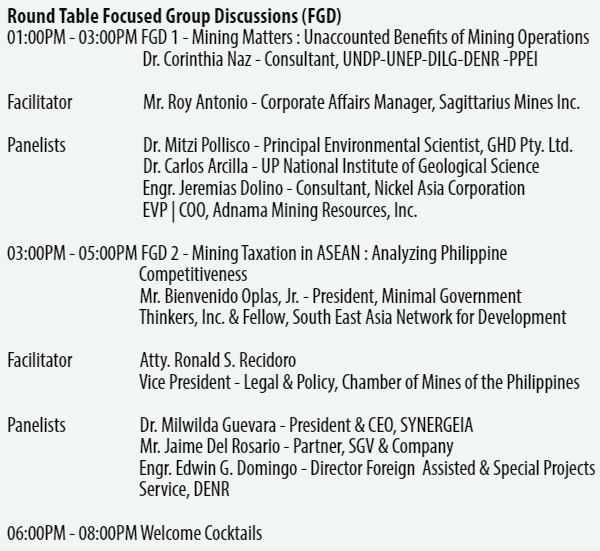
Last Tuesday, September 15, I was one of the speakers during the opening day of the 3-days Mining Philippines 2015 Conference, held at the Grand Ballroom of Solaire Resort Casino Manila. Good audience, perhaps about 200 people.


Opening speeches in the morning, then two focused group discussions in the afternoon. We were on the 3-5pm slot.

This is my presentation, 28 slides total, showing 7 of them here.

After showing various tables on comparative taxation in the region, I asked the audience of this question. About 4 hands were raised to say True, none raised hand to say False, the majority just waited for me to answer my own question.


The 3 pitfalls are (a) deadweight loss, (b) declining revenue in a Laffer curve, and (c) non-recognition of the  "multiplier effect" of mining as raw materials.


I discussed the  various bureaucracies in the power/energy sector, and  the  mining sector, the multiple taxes, royalties, fees, mandatory spending such as SDMP, and yet...


Reflecting  on those tables shown earlier...

I showed 4 annexes -- mining taxation in Vietnam, Indonesia, China, and this proposal.

My full presentation is available in slideshare and in dropbox.


The UP Miners, an organization of Mining Eng'g undergrad students in UP Diliman, made this photo and posted it in fb. Thanks Niel and all.


Meanwhile, I like these comments from two friends, Yani and Raul.

Bayani Camitan: noy, we have very much potential in this industry. in fact mining industry was a significant (if not today in the future) contributor to GDP. but then again, it is sad to say that government support is lacking and related policy is unclear. for one, we have as u may know Surigao (which is partly known for surfing) is the so-called "nickle-ore capital of the Philippines". it is one of the main supplier exporter of nickle ore competing against Indonesia for China market. unfortunately the mining players in Surigao do NOT have a centralized laboratory for nickle ore testing; each of them has their own way to cheat if not hide the characteristics of this mineral ore. an act of one will spoil the whole of it. if only government could support and have a government-instituted laboratory which should be a common facility for about 14 mining companies in Surigao alone, with this guess we can be recognized in the world for this mineral ore.

Raul De Leon: That's the problem with government thinkers! Everytime they see an industry grow, the first thing they think of is to increase taxes instead of improving the collection system. Just like they did in the mid 90s when they saw the stock market boom. They imposed higher taxes on trades that lead to investors shying away from our market and invest else where. This wrong mindset of increasing taxes out of a booming industry has Instead yielded negative results to all stakeholders especially the government who has lost a lot of opportunities and losing to our asian neighbors by giving less incentive, more government involvement and lesser investor facilities.
----------

See also:

Mining 43: Mandy Armas, Christian Monsod at the PES Conference, December 01, 2014

Tuesday, July 16, 2013

Mining 26: Presentation at Rotary Club of Taguig Fort Bonifacio

Last night, I gave a talk at our Rotary Club of Taguig Fort Bonifacio. My clubmates were happy to see these data and insights. One member suggested to have a bigger forum on the subject with speakers from opposing sides, to be sponsored by the club. Good proposal, supported by many other club members.


Tuesday, June 25, 2013

Mining 24: Casino-Hontiveros Mining Socialism is Off Tangent

Today is part 2 of the oral debate at the Supreme Court between the anti-corporate mining groups led by former Party-list Congressman Teddy Casino and Congresswoman Risa Hontiveros, and the Chamber of Mines of the Philippines (COMP). The former simply wants the government to confiscate as much money and revenues from the big mining corporations as possible because of their exploitation of the country’s mineral and forest resources, while being silent about similar exploitation by  the so-called “small scale mining” groups and individuals.

While data on various payment in taxes, fees, royalties and penalties made by large mining companies are available (See Mining Taxation and Government), there is zero data available for taxes and other payment by the small scale metallic (gold especially) mining. See also this comparison of mining taxation policies of Chile vs. the Philippines.


The petitioners want the SC  to declare Secs. 80 and 81 of RA 7942 as unconstitutional and then what, the SC will make its own tax rates in mining and insert them as the new Secs. 80 and 81 of this law? Can the SC legislate taxes and tax rates? This is not possible unconstitutional itself because such function is assigned by the Constitution exclusively to Congress, the House and Senate crafting a synchronized bill, and must be signed by the President.

I am wondering why these ex-legislators simply cannot wait for the new 16th Congress to convene just four weeks from now and introduce an amendment to RA 7942, say government should get 90 to 95 percent of the net revenues of big mining companies and go for explicit mining socialism. Teddy Casino and Risa Hontiveros are socialists anyway, I do not think they will deny their affinity with near- or full-socialism and have social and economic equality in society, demonize and over-tax the rich, over-subsidize the poor including the lazy and irresponsible.

Below are some news reports on this subject.


Philippine Star, June 21, 2013

COMP argued that since the La Bugal ruling – the longest in Supreme Court history which took six years for the high tribunal to deliberate on – there has been no material change in the circumstances of the Philippine mining industry.

“There is no compelling reason for the high tribunal to abandon its previous ruling,” COMP said in its motion.

Sec. 80 stipulates that the government share in mineral production sharing agreement (mpsa) is limited to excise taxes.

Sec. 81,on the other hand, limits the government’s share in Financial and Technical Assistance Agreement  (FTAA) to taxes, fees and royalties.

COMP said about P173 billion ($4 billion) in mining investments have been poured into the country since 2004 following the high court’s ruling, making the industry a significant contributor to national development, added COMP….

Sun Star, June 24, 2013

Debates started last April as the SC wanted to know whether the mineral production sharing agreement (MPSA) is unconstitutional for allowing an inequitable sharing of wealth (Section 80) and the government surrenders control and beneficial use of mineral resources under the financial and technical assistance agreement (FTAA) under Section 81.

The Chamber of Mines of the Philippines (COMP)… also said an equitable revenue sharing in mining is a question for the legislative and executive branches of government to decide....

GMA News, June 24, 2013

In a press conference in Manila, Erwin Quinones of the SOS-Yamang Bayan, one group opposed to the law, said that they wanted an "Alternative Minerals Management Bill", in which mining activities are "regulated and needs-based."

Quinones said the alternative mining law should also pave the way for the creation of a "minerals management council" that would ensure the Philippine Government's interests are protected.

"In its present form the so-called revenue regimes of the Mining Act reveals that with its many fiscal incentives and tax holidays, it is a one-way assurance for mining companies get their profits while the Government and the Filipino people bear the brunt of the social and environmental risks," the groups said.

Philippine Daily Inquirer, June 25, 2013

… In its 38-page comment in intervention, the Chamber of Mines asked for the dismissal of the petitions for certiorari and prohibition filed by Hontiveros and her copetitioners, citing three reasons.

These were: That the arguments raised by petitioners had already been passed upon and disposed of against petitioners in the case La Bugal-B’laan Tribal Association v Ramos, which the Supreme Court made a landmark ruling; that the high court should stand by its ruling here; and that the legislative and executive branches should decide on the question of what is an equitable revenue sharing from mining.

The chamber also said the petitioners had not shown any compelling reason to abandon the La Bugal B’laan case as it described their arguments to be a “mere rehash of those already overruled” in the same case.

It also held that there was no actual case or controversy in which to relitigate the case and that petitioners did not complain that they had been injured because of these provisions.
-------------

See also:
Mining 21: Chile Policies, May 21, 2013 

Mining 22: Philippines as EITI Candidate, June 05, 2013 

Mining 23: On the Proposed 10 Percent Gross Revenue Tax, June 06, 2013

Tuesday, April 09, 2013

Mining 12: Political Risks vs. Natural Risks

Mining, the science and engineering of discovering and extracting valuable minerals for various human needs, is among the high risk investments in the country and elsewhere around the world. Since almost all governments worldwide follow the Regalian doctrine saying that "all lands of the public domain belong to the State, that the State is the source of any asserted right to ownership of land and charged with the conservation of such patrimony", then all economic and business activities that deal with natural resource extraction must deal with governments.

Political risks therefore, can be high as there are various government agencies and institutions that a mining firm must deal with, from local to national government units, from the Executive to Legislative to the Judiciary. And even civil society organizations (CSOs) that can create certain negative publicity and political pressure can be part of the political risks.

Natural risks or those coming from nature are relatively easier to deal with. Heavy flooding and erosion of an open mining pit, collapse of a containment wall of mine tailings and the wastes spill into a river or the sea, collapse of structures in underground mining. These are engineering problems which have engineering solutions. Or financial problems with financial solutions, like getting an insurance to deal with natural calamities.

In a presentation, The Mining Industry in Emerging Markets: The Philippines made during the Mining Philippines 2012 Conference last September 18-20, 2012, these three risks were mentioned: 
Title Risk
A major part of legal risk is the nature of the right of the mining company in question to develop the deposit that forms the basis of the mining project... ownership right in minerals is vested in the central government, and all that can be obtained is a license to mine the minerals in question. 
Tax Risk Potential taxes assessable on a mining project are numerous. The local project company may be subject to a profits tax, value added tax ("VAT") on services, royalties or other forms of local taxation. In addition, there may be withholding taxes on interest and dividend payments made offshore. 
Political RiskThis is viewed by the majority of institutional investors as the number one risk in emerging markets. It might be difficult to quantify but its systemic impact is quite evident. Stability is the single biggest threat. How strong are the pertinent governing institutions? How rampant is corruption and bribery? The reason this is the greatest risk is that it can very well lead to cancellation of a project or confiscation and/or abandonment of an investment.

One example of political risk, well risk that has materialized and has created policy damage already, is portion of Executive Order (EO) 79 issued by the President on July 06, 2012. Among the new areas "closed to mining" under Sec. 1, c to e are:
  • Prime agricultural lands, in addition to lands under CARP, strategic agriculture and fisheries development zones and fish refuge and sanctuaries as declared by the Secretary of the Department of Agriculture.
  • Tourism development areas, as identified in the National Tourism Development Plan.
  • Other critical areas, island ecosystems, and impact areas of mining that the DENR may identify.

These new restrictions are not found in the Mining Act of 1995 (RA 7942) or other laws created by Congress. Yet private players have to obey this new ruling and any existing project, or proposed and planned mining project on any of those four areas, will have to be shelved, even temporarily.

In a short article last April 05 in The Daily Tribune, EVP of the Chamber of Mines of the Philippines, Nelia Halcon, said among the recent risks that mining firms have to face here are:
... the moratorium imposed by the local government units (LGUs) on mining projects also needs to be addressed. She said the Mines and Geosciences Bureau (MGB) moratorium on the grant of mining tenements obscure investment promotion activities. 
“If the moratorium in the grant of new mining permits will remain, which is now on its third year, the chances for the mining industry to grow will not happen and will cancel out the progress made in the past,” she said.The country also has to come out with a clear-cut policy on small-scale mining, she said.
Halcon also cited the recently issued Circular by the Bureau of Internal Revenue (BIR) indicating that companies have to pay taxes during the recovery period. “Companies are still recouping their investments during this period. This will have great implications on projects that have recently been on stream as well as on new projects, further eroding investor confidence in the country,” she said. 
There you go. Uncertainties and political risks from (a) local government units, (b) Mines and Geosciences Bureau, (c) Bureau of Internal Revenue, (d) Office of the President itself. And uncertainties when the current Mining Act is revised.

On a related subject, a presentation by a friend JB Baylon, VP of Nickel Asia Corporation, entitled  Mining and Me! My personal discoveries about the Mining Industry as it addresses the challenges ahead made at DLSU Manila last January, showed these points.


I like the three photos on point #5. From a denuded, zero vegetation and mined-out area, to thick forest cover in just three years. Many people do not know that.


The main purpose of government is to promulgate the rule of law that will protect private property, like private investments. So when government creates new orders or regulations that significantly revise or contradict existing laws as created by Congress, this promotes not the rule of law, but the rule of men and the bureaucracy. These things need to change and government should stick to respecting laws as made by those entrusted by the Constitution to make laws, Congress.

Meanwhile, there is an interesting, well written article today about Rio Tuba written by a new friend, Carla Ravanes,  The Mine of the Matter.
------------

See also:
Mining 8: Rio Tuba Mining in South Palawan, March 17, 2013
Mining 9: Supreme Court Hearing on RA 7942, March 27, 2013
Mining 10: Urban Tailings vs. Mining Tailings, March 31, 2013

Mining 11: Big Projects in the US, UK, Canada and Australia, April 04, 2013

Thursday, April 04, 2013

Mining 11: Big Projects in the US, UK, Canada and Australia

Among the arguments hurled against large scale mining in the Philippines is that the rich countries are heavily regulating if not closing some of the big mining projects there to protect their environment, so we should not allow -- or at least heavily regulate -- big mining to continue in our country and protect our own environment too. The message here, both explicit and implicit, is that "mining = environmental destruction". So the policy implication is that "less or no mining = less or no environmental damage." This is wrong.

As repeatedly argued in my previous articles here, no mining, no modern life. And no modern life means even more environmental destruction. Proof?

High rise residential and commercial condo buildings with lots of residential and office units, with swimming pools and badminton courts, some even have basketball courts, save lots of land. Instead of clearing more land for housing, commercial space, roads and sports facilities, just one building with three or four towers on a half-hectare piece of land can accommodate them all. Thus, more land for agriculture, forestry and meadows can be preserved.

And those buildings, towers, shops and malls, with their electricity and internet connection, appliances and electronic gadgets, are all products of mining. That is why the anti-mining hysteria is full of contradiction if not hypocrisy.

Anyway, these slides below are about some of the biggest mining projects in the rich countries of the US, UK, Canada and Australia. Which debunk the claim of certain sectors that big mining projects are being stopped in rich countries to protect their environment. These slides are from a presentation by Atty. Ronald Recidoro of the Chamber of Mines of the Philippines (CMP) during a forum at De La Salle University (DLSU) Manila last January.

Below, the Bingham Canyon in Utah, USA, is the biggest mining excavation in the planet, operating since 1903 until now, and measuring 2 ¾ miles across at the top and ¾ of a mile deep. So huge.

Further below it is Hibbing, Minnesota, USA, operating since 1895 and producing 8 million tons of iron ore yearly. That's several thousand truck trips per year.


Below is the largest coal producer in UK, found in Nottinghamshire, UK and has been operating since 1974.

Next is "The Super Pit" in Kalgoorlie, Western Australia. Been operating since 1893, measures about 3.5 kms long, 1.5 kms. wide, and 0.36 km. deep. As shown in the photo, thousands of people depend on it for direct and indirect jobs created.


Below, the Argyle in Kimberley, Western Australia. Operating since 1985.

Next is The Diavik in Northwest Territories, Canada, produces 8 million carats of diamonds yearly, wow.


The Ekati in Yellowknife, Northwest Territories, Canada, not far from the Arctic Circle. Operating since 1998, has produced 45 million carats of diamond from 1998-2009. That's lots of wealth for Canada.

Further below, another example of responsible mining, rehabilitating and reforesting a mined out area. Almost zero trace that it used to be a denuded area totally clear of any piece of vegetation.


One can say that those rich countries are rich because of their utilization of their mineral deposits, because they allowed big, accountable mining firms to dig deep and produce important mineral products, from coal to iron to gold to diamond. If an economy is rich, it can provide more jobs, more products and services for its citizens and other people around the world.

The role of government in this case is to promulgate the rule of law. There are laws and regulations that allow firms and businesses to extract mineral deposits from the ground without causing major environmental damage and health risks to the nearby communities and residents. Make sure that the mining companies stick to those laws, penalize them if they violate, reward them with non-intervention and respect of private property rights if they comply with those laws.
----------

See also:
Mining 7: Mining Taxation and Government, March 08, 2013
Mining 8: Rio Tuba Mining in South Palawan, March 17, 2013

Mining 9: Supreme Court Hearing on RA 7942, March 27, 2013
Mining 10: Urban Tailings vs. Mining Tailings, March 31, 2013

Sunday, March 31, 2013

Mining 10: Urban Tailings vs. Mining Tailings

This is a continuation of my earlier article, Rio Tuba Mining in South Palawan last March 17, 2013. Among the most commonly-cited reasons why many people dislike mining in general and large-scale mining in particular, are the mine tailings -- or mining dumps, slimes, tails, residues that look ugly and discolor rivers and seas. Four photos below I got from the facebook wall of JB Baylon, posted March 16, 2013.

Urban tailings, or upland farm tailings or mud, coming from Pasig River and its upland tributaries like portions of Laguna Lake and Marikina River.


Manila Bay, mouth of Pasig River
Compare it with Rio Tuba River below, where mineral ore extraction is also happening 24/7 so long as it's not raining. No mine tailings.

Rio Tuba River, Bataraza, Palawan
The bay area where the mining ores are stockpiled before they will be loaded to waiting ships. Those in orange hills are tarp cover to reduce or control any dust pollution when the wind blows from the sea. Those not covered yet are still under solar drying to reduce moisture content, or dry enough and are slowly being transported to the ships.


Mining ores ready for transport to waiting ships
Another ore stockpile area below. It is sandwiched between an agri farm and a thick layer of mango forest by the bay. Again, no trace of mine tailings.


Another ore stockpile area in Rio Tuba

Tuesday, February 19, 2013

Mining 6: Large Investments vs. Large Bureaucracies

The mining is perhaps the most regulated, most intervened, and most taxed sector by the government. Coming second would be the pharmaceutical sector, and perhaps the water and other utilities. One important indicator that there is heavy government regulation and taxation of a particular sector is the high presence of the informal or black market for such sector.

In the case of mining, the black market is the high presence of the  so-called "small mining" like in Mt. Diwalwal in Davao. In the pharma sector, it's the existence of so many unregistered "health products" like the "magic coffee" (or tea, juice, etc.) that can treat all types of cancer, TB, diabetes, and two dozens or more of other diseases, or even the fake and substandard medicines.

Last November 27, 2012, I attended the Philippine Economic Society (PES) 50th Annual Conference held at the PICC in Manila. In the afternoon session, I attended the panel on Mining Taxation. There were several speakers, like the IMF Philippines Country Director, one from the Asian Institute of Management (AIM), one from the DENR Mines and Geosciences Bureau (MGB), another one from UNDP I think, and the Chairman of the Chamber of Mines of the Philippines (CMP), Dr. Artemio Disini, also of the UP College of Engineering.

Of the various presentations, the most substantial for me was the paper by Dr. Disini. I got a copy of his powerpoint, posting here some of those slides. I will post the slides on mining taxation in another blog post as it seems to be the most controversial aspect that will require legislation.

From Dr. Disini's presentation, there is indeed huge investment, both actual and planned or potential, in the Philippine mining sector. See these two slides below. Please note again that these data were as of November 2012. There could be some slight changes in the data by now, am not sure.


The biggest is the Tampakan project by Sagittarius Mines, Inc. (SMI). Almost $6 billion, wow. It's a weird case. The company has already started so many infrastructures when suddenly the provincial government of South Cotabato passed a resolution banning open pit mining, so the operation was halted. You pour huge amount of money and human resources and suddenly one branch of the government, the provincial government, says "Stop!" wow.

I read today that Finally, Tampakan mine environmental clearance okayed. But still the company cannot operate because the moratorium on mining is still in effect unless a new law on mining taxation and other matters is enacted.

Below is a good map of where the big copper and gold mining projects are located. In copper mining, only three companies are operational while seven are still waiting for the final go signal from the government. Companies in gold projects are "smaller" compared to copper projects.


For nickel, the four companies still on the pipeline are pouring huge money, average of some $1 billion each. The projected exports revenues of those companies in the 3 metallic products would reach some $12.3 billion by 2018, that's a big amount indeed. But that is still a big IF because industry players, both existing and potential, cannot really predict what the legislators in the Senate and House of Representatives, as well as the Governors and Mayors in the provinces, will do with their existing and proposed investments.

The only saving grace of the Philippines perhaps is its geology. In the "Pacific Rim of Fire" where about 80 percent of all earthquakes and volcanic eruptions in the planet occur, those volcanic and other geological movements would turn ordinary rocks beneath the surface into something precious metallic rocks.