Showing posts with label mining. Show all posts

Monday, May 21, 2018

BWorld 212, Commodities competition and the mining debate

* This is my article in BusinessWorld on May 15, 2018. The chart is added here as it was not accommodated in the column due to space constraints that day.


Commodities competition as defined in this piece refers to companies that are producing certain commodities and are competing for investors. Thus, energy companies are those that plan to attract more investors and expand operations when world energy prices are high as compared to those companies producing agricultural, industrial, and other commodities.

This is a continuation of a series of pieces about competition.

Last week we discussed overall competition and the role of the Philippine Competition Commission (PCC), electricity competition and the role of Philippine Electricity Market Corp. (PEMC), innovation and the role of IPR protection.

Endless competition also leads to endless innovation and this results in disruption in global economic balance or imbalance, which, among others, would be discussed in BusinessWorld’s Economic Forum 2018 that carries the theme: “Disruptor or Disrupted? The Philippines at the Crossroads.”

Currently, energy prices especially oil are rising again as the supply from OPEC-Russia remains constricted and US shale oil production expands but insufficient to cope with high world demand. But this rise in energy prices do not represent disruption in the global energy balance yet.

I visited the Commodities section of Trading Economics, https://tradingeconomics.com/commodities, and checked which of the many commodities have “disrupting”prices over the last five years.

The commodities are divided into five groups: (1) Energy (crude oil, natural gas, naptha, propane, uranium, etc.), (2) Metals (gold, silver, manganese, palladium, rhodium, etc.), (3) Agricultural (rice, corn, coffee, cheese, lumber, sugar, soybeans, wheat, etc.), (4) Livestock (poultry, cattle, hogs, beef), and (5) Industrial (coal, copper, cobalt, steel, nickel, lead, aluminum, etc.). There are about 50 commodities in total.

What is surprising is the eminence of certain metallic products.

Four commodities have incurred disruptive price hikes — cobalt, rhodium, palladium, and lumber. Zinc and lithium also have rising price trends but not as steep as these four. The rest of the commodities have up-down-up cycles, or declining prices like uranium.


Cobalt is mainly used to produce high performance alloys and rechargeable batteries. Thus, companies producing batteries for mobile phones, electric cars, motorcycles and buses would be scrambling for limited cobalt supply in the world as Congo is the dominant supplier but politically unstable. Cobalt is found in copper and nickel ores and the Philippines is a major nickel producer in the world and an average copper producer.

Rhodium is a silver-white metallic element that is highly resistant to corrosion. Thus, it is mainly used in automobiles as a catalytic converter, changing harmful unburned hydrocarbons, carbon monoxide, and nitrogen oxide exhaust emissions into less noxious gases. It is found in platinum or nickel ores and other metals, and again, the Philippines is a major player in global nickel production and exports.

Palladium is used in catalytic converters, also in jewelry, dentistry and surgical instruments, watch making, aircraft spark plugs, ceramic capacitors, among others.

High lumber demand is experienced as there is a new trend in building construction using treated wood instead of cement and steel. Innovations in wood treatment allow them to be fire-resistant. Demand for “eco-friendly” packing materials and related products also experience rising demand.

And this brings us to the endless mining debate in the Philippines.

The trend is there — rising if not disruptive price hikes in many metallic products — so why make mining production highly politicized and bureaucratic? Why is that DENR circular that suspended or closed several mining companies issued by a former secretary who believes she can fly still not lifted until now?

Not content with bureaucratic licensing and monitoring of mining companies, mining excise tax has been doubled in the TRAIN 1 law of 2017 and there are moves to further raise this tax in TRAIN 2 bill now in Congress.

A better alternative for Congress would be to ban “small-scale” mining as almost all such mining actually use heavy equipment such as backhoes, bulldozers, and huge trucks. They should then be encouraged to pool their resources to become medium- to large mining corporations registered with SEC and subject to mandatory community projects as provided in the Mining Act of 1995.

Australia and Canada, among the biggest mining powerhouses in the world despite having major environmental NGOs, do not have “small-scale” mines that are harder and more time-consuming to monitor.

The Philippine government should be a partner and not a hindrance to more modern and responsible mining and allow us to take advantage of this upward trend in global metal prices.

The government should be an enabler of disruption, not a disruptor, in the clear potentials of metallic mining.
--------------


Monday, April 30, 2018

BWorld 204, Mining attractiveness index and the Philippines

* This is my column in BusinessWorld last April 12, 2018.


There are two similarities between the mining industry and Boracay.

The first is that both have small contributions to GDP, and the second is that both can be closed by the Duterte government for six months without any compensation to affected enterprises including environment-compliant ones. Mining companies and Boracay establishments show the face of business uncertainties in the country.

Mining production is 0.6% of GDP while Boracay production of services is 0.1% of GDP, an amount that is “very insignificant” according to the National Economic and Development Authority (NEDA).

By extension, the six-month closure Boracay island will adversely affect only a few number of businesses and jobs. That’s a very flawed argument.

Meanwhile, last April 9, President Duterte told mining companies: “I’m going to give you six months from now. Six months. I do not want to see any bald [areas]. I want [to see] the trees as tall as me by six months. Without the replacement of those trees, consider your permit revoked. Better pack up your things. You can go and that would be closed permanently.”

In early 2017, the former DENR secretary who was rejected by the Commission on Appointment (CA) issued a ban on open pit mining. That ban has not been lifted until now even though the Mining Industry Coordinating Council (MICC) has already recommended ending the ban.

The continuing investment uncertainties in Philippine mining are partly discussed by the Fraser Institute’s “Survey of Mining Companies 2017” report. Fraser is a famous free market think tank in Canada while the survey is an annual study of mining and exploration companies around the world with the goal of assessing how mineral endowments and public policies like taxation and regulations affect exploration and extraction investment.

In the 2016 Report, 104 jurisdictions were covered while it was 91 for 2017.

These 91 jurisdictions are: 13 states in the US, 12 states in Canada, 9 states in Argentina, 7 states in Australia; 15 countries each in Africa and Latin America/Caribbean, 12 countries in Europe, and 8 countries in Asia-Oceania.

These numbers show the investment attractiveness of the 91 places. The index is constructed by combining the Best Practices Mineral Potential index (which rates regions based on their geologic attractiveness) and the Policy Perception Index (which measures the effects of government policies like taxation and regulations on exploration investment (see table).


Fraser noted that “The 10 least attractive jurisdictions for investment based on the PPI rankings are (starting with the worst) Venezuela, Chubut, Zimbabwe, Guatemala, Democratic Republic of Congo (DRC), China, Philippines, Indonesia, Bolivia, and Ecuador.”

While rich countries in the world like Ireland, Finland, Sweden, Canada, USA, and Australia have business-friendly mining policies as indicated in the table, poorer countries like the Philippines have business-unfriendly policies in the sector. And this can be a good explanation among many other factors why many poor countries remain poor.

Nature has given the Philippines and other now poor countries good natural and mineral endowments. Their governments though have given these countries bad policies and extortionary regulations. All the fears of “mineral depletion,” “unmitigated surface soil destruction” and other concerns did not happen in these rich countries. Why?

The rule of law. Investments and environmental laws are strictly enforced and followed by all players, big and small, local and foreign.

It is not “nature preservation and environmental conservation” that determine sustainable mining and job creation. Rather, it is the rule of law. This is the essence of government raison d’etre or reason for existence.
------------------

See also:
BWorld 192, Cobalt mining and TRAIN, March 16, 2018
BWorld 196, Mining tax and TRAIN, March 20, 2018
BWorld 201, Expanded environmental rights and anti-coal drama, April 05, 2018 

BWorld 202, Tourism, casinos, and Boracay, April 08, 2018 

BWorld 203, TRAIN, inflation and PPP, April 10, 2018

Saturday, December 30, 2017

BWorld 172, Mining and natural disasters

* This is my article in BusinessWorld on December 15, 2017.


Environmental activists claim that the planet is going into a deepening death spiral with more and more people either killed or displaced by natural disasters that occur around the world.

The method and counting of deaths and displacement, however, is deceptive.

Whether flood or drought, torrential rain or foul weather, these are all counted as “proof” of the “deteriorating situation of the global environment.”

A more objective assessment of the effects of natural disasters is to get data of global temperatures, especially the lower tropospheric temperature (LTT) and sea surface temperature (SST) that are collected by satellites 24/7, and not just the land surface temperature that are collected by various meteorological agencies of many countries.

Another approach is to get the ratio of casualties over X number of people. I found one piece of data that precisely answers the question, “Are there more deaths and displacement in the world today compared to 40, 50, or 100 years ago?”


Based on the chart above, the answer to the question is no.

Assuming that the frequency of strong storms or of an El NiƱo is rising now compared to hundreds or thousands of years ago, the number of casualties have declined because (1) people now live and work inside stronger structures, and (2) better preparations have been made, thanks to modern forecasting models and communications technology.

Mining in particular is often blamed for big landslides and soil or mountain erosions.

While it is true that some irresponsible mining companies are to blame and must be held accountable — the same way that there are irresponsible construction companies and irresponsible logging and fishing companies — it is also true that landslides occur simply because of the volume of rainfall and flashfloods that come, not because of any mining and quarrying in a particular area.

To further control irresponsible mining, non-environmental regulations have been tightened further to squeeze mining companies to become “responsible” to the communities.

The more complicated ones are mining taxes, royalties, regulatory fees, and mandatory community projects on top of taxes, royalties and fees.

And the Duterte government’s tax reform program has raised the mining excise tax from 2% to 4% of revenues. This excise tax is on top of corporate income tax, VAT, withholding tax, documentary stamp tax, etc.

Perhaps a better option that should have been done was to raise the mining excise tax from 2% to 10%, then abolish some mandatory expenditures and programs, like any or some of these: Annual Environmental Protection & Enhancement Program (EPEP), Social Development and Management Program (SDMP), Community Development program, Environmental Work program (EWP), Safety and health program, and others.

The advantage of this option is that government will collect more money since many people always argue that mining firms don’t pay enough taxes. Then government through the national and local government agencies should do those community projects that mining firms are currently forced and coerced to spend on top of various taxes and fees they pay.

So to prepare the locals from natural disasters like annual flash floods, government should build huge and stable drainage, ensure robust riprap structures on hills and cliffs to control erosion and landslides.

It remains a question of course if government officials and legislators will really do this once they hold the money. After all, giving away freebies and endless subsidies is often seen as more “politically productive” than building long-term infrastructures to communities.
 ---------------

See also:

Sunday, November 05, 2017

BWorld 162, Open pit mines and open economy

* This is my article in BusinessWorld on October 27, 2017.


Open pit mining (OPM) is not as scary and draconian as many activists would paint it to be. Thus the ban on OPM by the CA-rejected ex-DENR secretary Gina Lopez has little or zero technical basis, only emotional outburst.

The Mining Industry Coordinating Council (MICC), the multi-stakeholder body on the sector has finally decided that the ban on OPM should be abandoned and new DENR Secretary Roy Cimatu has said that he will soon issue a new department order for this.

OPM is done and practiced in many countries including developed ones like the US, Australia, Germany, Sweden and Canada. Mining firms and their stockholders get good income, governments get huge tax revenues, many workers get long-term high-paying jobs, and consumers worldwide enjoy continued supply of electricity, gadgets, appliances, cars, steel bars and numerous other products of mining. (See table)


Now that the uncertainty of OPM banning has been removed, existing mines should be able to continue their production without fear of policy reversals. The image of the country as having fickle, atras-abante investment policies should be somehow corrected.

New, big prospective mining projects in the Philippines will hopefully see the green light for their operations. Two of those big potential projects are (1) the $2-billion MVP-led Silangan gold mine in Surigao del Norte, and (2) the $5.9-billion Tampakan gold-copper project in South Cotabato. The latter is actually the Philippines’ single biggest foreign investment project and is expected to bring huge income for the locals and the government, national and local.

Many local anti-mining groups vehemently oppose the Tampakan project citing thousands of hectares of land that will soon be wasted. That is an outright exaggeration. The copper-gold ore extraction in just one area is projected to be about 2.5 kms. wide, 3 kms. long and about 0.8 km deep, after 17 years of operation. This is significantly smaller than the Hibbing and Bingham Canyon in the US, among other big OPMs in the world.

Government should simply set the parameters and criteria for business to follow based on existing laws, like the Mining Act of 1995. Once government has given its permit and approval for a mining project, it should simply monitor the players that they comply with the laws and penalize violators, not change rules midway and in the process, violate the laws that it is bound to follow and implement in the first place.

The rule of law applies not only to businesses and regulated entities but also to the government. The rule of law applies to both governors and governed, both administrators and administered, both regulators and regulated. If governors and regulators want to exempt themselves from the law and make their own instant rules, that is the rule of men with arbitrary powers circumventing the rule of law.
----------------

See also:
BWorld 151, Mining taxes per hectare of land, September 22, 2017
BWorld 159, Electoral reforms and the President, October 19, 2017 

Thursday, August 10, 2017

Mining 53, Cobalt mining for electric cars

The Democratic Republic of Congo (DRC) is among the poorest countries in Africa and the world. But it  "is the world’s biggest (cobalt) producer, with 60 per cent of the planet’s reserves. The cobalt is mined by unregulated labour and transported to Asia where battery manufacturers use it to make their products lighter, longer-lasting and rechargeable.

The planned switch to clean energy vehicles has led to an extraordinary surge in demand. While a smartphone battery uses no more than 10 grams of refined cobalt, an electric car needs 15kg (33lb)."

I am reposting in quotes other stories from other sources:

"The worldwide rush to bring millions of electric vehicles on to our roads has handed a big advantage to those giant car-makers which saw this bonanza coming and invested in developing battery-powered vehicles, among them General Motors, Renault-Nissan, Tesla, BMW and Fiat-Chrysler."

"Assuming electric car ownership becomes widespread, the amount of cobalt used in car batteries (which typically weigh 100s of kilograms) will utterly dwarf the amount of cobalt used in laptop and mobile batteries. A surge in demand for electric cars would create tremendous financial incentives DRC mining companies to increase production."


"This report is the first comprehensive account of how cobalt enters the supply chain of many of the world’s leading brands."
 -- From WHAT WE DIE FOR: HUMAN RIGHTS ABUSES IN THE DEMOCRATIC REPUBLIC OF THE CONGO POWER THE GLOBAL TRADE IN COBALT", Amnesty Intl report, January 2016, https://www.amnesty.org/en/documents/afr62/3183/2016/en/

"When too much cobalt is taken into your body, however, harmful health effects can occur. Workers who breathed air containing 0.038 mg cobalt/m3 (about 100,000 times the concentration normally found in ambient air) for 6 hours had trouble breathing. Serious effects on the lungs, including asthma, pneumonia, and wheezing, have been found in people exposed to 0.005 mg cobalt/m3 while working with hard metal, a cobalt-tungsten carbide alloy. People exposed to 0.007 mg cobalt/m3 at work have also developed allergies to cobalt that resulted in asthma and skin rashes."
-- TOXICOLOGICAL PROFILE FOR COBALT,
by the U.S. DEPARTMENT OF HEALTH AND HUMAN SERVICES, April 2004, 486 pages long,

"Problems can creep in when these batteries are disposed of. Scientists, in a new study in ACS’ journal Chemistry of Materials, are reporting that compounds increasingly used in lithium-ion batteries are toxic to a type of soil-dwelling bacteria that plays an important environmental role.

An estimated 20 million electric vehicles are expected to be on the road by 2020, according to an International Energy Agency report. Each one of these will likely contain more than 83 pounds of nanoscale cathode materials, potentially including a class of compounds called lithium nickel manganese cobalt oxides (NMCs)." -- American Chemical Society, February 2016,

When I posted those news links in my fb wall, a friend who is a fan and owner of an e-car in the US quickly attacked the Koch Brothers for funding these news reports. I reminded him to stick to the issue -- huge need for cobalt mining worldwide, cheaper cobalt batteries so that their expensive and fanciful e-cars can become more "affordable." Without mentioning the Koch brothers, Trump, Spiderman or any other personalities they dislike, they should stick to the issue. Prove that large-scale cobalt mining especially from DRC is good to help "save the planet." Even Amnesty Intl., among the believers of "save the planet" mantra has already spoken about the evils of large-scale cobalt mining in Congo.

About Tesla e-cars. On average they get $7,500/car subsidy from US taxpayers, to make expensive e-cars become "affordable". The cheapest Tesla car I think costs about $34k (about P1.7M), already "discounted" with US taxpayers' subsidy.

Governments should step out picking winners and pampering them with lavish subsidies at the expense of taxpayers. Anti-mining "planet saviour" groups and individuals will likely remain silent about this anomaly; worse, they may even defend such type of mining because it conforms with their political and environmental biases.
---------------

See also: 

Sunday, May 14, 2017

Mining 51, Gina Lopez, Roy Cimatu and rule of law

When Gina Lopez was finally rejected as DENR Secretary by the Commission on Appointments (CA), lots of conspiracy hypothesis were flying. And one thing I notice about these comments and opinions is that it seems all of the people who spread such opinions did not watch the 2 1/2 hours CA hearing of Gina last May 02, 2017.

I watched it in full and here are my impressions:

1. Simple questions answerable by Yes or No, Gina cannot answer. Her mind and mouth is full of emotions, little or nothing on specifics, numbers and law.

2. Three questions by Sen. Alan Cayetano: (a) how much of total PH land area is actively mined, (b) beach resorts, how much of total coastal land of the PH have beach resorts, (c) what are the standards and criteria for her recent orders on mine closure — she could not answer.

3. Questions on land multiple titles involving DENR corruption resulting in perennial land grabbing problem raised by 3 Congressmen, what she’s doing about it in her 10 months in office, she was clueless, no specific answer, only generalized ones like “we are cleaning up the department” or “we are computerizing things.” She can suspend or close down many mining firms that follow certain regulations but she cannot suspend or kick out any corrupt officials in her department the past 10 months.

4. Question on very dirty rivers like Marilao river, Pasig river, she answered “structural problems” daw, despite heading the Pasig river clean up commission. She has no specific plans to clean up these rivers.

5. Questions on unabated logging, she has no clear answer.

6. Questions on legal basis, what existing laws, as basis for her recent AOs (Administrative Orders) on P2M/hectare of “disturbed” agri land as deposit — no answer. She argued “my prerogative” as Secretary.  Congw. Josephine Sato who insisted on this issue is very specific in her points — “we are a nation of laws, not of men”. Our actions and policies should be based on existing laws, not on whims of men/women leaders. Bright legislator.

DENR work is more than mining. She’s very hard-working, very passionate, only in anti-mining campaigns. But she’s lazy on other mandates of the DENR. Gina's big problem is her big ego.

I liked Congw. Sato’s rejection of Gina’s “my prerogative as Secretary” answer to her question. Department Secretaries cannot legislate on their own, otherwise Secretaries of DA, DOTC, DPWH, DSWD, DAR, etc. can just issue dozens of AOs or Department circulars (DCS) creating new prohibitions and regulations, new fines and penalties, new subsidies and entitlements — all bypassing Congress as legislative body.

PDu30 made a mistake in appointing her as DENR Secretary even without fully scrutinizing her work ethics, her technical skills. Du30 corrected this mistake by not defending her at the CA.

People who oppose mining and argue “zero mining” are as confused as the people who say “zero fossil fuel”. These people should be riding bicycles or skateboards or just walking/running, or riding horses, cows, ponies. They should not ride cars, jeeps, buses, airplanes, ships because all these use fossil fuels 100%.

People who say “zero mining” don’t want to live in caves. Even barong-barong use mining products like nails, hammer, saw, bolo, etc. Hypocrisy always finds some scapegoats like the “oligarchs”, as if the Lopezes are not oligarchs.
------------

Last Monday, May 08, former AFP Chief Roy Cimatu was appointed as new DENR Secretary by President Duterte. A retired soldier, then labor diplomat in the Middle East, and now a DENR chief.

Perhaps near-zero official experience in managing an environment agency except in some tree planting activities of the AFP, his appointment is a guessing game for many sectors under DENR supervision — mining, forestry, solid waste, air pollution, coastal resources, rivers/lakes/sea water quality, land titling, etc.

Since all Cabinet posts are political appointees of the President, then it is assumed that the major policies of the appointed Secretary are also the policies of the President.

I am not a fan of “good governance” in a BIG government because it is a contradiction in terms. Big government almost always lead to bad governance because government would over-extend its power of coercion. Like creating a dozen new regulations on top of hundreds of regulations, laws and prohibitions that are already in place. That is what former DENR Secretary Gina Lopez did, creating new department regulations (administrative orders (AOs), department circulars (DCs), etc.) that pile up new requirements on top of existing ones, resulting in the closure and/or suspension of many mining firms.

The big question now is whether the new DENR Secretary will focus on the rule of law, enforce existing laws and regulations before creating new department orders or seek new laws in Congress. Like the laws regulating small-scale mines and quarrying equally implemented as the laws regulating large-scale metallic, non-metallic mines and quarrying.

This act alone of focusing on the rule of law will be a big improvement in the department and in the national government as a whole. A better situation of course is that many existing regulations that are “out of tune” are abolished, or consolidated with others so that instead of having 10 “out of tunes” AOs, DCs and other department orders, they are consolidated into one AO that is more “in tune” with the times.
--------------

See also: 

Wednesday, April 12, 2017

Mining 49, Ma'am Monsod on poverty in mining areas

Recycling an old article I wrote in September 2013, I re-read this BWorld article by my former undergrad thesis adviser in UPSE in the 80s, Ma'am Winnie Monsod.

min1

She wrote,
“… the incidence of poverty in the mining sector is much higher than the Philippine average (roughly twice, if memory serves).

A 2004 paper by Scott Pegg of the University of Indianapolis, entitled “Mining and Poverty Reduction: Transforming rhetoric into reality”…. found that not only was per capita GDP growth negative for all three categories during that period, but that the growth rates were inversely associated with the level of dependence on mineral exports -- i.e., countries with substantial incomes from mining performance performed less well than countries with less income from mining.

The list of the negative effects of mining (and other extractive industries) continues: countries that become heavily dependent on oil and mineral exports are become more vulnerable to economic shocks (e.g. price volatility), not to mention risk of “intrastate armed conflict,” social risks (price inflation, alcohol abuse, prostitution and child labor). Then there is corruption: Pegg cites the work of Leite and Weidmann (at the IMF) finding that “capital intensive natural resources are a major determinant of corruption.” Further, there is the matter of anti-democratic effects: Ross finds that oil and other minerals impede democracy, but other primary commodities -- which generate few or no rents, produce less export income for the state, and employ a larger fraction of the labor force -- do not….”
min2The first paragraph is easy to debunk. This table from NEDA's MTPDP 2011-2016 shows the top 25 poorest provinces in the country. Only 5 of these host big mining firms (at least 4,000 hectares) -- Zamboanga del Norte (2 firms), Surigao del Norte (5 firms), Surigao del Sur (3 firms), Mindoro Occ. and Mindoro Or. (2 firms).

In addition, capital intensive large metallic mining firms attract lots of job seekers, both skilled and unskilled. Some would get a job either as direct employees of the mining company or working indirectly in various micro to medium size enterprises around the mining area. Some would not find any job and become marginal and subsistence earning workers around the communities. The latter group is what is referred as “higher incidence of poverty” group of people.
The second paragraph would most likely refer to informal or small scale mining in those countries studied. There are many factors to explain a country’s fast or anemic economic growth. Like the quality and maturity of their institutions that observe the rule of law and penalizes corruption, frequent stealing or plunder. Compare for instance mining rich Indonesia and its neighbor, mining poor Singapore. The level of economic growth and per capita income in the latter is a lot higher than that in the former. The same can be said of mining rich Philippines and its neighbors, mining poor Hong Kong and Taiwan.
The third paragraph is highly suspect as it does not recognize mining rich yet developed economies like Australia and Canada. And the statement has gathered many types of social ills associated with poverty and dragged them as contributed by mining or extractive-dependence. Non-mining rich countries like India, Pakistan and Bangladesh also have”price inflation, alcohol abuse, prostitution and child labor, corruption.”
An paper from the Philippine Senate five years ago showed this table, nationwide averages.

min3
Source: Alonzo, Emmanuel, Issues Affecting the Mining Industry, Senate STSR Taxbits, July-August 2012.

I think the numbers would approximate current data. Many agricultural farms and enterprises in the Philippines remain non-mechanized and hence, output per worker or farmer is low, whereas large metallic mining is highly-mechanized, output per worker is high.

Allotting some 0.2% to 0.3% of the country's total land area for active mining is not that big and destructive. A big portion of a mining firm's concession area is either for future mining or past, mined-out area that has been rehabilitated and hence, covered with forest or some agricultural farms, plus the usual areas for roads, offices, housing, school grounds, hospital, etc.

Government should recognize the value and job creation function of those big mining investments in a few provinces in the country and not just issue regulations that close down some firms without scientific and transparent basis, while allowing the others to operate but the threat of closure in the near future remains hanging on their heads.

------------

See also: 
Mining 46, The new DENR Secretary and other watermelon activists, July 07, 2016 

Saturday, April 08, 2017

Mining 48, Sec. Gina Lopez's rants, DENR inaction in other sectors

The other day, DENR Secretary Gina Lopez was recorded belittling a BWorld reporter as ...

http://www.bworldonline.com/content.php?section=Nation&title=denr&8217s-lopez-defends-new-mining-directive-as-she-accuses-ibwi-reporter-of-&145being-bought&8217&id=143441

http://www.gmanetwork.com/news/story/606173/news/nation/gina-lopez-recorded-telling-reporter-you-re-just-a-f-ing-employee

http://interaksyon.com/business/138315/quizzed-on-mining-directive-gina-lopez-vents-ire-on-bw-reporter-youre-just-a-f---ing-employee

The issue is Sec. Lopez's new order requiring mining companies to pay P2 million/hectare for farmlands that are affected by mining, the BWorld reporter asked her about this and related issues and the Secretary lost her temper.  I did not see the new order but offhand, how can the DENR prove which farms are "disadvantaged", at what extent or level, vs those that are not adversely affected?

When this was reported in the news, she was upset, or angry. Well, she is angry that her hypocrisy is recorded and publicized. In public she portrays herself as a caring person but in private she can be a b__c but people should not record and report it. But reporters always record their interviews whether in a formal press conference or informal "press ambush" while walking.

Here is the backlash.

----------

Other DENR concerns that Ms. Lopez seems to ignore.

These are the mountains in western Pangasinan (municipalities of Aguilar, Bugallon, Labrador), I took this photo just 2 weeks ago. Is Sec. Gina Lopez going there making video behind those bald mountains asking "what have we done for the future, the future?"


No, of course. Why? Because there are no big mining companies to blame there. The DENR and LGU people are not doing enough to stop the regular cutting and stealing of trees in public forest land.

A mountain just behind the NGCP station in Labrador, Pangasinan, photo also taken 2 weeks ago. This is a "public forest land", no big mining or big logging activity there. Would the "passionate" Lopez  go there and record a video lambast the people who regularly steal whatever regenerating trees there? Nope, no media mileage or political pogi point kasi walang mining firm na pweding birahin at sisihin.


Another non-work of "passionate" Lopez. Manila Bay, Paranaque area, article dated February 18, 2017, file photo June 8, 2013.


Marilao river, Bulacan. Date of article May 24, 2016. Would the Secretary go there and make a video attacking some companies? Nope, there are no mining firms to blame for siltation-pollution-environmental destruction of the river.


This is a river in our barrio in Cadiz City, Negros Occ. Until about 25 yrs or more, the river width was 2x to 3x its current width. Large-scale soil erosion due to sugarcane farming upstream. Because of the narrower river, there is frequent flooding in the area, yearly, several times a year flooding.


This is obviously outside the work of DENR, this is DA, DPWH and LGU work. But it shows that large-scale soil erosion can be caused by agriculture, frequent tilling of land. I took this photo last month.

If government is to be strict in its environmental laws, it should be strict in all sectors and sub-sectors: big and small-scale mining, big and small-scale logging, tilling of farmlands, protection of rivers from solid wastes and huge soil erosion, and so on. Government should not pick just a few sectors for strict compliance and ignore the others.
----------------

See also:

Mining 45, Presentation at UP Diliman, October 02, 2015

Friday, October 02, 2015

Mining 45, Presentation at UP Diliman

Last September 22,2015 evening, I was one of two speakers in a symposium, "OPEN MINEded ka ba?" organized by the University of the Philippines (UP) Mining Engineering Society (UP Miners) and co-sponsored by about 10 other student organizations in UP. Venue was the College of Science Auditorium, UP Diliman, Quezon City.


The other speaker was Engr. Gabriel "Gab" Pamintuan Jr., an alumni and part-time faculty member of Mining Engineering in UP, with an MS in Petroleum Engineering in a US university, and currently pursuing a PhD in nuclear engineering.


Including those who come and go, there could be 100+ students who attended the forum. One young faculty member from the National Institute of Geological Sciences (UP NIGS) brought her entire class to the forum. She later asked for my presentation and that of Gab, to be among her resource materials in her presentation at a forum abroad this month.


Among the slides I showed, below. If the direct and indirect payments are summed up, the local communities really benefit from sustainable, long-term, scientific and corporate large-scale mining. Workers and their kids who have free or subsidized housing, free private hospitalization, private school, roads and street lighting, etc. Then the non-employees who have shops, carinderias, vendors who cater to the needs of officers and employees. Not to mention the various taxes, fees, royalties, paid to local and national government units.  My 23-slides presentation is posted in slideshare here.


Still, many people hate mining, especially corporate mining without understanding,  or refusing to understand that a lot of bad and negative images of mining destruction come from "small scale", short-term, guerilla type of mining. Gab Pamintuan's presentation with lots of photos was truly an  eye-opener.


With members of UP Miners. Thanks again, Neil Clark, for the invite. This is the 2nd time that I spoke at UP Miners' forum, the 1st time was last year, held at the UPSE auditorium.


There were also participants from Adamson University, geology students, below. They traveled from Manila to UP in Quezon City to hear the discussion.


Thanks again for the opportunity to discuss the ugly realities of government's heavy taxation, regulations and bureaucratism of this otherwise very useful industry. If people do not believe that mining is useful, try NOT using any products of mining -- tv and ref, cars and buses, spoon and fork, electricity and electronic gadgets like cell phones and computers,...
-----------

See also:

Mining 43: Mandy Armas, Christian Monsod at the PES Conference, December 01, 2014 

Mining 44, Presentation at the Mining 2015 Conference, September 17, 2015 

BWorld 19, Taxation and regulations in PH mining industry, September 24, 2015


Thursday, September 17, 2015

Mining 44, Presentation at the Mining 2015 Conference

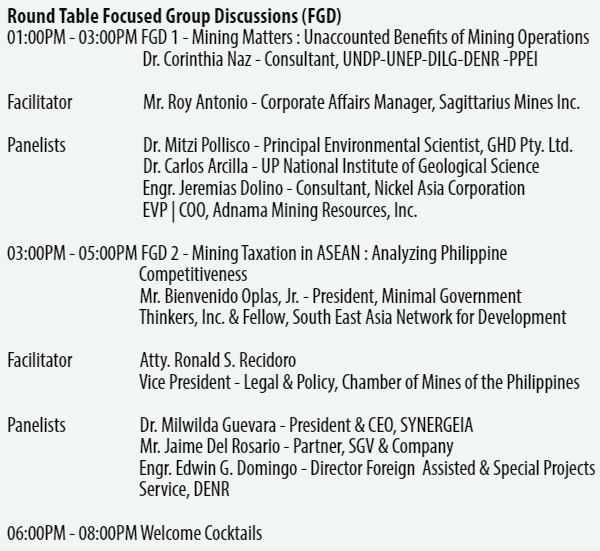
Last Tuesday, September 15, I was one of the speakers during the opening day of the 3-days Mining Philippines 2015 Conference, held at the Grand Ballroom of Solaire Resort Casino Manila. Good audience, perhaps about 200 people.


Opening speeches in the morning, then two focused group discussions in the afternoon. We were on the 3-5pm slot.


This is my presentation, 28 slides total, showing 7 of them here.

After showing various tables on comparative taxation in the region, I asked the audience of this question. About 4 hands were raised to say True, none raised hand to say False, the majority just waited for me to answer my own question.


The 3 pitfalls are (a) deadweight loss, (b) declining revenue in a Laffer curve, and (c) non-recognition of the  "multiplier effect" of mining as raw materials.


I discussed the  various bureaucracies in the power/energy sector, and  the  mining sector, the multiple taxes, royalties, fees, mandatory spending such as SDMP, and yet...


Reflecting  on those tables shown earlier...

I showed 4 annexes -- mining taxation in Vietnam, Indonesia, China, and this proposal.

My full presentation is available in slideshare and in dropbox.


The UP Miners, an organization of Mining Eng'g undergrad students in UP Diliman, made this photo and posted it in fb. Thanks Niel and all.


Meanwhile, I like these comments from two friends, Yani and Raul.

Bayani Camitan: noy, we have very much potential in this industry. in fact mining industry was a significant (if not today in the future) contributor to GDP. but then again, it is sad to say that government support is lacking and related policy is unclear. for one, we have as u may know Surigao (which is partly known for surfing) is the so-called "nickle-ore capital of the Philippines". it is one of the main supplier exporter of nickle ore competing against Indonesia for China market. unfortunately the mining players in Surigao do NOT have a centralized laboratory for nickle ore testing; each of them has their own way to cheat if not hide the characteristics of this mineral ore. an act of one will spoil the whole of it. if only government could support and have a government-instituted laboratory which should be a common facility for about 14 mining companies in Surigao alone, with this guess we can be recognized in the world for this mineral ore.

Raul De Leon: That's the problem with government thinkers! Everytime they see an industry grow, the first thing they think of is to increase taxes instead of improving the collection system. Just like they did in the mid 90s when they saw the stock market boom. They imposed higher taxes on trades that lead to investors shying away from our market and invest else where. This wrong mindset of increasing taxes out of a booming industry has Instead yielded negative results to all stakeholders especially the government who has lost a lot of opportunities and losing to our asian neighbors by giving less incentive, more government involvement and lesser investor facilities.
----------

See also:

Mining 43: Mandy Armas, Christian Monsod at the PES Conference, December 01, 2014