Showing posts with label Artemio Disini. Show all posts

Thursday, August 15, 2013

Mining 30: Some Conceptual Considerations in Mining Tax

* This is my article today in Mining Week
----------

There are several proposals to amend the mining tax policy as contained in RA 7942 or the Mining Act of 1995. The dominant proposal so far is to have a 10 percent tax (7 percent on gross revenue + 3 percent on windfall income) on gross profit (ie, net of operating costs) to replace the two percent excise tax and royalties. The government says it will raise an additional P10 billion a year on average.

Another proposal, raised by Prof. Winnie Monsod, is to have the Malampaya gas revenue sharing where the government and Shell/private developers get a 60-40 percent of the gross profit, respectively, be applied to mining too.

There are several considerations, theoretical and empirical, in deciding whether to raise, retain or cut taxes in metallic mining, or any other sectors in general. Here are some.

One, there is a limit to raising taxes. There is an “optimal” tax rate where government tax revenues can be larger than if government will further touch the “maximum” tax rate. As the tax goes higher, either people will reduce working and hence, gross output will decline, or people will resort to under-report actual production. And government (national and local) tax assessors and collectors will be happy to accommodate such under-reporting in exchange for a bribe. This situation is demonstrated by the Laffer Curve.

Figure 1. Optimal tax rate in the Laffer Curve


This curve is saying that government tax revenue is larger if the tax rate is only on that “revenue maximizing point” (RMP) rather than go for 50 or 80 or 100 percent. At higher tax rates, under-reporting of production, if not under-working, is likely to happen, so that the tax base declines and hence, revenue collection declines.

Two, there are “deadweight losses” to society as the tax rates go up. Deadweight loss is an economic term that means “excess burden” or “inefficiency in resource allocation” because of monopolistic pricing including government higher tax imposition, externalities and price controls. For instance, people will buy only a few units of a particular commodity even if they actually needed more, because of its high price. Or people will buy more than what they need and end up wasting or losing the excess units bought, because of government subsidy that result in artificially low price. Such non- or reduced purchase of certain essential items, or over-purchase of certain items resulting in wastes, are called excess or unnecessary burden, or simply “deadweight loss.”

In this hypothetical graph that this author has developed, let us assume that corporate income tax + excise tax + royalty tax + certain other taxes would be equivalent to about six percent of the gross revenues of large-scale mining companies, and consider it as a temporary equilibrium tax rate . Mining output at that rate is 12 million tons, composite for various types of metals.

If the government will raise it to 10 percent or higher to collect more tax revenues, it can result in an area on the left of the RMP of the Laffer curve and hence, result in higher revenues, or it could be on the right side of RMP and hence, result in lower revenues.  

Figure 2. Possible Effects of Higher Tax Rate in Mining
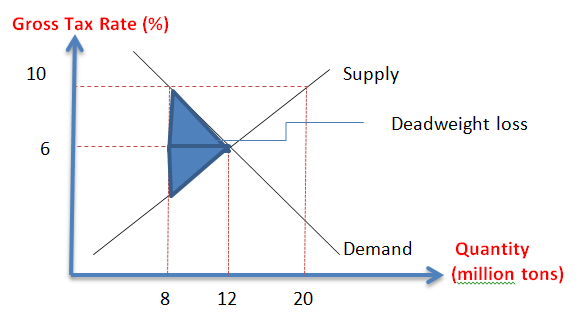

A decline in reported production from 12 to 8 million tons is possible if (a) existing local mining companies will reduce production even temporarily due to lower international prices of certain metals while local costs (wages, mandatory social contributions, electricity, fuel, taxes, fees, etc.) are rising. Or (b) simple under-reporting of actual production by some companies.

Currently, large scale metalling mining companies (LSMM) are already paying high taxes and fees to both national and local governments. In 2010 for instance, LSMM companies paid 43 percent of their net revenue to the government.

Figure 3. Taxes and Fees Collection from Philippine Mining, 2010


Source: Dr. Artemio Disini, COMP, presentation at the Philippine Economic Society (PES) Conference, November 27, 2012, PICC, Manila.

The numbers above would imply that there may be no need to amend RA 7942, especially on the taxation aspect. But since many sectors and legislators are driven by the politics of envy, a hike in mining tax may be inevitable.

The bigger issue in the mining industry is not raising the tax, but implementing the rule of law. That mining enterprises, large- or small-scale, local or foreign, should pay the established tax rates and regulatory fees; that environmental rehabilitation is strictly implemented after a mined out area; that mine tailings are securely impounded and isolated away from creeks, rivers, lakes and the sea; that certain community development projects are implemented to the host villages or barangays of the mining companies.
--------------- 

See also:

Tuesday, July 16, 2013

Mining 26: Presentation at Rotary Club of Taguig Fort Bonifacio

Last night, I gave a talk at our Rotary Club of Taguig Fort Bonifacio. My clubmates were happy to see these data and insights. One member suggested to have a bigger forum on the subject with speakers from opposing sides, to be sponsored by the club. Good proposal, supported by many other club members.


Friday, March 08, 2013

Mining 7: Mining Taxation and Government

* This is my 3rd guest post in antipinoy.com.
----------

The large-scale mining sector  is probably the most taxed sector in the country. National taxes and fees include corporate income tax, tax on stockholders dividends (local and foreign),  excise tax, value added tax (VAT), capital gains tax, documentary stamp tax, tax on bank interest, tax on interest payment for foreign loans, vehicle registration tax, import tax for mining equipment and heavy machineries,  royalties to indigenous communities, mine tailing fees and occupation fees.

Local taxes include community tax, business permit tax, real property tax, registration fees, occupation fees, other taxes and fees.

In addition, big mining companies are also expected to provide various hard and social infrastructures to the residents and workers of the mining area, on top of the various taxes and fees to the national and local governments.

In contrast, the small-scale  mining enterprises are minimally  taxed and regulated.  

On top of these, there were a few recent moves by the government that expands the taxation base of big mining companies. One is the draft scheme by the Mining Industry Coordinating Council (MICC) through the Department of Finance and the Department of Environment and Natural Resources where big mining companies will be taxed twice, first on the gross revenue and second, on the end of year net income.

The other is the Revenue Memorandum Circular (RMC) No. 17-2013 dated February 15, 2013, saying that companies under the Financial or Technical Assistance Agreement (FTAA) must pay taxes throughout the duration of their contract with the government, and not just after the cost recovery period as provided under RA 7942 or the Philippine Mining Act of 1995.

These new revenue measures are created to further tax the sector which many people believe is “not taxed enough” yet and hence, endangers the environment.

Let us review how valid is this statement.

In 2010, the different players in the mining sector paid P13.4 billion in various taxes and fees to the government. There are different interpretations of what this figure represents as share of the government, local and national.

The three tables below collapsed into one image are from Dr. Artemio F. Disini, Chairman of the Chamber of Mines of the Philippines (CMP) in his paper, Getting a Fair Share: The Industry Perspective on Mining Taxation, presented at the Philippine Economic Society (PES) 50th Annual Conference last  November 27, 2012, held at the PICC, Manila.

I attended that conference and the panel on mining taxation. The other speakers in the panel were Shanaka Peiris, IMF Resident Representative to the Philippines, Tristan Canare of the Asian Institute of Management (AIM), and Donna Gasgonia of the UNDP.


Dr. Disini was saying that the actual contribution of the large scale metallic mining industry to the government coffers was not just 9 percent but 13 percent of gross value production, as the small scale mining (SSM) sub-sector does not pay any taxes, at least to the national government.

After deduction of production cost, 60 percent for metallic and 50 percent for non-metallic, the total taxes, fees and royalties paid to the government of P11.9 billion in 2010 comprised 43 percent of the large scale mining companies’ net revenue.

This government share of nearly P12 billion in 2010 alone and constituting nearly one-half of big mining companies’ net revenue is big. It is hard to find other sectors that are taxed this much.

Thus, the statement that large scale mining is “not taxed enough” is not valid.

For one, humanity benefits from mining because no mining and mineral products means no modern life. From spoon and fork, nails and hammer, cellphones and laptops, cars and airplanes, engines and buildings, all of these came from mining. A mining expert Kennedy “Kori” Coronel aptly put it this way: “Everything that humanity needs that cannot be grown, must be mined.”

So, a “No to mining whatsoever” statement is a non-option. A corollary statement “tax mining as prohibitively as possible” is next to non-option as this will drive the legal, large and responsible mining companies and leave the country’s mineral resources to the guerilla type small-scale mining enterprises that are hardly taxed and regulated.

The appropriate attitude for government and the rest of society is to keep taxation at the minimum and go for full transparency and accountability of all mining companies, from small to medium to large firms. Putting strict regulations and high taxes only to large players but allowing small players that are often owned or protected by local politicians to disobey those regulations do more harm than good, to the environment, economy and society.
---------------

See also:
Fat-Free Econ 3: Mining and Environmentalism, March 15, 2012
Mining 3: Debates on Mining, March 17, 2012
Mining 4: EO 79 and the MICC, July 12, 2012
Mining 5: Benefits of Mining Even Without Taxes, December 09, 2012
Mining 6: Large Investments vs. Large Bureaucracies, February 19, 2013

Tuesday, February 19, 2013

Mining 6: Large Investments vs. Large Bureaucracies

The mining is perhaps the most regulated, most intervened, and most taxed sector by the government. Coming second would be the pharmaceutical sector, and perhaps the water and other utilities. One important indicator that there is heavy government regulation and taxation of a particular sector is the high presence of the informal or black market for such sector.

In the case of mining, the black market is the high presence of the  so-called "small mining" like in Mt. Diwalwal in Davao. In the pharma sector, it's the existence of so many unregistered "health products" like the "magic coffee" (or tea, juice, etc.) that can treat all types of cancer, TB, diabetes, and two dozens or more of other diseases, or even the fake and substandard medicines.

Last November 27, 2012, I attended the Philippine Economic Society (PES) 50th Annual Conference held at the PICC in Manila. In the afternoon session, I attended the panel on Mining Taxation. There were several speakers, like the IMF Philippines Country Director, one from the Asian Institute of Management (AIM), one from the DENR Mines and Geosciences Bureau (MGB), another one from UNDP I think, and the Chairman of the Chamber of Mines of the Philippines (CMP), Dr. Artemio Disini, also of the UP College of Engineering.

Of the various presentations, the most substantial for me was the paper by Dr. Disini. I got a copy of his powerpoint, posting here some of those slides. I will post the slides on mining taxation in another blog post as it seems to be the most controversial aspect that will require legislation.

From Dr. Disini's presentation, there is indeed huge investment, both actual and planned or potential, in the Philippine mining sector. See these two slides below. Please note again that these data were as of November 2012. There could be some slight changes in the data by now, am not sure.


The biggest is the Tampakan project by Sagittarius Mines, Inc. (SMI). Almost $6 billion, wow. It's a weird case. The company has already started so many infrastructures when suddenly the provincial government of South Cotabato passed a resolution banning open pit mining, so the operation was halted. You pour huge amount of money and human resources and suddenly one branch of the government, the provincial government, says "Stop!" wow.

I read today that Finally, Tampakan mine environmental clearance okayed. But still the company cannot operate because the moratorium on mining is still in effect unless a new law on mining taxation and other matters is enacted.

Below is a good map of where the big copper and gold mining projects are located. In copper mining, only three companies are operational while seven are still waiting for the final go signal from the government. Companies in gold projects are "smaller" compared to copper projects.


For nickel, the four companies still on the pipeline are pouring huge money, average of some $1 billion each. The projected exports revenues of those companies in the 3 metallic products would reach some $12.3 billion by 2018, that's a big amount indeed. But that is still a big IF because industry players, both existing and potential, cannot really predict what the legislators in the Senate and House of Representatives, as well as the Governors and Mayors in the provinces, will do with their existing and proposed investments.

The only saving grace of the Philippines perhaps is its geology. In the "Pacific Rim of Fire" where about 80 percent of all earthquakes and volcanic eruptions in the planet occur, those volcanic and other geological movements would turn ordinary rocks beneath the surface into something precious metallic rocks.