Showing posts with label DTI. Show all posts

Monday, July 09, 2018

BWorld 223, Ease of setting up and closing down business

* This is my article in BusinessWorld last June 18, 2018.


Last June 6, I attended the “Seminar on Protecting your Trademarks and Inventions Overseas” jointly organized by the Philippine Chamber of Commerce and Industry (PCCI) and the World Intellectual Property Organization (WIPO), held at the PCCI building in McKinley Hill, Taguig City.

The main audience of that seminar were entrepreneurs and companies big and small to help them be aware of existing intellectual property rights (IPR) rules and their protection, commercialization, licensing and dispute resolution. I do not represent any SME or big company but I was invited there by Jess Varela, Chairman of PCCI Committee on IPR.

The three important speakers that day were Dennis Broze and Peter Willimott of WIPO Office in Singapore and Atty. Allan Gepte, Commissioner of the Tariff Commission and former Director-General of the Intellectual Property Office (IPO).

Then last June 13, I attended the 6th Ease of Doing Business (EODB) Summit 2018 at the PICC, organized by the Department of Trade and Industry (DTI). It is an annual event sponsored by the DTI with one important goal — to raise or improve the Philippines’ global ranking in the World Bank’s (WB) Doing Business (DB) annual reports. The DB 2018 report was recently released and the Philippines’ global rank has worsened, compared to its ranking in the last two or three years.

This year, the EODB 2018 event is more optimistic because of the passage of the “Ease of Doing Business Act of 2018” or RA 11032 which was signed into law only last month. The DTI and various agencies including SEC, LRA, BIR, BOC, BFP, LGUs have adopted various measures to hasten the law’s implementation.

Among the important speakers in the EODB 2018 were DTI Secretary Ramon Lopez, who is also the Chairman, Ease of Doing Business and Anti-Red Tape Advisory Council; Senators Juan Miguel Zubiri and Aquilino “Koko” Pimentel III, and Mr. Guillermo Luz, former Co-Chairman of the National Competitiveness Council (NCC). Sen. Zubiri is the main author of the law in the Senate and also the Majority Leader while Sen. Pimentel is former Senate President and now Chairman of the Committee on Trade.

In both the PCCI-WIPO and DTI events, the over-riding subject is competitiveness of the Philippine economy and its businesses.

Below are results of three annual reports, the WB’s DB, World Economic Forum’s (WEF) Global Competitiveness Index (GCI), and WIPO, INSEAD and Johnson Cornell University’s Global Innovation Index (GII) annual reports.


Numbers in parentheses represent the number of countries and economies covered in that particular annual report.

While the results in global ranking vary among the three reports, one trend can be identified — the most competitive Asian economies are Singapore, South Korea, Hong Kong, Japan, Malaysia, and Thailand.

The Philippines is among the least competitive in the region, which is not good for us.

I have three wish lists on this matter.

One, the prioritization and signing into law of RA 11032 is among the very few measures of the Duterte administration that I support. I wish that he will do more ease of doing business policies, not the ease of closing businesses such as when he moved to close Boracay for six months or the ease by which the government over-taxed people via TRAIN.

Two, I wish there was a provision on the ease of closing a business in RA 11032. Among the best incentives to attract investment is a contestable market or free/easy entry, free/easy exit. If businesses see that government will bureaucratize and harass them if they decide to close shop someday, they will think twice about coming in.

Three, I wish there was another law mandating that work in government (local and national, elected and appointed, continuous or on-off) will only be a maximum 15 years, prompting officials and staff to go back to the private sector.

Since many officials intend to become regulators and bureaucrats until they retire, they tend to be more prohibitionist and extortionist since their over-regulations and taxation of business will not apply to them.


Bienvenido S. Oplas, Jr. is President of Minimal Government Thinkers, a member-institute of Economic Freedom Network (EFN) Asia.
---------------

See also:

Saturday, December 17, 2016

BWorld 95, Manufacturing and electricity costs in Asia

* This is my article in BusinessWorld last December 06, 2016.


A country’s manufacturing sector is a good indicator of its degree of industrialization and prosperity. The sector provides most of the basic needs of the people, from consumer items like bread, shoes, mobile phones, and cars, to capital goods like tractors and bulldozers.

Aware of the sector’s important function, the Department of Trade and Industry (DTI), Board of Investments (BoI), with funding assistance from USAID and JICA, organized a big, two-day “Manufacturing Summit” last Nov. 28-29, at Shangri-La Makati.

Besides DTI Secretary Ramon Lopez, high profile speakers included Diosdado Banatao of Tallwood Venture Capital, Jaime Zobel de Ayala of Ayala Corp. and IMI, Roberto Batungbacal of Dow Chemical Pacific, Alpesh Patel of McKinsey, Lawrence Qua of Ionics EMS, and many more.

Currently, different sectors and groups conduct their own study of the degree of modernization and competitiveness of the Philippine manufacturing sector. But sometimes, these studies have conflicting results.

One study is made by Japan External Trade Organization (JETRO) in 2015, showing that the Philippines has one of the more affordable, more competitive markets to do manufacturing business.

Recent macroeconomic figures also show that the Philippines has one of the most dynamic, fast-growing economies in Asia and the rest of the world. And in industrial production, the country managed to have modest growth, not as high as those of Vietnam and China but not low or negative as experienced by Hong Kong and South Korea (see Table 1).

  
Among the important activities of the Manufacturing Summit was the breakout sessions into seven simultaneous workshops. I have attended two pre-summit consultations by the DTI in early November, on International trade policy and Free Trade Agreements (FDAs), and Competitive and Innovation industries. So during the breakout sessions, I attended the workshop on Physical infrastructure.

The focus of discussions were on streamlining and modernizing the roll-on roll-off (RORO) system that allows buses, trucks, and other vehicles to transport goods and people from Luzon to Visayas and Mindanao and vice versa, and solving the heavy traffic congestion in Metro Manila and other big cities in the country.

The subject of the Philippines’ high cost of energy and unstable power supply was brought up by the representative from the garments and textiles industry, saying that we have the second highest electricity rates in Asia making our manufacturing sector less competitive.

I followed this up and I said that aside from the distortions in energy taxation/royalties and bureaucratic processes that make power plants construction more lengthy and costly, subsidies to renewables will further exacerbate the high energy cost.

While the EPIRA (Electric Power Industry Reform Act) of 2001 promised cheaper energy because it allowed competition among more players in power generation, the RE (Renewable Energy) Act of 2008 promised expensive energy because of various subsidies to renewable firms, especially the feed in tariff (FIT) system.

Arangkada Philippines, a project of the Joint Foreign Chambers of the Philippines, also distributed its latest policy note on Manufacturing during the summit and proposed measures to improve the Philippines’ manufacturing competitiveness. No. 1 in their 10 recommendations is to “Address high cost of power through tax credits and discounts.”

Here is possibly the latest available data for comparative electricity prices in Asia. Meralco contracted the International Energy Consultants (IEC) to conduct the study (see Table 2).

  
Based on IEC data, the Philippines has the 3rd highest electricity prices among developed and emerging economies in Asia.

This isn’t really good news but it is somehow an improvement from “2nd highest” ranking we had a few years ago.

Consider that (a) the governments of Indonesia, Malaysia, Thailand, South Korea and Taiwan subsidize their energy sector while the Philippines along with Japan (Kansai), Hong Kong and Singapore do not have such arrangements. And (b) Meralco tariff rate decline from 2012 to 2016 was a significant 28%.

The huge price cut in Singapore is worth noting and the Philippines should learn from it.

Aside from low global oil prices from 2015 to 2016, Singapore: (a) has high dependence on cheaper fossil fuel (natural gas, 92% of total electricity output in 2013) and almost zero wind-solar that are expensive, (b) does not seem to have energy tax for its natural gas consumption, whereas the Philippines imposes a high royalty (an energy tax) on its domestic natural gas production from Malampaya, and (c) market-oriented operator, the National Electricity Market of Singapore (NEMS) that is 100% independent of government and hence, relatively free from political pressures and interventions.

All manufacturing and financial powerhouses in Asia have huge power generation capacities, four to twenty times per capita electricity consumption of the Philippines.

Having a dynamic manufacturing sector is a must for the country to provide more jobs, more locally produced, and assembled consumer and capital goods. So having cheaper electricity and huge generation capacity from baseload and stable power plants, not intermittent sources, will help the Philippines achieve its manufacturing and industrialization goals.


Bienvenido S. Oplas, Jr. is President of Minimal Government Thinkers and a Fellow of SEANET and Stratbase-ADRi.
------------

See also: 
BWorld 92, Climate action and Asian energy realities, November 19, 2016 
BWorld 93, ASEAN multinationals, December 02, 2016 
BWorld 94, Economic freedom, taxes and tariffs in Asia, December 17, 2016

Monday, November 14, 2016

BWorld 91, Free trade means faster growth in manufacturing

* This is my article in BusinessWorld today.


There is a populist and persistent belief that free trade means weakening, if not, bringing about the death of local manufacturing industries because they will not be able to withstand competition from more advanced economies abroad.

This belief has been repudiated many times in countries including the Philippines. And there is a new paper that repudiates this belief again.

Former NEDA Secretary Dr. Cielito Habito discussed a new paper at the Department of Trade and Industry (DTI) pre-summit roundtable, based on their research at the USAID-funded Trade-Related Assistance for Development (TRADE) Project.

The roundtable was part of the preparations of the DTI and the Board of Investments (BoI) in an important event they are jointly organizing, the “Manufacturing Summit 2016: Trabaho at Negosyo” this coming Nov. 28-29, 2016 at the Makati Shangri-La Hotel.

Besides plenary sessions, breakout sessions to be held will cover seven topics, one of which is International Trade Policy and Free Trade Agreements and Dr. Habito’s discussion was in preparation for this session. I was among those invited by the DTI for the pre-summit roundtable, thanks to Assistant Sec. Rafaelita Aldaba.

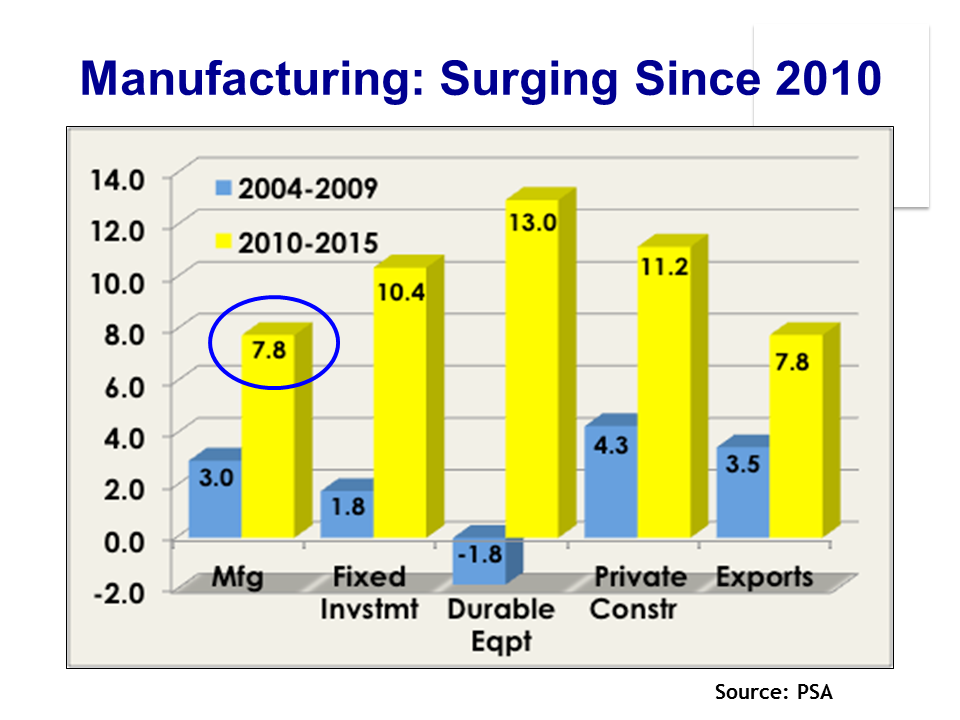
In January 2010, the ASEAN Free Trade Agreement (AFTA) became operational. The import tariffs on nearly all products traded across the ASEAN-6 (Brunei, Indonesia, Malaysia, Philippines, Thailand, and Singapore) dropped to 0, some at 5% maximum. What happened to Philippine manufacturing by 2010 onwards? Dr. Habito showed this data (see Table 1).

Philippine manufacturing did not weaken nor did it die with freer trade. From an average growth rate of only 3% per year in 2004-2009, it went up to an average of 7.8% per year from 2010-2015.

Other sectors -- fixed investment, durable equipment, private construction, exports -- also showed faster growth rates under a freer trade regime, about three to four times faster than average growth in 2004-2009.

Ciel also showed slides where Philippine exports have moved up the value chain.

For instance, the Philippines exported around $200M of boilers, nuke reactors, machineries, optical, technical, medical apparatus, etc. to Indonesia in 2013 alone.

As we moved to freer trade, to zero tariff, our manufacturing and exports became more dynamic, more competitive, more job creating and more forex-earning.

One may also credit the past Aquino administration for keeping with trade liberalization agenda compared to its predecessor Gloria Arroyo administration.

Freer trade benefitted not only the Philippine economy but also almost all other ASEAN countries (see Table 2).


The above numbers tell us the following.

One, the size of manufacturing output of the six countries have expanded significantly in just five years. The Philippines’ has grown from $26.5B in 2009 to $38.9B in 2014.

Two, in terms of manufacturing annual growth rate, Malaysia, the Philippines, and Singapore experienced faster growth rates while Thailand and Vietnam experienced slower expansion -- but they nevertheless reported growth.

Three, manufacturing as percentage share of GDP has declined for all the countries above. This is not something to be taken negatively because almost all countries have shown this trend, with the declining share of agriculture and manufacturing and rising share of services.

Some policy measures that the DTI, other departments, and Congress should consider to further improve the country’s manufacturing and trade capacity would be the following:

1. The government should help improve the economy’s competitiveness. Very often it is not “what government should further do” but rather, “what government should NOT do and intervene,” like fewer taxes, regulations, restrictions, and bureaucratic processes.

2. Some factors that deter more investments in manufacturing in the country are outside the scope of DTI, like expensive and unstable electricity supply, slow Internet, poor infrastructure. More competition in these sectors should be encouraged.

3. There are winners and losers in free trade, there are also winners and losers in protectionism. Overall, there is “net gain from trade” while there is net loss under protectionism. Tables 1 and 2 above have shown and quantified some of these gains, so we should never backtrack from further liberalization.

4. Over the long term, we should consider adopting unilateral trade liberalization, one-way free trade policy, both in tariff and non-tariff measures (NTMs), and ultimately in services too. Hong Kong and Singapore are good examples of unilateral liberalization regimes, their exports of goods and services are much larger than most countries in the world despite their small population.

5. NTMs as indirect barriers to trade should be relaxed through time and ultimately abolished. The main purpose of trade policy should be consumers protection and empowerment, to allow the local consumers to have more choices in buying and selling, to have more access to more markets and economies abroad.


Bienvenido S. Oplas, Jr. is the head of Minimal Government Thinkers and a Fellow of SEANET. Both institutes are members of the Economic Freedom Network (EFN) Asia.
----------

See also:
BWorld 64, The WTO and trade agreements, June 17, 2016 
BWorld 65, PH exports growth from 1960-2014, June 22, 2016
BWorld 71, Free trade and higher income, July 11, 2016 
BWorld 78, If the US becomes protectionist, who loses? August 11, 2016
BWorld 88, Economic freedom and human rights, October 31, 2016 
BWorld 89, President Duterte's outbursts and PH economic momentum, November 12, 2016 
BWorld 90, Who should set the energy mix, government or consumers?, November 12, 2016

Friday, November 04, 2016

Free Trade 64, PH experience in manufacturing growth

Yesterday, I attended a pre-summit consultation meeting by the DTI on free trade agreements (FTAs). It was part of the preparation for the "Manufacturing Summit 2016" this coming November 28-29, 2016 at Shangrila Makati. Small group with representatives from selected sectors in the PH economy like the garments and textiles, pharma (represented by Unilab), other manufacturers and government agencies. I was lucky to be among the invitees. Thanks to DTI Asec Fita Aldaba for the invite.

Former NEDA Secretary Ciel Habito gave the preliminary inputs based on their research at the USAID-funded Trade-Related Assistance for Development (TRADE) Project. This chart is from his presentation, and it is a very useful one for me.

I posted that chart in my fb wall with a note that there are at least two ways to interpret this chart, growth rate of PH manufacturing output, average for 2010-2015 vs 2004-2009 average. One interpretation on trade and economics, the other on politics.

(1) Economics: PH manufacturing surged at average growth rate of 7.8% per year vs. only 3% in 2004-2009. With the ASEAN FTA (AFTA), PH import tariff rates went down to 0 - 5% by 2010. So the chart demolishes the hypothesis that “free trade kills local industries”. The opposite happened, that as the economy turns to freer trade, tariff down to zero, the manufacturing and exports sectors become more dynamic, stronger, and more competitive. 

The annual growth rates in fixed investment, durable equipment, private construction and exports also grew fast, 3-4x growth average in 2004-09.

(2) Politics: PNoy Aquino administration enabled the PH economy to recover its slow and anemic growth during the previous Gloria Arroyo admin.

The anti-Aquino groups and people will be unhappy to see this chart.

True enough, one friend who is very consistent in attacking the previous administration and the "yellows" came in and commented that the bar chart is a "poorly graphed data", that it "should be a line plot over time to show trends," and that "bad graph use can be used to lie."

Well I ignored his attacks of that chart because he cannot produce an alternative chart or graph based on actual numbers, basta bira lang ng bira.

Another chart from Dr. Habito's presentation. Big change in the composition and value of PH exports to TH, 2003 vs 2013. TH is more developed than PH in exports and manufacturing and still, PH was selling modern exports like optical and medical apparatus.


The PH exported around $200 M of boilers, nuke reactors, machineries, optical, technical, medical apparatus, etc to ID in 2013 alone. As we move to freer trade, to zero tariff, our manufacturing and exports capacity do not die; the reverse happens, they become more dynamic, more competitive, more job creating and more forex-earning.


After Ciel's presentation, open forum. I commented the following.

1. To improve the economy's competitiveness, very often it is not "what government should further do" but rather, "what government should NOT do and intervene. 

2. Our main advocacy in MGT and SEANET is real free trade, unilateral trade liberalization both in tariff and non-tariff measures (NTMs) and also in services.

3. Some factors that deter more investments in manufacturing in the country are outside the scope of DTI, like expensive and unstable electricity supply, slow internet.

4. There are winners and losers in freer trade, and there are winners and losers too in protectionism. What is important is for DTI and other stakeholders to show "net gains from trade"

5. NTMs as indirect barriers to trade should be relaxed and ultimately abolished. both by the PH and its trade partners.

6. The main purpose of trade policy should be consumer protection, to allow the consumers to have more choices in buying and selling, to have more access to more markets and economies from abroad.
-------------

See also:


Monday, July 26, 2010

The President's SONA, 2010

The new President of the Republic of the Philippines, Benigno "Noynoy" Aquino, delivered this afternoon his first State of the Nation Address (SONA). He has been in power for only 4 weeks now.

The Address is long, I will only make a few comments on some of the points he discussed.

I really expected him to say something on reducing government bureaucracies for the entrepreneurs, the job creators, the capitalists, big and small. And I was not disappointed.

Towards the middle of his address, he said, referring to the Department of Trade and Industry (DTI) and other government agencies like the BIR and SEC.

"Ang walang-katapusang pabalik-balik sa proseso ng pagrehistro ng pangalan ng kumpanya, na kada dalaw ay umaabot ng apat hanggang walong oras, ibababa na natin sa labinlimang minuto. Ang dating listahan ng tatlumpu't anim na dokumento, ibababa natin sa anim. Ang dating walong pahinang application form, ibababa natin sa isang pahina."

Translation: "The endless procedures in registering a business, which takes between four to eight hours per visit, we will reduce to 15 minutes. The old requirement of 36 documents, we will bring it down to six. The eight pages application form, we will reduce it to one page."

Bingo! Reduce the bureaucracies, reduce the number of signatures by government officials and bureaucrats, that alone will bring down corruption in the country.

Some guys though, considered the President's SONA as "elitist". They blasted it as pro-big business, and hence, worsening the inequality in Philippine society.

Consider this example. A group of OFWs with some savings wants to put up a micro-business, say a parlor or barber shop, or bake shop or internet shop or food shop. Various national and local government bureaucracies require them 3 to 4 dozens of different taxes and regulatory fees to pay every year, excluding the taxes and fees just to start a business. The President said this is wrong. The number of business regulations, the procedures in getting a business name, the number of pages of application forms, etc., should be drastically cut. Is this elitist?

I don’t think so. It is pro-small busines, it is pro-big business too. When there are lots of bakeshops, lots of internet shops, lots of parlor/barber shops, lots of food shops, lots of jobs will be created. When people have jobs, they tend to become independent of government. They do not easily run to politicians and government welfare offices, they have the resources to take care of themselves, their families, friends and relatives.

On health, the President devoted only two paragraphs in his address, and that is on expanding the Philippine Health Insurance Corporation (PhilHealth) coverage for the pooorest five million Filipino households. He said,

"Una, tutukuyin natin ang tunay na bilang ng mga nangangailangan nito. Sa ngayon, hindi magkakatugma ang datos. Sabi ng PhilHealth sa isang bibig, walumpu’t pitong porsyento na raw ang merong coverage. Sa kabilang bibig naman, singkuwenta’y tres porsyento naman. Ayon naman sa National Statistics Office, tatlumpu’t walong porsyento ang may coverage.

"Ngayon pa lang, kumikilos na si Secretary Dinky Soliman at ang DSWD upang ipatupad ang National Household Targetting System, na magtutukoy sa mga pamilyang higit na nagangailangan ng tulong. Tinatayang siyam na bilyon ang kailangan para mabigyan ng PhilHealth ang limang milyong pinakamaralitang pamilyang Pilipino."

Translation:

"First, we will identify the correct number of Filipinos who sorely need PhilHealth coverage, as current data is conflicting on this matter. On one hand, PhilHealth says that eighty-seven percent (87%) of Filipinos are covered, then lowers the number to only fifty-three percent (53%). On the other hand, the National Statistics Office says that only thirty-eight percent (38%) of Filipinos are covered by Philhealth.

"Even as we speak, Secretary Dinky Soliman and the Department of Social Welfare and Development are moving to implement the National Household Targeting System that will identify the families that most urgently need assistance. An estimated 9 billion pesos is needed in order to provide coverage for five million poor Filipinos."

There are three significant things to note here.

One, correct PhilHealth's exagerration of its actual coverage. I have written two papers in the past pointing out that PhilHealth was exagerrating the actual number of its beneficiaries. What PhilHealth does is to multiply each member (private employed, government employed, indigents, individually-paying, OFWs) by five. Thus, even a single, new college graduate with no dependent (no spouse, no kid, parents are either working and PhilHealth members too or parents are deceased or not working but below 60 yrs old, not qualified to be declared as dependent, etc.) is assumed by PhilHealth to have four dependents. This is lousy and simplistic math.

So what happened is that for the 1st quarter of 2009 for instance, total number of members excluding the "lifetime members" or the registered senior citizens who are not pensioners somewhere, was 16.35 million. But PhilHealth's count of the number of beneficiaires was 76.69 million, or about 85 percent of the total population of the country. Lazy and simplistic math, really.

To see further discussion about this number-magic by PhilHealth, check my paper,
"Health insurance and government failure" (presented in a health forum last August 17, 2009, 7 pages), http://www.minimalgovernment.net/media/mg_20090817.pdf

I sent this and another paper to some PhilHealth officials and I was wondering why they did not correct me when I said that their office is exagerrating its number of beneficiaries. Now it is the new President of the country who expresses disbelief in their numbers.

Two, no mention of the Department of Health (DOH) and drug price control policy, something that was among the highlights of the past President's last SONA a year ago. I hope that this is a signal that the President will soon abrogate Executive Order (E0) 821 by the past President imposing price control on certain medicines, starting mid-August 2009.

I have also written a number of papers why the drug price control policy is a failure in improving access of the poor to more life-saving and disease-killer drugs, all posted in the MG website, www.minimalgovernment.net.

And three, there is bigger role for the national government in providing healthcare for the poor. Before, the local government units (LGUs) need to put up a counterpart fund in financing the healthcare coverage of the really poor. Lots of problems encountered in that scheme as some poor LGUs cannot put up the counterpart fund. So the next tack of the national government is to solely shoulder the cost of healthcare of the really poor. Now they are targetting some five million households, roughly about 25 million individuals, to be covered by PhilHealth.

Further nationalization of the service is not a wise move. There is a new development in UK's healthcare where the UK government will decentralize its socialized and nationalized healthcare system, as reported in this story.
------

Britain Plans to Decentralize Health Care
By SARAH LYALL
Published: July 24, 2010

LONDON — Perhaps the only consistent thing about Britain’s socialized health care system is that it is in a perpetual state of flux, its structure constantly changing as governments search for the elusive formula that will deliver the best care for the cheapest price while costs and demand escalate....

http://www.nytimes.com/2010/07/25/world/europe/25britain.html?pagewanted=1&_r=1&ref=global-home
--------

Of course decentralization does not mean privatization. It only means to transfer the function of healthcare delivery from the national government to the local governments. There is realization that too much bureaucracy at the national level impedes health delivery to the public.

Finally, my position on healthcare is that it is first and foremost, a personal and parental responsibility, not government responsibility. Government role is most needed in limited cases like the spread of infectious diseases.

People should not drink and drink, smoke and smoke, eat and eat, and when their internal organs are dilapidated by such vices or their blood vessels are choked by fat, they just run to the government to demand that "health is a right." Parents and guardians should also teach their kids to wash their hands well before they eat, or to keep their house and surrounding clean so that the rats and cockroaches will not hold daily and nightly general assembly in their place.