Showing posts with label gravity theory. Show all posts

Saturday, November 28, 2015

Free Trade 57, Growth, IPRI 2015 and the TPP

Two weeks ago, I attended the launching of  the International Property Rights Index (IPRI) 2015 Report in Kuala Lumpur, then I also gave a short presentation on IPR and the Trans Pacific Partnership (TPP) Agreement.


I showed portions of Dr. Ramon Clarete (University of the Philippines School of Economics, UPSE) paper during the UPSE-Ayala forum, Going Regional: Which Mega Trade Deals Should the Philippines Join? last February 2015.

He used the Gravity model of trade in estimating the level of bilateral exports or imports between two trading partners.

* Dependent variable: flow of trade between and among countries studied

* Independent or explanatory variables, their expected signs or relationships: GDP (+), population (+), dist. between two countries (-), commonality of language (+), shared borders (+), landlocked state (-).

* In addition, TPP and RCEP indicators or dummy variables are introduced: (a) TB1, 1 if both trading countries are TPP or RCEP members, 0 otherwise, (b) TB2, 1 if exporting country is a TPP or RCEP member, 0 otherwise; (c) TB3, 1 if importing country is a TPP or RCEP member, 0 otherwise. For overlapping memberships, a dummy variable where TPP*RCEP =1 if both trading partners are members of the two trade blocs.

And here are some results.


Then I briefly discussed my article in BusinessWorld that day, Property rights protection in APEC economies. Then I discussed the IPR on medicines aspect of the TPP.


And showed actual texts in the TPP agreement....


Below, from left: Lorenzo Montanari, Exec. Dir. of the Property Rights Alliance (PRA); Dr. Sary Levy, author of IPRI 2015, and Wan Saiful Wan Jan, CEO of IDEAS and Director, SEANET.


Concluding Notes:

1. Joining the TPP has more gains than pains for member-countries, especially in exports and overall GDP expansion.

2. IPR health provisions in TPP are not scary, they do not reduce access to cheaper generic drugs. Existing TRIPS flexibilities are maintained.

3. It seems that the generic pharma lobby + the anti-capitalism, anti-globalization NGOs created more noise and fear than what the TPPA actually provides.

4. There is more to fear in government taxation of medicines, in mandatory drug price discounts and price controls, than IPR protection.

“IPR create incentives for businesses to invest in ideas, to develop new products, and to earn a profit from the sale of those products. This in turn leads to improved customer satisfaction, improved profitability, and greater employment opportunities.”
– Prof. Sinclair Davidson, RMIT Univ. (Econ Dept.), Melbourne, Australia.

The full presentation is posted here.
------------

See also:

Tuesday, September 08, 2015

Free Trade 52, More on the Gravity model

A presentation by Dr. Ramon Clarete of UPSE during the UPSE-Ayala forum early this year was entitled "Going Regional: Which Mega Trade Deals Should the Philippines Join?"

He used the Gravity model of trade in estimating the level of bilateral exports or imports between two trading partners. So the dependent variable is the flow of trade between and among countries studied, the independent or explanatory variables are the following and their expected signs or relationships:

GDP (+), population (+), distance between two countries (-), commonality of language (+), shared borders (+), landlocked state (-). 

In addition, Trans Pacific Partnership (TPP), Regional Comprehensive Economic Partnership (RCEP) indicators or dummy variables are introduced: 

TB1, 1 if both trading countries are TPP or RCEP members, 0 otherwise,
TB2, 1 if exporting country is a TPP or RCEP member, 0 otherwise,
TB3, 1 if importing country is a TPP or RCEP member, 0 otherwise.

For overlapping memberships, a dummy variable where TPP*RCEP =1 if both trading partners are members of the two trade blocs.

Some 209 trading countries and their annual trade data from 1948 to 2013 was used and analyzed.

A time interaction variable, 1 after 1990s (representing more or less the fact that China has become integrated with the world economy).

Here is the result. All estimated coefficients are statistically significant and bear the expected signs.

In particular, these coefficients mean that...


The implied change of exports of membership are shown below. If the Philippines, already a member of RCEP, and it further becomes a TPP member, its exports are expected to rise by 48%, and real GDP projected to rise by 61%.


Meanwhile, a paper produced February 2015 (39 pages), Trade Theory Network, by Michael Hubler, Four theoretical examples with numerical applications are presented, below:

* increase in trade from Asia to North America affects the world economy,
* an intuitive rule for finding the welfare-optimal tariff is derived,
* three possibilities for vanishing trade effects (fluctuations) are explained: trade diversion, the “river-island effect”, and overlapping business cycles. Fourth, it is shown how adjustment costs delay the propagation of shocks or business cycles.

Among the results are as follows:

A reduction in TPP trade barriers is welfare-improving for North America and Asia. This result corroborates plans for trans-Pacific free trade agreements. The paper has shown that a moderate increase in trans-Pacific trade has significant repercussions on the world economy…. Moreover, the paper has shown that halving the trade barrier between Europe and Asia could create a situation in which the rest of the world, in particular Africa, is to some extent protected from shocks affecting international goods markets.

Less trade barriers, less regulations and permits, mean higher trade flows and economic growth.
--------------

See also:


Friday, March 06, 2015

Free Trade 44: The Gravity Model

An old theory in international trade (and migration) but which I heard and read only last month, is the gravity model. This is on top of the classical David Ricardo theory of "comparative advantage" and the Heckscher-Ohlin theorem of factor abundance as basis for trade. The first two theories assumed that all other things being equal, meaning distance between and among trade partners are assumed to be similar. The addition of the gravity theory on the first two or other theories somehow completes the picture of why and where people in one country trade more with people in country X than in country Y.

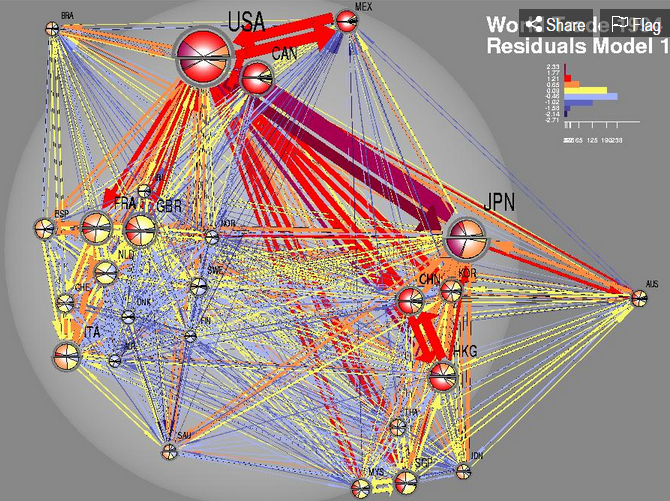
Below is an illustration of economic mass (GDP size, especially) and corresponding trade with each other of major economies, as well as the medium and smaller size economies. The US, EU and Japan are prominent in  the illustration.

* Note: these three illustrations I got from the web, I did not develop  them.


A simple and generalized illustration and definition of the theory. This can apply in  international trade, migration, tourism, investments, cultural exchanges. 

Thus in international commerce, trade costs increase with distance between or among trade partners. 

Technology comes in to reduce such trade cost, via huge container ships, jumbo cargo planes, and so on.

Another illustration and basic math formula. 
F is the trade flow, M is the economic mass (GDP size) of each country, d is the distance and G is a constant. There is direct relationship in  M and inverse relationship in d.


So again, it is nature and geography that initially or generally dictates movement of goods and people, not so much governments. But governments with more market-friendly policies encourage faster growth in M, which later attracts or begs more trade with people from other countries.

Below is an  illustration of the shift in trade of selected Asian economies from 1990 to 2013. Before, a number of Asian economies tend to trade more  with their former colonial masters (ex. Philippines trade with the US; Cambodia with France?) or political allies. This has slowly changed through the years, especially from the late 90s up to the present. Asians now trade more with each other, partly because of regional free trade areas (FTAs) like the ASEAN FTA (AFTA) that have been established and  formalized.


source: ADB, Key Indicators for Asia and the Pacific 2014.
-----------

See also:
Free Trade 40: Razeen Sally Joins IDEAS, to Campaign for More Liberalization, November 25, 2014 
Free Trade 41: David Ricardo, CPE, FPE and Consumer Surplus, December 06, 2014
Free Trade 42: ASEAN Trade and Unilateral Liberalization Challenge, January 23, 2015 
Free Trade 43: On PH-Germany or PH-EU FTA, February 16, 2015