Showing posts with label intellectual property rights. Show all posts

Wednesday, May 31, 2017

IPR and Innovation 36, Plain packaging from tobacco and soon to soft drinks, alcohol, ice cream products

I am reposting this good interview of my friend, PRA Exec. Director, Lorenzo Montanari, published in The Financial last May 29, 2017. State nannyism is wrong, there will be too much state intervention to "protect people from 'harming' themselves", the state semi-own people's body and mind.
lorenzo
“We are really worried about the new regulations,” Montanari commented. “Plain packaging - removing all signs of the brand from the packaging of cigarettes - is a direct attack on the trademark system. The first plain packaging was implemented in Australia in 2012. We were against it and criticized it of course. As a reaction to that we have already published an International Coalition letter against plain packaging. We collected more than 40 think tank signatures from around the world; New Economic School is also amongst them. We claim that if one wants to reduce smokers’ numbers then that’s fine, but it can be done in another way, for example educational campaigns can help. The countries that have approved the law on plain packaging, for example France and Ireland, are also considering moving on to another sector, like wine, soft drinks, junk food, etc. I want to say that it is not about the tobacco itself, we care about the trademark. This is our mission because it’s intellectual property.”
Q. At present, in terms of Georgia, does it only affect the tobacco sector?
A. It has started with tobacco. It is very easy to attack this sector. In Thailand and Indonesia for example they have already started to talk about plain packaging in the wine sector too. The point is to think about the Georgian wine producer. At the moment Georgian wine is famous throughout the world. Local producers have invested so much money in building brand identity. Imagine what would happen if they weren’t able to show their label. I have heard that the Ministry of Economy, the Ministry of Finance, and even the Prime Minister of Georgia are against it. If parliament decides to implement the new law, what will happen hereafter to Georgia wine? This is the point we are strongly criticizing.
Since we analyzed the 128 country index, Georgia held 90th place. In terms of the legal political environment Georgia is not performing too badly. By registration of property Georgia is the best country in the world. The problem in Georgia is the protection of intellectual property rights. In this case we discovered the score is 2.4 - the lowest in our ranking. A policy like plain packaging will not help to improve the protection of intellectual property. I had the pleasure to speak to the Chairman of Sakpatenti. He is against this new regulation about plain packaging. We want to collaborate with them also.
Q. Can you tell us more about the experience of foreign countries which have already implemented the law?
A. The Australia National Drug strategy household survival has shown that in 2014 the daily smoking use rate was 2.5 and 1 year after the implementation was 3.4. Plus, according to the dates, afterwards a 20% increase of contraband cigarettes can be seen. Since there is no trademark it’s very easy to fake, they don’t need to reproduce the logo of the brand or label.
Even if plain packaging will reduce the number of smokers, we are still against it, because of the policy being against the principle of the trademark. I have seen interesting research by IPM. According to it, 81% of Georgians don’t have information about plain packaging. 54% of Georgians think that it will simplify the reproduction of fake cigarettes.
The Georgian Government is doing everything to make Georgia the best performing in terms of economic freedom. We are worried that parliament is moving in the opposite direction. Even in the EU, the European directive of tobacco has been approved, for example Germany is completely against plain packaging.
Q. You mentioned the EU. Georgia has signed an EU Associate Agreement which requires some changes to tobacco regulations. They also have some recommendations for approaching European standards. Do you think that this might be the reason for these regulations?
A. Germany, the leading country in the European Union, is not implementing it. This demonstrates perfectly, that even if the EU gives a recommendation, the country can still disagree. Italy and Greece are against the implementation also. If you want to cut down on the number then it’s better to hold educational campaigns. We believe that an attack on the trademark system is bad for the economy.
Q. Due to the law the tobacco industry will not have the right to conduct any philanthropy hereafter. They won’t even have the right to conduct any ads or marketing action. What do you say to that?
A. My mission isn’t to judge a law, it’s up to the Government to decide. In general, since I believe in a free market economy, if you have legal activity you can advertise. If you are legally working why should someone forbid advertising? This type of banning is against freedom of speech and expression. Removing one’s brand is the same. You can’t describe your product anymore.
Q. How can the new regulation affect the tobacco business in general and the economy as well?
A. I think that in the future if any company thinks that plain packaging will touch them they won’t invest in Georgia anymore. I honestly don’t know what tobacco companies are going to do in the future. I understand that they aren’t happy. I don’t know what will happen afterwards. What I do know is the law is violating trademarks. If we take into consideration foreign countries’ examples, in France ex-president Nicola Sarkozy criticized the plain packaging law for wine. It’s impossible to survive without brand identity.
Q. What do you think, if the Parliament of Georgia passes this new regulation, will it force some tobacco companies to leave the Georgian market?
A. I honestly don’t know. It could cause this too. For sure it is not going to be a positive signal to other companies who want to invest. Afterwards these companies might ask for help from the World Trade organization. They might find themselves in a very bad situation, because they have put millions into advertising and creating brand awareness which they now might lose.
Written By Tamta Kldiashvili
------------

See also:

Friday, September 30, 2016

BWorld 81, Property rights are human rights

* This is my article in BusinessWorld last August 25, 2016.


Private property and its protection is among the cornerstones of a free society. It bestows upon the individuals, households and enterprises exclusive rights what to do with their private property like a car or a piece of land -- use it, sell it, rent it out, or donate it.

When private property rights are unprotected, society can quickly degenerate into chaos and disorder. Gangs and bullies can confiscate other people’s houses, cars, or shops, and the enterprising people will flee and escape such society and only the lazy, bullies, and opportunists will stay.

Measuring property rights protection across many countries has been done by the Property Rights Alliance (PRA), a Washington DC-based think tank. It produces the International Property Rights Index (IPRI) annual reports and partners with independent, nongovernment and market-oriented think tanks and institutes from many countries around the world in spreading the philosophy and measurement of protecting private property rights.

The IPRI 2016 Report was released in partnership with 102 independent think tanks from 70 countries and it was launched on Aug. 10, 2016 in Delhi, India.

PRA Executive Director, Lorenzo Montanari summarized the value of this exercise:

“Property rights are the linchpin of a prosperous society. They say what is yours, what is not, and how to exchange with others in order to create value... that is why they are human rights and essential to individual liberty.”

IPRI is derived by getting the score (1 to 10, 10 being the highest) of each country covered in three major areas:

(1) Legal and Political Environment (LP), which covers judicial independence, rule of law, control of corruption and political stability of a country or economy.

(2) Physical Property Rights (PPR), which includes registration and protection of physical properties, access to loans.

(3) Intellectual Property Rights (IPR), that includes IPR protection, especially patents and copyrights.

Thus, countries with high scores in two or all three of these areas will have a high IPRI overall score and global rank.

Below are the scores and global rank of ASEAN (Association of Southeast Asian Nations) countries and their neighbors in the region. Three ASEAN countries -- Brunei, Cambodia, and Laos -- were not included in the IPRI annual reports, mainly for lack of reliable data for comparative purposes. Myanmar was included only starting 2015.


The table show the following:

1. The more developed the economy is (Singapore, New Zealand, Japan,...), the higher the IPRI score and global rank. Which implies that as private property is better recognized and protected, there are more economic activities that occur.

2. Emerging markets of the ASEAN except Thailand have improving global rankings: Malaysia, Philippines, Indonesia and Vietnam. The decline in Thailand’s ranking coincided with the rise of the military leadership there.

3. The Philippines experienced the biggest improvement among the emerging markets in the region, from 77th in 2013 it rose to 64th in 2016. Its overall score of 5.15 in 2016 is a result of its low score in LP of only 4.15 but compensated by its high score of 6.07 in PPR, while its IPR score in IPR was a modest 5.23.

The continuing uncertainties in human rights protection due to the ongoing extrajudicial killings (EJKs) related to the drugs war of the Duterte administration may have some negative repercussion in the country’s future low scores and position in rule of law and judicial independence. These two are part of the Legal and Political environment (LP). There is danger of a possible decline in the Philippines’ overall IPRI score and global rank if these uncertainties continue for long.

The main functions, the raison d’etre or reason for existence of governments are to enforce the rule of law, to protect the citizens’ right to life (against aggressors, murderers, rapists, etc.), right to private property (against thieves and destroyers of properties), and right to liberty (against censorship, bullies and despots).

Private property rights as human rights are good incentives for the people to become productive citizens and stay away from being dependent on state welfare. Governments should stay the course in securing this philosophy and veer away from forcing equality by penalizing the hard working with high, multiple taxes, fees and permits.

Bienvenido S. Oplas, Jr. is the President of Minimal Government Thinkers and a SEANET Fellow. Both institutes are among the 102 independent organizations and partners of PRA in producing the IPRI 2016 Report. minimalgovernment@gmail.com
---------------- 


See also: 
BWorld 26, IPRI 2015 in APEC economies, November 19, 2015 
BWorld 45, Asia Liberty Forum and property rights, February 29, 2016
BWorld 78, If the US becomes protectionist, who loses? August 11, 2016 
BWorld 79, Brownouts, coal power and the electricity market, August 21, 2016 
BWorld 80, Declining share of agriculture in GDP, September 11, 2016

Sunday, March 27, 2016

IPR and Innovation 32, On tobacco plain packaging proposal in Singapore

This is my letter to the HPB yesterday. The auto reply said they have received it and will look into it.
-------------

Subject: Singapore's plan on "Standardized packaging" of tobacco products
To: HPB_Mailbox@hpb.gov.sg

Health Promotion Board
3 Second Hospital Avenue,
Singapore 168937

Dear Sir/Madam,

I have read your campaign to control tobacco use and promote good health among Singapore citizens, it is a good objective. But I notice that you also plan to introduce or legislate “standardized packaging” or “plain packaging” in tobacco products, and I think it can adversely affect Singapore’s good image on protecting intellectual property rights (IPR).

It is true that smoking is dangerous to one's health. I myself am not a smoker, never smoked a single stick in my whole life, never worked for the tobacco industry or its allied industries. But I think people have a choice for their body. They recognize the danger of smoking -- and drinking, drugs, over-eating, sedentary lifestyle, etc. -- and still they do it. They compare the health risks with the pleasure of those actions then they decide whether to continue doing it or not; if they continue, whether to smoke 1 or 20 sticks a day, drink 1 or 10 bottles of beer a day, etc.

Plain packaging (PP) is wrong for the following reasons.

1. Singapore is known for its clear and strong property rights protection, both physical and intellectual property. Abolition or significant reduction of the trademarks and corporate logo of tobacco companies via PP will dent this image and put Singapore’s adherence to IPR protection in a question mark.

2. If Singapore is to be consistent in its policy, then it will be pressured in the near future to also introduce PP for alcohol products like beer and whiskey, soda, chocolate bars, other high sugar, high fat content meals and snacks.

3. People who derive pleasure in smoking will continue to smoke despite PP and they will likely shift to cheaper and illicit products. Overall smoking incidence can either flatline or even increase because tobacco companies will produce cheaper but cool-tasting products, which will attract new  smokers or entice the few-sticks-a-day smokers to become one pack a day smokers. PP will only adversely affect the sale of known and premium products of the big multinational tobacco  companies but not the cheap products of lesser known companies.

4. If drawn in a graph, the supply curve of cheap cigarettes will move to the right as manufacturers of premium brands will soon produce lots of plain pack but cheap cigarettes. Equilibrium price goes down while equilibrium quantity goes up, even if the demand curve does not move.

Discouraging the people from smoking can be done via more public education. The graphic health warnings, campaigns by the  Ministry of Health and health NGOs or groups are part of such public education.

But some people will continue to  smoke – and over-drink, over-eat, over-sit in  sedentary lifestyle – despite learning more and new things  about the dangers of smoking, over-drinking, and so on. Government cannot micro-manage the lives of people all the  time. What Singapore should continue protecting is its image  as the bastion of IPR  protection, whether companies are in  IT, pharma, healthcare, hotels, food,  alcohol or tobacco.

Thank you very much.

Sincerely,


Bienvenido Oplas, Jr.
President, Minimal Government Thinkers
Manila, Philippines
-------------

See also:

Monday, February 29, 2016

IPR and Innovation 32, On TPP, medicines patent and tobacco trademark

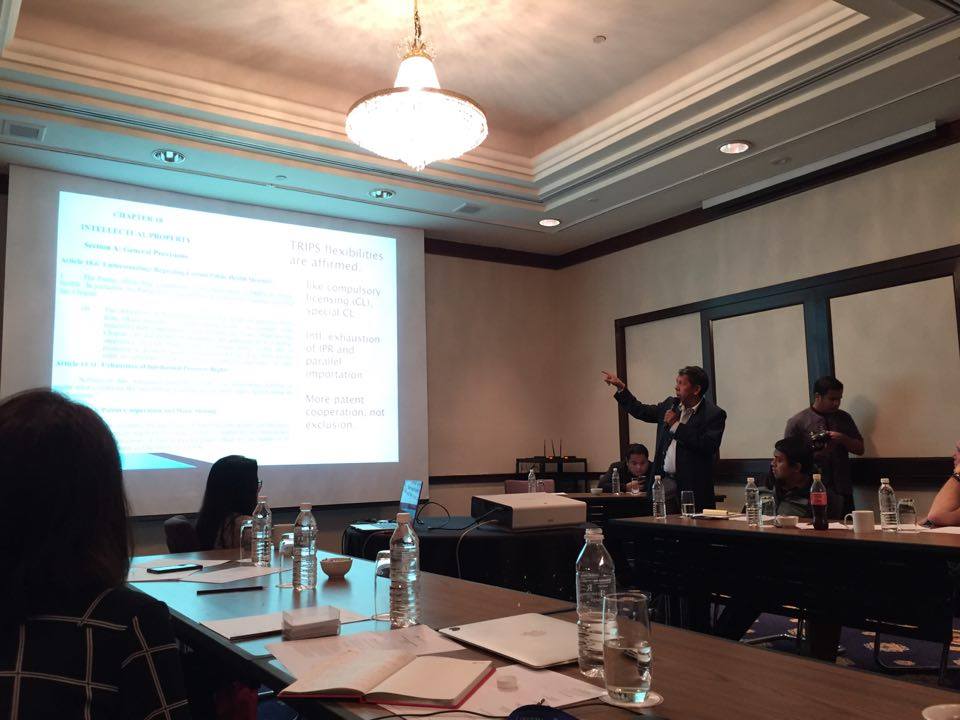
After the 4th Asia Liberty Forum (ALF) ended in Kuala Lumpur on February 20, SEANET organized a small group discussion on "business friendly regulations", same hotel venue. I was one of those invited. Below, Wan Saiful Wan Jan, CEO of IDEAS and Director of SEANET, spoke to explain once again what the meeting-seminar was all about.


Aside from independent think tank leaders from some ASEAN countries, some friends outside the region were also there, like Barun Mitra, Cris Lingle, Julian Morris, Lorenzo Montanari.


I gave a brief presentation. Brief as in 8 minutes or less.


TPP’s liberalization agenda will:

1. Force open members’ economic sectors such as agriculture, affect poor peasants, women

2. Further push them into poverty, compete with giant agricultural corporations from more developed countries

3. Increase corporations’ access to indigenous people’s lands and territories for resource extraction without their free prior informed consent (FPIC)

4. Undermine country’s right to reject genetically modified
organisms (GMOs), subject those GMOs to prior risk assessment; ensure uninterrupted trade for GMOs to the benefit of major GMO producers and exporters like the US and Canada

5. Permit corporations to violate labor rights by making it easier to offshore jobs to countries with lower labor standards

6. Encourage more inflows of migrants who later forced to become undocumented migrants  to add more cheaper and docile labor


7. Endanger people’s right to quality and affordable healthcare due to strict intellectual property rights (IPR) on patents, data monopolies to medicines

8. Make educational materials become expensive with strict IPR

9. Violate internet users’ privacy rights and will stifle creativity and freedom of expression through severe copyright rules

10. Mean death to democracy, allow corporations to use investor-state dispute settlement (ISDS) to attack public interest laws to increase their profits; corporations suing governments over living wages, environmental protection , people’s access to public utilities

11. Have knock-on effects on the whole region, have potential to be the standard that all future trade deals will follow


12. Promote the hegemony of corporations, neoliberal regimes and political and economic dominance of the US and other powerful States over the developing and underdeveloped economies of the world.


Among the prominent arguments why people hate the TPP and other FTAs with the US and EU is that stronger IPR protection would mean more expensive medicines, affecting even off-patent, generic drugs. Is this true?


No. Perhaps all TRIPS flexibilities with regards to newly-invented medicines were respected by the TPPA. Like these texts, the red comments on the right are mine.

Then I added another aspect of IPR infringement, the abolition of trademarks and brand logo for cigarettes.


Concluding Notes:

1. Joining the TPP has more gains than pains for member-countries, especially in exports and overall GDP expansion.

2. IPR health provisions in TPP not scary, apply only to newly-invented medicines and not to cheaper generic drugs. Existing TRIPS flexibilities for new meds are maintained.

3. Possible that generic pharma lobby + anti-capitalism, anti-globalization NGOs created more fear than what the TPPA actually provides.

4. More to fear in government taxation of medicines, mandatory drug price discounts and price controls, than IPR protection.

Brief presentation, I think I spoke for only 7-8 minutes, then the others gave their own inputs and insights on other topics. The full 14-slides presentation is available in slideshare.
-----------

Meanwhile, the debate seems raging in Malaysia now regarding their government's plan to introduce plain packaging in tobacco products too. All these news reported since last week.


It's now a Singapore-Indonesia-Malaysia triumvirate of tobacco plain packaging legislation. Soon it will infect the governments and stakeholders in the Philippines, Thailand, Vietnam, etc. And if they succeed, next would be beer, whiskey, other alcohol products? Then chocolate bars, soda and cola. The WHO should be involved in this new government initiatives. I will follow this development.
------------

See also:

Monday, January 18, 2016

IPR and Innovation 29, Civil society enforcement of patents, copyrights

Property rights, physical or intellectual, are good only if they are enforced. While the means of property rights protection is via government, national and local, there are other non-governmental, professional and civil society way of enforcing IPR. Some news reports here last year. 

(1) "The benefits of a strong regime of property rights apply just as much to intangibles as to land and goods. We long ago worked out how to make the ownership of cars and houses and factories work, but we are not always as effective at protecting the interests of the originators of an idea, the creators of a work of art or design, or the inventors of a scientific process. Yet the benefits from clear ownership of intellectual property (IP) are every bit as clear as those flowing from the ownership of land and buildings. Those of us who watched the ease with which the private sector beat the government in mapping the human genome is but one recent example of the galvanising effect IP can have on investment in R&D."

(2) "Imagine spending years on research, experiencing a breakthrough, developing a new tool, technology, or medicine, but knowing that your innovation may not be protected. Many innovators around the world face this harsh reality. Intellectual property creates value – both socially and economically- by creating jobs, driving economic growth, and enriching our culture. Yet, despite these things, intellectual property protections around the globe remain inconsistent."

(3) "Rather than looking to Washington for solutions, a coalition of thousands of advertising firms are looking to collaboration to combat digital piracy and counterfeiting in today’s globalized economy. This new initiative is part of an industry led and managed effort designed to restrict the activities of those that promote counterfeit or stolen products and hamper innovation.

Earlier this week, the Trustworthy Accountability Group (TAG), a coalition of advertising industry groups, launched the “Brand Integrity Program.” The initiative, supported by the Association of National Advertisers, the American Association of Advertising Agencies, and the Interactive Advertising Bureau plans to “attack ad-supported piracy, digital advertising fraud, malware, and other deficiencies in the digital communications supply chain.”

(4) "In order to realise the goal of an industrialised India, policymakers, the legal community and industry must prepare a synchronous blueprint to align the objectives of our nation building with a responsive IPR regime. Such a regime must lay down the minimum IP capability and process maturity standards for government institutions, industry, education system, judiciary and legal environment."

(5) With the strongest data protection laws in the Asia-Pacific region, Japan and the US have become leading centers for biologic research. There are plenty of reasons for others to join them in setting high standards. Relative to traditional chemical formulations, development of biologic medicines involves fewer barriers to entry. The sector is dominated by small, start-up companies. Today, many countries can foster a dynamic medicines sector, and firms in Singapore, Malaysia and elsewhere are among those leading the way."

(6) "Unfortunately, attacking patents is a misguided way to improve access to medicines in low and middle-income. Although it is a counter-intuitive conclusion, strong patent rights are a better way to achieve this goal.

In an international environment of strong patent rights, innovative drug makers would have every incentive to lower prices voluntarily to poor countries. Costs of manufacturing and distribution are a small percentage of prices charged for patented medicines in the United States. The reason the government recognizes patents is so the manufacturer can charge enough to earn a return on investment in research and development."


Nearly 3 years ago, I briefly debated Jeffrey Tucker, a famous anti-IPR libertarian anarchist. He wrote,

"If patents for inventions were part of the free market, to make and sustain them would not require legislation, constitutions, bureaucracies, filings, armies of attorneys, and years of litigation."

I countered that it is faulty thinking because:

"One, physical assets like cars,... are part of the free market, and they require legislation, constitution, bureaucracies.. And so IPRs are also part of the free market, they are property rights that need respect and enforcement.

Two, private property rights can be enforced by the private sector or civil society, with or without govt penalties. If thieves and shoplifters are caught inside a mall, they are apprehended by private security guards, they can be photographed and their faces plastered in the mall in a wall of shame...

The same way, thieves of IPRs like patent, trademark and copyright can be penalized by an industry association, a civil society org. If someone sells burgers wrapped with fake McDo or Burger King wrappers and trademark, and the consumers get good poisoning, who will they sue -- (a) the orig McDo/BK, (b) the IPR thieves like those sellers, or (c) IPR abolitionists like Jeff Tucker? Obviously (a) and (c) will not accept responsibility so (b) must be prosecuted for misleading the public and consumers."
------------

See also:

Saturday, November 28, 2015

Free Trade 57, Growth, IPRI 2015 and the TPP

Two weeks ago, I attended the launching of  the International Property Rights Index (IPRI) 2015 Report in Kuala Lumpur, then I also gave a short presentation on IPR and the Trans Pacific Partnership (TPP) Agreement.


I showed portions of Dr. Ramon Clarete (University of the Philippines School of Economics, UPSE) paper during the UPSE-Ayala forum, Going Regional: Which Mega Trade Deals Should the Philippines Join? last February 2015.

He used the Gravity model of trade in estimating the level of bilateral exports or imports between two trading partners.

* Dependent variable: flow of trade between and among countries studied

* Independent or explanatory variables, their expected signs or relationships: GDP (+), population (+), dist. between two countries (-), commonality of language (+), shared borders (+), landlocked state (-).

* In addition, TPP and RCEP indicators or dummy variables are introduced: (a) TB1, 1 if both trading countries are TPP or RCEP members, 0 otherwise, (b) TB2, 1 if exporting country is a TPP or RCEP member, 0 otherwise; (c) TB3, 1 if importing country is a TPP or RCEP member, 0 otherwise. For overlapping memberships, a dummy variable where TPP*RCEP =1 if both trading partners are members of the two trade blocs.

And here are some results.


Then I briefly discussed my article in BusinessWorld that day, Property rights protection in APEC economies. Then I discussed the IPR on medicines aspect of the TPP.


And showed actual texts in the TPP agreement....


Below, from left: Lorenzo Montanari, Exec. Dir. of the Property Rights Alliance (PRA); Dr. Sary Levy, author of IPRI 2015, and Wan Saiful Wan Jan, CEO of IDEAS and Director, SEANET.


Concluding Notes:

1. Joining the TPP has more gains than pains for member-countries, especially in exports and overall GDP expansion.

2. IPR health provisions in TPP are not scary, they do not reduce access to cheaper generic drugs. Existing TRIPS flexibilities are maintained.

3. It seems that the generic pharma lobby + the anti-capitalism, anti-globalization NGOs created more noise and fear than what the TPPA actually provides.

4. There is more to fear in government taxation of medicines, in mandatory drug price discounts and price controls, than IPR protection.

“IPR create incentives for businesses to invest in ideas, to develop new products, and to earn a profit from the sale of those products. This in turn leads to improved customer satisfaction, improved profitability, and greater employment opportunities.”
– Prof. Sinclair Davidson, RMIT Univ. (Econ Dept.), Melbourne, Australia.

The full presentation is posted here.
------------

See also:

Tuesday, October 06, 2015

Free Trade 55, TPP Agreement, finally

Finally, the Trans Pacific Partnership (TPP) Agreement will become a reality soon. The final language and texts will take a few more weeks, but the deal has been reached among  the original 12 member-economies. Next stage will be ratification by each country, especially in the US Congress.


The Philippines is not in the original 12 TPP countries but will soon in the second wave of signatories. I support the PH to become a TPP member too. There are risks and "losses" but there are greater opportunities and benefits. Overall, there will be "net gain" (positives outweigh the negatives) from freer trade, there is net gain in joining the TPP. This graphics from the NYT


Compared to the ASEAN Free Trade Area (AFTA) or the Regional Comprehensive Economic Partnership  (RCEP, ASEAN 10 + 6 regular partners China, Japan, S. Korea, India, Australia and NZ) or APEC, the TPP is considered a "gold standard" in regional and multilateral trade agreements because of certain provisions that reaffirm private property rights, like IPR. At the WTO and UN, there are certain agreements that attempt to negate those private property protection, like an elaborate system of TRIPS flexibilities.

The usual fear and objection to TPP is that "big pharma to squash generics, or equivalent knock-offs of high priced drugs." So TPP "works to protect big pharma at the expense of patients in the developing world."

It is a big misconception that patent for newly-invented drugs apply even to old, off-patent, generic drugs. No. For instance, amlodipine molecule (against hypertension) is already off-patent. Any generic manufacturer, thousands of them worldwide, can make their own brand of amlodipine and sell at the lowest price they can afford or endure due to heavy competition. In the PH for instance, I think there are about 200 different brands of amlodipine generics alone. Any TPP or similar agreement will not affect these generics.

If another company produces another molecule against hypertension with a different property, say effective for patients with hypertension + diabetes + asthma and so on, the patent applies only to that newly-invented, patented molecule.
  
People refer to compulsory licensing (CL), a provision in the TRIPS flexibilities in the WTO which signatory countries respect, in advocating for certain types of patent confiscation. Opposition to TPP is generally misplaced and driven by emotions.

"Why is big pharma such a big supporter of TPP?" some ask. Well, big innovator pharma and big generics pharma support the TPP. Generic manufacturers in Vietnam and Malaysia can soon export their products big time to the US, Canada, markets that are otherwise protected due to high health, sanitary, technical barriers. 

A friend, Bruce Hall, made this useful observation:

Corporations in general want consistency so that they can plan and invest. If one does not know what is happening from one year to the next when it comes to patent law or importation rules or what-have-you then one cannot know if one will get the investment back. TPP provides a single set of rules across a large portion of the planet that is not subject to the whims of politics. It is likely that big pharma supports TPP so that same reason that other exporters support it -- more markets.

TPP has actually led to the US agreeing to patent rules more in line with other countries' rules. See http://www.reuters.com/.../us-trade-tpp-australia...

TPP will not be the end of patent fights. Ultimately the fate of patents will lie within American politics. While outside pressure will help around the edges (see the linked article), patent law in the US will only be changed when US politics changes (which it constantly is). Unfortunately, too many domestic US pressure groups are using TPP to push their own agenda. We should not be swayed by such efforts. TPP is about building an international system based upon the rule of law and free trade that is flexible enough to address whatever changes will occur within global economics

Besides, many people who attack "big pharma" (referring to  the big multinational pharma) do not realize that in  many economies, they unknowingly attack big generic pharma. In the PH for instance, the big, huge, monster pharma here is not a multinational and innovator, but a local, generic pharma, United Laboratories (Unilab). It's annual gross sales is 1/4 of the total PH pharma market, and bigger than the combined sales of #s 2, 3 and 4 (Pfizer, GSK, another multinational).

For free marketers, the best trade arrangement is unilateral trade liberalization, least involvement and restrictions by governments in voluntary trade and exchange among people and private enterprises. Since this is far out from happening, a regional and multilateral FTA is the second-best solution.
------------


See also:


Wednesday, September 30, 2015

IPR and Innovation 27, India strengthening its IP protection

There are a number of positive news in India recently regarding strengthening its intellectual property right (IPR) protection. Among the most recent was the article at The Hill by Mark Elliot, the EVP of the U.S. Chamber of Commerce’s Global Intellectual Property Center (GIPC). He wrote,
The ultimate goal – both for India and for all nations striving to foster economic growth and global competitiveness – is to put in place policies which lay the groundwork for the creation of a true knowledge-based economy.  For that to happen, the government must create guidelines which provide greater legal certainty for private sector investors, create a viable technology transfer mechanism, and foster greater enforcement of legislation aimed at protecting IP-intensive industries in India. Each of these factors, in turn, will support the creation of a robust innovation ecosystem, one from which India surely has the most to gain.
Then a report from NDTV, India to protect intellectual property rights, PM Modi  tells media heads,
"This is a technology driven era. We are a technology driven society... We are committed to protecting IPR which is essential to fostering creativity," PM Modi said. In May, the US had kept India and China on its Priority Watch List of trading partners that fail to protect intellectual property rights of its enterprises that invest in India, hurting the economy.


And this news from The Hindu,


Thanks to those pieces of good news. It is not possible to have more revolutionary and costly innovations in many sectors and sub-sectors of an economy if the inventors and innovators cannot internalize the rewards of success and the losses of failures, simply because a horde of copy-catters are just milling around to say later on, "we also invented that" and do good business even if they contributed nothing to the discovery of new molecules, industrial and circuit designs, new songs and books, and so on.

Meanwhile, Pugatch-Consilium released its new report, the Biopharmaceutical Competitiveness and Investment (BCI) Survey 2015. From the few selected countries covered by the report, here is the summary of BCI scores and ranking. India ranked 11th out of the 15 countries surveyed.


For India in particular, a score below 60 means that it is non-competitive in biopharmaceutical research, clinical trials and investments.


The US Chambers' GIPC also released the supplementary statistical charts and analysis, Unlimited Potential, also prepared by Pugatch-Consilium. Below, the report plotted the data of the GIPC Index Score and the Global Innovation Index 2014.

While Singapore, S. Korea and Japan scored high, India and Indonesia scored low, though not as low as Nigeria's.


Also a plot of GIPC index score and Online creativity score, and India and Indonesia scored low, though not as low as Nigeria's.


Hence, the recent pronouncements by PM Modi. He needs to counter the low or negative image of India when it comes to respecting and protecting the various products of the mind and intellectual entrepreneurship.

The main role of government in this case is to lay down rules that are fair and transparent to all players, to protect private property whether they are physical or non-physical/intellectual.
-------------

See also:
IPR and Innovation 23, Letter to WIPO by 85 think tank leaders from 51 countries,July 21, 2015 

Sunday, September 13, 2015

IPR and Innovation 25, Malaysia's IP Monetization strategy

There is a report this week about Malaysia's "IP Monetization" program as articulated by PM Najib Razak.  From that news,  "We need to be competitive in our bid to become a high-income nation that is not dependent on traditional and physical resources but is based on new sources of wealth such as intellectual property.

"To ensure the country's continued momentum in making intellectual property a new source of wealth, we have a responsibility to be more innovative and creative as well as to constantly create value added in order to come up with high-impact products and technologies for the local and global markets," he said at the National Intellectual Property Awards 2015 today.

Najib, who is also finance minister, said the effectiveness of initiatives to strengthen the national intellectual property ecosystem was shown by the 6% average annual rise in applications.

This shows the potential of intellectual property to contribute to national economic growth, he said, adding the government had agreed to consider providing an allocation to encourage intellectual property rights applications as part of efforts to raise the number of registrations. Some 42% of intellectual property rights applications are from within the country. 

Well and good. Kuala Lumpur is just 4 hours away by car from Singapore, the center of IPR protection and the richest economy in the ASEAN. The interdependence between  the two  in  trade and investments, both physical and non-physical/intellectual commodities, is high.

More and more, the world is moving towards high value products and services production and trade. New mobile  phones, flat or curved tv, other appliances and  furnitures with sleek, modern  or exotic designs, etc. are all guided by new ideas that were non-existent  and  unimaginable just a few decades ago. And these ideas are protected by various forms of IP protection -- patent, copyright, trademark, service mark, industrial designs, circuit designs -- to protect the innovators and inventive people and enterprises from copycat ones.

The program or strategy is good, except that PM Razak is still embroiled in a huge corruption scandal that greatly diminishes his credibility and effectivity in initiating new programs.

On a related note, I saw from a World Intellectual Property Organization (WIPO) website the various IP laws and IP-related laws of Malaysia.


They have a law for each type of IP. Being a non-lawyer, I am not sure if this is better than a single, big and long law that covers all types of IP that we have here, the IP Code of the Philippines (RA 8293) enacted in 1997. One advantage of one law for each type of IP perhaps is that if we revise or amend in the future one aspect, say only the patent system or copyright system, it will not affect the whole big law -- and cause some confusion.

Nonetheless, establishing clear property rights for the people, physical or non-physical property, is one of  the most important functions of any government. More important than endless welfarism and  political populism.
---------------

See also:

Tuesday, August 18, 2015

IPR and Innovation 24, The US-China IP cooperation dialogue

Here is another instance that while there are hawkish calls for military and political confrontation between the US and China in the future, another side of reality is that there are many instances of cooperation and dialogue between the two biggest economies in the planet. Being a non-believer and non-advocate of  BIG government, I side with the non-militarist view, of more trade and investments relations between and among countries as the key to a more peaceful, more prosperous world.

There is an existing US-China Intellectual Property (IP) Cooperation Dialogue. The first report was released last year and the new, second report was released by the joint US-China working group only last August 10. This initiative is a collaboration between the U.S. Chamber of Commerce and Renmin University’s China Intellectual Property Academy.  Meaning this is a non-government, civil society initiative, and it brings together 10 thought leaders annually, five each from the US and China.

It is a good initiative, to strengthen IP rights in China. Being politically socialist, the possibility of the China government socializing and nationalizing certain private properties, physical or non-physical/intellectual, will always be there, no matter how small that possibility is. Thus, involving the academe and other civil society actors to help strengthen the rule of law, encourage people, public and private leaders, to respect and protect private property is a great initiative.

I saw the report. It examines five key areas: (1) IP and innovation in the technical sector, (2) IP and innovation in the pharmaceutical sector, (3) judicial protection of IP, (4) trade secrets protection, and (5) copyright enforcement.

This is the report’s Executive Summary:

• Use quality instead of quantity as the measure of innovation.

• Explore the possibility that a judicial interpretation be issued to ensure no injunctive threat is available until utility model patents have been substantively examined for validity.

• Adopt a more balanced and market-driven approach to promote innovation by entrepreneurs, inventors and universities.

• Improve the patent linkage system, and provide effective protection for clinical data of new chemical entities by using the ongoing effort to amend the Patent Law and the Drug Administration Law as an opportunity for change.

• Initiate a special study on establishing a single IP appellate court to unify China's judicial adjudication of IP.

• Improve the guiding case system with respect to procedures for reviewing, selecting and releasing cases and support better adoption of case law information.

• Recommend research on the possibility to have a stand-alone and uniform trade secret law, in order to effectively maintain a fair market competition environment.

• Address new problems created by changing technology and business models; develop a good ecosystem for innovation by the interaction of law and the marketplace; and provide more market opportunities for copyright holders while dealing with piracy.

Cool. The report also examines why China’s talent pool and investments did not result in new drug discoveries and calls for transparency and stability of the Chinese legal process, including establishing one single IP appellate court, a searchable case database and an amicus system. 

As I argued in my previous papers here, not all ideas are the same. Many are too common or wild or plain lousy and idiotic and hence, they do not need protection. Their supply is very high and non-scarce. Bright ideas are scarce, they need protection. 

An effective IP system that leads to a lot of innovation should be supported by the rule of law and implemented in a competitive environment. Continued innovation, improvement of old and existing technologies and processes, is our assurance for a more prosperous, wealthier and healthier life in the planet.

I hope that this non-government, civil society initiative will be heard and studied especially by the China government. Being a member of the civilized international community of nations and governments, respect of private property even by socialist leadership is a responsibility of member-governments.

See the full report here, 70+ pages, more than half in Chinese language, http://www.theglobalipcenter.com/wp-content/uploads/2015/08/US-China-IP-Dialogue_2014-2015.pdf
------------

See also: