Showing posts with label trademark. Show all posts

Thursday, March 22, 2018

IPR and Innovation 42, Coalition letter to WHO re plain packaging

Today, a global coalition of 62 market-oriented independent or non-government think tanks and institutes sent a letter to the WHO. Three institutes from ASEAN countries were among the signatories -- CIPS in Indonesia, IDEAS in Malaysia, and MGT in the Philippines.


Dr. Tedros Adhanom Ghebreyesus
Director-General
World Health Organization

December 01, 2017, marked the five-year anniversary of the full implementation of plain packaging in Australia. The removal of brands and trademarks from packaging remains a gross violation of intellectual property rights and has failed to achieve its intended goal. As a global coalition of sixty-two think tanks, advocacy groups and civil-society organizations that have been critical of plain packaging for any product, we write in response to proposed plain packaging tobacco control measures and to the announcements by several countries of their interest in pursuing these policies.

Intellectual property rights are human rights enshrined in the Universal Declaration of Human Rights: Article 17, the right to ownership; Article 19, the right to freedom of expression; and Article 27, the right to protection of material interests. In this regard, even if plain packaging is effective, it should still be repealed, as rights are inalienable and should not be discarded for political purposes.

International trade law, the UNDHR, and historic international treaties are designed to protect intellectual property for this very purpose. The innovation incentive created by trademarks fuels competition and produces amazing products demanded by consumers like affordable medical advances that save lives. Obviously, any loophole should be closed, not exploited....


After Australia implemented the policy, other industries have been targeted around the world: alcohol, sugary beverages, fatty foods, even toys. These industries employ millions and any regulation that would deny key IP assets would have a devastating global economic impact. The trademark value alone of only twelve companies associated with these sectors is estimated to be more than $1.8 trillion.

The costs of plain packaging are enormous: the loss of the innovation incentive to the economy and society are inestimable, the mutilation of established international IP law is unprecedented, and the market carve-out to illicit actors, including terrorists, is reprehensible. It is beyond reason that such a policy continues to be pursued, even after it has failed to achieve its intended goal.

We urge the WHO and governments around the world to stop infringing on intellectual property rights with plain packaging policies.

---------------

See also: 

Tuesday, December 12, 2017

BWorld 169, On tobacco tax and plain packaging

* This is my column in BusinessWorld last November 30, 2017.


Protection of private property rights — including physical and intellectual — is an important cornerstone of a free society. People can exclusively use, keep, sell, donate or give away their property if they want to.

There is a measurement of property rights protection worldwide being done annually by the Property Rights Alliance (PRA), a Washington DC-based think tank. It produces the annual International Property Rights Index report and partners with independent, nongovernment, and market-oriented think tanks and institutes from many countries. IPRI covers three major areas: (1) Legal and Political Environment, (2) Physical Property Rights (PPR), and (3) Intellectual Property Rights (IPR) that include protection of patents, trademarks and brands, copyrights and trade secrets.

In the IPR of several ASEAN countries, the gap is not very wide between say, Singapore and the Philippines or Indonesia (see table).


Currently, there are IPR issues that are intertwined with taxation issues of some “sin products” like tobacco and alcohol.

In the Philippines, the sin tax law of 2012 or RA 10351 is turning five years old next month. The law has dual purposes of (a) reducing smoking and drinking incidence in the country by raising tobacco and alcohol taxes, and (b) raising more government revenues.

So far, both have been achieved but there are moves and legislative bills to further raise tobacco tax to twice or thrice their current rates.

In December 2012, Australia introduced a variant of this law aimed to further discourage smoking. Its plain packaging law required tobacco companies to remove the brand, trademark, and logos of its tobacco products and replace them with plain packs with graphic warnings.

Since some smokers may be unable to distinguish good brands from new and/or inferior brands, they are supposedly discouraged from stop smoking.

While the goal is good — to protect public health — the means and the policy leaves much to be desired.

Since it is assumed that consumers can no longer distinguish good brands from inferior ones, brand competition is precluded.

As a result, companies will now be forced to compete on the basis of prices alone, allowing players with poor but cheap products to gain advantage and attract more customers.

Which may then defeat the purpose of anti-tobacco initiatives because this may yet increase the incident of smoking.

Five years after introducing its plain packaging scheme, has Australia been able to meet its goal?

The Australian government collects data on national smoking incidence every three years as part of its National Drug Strategy Household Survey (NDSHS).

Based on 2016 data — its most recent — there has been no statistically significant decline in the overall daily smoking rate between 2013 (12.8%) and 2016 (12.2%).

So the plain packaging scheme is a failure in Australia.

Moreover, the plain packaging law has unwittingly succeeded in raising the consumption of illegal tobacco, estimated at 13.9% of total consumption in 2016. This results in an estimated excise tax loss of A$1.6 billion for the government last year.

Furthermore, Australia is also facing a dispute resolution panel at the WTO for implementing the law that disrespects IPR laws on trademark and branding.

France and the UK have also introduced the plain packaging scheme in recent years. One unintended result in France is the rise in illicit tobacco coming from some terrorist groups and criminal syndicates while the French government suffered an excise tax loss of approximately €2 billion in 2016. This illicit trade was linked to jihadists traveling to Syria and Iraq and terrorist attacks in France. Counterfeit cigarettes are also among the most investigated IP-crime in the UK and are linked directly to criminal organizations.

In Asia, there are plans to introduce plain packaging legislation in Singapore, Malaysia, Taiwan, Sri Lanka, and Nepal.

This may a dangerous precedent.

Soon, other “sin products” will be targeted — alcohol, sugary drinks and beverages, fatty foods, even toys.

I am a non-smoker and have never been a fan of smoking. I am just a fan of individual liberty and people having the freedom what to do with their own body and life, also a fan of the rule of law and people’s right to private property.

The plain packaging scheme is dangerous because (a) it disrespects private property rights and IPR laws, (b) encourages the production of illicit items from illicit and possibly criminal players who can easily play with price competition, (c) it encourages more consumption because very cheap products with no brands are more easily available, and (d) it reduces government potential excise tax revenues, which might result in creating new taxes elsewhere.
--------------

Sunday, November 05, 2017

IPR and Innovation 39, Recent IP developments in CN, TW, KR, ID

Reposting these news stories collated by PRA, enjoy.
-----------

China.org.cn, September 19, 2017

The Chinese government has begun a campaign to protect the intellectual property rights (IPR) of foreign companies.

The campaign will focus on malicious trademark registration and imitation of foreign brands, the Ministry of Commerce said Monday, citing a joint action plan by 12 government departments.
From September to December, the campaign will also target infringement of online IPRs, patent rights and plant variety rights, as well as industrial espionage, according to the plan.

Lexology, October 20, 2017

China is in the middle of a rapid shift towards cloud technologies. Execution of the 13th Five Year Plan will deliver substantial investment into cloud computing and the sector is undergoing unprecedented growth. Meanwhile, organisations operating in this digital economy face an increasingly complex intellectual property (IP) environment, as China becomes a global IP center and scales up IP protection, enforcement and penalties for infringement. Indeed, the number of cloud-related IP lawsuits in China grew 158% between 2011 and 2016. Against this backdrop, organisations face an important question: how can they take advantage of the enormous opportunities presented by the cloud in a way that manages this complex IP landscape? In this post, Matt Pollins and Nick Beckett from CMS look at the practical steps organisations can take to protect themselves and succeed in the cloud. 

World Trademark Review, September 26, 2017

A major amendment in Taiwan to the regulations governing customs border measures will play a key part in protecting trademarks. The measures allow the owner of a trademark registered in Taiwan to file an application with Customs to have the trademark recorded on its database enabling Customs to seize counterfeits when it inspects imported or exported goods ex officio. The legal basis for this mechanism is rooted in the Regulations Governing Customs Measures in Protecting the Rights and Interests of Trademark, which is enacted pursuant to Paragraph 2 of Article 78 of the Trademark Act.

XinhuaNet, October 10, 2017

South Korea's unification ministry on Tuesday urged the Democratic People's Republic of Korea (DPRK) not to violate property rights owned by South Korean companies which had operated factories in the currently closed inter-Korean industrial complex.

The Economic Times, October 27, 2017

Seeking to achieve a "more balanced" trade relationship, the Trump administration has pressed India on key issues like market access, lifting of trade barriers and intellectual property protection. During the first US-India bilateral Trade Policy Forum (TPF) under the Trump administration which was attended by US Trade Representative Robert Lighthizer and Union Minister of Commerce and Industry Suresh Prabhu, India strongly differed with the American position on many of the contentious issues.


PRA

During a meeting in New Delhi last week, Indian Commerce & Industry Minister Suresh Prabhu announced how "extremely important" it is for India to protect intellectual property rights. Minister Prabhu noted that the Indian economy has undergone robust changes during recent decades and is now a leader in innovation and developing technologies.
-------------- 

See also:

Tuesday, October 24, 2017

IPR and Innovation 38, Recent IP developments in some ASEAN countries

Property rights protection of both physical and non-physical/intellectual -- trademark/logo, copyright, patent, etc. -- is among the cornerstones of dynamic, mature and market-friendly economies. Individuals and enterprises develop new products and services via innovation and they create new value, new wealth for society.

I am reposting some developments on IPR in the ASEAN. Thanks to the Property Rights Alliance (PRA) for the bi-weekly IP updates.
---------------

The Nation, October 02, 2017 

There's a role for intellectual property protection in the Thailand 4.0 vision and initiative, and the national government's Intellectual Property Department sees a role for itself promoting innovation through offering increased knowledge sharing and more convenient services.

"We are a key mechanism in protecting new technology and innovation vital to economic development, and we do this by motivating new developments," said Thosapone Dansuputra, director-general of the department.

Lexology, October 04, 2017

As of November 2017, Thailand will accede to the so-called Madrid Protocol as member no. 99. This entails cost savings compared to previously when trademark proprietors are to register their trademarks in Thailand. The Madrid Protocol is an international system through which trademark proprietors may apply for protection in several countries through one basic registration.

The Edge Markets, October 10, 2017 

Website blocking in Malaysia has significantly reduced online piracy, with a 74% fall in traffic to pirate websites recorded in the six months after the government initiated its sixth effort to block such sites in June 2016, says the Motion Picture Association (MPA). As pirate websites generate income through advertising revenue, a disruption to their business model can help stop online piracy, said Oliver Walsh, regional director at the Asia-Pacific hub for Motion Picture Association International (MPA-I).

XinhuaNet, September 19, 2017

The number of trademark registrations is lagging in Laos as many businesses lack understanding of their rights and fail to register to protect their intellectual property, according to the Intellectual Property (IP) Department under Ministry of Science and Technology on Monday.

PRA, October 6, 2017 

According to a study by the Intellectual Property (IP) Department of the Ministry of Science and Technology, only about 40,500 trademark applications have been filed in the Southeast Asian country since 1991. This is a relatively low number of applications for trademark protections for a country of 7 million and an economy with a GDP of $37.3 billion.

Lexology, October 11, 2017

On August 28, 2017, the Brunei Intellectual Property Office (BruIPO) signed an agreement to introduce a new patent examination initiative - the Patent Prosecution Highway Plus (PPH+) - with the Japan Patent Office (JPO), which commenced on October 1, 2017. Using this PPH+ system, patent prosecution procedures in Brunei are accelerated by allowing BruIPO to reuse the search and examination results of corresponding patent applications filed in Japan - thus reducing examination workload and time, minimizing costs, and improving patent quality.
-------------

See also:

Saturday, September 30, 2017

BWorld 153, Property rights, trademarks and consumer protection

* This is my article in BusinessWorld last September 18, 2017.


Private property rights that people and businesses enjoy are among the cornerstones of a free and dynamic society. People have exclusive rights on what to do with their private properties — use them, sell, rent out, or donate.

However, when rights to private property — both physical and intangible assets — are unprotected, society can quickly degenerate into disorder. As a result, consumers will be unable to recognize which among manufacturers and service providers are trustworthy and which are suspicious.

Measuring the extent of property rights protection across many countries is done annually by the Property Rights Alliance (PRA), a Washington DC-based think tank. It produces the International Property Rights Index (IPRI) annually and partners with independent, nongovernment, and market-oriented think tanks and institutes from many countries.

IPRI is derived by getting the score (1 to 10, 10 being the highest) of each country covered in three major areas:

1. Legal and Political Environment (LP), covers judicial independence, rule of law, control of corruption, and political stability of a country or economy.

2. Physical Property Rights (PPR), includes registration and protection of physical properties, access to loans.

3. Intellectual Property Rights (IPR), includes protection of patents, trademarks and brand, and copyrights.

Countries with high scores in two or all three of these areas will have a high IPRI overall score and global rank (see table).


Among the important insights in the above numbers are: One, the more developed the economies are like Singapore and Japan, the higher the IPRI score and global rank. Which implies that as private property is better recognized and protected, there are more economic activities and innovations that occur.

Two, the Philippines experienced some improvement in its global rank, from 77th out of 131 countries in the 2013 report. It rose to 64 out of 127 countries in 2017. Its low score in legal and political environment was compensated by its high score in physical property rights.

One emerging issue in IPR non-protection is plain packaging (PP) of tobacco products purportedly for health reasons. Besides being slapped with high taxes, tobacco products also feature graphic warnings on packaging. Advertising tobacco products have also been restricted and smoking in may areas have been disallowed, which are part of several moves to deter people from lighting up.

These have been tried in many countries but smoking incidence does not seem to significantly decline as people shift to cheaper and often, illegal, illicit products. So the next step is to prohibit the use of a tobacco brand, logo, or trademark. This has been done in Australia and there are plans to introduce legislation in Singapore, Malaysia and Taiwan.

This plan does not appear to be right because a brand or logo of a company represents how effective it is in developing consumer loyalty and service. Imagine also if all ice cream, all soft drinks, all beer, all wine, etc. will simply be labeled as “ice cream,” “soda,” “beer,” etc. with no brand recognition of who produced or manufactured the products.

Or all government departments and agencies (DoH, DoF, DPWH, NEDA, etc.) will lose their logo and will simply have a generic brand “Philippine government,” it would not seem right.

I have never been a smoker nor have I been a fan of smoking but was once a fan of tobacco ads in cycling or in the F1 race. But I will not recommend the scrapping of a brand or trademark of companies in a particular industry. People who hate the companies should attack them as such and they may even use the company brand for their attacks.

Intellectual property rights like medicine patents, song copyrights, company brand or trademarks, play an important role of recognizing efficiency and innovation. Consumers look up to these brands and decide which ones to support and patronize and which ones to reject based on their specific needs and interests.

Governments therefore, should respect and protect these IPRs the same way it should respect and protect physical private properties. Moreover, people own their bodies and not the state nor NGOs.

After rising taxes, health warnings, and business regulations are in place, governments should leave individuals and allow them to seek their own happiness without harming other people.

Bienvenido S. Oplas, Jr. is the president of Minimal Government Thinkers, which is a member of EFN Asia and the Property Rights Alliance (PRA).
---------------

See also:

Wednesday, May 31, 2017

IPR and Innovation 36, Plain packaging from tobacco and soon to soft drinks, alcohol, ice cream products

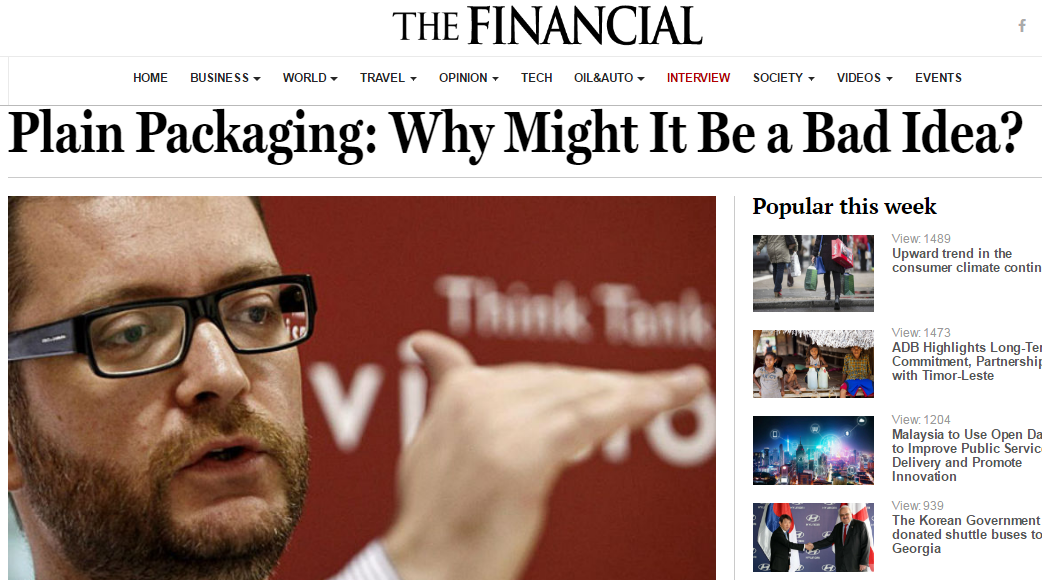
I am reposting this good interview of my friend, PRA Exec. Director, Lorenzo Montanari, published in The Financial last May 29, 2017. State nannyism is wrong, there will be too much state intervention to "protect people from 'harming' themselves", the state semi-own people's body and mind.

lorenzo
“We are really worried about the new regulations,” Montanari commented. “Plain packaging - removing all signs of the brand from the packaging of cigarettes - is a direct attack on the trademark system. The first plain packaging was implemented in Australia in 2012. We were against it and criticized it of course. As a reaction to that we have already published an International Coalition letter against plain packaging. We collected more than 40 think tank signatures from around the world; New Economic School is also amongst them. We claim that if one wants to reduce smokers’ numbers then that’s fine, but it can be done in another way, for example educational campaigns can help. The countries that have approved the law on plain packaging, for example France and Ireland, are also considering moving on to another sector, like wine, soft drinks, junk food, etc. I want to say that it is not about the tobacco itself, we care about the trademark. This is our mission because it’s intellectual property.”
Q. At present, in terms of Georgia, does it only affect the tobacco sector?
A. It has started with tobacco. It is very easy to attack this sector. In Thailand and Indonesia for example they have already started to talk about plain packaging in the wine sector too. The point is to think about the Georgian wine producer. At the moment Georgian wine is famous throughout the world. Local producers have invested so much money in building brand identity. Imagine what would happen if they weren’t able to show their label. I have heard that the Ministry of Economy, the Ministry of Finance, and even the Prime Minister of Georgia are against it. If parliament decides to implement the new law, what will happen hereafter to Georgia wine? This is the point we are strongly criticizing.
Since we analyzed the 128 country index, Georgia held 90th place. In terms of the legal political environment Georgia is not performing too badly. By registration of property Georgia is the best country in the world. The problem in Georgia is the protection of intellectual property rights. In this case we discovered the score is 2.4 - the lowest in our ranking. A policy like plain packaging will not help to improve the protection of intellectual property. I had the pleasure to speak to the Chairman of Sakpatenti. He is against this new regulation about plain packaging. We want to collaborate with them also.
Q. Can you tell us more about the experience of foreign countries which have already implemented the law?
A. The Australia National Drug strategy household survival has shown that in 2014 the daily smoking use rate was 2.5 and 1 year after the implementation was 3.4. Plus, according to the dates, afterwards a 20% increase of contraband cigarettes can be seen. Since there is no trademark it’s very easy to fake, they don’t need to reproduce the logo of the brand or label.
Even if plain packaging will reduce the number of smokers, we are still against it, because of the policy being against the principle of the trademark. I have seen interesting research by IPM. According to it, 81% of Georgians don’t have information about plain packaging. 54% of Georgians think that it will simplify the reproduction of fake cigarettes.
The Georgian Government is doing everything to make Georgia the best performing in terms of economic freedom. We are worried that parliament is moving in the opposite direction. Even in the EU, the European directive of tobacco has been approved, for example Germany is completely against plain packaging.
Q. You mentioned the EU. Georgia has signed an EU Associate Agreement which requires some changes to tobacco regulations. They also have some recommendations for approaching European standards. Do you think that this might be the reason for these regulations?
A. Germany, the leading country in the European Union, is not implementing it. This demonstrates perfectly, that even if the EU gives a recommendation, the country can still disagree. Italy and Greece are against the implementation also. If you want to cut down on the number then it’s better to hold educational campaigns. We believe that an attack on the trademark system is bad for the economy.
Q. Due to the law the tobacco industry will not have the right to conduct any philanthropy hereafter. They won’t even have the right to conduct any ads or marketing action. What do you say to that?
A. My mission isn’t to judge a law, it’s up to the Government to decide. In general, since I believe in a free market economy, if you have legal activity you can advertise. If you are legally working why should someone forbid advertising? This type of banning is against freedom of speech and expression. Removing one’s brand is the same. You can’t describe your product anymore.
Q. How can the new regulation affect the tobacco business in general and the economy as well?
A. I think that in the future if any company thinks that plain packaging will touch them they won’t invest in Georgia anymore. I honestly don’t know what tobacco companies are going to do in the future. I understand that they aren’t happy. I don’t know what will happen afterwards. What I do know is the law is violating trademarks. If we take into consideration foreign countries’ examples, in France ex-president Nicola Sarkozy criticized the plain packaging law for wine. It’s impossible to survive without brand identity.
Q. What do you think, if the Parliament of Georgia passes this new regulation, will it force some tobacco companies to leave the Georgian market?
A. I honestly don’t know. It could cause this too. For sure it is not going to be a positive signal to other companies who want to invest. Afterwards these companies might ask for help from the World Trade organization. They might find themselves in a very bad situation, because they have put millions into advertising and creating brand awareness which they now might lose.
Written By Tamta Kldiashvili
------------

See also:

Sunday, March 27, 2016

IPR and Innovation 32, On tobacco plain packaging proposal in Singapore

This is my letter to the HPB yesterday. The auto reply said they have received it and will look into it.
-------------

Subject: Singapore's plan on "Standardized packaging" of tobacco products
To: HPB_Mailbox@hpb.gov.sg

Health Promotion Board
3 Second Hospital Avenue,
Singapore 168937

Dear Sir/Madam,

I have read your campaign to control tobacco use and promote good health among Singapore citizens, it is a good objective. But I notice that you also plan to introduce or legislate “standardized packaging” or “plain packaging” in tobacco products, and I think it can adversely affect Singapore’s good image on protecting intellectual property rights (IPR).

It is true that smoking is dangerous to one's health. I myself am not a smoker, never smoked a single stick in my whole life, never worked for the tobacco industry or its allied industries. But I think people have a choice for their body. They recognize the danger of smoking -- and drinking, drugs, over-eating, sedentary lifestyle, etc. -- and still they do it. They compare the health risks with the pleasure of those actions then they decide whether to continue doing it or not; if they continue, whether to smoke 1 or 20 sticks a day, drink 1 or 10 bottles of beer a day, etc.

Plain packaging (PP) is wrong for the following reasons.

1. Singapore is known for its clear and strong property rights protection, both physical and intellectual property. Abolition or significant reduction of the trademarks and corporate logo of tobacco companies via PP will dent this image and put Singapore’s adherence to IPR protection in a question mark.

2. If Singapore is to be consistent in its policy, then it will be pressured in the near future to also introduce PP for alcohol products like beer and whiskey, soda, chocolate bars, other high sugar, high fat content meals and snacks.

3. People who derive pleasure in smoking will continue to smoke despite PP and they will likely shift to cheaper and illicit products. Overall smoking incidence can either flatline or even increase because tobacco companies will produce cheaper but cool-tasting products, which will attract new  smokers or entice the few-sticks-a-day smokers to become one pack a day smokers. PP will only adversely affect the sale of known and premium products of the big multinational tobacco  companies but not the cheap products of lesser known companies.

4. If drawn in a graph, the supply curve of cheap cigarettes will move to the right as manufacturers of premium brands will soon produce lots of plain pack but cheap cigarettes. Equilibrium price goes down while equilibrium quantity goes up, even if the demand curve does not move.

Discouraging the people from smoking can be done via more public education. The graphic health warnings, campaigns by the  Ministry of Health and health NGOs or groups are part of such public education.

But some people will continue to  smoke – and over-drink, over-eat, over-sit in  sedentary lifestyle – despite learning more and new things  about the dangers of smoking, over-drinking, and so on. Government cannot micro-manage the lives of people all the  time. What Singapore should continue protecting is its image  as the bastion of IPR  protection, whether companies are in  IT, pharma, healthcare, hotels, food,  alcohol or tobacco.

Thank you very much.

Sincerely,


Bienvenido Oplas, Jr.
President, Minimal Government Thinkers
Manila, Philippines
-------------

See also:

Monday, February 29, 2016

IPR and Innovation 32, On TPP, medicines patent and tobacco trademark

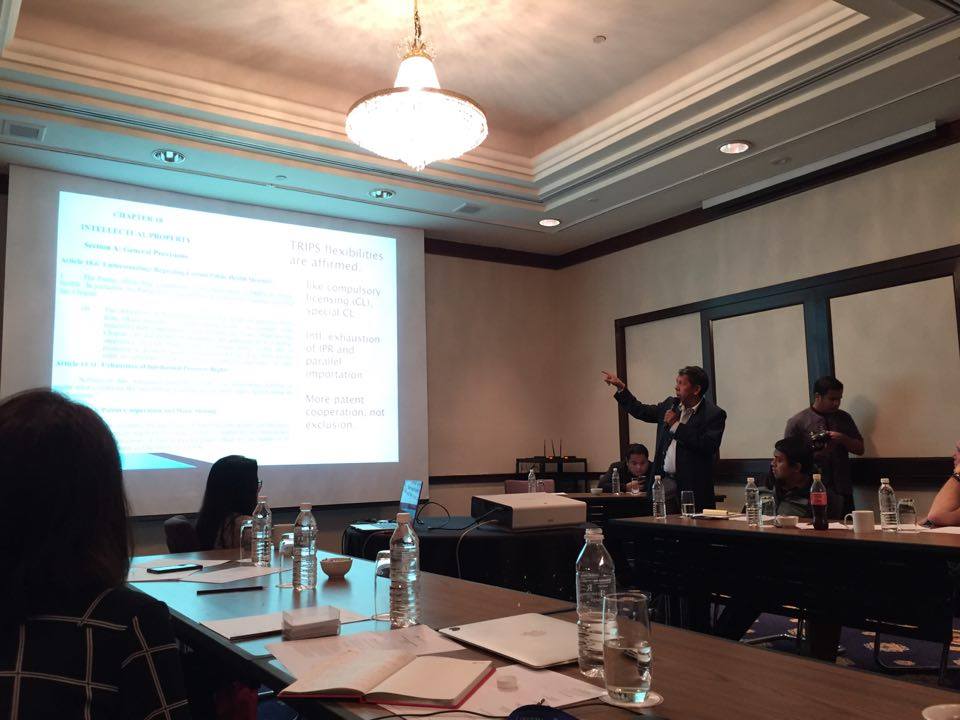
After the 4th Asia Liberty Forum (ALF) ended in Kuala Lumpur on February 20, SEANET organized a small group discussion on "business friendly regulations", same hotel venue. I was one of those invited. Below, Wan Saiful Wan Jan, CEO of IDEAS and Director of SEANET, spoke to explain once again what the meeting-seminar was all about.


Aside from independent think tank leaders from some ASEAN countries, some friends outside the region were also there, like Barun Mitra, Cris Lingle, Julian Morris, Lorenzo Montanari.


I gave a brief presentation. Brief as in 8 minutes or less.


TPP’s liberalization agenda will:

1. Force open members’ economic sectors such as agriculture, affect poor peasants, women

2. Further push them into poverty, compete with giant agricultural corporations from more developed countries

3. Increase corporations’ access to indigenous people’s lands and territories for resource extraction without their free prior informed consent (FPIC)

4. Undermine country’s right to reject genetically modified
organisms (GMOs), subject those GMOs to prior risk assessment; ensure uninterrupted trade for GMOs to the benefit of major GMO producers and exporters like the US and Canada

5. Permit corporations to violate labor rights by making it easier to offshore jobs to countries with lower labor standards

6. Encourage more inflows of migrants who later forced to become undocumented migrants  to add more cheaper and docile labor


7. Endanger people’s right to quality and affordable healthcare due to strict intellectual property rights (IPR) on patents, data monopolies to medicines

8. Make educational materials become expensive with strict IPR

9. Violate internet users’ privacy rights and will stifle creativity and freedom of expression through severe copyright rules

10. Mean death to democracy, allow corporations to use investor-state dispute settlement (ISDS) to attack public interest laws to increase their profits; corporations suing governments over living wages, environmental protection , people’s access to public utilities

11. Have knock-on effects on the whole region, have potential to be the standard that all future trade deals will follow


12. Promote the hegemony of corporations, neoliberal regimes and political and economic dominance of the US and other powerful States over the developing and underdeveloped economies of the world.


Among the prominent arguments why people hate the TPP and other FTAs with the US and EU is that stronger IPR protection would mean more expensive medicines, affecting even off-patent, generic drugs. Is this true?


No. Perhaps all TRIPS flexibilities with regards to newly-invented medicines were respected by the TPPA. Like these texts, the red comments on the right are mine.

Then I added another aspect of IPR infringement, the abolition of trademarks and brand logo for cigarettes.


Concluding Notes:

1. Joining the TPP has more gains than pains for member-countries, especially in exports and overall GDP expansion.

2. IPR health provisions in TPP not scary, apply only to newly-invented medicines and not to cheaper generic drugs. Existing TRIPS flexibilities for new meds are maintained.

3. Possible that generic pharma lobby + anti-capitalism, anti-globalization NGOs created more fear than what the TPPA actually provides.

4. More to fear in government taxation of medicines, mandatory drug price discounts and price controls, than IPR protection.

Brief presentation, I think I spoke for only 7-8 minutes, then the others gave their own inputs and insights on other topics. The full 14-slides presentation is available in slideshare.
-----------

Meanwhile, the debate seems raging in Malaysia now regarding their government's plan to introduce plain packaging in tobacco products too. All these news reported since last week.


It's now a Singapore-Indonesia-Malaysia triumvirate of tobacco plain packaging legislation. Soon it will infect the governments and stakeholders in the Philippines, Thailand, Vietnam, etc. And if they succeed, next would be beer, whiskey, other alcohol products? Then chocolate bars, soda and cola. The WHO should be involved in this new government initiatives. I will follow this development.
------------

See also:

Friday, February 19, 2016

IPR and Innovation 31, Plain packaging and trademark-busting

Trademarks and brand logo are important to distinguish companies and producers from each other. A customer can say, "I don't want to ride airline X because they are frequently late/delayed, nor airline Y too because they are expensive, I prefer airline Z because their fares are cheap they mostly fly on time." That is branding from the perspective of customers.

When government or many groups dislike or hate something, this is how regulations and later prohibitions look like:
1. Raise the tax, make it more expensive.
2. Restrict or prohibit advertising to certain events.
3. Mandate graphic warnings, like "Smoking kills" and show ugly pictures of dilapited lungs and mouth.
4. Actual product restrictions to certain consumers, like "for people above 21 years old" and so on.
5. Ultimately, plain packaging. Like all tobacco products, all beer and wine products, all  chocolate bars, etc. to be labelled as plain "cigarettes" or "beer" or "red wine" or "chocolate". 

Boring and lousy, right?

Of course smoking -- and drinking lots of alcohol, and taking lots of soda, ice cream, eating lots of fatty, salty, preserved food, sedentary lifestyle, etc. etc -- is bad for people's health. 


But people -- not the state or media or the health NGOs, etc. -- own their body. People recognize the risks of smoking, drinking, drugs, etc. and they compare such health risks with the pleasure of smoking and drinking. Then they decide whether to continue doing it or stop; if they continue, whether to smoke 1 or 20 sticks a day, drink 1 or 6 bottles of beer a day, etc.

Too much nannyism by the state purportedly to "protect public health" is wrong, and is a clear smoke screen and excuse for more taxation, more regulations, prohibitions, more government.

Plain packaging of tobacco, beer, whiskey, chocolates, etc. in the Philippines, I do not think this kind of legislation will prosper here. Mainly because legislators themselves are among the big fans of branded tobacco, beer, wine, etc. But it is an opportunity for big time extortion by health regulators and/or legislators.

Meanwhile, the graphic photos law against tobacco consumption, the implementing rules and regulations (IRR) to be signed soon, http://www.interaksyon.com/article/123786/doh-implementing-rules-for-cigarette-graphic-health-warnings-out-before-march
--------------- 

See also:

Wednesday, March 06, 2013

EMHN 8: Brand Protection and Safe Medicines

Our international health network has produced another good paper, Fake medicines in Asia The importance of brands to medicine quality. Authored by a good friend Philip Stevens, this six pages long paper is able to argue that corporate brand protection and brand competition coupled with rule of law, are the best way to protect the public from counterfeit and/or substandard medicines.

Fake or substandard drugs are dangerous and can be fatal. Either the patient does not get well, allowing the disease inside the body to mutate and become more serious, or the drug causes several adverse reactions and trigger more diseases and complications. 

As the "cheaper medicines" mantra is all over the country and the planet, somehow it gives an opening to dirty businessmen to offer really cheap but fake or substandard medicines. They do this by introducing unknown or lesser known brands to non-suspecting patients and drugstores. Or they simply copy the logo, brand and trademark of some known drug manufacturers, innovator or generic, and sell cheap.

The chief government regulating agency is the Food and Drugs Administration (FDA, http://www.fda.gov.ph/ in the Philippines, http://www.fda.gov/ in the US, and so on). The big problem is that this small bureau is mandated to check on the quality of (a) drugs, medicines and vaccines for humans, (b) drugs, vaccines for animals and fishes, (c) food/drink supplements and vitamins, (d) food and juice ingredients, sauces, etc., (e) perfumes, shampoo, soap, detergents, body odor spray, etc., (f) poisonous substances like insecticides and pesticides, and many others.

I think these products constitute at least 10 percent of the total output of the economy. FDA therefore, should have pharmacists, doctors, dentists, chemists, physicists, biologists, engineers, on top of having lawyers and administrators. Is it possible to have such an agency with supposedly super-technical powers and capability to minimize or control mistakes in doing its functions? I really doubt it.

One way to minimize risks and threats to public health, is to devolve product quality to the manufacturers and traders themselves, via brand protection and competition. Like "Jollibbee or McDonalds burger yan", "Starbucks or UCC or Figaro coffee yan", "Pfizer or GSK or Unilab or Pharex medicines yan", "Mercury or Watsons or The Generics yan", and so on. Consumers hold on to the brand as generally safe and these companies do all they can to avoid not even a single, not one, case of food or drinks or drug poisoning. 

Thus, products of these brands will be given minimal regulations and approval process. The main regulator for these brands and companies is the fear of being blacklisted or boycotted or sued by consumers due to bad or unhealthy products. Since these are huge if not global brands, the thought of being put in a bad light scares them more than the peering eyes of a few inspectors from the regulatory agency. Then the latter can focus their energy and resources on new products and brands. Shrewd and opportunist businessmen can put up a company and sell bad products and services that can harm public health. When the company is blacklisted, they simply close down the company and put up a "new" one and create new schemes to fool the public.

The sub-topics discussed by the paper are:

* Limits of regulation
* Brand competition and drug quality
* Intellectual property and brand integrity
* Brands are not just for multinationals
* Rule of law in defending brands
* Technological solutions to fake medicines
* Malysia's meditag scheme
* 2D and QR barcodes
* Dangers of government-mandated technology

And the paper's brief conclusions are:
The most fundamental cause of the spread of fake drugs in Asia has been the inability of manufacturers to protect the identity of their products. This is largely down to a lack of functioning rule of law, which makes it very difficult for manufacturers to protect their trademarks and brands via the civil and criminal courts – thereby handing a free rein to counterfeiters. The extra regulation called for by many commentators may well entrench the corrupt relationship between criminals and certain drug regulators. 
Strengthening the rule of law is a vital but long-term process. In the meantime, the private sector should take advantage of its innovative capacity to experiment with different technological solutions to brand infringement. It is well placed to lead this process, as it has unparalleled access to the entire pharmaceutical supply chain, as well as the clear financial incentive to protect its revenue. Governments should encourage this process, but refrain from mandating specific technologies or systems.

This new paper is another good reference for both government administrators and healthcare advocates in the country or abroad. Markets work. And though there are indeed market failures, there are also market solutions to such failures. Government simply have to focus on only one thing: rule of law. Private players and enterprises should do what they say they are supposed to do, and not offer counterfeits or substandard if not entirely useless products and services. If they don't, existing  governmentregulations and the penalty system should be slapped on them. No exception and no one can grant an exception. The law applies equally to unequal people.
-------------------

See also:
On IPR Abolition 12: Patent, Mini-Monopolies and Trademark, September 20, 2011
EMHN 4: Free Trade, TPP and Public Health Protection, January 13, 2013
EMHN 5: Free Trade and Markets in Healthcare, January 17. 2013 
EMHN 6: Fake Medicines in Asia, February 15, 2013

EMHN 7: Free Trade Improves Public Health, February 26, 2013

Wednesday, March 07, 2012

On IPR Abolition 13: Protecting Bright Ideas from Mediocre Ones

Below is my article today in the online magazine,  http://www.thelobbyist.biz/perspectives/less-gorvernment/1282-ipr-exclusivity-and-innovation.
The photos are not part of the original article though, I just added them here.
---------


There are two camps that oppose intellectual property rights (IPR) like patent, trademark and copyright and hence, they advocate the abolition of IPR. These are the socialists and the libertarian anarchists.

Socialists advocate the social and collective ownership of the means of production, both physical and non-physical or intellectual. Thus, the socialists are consistent in their philosophy of abolition of private property.

The libertarian anarchists support protection of private property rights for physical properties (house, car, cellphone, etc.) but not intellectual property for two reasons: (a) ideas are not scarce, one can use an idea without excluding other people from using it too, unlike a physical good like a cellphone, and (b) more power is given to the state to enforce IPR.

I consider myself a libertarian, someone believing in the primacy of individual liberty over collective or national liberty and forced equality. But unlike the anarchists, I consider myself a miniarchist (believes in small or minimal government). I have debated with some socialists in the past and it is relatively easy to demolish their arguments of abolishing private property.

My debate with the lib anarchists on IPR is long-running, and I was earlier surprised that they are the more staunch and more articulate IPR abolitionists than the socialists. Here are my quick answers to their two concerns.

Not all Ideas are the same. Not all people, not all dogs, not all cars, are the same. Mediocre if not stupid ideas are not scarce, they are everywhere; but bright ideas are. Mediocre ideas do not need protection because there is abundant supply in the planet, almost anyone can produce them. Bright ideas, like a good song composition, a good and attractive business logo, a revolutionary disease-killer medicine, need protection to distinguish them from mediocre ideas.

Enforcement of private property rights need not come from the government. Banks, shops, malls, residential villages, have their own private security agencies that enforce their rules against stealing and other criminal acts. They do not need the state police or barangay tanod to do that. Private enforcement of private property right is possible and is happening, including private enforcement of IPR via industry associations. A federation of artists, singers and composers can hire private security forces to swoop down on shops that sell pirated songs and movies. A federation of pharmaceutical companies can hire private security groups to locate and confiscate counterfeit and fake drugs from certain pharmacies. So the paranoid opposition to IPR simply because the state will enforce it holds no water.

On spoofs of known brands like Jollibee, Mcdo, Starbucks, Coke, Chowking, etc., I don’t think there is anything wrong with that. People poke and make fun of known politicians, sports and showbiz superstars, known business leaders. It is part of human nature to be happy and have fun somewhere sometime.

While it is easy to spoof and copy, it is hard to develop a brand that will be liked by so many people for so many years. If trademark is abolished, one can put up a food shop with lousy or expired food and use a Mcdo or Jolibee wrapper and make lots of money from it because many people will buy. When some customers get food poisoning, who do they sue and be made accountable -- the real Mcdo, the trademark theft, or the IPR abolitionists?

If there were no copyright in songs, perhaps Eraserheads, Parokya ni Edgar, Bamboo or Kamikaze would become famous and rich by simply singing "Hey Jude" or “Heaven” or “Sultans of Swing” in the same tune, just Filipino translation. But because of exclusivity and copyright, these Filipino rock bands invented their own songs, totally different from what the Beatles, Bryan Adams, U2, Dire Straits, etc sang. And these Filipino bands got rich and famous with their original songs.

On medicine invention, if 10 innovator pharmaceutical companies have successfully invented a new drug each against breast cancer, then that's 10 new monopoly drugs competing in the market based on efficacy and price. What's wrong with this? There is no single pharma company that has the monopoly on the new anti-breast cancer drugs, there are 10 of them now. Besides, there were many other pharma companies that have invented a drug for the same disease but their drug patents have already expired. That expands the number of competing drugs from different competing manufacturers for one disease alone.

One friend complained why famous NBA star Jeremy Lin has filed a trademark for “Linsanity” when he did not even invent that word. He followed up, "What if someone filed a trademark on the word ‘the’ or ‘do’ just because they were named THEoDOre or something?"


I think this paranoia is similar to the fear of dance steps or clowning style as patentable, formula in differential calculus as patentable, a chemistry formula as patentable. They are not, there was no “inventive step” involved, these are just products of paranoia and misconceptions on IPR.

I think JLin simply wants the "linsanity" trademarked for him because he and his company plan to roll out various sporting goods and services bearing the trademark soon. If so, then it’s a good business decision because “linsanity” is associated with him and no one else, and only he can endorse it. I also think he won't mind the term being used by anyone in the planet so long as they do not use the trademark and its logo, his face, in huge commercial quantity.

Copyright, patent, trademark, IPR and exclusivity, will force people to become innovative and creative. The copycaters, the lazy and non-innovative who only want to copy or steal someone else's composition and invention and do no original song or logo or medicine but still want to get rich and famous will not be happy with IPR. Why invent the Figaro brand when they can just steal Starbucks or UCC or other famous coffee brands which have been trusted by millions worldwide? Why compose "Harana" or "Ligaya" or “Tatsulok” when they can just sing and record "Hey Jude" or "With or Without You" and do concerts as if they also composed them? Why spend xx million $ inventing a costly but life saving drug when they can just make counterfeit copies or steal the formula and say "We also invented it" then sell it? Why be innovative if people can just copy or steal?

Exclusivity via IPR almost always force people and enterprises to produce their own business trademark, their own copyright and patent for their inventions and composition. People are forced to become creative and innovative in producing their own trademark, working hard to make their mark or brand be known nationwide, if not worldwide.
------

See also:
On IPR Abolition 5: Various Comments to Ownership of Ideas, May 15, 2011
On IPR Abolition 6: Blog Ownership and Drug Molecules, May 16, 2011
On IPR Abolition 7: Ideas Cannot be Owned?, May 18, 2011
On IPR Abolition 8: Data Exclusivity in the Proposed EU-Philippines FTA, June 06, 2011
On IPR Abolition 9: Seed Patent and Explosion of Seed Varieties, June 14, 2011
On IPR Abolition 10: Debate with Mises Blog IPR Abolitionists, June 14, 2011
On IPR Abolition 11: Trademark and Brands, September 05, 2011
On IPR Abolition 12: Patent, Mini-Monopolies and Trademark, September 20, 2011