Tuesday, September 06, 2022

BWorld 558, ABS-TV5 Partnership, SMC rate hike petition, and Budget 2023

* My column in BusinessWorld last August 29.
---------------

“Consolidation means more visibility, more content, and more accountability and this will be good for media consumers.” I wrote that in this column on Aug. 15 when the news on a planned joint venture of two broadcast networks was announced. ABS-CBN will acquire 35% of TV5, and Cignal TV will acquire 38.9% of Sky Cable.

BRIEF EVOLUTION OF ABS-CBN AND TV5 PARTNERSHIP

These four reports in BusinessWorld this month summarize the quick evolution of the planned deal:

“Pangilinan media group plans joint venture with ABS-CBN” (Aug. 5)

“ABS-CBN, TV5 sign landmark deal that includes SkyCable” (Aug. 11)

“ABS-CBN, TV5 partnership to face scrutiny — NTC” (Aug. 12)

“ABS-CBN, TV5 ‘pause’ partnership to face concerns” (Aug. 25).

Congress and the National Telecommunications Commission (NTC) quickly intervened in otherwise purely corporate affairs and deal-making. This is wrong. Here are five reasons why.

One, there is no merger and acquisition (M&A) that will happen, only a joint venture (JV) where content-rich ABS-CBN will have airspace via TV5 which has franchise to operate as TV network.

Two, there is no threat of a monopolistic position because the No. 1 TV station, GMA Network, Inc. (with gross revenues of P19.3 billion in 2020, and P22.4 billion in 2021) is not involved. On the contrary, there will be better competition with GMA because TV5 is still far out from the competition — it is not even in the Top 1,000 Corporations — while ABS-CBN has been weakened by three years of consecutive net losses, P8.6 billion in 2019, P11.9 billion in 2020 (see Table 1), and P5.7 billion in 2021.

Three, both Sky Cable and Cignal TV may be justified to have a JV because their combined net income is thin, P0.05 billion in 2018, P0.55 billion in 2019, P0.40 billion in 2020. Pooling of resources and a cutback in some expenses will help both companies optimize revenues for their shareholders and employees. Newcomer Converge ICT has 10 times the net income of these two firms combined in 2020.


Four, the NTC opposition to the JV is not valid because the NTC can continue its scrutiny of previous ABS-CBN violations that resulted in non-renewal of its franchise in 2020. It is not merging with TV5, it is not being acquired by TV5, it retains its corporate identity as ABS-CBN.

Five, Congress should focus on scrutinizing Budget 2023 of P5.268 trillion, and the revenues and borrowings needed to finance such huge spending, as the target approval of end-September is fast approaching before the House-approved budget is submitted to the Senate. Congress should focus there and not on corporate matters.

The partnership of these and other corporations should proceed with no or little intervention by Congress. There will be more competition in free (non-cable) TV, more content and information for the public, and more checks and balance as the “fourth estate” (which some politicians want to cripple to escape accountability).

SMC PETITION FOR POWER INCREASE

These two recent reports in BusinessWorld might send another chill down the spines of consumers in the Meralco franchise area:

“SMC power unit says losses hit P15B, seeks rate hike” (Aug. 2)

“SMC unit warns of power price surge starting Oct.” (Aug. 24).

San Miguel Corp. (SMC) has two power generation companies (gencos) — San Miguel Energy Corp. (SMEC), a coal plant in Sual, Pangasinan, and South Premiere Power Corp. (SPPC), a natural gas plant in Ilijan, Batangas — which it declared had incurred combined losses of P15 billion: P10 billion in 2021, and P5 billion in January-May 2022.

SMEC committed 330 MW and SPPC committed 670 MW, for a total of 1,000 MW, to Meralco from December 2019 to December 2029. SPPC has asked the Energy Regulatory Commission (ERC) for a rate increase from January to May 2022 of P0.80/kWh (from P4.30 to P5.10/kWh), and SMEC asked for a big increase of P4/kwh (from P4.30 to P8.30/kWh).

SMC issued notices of termination of their power supply agreements (PSAs) to Meralco, blaming the unexpected “change in circumstance,” especially the global surge of oil and coal prices. If the ERC will not give them the requested relief, the termination will be effective on Oct. 4 or five weeks from now.

SMC’s petition is understandable — but if granted by the ERC it can be dangerous. For two reasons.

One, it will set as a bad precedent that PSAs and contracts can be revised and amended depending on one’s corporate influence. Bidders can shrewdly offer a low price to ensure winning a supply contract and, when things go bad, lobby to change the contract. If granted by the ERC, they must also grant PSA revisions and rate hike adjustments of other gencos that will come to them for similar reasons.

Two, both SMEC and SPPC benefitted from previous low fuel prices, with combined net income of P15.75 billion in 2020, and yet there were no petitions to lower their contract prices. Other gencos of First Gen (EDC, FGPC), Aboitiz, even NPC were less lucky in 2020 (see Table 2).

So, both gencos were rewarded when fuel prices were low and they must be rewarded again via relief when fuel prices are high. Since SMC is a very influential conglomerate in the country, the ERC or the courts may likely grant their petition. If so, there are two possible compromises.

One, any change in existing contract rates must be based on marginal cost, not full recovery; and keep the relief to bare a minimum, just enough to continue operations and not close down.

Two, the gencos that are granted relief in contract amendment may be disqualified from participating in future competitive selection processes (CSP) as they have a track record of petitioning to change rules midway.

BUDGET 2023 AND HIGH INTEREST PAYMENT

The proposed budget for 2023 is huge — P5.27 trillion — but the good thing is that it is just a 4.9% increase over this year’s budget, which is 9.2% higher than 2021’s budget. Interest expenses remain high — from P300+ billion a year few years ago to P500+ billion a year in 2022 and 2023. It comprises 10-11% of the total budget.

Salaries, allowances, and bonuses for government personnel kept rising in 2020 and 2021 even when many workers and professionals lost their jobs and businesses during the two-year COVID-19 lockdowns. Personnel services including pensions will reach P1.6 trillion in 2023.

There is high inequality in the pensions of military and uniformed personnel (MUP) vs. civilian personnel. In 2014, the MUP pensions were 18 times larger than the pensions of civilians. This further rose to 22 times in 2016 and 2021, 41 times in 2022, and are projected to decline to 17 times in 2023 (see Table 3).

The Department of Budget and Management’s Rightsizing program for the various agencies will be important. Government size must taper down, giving relief to taxpayers. It is good that many of President Ferdinand Marcos, Jr.’s campaign pronouncements of many other subsidies are not being pushed through by the economic team.
---------------

See also:
BWorld 555, Motorcycle taxis, illicit tobacco, and electric cooperatives, August 17, 2022
BWorld 556, Growth recovery, declining births, and rising power demand, September 04, 2022
BWorld 557, 10 things to watch in energy, the budget, and taxes, September 5, 2022.

Monday, September 05, 2022

Covid 75, Vax effects -- myocarditis, thrombosis, pericarditis...

Foremost is this compilation, 1,000+ all studies and reports with links. Vax-related diseases are listed by category of diseases. For instance,

1. Myocarditis (includes terms: Inflammatory Heart Reactions & Myocardial) -- 226 studies
2. Thrombosis (includes terms: Thrombotic & Thromboembolic & Thromboembolism) -- 150 studies
3. Thrombocytopenia -- 115 studies
4. Cerebral Venous Thrombosis -- 61 papers
5. Vasculitis (includes term: Microscopic polyangiitis) -- 43 papers
6. Guillain-Barré syndrome -- 43 papers
7. Lymphadenopathy (includes term: Unilateral, Supraclavicular And Cervical -- 35 papers
...

1. 1000 Peer Reviewed Studies Questioning Covid-19 Vaccine Safety
Peer Reviewed Medical Papers Submitted To Various Medical Journals, Evidencing A Multitude Of Adverse Events In Covid-19 Vaccine Recipients.
https://www.informedchoiceaustralia.com/post/1000-peer-reviewed-studies-questioning-covid-19-vaccine-safety

2. Vaccinated Young Adults 18-24 Are 41-44 Times More Likely To Be Afflicted With Myocarditis Than Unvaccinated
By Kenneth Richard on 11. August 2022
https://notrickszone.com/2022/08/11/young-adults-18-24-are-41-44-times-more-likely-to-be-afflicted-with-myocarditis-than-unvaccinated/

Prior to the widespread availability of COVID-19 mRNA vaccines for all age groups (March 2020 to January 2021), there was no increased risk (and perhaps a slightly lower risk) of myocarditis following COVID-19 infection among the unvaccinated vs. control group (Tuvali et al., 2022).

3. The Incidence of Myocarditis and Pericarditis in Post COVID-19 Unvaccinated Patients—A Large Population-Based Study
https://www.mdpi.com/2077-0383/11/8/2219

Post COVID-19 infection was not associated with either myocarditis (aHR 1.08; 95% CI 0.45 to 2.56) or pericarditis (aHR 0.53; 95% CI 0.25 to 1.13). We did not observe an increased incidence of neither pericarditis nor myocarditis in adult patients recovering from COVID-19 infection.

Another new study indicates the rate of myocarditis or pericarditis is 1 in 3,339 for males 18 to 24 receiving 2 doses of the Moderna vaccine, and it is 1 in 6,262 for males 12 to 17.

4. Two Runners Drop Dead During Marathon, 74 Runner’s Rushed to The Hospital
by Missy CraneAugust 29, 2022
https://waynedupree.com/2022/08/the-comrade-marathon-deaths/

5. Double-Vaccinated Italian Man Dubbed as the World’s First Man to be Diagnosed with COVID-19, Monkeypox, and HIV at the Same Time
By Jim Hoft. August 30, 2022
https://www.thegatewaypundit.com/2022/08/double-vaccinated-italian-man-dubbed-worlds-first-man-diagnosed-covid-19-monkeypox-hiv-time/

The unidentified man had received two doses of Pfizer’s BNT162b2 mRNA vaccine for COVID-19 last in December 2021 and had contracted COVID-19 the following month.

6. 413 German Physicians, Healthcare Workers, Call For Immediate Vaccine Suspension…””Serious Side Effects…Consequential Damage”
By P Gosselin on 7. August 2022
https://notrickszone.com/2022/08/07/413-german-physicians-healthcare-workers-call-for-immediate-vaccine-suspension-serious-side-effects-consequential-damage/

Germany’s Hauke publishing house has published an open letter from 413 physicians, addressed to Thuringia’s Prime Minister, harshly criticizing the government’s Corona policy and call for the immediate suspension of Covid vaccinations due to “serious side effects and consequential damage”.

7. Epidemiology of Myocarditis and Pericarditis Following mRNA Vaccination by Vaccine Product, Schedule, and Interdose Interval Among Adolescents and Adults in Ontario, Canada
Sarah A. Buchan, PhD1,2,3; Chi Yon Seo, MSc1; Caitlin Johnson, MPH1; et al
June 24, 2022
https://jamanetwork.com/journals/jamanetworkopen/fullarticle/2793551

Question  Do rates of reported myocarditis or pericarditis following COVID-19 mRNA vaccination vary by vaccine product and interdose interval?

Findings  This population-based cohort study of 297 individuals in Ontario, Canada, with myocarditis or pericarditis following COVID-19 vaccination found higher rates of myocarditis or pericarditis associated with receipt of mRNA-1273 compared with BNT162b2 as a second dose, particularly among male individuals aged 18 to 24 years. Higher rates were also observed with shorter interdose intervals.

8. The Tragic COVID Vaccine Injury Story Of A 36-Year Old German. Now Permanently Disabled
By P Gosselin on 10. July 2022
https://notrickszone.com/2022/07/10/the-harrowing-covid-vaccine-injury-story-of-a-36-year-old-german-now-permanently-disabled/

9. Vaccines are taking an average of 5 months to kill people
Steve Kirsch, September 1, 2022
https://stevekirsch.substack.com/p/this-one-graph-tells-you-everything

I got this chart from a whistleblower who works for HHS. This is data you are not supposed to see. The mortality increase (60% at peak) is huge. That sort of increase can only be caused by something novel that affected massive numbers of people.

There is only one possibility that fits that: the COVID vaccine.

The peak is September 9, 2021.


Daily vaccine doses administered in the US

The peak is April 12, 2021.

https://ourworldindata.org/grapher/daily-covid-19-vaccination-doses?tab=chart&region=NorthAmerica&country=~USA

BWorld 557, 10 things to watch in energy, the budget, and taxes

* My article in BusinessWorld last August 22.
-------------------

This week will mark the sixth month of Russia’s invasion of Ukraine, so we review commodity prices as a result of invasion and US-led economic sanctions against Russia. We will also discuss the Philippine government budget for 2023 which is to be submitted to Congress today. Here are 10 things to watch out.

1. Continued high power prices that trigger high inflation.

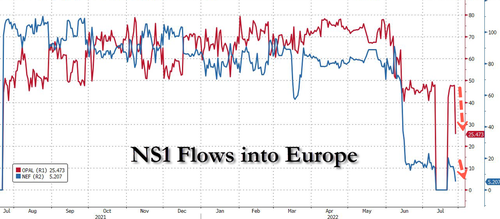
Last week, the Dutch Title Transfer Facility (TTF), the leading Europe benchmark for wholesale gas prices, reached an all-time high of €245 per megawatt hour (MWH) — 505% higher than it was a year ago. And last week, the UK reported a double-digit inflation rate of 10.1% in July, another 40-year high record. Germany’s overall electricity prices (all in for generation, transmission, distribution, etc.) have been rising from €0.14/kwh in 2000 to €0.24 in 2010, €0.32 in 2020, and €0.41 in 2022.

2. High fertilizer prices, high food prices.

Fertilizers — urea/carbamide, urea ammonium nitrate (UAN), di-ammonium phosphate (DAP), and others — are mainly produced from oil and natural gas. The continued demonization of oil and gas on climate grounds leads to underinvestment and undersupply in fertilizer production, leading to higher fertilizer prices, thus higher agricultural prices for products like potatoes, rice, and corn (See Table 1).

3. Underinvestment in fossil fuels, not the Russian invasion, are drivers of high commodity prices.

The prices of some commodities today are generally similar to their pre-invasion levels — see Dubai and WTI crude, UAN, DAP, potatoes, and so on. Most price hikes occurred even before the invasion on Feb. 24, except for solar and wind price indices which had bubble prices that peaked in January-February 2021, coinciding with US President Joseph Biden entering the White House. The Commodity Research Bureau (CRB) Index, comprising a basket of 19 commodities in energy, agriculture and metals, also exhibited this trend.

4. Degrowth and deindustrialization economics.

The numbers mentioned in Table 1, like 40-year high in UK inflation, are among the indicators of the long-term deindustrialization and degrowth economics of Europe. Very soon many companies there will migrate to Asia, the ASEAN in particular. The Philippines should prepare a wide welcome mat for big foreign investments and ensure that our energy supply is big and prices are competitive.

5. The P1+ trillion/year deficit to continue until 2025.

Today the Department of Budget and Management (DBM) submitted the 2023 budget materials to Congress. These are thick documents — the National Expenditure Program, Budget of Expenditures and Sources of Financing (BESF), and Staffing Summary. From BESF, the overall fiscal program shows big increases in revenues and disbursements in 2023 to 2025, so the budget deficits are expected to slow down to below P1 trillion perhaps by 2026 (See Table 2).

6. Interest payment alone from huge public debt will be P582 billion in 2023.

Government annual financing or borrowings will remain at P2+ trillion/year until 2024. Huge interest payments alone will siphon off more public resources, to 11% of total expenditures.

7. The military and uniformed personnel (MUP) pension is still a big fiscal risk.

MUP pension is P120+ billion/year from 2021 onwards and constitute 2.4%+ of total expenditures. Contrast that with the pensions for all other civilian personnel (retired government doctors, nurses, teachers, engineers…) of only P5.5 billion in 2019, P6.2 billion in 2020, P5.6 billion in 2021, P7.1 billion in 2022, and P7.5 billion in 2023.

There is a need to control certain public spending, remove favoritism for certain sectors and personnel like the MUP, control subsidies and not make them last forever.

8. Tax revenues will jump starting 2023.

It will have taken nine years to double the tax revenues of P1.54 trillion in 2013 to P3.14 trillion this year. This then will rise by P300-400 billion a year from 2023 onwards. Excise tax revenues from “sin” products were the fastest to rise, from P119 billion in 2013 it nearly doubled to P209 billion in 2017, or just four years (See Table 3).

9. Tobacco tax will take in P200+ billion/year, alcohol tax P100+ billion/year starting 2022.

With the current excise tax of P55/pack of cigarettes, then a 5% increase yearly after, the advocates and implementers of universal healthcare will jump with joy when there are more smokers of legal tobacco. They will also be happy with more drinkers of legal alcohol.

10. Government should be more strict in fighting illicit trade and smuggled products.

Since the government earns big from legal alcohol and tobacco, and earns zero from smuggled cigarettes and alcohol, and smuggling rises in direct proportion to tax hikes, there should be stricter implementation of anti-illicit trade and anti-smuggling laws. Criminal and terrorist groups, smugglers, and their protectors in government are the main beneficiaries of more illicit trade.
---------------

See also:
BWorld 554, The Post-SONA Economic Briefing; FVR’s economy, August 16, 2022
BWorld 555, Motorcycle taxis, illicit tobacco, and electric cooperatives, August 17, 2022
BWorld 556, Growth recovery, declining births, and rising power demand, September 04, 2022.

Sunday, September 04, 2022

Deindustrialization 2, Germany, June-July 2022 reports

The crawling Germany deindustrialization, degrowth economics. See these reports in June-July 2022.

1. Germany sets out ways to cut gas usage amid Russia supply crunch
Vera Eckert and Ludwig Burger. June 22, 2022. 12:28 AM GMT+8
https://www.reuters.com/markets/commodities/germany-maps-out-ways-cut-gas-usage-amid-russia-supply-crunch-2022-06-21/

2. "Social Peace Is In Great Danger": Germany Is Quietly Shutting Down As Energy Crunch Paralyzes Economy
TYLER DURDEN, JUL 09, 2022
https://www.zerohedge.com/markets/social-peace-great-danger-germany-quietly-shutting-down-energy-crunch-paralyzes-economy

3. German firm calls for energy price cap to avoid social unrest
Holger Hansen  July 14, 2022  6:03 AM GMT+8
https://www.reuters.com/business/energy/german-firm-calls-energy-price-cap-avoid-social-unrest-2022-07-13/

Household energy costs could triple in Germany as Russian gas supplies dwindle, officials in the sector said, and one company representative raised the possibility of social unrest unless there was a cap on prices.

4. Electrical Engineering Professor: “Germany Urgently Needs An Energy Strategy Change”
P Gosselin on 13. July 2022
https://notrickszone.com/2022/07/13/electrical-engineering-professor-germany-urgently-needs-an-energy-strategy-change/

5. German Energy Giant Warns Of Insolvency "Within Days", Starts Draining Gas From Storage
TYLER DURDEN, JUL 16, 2022
https://www.zerohedge.com/markets/german-energy-giant-starts-draining-gas-storage-it-warns-insolvency-within-days

6. Germany’s Running Out Of Energy: Wind Turbine Construction Stalls, Firewood Becoming Scarce!
By P Gosselin on 16. July 2022
https://notrickszone.com/2022/07/16/germanys-running-out-of-energy-wind-turbine-construction-stalls-firewood-becoming-scarce/

According to firewood dealer Konrad Kötterl. “Some people are panicking about not being able to get any more wood.” As a result, they’re stockpiling. Normally, he has three to four orders a day in the summer. “Right now, it’s 20 to 30.”

7. Top Energy Regulator Warns Germany Won't Survive Winter Without Russian NatGas
Tyler Durden MONDAY, JUL 18, 2022 - 01:00 AM
https://www.zerohedge.com/commodities/top-energy-regulator-warns-germany-wont-survive-winter-without-russian-natgas

8. Germany Now ‘Hostage’ To Putin After US Poured Billions Into Defending It From Russia
MICAELA BURROW July 24, 2022
https://dailycaller.com/2022/07/24/german-leaders-apathy-cave-russia/

9. German landlord LEG calls for limiting heating supply, Handelsblatt reports
July 25, 2022
https://www.reuters.com/business/energy/german-landlord-leg-calls-limiting-heating-supply-report-2022-07-25/

10. BASF readies more ammonia production cuts in gas supply crunch
By Ludwig Burger July 27, 2022. 3:27 PM GMT+8
https://www.reuters.com/business/energy/basf-considers-more-ammonia-production-cuts-gas-supply-crunch-sources-2022-07-27/

Germany's BASF (BASFn.DE), the world's largest chemical company, is cutting ammonia production further due to soaring natural gas prices, it said on Wednesday, with potential ramifications from farming to fizzy drinks.

Germany's biggest ammonia maker SKW Piesteritz and number four Ineos also said they could not rule out production cuts as the country grapples with disruption to Russian gas supplies.

Ammonia plays a key role in the manufacturing of fertiliser, engineering plastics and diesel exhaust fluid. Its production also yields high-purity carbon dioxide (CO2) as a byproduct, which is needed by the meat and fizzy drinks industries....

"We are reducing production at facilities that require large volumes of natural gas, such as ammonia plants," BASF Chief Executive Martin Brudermuller said in a conference call after an earnings report.... 

Chemical companies are the biggest industrial natural-gas users in Germany and ammonia is the single most gas-intensive product within that industry....

Most ammonia goes into nitrogen fertilisers but other uses include diesel exhaust fluid AdBlue and engineering plastics....

11. German firms weigh options to save gas, warn may need to cut output
Victoria Waldersee and Riham Alkousaa July 26, 2022
https://www.reuters.com/business/energy/german-firms-weigh-options-save-gas-warn-may-need-cut-output-2022-07-26/

In its push to curb its reliance on Russian gas after Moscow's invasion of Ukraine, Germany has already cut the share of gas in its electricity production to around 6% this year from 15.2% last year and has permitted reconnecting coal-fired power plants to the grid. read more

Germany's gas-guzzling chemicals industry could lower gas consumption by 2% to 3% by fuel switching, national chemical industry association VCI told Reuters.

12. German Experts Warn Of Grid Instability…”Conventional Power Plants Needed For A Long Time To Come”
P Gosselin on 27. August 2022
https://notrickszone.com/2022/08/27/german-experts-warn-of-grid-instability-conventional-power-plants-needed-for-a-long-time-to-come/

13. BASF Prepares To Slash Ammonia Production In Germany Amid Worsening NatGas Crunch
Tyler Durden JUL 27, 2022
https://www.zerohedge.com/commodities/basf-prepares-slash-ammonia-production-germany-amid-worsening-natgas-crunch

German chemicals company BASF SE paid an extra 800 million euros ($809.5 million) to keep its plants operating in the second quarter compared with a year earlier amid skyrocketing natural gas prices...

14. Germany set to impose gas levy on consumers to support ailing importers
Markus Wacket and Riham Alkousaa. July 28, 2022
https://www.reuters.com/business/energy/germany-set-impose-gas-levy-consumers-support-ailing-importers-2022-07-28/

Germany is set to impose a levy on all gas consumers from Oct. 1 aimed at helping suppliers struggling with soaring gas import prices...

Households and industrial consumers with long-term contracts will be hit by the charge, which will be valid until the end of September 2024, the document showed. Gas importers will have to bear rising costs by themselves until the levy kicks in...

German Economy Minister Robert Habeck said the levy would amount to between 1.5 euro cents and 5 euro cents per kilowatt hour (Kwh), with the proceeds available to all companies that need to replace Russian gas.

This means that a four-person household could face additional costs of up to 1,000 euros ($1,014) per year.

15. Gas Levy Could Triple Household Heating Bills In Germany
By Charles Kennedy - Jul 28, 2022, 2:30 PM CDT
https://oilprice.com/Latest-Energy-News/World-News/Gas-Levy-Could-Triple-Household-Heating-Bills-In-Germany.html

16. German cities impose cold showers and turn off lights amid Russian gas crisis
Most of the lights on Berlin Cathedral are switched off on Wednesday night to save energy costs
28 Jul 2022 18.00 BST
https://www.theguardian.com/world/2022/jul/28/german-cities-impose-cold-showers-and-turn-off-fountains-in-face-of-russian-gas-crisis

https://www.zerohedge.com/commodities/german-cities-turn-hot-water-and-cut-lighting-government-buildings

17. German cities impose cold showers and turn off lights amid Russian gas crisis
Philip Oltermann in Berlin  28 Jul 2022
https://www.theguardian.com/world/2022/jul/28/german-cities-impose-cold-showers-and-turn-off-fountains-in-face-of-russian-gas-crisis 

See also: Deindustrialization 1, Europe's sagging energy supply, July 26, 2022

BWorld 556, Growth recovery, declining births, and rising power demand

* My column in BusinessWorld last August 15.
--------------

This piece will cover six topics and events that occurred last week so we go straight to them.

1. GROWTH RECOVERY AND RISING INFLATION

Last week, the Philippine Statistics Authority (PSA) released the 2nd quarter (Q2) 2022 GDP growth and it was 7.4%, a bit lower than the Q1 growth of 8.2%. The PSA also released the July 2022 inflation rate last week and it was 6.4%, a bit higher than June’s inflation of 6.1%.

So, for Table 1, I averaged the GDP growth for Q1 and Q2 of selected countries and compared them with the Philippines’. Then I also averaged the inflation rate from January to July. The big East Asian economies with no Q2 GDP report yet, like Japan and Thailand, are not included in the table.

The Philippines so far has the fastest growth recovery in first half 2022 with 7.8%, followed by Malaysia and Vietnam. The main explanation is low base effect — the Philippines had the deepest GDP contraction in Asia in 2020, followed by low growth in 2021, so high growth in 2022 is just trying to recover and slightly surpass the 2019 GDP size and level.

The Philippines inflation for January-July is 4.7%, within the inflation target of 4.5%-5.5% set by the Development Budget Coordination Committee (DBCC) or the economic team (Table 1). If GDP growth in the second half of 2022 is sustained at 7-8%, this column projects a full year inflation of 5-5.2%.

The DBCC growth target of 6.5%-7.5% in 2022 is attainable — and we will likely surpass it. The growth target from 2023-2028 of 6.5%-8% is also attainable and something that we should work collectively for. Fast growth automatically tempers inflation via a higher supply of goods and services in the economy.

Notice Europe and the US, their deep contraction in 2020 and anemic growth after, coupled with high inflation this year. Stagflation is becoming more real for them. Many businesses there will consider migrating to Asia, including the Philippines.

The Philippines just enacted many market-oriented reforms: the corporate income tax cut under the CREATE law, the liberalization of the Public Service Act, the Foreign Investment Act, the Retail Trade Liberalization Act, dynamic Public Private Partnership (PPP), and there are no planned major tax hikes on the horizon. These are good attractions for those foreign businesses to come in, and for those already here to stay put.

2. DECLINING BIRTHS

The PSA also released last week its update of vital statistics for 2021 — births, deaths, marriages. Births in the Philippines continue on a declining trend (Table 2).

There are three possible reasons for this trend. One, the Reproductive Health Law of 2012 (RA 10354), essentially state-sponsored population control dubbed as “pro-choice” family planning, has kicked in.

Two, lockdown scarring leading to fewer marriages plus less desire to have new babies. The average number of marriages per month was 36,000 in 2019, down to 20,060 in 2020 (only 866 and 4,135 in April and May 2020), and 29,740 in 2021.

Three, the effect of vaccination that may have affected some people’s fertility. Mass vaccination in the Philippines started in March 2021. The various COVID-19 vaccines were developed in just months, with no long-term study on reproductive health of people done, they were rushed as emergency use authorization (EUA).

The decline in births is bad, meaning fewer entrepreneurs and fewer workers in the future. The Marcos Jr. administration should pause mass vaccination for young and healthy people pending the results of big and multi-country studies on the impact of COVID-19 vaccines on fertility.

3. RISING POWER DEMAND

Also last week, the Independent Electricity Market Operator of the Philippines (IEMOP) held a media briefing which I attended. Among the highlights of the August briefing were:

One, rising peak demand in the Luzon-Visayas grids was 13,450 MW in 2019, 13,752 MW in 2021, 14,380 MW in 2022. This implies growth recovery.

Two, a rise in power reserves led to a lower price of P6.84/kwh in the August billing vs. P8.92 in June and P8.51 in the May billing.

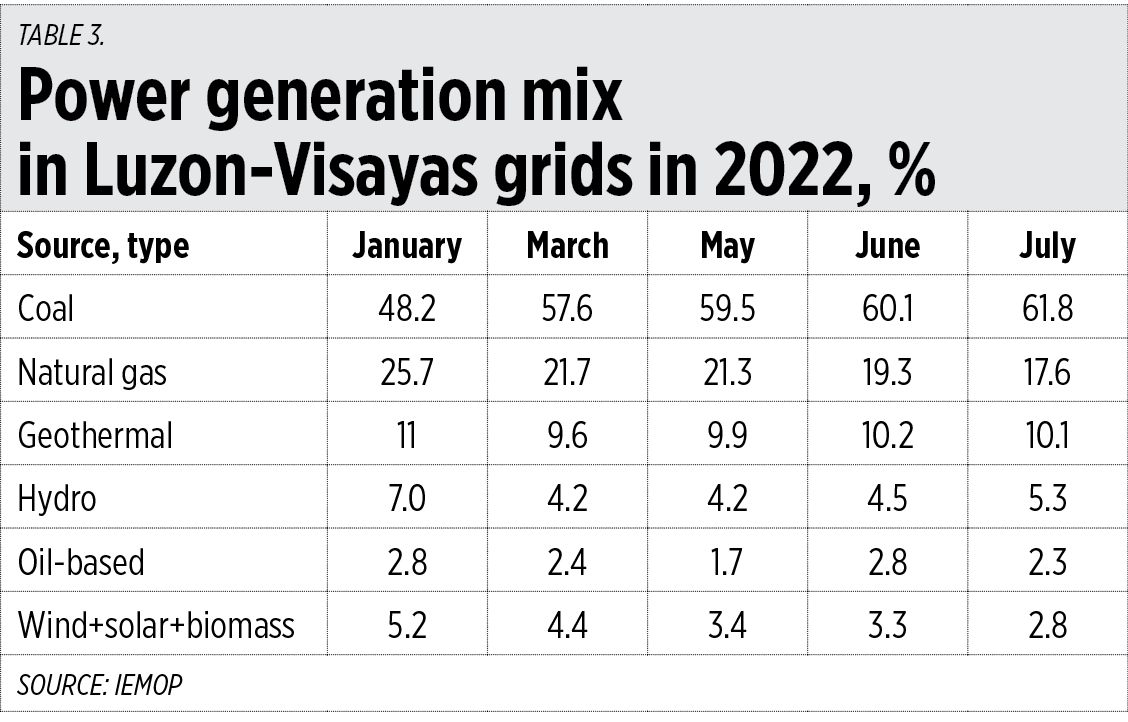
And three, a rising share of coal power, a declining share of natural gas and intermittent renewables (Table 3).

The forced transition to “decarbonization” and to more intermittent renewables, and less coal power is dangerous. It can lead to more blackouts in the future and businesses will not come in or stay if they have to buy big gensets, meaning higher production cost and less profit for them. The dirtiest and most dangerous energy sources are candles and gensets, not coal. More candles mean more fires and destruction of property. More gensets mean more air and noise pollution. Dark streets at night mean more road accidents and more crime.

4. TRANSPORT LIBERALIZATION, NOT RESTRICTION

Also last week, noted consultant on infrastructure and public transportation Rene Santiago was interviewed on OneTV and he shared many good points. Among these: 1.) Cable cars are a technically viable option for urban commuting but only under special circumstances such as short trips, a hilly terrain, and narrow roads with no expansion possibilities; 2.) Public transportation will worsen with a shortage of buses and jeepneys, and the root causes are two flawed policies: re-franchising and a cap on fares; 3.) Service Contracting Scheme (SCS) is wrong, is not equitable nor is it sustainable, it spawned free rides on selected routes in a few urban centers, and more than 1,500 LGUs did not benefit from it.

I will add that the Land Transportation Franchising Regulatory Board (LTFRB) should abolish not only the fare cap, but also the cap on number of players in motorcycle taxis, and the cap on number of motorcycles per player. Have more competition in public transportation, give the commuters more choices, more options, more convenience and safety.

5. TV5-ABS PARTNERSHIP AND MEDIA ACCOUNTABILITY

A report last week in BusinessWorld says “ABS-CBN, TV5 sign landmark deal that includes SkyCable” (Aug. 11). ABS-CBN will acquire nearly 34% of TV5, and Cignal TV will acquire nearly 39% of SkyCable.

While new radio and TV networks are born, there is also the consolidation of broadcast media in many countries around the world. Consolidation means more visibility, more content, and more accountability and this will be good for media consumers.

Our home internet is Red Fiber with a Cignal TV subscription. The internet is really fast and Cignal TV has many channels on board — I am happy with our setup. The partnership would possibly mean more channels, more choices, at the same price. Good.

6. SUGAR IMPORTATION AND FREE TRADE

I am from Cadiz City, Negros Occidental and whenever I go back home, I am still fascinated by the wide sugar farms that stretch from the highway to the mountains. But there are also huge land conversions from sugar to commercial-residential.

The new Silay-Bacolod airport, with its long runway and wide access roads and the diversion roads, were previously sugar farms. The large Ayala subdivision in Talisay and other new big subdivisions in the province were once sugar farms.

With declining hectarage, domestic sugar output is either flat-lining or declining while demand keeps rising. We should have free trade in sugar, and there should have been no scandal over sugar importation because it is something that we should do yearly to protect consumers.
-----------------

See also:
BWorld 553, State of the world, state of the nation, July 27, 2022
BWorld 554, The Post-SONA Economic Briefing; FVR’s economy, August 16, 2022
BWorld 555, Motorcycle taxis, illicit tobacco, and electric cooperatives, August 17, 2022.

Saturday, September 03, 2022

Covid 74, Vax spending in the Philippines

 Possible that Covid vaccines procurement in the PH is around P120 B+ per year? See numbers and reports.

A. National government Covid vaccine procurements:

1. 2021 P88.6 B
https://www.philstar.com/headlines/2021/06/17/2106031/no-sticky-fingers-vaccine-purchase-senators

2. 2022 under GAA 2022, P45 B.

B. Rich cities, 2021 alone:

Makati P1 B, QC P1 B, Taguig P1 B, Pasig P300 M, Manila P250 M, Paranaque P250 M, Pasay P250 M, Mandaluyong P200 M, Valenzuela P150 M, Caloocan P125 M, Marikina P83 M, San Juan P50 M, Navotas P20 M,
https://newsinfo.inquirer.net/1379245/covid-19-vaccine-procurement-projects-of-metro-manila-lgus

Muntinlupa P170 M,
https://www.muntinlupacity.gov.ph/?p=21434

Manila P298 M for Sinovac alone, "Manila-procured 400K doses of Sinovac arriving soon" https://www.pna.gov.ph/articles/1143913

"Mayor Abby: Makati sets P1-billion budget for COVID-19 vaccine; All Makatizens to get free vaccinations",
https://www.makati.gov.ph/content/news/42445

Cebu City P500 M, "Rising demand for Covid-19 vaccines noted in Cebu City" https://www.pna.gov.ph/articles/1145487

Davao, Bacolod, Iloilo, Baguio,...

2022....

C. Corporate/Private sector

Expiring jabs cost private sector P1.3B 
https://www.manilatimes.net/2022/07/22/news/national/expiring-jabs-cost-private-sector-p13b/

"1.5M vaccines expire in July"
https://www.manilatimes.net/2022/07/20/news/national/15m-vaccines-expire-in-july/1851584

27 million COVID-19 vaccine doses to expire in July, says Concepcion
John Eric Mendoza  April 02, 2022
https://newsinfo.inquirer.net/1577167/27-million-covid-19-vaccine-doses-to-expire-in-july-says-concepcion

P40B worth of vaccines wasted in low vaxxing turnout — Concepcion
Daniza Fernandez April 20, 2022
https://newsinfo.inquirer.net/1585570/p40b-worth-of-vaccines-wasted-in-low-vaxxing-turnout-concepcion

SMC P1 B,
https://www.sanmiguel.com.ph/stories/walang-iwanan-smcs-covid-19-efforts/smc-takes-initial-delivery-of-own-vaccines-to-inoculate-all-70000-in-its-workforce
--------------

Related stories:

Birx Admits She Knew COVID-19 Vaccines Were Never "Going To Protect Against Infection"
Tyler Durden SUNDAY, JUL 24, 2022 - 10:30 AM
https://www.zerohedge.com/covid-19/birx-admits-covid-19-vaccines-were-never-going-protect-against-infection

https://www.zerohedge.com/covid-19/recent-fauci-claims-dismantled-former-cdc-director-and-faucis-own-words
----------------

See also:
Covid 71, More vax adverse reactions, February 24, 2022 
Covid 72, More testimonies of vax injuries, April 03, 2022 
Covid 73, More deaths, more marriages, but less babies in 2021, why? April 12, 2022.

Wednesday, August 17, 2022

BWorld 555, Motorcycle taxis, illicit tobacco, and electric cooperatives

* My article in BusinessWorld last August 8.
--------------

There were four economic developments last week that I want to comment on.

The first is high inflation driven by transport, alcoholic beverages and tobacco (ABT), and financial services.

Last Friday, the Philippine Statistics Authority (PSA) reported the July 2022 inflation rate at 6.4%, another four-year high from October 2018’s 6.9%. Transport and ABT are among the big inflation generators (Table 1).

From transport inflation of 18.1% July, the inflation rates of sub-components are:

1.) Operation of personal transport equipment, 48.1%;

2.) Passenger transport services, 7.2%;

3.) Purchase of vehicles, 1.3%;

4.) Transport services of goods, 0.3%.

MOTORCYCLE TAXIS AND LTFRB

As shown in the numbers above, the cost of operating personal transport like cars was very high, 48% in July due to higher gasoline and diesel prices.

Last week, there was this report in BusinessWorld: “Grab PHL says MOVE IT acquisition compliant with rules” (Aug. 8). This is good news.

Currently there are three motorcycle taxi (MCT) companies in the Philippines — Angkas, Joyride, and Move It. The latter is the smallest with just a few hundred drivers, while the first two have at least 15,000 drivers, the cap per player imposed by the Department of Transportation (DoTr) Technical Working Group that includes the Land Transportation Franchising Regulatory Board (LTFRB). The acquisition by Grab PHL of Move It will have many benefits for the public.

One, commuters will have more options, more convenience with three large MCT players to choose. Long lines of people queuing for a ride will be cut shorter.

Two, thousands of new drivers will be on-board — not hired as it is not an employer-employee arrangement. More drivers mean more MCTs to serve the riding public.

Three, there will be more competition as the virtual duopoly by Angkas and Joyride will be broken. So, there will be more competition in technology/apps, better services, more competitive fares, more passenger convenience and safety.

Four, traffic will ease as more people leave their cars or motorcycles at home and take public transportation. MCTs will help provide the “first mile” house-to-train/bus station, and “last mile” train/bus station-to-destination. And reverse back going home.

Five, the overall inflation rate will be tempered when inflation in transport, especially in operation of personal transportation, is reduced. And people will have more savings.

To further increase competition and passenger convenience, Transportation Secretary Jaime J. Bautista and LTFRB Chair Cheloy Velicaria-Garafil should consider removing two caps — remove the maximum number of MCT players from only three, and remove the maximum 15,000 drivers per player. At a maximum of 45,000 legal drivers, it is very likely that the number of unregistered “habal habal” drivers may be twice or more than that number nationwide. Since they are already existing, they should be onboarded via legal MCT companies, for better regulatory transparency and better passenger safety.

If the two caps are removed, it is estimated that at least one million rides daily can be served by MCTs. Secretary Bautista comes from the air transportation sector where there are no caps on flights per destination per day or per month, so he can appreciate the need to remove the caps on the number of players and vehicles in land transportation.

More restrictions mean less choices, and more suffering for the public. More competition means more choices, and less suffering for the commuters. More and faster mobility of people and goods means more economic growth, more businesses and job creation, and lower inflation.

TOBACCO TAXES AND ILLICIT TRADE

Last week, Budget Secretary Amenah F. Pangandaman reiterated that they will submit Budget 2023 to Congress on Aug. 22. The thick documents include projected tax revenues and other measures to fund the government’s huge expenditures, including sin taxes.

Eight years ago, now Finance Secretary Benjamin Diokno wrote a column, “Illicit trading of cigarettes rising” (Manila Speak, Oct. 9, 2014; reprinted in one of his four books, Through the Looking Glass, published 2020). He cited Oxford Economics’ estimates of tax losses from illicit cigarettes: P2.62 billion in 2012, and P15.60 billion in 2013. The estimated number of illicit cigarettes was 6.4 billion sticks in 2012 and 19.1 billion sticks in 2013, an almost 200% increase in just one year.

Last April, I attended a webinar organized by the National Tobacco Administration on illicit tobacco and Congressman Jericho “Koko” Nograles was one of the speakers. He shared Euromonitor’s estimates of illicit tobacco as a share of total supply: Nationwide 13%, Zambales 11.5%, Nueva Ecija 22%, Bataan 32%, Palawan 25%, Sultan Kudarat 36%, Zamboanga de Sibugay 51%, Misamis Occidental 57%, some areas of Mindanao up to 60%.

Mr. Nograles’ estimate of foregone revenues from illicit tobacco nationwide is P26 billion/year. In March 2021, Congressman Joey Salceda released his estimate of tax losses from illicit tobacco at P30 billion/year. These are huge amounts that benefit the smugglers, and criminal gangs in cahoots with some corrupt government officials, both national and local.

To verify the numbers of the two legislators, I made my own estimate, taking off from the Euromonitor estimate of 13% illicit cigarette share to total supply, meaning 87% is legal tobacco. The numbers I got range from P24 to P49 billion in 2021 alone (Table 2).

High inflation contribution of ABT (Table 1) is mainly due to the steadily rising tobacco tax: P50/pack in 2020, P55 in 2021, P60 in 2022, and 5% yearly increase starting 2023. It is safe to assume that illicit tobacco will only increase, not decrease. With cheap smuggled tobacco, there will be more smoking, not less. And there will be more money for the criminal gangs and their partner corrupt government officials, not less.

ELECTRIC COOPERATIVES AND BLACKOUT ECONOMICS

Last week, Senator Raffy Tulfo, Chairman of the Senate Committee on Energy, lambasted a number of electric cooperatives (ECs) in the country for the frequent blackouts in their franchise area. I also saw these reports in BusinessWorld: “ERC orders 3 electric cooperatives to refund nearly P294M” (May 31), “Gov’t imposes sanctions on two electric cooperatives” (June 9), and, “Tulfo threatens to summon officials of inefficient power co-ops before Senate Energy Committee” (Aug. 3).

Report number one is about Central Negros EC (Ceneco), Pangasinan I EC (Panelco I), and La Union EC (Lueco) that over-charged their customers.

Report number two is about Maguindanao EC (Magelco) and Lanao del Sur EC (Lasureco) that owe P16.7 billion to the Power Sector Assets and Liabilities Management Corp. (PSALM), a government corporation under the Department of Finance. Magelco owes P3.8 billion, Lasureco owes P12.9 billion and they have not expressed the intention to pay. So, taxpayers have shouldered their unpaid debt -— very wasteful and corrupt.

Report number three is about frequent brownouts in EC areas in provinces including Palawan, Bataan, and Davao. Later Oriental Mindoro EC was also investigated.

Five years ago, I wrote in this column, “Unstable power supply due to problematic electric cooperatives” (BusinessWorld, Feb. 8, 2017), about the Abra Electric Cooperative (ABRECO) and Albay Electric Cooperative (ALECO) that owed big amounts to the Wholesale Electricity Spot Market (WESM).

ALECO, in particular, owed P1 billion to WESM around 2010, it also owed PSALM about P2 billion. In 2014, SMC Global bought ALECO and renamed it Albay Power and Energy Corp. (APEC), and assumed its P4 billion debt. Two years later, the debt ballooned to P5.6 billion. Until now, ALECO or APEC still owe some gencos hundreds of millions of pesos.

Many ECs are notorious for inefficiency, frequent blackouts and/or high electricity rates that penalize their customers. See some of those ECs and compare their rates with Meralco and the National Capital Region (Table 3).

I am sure Energy Secretary Raphael “Popo” Lotilla is doing something to address the twin problems of blackout economics and the fiscal burden of unpaid debt to PSALM and gencos by many ECs.

Finally, during the Philex Mining Corp. Stockrights Offering last week, Finance Secretary Ben Diokno, as Keynote Speaker, reiterated his support for the mining sector, especially Philex’s new gold mining project in Surigao. Metal prices can only go up, not down, as global demand for gold, copper, silver, nickel, etc. keep rising. The current high excise tax for mining output means higher revenues for the government while allowing the companies to export more and create more jobs. Good policy, Secretary Diokno.
-------------

See also:
BWorld 552, Lucky Me, bureaucracy rightsizing, electricity prices, and MPIC, July 21, 2022
BWorld 553, State of the world, state of the nation, July 27, 2022
BWorld 554, The Post-SONA Economic Briefing; FVR’s economy, August 16, 2022.

Energy 168, News reports on Europe situation, June-August 2022

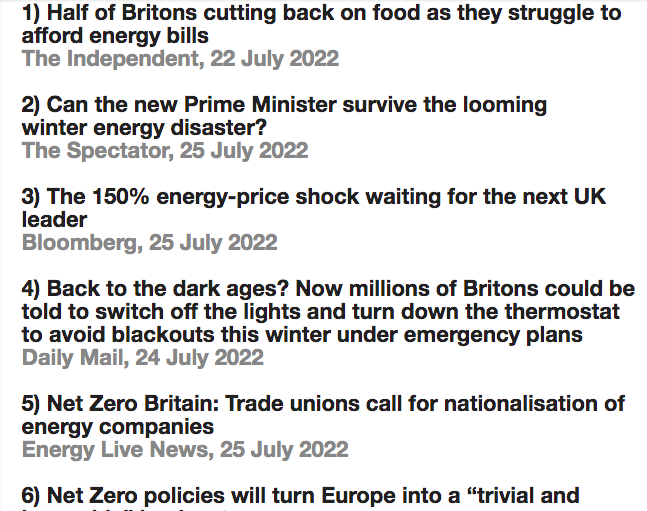
Check these reports, I just got screenshots from the email service of Net Zero Samirsdat by The Global Warming Policy Foundation (GWPF) https://www.thegwpf.org/. When ecological central planning and government energy rationing prevails, things like these are the results.


-----------------

See also:
Energy 164, More Europe energy agony, May 7, 2022
Energy 165, ESG and more impact of sanctions vs Russia, June 03, 2022
Energy 167, ESG, Russia and US oil, June 28, 2022.