Thursday, May 16, 2024

Macroecon 27, Q1 2024 growth of Europe and Asia

Posting here what I shared with friends in the "Oplas Perspectives" viber group.


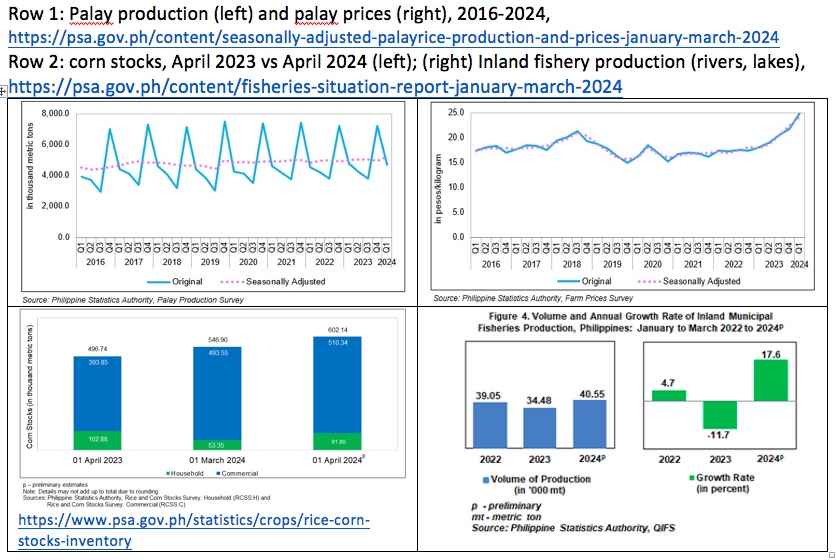
Meanwhile, about PH agri production during El Nino period in Q1 2024.


Palay production this year flat as last year, did not decline but the price has increased. Corn stocks have increased. Inland fishery production is higher in Q1 2024 than Q1 2022 and Q1 2023. So despite the El Nino, agriculture and fishery production in metric tons this year did not decline, only the % increase decline but still an increase.
-------------

BWorld 702, Privatize assets to cut debt

Privatize assets to cut debt
April 30, 2024 | 12:02 am

My Cup Of Liberty
By Bienvenido S. Oplas, Jr.
https://www.bworldonline.com/opinion/2024/04/30/591702/privatize-assets-to-cut-debt/

There have been some good reports on the Philippines’ fiscal situation early this year. See these recent stories in BusinessWorld: “Debt service bill falls by 22% in Feb.” (April 22), “Budget deficit narrows in March” (April 25), and “NG gross borrowings fall in March” (April 29).

I checked the cash operations report released last week by the Bureau of the Treasury (BTr) for the first quarter (Q1) of 2024, then compared it with first quarter data of 2019 to 2023. Here are some of the highlights.

HIGHER REVENUES, DECLINING DEFICIT

1. For the first time, revenues have breached the P900 billion mark this year. The Bureau of Internal Revenue (BIR) collected nearly P600 billion, but the Bureau of Customs has been a laggard, with a nearly flat performance as in 2023.

2. The interest payment is high at nearly P200 billion, no thanks to the huge public debt stock of P14.97 trillion as of end-2023 and P15.18 trillion as of February this year, and the high interest rate policy of the Bangko Sentral ng Pilipinas.

3. The budget deficit was flat at the 2023 level, which is good as the deficit/GDP ratio should be lower. Again, thanks to the high revenues.

4. Financing or borrowing has dipped to below P800 billion, and this is good (see Table 1). In non-crisis years, borrowings should be kept to a minimum and higher revenues should be devoted to reducing the public debt and not creating new spending, like the lousy proposal to buy submarines, new battleships, and other paraphernalia of war.

In a social media post, Budget Secretary Amenah F. Pangandaman emphasized the role of fiscal transparency and discipline, the priority expenditures on human capital, infrastructure development, and digitalization of government transactions to improve our people’s productivity, government spending efficiency, and ease of doing business in the country.

When social and hard infrastructure spending is efficient, the overall productivity of the economy will increase, revenues will improve, and the need for new borrowing will also decline. Continue this path, Madame Secretary.

Finance Secretary Ralph G. Recto reiterated this in his Keynote speech during the Philippine Dialogue in Washington DC on April 17, saying, “In 2023, our fiscal deficit continued to narrow down to 6.2% of GDP from its peak of 8.6% at the height of the pandemic… attributed to the consistently higher government revenue collections and improved expenditure management, which prioritizes massive infrastructure projects and social services.”

HIGH REVENUES/GDP RATIO

Last week, this column presented data on government expenditures as a percentage of gross domestic product (G/GDP ratio) across countries from 2004 to 2023. Today I will present government revenues as percentage of GDP (R/GDP ratio).

The Philippines has a high R/GDP ratio of 20%, considering National Government revenues alone. If revenues by local government units (local business taxes, fees and charges) are added, this will increase to about 23%. Meanwhile, Hong Kong, Taiwan, Singapore, Vietnam, Malaysia, and Indonesia have R/GDP ratios of below 19% (see Table 2).

HIGH TAX/PROFIT RATIO

Table 2’s data for the Philippines may not look good for investors, local and foreign. Recall the World Bank’s annual Doing Business (DB) reports, especially on “Paying Taxes.” The Philippines has a high total tax and contributions as percentage of profit, 47% in the DB 2006 report and 41% in the DB 2020 report. Meanwhile, Vietnam and Malaysia have 38%, and Hong Kong and Singapore have only 16% and 19% respectively in the DB 2020 report (see Table 3).


The WB discontinued this project in 2021 after reports of data irregularities for DB 2018 and DB 2020 and they reviewed the audits and methodology. Nonetheless, the trend is there to see so that despite reported data irregularities in the 2018 and 2020 reports, there is consistency in the numbers. This will guide the current Philippines economic team on how to further improve the ease of paying taxes, and the President to discipline tax-hungry LGUs that discourage instead of encourage more business competition and dynamism in their localities.

In his first 100 days review as Finance Secretary, Mr. Recto highlighted that “Together with the Development Budget Coordination Committee (DBCC) economic managers, we recalibrated the government’s medium-term macroeconomic assumptions, fiscal program, and growth targets… the government’s revenue performance will continuously increase from P4.27 trillion (16.1% of GDP) in 2024 to P6.08 trillion (16.4% of GDP) in 2028… the fiscal deficit will decrease (from) 5.6% of GDP in 2024 to only 3.7% in 2028.”

Push for the privatization of some large government assets and corporations too, Mr. Recto. While higher revenues from higher GDP growth and more business activities will do this, revenues from privatization will greatly help and should be used entirely to reduce the public debt. Then tax revenues can be devoted to infrastructure instead of debt servicing for principal plus interest payments.
--------------

See also:
BWorld 699, On oil economics and Philippines vital statistics
BWorld 700, On nuclear energy, LFSCOE, and the red-yellow alerts
BWorld 701, A dying free market movement in the world

Tuesday, April 30, 2024

This blog has reached 2.48 million views

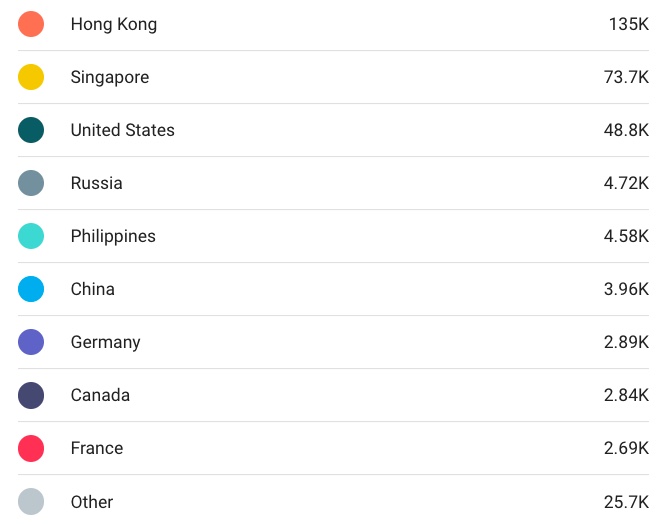
As of today April 30, 6:30pm Manila time, this blog has reached 2.476 million views. The last six months there was high traffic, 305,000 views or 50,833/month or 1,694/day. Before this period the average was only about 350/day. 

It reached 2 million views last March 2023, or an increased of 0.476 million over the last 13 months.

The bulk of readers/viewers are from HK and Singapore, 208,000 out of 305,000 views in the last six months. Before, the bulk of readers were from the US.


Here is the all-time views from July 2010 to April 2024, 2.48 million views after 13 years and 10 months. Largest views were on these months:

1. March 2024, 106,866 views
2. April 2024, 66,972 (as of 6:30pm April 30)
3. April 2021, 58,845
4. February 2024, 56,485
5. September 2023, 54,980
6. December 2023, 51,474
7. March 2011, 47,684
8. August 2023, 43,374.

All time views, largest from (1) US, (2) Philippines, (3) Russia, (4) Singapore, (5) HK.


Thank you, readers.
--------------

See also: 
Finally, this blog has reached 1 million pageviews, October 6, 2016
This blog has reached 2 million views, thanks readers, March 7, 2023

BWorld 701, A dying free market movement in the world

A dying free market movement in the world
April 25, 2024 | 12:02 am

My Cup of Liberty
By Bienvenido S. Oplas, Jr.
https://www.bworldonline.com/opinion/2024/04/25/590505/a-dying-free-market-movement-in-the-world/

This month is the 20th year that I have been involved in the free market movement. In late April 2004, I went to the US as an Atlas International Fellow. For one month I attended free market conferences, met leaders of market leaning think tanks, research institutes and NGOs in the US and other countries in the world. My trip was sponsored by the Atlas Economic Research Foundation, renamed as the Atlas Network.

I attended the McKinac Leadership Conference at the Mckinac Center in Midland, Michigan, headed by the very articulate and dynamic libertarian Larry Reed. Then the Annual Resource Bank Meeting of the Heritage Foundation, followed by the Atlas Liberty Forum (ALF) at the same hotel in Chicago. My hotel roommate then was the very famous Indian libertarian Barun Mitra, head of the Liberty Institute in Delhi.

This was followed by a series of meetings with free market think tanks in Washington DC, like the Americans for Tax Reforms (ATR) headed by Grover Norquist, the Cato Institute, the Tax Foundation, the Heritage Foundation, etc.

There was one Atlas official who was very friendly with me, Jo Kwong. A Chinese-American libertarian, she recommended me to the Friedrich Naumann Foundation for Freedom (FNF) and FNF has since invited me to their annual Eco-nomic Freedom Network (EFN) Asia conferences: Hong Kong in 2004, Phuket, Thailand in 2005, Kuala Lumpur in 2006, and so on until around 2018 in Singapore. Jo also secured funding for my participation in the ALF in Atlanta in 2008, Los Angeles in March 2009, and the Tear Down the Wall conference in Washington DC in Nov. 2009. In 2010 there was a reorganization in Atlas, Jo and her staff resigned, and ever since I got no sponsored invitations from Atlas.

Another friend who supported me and Minimal Government Thinkers was Julian Morris, then the head of the International Policy Network (IPN) in London. IPN sponsored my participation in the Global Development Summit in June 2005, a global free trade conference to help counter the narratives of the “more government, more taxes, more aid” G8 Summit in Scotland. IPN gave me a modest grant for sustenance of my think tank, plus it support-ed my participation in various free market meetings in Asia from 2006 to around 2011.

After 20 years, I look back and ask myself if the free market movement in the world has progressed, have governments and multilaterals stepped back from too much intervention and coercion in people’s everyday lives?

The quick answer is “no,” and I have observed this since around 2008.

Governments and the United Nations (UN) have invented all sorts of “crisis” narratives since the 1960s until today: population/food crisis, oil/energy crisis, health/NCDs crisis, education crisis, plastic/garbage crisis, climate crisis, virus crisis and so on.

Since all these were “unprecedented” and “man-made” crisis, then the “solutions” are also man-made or more government-focused: universal (or socialized) healthcare, universal education, sin/excise taxes, carbon/oil taxes, renewables subsidy, food subsidy, etc.

To help quantify how much governments have expanded, I checked the size of central government (local governments, if any, are not included) spending and government debts as percent of gross domestic product (GDP). I divided the countries below into four: In Group A are the European countries, in Group B are the North and South American nations, in Group C are the North Asian nations plus India, and in Group D are the ASEAN-6. For many, government spending indeed expanded from 2004 to 2019 (pre-lockdown), including the Philippines where the percentage rose from 19.4% to 21.7% of GDP.

When the lockdown dictatorship was imposed in 2020 in many countries around the world, economic freedom was severely restricted and punished in the name of “fighting the virus.” Government spending jumped from 2020 to 2022, and onwards until 2023.

A more graphic measurement is central government debt as a share of GDP. Here, almost all governments expanded in 2023 over their 2004 levels, except Russia, India, Indonesia, Taiwan and the Philippines (see Table 1).


In the mid 2000s, the Philippines (under the Gloria Macapagal Arroyo administration) had a big public debt (numerator) with a small GDP size (denominator) so the quotient was high — 71% in 2004. With fast growth and hence, larger GDP size during the Benigno Aquino III administration, the government debt/GDP ratio declined to 46% in 2012 and 37% in 2016, and this continued until 2019.

Many free-market groups and leaders made the big mistake of following the United Nations, the World Health Organization, and government narratives that, a.) a lockdown dictatorship was necessary while waiting for the vaccines, b.) that there was no natural immunity via natural infection from the virus, only vax immunity should be trusted, and, c.) only the virus evolves, humans do not evolve and adapt, especially when aided by decades-old and proven treatment.

I checked the websites of some free market think tanks in Asia, Europe, and the US, and I discovered that many of them supported the lockdown, or at least did not issue statements opposing the lockdown. They sheepishly al-lowed government coercion to expand indefinitely. That was so sad.

There are two new trends seen in many developing countries because of the lockdowns and mandatory vaccination. One is that there were high excess deaths in 2021 when there was forced vaccination in many countries.

As I noted in this column last week (“On oil economics and Philippines vital statistics,” April 18), “there were no excess deaths in 2020 over 2019 despite the high number of reported COVID cases, but there was a high num-ber of excess deaths in 2021 (when mass vaccination was done in March 2021 onwards) compared to 2020 and 2019. There were 20,000/month excess deaths in 2021.”

The second trend is the declining birth rates in many countries. In the Philippines, for the period January-August of each year covered, the decline on average was 20,600 fewer births per month from 2020 to 2023.

Combine these two trends — excess deaths in 2021 and declining births in 2021 onwards — the result is declining overall life expectancy in many countries (see Table 2).

The weakening of the free-market movement does not keep me from continuing my advocacy for market-oriented reforms and less government coercion and taxation, explicit or implicit. High and sustained economic growth and job creation is not possible under a restrictive, heavily regulated, and over-taxed business environment.
-------------

See also:
BWorld 698, Improving state revenue and boosting FDIs
BWorld 699, On oil economics and Philippines vital statistics
BWorld 700, On nuclear energy, LFSCOE, and the red-yellow alerts

Demography 27, Declining life expectancy in many countries, declining births

I posted this in the viber group Oplas Perspectives. Some worrying trend in declining life expectancy and births.


Meanwhile in Europe...

Fertility rates will see 'dramatic decline' with 97% of countries unable to sustain populations

How Europe can dodge a birth rate hard landing
By Mark John, Anne Kauranen and Gergely Szakacs February 14, 2024

Germany's birth rate falls to lowest level since 2009
Source: Xinhua. 2024-03-21
-------------

See also:
Demography 24, The Maddison Project data, August 13, 2015 
Demography 25, Ageing societies, Japan's depopulation, December 29, 2015 
Demography 26, Once again on the RH law, August 6, 2016

Monday, April 29, 2024

BWorld 700, On nuclear energy, LFSCOE, and the red-yellow alerts
On nuclear energy, LFSCOE, and the red-yellow alerts
April 23, 2024 | 12:02 am

My Cup of Liberty
By Bienvenido S. Oplas, Jr.
https://www.bworldonline.com/opinion/2024/04/23/589739/on-nuclear-energy-lfscoe-and-the-red-yellow-alerts/

Since I will cover three energy topics in this piece, I will focus on the data and shorten the discussion.

RISE IN NUCLEAR POWER USE AND HIGH GROWTH

Nuclear energy — having the highest energy density, a high capacity factor, and least cost of fuel per kilowatt hour (kwh) of generation — shows that it can help sustain high growth of an economy, among various factors and drivers of economic growth. This is shown in the cases of China, South Korea, India, and Pakistan. Meanwhile, adding more intermittent wind and solar power contributes to slow growth, if not degrowth and deindustrialization. Clear cases of this are shown by the United Kingdon and Germany.

For Table 1, I have grouped the countries into Group A (denuclearizing countries), Group B (fluctuating use), and Group C (countries with rising nuclear energy use).

LEVELIZED FULL SYSTEM COST OF ELECTRICITY

I tackle this since I went through a study, “Levelized Full System Costs of Electricity” (LFSCOE) by Robert Idel, in Energy 259 (2022), published by Elsevier.

The common measurement of economic and energy efficiency of various power sources is the Levelized Costs of Electricity (LCOE) which summarizes different ratios of fixed to variable costs into a single cost metric. But this measurement does not consider the intermittency (or instability, unreliability) and non-dispatchability on demand of renewables. So, a more realistic measurement was created, the LFSCOE.

Under LCOE (where storage cost and backup power are not incorporated), solar and wind power appears “cheap,” only $36-$40/Megawatt hour (MWh). But when storage and related costs are included, the cost of solar jumps to $1,380/MWh in Germany and $413/MWh in Texas.

The capacity factor or actual electricity generation per megawatt of installed power are lowest for solar (only 1.5% in Germany and 10.4% in Texas and hence, unreliable if not dangerous for energy-intensive industries and sectors (see Table 2).


This further explains why countries that added more wind and solar power in their grid are experiencing crawling or stunted growth. Like the United Kingdom and Germany.

YELLOW AND RED ALERTS

Last week, from April 16-18, the Luzon and Visayas grids experienced a prolonged series of yellow and red alerts. The main reason was high electricity demand due to extremely hot weather and cloudless skies almost daily, and the decline of the power supply due to the unscheduled shutdowns of several power plants plus the de-rating of other plants like hydro. In Table 3 are the relevant numbers from the Independent Electricity Market Operator of the Philippines (IEMOP).


In a press conference last Friday, April 19, Energy Secretary Raphael EM Lotilla thanked the various energy stakeholders and the public “for their cooperation in avoiding power interruptions despite the red and yellow alerts that were declared (due) to thin reserves.” He reiterated the need for energy conservation by consumers, mentioned the role of the Interruptible Load Program (ILP) by Meralco and many other distribution utilities and electric cooperatives to augment overall power supply, and the possibility of rain seeding in coordination with the Agriculture Department.

The Energy Regulatory Commission (ERC) also released a statement on April 18 where Chairperson Monalisa Dimalanta emphasized the importance of having “a steady and adequate power supply to meet consumer demands and the grid’s regulating requirements… We have directed power plant operators to submit to the Commission their estimated timelines for the resumption of their operations, and we will continue to monitor their timely compliance.”

The ghost of big blackouts of 1990-1992 continues to hound us after more than three decades. This is not good. As a developing country aspiring to industrialize and have sustained growth, we should focus on high-growth targets, not high-renewables targets. All our efforts to attract foreign and domestic investments (FDIs) will be endangered if investors see the dangers of regular yellow and red alerts.
-----------

See also:
BWorld 697, Philippine Energy Plan won’t ensure security
BWorld 698, Improving state revenue and boosting FDIs
BWorld 699, On oil economics and Philippines vital statistics

Sunday, April 28, 2024

Philip Stevens -- cool, friendly and intelligent

Today I just learned that a good friend Philip Stevens has passed away several months ago.

Phil was a keen researcher, writer and speaker on intellectual property rights (IPR) issues especially related to healthcare and trade. He was the Founder and Executive Director of Geneva Network (GN) based in UK, former analyst at World Intellectual Property Office (WIPO) in Geneva, former Exec. Director of Emerging Markets Health Network (EMHN) in KL, former analyst of International Policy Network (IPN) London. 

I met Phil first time when IPN (then headed by Julian Morris)  organized the "Global Development Summit" in June 2005 in London. It was a pro-free trade, free market conference and against more aid, more government narrative of the G8 Summit in Scotland the following week.

Then on September 2007, I organized the "Symposium on Intellectual Property, Innovation and Health" at Manila Hotel. It was a Minimal Governent-IPN forum, we made the local preparations and invites, IPN provided the funding. The speakers were Philip Stevens of IPN and Bibek Debroy from India. The moderator was Dr. Epictetus Patalinghug, then Professor at the UP College of Business Administration, also MG adviser.

Phil and Bibek talked among others, about the importance of innovation in medicine development, other measures that the WHO and Health Departments or Ministries of governments can do like improving the health infrastructure, expanding the generic drugs sector, and not become too focused on drug patents and pricing of newly-developed medicines. 


Sometime in 2009, I participated in a small group Asian think tanks' IPR and Innovation meeting in Singapore. It was organized by IPN.

Photo below from left: Xingyuan Feng (China), Peter Wong (HK), Krishna Neupane (Nepal), Philip, Julian Morris (UK), Alec Van Gelder (Belgium, also with IPN), Luthfi Assyaukanie (Indonesia), me, Barun Mitra (India). Standing in front were ______ (Thailand) and Wan Saiful Wan Jan (Malaysia). 


January 2011 also in Singapore, IPR-Health-Trade seminar organized by IPN.
From left: me, Amir Khan (India) Philip, and Julian Morris of IPN.

Around December 2011 I went again to Singapore for a meeting with some fellow free market leaders in Asia. Night before I met up with Singapore libertarians, the New Asia Republic (NAR) group headed by Donaldson Tan. 

From left: Philip, his wife Debbie, me, Xingyuan Feng and Fu Weigang (from China). Donaldson is 2nd from right, beside him is Min Cheong. Behind Donaldson them were other writers and supporters of NAR.


November 2012, Economic Freedom Network (EFN) Asia conference 2012 in Hong Kong. Sponsored by the Friedrich Naumann Foundation for Freedom (FNF) and Lion Rock Institute (HK). 

From left: Andrew Work (LRI), Philip, me, CathyWindels (US), and ______.

May 2019, Phil and Geneva Network organized an IPR conference in KL, co-sponsored by IDEAS Malaysia. Group photo after the seminar.

After dinner, from left: Junjie "Jack" Ma (China), me, Amir, and Philip.

Last time I met Phil was September 2019, Geneva Network launched the report "The importance of IPR for growth: reform agenda for ASEAN countries" in Manila at Holiday Inn Makati. GN partners in ASEAN for that report were from the PH, MY, ID, TH and VN. I organized that forum, I successfully got DTI Secretary Ramon M. Lopez as the keynote speaker.

Below, from left: Josephine Santiago, Atty. George Katigbak, Secretary Lopez, Philip, me, and Jesus "Jess" Varela.


Atty. Santiago was the Director General of the Intellectual Property Office of the Philippines (IPOPHL), Atty. Katigbak was with the Foundation for Economic Freedom (FEF) Property Rights Team and served as program MC that afternoon, Jess was the Director of the IPR Committee, Philippine Chamber of Commerce and Industry (PCCI).

Below from left: Jess Varela, Atty Kristine Alcantara, Dir. Gen. Santiago, Atty. Katigbak, me and Philip.

Atty. Alcantara was with the Trade Lawyers firm and also an FEF Fellow. She, Jess and DG Santiago served as reactors to the report presented by Philip that afternoon.

Below, a b&w version of the photo posted by Kristine. Cool.

Here, Phil listening and enjoying the discussion.


Thank you Philip. You and Julian Morris were very helpful and supportive of Minimal Government Thinkers early on. If I had known that you were sick, I should have written you to express how helpful and friendly you were to me. 

Until then, my friend. Peaceful journey....
And Debbie, my deep condolence to you and your three kids...
-------------

See also:
Christmas Notes 4: Thanks to International Policy Network (IPN), Dec. 14, 2011
IPR and Innovation 21: Recent News + IPN Assistance to Asian Think Tanks, Feb. 15, 2015
Photos during the IPR-Trade seminar in KL, May 2019, June 28, 2019
Photos, launching of IPR-ASEAN report with Geneva Network, Oct. 19, 2019

Friday, April 26, 2024

BWorld 699, On oil economics and Philippines vital statistics

On oil economics and Philippines vital statistics
April 18, 2024 | 12:02 am

My Cup Of Liberty
By Bienvenido S. Oplas, Jr.
https://www.bworldonline.com/opinion/2024/04/18/588752/on-oil-economics-and-philippines-vital-statistics/

On April 1, Israel bombed the Iran embassy annex building in Syria. Last Saturday, April 13, Iran sent hundreds of drones and cruise missiles to Israel. Since April 14, the world has been waiting to see if a large-scale counterattack by Israel would happen or not. As of this writing, there has been none; de-escalation of the conflict is good for the world.

OIL ECONOMICS: SUPPLY, DEMAND AND PRICES

World oil prices did not jump up high after the exchange of bombs and missiles between the two countries. WTI crude went from $82/barrel in end-March to $87 on April 5 and $85 as of April 17. Dubai crude was $84/barrel in end-March and went up to $91 on April 5 and $90 as of April 17.

Iran is the third largest oil producer among the 12-members Organization of Petroleum Exporting Countries (OPEC). Its oil output was 3.2 million barrels per day (mbpd) in the first quarter of 2024. But a major war between Israel and Iran will affect not only Iranian oil output and exports but also those of the neighboring countries like Iraq, Kuwait, Saudi Arabia, and the United Arab Emirates (see Table 1).


The US is the largest oil producer and largest oil consumer in the world. In 2023, its total liquids output was 20.9 mbpd but its consumption was 20.6 mbpd. Not all oil is the same so US refineries still import a lot of oil from the Middle East, Africa, and South America with different qualities from US crude oil to produce the desired gasoline and petrochemical products.

Russia is the world’s second largest oil producer. In 2023 it produced 10.93 mbpd while its consumption was only 3.84 mbpd, giving it a surplus of 7.1 mbpd for exports, most of it going to China and India.

China is the fourth largest oil producer (Saudi Arabia is third) but it is the second largest oil consumer after the US. In 2023, China’s oil output was 4.52 mbpd while its consumption was 16.22 mbpd so to cover its deficit of 11.7 mbpd, it buys mostly from Russia, Iran, and Saudi Arabia.

Total global oil demand was 102.21 mbpd in 2023 and is projected to rise to 104.46 mbpd in 2024 and 106.31 mbpd in 2025 (data from OPEC). The bulk of rising global oil demand will be supplied by major oil exporters Russia, Saudi Arabia, and the other OPEC member-countries.

There are three main lessons to draw from current global oil economics.

One, global oil demand keeps rising despite all the demonization against oil and fossil fuels.

Two, de-escalation of the Middle East conflict, especially between Israel and Iran plus its allies in Yemen (Houthis), Lebanon (Hezbollah), Syria and Iraq (Shi’ite militias), and Palestine (Hamas), is very important.

Three, since all major military hot spots in the world have US involvement — Ukraine, Iraq and Syria, Israel-Iran, Taiwan, the South China Sea, etc. — the US should learn to step back from too much interventionism, allow disputing countries to talk to each other and resolve conflicts as peacefully as possible and help stabilize global energy markets.

PHILIPPINES VITAL STATISTICS

Last week, the Philippine Statistics Authority (PSA) released the monthly update of the country’s demographics and mortality statistics for 2023. I summed up the total for January to August and compared it with data for the same period in preceding years. The results are not exactly good.

One, the number of births has been falling since the imposition of lockdown dictatorship in 2020-2021 and mandatory COVID vaccination in 2021-2022.

Two, there were no excess deaths in 2020 over 2019 despite the high number of reported COVID cases, but there was a high number of excess deaths in 2021 (when mass vaccination was done in March 2021 onwards) compared to 2020 and 2019. There were 20,000/month excess deaths in 2021.

Three, the number of marriages significantly declined in 2020-2021 during lockdown. This recovered in 2022, going up to 2018’s level, then declined again in 2023 (see Table 2).


The COVID vaccines, being experimental with no long-term studies on their effect on heart conditions, fertility, and other health indicators, could be a major factor for the rise in excess deaths in 2021 and the decline in births until 2023 and possibly until today.

Economic scarring like the -9.5% GDP performance in 2020 (the worst in Asia that year, the worst in Philippine economic records since post World War 2), very high unemployment numbers and increase in business bankruptcies, and now an emerging demographic problem of declining births — these are the major damage caused by the lockdown dictatorship and mandatory vaccination.

Philippines government, business, and civil society leaders should keep this in mind: that curtailing economic freedom, disrespecting natural immunity from the virus and believing only in so-called vax immunity, are a sure formula for economic underdevelopment and demographic distortion.
------------

See also:
BWorld 696, Higher deficit ceilings point to dangerous trend
BWorld 697, Philippine Energy Plan won’t ensure security
BWorld 698, Improving state revenue and boosting FDIs