Friday, January 23, 2015

Free Trade 42: ASEAN Trade and Unilateral Liberalization Challenge

Yesterday, I was a guest lecturer to an undergraduate class of graduating management engineering students of Ateneo. The class is handled by my long time friend and classmate from UP PDE, Joey Sescon.


About 20 students, nice. Joey mentioned that I just came from Nepal, so I made a brief intro about Nepal  and why a communist government in power cannot be responsive to the rising need for economic freedom by its citizens.

My outline:
I. Trade Theory: Comparative Advantage, CPE,
Consumer Surplus
II. ASEAN Tariff and Trade
III. Trade Bureaucratism
IV. Unilateral Liberalization
V. Concluding Notes


People do not have to produce everything they need or want, even if they have the skills and resources to make them. Specialization and trade will make people from across borders and countries better off and attain wealthier outcome.

The above is just a micro and modern example of David Ricardo's theory of comparative advantage, that a country that trades for products it can get at lower cost from another country is better off than if it had made the products at home.


A fraternal concept of CPE is factor price equalization (FPE). Replace commodities with factors of production  like labor,  capital and technology, and allow free mobility of such services across borders and soon, wages across certain skills levels will generally equalize across countries, all other things being equal. The low global and regional interest rates is also one proof  of FPE. What differentiates for interest rates is allowance for risk premium of  certain countries.


Protectionism and trade restrictions is trade dictatorship and hence, wrong. The government and its ally domestic special interest groups are telling the people, "you can only buy from us but not from them abroad. If you buy from them, you must pay high, or in limited quantities."


Tariff among ASEAN countries is almost zero, which  is a good thing. What really causes more smuggling is not the import tariff which are generally small, but the VAT, 12 percent.


Socialist economies that optimize their integration with the global economy, like China and Vietnam, were able to export and sell a lot to  more countries.


Part 4 of the outline is trade bureaucratism. I showed a table from the "Doing Business" annual reports of the WB-IFC, section on international  trade. And see this report, WTO was created in 1995 and it was only in 2014 or after 19 years, that the thousands of trade officials and negotiators have achieved something  significant -- trade facilitation, reduction of customs and trade bureaucracies. Which shows that many governments still pay lip service to  free trade and multilateral negotiations.


Thus, aside from multilateral negotiations  and agreements, there are regional and bilateral trade agreements  and liberalization. But the best, fastest, scheme towards free trade  is via unilateral liberalization. A good article from Dr. Razeen Sally, Chairman of  IDEAS Political Economy and Governance Program, also  of the National University of Singapore.

Another good article arguing why free trade is good for the domestic economy and the people.


I ended my presentation  with these concluding  notes.

Free trade means free individuals, free enterprises. Restrictions to trade is restricting potential economic development. Governments should reduce restrictions on people and goods mobility.

Free mobility of people and services across countries and continents will result in commodity and factor price equalization (CPE and  FPE) over the long term, all other things being equal.

Countries with expensive labor due to low population will experience decline in labor cost once additional and competing labor of similar skills from abroad come in.

Unilateral trade liberalization is pro-development. No prohibitions/regulations except bringing in or out of guns, bombs, poisonous substances, other products that are threat to public health.

The full 20-slides presentation is available in slideshare.
------------

See also:
Free Trade 38: Liberalize Rice Imports and Demonopolize NFA, September 28, 2014
Free Trade 39: Advantages of Unilateral Trade Liberalization, October 12, 2014 
Free Trade 40: Razeen Sally Joins IDEAS, to Campaign for More Liberalization, November 25, 2014 
Free Trade 41: David Ricardo, CPE, FPE and Consumer Surplus, December 06, 2014

Tuesday, January 20, 2015

ALF 3: Photos with Friends, Kathmandu Conference

More photos here during the 3rd Asia Liberty Forum (ALF) held at Soaltee Crowne Plaza, Kathmandu, Nepal, last January 8-10, 2015.

Charu Chadha of Media 9 in Kathmandu, publisher of Business 360 monthly magazine of which I am one of their columnists, sent me today our group photo. From left: Casey Lartigue of Freedom Factory Ltd. (Seoul, S. Korea), Charu, me, Cong Minh Nguyen (doimoi.org, Hanoi, Vietnam). Casey represented Dr. Chung-ho Kim, President of Freedom Factory, who was with us in the small  group roundtable discussion on "The Constitution of Liberty in Asia" held in Phuket, Thailand, October 2005.


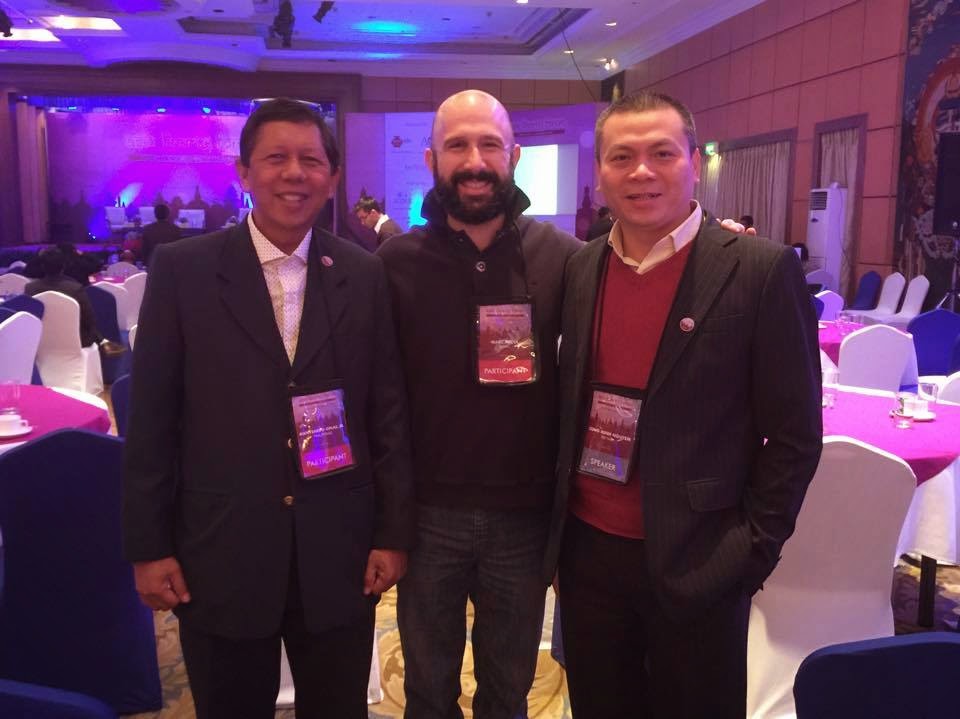
Marc Abela, center, also posed with me and Minh, he represented Mr. You and Yoshida Hiroshi of the Japanese for Tax Reforms (JTR) and Institute for Free Economy (IFE), respectively. Mr. You and Hiroshi were also with us in Phuket in 2005.


Another photo with Minh and Charu. Haaaaa, we were relieving the past. :-)


Ok, here's one of our group photos in Phuket in 2005. This was during the Economic Freedom  Network (EFN) Asia conference, a day after our roundtable discussion. From left: Simon Lee (Lion Rock Institute, Hong Kong), Mr. ____ (Association for Liberal Thinking, Turkey), Chung-ho Kim (then with Center for Free Enterprise, Seoul), Colleen Dyble (Atlas, USA), Mr. You (JTR, Japan), Charu, me, and Yoshida Hiroshi (IPSA, IFE, Japan).


Another photo. Leon Louw holding a camera (Free Market Institute, S. Africa) and Mohit Satyanand (Liberty Institute, India). That was nearly 10 years ago.


More photos during the 3rd ALF. From left: Peter Wong (LRI, Hong  Kong),  Jadranco Brkic (Bosnia), Randy Hencken (Seasteading.org), me. Randy discussed the concept of seasteading, people who want small and limited government wanting to create their own country on the sea, outside the political jurisdiction of any existing country although within the EEZ. It's a bright and revolutionary idea.


From left: me, Cindy Cirquetela (Atlas, USA), Linda Whetstone (Network for a Free Society, UK) and Xingyuan Feng (Unirule, CIPA, Beijing, China). Atlas and NFS, along with FNF South Asia regional office, provided lots of logistical and financial support for that conference.


From left: Bican Sahin (Freedom Research Association, Turkey), me, Gulmira Aidaralieva (Central Asian Free Market Institute/CAFMI, Kyrgyz Republic), _____ also of CAFMI, and Ruki Fernando (Human Rights activist, Sri Lanka).


The Executive Director of Samriddhi Prosperity Foundation, Robin Sitoula. Robin is a friend since about 7-8 years ago. Samriddhi  is the local host that co-sponsored with the Asia Center for Enterprise (ACE) in holding  the 3rd ALF. Great job, fantastic conference, Robin and Samriddhi guys. Congratulations once again.


On the 2nd night  of the conference, after the speeches and before dinner, there was a short song number, it was lively, I pushed Arpita Nepal (lady in white dress on the left), wife of Robin and Director for Research of Samriddhi, to a snake dance. Many participants followed and formed a long snake dance :-)  Man holding the microphone  was the  one  who  sang the  lively song.


Miscellaneous photos: with Wan Saiful Wan Jan (IDEAS, Malaysia) and Barun Mitra (Liberty Institute, India), Adinda Muchtar (Indonesia Institute, Jakarta) and Miho Mochizuki (JTR, Tokyo).


Many thanks again, ACE and Samriddhi, for that wonderful conference.

Special thanks to the following: (1) Media 9/Business 360 for sponsoring my plane fare, (2) ACE/Samriddhi for sponsoring  my 4 nights hotel accommodation, and (3) EFN Asia for sponsoring my related expenses (PH travel tax, Nepal visa fee, etc.).
------------

See also: 
Asian Liberty Forum 2015, Kathmandu, January 07, 2014 

ALF 2: Opening Dinner Program, January 09, 2015

Monday, January 19, 2015

Leftist Opportunism During the Pope Motorcade

This morning, Pope Francis will leave the Philippines and go back to the Vatican. He arrived four nights ago, January 15, from Sri Lanka. The visit at UST yesterday in the morning  and the last mass at Luneta in the afternoon drew several millions of people.

Yesterday too, some leftist groups in the Philippines played epal, unfurled streamers calling for social justice, social debt, socialism. What a bunch of lousy minds.


If it was Senator X or Congressman Y or Governor or Mayor Z, or other party list groups unfurling   streamers and placards showing their faces and names during the Pope motorcade, the public and the left will criticize them. But if it's the left like Partido Manggagawa (PM) party list and the Freedom from Debt Coalition (FDC), it is fine?

Another display of double talk and hypocrisy. They cannot distinguish what is strictly secular and religious activity from any political activity.

Social debt, social justice, socialism. Picking quotes from the Pope hoping to justify their political opportunism.

Photos I got from Arcy Garcia, a friend since the late 80s when I was still a socialist. Arcy remains a socialist and admitted that he was part  of this group who unfurled this cheap opportunist stunt. They should get anti-votes now for the 2016 elections.

Arcy's album title for the street demonstration was

“mga tinig sa kawalan...matatapang kahit di gaanong pinakikinggan. …ito ba ang version ng epal nating mga kaliwa?.”

("voices from nowhere... brave although not often heard... is this the epal version of the left?")

"Matatapang"/brave, against whom? Against the people who wish zero politics, just see the Pope on the road?

"ito ba ang version ng Epal naming mga kaliwa?" -- Yes. Secular, non political activity. Even some non-catholics that I know joined joined the streets welcome, they say he's a different kind of church leader. So zero politics activity, then  the left will force the issue of socialism, social debt, etc. Off tangent and really epal.


Kung si Binay or Mar Roxas or Drilon or other politicians maglatag din ng streamers with pol messages like "inclusive growth", "social justice", etc tapos andon pangalan nila, hindi ba bobombahin ng publiko at ng kaliwa na opportunism? Pero pag kayo mag latag ng mga ganong streamers, justified? Double talk yan.

Meanwhile, two photos of the huge crowd yesterday at the Luneta mass.


Government estimates put the crowd at six million including those spilling over at surrounding roads and streets.

This Pope visit and the warm welcome by Filipinos to him is truly phenomenal. The Pope displayed humility a number of times in his speeches. Some of my non-religious friends admitted that they themselves were swept by his simpleness.

I think Pope Francis can greatly help bridge the divide among Christians, Protestants, Muslims, Buddhists, Hindus, and so on. Tolerance and respect of our diversity, that is the single most important character that the people of our planet should embrace to have world peace. His role is more significant then than efforts and wars by many governments in enforcing tolerance and respect among people partly or wholly driven by religious differences.
----------

See also: 
Pilipinas Forum 17: The Church and Galileo, November 07, 2011 
The Pope and Capitalism, December 03, 2013 

The Pope in Manila, Security Paranoia vs People on the Roads, January 16, 2015

Saturday, January 17, 2015

Energy 32: Is the PH Power Supply Ready for the AEC?

* This is my article for the maiden issue December 2014 of ASEAN Voices, pages 28-31. It is a new magazine based in Jakarta scouring important news and opinions about the region. The pdf copy is also posted in slideshare.
----------

The Asean Economic Community (AEC) is to begin operations by the end of 2015, as trade, investments, tourism and cultural exchanges are expected to see further increases among the member economies. However, ensuring an adequate and stable supply of electricity at affordable or competitive rates will pose a significant challenge to Asean economies.

It is generally understood that growth in electricity production in the Philippines has been slower than that of its neighbors in the Asean countries. China, South Korea, Indonesia, Malaysia and Vietnam have expanded their electricity production by five times or more in just two decades, causing some anxiety mixed with optimism, over the potential impact of the region’s fast-approaching economic integration.

Figure 1. Electricity production in Asia, 1990 vs 2011 in billion kWh


In the Philippines, a number of reports have claimed that rotating brownouts and power outages will be inevitable in the hot months of March to May 2015, when electricity demand is high and power reserves are thin. The Department of Energy (DOE) has asked Congress to grant President Benigno Aquino the authority to deal with the projected power supply deficit in an emergency.

Figure 2. Power supply-demand in Luzon, 2014-2019, as of November 2014


Source: Department of Energy (DOE); abridged version

The above medium-term supply-demand outlook for Luzon, the largest island in the Philippines, is based on the assumption that the Required Reserve Margin is a 4% regulating reserve, as well as a contingency and dispatchable reserve requirement. It also assumes that there will be a 4.2% peak demand growth rate in 2015, compared with the current year, based on the observed 0.6 elasticity ratio of demand for electric power, with a projected GDP rate of 7% in 2015. Also, there will be a 4.8% peak demand growth rate in 2016-2020, based on a projected 8% GDP growth rate for this period, and assumed average forced outage or scheduled maintenance, while the monthly percentages of the total available capacity are as follows.

Figure 3.

However, available capacity calculations and committed projects do not deliver 100% of their rated capacity. Old conventional power plants tend to require more frequent maintenance or scheduled shutdowns, or they suffer from more unscheduled shutdowns. For new renewable sources of energy, such as wind and solar power, their dependable capacity is only some 20% of their rated capacity. Thus, a 100 MW solar or wind plant can deliver only around 20 MW, on average. When there is little to no sunlight or wind, the energy output from these plants is zero or minimal. The DOE's outlook fails to adequately reflect future dependable supply (FDPS), and so, the true gap between peak demand and available capacity/committed projects cannot be effectively addressed.

For its part, the National Grid Corporation of the Philippines issues alert levels in cases of power deficiencies. "Red Alert," for instance, means the contingency reserve is near zero, if not negative. Red alerts have already been issued a number of times between June and September 2014, well ahead of the launch of the AEC.

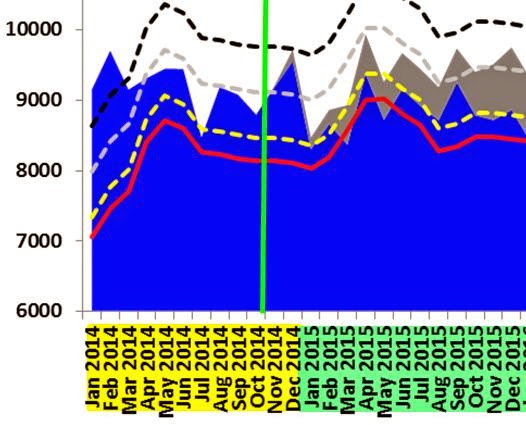
Here are some critical periods in 2014, they can give a preview of supply outlook in 2015.

Actual peak demand this year was 8,717 MW, made in May 21, 2014. “Red alert” have been issued on June 17 (natural gas restriction), June 25 (3 coal plants have unscheduled shutdowns, 1 has derated power), and July 12-13 (natural gas pipeline problem).

Thin reserves were also experienced last September 8-11 (natural gas restriction), last August 30 - September 28 (Sual coal unit 2 maintenance, 647 MW), September 26 - October 25 (Sual coal unit 1 maintenance, also 647 MW).

Figure 4. Detailed view of 2014 and 2015


Thin reserves, if not power supply deficit, will be most critical on April-May 2015. But big industrial and commercial consumers have back up power.

Metro Manila and Luzon provinces are heavily dependent on a number of power facilities, many of which are already more than 20 years old; hence, they either require more frequent maintenance shutdowns or are prone to unscheduled shutdowns. From 2002 to 2013, only one new power plant was commissioned: the Mariveles GN Power coal plant. The oil barge by TMO is an old power plant that had remained inactive for at least five years and was re-commissioned in late 2013, purely to help prevent brownouts during last year's Christmas season.

Figure 5. Existing major power plants in Luzon, early 2014


Source: DOE
(Smaller plants not included in this list. Marked in red are power plants that are 20 years or older.)

So, is the Philippines ready for the anticipated energy demand surge when the AEC begins operations?

If existing and committed power plants are to be relied on, then the answer is no. Many of them are old, and many new plants utilize intermittent sources, such as wind, with low dependable power capacities.

If large industrial and commercial consumers use back-up power, as part of the Interruptible Load Program, then the answer is yes.

However, the latter would drive up the price of electricity, as these large consumers would use their own generators, and the reduced demand in the national grid would have to be compensated. This would come in the form of higher “universal charges” in succeeding months or direct payments by the DOE, using taxpayers' money.

Still, there are a few solutions that could help expand the country’s power supply capacity.

First, power companies should bring in more peak-load plants, similar to mobile diesel power barges. The drastic decline in global oil prices presents an opportunity to lower the cost of fuel for these power plants and, in turn, lower their power-generation prices. Second, large industrial and commercial consumers can enter the power-generation business, as well. Third, media campaigns can be run to request the public, households and commercial offices to reduce their power demands by using more energy-efficient lights and appliances.

Further, government agencies should limit the bureaucratic red tape involved in getting the permits required to commission and build new power plants. DOE Secretary Jericho Petilla once said that for some projects, about 100 signatures are needed to launch and maintain a single large power plant.

Over the medium term, the government should reduce taxes and royalties for power generation, as these impositions significantly contribute to high electricity prices. The natural gas tax, for instance, amounts to 60% of the net price of gas.

It is equally important to ensure that the trade of liquefied natural gas, coal and oil among Asean countries is further assisted to help boost national and regional power supplies.

----------

See also:

Friday, January 16, 2015

The Pope in Manila, Security Paranoia vs People on the Roads

Pope Francis' visit here is nice and good. The Philippines is the only predominantly-Catholic country in Asia, about 80 percent of its 100 million population consider themselves as Catholics. Thus, a visit of the Pope is a big event for many people here.

But I saw in tv that the security system laid by the PH is OA and too paranoid. Why? 

1. Closure of the airport (NAIA) for five hours, 2-7pm yesterday.

The Pope's plane from Sri Lanka was scheduled to arrive at 5:45pm yesterday but the government closed the airport at 2pm, Five of zero activity at the airport except the arrival of the Papal plane, when that airport has one activity, landing or take off, every 30 seconds I think. So many flights in and out of the airport, domestic and international, were either postponed or cancelled or diverted, affecting tens of thousands of passengers.

They could have closed the airport from 5-7 pm only.

2. Motorcade at fast speed.

The Pope's plane arrived on time but the motorcade started late. From Villamor Airbase to the Papal house in Manila, they were travelling fast as if there was a very important meeting at the destination. Tens of thousands of people were waiting for the Pope as early as 3pm perhaps in that short route. They could h ave slowed down to allow those people to see the Pope much longer. 

In this photo, notice the wide gap between the thousands of people and the Pope's mobile car as police cars made a wide  gap from the crowd, at a fast speed. ALL photos below I got from  the web, not one from my camera.


Yesterday, I arrived at Terminal 3 around 11:30am, CX flight from HK. Hardly any taxi, long lines of passengers waiting for the yellow airport taxi, so I took the white bus to Baclaran. I saw there were already some people at Roxas Blvd. Baclaran area waiting for the Pope. So for these people, they waited since 11am or 12 noon, and the Pope passed by around 6:45 pm on a whiizz and they hardly saw him.


Then this morning, a huge crowd of people were waiting on the roads again waiting for the Pope to pass by, in a short distance from the Papal house to Malacanang to meet again the President and his official family.


Then they were moving fast again from the Papal house to Malcanang, And instead of a single column of cars, they have 2-3 columns near the Pope's car, making him far from the huge crowd.


The Pope's visit is good and nice. People can further affirm their religious faith when they see the head of the church, flying from Vatican to Asia. But the militaized security paranoia is not. 


Those people will hardly have the opportunity to see him up close. They could not enter the airport arrival area yesterday; they could not enter the Papal house in Manila, nor Malacanang, nor Manila Cathedral, nor the SM Arena. They could not fly to Tacloban, and they could not come close to him on his mass at Luneta on Sunday. Seeing him on the road is the closest thing they can get and see the Pope. And the paranoid security system tried hard to make the public's view of the Pope as short as possible, as far as possible.


The police and other security system should have slowed down the motorcade, allow the people on the roads to see the Pope much closer, much longer. He is the "People's Pope", not the government's Pope. It is not good when a militarized system would take over the movement of the Pope.

3. Temporary loss of mobile signal  and internet connection especially in areas near his motorcade route.

Since yesterday evening, internet connection  was slow in our house in Makati, far from the motorcade route or from the place that he is staying. It continued until this morning. It turns out that the National Telecommunications Commission (NTC) has ordered the two telecoms company to do so. Zero connection near the motorcade and meeting area, slow connection nearby, several kilometers away.

Please do not misunderstand this post. This is NOT a party-popper against the Pope and his visit to the Philippines. Rather, this is a party-popper to the paranoid security system that the government has designed.
-----------

See also: 
Pilipinas Forum 17: The Church and Galileo, November 07, 2011 
The Pope and Capitalism, December 03, 2013

Thursday, January 15, 2015

Liberty in Singapore, Speech by Rainer Heufers in 2013

Reposting this from the International Society for Individual Liberty (ISIL), a nice speech by Rainer Heufers during the ISIL World Conference 2013 in Lauseanne.
----------

... Right now Singapore is where I have been based for the last two years. I created my company there and now that I am coming from Singapore, I always get the response, “Oh Singapore, great country isn’t it?” I am always a little surprised how often I hear that and where I hear that. So I started to wonder, do we have a case of Libertarian Orientalism actually?

Who are among the admirers of Singapore?

President Saakashvili of Georgia is very much one. When you go there, they often talk about the Singapore model. You go on and you find that the Communist Party of China really likes the Singapore model.

Well if you are in Africa, there is a big fan of Singapore over there. It is, Prime Minister Luc Adolph Tiao of Burkina Faso. And then there are the Libertarians and you wonder, whoa, how does it all go together? You look at this little website: GettingOutofAmerica.com that says that for those of the Libertarian persuasion, this tiny city-state has long represented their idea of a free market Valhalla. Whoa, big terms!

So I was really wondering how’s it all possible, and I am here to ask you what do you make out of it? You will have to give me the answers when we have the discussion later.

What libertarians see mostly are a couple of impressive facts. This is just ranking in the world, GDP per capita, 3rd out of 187 nations. Economic Freedom Ranking is 2nd out of 144. Global Competiveness Ranking is 2nd out of 144. Ease of Doing Business 1st of 185, and I don’t think libertarians look much at the Human Development Index, but if you have a quick peek at it, it would also be impressive at 18th out of 187. So that is really impressive and that makes a lot of governments look at Singapore.

See that’s what I am talking about. First of all I must say a lot of people really don’t know where Singapore actually is, so I don’t know whether everybody here knows where it is, there it is. That tiny little spot inside the yellow circle and on any reasonable map you have to circle it, otherwise it is really too small. Some images that I want to share, this is actually there at the tip of Malaysia of the Malaysians Peninsula that little island is an island actually. The merlion used to be the symbol of the city-state, now it’s really more the three towers. The Marina Bay Sands with that swimming pool on top of the roof like an arch on top and the Singapore Airlines. To those that fly a lot in the society of Singapore, I like to say it’s the preferred choice.

Okay let’s now take the bridge between Singapore and the libertarian principles. What are the libertarian principles? Quickly I believe, no, I am quoting here three principles,

1. Individual rights: that we have the right to live the life that we want to live, the way we want to live it, individually.
2. Spontaneous Order: where basically things and institutions and processes and procedures arrange themselves in a spontaneous way.
3. Limited Government: thirdly of course there needs to be a limited government.

I am quoting here from a speech that David Boaz once gave. I like these kinds of simplified things it helps a lot. So three simple principles: individual rights, spontaneous order, and limited government, I don’t think in this audience I need to explain on any of that.

And I thought okay then, let’s do a libertarian checklist looking at Singapore, how does it score?

Individual rights

Well first of all, there is no freedom of expression. Even giving this speech here I must admit, when you have a permanent residency in Singapore, you must think twice about what you say. It’s strange, but it is. You have to be careful. This is what a minister has to say, “it is important for us to ensure that Singaporeans read the right thing”. The ‘right thing’, that’s a typical statement from the government in Singapore. We want to make sure that people consume the right kind of information. He said that to the BBC.

Now, in June, they came up with a new idea. Any website that reports about Singapore and which has more than 50,000 unique visitors needs to pay a performance bond which is a $50,000 (dollar) license or in U. S. dollars a thirty nine thousand dollar ($39,000) license to be allowed to do so. This basically kills the most critical and underfunded websites that do report independently about Singaporean politics.

Not surprising then that the Freedom House would rank Singapore as only partly free, scoring 4 out of 7 on average. This basically means political rights and civil liberties are not guaranteed, especially the press in the country is not free. The newspaper there is a joke. It’s really great if you need to wrap fish or if you want clean your windows, but for anything else it’s really not really worthwhile. This you can say in Singapore because everybody thinks so.

Then there is no sex in the city or more precisely no gay sex in the city. This has been criminalized according to the laws that mutually consenting adult men cannot have sex with each other. Oral sex was prohibited and everybody was wondering which position of police would actually be in charge of checking on that? Though there was a very big demand for that job, but now they legalized it in 2007.

Actually Singapore is liberalizing because the people are fed up with this kind of government. There are changes that are happening now in Singapore as you can see now for example a gay movement the pink dot movement. This year and 2013 they had a massive uproar of people who all wore pink. You can’t make statements like you can’t wear pink and sit in a park. So that’s the pink dot movement and they were very successful this year. People are just fed up with being told what to say, what to think and what to do. The political position, well they had a lot of choices between prison and bankruptcy.

Singapore went so far that the government actually had an appointed member of opposition in the parliament because they thought that it’s quite bad the image if it’s all government. We need some opposition, so they appointed a member of the parliament to be the opposition. People thought it was also not a good idea. So, that has also changed because you can see now rallies of the opposition party which unfortunately is the workers party, have massive out pour again and if you go by the electoral vote it’s quite close for the government to actually lose power. Good outlook, so things are changing. The strong man he isn’t there anymore. Well, he is there, but he is not in power anymore. It is his son and his son is softer than Daddy.

Okay, so looking at our libertarian check list on individual rights; not really, on this one Singapore definitely failed. You can’t call that a libertarian system, oppressing individual rights, and I am only giving you some examples. I can’t give you the entire talk about everything in Singapore.

Spontaneous Order

Then, let’s all look at spontaneous order. Of, course the first thing you think about in spontaneous order is can everyone engage in business? Can you create a company, can you do business, etc. You saw already that Singapore is ranking very well in this report and this is truly the case. Singapore ranks number one in the world in this report and already in the first indicator in starting a business. It says it takes three procedures and three days to start a company.

This is actually not quite right. I started my own company. It takes about three hours. It’s amazing, I mean you can just create you can spend your day creating companies because it’s so easy. It’s really no problem so, that is truly amazing. The only thing that takes a little while is your bank then to check whether you’re actually worthy of having a bank account. You know the usual of what the banks do it takes what about two days or something, that is the little thing that you’re waiting for to open your corporate bank account.

I am also starting a business at the moment in Indonesia and I can tell you it takes longer and it costs a lot of money. But not in Singapore that one is fantastic. So that speaks a lot for spontaneous order to have this, starting a business like this. Then if you look at the top right, the one in red, trading across borders, ranks one. So free trade definitely that’s the hallmark of Singapore and that’s why we see Singapore I think the way we look at it like a libertarian Valhalla.

Free trade is really what Singapore is all about internationally. However, I am always trying to find a hair in the soup. Here is one about enforcing contracts. Suddenly out of brilliant performance enforcing contracts isn’t as good, its only ranking 12th because it takes a lot of procedures and 150 days to enforce your contract so there seems to be something not as brilliant, but in terms of starting a business and trading across borders, Singapore definitely, excellent performance.

What I have tried to do, is I tried to look now modestly at the Economic freedom of the world report to give you some figures from the freedom to trade report. Here is where freedom to trade international as you can see Singapore in 2010 ranks 2 with a score of 8.86, so basically that underlines the same thing; free international trade, Singapore with an absolutely brilliant performance. This goes really to the philosophy and the rationale of the country.

Liberty in the Philippines

* Reposting this  article from the ISIL. Thanks Joe for this opportunity.
----------

BY JOE KENT - JANUARY, 13TH 2015

Nonoy Oplas is an economist in the Philippines, and the President of Minimal Government Thinkers Inc.   Over the past five years, he has established network and alliances with other free market-oriented think tanks in Asia and other parts of the world.  Nonoy was interviewed by the International Society for Individual Liberty about liberty in the Philippines.  He blogs at funwithgovernment.blogspot.com.

Joe: What does the average person in the Philippines think of government and liberty? Is there any possibility for change?

Nonoy: The average Filipino would think that government regulations, subsidies, taxation, etc. are the answer to most problems, but also think that many government officials and employees are corrupt.  So they demand less corruption or “better governance”, not less governance.

However, liberty and economic freedom are accepted unconsciously.  People always go for bargains and cheaper prices when they go shopping or buy groceries.  They want freedom to buy and sell anywhere they want.

Joe: Are the ideas of liberty spreading in the Philippines, and if so, how?

Nonoy: Yes, even unconsciously.  They want freedom of expression, no censorship in the things they read and write on the web.  Conscious political liberty is still small though; people who explicitly demand less government.

Joe: Why do so many Filipinos go overseas to work?

Nonoy: Both supply push and demand pull. Supply push, many Filipinos want to try working and living abroad for higher pay, a new environment.  Demand pull, many foreigners want Filipino workers than other migrant workers.

Healthcare for instance, Filipino nurses and physicians are more warm in taking care of their patients, so hospitals in Saudi, UK, US, etc. prefer Filipino health workers.

Joe: Are there other factors as well? For example, do government policies have anything to do with the many Filipinos going overseas for work?

Nonoy: Certain government policies actually limit or restrict the potentials of migration of more Filipinos.  Like it imposed a ruling in Hong Kong that overseas Filipino workers (OFWs) should get this much as minimum wage there, and so on.  So some Hong Kong employers stopped getting OFWs and got Indonesians, Vietnamese, or other nationals instead.  I made a blog post on migration (here).

Joe: What policies are damaging to the people who are attempting to start a business in the Philippines?

Nonoy: Protectionist policies of the Constitution.  Some sectors are reserved exclusively for Filipinos, and some sectors allow foreign investments — but only up to 40% of total equity.  Then there are bureaucracies in national and local governments, both requiring their own set of permits.  Also multiple taxes and changing policies midway.

Joe: You mentioned permits.  What are some examples of permit requirements that prevent the average person from starting a business?

Nonoy: I wrote this two years ago but the type of bureaucracies still apply. http://funwithgovernment.blogspot.com/2013/02/business-bureaucracy-6-presentation-at.html

Joe: Is property rights abuse a problem in the Philippines, and do you have any examples?

Nonoy: Yes.  A clear example are the squatters and illegal settlers in private lands.  They come in droves, and many local governments do not drive them away because they are a big source of votes and political supporters.

Joe: I guess I mean, does the government ever take private property in the Philippines?

Nonoy: No, no instance of the Philippine government taking over a business or private property that I can remember.  The most that government does is to stop the construction of a building, or prevent the transfer of property ownership if there are active tax and other cases involved.  Or harass the owner(s) of a business if they happen to be a strong political enemy of those in power.

Joe: What other challenges do Filipinos face when it comes to individual freedom?

Nonoy: External factors, the foreign aid bodies and multilaterals (UN, WB, ADB, IMF, USAID, etc.) who think that governments should keep expanding.  They hire many academics and consultants who justify big government.  Internal factors — the populist belief that for many problems in society, more government regulations are the answer.

Wednesday, January 14, 2015

Migration 23: Why Do Many Filipinos Work Abroad?

Still here in Kathmandu, Nepal. I was asked two times by two friends that question, why do so many Filipinos work abroad?

Good question and they are referring to the estimated 10 million Filipinos who work and study abroad, including their dependents. Yes, the 10 M includes children and dependents, university students, they are not all workers and managers as often implied by many articles. The National Statistics Office (NSO) data says that there are only 2.3 million OFWs in 2013.

First table below, Distribution of OFWs by Place of Work, 2013.


More OFWs data here, 
http://census.gov.ph/content/statistical-tables-overseas-filipino-workers-ofw-2013 
The quick answer to the above question I think, is that the phenomenon is both supply push and demand pull. 

Supply push, many Filipinos want to try working and living abroad for higher pay, have a new environment, join other family members, relatives or friends who are already there, accompany some kids who study abroad, and so on.  

Demand pull, many foreigners want overseas Filipino workers (OFWs) than other workers from other countries. Three examples. One, Filipino healthcare professionals like nurses and physicians are generally known to be more warm in taking care of their patients, so hospitals in Saudi Arabia, UK, US, etc. prefer Filipino health workers. Two, many Filipinos can speak and understand English is another important factor, easily trainable. And three, many maritime companies like cargo ships, cruise ships, want Filipinos because they are more used to riding or navigating boats. We are an archipelago of 7,100+ islands and islets, so for many Filipinos to move from one island to another, riding boats, small or big, is a common experience.

A common follow up question is, Is the Philippine government producing policies that encourage more Filipinos to work and live abroad?

I think the reverse is true, that certain government policies do not encourage but actually limit or restrict the potentials of migration of more Filipinos. Two examples. One, the mandatory trainings and seminars by TESDA, a government training agency and sometimes long waiting period to get training schedule; seminars by POEA and OWWA, the government deployment and welfare agencies, a then waiting period after finishing the training and actual deployment,  And two, the PH government imposes certain rulings like in HK, OFWs in household work should get this much as minimum wage there, and so on. Some HK employers say they already paid a lot to  the HK and PH manpower agencies, they give decent room to their helpers, etc. So giving a mandatory high minimum wage is additional cost to them, so they stopped getting OFWs and got Indonesians, Vietnamese, or other nationals  instead.

Employment, whether local or international/migrant employment, is a private contract between the employers and the potential employees or workers. Governments should not intervene in the pricing of labor especially with foreign employers in foreign countries. Governments should focus on the enforcement of those contracts, that the provisions are implemented and violators, whether the employee or the employer, are sufficiently sanctioned or fined, for breaching the contract.

Overall, I wish to see the full freedom of mobility of people across countries and continents, like more Filipinos moving into many countries abroad, temporarily or permanently; foreigners moving into the Philippines, whether temporarily or permanently. The only things or acts that should be limited and restricted, are acts of crime against persons, properties and liberties. Thus, no killing, no stealing, no abduction and trafficking of people, no destruction of private property, no unnecessary censorship. In short, no harming of other people. Whether they are in the Philippines or abroad, whether they are Filipinos or foreigners.
------------

See also:
Migration and Freedom 18: Getting a Philippine Passport, July 18, 2012 
Migration and Freedom 19: PH Immigration Bureaucracy, September 08, 2012

Migration 20: Overseas Employment, Positives Outweigh the Negatives?, October 09, 2013
Demography 22: Japan's Depopulation and Migration Policy, May 11, 2014