Friday, May 30, 2025

BWorld 759, BW’s Forecast 2025 forum and MUP pension reform

BW’s Forecast 2025 forum and MUP pension reform

November 26, 2024 | 12:01 am

My Cup Of Liberty

By Bienvenido S. Oplas, Jr.

https://www.bworldonline.com/opinion/2024/11/26/637000/bws-forecast-2025-forum-and-mup-pension-reform/


The BusinessWorld Economic Forum today has a theme “Forecast 2025” and among the keynote speakers is Department of Finance (DoF) Undersecretary and Chief Economist Domini S. Velasquez. I have high regard for DoF’s economists in terms of fiscal and macroeconomic forecasting.


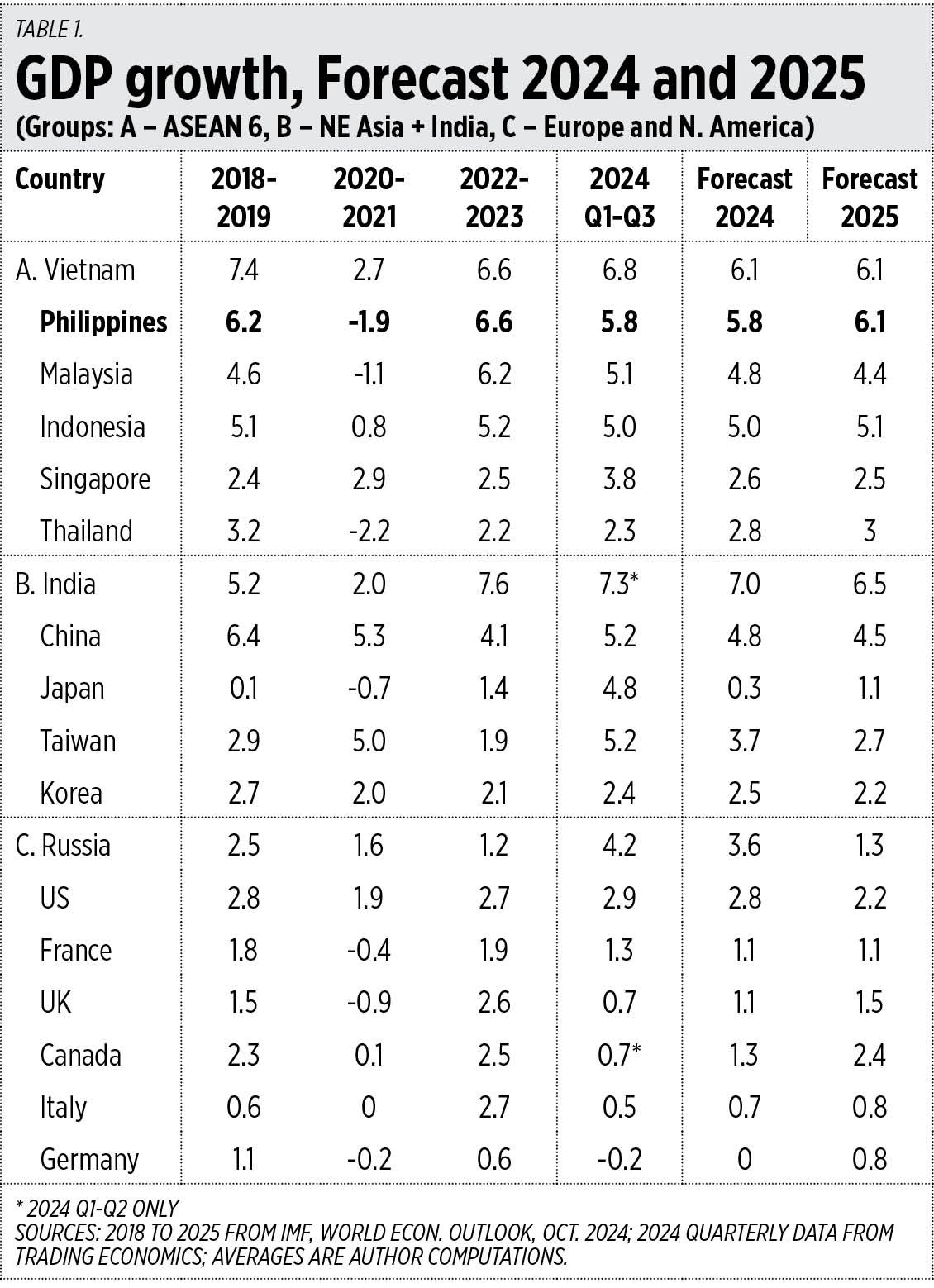
So far, the Philippines has had an average growth of 5.8% in the first three quarters (Q1 to Q3) of 2024. This is third highest among the major economies of Asia after India and Vietnam, and much higher than the average growth of countries in North America and Europe. The International Monetary Fund’s (IMF) forecast for the Philippines in 2025 is 6.1% growth — fair enough (see Table 1).


I saw two pieces of good news last week that I think will help the Philippines attain a growth rate of 6% or higher next year. These reports in BusinessWorld (BW) were: “Canada sending 300-member biz delegation to PHL in December” and “PEZA approvals hit P186B as of mid-Nov.” (Both came out on Nov. 21.)


Senior Trade Commissioner Guy Boileau of the Canadian Embassy in Manila was quoted saying that: “This is the biggest Team Canada Trade Mission that we have done. It is bigger than the delegations sent to Japan and Korea.”


Mr. Boileau also mentioned that among the standout reforms and new laws that helped many Canadian investors to consider the Philippines were: the amendment to the Public Service Act, Public-Private Partnership Code, and the Corporate Recovery and Tax Incentives for Enterprises to Maximize Opportunities for Reinvigorating the Economy (CREATE MORE).


DoF Secretary Ralph G. Recto used a lot of his political capital in pushing the CREATE MORE bill into a law, which was signed by the President on Nov. 11. The reduction in the corporate income tax rate from 25% to 20% is among the big reforms in the CREATE MORE law. I think it is a beautiful law because it responds to tax competition in East Asia, among other reasons.


The Philippine Economic Zone Authority (PEZA) reported that investment approvals in 2023 came to P140.88 billion, and now it is already P186 billion, and the year is not over yet. Cool.


MUP PENSION REFORM

Another piece of good news that was reported in BusinessWorld is this: “Military pension reform ‘not dead’ — DBM chief” (Nov. 25). It quoted Department of Budget and Management (DBM) Secretary Amenah F. Pangandaman and Undersecretary and Principal Economist Joselito R. Basilio.


Ms. Pangandaman said that a different version is being worked out and it is “different from what Secretary Ben [Diokno] has intended from the very beginning.” Mr. Basilio said that “Discussions are still ongoing, there will be updating.”


The pension of the Military and Uniformed Personnel (MUP) in the government’s annual budget should be zero — that is if the MUPs had not been pampered by previous administrations, especially the Ramos administration. Instead, active personnel contribute nothing to their own personal pensions, plus the pensions of retired MUP are indexed to the salaries of active personnel.


The pension comes out to about P130 billion/year on average. The share of pension to basic pay is 68% to 72% (see Table 2).


There are bills to remedy this oddity, and compared to the House version, I like the provisions in the Senate version, SB 2501, better. It says members of the military should contribute 7% of their base monthly salary to a pension system and the National Government will contribute 14%; indexation is removed and the pension is limited to 50% of the base pay for the last position held by retired MUPs. The ideal, according to Mr. Basilio, is 9% and 11%.


If indexation is retained, as is being lobbied by the Defense department and other agencies, another option is that the pension should be subject to tax, around 25%. This way, pensioners who did not contribute to their pensions during their active days would now be helping contribute to their own pension.


Every year the DBM and DoF come under pressure from so many agencies wanting higher budgets while taxes and other revenues are not able to keep up, leading to a high annual budget deficit and high borrowings. It is time to reduce and cut the subsidies and freebies, both to the public and certain government personnel.

---------------- 


PhilStar 17, Gas power in Asia and Pacific Light (Part 1 of 2)

Gas power in Asia and Pacific Light (Part 1 of 2)

ENERGY, INFRA AND ECONOMICS - Bienvenido Oplas Jr. - The Philippine Star 

November 28, 2024 | 12:00am

https://www.philstar.com/business/2024/11/28/2403391/gas-power-asia-and-pacific-light-part-1-2


SINGAPORE – It’s the city of bright lights, fast and efficient trains underground, the regional headquarter of many big multinationals from the West and the host of one of Formula 1’s famous races held at night because it can afford to brighten the road tracks as if it is daytime.


Singapore is the richest Asian country in terms of per capita income. In 2023, Singapore has a per capita GDP at current prices of $84,734, fifth highest in the world behind Luxembourg, Ireland, Switzerland and Norway. But at per capita GDP at purchasing power parity (PPP) values, Singapore is the second highest at $127,544 just behind Luxembourg’s $133,973.


The per capita GDP at PPP values of other East Asians in 2023 were: Taiwan $67,044, Hong Kong $64,538, South Korea $54,103, Japan $54,103, Malaysia $34,864, China $22,078, Thailand $21,608, Indonesia $14,014, Vietnam $13,499 and the Philippines $10,165 (Source: IMF, World Economic Outlook database Oct. 2024).


One wonders what powers or what sustains the heavy use of electricity in Singapore. Well, in 2023, Singapore was the most natural-gas intensive country in the world. Here is the percentage share of natural gas in total power generation in terawatt-hours: Singapore used about 90 percent of 57 TWH, Iran used 84 percent of 383 TWH and Egypt used 81 percent of 220 TWH.


Other Asians have these numbers: Thailand with 68 percent of 190 TWH, Taiwan with 40 percent of 282 TWH, Malaysia with 37 percent of 188 TWH, Japan with 32 percent of 1,013 TWH, S. Korea with 27 percent of 618 TWH, Indonesia with 17 percent of 351 TWH, Philippines with 14 percent of 118 TWH (Source: Energy Institute, 2024).


So many Asians have high use of natural gas which contributes to their high power generation, which in turn, contributes to their high GDP size and/or high per capita GDP. It is an energy source that we should keep expanding in the Philippines.


There are five existing natural gas plants in the country, all located in Batangas, the biggest of which is the Ilijan plant with installed capacity of 1,436 MW and dependable capacity of 1,200 MW. It has been running since 2002, making it 22 years old already. It is owned by San Miguel Global Power (SMGP) but Chromite Gas Holdings Inc. (CGHI) where Aboitiz Power (AP) and Meralco Power Gen Corp. (MGen) are also co-investors with SMGP in Ilijan.


There are three other gas plants under construction. The biggest of which is the Excellent Energy Resources Inc. (EERI) in Batangas with 1,760 MW capacity (440 MW x 4 units), followed by Batangas Clean Energy Inc. with 1,100 MW and Energy World Corp. with 650 MW in Pagbilao, Quezon. EERI is also owned by SMGP but CGHI will later own and operate this, meaning it will be a partnership among SMGP, AP and MGen. The deal is still pending approval with the Philippine Competition Commission.


Now MGen also co-owns a gas plant in Singapore, Pacific Light Power (PLP). It is 830 MW (415 MW x 2 units) running on liquified natural gas (LNG) but capable of running on diesel as well, operational since 2013. MGen has 58 percent ownership with partner First Pacific Co. Ltd (HK) owning 42 percent. It is one of six generation companies in Singapore, located in Jurong Island, an industrial and energy enclave of the country.


In a press statement, Yari Miralao, president & CEO of MGen Gas Energy Holdings Inc. (MNatural Gas) said that “we are dedicated to investing in state-of-the-art facilities to enhance our competitiveness in the Singapore energy market. This includes a potential investment in a new 600- MW power plant, designed to be larger, more efficient and one of the most reliable on the Singapore grid.”


I find PLP interesting for four reasons. First, it occupies a small land area with only 13 hectares housing an 830-MW gas plant and will further expand to another 100 MW of fast-start LNG and hydrogen-ready ancillary service or peaking plant.


Second, it is competitively priced. It has about eight percent of installed capacity but gets about 10 percent of market share.


Third, it is the first power plant in Singapore to exceed 60 percent efficiency after the Advanced Turbine Energy Package upgrade, making it one of the most efficient gas plants in East Asia.


Fourth, it has a safe work environment with over one million man-hours without lost time injury and 1,000+ accident-free days as of October 2024.


Singapore recently solicited a supply of two new plants. PLP submitted its bid to build another gas plant with a capacity of 600 MW. The average cost of building a gas plant is $1.5 million per MW so this will cost around $900 million. See this story in PhilStar, “MGen’s PacificLight allots $900 million, to bid for 600-MW Singapore plant” by Brix Lelis (Nov. 27).


During the global lockdowns in 2020, Singapore suffered a 3.9 percent GDP contraction (or “negative growth”) but recovered with a 9.7 percent GDP growth in 2021. The Philippines suffered a much worse 9.5 percent contraction in 2020 and only recovered to a 5.7 percent growth in 2021.


Being a major exporter in the world with merchandise exports of $391 billion in 2019, $457 billion in 2021 and $476 billion in 2023, and further moving into high-end electronics exports, Singapore will need more electricity supply yearly. PLP expansion will help address this rising power demand while providing additional knowledge to MGen for the operation of the big EERI gas plant.

----------------


See also: 

BWorld 758, On the nuclear forum, and the link between nuclear energy and inflation

On the nuclear forum, and the link between nuclear energy and inflation

November 19, 2024 | 12:02 am

My Cup Of Liberty

By Bienvenido S. Oplas, Jr.

https://www.bworldonline.com/opinion/2024/11/19/635645/on-the-nuclear-forum-and-the-link-between-nuclear-energy-and-inflation/


Last week I attended the “Philippine International Nuclear Supply Chain Forum 2024” at Solaire Resort North in Quezon City. It was organized by the Department of Energy (DoE) and ran from Nov. 13-15, but I attended only the last two days.


Held on Nov. 13 was the Opening Ceremony with Keynote speeches from DoE Secretary Raphael P.M. Lotilla, US Ambassador to the Philippines MaryKay L. Carlson, and Special Assistant to the President on Investment and Economy Affairs Secretary Frederick D. Go (who was represented by his Assistant Secretary Marvin Jason Bayang). Then there were discussions on the US experience in nuclear energy development.


Nov. 14 focused on the nuclear energy experience of Canada in the morning, and that of France in the afternoon. The host in the morning session was Guy Boileau, Counselor and Senior Trade Commissioner of the Canadian embassy in the Philippines. A Welcome Message was given by the Ambassador of Canada, David Hartman. Among the speakers were Todd Smith, Vice-President of AtkinsRéalis’ Candu Energy, Inc., and Dr. Sara Supa-Amornkul also of AtkinsRéalis, a Thai-Canadian scientist who talked about CANDU (Canada Deuterium Uranium) technology as the only unenriched uranium technology in the world.


(I was one of several media participants who went along during the Philippines’ nuclear trade mission to Canada last March in Toronto, led by DoE Undersecretary Sharon Garin and other government officials.  Mr. Boileau was with us and Todd Smith was the Energy Minster of Ontario at that time and we met him there. It was one of the most educational foreign trips I have ever attended.)


On the afternoon of Day 2, France’s Ambassador to the Philippines Marie Fontanel gave an overview of the two countries’ economic partnership and her country’s nuclear energy delegation. A talk on France’s extensive nuclear experience was delivered by Thomas Muisset, Nuclear Special Adviser of the French Government in Paris.


Nov. 15 focused on the nuclear energy experience of South Korea in the morning and of Japan in the afternoon. Opening remarks in the morning were given by Energy Regulatory Commission Monalisa Dimalanta. I like the discussion given by an official of Korea Hydro and Nuclear Power (KHNP) of KORI 2, a nuclear plant “twin” of our Philippine Nuclear Power Plant 1 (PNPP 1) in Bataan. Both were built by Westinghouse. Kori 2 produces 640 megawatts (MW) of power and was commissioned in 1983 while the PNPP 1 is capable of producing 620 MW and should have been commissioned in 1985 but was unlucky.


The afternoon of Day 3 had plenty of presentations from Japanese agencies, nuclear vendors, and energy companies — the Ministry of Economy, Trade and Industry (METI), Japan NUS Co. (JANUS) about their small modular reactors (SMR), from JGC, Hitachi-GE, and Japan Atomic Power Co. (JAPC).


When we were in Toronto last March, we saw the future site of Hitachi-GE’s SMR named BWRX 300 at the Ontario Power Generation (OPG) — it was small, about the size of one soccer field, and yet it can deliver 300 MW of 24/7 reliable and cheap electricity. That is beautiful.


Also that afternoon, Senator Sherwin Gatchalian came to the venue and I briefly chatted with him. I was happy when he told me that he regularly reads my column on energy, especially my discussion and critique of the LNG bill, but it has already been enacted into a law last week.


Congratulations to the DoE, especially Secretary Lotilla and Undersecretary Garin. Ms. Garin stayed all throughout the three-day event. I think it was very successful and gave the Philippine energy sector a wider perspective of these rich countries — the US, Canada, France, South Korea, and Japan — who have been industrialized for many decades now.


ON NUCLEAR ENERGY AND INFLATION

I checked again the nuclear power generation of these five countries, plus that of some other countries. I also compared their power generation with their consumer price stabilization. These are some interesting points I discovered:


1. Countries with rising nuclear power use experienced declining inflation rates — China, Russia, India, South Korea, and the United Arab Emirates (UAE).


2. Countries with declining nuclear power use experienced rising inflation rates — Germany, Japan, and France.


3. Countries with generally flat nuclear power use also experienced generally flat inflation rates — the US and Canada (see the table).


There are many factors why a country’s inflation rate rises, stays flat, or declines. But the cost of energy and electricity is one of the big contributors to inflation trends among countries. This should be one important incentive for the Philippines to go into nuclear power generation — to acquire many SMR units or quickly rehabilitate or refurbish BNPP 1 and proceed with BNPP 2 and other large nuclear plants.


I saw a press release from the Manila Electric Co. (Meralco) along with the Meralco Power Academy (MPA) about a recent visit to the Université Paris-Saclay (UPS) and top nuclear institutions in France. Meralco has a new initiative called nuclear energy strategic transition (NEST) and the visit to France was cool, exploring possible collaborations on capacity building and knowledge sharing.


Among the Meralco officials who went to France were Executive Vice-President and Chief Operating Officer Ronnie L. Aperocho, Senior Vice-President and Chief Human Resources Officer Edgardo V. Carasig, and First Vice-President and Head of Networks Froilan J. Savet.


UPS will be one of Meralco’s partner institutions for its Filipino Scholars and Interns on Nuclear Engineering (FISSION) program. The company sends young Filipinos abroad to cultivate the next generation of strong innovators and professionals in nuclear energy. Good move. Keep giving your consumers in the country stable, reliable, and competitively priced electricity.

----------------


See also:

Friday, May 23, 2025

Economic liberalization vs economic retrogression: Why Finance Secretary Ralph Recto should be reappointed

Dear readers, here is my statement about the reappointment of DOF Secretary Ralph G. Recto. Thank you. 


Saturday, March 15, 2025

Philstar 16, CREATE MORE and Trump tax, spending cut plan

CREATE MORE and Trump tax, spending cut plan


ENERGY, INFRA AND ECONOMICS - Bienvenido Oplas Jr. - The Philippine Star 

November 21, 2024 | 12:00am

https://www.philstar.com/business/2024/11/21/2401691/create-more-and-trump-tax-spending-cut-plan


The Corporate Recovery and Tax Incentives for Enterprises to Maximize Opportunities for Reinvigorating the Economy (CREATE MORE), signed into law last Nov. 11, is another good law pushed by the Department of Finance (DOF) and the economic team.


A key provision is the further reduction in corporate income tax (CIT) rate to 20 percent from 25 percent for Registered Business Enterprises (RBEs) under the Enhanced Deductions Regime (EDR) on their taxable income derived from registered projects or activities during the taxable year.


DOF Secretary and Fiscal Incentives Review Board (FIRB) chairperson Ralph Recto has been pushing for this proposal. I see at least four ways that this law will make the Philippines even more globally competitive in attracting and keeping investments.


One, our 20 percent CIT will put us at par with Vietnam (reduced from 22 percent until  2015), Thailand (from 23 percent until 2012), Taiwan (increased from 17 percent until 2017) and Cambodia (flat 20 percent for decades). It will be lower than Indonesia’s 22 percent,  Malaysia and South Korea’s 24 percent and China’s 25 percent, but higher than Singapore’s 17 percent and Hong Kong’s 16.5 percent. Tax competition in East Asia is real and not fictional.


Two, our 20 percent CIT under EDR will put us nearer the global minimum tax (GMT) rate of 15 percent under Pillar Two of the Organization for Economic Co-operation and Development (OECD). Thus, businesses from rich OECD member-countries can easily align with Philippines’ CIT and still enjoy deductions on research and development, seminars and related expenses.


Three, RBEs have the option to choose between the Special CIT (SCIT) of five percent or EDR right from the start of their commercial operations, and these incentives have been extended from maximum of 10 years to 17 or 27 years.


Four, it increased the deduction for power expenses to 100 percent from 50 percent so that energy-intensive industries like manufacturing and tourism can further reduce their cost of business. This is in recognition of the fact that the Philippines has a higher cost of electricity than most East Asian neighbors, many of whom subsidize their power costs. There is additional 50 percent deduction for expenses related to trade fairs and tourism reinvestments until 2034.


Secretary Recto said during the signing ceremony of the law that “CREATE MORE will certainly fast-track the entry of more foreign investors into the Philippines, as evidenced by the bullishness and strong interest from nearly a thousand investors who attended our recent economic briefings abroad. This will help facilitate more partnerships and joint ventures with our local companies.”


Trump tax and spending cut plan


The US had a CIT rate of 46 percent in the 1980s, then former president Ronald Reagan cut it to 34 percent in 1988 during his second term. Succeeding presidents (Bush Sr., Bill Clinton, Bush Jr., Obama) raised and kept it at 35 percent. Trump came in 2017 and cut CIT to 21 percent. In his second term, Trump plans to further cut it to 15 percent.


Initial reduction in tax revenues will be compensated by (a) revenues from higher tariffs, especially imports from China, (b) a bigger number of companies from abroad that will locate to the US and (c) spending cuts.


Trump will create a Department of Government Efficiency (DOGE) to “slash excess regulations, cut wasteful expenditures and restructure federal agencies” and make the US government more efficient and non-burdensome to taxpayers. DOGE will be jointly led by Elon Musk and Vivek Ramaswamy. They will not get any government compensation along with their staff who will all be volunteers.


Elon is the richest man in the world because he created super-efficient and super-innovator companies like SpaceX, Tesla, and Starlink, and revolutionized X, formerly Twitter...


When Elon took over Twitter, he removed up to 80 percent of personnel and new technology allowed X to keep running even with a higher number of users and subscribers.


DOGE will not be a regular Department but an advisory Commission that is time-bound and not a forever bureaucracy. It will start work when Trump takes over Jan. 20, 2025 and end by July 4, 2026, or one and a half years only.


Elon stated that they can possibly slash up to $2 trillion yearly of the federal budget, both salaries/allowances and subsidies/freebies. That is equivalent to one-third of the $6.1 trillion federal spending in fiscal year 2023.


Our DOF made good timing slashing the CIT to 20 percent by 2025 as Trump will soon create shockwaves across Europe and Asian businesses with his planned 15 percent CIT possibly by 2026. Many European countries have 25 percent CIT, Germany has 30 percent. Great job, Secretary Recto and DOF team for pushing this kind of tax cut reform early enough.


Our Department of Budget and Management (DBM) also has a plan to improve government efficiency via the National Government Rightsizing Program (NGRP) bill in Congress. It intends to abolish, merge and restructure certain agencies to create a more efficient bureaucracy. Passed in the House, it is now in the Senate.


In a Viber message, DBM Secretary Amenah Pangandaman said that “the DBM intends to have the NGRP bill become a law soon. We need to make the government more efficient and less costly to the taxpayers.”


Go for it, Madame Secretary. And if you can suggest to the President to possibly follow the DOGE model – high caliber business people working for the government for a year, not receiving any tax money and proposing to make the government bureaucracy and welfare programs less burdensome to the taxpayers.

------------

BWorld 757, Philippine energy realism and Trump’s energy policies

Philippine energy realism and Trump’s energy policies

November 14, 2024 | 12:02 am

My Cup Of Liberty

By Bienvenido S. Oplas, Jr.

https://www.bworldonline.com/opinion/2024/11/14/634706/philippine-energy-realism-and-trumps-energy-policies/


I attended the afternoon session of Stratbase’s “Pilipinas Conference 2024” on Nov. 7. It was on “Energy transition and green industries.” The keynote speakers were Energy Secretary Raphael Lotilla and Environment Secretary Toni Yulo Loyzaga.


Mr. Lotilla highlighted huge targets for offshore wind, plus the slow introduction of nuclear power in our energy mix. Ms. Loyzaga started with the usual climate fears, talking about the high number of deaths and destruction of property because of too much water and flooding.


On the panel were Manny Rubio, president and CEO of Meralco Power Gen Corp. (MGen); Sandro Aboitiz, chief financial officer of Aboitiz Power Corp.; Paul Everingham, CEO of Asia Natural Gas and Energy Association; Michael Toledo, chairman of the Chamber Mines of the Philippines; and Martin Antonio “Dennis” Zamora, president and CEO of Nickel Asia Corp.


I liked the points made by these three gentlemen — Messrs. Rubio, Aboitiz, and Toledo.


Mr. Rubio emphasized the need for energy security and a balanced mix of reliable baseload with intermittent renewables. He noted that their 3,500-megawatt (MW) Terra Solar facility — the world’s largest contiguous solar plus battery storage facility — is equivalent to 850 MW of mid-merit reliable energy with battery.


I like the kind of energy realism shown by Mr. Rubio, not the usual energy alarmism or hyped-up optimism about renewables that we often hear or read. It is good that MGen has a portfolio of coal and gas plants that can deliver electricity 24/7 even if the sun is not shining at night or is behind heavy clouds, even if the wind is not blowing.


Mr. Aboitiz made similar realistic statements, saying that “the energy transition journey is not linear and is extremely complex, [it] needs alignment with the country’s needs and circumstances, [there is] no one-size-fits-all solution or silver bullet.” He is correct to remind us that we are still “a developing country that aspires for continued growth, to become an upper-middle-income economy and eradicate poverty. Striking a balance between energy security, affordability, and sustainability requires the adoption of a tailor-fit transition strategy.”


He calculates that the Luzon grid alone will need 600-700 MW of new baseload energy per year, and this does not yet consider new power intensive sectors like data centers or the electrification of transportation. Thus, the need for a balanced mix of traditional and renewable energy sources, supported by new technologies in energy storage and emissions reduction.


Meanwhile, Mr. Toledo passionately and articulately highlighted four policy challenges and measures in the mining sector. One, the need for long-term policy consistency from national to local governments. Two, the need to simplify and expedite the approval process for mineral agreements. Three, the need to minimize business continuity risks from local ordinances. And four, the need to have a stable, predictable mining fiscal regime, including a “financial stability clause.”


I agree with all of these four points. I will add that open-pit mining should be encouraged for two reasons: it makes the extraction of ores and metals easier, and the mined-out area can serve as a man-made lake and water catchment. This will help reduce flash flooding.


TRUMP’S ENERGY POLICIES


During his first term as US President in 2017-2020, Donald Trump had a “drill baby drill” policy and significantly expanded US oil-gas production and exports. Take liquefied natural gas (LNG) for instance. US exports were only 0.8 billion cubic meters (bcm) at the end of Obama’s first term in 2012, increasing slightly to 4 bcm at the end of Obama’s second term in 2016. In Trump’s first year, this quadrupled to 17 bcm, and further ballooned to 61 bcm in 2020.


Looking at crude oil, US exports were only 2.68 million barrels per day (mbpd) in 2012, rising to 5.1 mbpd in 2016, and further increasing to 5.9 mbpd in 2017 and 8.1 mbpd in 2020. The Biden administration took off from the high momentum of oil-gas exports under Trump (see the table).


In his second term, Mr. Trump will resume his “drill baby drill” policy and pursue US energy dominance — not just energy security — to be a powerhouse producer of oil, LNG, and coal, plus nuclear technology, and export more to its allies worldwide, helping strengthen their economies. Trump explicitly announced energy deregulation, not energy heavy regulation and rationing, and the streamlining of permitting processes for energy infrastructure. He also intends to repeal the Inflation Reduction Act (IRA), even partially. The IRA is expanding the mandates and favoritism for intermittent renewable power sources like wind-solar, among others.


We should have similar policies here in the Philippines, as should other developing countries. We should prioritize saving our jobs and businesses from high energy prices and big bureaucracies. Not saving the planet or saving climate bureaucracies.

--------------


See also:

Fiscal Irresponsibility 39, Trump's plan of zero income tax below $150,000/year

US outstanding public debt, data from Debt to the Penny, Dept of Treasury.


Nearly 2 months old Trump admin until Feb 13, public debt did not increase, declined by $1 billion. In contrast, Biden admin two months before the Nov. 4 elections, public debt increased by $540.6 billion or average of $9 billion/day increase hoping they could bribe more voters to support Kamala and the Democrats.

The former is an example of fiscal discipline and responsibility. The latter is an example of fiscal imprudence and irresponsibility. And many people are angry at Trump (smiley)

Next fiscal move by Trump is a new law that will have zero tax on tips, zero tax on overtime pay, zero tax on social security payments. And soon zero tax on income below $150,000/year. 

Income tax revenue decline will be compensated by spending cut, bureaucracy cut, higher revenues on sales tax and import tariff. The never-Trumpers and TDS camp will be unhappy again.  

No taxes if you earn under $150k in the US: Trump’s radical plan to rewrite America’s tax code revealed

Trump’s proposal, if implemented, would exempt anyone earning below $150,000 — about ₹1.3 crore a year — from paying taxes. Lutnick emphasized that making this goal a reality is his current mission.

Business Today Desk, Mar 13, 2025,

https://www.businesstoday.in/world/us/story/no-taxes-if-you-earn-under-150k-in-the-us-trumps-radical-plan-to-rewrite-americas-tax-code-revealed-467957-2025-03-13 

Trump eyes no taxes for Americans making less than $150k, says Lutnick

The plan could offer $24,000 in relief for some taxpayers, but experts warn of consequences.

Leo Almazora, MAR 14, 2025
https://www.investmentnews.com/tax/trump-eyes-no-taxes-for-americans-making-less-than-150k-says-lutnick/259713


Lutnick Explains Trump Plan To Eliminate Taxes For Those Earning Under $150,000

Tyler Durden, MAR 15, 2025
https://www.zerohedge.com/political/lutnick-explains-trump-plan-eliminate-taxes-those-earning-under-150000

-------------

Friday, March 14, 2025

Philstar 15, The Freeman energy forum; avoiding carbon tax

The Freeman energy forum; avoiding carbon tax

ENERGY, INFRA AND ECONOMICS - Bienvenido Oplas Jr. - The Philippine Star 

November 14, 2024 | 12:00am

https://www.philstar.com/business/2024/11/14/2399887/freeman-energy-forum-avoiding-carbon-tax


As mentioned in this column last week, I attended The Freeman energy forum on the theme, “Powering Cebu,” at Waterfront Hotel in Cebu IT Park. The Freeman is a leading regional newspaper in Cebu and Central Visayas, and is part of the Philippine STAR Media Group.


The opening message was given by Miguel G. Belmonte, president and CEO of the Philippine STAR Media Group. He emphasized the economic dynamism of Cebu and the region, the fast demand in power and the challenge of significantly expanding energy infrastructure.


Department of Energy Assistant Secretary Mario Marasigan discussed the lineup of big wind power, onshore and offshore that are projected to provide big power supply into the future.


Niel Martin Modina, assistant vice president for Visayas System of National Grid Corp. of the Philippines, showed maps of new transmission lines dotting and connecting major economic corridors of Luzon, and between major islands of Visayas and Mindanao.


Engr. Raul Lucero, president and COO of Visayan Electric Co.(VECO) mentioned that the Philippine Energy Plan itself projected that peak demand in Visayas would leap from 2,464 megawatts in 2023 to 10,678 MW by 2050. The power situation in Cebu is critical to the economic fate of the Visayas as it is the connection hub of energy transfers from Luzon and Mindanao to reach the rest of the Visayas.


He then discussed their consumer app “MobileAP” that will “enable customers to track their electricity consumption, help raise their appreciation of the industry, and understand that they have a huge stake in the energy transition in the Visayas and the rest of the country.”


Engr. Don Paulino, chief engineering and projects officer of Aboitiz Power Thermal Group, discussed the need for Cebu to grow its power plant capacities “using all forms of technologies especially reliable, continuous, and affordable electricity coming from baseload sources that would also support the entry of more renewable energy.”


The energetic and fast-talking engineer is correct because Cebu’s high demand and Visayas grid’s perennial low reserve margins should be an important factor for people there to realize that what is needed are more baseload thermal plants.


Cebu Gov. Gwen Garcia gave a long, passionate extemporaneous speech about their past experiences of power failures, of dependence on geothermal power from Leyte because Cebu did not have enough domestic supply of power. She argued many years ago that Cebu should have more embedded power plants in the island, within Cebu itself. Many manufacturing, hospitality and hotels, IT and IT-BPM industries are all energy intensive and they are in Cebu and are Visayas’ growth drivers and help Cebu become more globally competitive.


She mentioned a few times environmentalist groups that oppose Cebu having many thermal coal plants. For the charming and frank governor, priority should be the jobs and businesses of her people in the province and neighboring islands that do business with Cebu.


Jay Yuvallos, president of the Cebu Chamber of Commerce and Industry; Alfredo Reyes, president of Hotels, Resorts and Restaurant Association of Cebu, and Fred Languido, editor of The Freeman, joined the panel discussion and provided more in-depth analysis and experiences as local business and media leaders who see the economic realities on the ground. I enjoyed listening to sharing local perspectives on Cebu’s real needs in business and electricity.


Overall it was a fantastic, dynamic and high caliber forum. No heated or antagonistic debate, only sincere dialogue and sharing of ideas and business outlook. The room was full with enthusiastic audience.


Congratulations, The Freeman and PhilStar Group, for holding that wonderful and intellectually engaging forum.


Recently there have been lobby especially from the ADB that the Philippines should impose a carbon tax. See for instance these reports this year: “ADB: Carbon tax has potential in Philippines” (PhilStar, May 7), “Philippines seeks P28 billion ADB loan to ramp up climate action” (PhilStar, Aug. 30), “Carbon tax seen generating essential revenue for Asia-Pacific, ADB says” (BusinessWorld, Oct. 31).


I think the ADB and other multilaterals, some business and environmental groups are wrong in pushing this lobby. Consider the following.


The Asian Development Fund (ADF) has a total fund of $35.39 billion. The top five contributors to ADF are: Japan 38.2 percent, US 13.7 percent, Australia 8.0 percent, Canada 6.0 percent, Germany  5.7 percent (Source: ADB, “Donor Contributions on Asian Development Fund”).


Now see the coal power generation of these five countries in terawatt-hours (TWH) in 2023: US 738 TWH, Japan 304 TWH, Germany 129 TWH, Australia 126 TWH, Canada 24 TWH.


Other Asians have these coal power generation in 2023: China 5,754 TWH, India 1,471 TWH, Indonesia 217 TWH, South Korea 203 TWH, Vietnam 130 TWH, Taiwan 119 TWH, Malaysia 81 TWH, and Philippines only 74 TWH.


The ADB should tell its four big country donors – Japan, US, Germany and Australia – to significantly cut their coal power generation and be at the level of the Philippines with only 74 TWH, before pressing the Philippines to have a carbon tax.


I hope that the economic team will ignore this irrational lobby by the ADB. A carbon tax is inflationary and can lead to premature closure of some cheap, reliable and dispatchable on demand thermal plants. Which can lead to thin power reserves and power failure.


Recently I bumped into Manny Rubio, the president and CEO of MGen Power Corp., and I asked him about his company’s plans for the Visayas grid. He replied that “MGen is considering expanding our Toledo Power Unit in Cebu to supplement existing 83.6 MW capacity. We are also evaluating modifications to our oil-based plants to offer competitive ancillary services in the co-optimized market.”

---------------