Thursday, September 17, 2015

Mining 44, Presentation at the Mining 2015 Conference

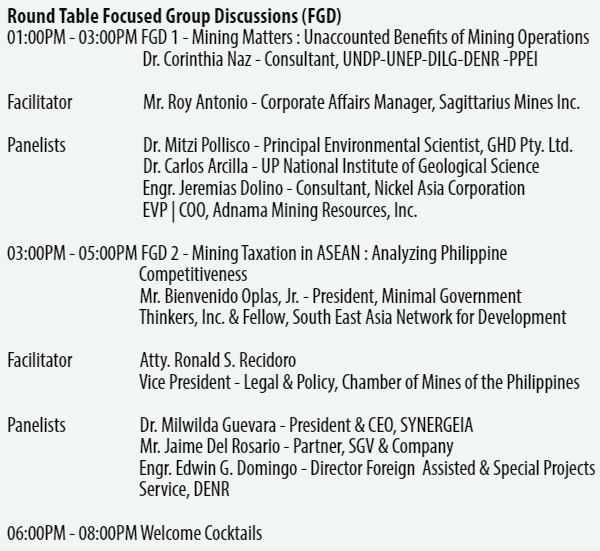
Last Tuesday, September 15, I was one of the speakers during the opening day of the 3-days Mining Philippines 2015 Conference, held at the Grand Ballroom of Solaire Resort Casino Manila. Good audience, perhaps about 200 people.


Opening speeches in the morning, then two focused group discussions in the afternoon. We were on the 3-5pm slot.


This is my presentation, 28 slides total, showing 7 of them here.

After showing various tables on comparative taxation in the region, I asked the audience of this question. About 4 hands were raised to say True, none raised hand to say False, the majority just waited for me to answer my own question.


The 3 pitfalls are (a) deadweight loss, (b) declining revenue in a Laffer curve, and (c) non-recognition of the  "multiplier effect" of mining as raw materials.


I discussed the  various bureaucracies in the power/energy sector, and  the  mining sector, the multiple taxes, royalties, fees, mandatory spending such as SDMP, and yet...


Reflecting  on those tables shown earlier...

I showed 4 annexes -- mining taxation in Vietnam, Indonesia, China, and this proposal.

My full presentation is available in slideshare and in dropbox.


The UP Miners, an organization of Mining Eng'g undergrad students in UP Diliman, made this photo and posted it in fb. Thanks Niel and all.


Meanwhile, I like these comments from two friends, Yani and Raul.

Bayani Camitan: noy, we have very much potential in this industry. in fact mining industry was a significant (if not today in the future) contributor to GDP. but then again, it is sad to say that government support is lacking and related policy is unclear. for one, we have as u may know Surigao (which is partly known for surfing) is the so-called "nickle-ore capital of the Philippines". it is one of the main supplier exporter of nickle ore competing against Indonesia for China market. unfortunately the mining players in Surigao do NOT have a centralized laboratory for nickle ore testing; each of them has their own way to cheat if not hide the characteristics of this mineral ore. an act of one will spoil the whole of it. if only government could support and have a government-instituted laboratory which should be a common facility for about 14 mining companies in Surigao alone, with this guess we can be recognized in the world for this mineral ore.

Raul De Leon: That's the problem with government thinkers! Everytime they see an industry grow, the first thing they think of is to increase taxes instead of improving the collection system. Just like they did in the mid 90s when they saw the stock market boom. They imposed higher taxes on trades that lead to investors shying away from our market and invest else where. This wrong mindset of increasing taxes out of a booming industry has Instead yielded negative results to all stakeholders especially the government who has lost a lot of opportunities and losing to our asian neighbors by giving less incentive, more government involvement and lesser investor facilities.
----------

See also:

Mining 43: Mandy Armas, Christian Monsod at the PES Conference, December 01, 2014

Tuesday, September 15, 2015

EFN Asia 49, Conference 2015 in Bhutan

Gross national happiness and not just gross national product (GNP) or gross national income (GNI). Buddhist ethic and economic liberalism, aside from Confucian ethic, Protestant ethic, Christian ethic, etc. Global ranking of countries worldwide in the Economic Freedom of the World (EFW) 2015 Report by Fraser Institute (Canada).

These are among the key topics to be tackled in the Economic Freedom Network Asia (EFN Asia) Conference 2015 to be held this coming November 23-24, 2015, in Thimphu, Bhutan, on the theme, "Economic Freedom as a Way to Happiness." 

The event will be organised by EFN Asia, QED Group, and the Friedrich Naumann Foundation for Freedom (FNF). QED is a private, independent think tank and consulting firm based in Thimphu.

EFN Asia is holding an annual conference of independent, non-government and free market-leaning think tanks, research institutes and academics, in different Asian cities. The theme varies yearly, in partnership with country-based host think tank/s and institute/s.

Venue will be the Taj Tashi hotel in the capital city of Thimphu. I saw some photos of this hotel, it looks very exotic and inviting.

I fully agree with  the  theme -- that individual and economic freedom is the formula for human happiness.  We can add that economic freedom and material wealth is protected by the rule of law. If there is more material  wealth -- like more sturdy houses and offices for the people, cheap and stable electricity that run 24/7, more schools and institutions of  learning, more modern healthcare facilities and health professionals, more tractors and mechanized harvesters for farmers, etc. -- then people can live more productively, live wealthier, healthier and longer. As one saying goes, "Money cannot buy happiness always, true, but it is better to cry in a van or SUV than in a bicycle."

Thimphu, Bhutan is a valley and still in a very high elevation of 2.25 kms (7,375 ft) and 2.65 kms (8,688 ft) above sea level. For us from an archipelagic country and capital city is just a few meters above sea level, and our highest mountain is only about 3 kms. high, Thimphu should be a brrrry cold place. Especially in late November.

The EFN Conference 2015 is open to the public, so long as they finance their way to the conference (plane fare, hotel, travel taxes, visa fee). The tourist visa fee is expensive though, US$250 a day.

Interested individuals, FNF and QED will help in securing the group visa, most likely at a discounted price. Fill up the (1) conference registration form (no conference fee) and (2) Bhutan visa form, see details here.
------------

See also:
EFN Asia 46: A Young Korean's Reflections of Conference 2014 in Hong Kong, February 10, 2015 
EFN Asia 47, Participation in Jeju Forum 2015, May 08, 2015 

EFN Asia 48: Report on "Free Market Environmentalism", May 29, 2015

Sunday, September 13, 2015

IPR and Innovation 25, Malaysia's IP Monetization strategy

There is a report this week about Malaysia's "IP Monetization" program as articulated by PM Najib Razak.  From that news,  "We need to be competitive in our bid to become a high-income nation that is not dependent on traditional and physical resources but is based on new sources of wealth such as intellectual property.

"To ensure the country's continued momentum in making intellectual property a new source of wealth, we have a responsibility to be more innovative and creative as well as to constantly create value added in order to come up with high-impact products and technologies for the local and global markets," he said at the National Intellectual Property Awards 2015 today.

Najib, who is also finance minister, said the effectiveness of initiatives to strengthen the national intellectual property ecosystem was shown by the 6% average annual rise in applications.

This shows the potential of intellectual property to contribute to national economic growth, he said, adding the government had agreed to consider providing an allocation to encourage intellectual property rights applications as part of efforts to raise the number of registrations. Some 42% of intellectual property rights applications are from within the country. 

Well and good. Kuala Lumpur is just 4 hours away by car from Singapore, the center of IPR protection and the richest economy in the ASEAN. The interdependence between  the two  in  trade and investments, both physical and non-physical/intellectual commodities, is high.

More and more, the world is moving towards high value products and services production and trade. New mobile  phones, flat or curved tv, other appliances and  furnitures with sleek, modern  or exotic designs, etc. are all guided by new ideas that were non-existent  and  unimaginable just a few decades ago. And these ideas are protected by various forms of IP protection -- patent, copyright, trademark, service mark, industrial designs, circuit designs -- to protect the innovators and inventive people and enterprises from copycat ones.

The program or strategy is good, except that PM Razak is still embroiled in a huge corruption scandal that greatly diminishes his credibility and effectivity in initiating new programs.

On a related note, I saw from a World Intellectual Property Organization (WIPO) website the various IP laws and IP-related laws of Malaysia.


They have a law for each type of IP. Being a non-lawyer, I am not sure if this is better than a single, big and long law that covers all types of IP that we have here, the IP Code of the Philippines (RA 8293) enacted in 1997. One advantage of one law for each type of IP perhaps is that if we revise or amend in the future one aspect, say only the patent system or copyright system, it will not affect the whole big law -- and cause some confusion.

Nonetheless, establishing clear property rights for the people, physical or non-physical property, is one of  the most important functions of any government. More important than endless welfarism and  political populism.
---------------

See also:

Saturday, September 12, 2015

BWorld 18, Non-tariff barriers in the ASEAN

* This  is my article in BusinessWorld last September 10, 2015.

Trade between and among people is beautiful. What one does not need because he has surplus production, he can sell it and get those things he does not have but he needs, via purchase or via the old system of barter.

Countries and economies that trade more are more advanced, more developed compared to countries that are less friendly to more international trade.

That is why free trade has become a known policy and advocacy in many countries for centuries now. Import tariff rates have been declining significantly, down to zero for some economies like Hong Kong and Singapore.

But protectionist interests have invented many types of non-tariff barriers (NTBs) or non-tariff measures and these limit or restrict trade.

Among the less-visible type of NTBs are the various business bureaucracies and regulations. For instance, while it is possible to require only three documents to allow exporters and importers to ship or receive their products, other Association of Southeast Asian Nations (ASEAN) countries require six to 10 documents.

Here is one result of the World Bank’s Doing Business 2015 Report, section on International Trade. There were 189 countries covered in that report. Global ranks of ASEAN countries are given.

It would take around three weeks for an exporter to finally move his containers out of Cambodia, Laos, Myanmar, and Vietnam, too long compared to less than one week in Singapore and around two weeks for exporters in Malaysia and Thailand. 


It is really possible to cut the time to export to just 11 days or less, as shown by Singapore and Malaysia plus the seven countries above. The eight other governments in the ASEAN need not hold back the exports of their entrepreneurs for two weeks or more.

A similar measurement of bureaucracies and taxes as new variety of NTBs is covered by Fraser Institute’s Economic Freedom of the World (EFW) annual reports. The EFW is composed of five areas, including the freedom to trade internationally. This area is composed of four sub-areas: (A) Tariffs, (B) Regulatory trade barriers, (C) Black market exchange rates, and (D) Controls of movement of capital and people.

The EFW employs a scoring system of zero to 10, where zero is totally unfree and 10 means there is full economic freedom. Thus, high revenues from trade taxes, high tariff, wide variations and deviation of tariff rates mean low score. And more regulatory barriers, more NTBs also mean low score, low degrees of economic freedom for entrepreneurs.

For this piece, sub-areas A and B are shown. Laos was not included in the EFW report. Hong Kong is added here as “benchmark” for being the freest economy in the world. 


The above numbers show that ASEAN countries generally have low tariff rates, with scores of eight to almost 10 (Singapore and Brunei). This is a reflection of the accelerated trade liberalization policy in the region.

But there are problems too, like having wide variations and high standard deviations in tariff rates. Singapore, Malaysia, Thailand, and Vietnam have scores below six.

The member-governments of the ASEAN need to be reminded from time to time that the main purpose of trade liberalization is to empower the consumers and producers of their own countries with more choices. NTBs and complicated bureaucracies defeat or undermine that goal.

Free trade means free individuals, free enterprises. Restrictions to trade is restricting individual and economic freedom, the freedom to choose and compete, where and from whom to buy and to whom to sell.

Some consumers though can lose from free trade and unilateral liberalization if the goods they regularly consume are being exported because prices can go higher. But this loss is temporary because more goods, more choices from abroad will become available in the domestic market.

Multilateral trade negotiations for free trade are too unwieldy and costly, time-consuming and bureaucratic. Regional and bilateral free trade agreements (FTAs) are faster in producing agreements and results but they are selective and become an excuse for protectionism against countries where no FTAs are signed yet.

Unilateral trade liberalization, no need for or minimum of negotiations, just open the borders at zero tariff and minimal bureaucracies, is pro-development. There is little or no justification to restrict trade as it is a voluntary exchange between two or more entities -- individuals, companies, and institutions.

People and companies, not nations and governments, trade with each other. Governments therefore should reduce restrictions on people and goods mobility.

In particular: (a) reduce tariff and non-tariff barriers like quantitative restrictions and customs bureaucracies, and (b) simplify visa requirements and issuance, reduce the cost of migration.

The main function of government in trade is to help enforce contracts and promulgate the rule of law. And the only justifiable considerations for governments to regulate trade are those involving public health and safety. Like bringing in or exporting weapons, ammunitions, dangerous substances, counterfeit or substandard medicines, virus-infected animals, etc.

All other goods should be allowed entry with the minimum or zero restrictions and taxation. This will significantly bring down prices and benefit consumers, especially the poor.

Two groups of people dislike unilateral trade liberalization: (a) the protected local businesses and cronies, political interest groups like militant trade unions and farmer organizations, and (b) trade negotiators and consultants who regularly fly and have endless meetings in some beautiful and expensive hotels and cities abroad.

Smuggling can be beneficial to consumers through lower prices compared to protectionist prices. But this expands corruption in government. To remove the opportunities for corruption and rent-seeking and at the same time give consumers and local producers the freedom to get cheaper goods and services, protectionism should be abandoned and unilateral liberalization should be pursued.

Other institutional constraints like protectionist constitutions that explicitly protect domestic business interests and limit foreign competition should be amended to allow or encourage more foreign investments and trade.


Bienvenido S. Oplas, Jr. heads a free-market think tank, Minimal Government Thinkers, Inc., and is a fellow of the South East Asia Network for Development (SEANET).
-----------

See also: 

Tuesday, September 08, 2015

Free Trade 52, More on the Gravity model

A presentation by Dr. Ramon Clarete of UPSE during the UPSE-Ayala forum early this year was entitled "Going Regional: Which Mega Trade Deals Should the Philippines Join?"

He used the Gravity model of trade in estimating the level of bilateral exports or imports between two trading partners. So the dependent variable is the flow of trade between and among countries studied, the independent or explanatory variables are the following and their expected signs or relationships:

GDP (+), population (+), distance between two countries (-), commonality of language (+), shared borders (+), landlocked state (-). 

In addition, Trans Pacific Partnership (TPP), Regional Comprehensive Economic Partnership (RCEP) indicators or dummy variables are introduced: 

TB1, 1 if both trading countries are TPP or RCEP members, 0 otherwise,
TB2, 1 if exporting country is a TPP or RCEP member, 0 otherwise,
TB3, 1 if importing country is a TPP or RCEP member, 0 otherwise.

For overlapping memberships, a dummy variable where TPP*RCEP =1 if both trading partners are members of the two trade blocs.

Some 209 trading countries and their annual trade data from 1948 to 2013 was used and analyzed.

A time interaction variable, 1 after 1990s (representing more or less the fact that China has become integrated with the world economy).

Here is the result. All estimated coefficients are statistically significant and bear the expected signs.

In particular, these coefficients mean that...


The implied change of exports of membership are shown below. If the Philippines, already a member of RCEP, and it further becomes a TPP member, its exports are expected to rise by 48%, and real GDP projected to rise by 61%.


Meanwhile, a paper produced February 2015 (39 pages), Trade Theory Network, by Michael Hubler, Four theoretical examples with numerical applications are presented, below:

* increase in trade from Asia to North America affects the world economy,
* an intuitive rule for finding the welfare-optimal tariff is derived,
* three possibilities for vanishing trade effects (fluctuations) are explained: trade diversion, the “river-island effect”, and overlapping business cycles. Fourth, it is shown how adjustment costs delay the propagation of shocks or business cycles.

Among the results are as follows:

A reduction in TPP trade barriers is welfare-improving for North America and Asia. This result corroborates plans for trans-Pacific free trade agreements. The paper has shown that a moderate increase in trans-Pacific trade has significant repercussions on the world economy…. Moreover, the paper has shown that halving the trade barrier between Europe and Asia could create a situation in which the rest of the world, in particular Africa, is to some extent protected from shocks affecting international goods markets.

Less trade barriers, less regulations and permits, mean higher trade flows and economic growth.
--------------

See also:


Saturday, September 05, 2015

Energy 41, On low global oil prices

Global oil prices have slightly recovered in recent days, West Texas Intermediate (WTI) for instance went down to as low as $38/barrel in late August, then recovered to $48+, and $46 a barrel as of this writing. Still, these are very low compared to prices 5-6 years ago.
My sister's accounting and auditing office, Alas Oplas & Co. CPAs, produced its most recent monthly Economic Update, August 2015 entitled Opportunities for Low Oil Prices. Among the data shown there are the following.
Net increase in global oil supply (supply minus demand) has increased from a deficit of 0.2 million barrels per day (mbpd) in 2013 to a surplus of 1.1 mbpd in 2015, and rose to an average of 2.9 mbpd in July this year. That is a huge number. If it is 2.9 million barrels per week, the price should not decline significantly. On the other hand, oil demand by Organization for Economic Cooperation  and  Development  (OECD) countries is declining, from an average of 46 mbpd in 2012-2014 to only 45.4 mbpd in the second quarter of this year. 
oil
Non-OPEC supply keeps rising, led by the US then Canada. These are mostly shale oil. Russia is still the second largest oil producer in the world (third is Saudi Arabia). Four ASEAN countries retain their average annual oil output with a combined supply of 2.2 mbpd. Indonesia has left OPEC several years ago.
oil1
source: OPEC
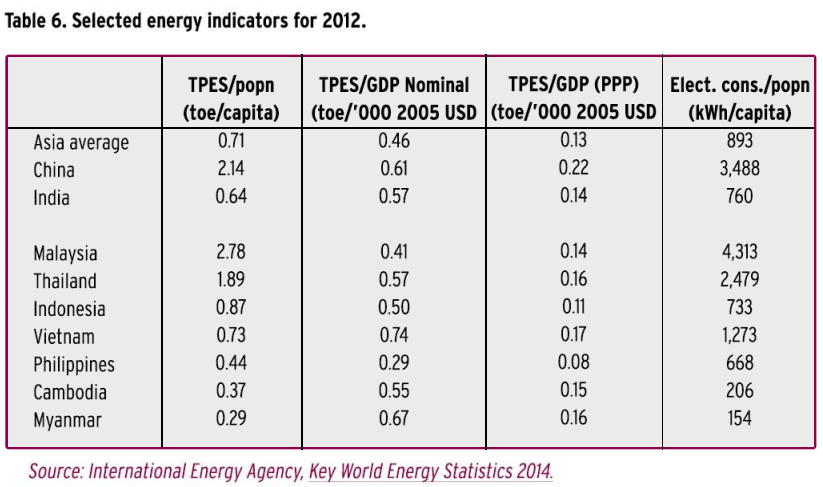
Developing countries like ASEAN members except Singapore can seize this opportunity to further expand and optimize economic growth. For instance, there is low total primary energy supply (TPES), expressed in tons of oil equivalent (toe), and low electricity consumption among developing ASEAN economies. High TPES means higher energy input for agriculture, industry and services sectors.  
oil2
The opportunities for them, among others, are the following.
One, higher electricity production at lower prices because oil-based power plants that are used only for peak hours can be made to run more frequently.
Two, the cost of air, land and sea transportation should decline and hence, more people and goods can be transported at lower costs. 
Three, agriculture and fishery sectors can benefit as more farmers and fisher folks can afford to use more hand tractors and motorized boats in their work. 
Governments, often prodded by the World Bank and IMF to raise oil tax rates during periods of low global oil prices, should not heed these institutions. Low oil prices has better welfare impact on the poor compared to high oil prices due to higher oil taxes. 
----------
See also: 

Thursday, September 03, 2015

Goodbye Mama. I love you.

My father Bienvenido Sr., mother Consuelo, and my eldest daughter Elle Marie. Taken at our house in Cadiz City, Negros Occidental, April 2010. Our house is not far from sugarcane farms, like most rural houses in the province. My wife was pregnant with our second child then and stayed home in Manila.


Mama is 81 years old. She has been weak in recent years, mostly bed ridden since about four years ago. She was battling a kidney problem and Alzheimer's disease.

A year after, April 2011, also in our house in Cadiz, we visited my folks again. Here, Mama was watching Bien Mary, then six months old.

Lower photo from left: my older sister Lilibeth, wife Ella, Elle Marie, younger brother Bobong, uncle Tioy Angelo, me. Seated were Bong's daughter Lois, Papa, Bien Mary and Mama.


We are five siblings, the eldest, Manong Nestor, died of prostate cancer about nine years ago. My other sister Marycris, is also based in Manila, not in the photo above.

Several weeks after our visit, Mama got sick and very weak. I flew back and visited her again, June 2011. She has recovered days after that.


December 2011, my family visited my folks again. Mama and Elle Marie, then five years old.


May 2012, after Elle Marie's Santa Cruzan parade in Iloilo City, we travelled again to Negros to see my parents. Mama was back being mostly bed-ridden again.

Last week, she was hospitalized. She was in great pain, assisted with various pain relievers.

Today, Mama has rested. Very sad to accept, to lose one's mother. But she has endured pain for so long. Her frail body is too weak to further endure the pains. It is better that she rest, but the pain is on us, the surviving children and our Papa.

Mama and Papa have done their job well as responsible parents. They have brought us up and gave us modest education. During and after graduation from college, it was our call what to do with our lives.

Thank you Ma. I terribly miss you. I love you and Papa. Self-reliance and parental responsibility is a trait that I will pass on to our kids. Thanks again Ma... See you someday when our time comes.

* See also Going back to our roots, April 25, 2011

Tuesday, September 01, 2015

Asian free market websites, Part 5

Here's an update of the global popularity of Asian free market think tanks and blogs, from alexa.com. Global rank as of today. They are arranged according to their global rank.

1. unirule.org.cn, Beijing
2. keri.org, Seoul
3. impencil.org, Beijing
4. freedom-institute.org, Jakarta
5. fef.org.ph, Manila
6. kriengsak.com, Bangkok
7. sifl.org.cn, Shanghai
8. nkradio.org, Seoul
9. funwithgovernment.blogspot.com, Manila
(This blog has a mirror site, http://funwithgovernment.blogspot.in/, with a global rank of 10,565,772 as of today. Mirror sites redirect portions of the traffic from the original sites, resulting in lower global rank of the original.)
10. primeinstitute.org, Islamabad
11. prudentinvestornewsletters.blogspot.in, Manila
(it is not an institute, just a blog owned by a friend; the original site is prudentinvestornewsletters.blogspot.com, with a global rank of 12,786,535 as of today; there are 3 other mirror sites)
12. suarakebebasan.org, Jakarta
13. ideas.org.my, Kuala Lumpur
14. samriddhi.org, Kathmandu
15. indiai.org, Delhi

The biggest gainers above compared to their global ranks in my last update dated July 19, 2015, are the following: 
(a) unirule, from 1.25 M to 0.97 M,
(b) fef.org.ph, from 8.70 M to 1.80 M,
(c) freedom-institute, from 3.45 M to 1.70 M, and 
(d) sifl.org.cn, from 5.29 M to 3.07 M.

The other websites and blogs are:

17. doimoi.org, Hanoi
18. libertyindia.org, Delhi
19. lionrockinstitute.org, HK
20. acenetwork.asia, Delhi
21. indefenceofliberty.org, Delhi
22. ccsindia.org, Delhi
23. jtr.gr.jp, Tokyo
24. asinstitute.org, Lahore
25. efnasia.org, Bangkok
26. freedomfactory.co.kr, Seoul


Other Asian free market sites which have no global rank yet:
akademimerdeka.org, Jakarta 
seanetwork.asia, Kuala Lumpur
* cips-indonesia.org,  Jakarta
-----------

See also: 
Asian free market websites, part 2, April 25, 2011 
Asian free market websites, part 3, May 10, 2011 
EFN Asia 31. Friends in the Asian Free Market Movement, November 07, 2013 

Asian free market websites, Part 4, July 19, 2015