A discussion venue about the role (and misrule) of big government and high taxes. Also a second website of Minimal Government Thinkers.
Saturday, September 28, 2024
Energy 180, Non-windy years 2021-2024
BWorld 731, Fast growth towards better credit ratings
Fast growth towards better credit ratings
August 13, 2024 | 12:02 am
My Cup Of Liberty
By Bienvenido S. Oplas, Jr.
https://www.bworldonline.com/opinion/2024/08/13/613533/fast-growth-towards-better-credit-ratings/
If there is an “economic Olympics” among the world’s top 50 largest economies this month, the Philippines should get two medals — a gold medal for its unemployment rate in June 2024, and a silver medal in GDP growth in second quarter (Q2) 2024.
In my column last week (“All-time low unemployment, revenue enhancement against illicit trade,” Aug. 8), I noted that the Philippines not only had among the lowest unemployment rates around — 3.1% vs Spain’s 11.3%, Sweden’s 9.4%, India’s 9.2%, and Italy’s 7% — but it also had the biggest drop in unemployment, from 6% in June 2022 to only 3.1% in June 2024. That is equivalent to a gold medal achievement.
Last week the Philippine Statistics Authority (PSA) also released the Q2 2024 GDP performance. It was 6.3%, much higher than most projections by the multilaterals and private economic analysts. It was a silver medal achievement next to Vietnam, which grew 6.9%. In contrast, many European countries have had zero growth and some even contracted like Germany and Ireland (see Table 1).
Other big European and North American countries have not reported their Q2 2024 GDP results yet, but their recent growth numbers — Q2 2023 and Q1 2024 — were already mediocre: the UK 0.2% and 0.2%, Poland -0.6% and 2%, Netherlands -0.1% and -0.7%, Switzerland 0.4% and 0.6%, the US 2.4% and 2.9%, Canada 1.3% and 0.5%, and Japan 2.3% and -0.2%.
The Philippines’ high growth in the last quarter was mainly due to base effect, with investments or capital formation growing by 11.5% (it had low growth last year), and government consumption growing at 10.7% (it contracted last year). Household consumption, which constitutes about 75% of GDP, has been stung by high inflation and grew only 4.6%.
By industrial origin, the main sources of growth were Industry, led by the Construction subsector, and Services led by the Finance and Insurance subsectors with 8.2% growth (see Table 2).
I must congratulate the economic team.
I quote three cabinet members here from a press release:
Finance Secretary Ralph G. Recto brightly noted that “We are happy with the back-to-back good news on employment and GDP growth. Our impressive growth performance clearly demonstrates that infrastructure is our way forward. We need to build more, build better, and build faster so that Filipinos can reap the benefits of these high-impact projects at the soonest possible time.”
The day before, he had announced a positive achievement: “the Marcos, Jr. administration’s ultimate goal of reducing the poverty rate to a single-digit or 9% by 2028, as the Philippines posted its highest-ever employment and historic low unemployment rates in June 2024.”
Economic Planning Secretary Arsenio M. Balisacan looked optimistic: “Amid evolving risks and challenges, the Philippines’ economic outlook remains promising in the near and medium term… we move closer to our vision of a strongly rooted, comfortable, and secure life for every Filipino.”
Budget Secretary Amenah F. Pangandaman was equally focused and optimistic: “It feels like we won another gold medal for the Philippines… we are focused on job-creating growth and poverty-reducing growth, and we are inspired to work even harder towards our inclusive economic transformation and sustainable growth.”
These twin outstanding economic performance results should help the Philippines earn higher credit ratings on the quest for an “A.” I checked the evolution of the country’s ratings from three big ratings agencies over the past decade, and ours is consistently moving up (see Table 3).
S&P’s “BBB” means the recipient is Investment Grade with adequate capacity to meet financial commitments, but more subject to adverse economic conditions. Next is “A,” Investment Grade with strong capacity to meet financial commitments, but somewhat susceptible to economic conditions and changes in circumstances.
Moody’s “Baa” is medium-grade and subject to moderate credit risks. Next comes “A” which is upper-medium-grade and subject to low credit risk.
Fitch’s “BBB” is good credit quality, default risk is low. The next step is “A” meaning high credit quality, default risk is low, strong capacity to pay financial commitments.
An Inquirer story last Thursday bannered the possibility of an “A” rating for the country as early as 2025, quoting Ms. Pangandaman.
Pol Ideology 89, Quotes from Ronald Reagan
When Ronald Reagan was US President and waxing anti-socialist policies in the mid-80s, I was a Marxist-socialist at that time. More than a decade later, I embraced Adam Smith and stayed away from Karl Marx. So I learned to appreciate Reagan, UK PM Margaret Thatcher.
Below some quotes from Reagan that I like. Enjoy.
1. August 12, 1986 press conf by Ronald Reagan:
"I think you all know that I’ve always felt the nine most terrifying words in the English language are: I’m from the Government, and I’m here to help. A great many of the current problems on the farm were caused by government-imposed embargoes and inflation, not to mention government’s long history of conflicting and haphazard policies."
2. Government's view of the economy could be summed up in a few short phrases: If it moves, tax it. If it keeps moving, regulate it. And if it stops moving, subsidize it.
3. We must reject the idea that every time a law's broken, society is guilty rather than the lawbreaker. It is time to restore the American precept that each individual is accountable for his actions.
4. Government's first duty is to protect the people, not run their lives.
5. The problem is not that people are taxed too little, the problem is that government spends too much.
7. We should measure welfare's success by how many people leave welfare, not by how many are added.
8. Welfare's purpose should be to eliminate, as far as possible, the need for its own existence.
9. Government is like a baby. An alimentary canal with a big appetite at one end and no sense of responsibility at the other.
10. The taxpayer - that's someone who works for the federal government but doesn't have to take the civil service examination.
11. We might come closer to balancing the Budget if all of us lived closer to the Commandments and the Golden Rule.
12. One way to make sure crime doesn't pay would be to let the government run it.
13. Man is not free unless government is limited.
14. Government does not solve problems; it subsidizes them.
https://www.brainyquote.com/search_results?q=ronald+reagan+quotes&pg=2
Pol. Ideology 86, Endless crisis narratives and authoritarianism, August 27, 2023
Sunday, September 08, 2024
BWorld 730, All-time low unemployment, revenue enhancement against illicit trade
All-time low unemployment, revenue enhancement against illicit trade
August 8, 2024 | 12:02 am
My Cup Of Liberty
By Bienvenido S. Oplas, Jr.
Yesterday the Philippine Statistics Authority (PSA) released the labor force data for June 2024, and we saw that the unemployment rate was only 3.1% which tied with December 2023’s level — the Philippines’ all-time low unemployment rate since the 1980s, and possibly since the 1970s although records from that period are scanty or not available.
So, I compared the Philippines’ unemployment rate with that of other Asian countries, and with major economies of North America and Europe. Not only is ours among the lowest, but ours has had the biggest drop over the last two years, from 6% in June 2022 to 3.1% in June 2024. In contrast, some countries experienced an increase over the same period, like Sweden, Germany, the UK, the US, and Canada (see Table 1).
This is a big economic achievement by the Marcos Jr. administration in general, and the economic team in particular.
It also serves as further proof that the high GDP growth in 2022, 2023, and the first quarter of 2024 was indeed job-creating growth and not the “jobless growth” usually claimed by some detractors.
In a Viber message to this writer, Budget Secretary Amenah F. Pangandaman reiterated the optimistic economic outlook of the Philippines, noting that “our prudent public spending especially in hard infrastructure is bearing fruit, helped improve our people’s productivity and helped our domestic businesses to create more jobs, reduce poverty in the country.”
Last Monday I briefly watched the presentation by the House of Representatives’ Development Budget Coordination Committee on the first day of public hearings on the 2025 budget. The secretaries of the departments of Finance (DoF) and Budget and Management, the head of the National Economic and Development Authority, and the central bank governor plus their respective officials were there.
Finance Secretary Ralph G. Recto gave an opening presentation and highlighted, among others, that “the DoF hiked the government-owned and -controlled corporations’ (GOCCs) dividend rates to 75% from 50% in 2024 as among the major sources of non-tax revenues…. Total revenue collection from January to June 2024 grew by 15.6% amounting to P2.15 trillion. Of which, tax collections increased by 10% to P1.84 trillion, while non-tax grew by 63.3% to P314.2 billion.”
On July 25, I attended the First National Anti-Illicit Trade Summit at the Manila Hotel, organized by the Federation of Philippine Industries (FPI). Dr. Jesus L. Arranza, chairman of FPI and Fight Illicit Trade (FightIT) noted in his opening message that a study they commissioned showed that the government is losing around P250 billion/year in value-added tax (VAT) due to smuggling.
Since VAT is 12% of the price of imported goods, that means around P2.3 trillion worth of smuggled products are sold here annually and unfairly competing against locally produced products in the domestic market.
I checked again the revenue performance of the government and saw that overall tax collections are increasing, except excise tax which experienced a revenue decline in 2022 and 2023, and possibly also this year. The main source of revenue losses is in tobacco tax collections, which peaked at P176 billion in 2021 and went down to only P135 billion in 2023, and seems on its way to declining further to around P120 billion by the end of this year (see Table 2).
Finance Undersecretary Charlito Martin Mendoza also gave a presentation in the same forum. He said that the Bureau of Internal Revenue and the Bureau of Customs are campaigning against smugglers and illicit traders through the “BRAVE” project: B (Border Security Enhancement), R (Revenue Collection and Protection), A (Adaptive Regulations and Compliance), V (Vigilant Enforcement Operations), and E (Effective Engagement with Stakeholders and Inter-Agency Cooperation).
The government — the DoF and Congress in particular — need to address this big conjoined issue of sustained illicit trade and smuggling and high tax rates (like a VAT rate of 12%, a tobacco tax of P63/pack and rising yearly) which are among the key factors why legal products are getting more expensive and the alternative smuggled products are getting more affordable. A downward shift in tax rates, especially in VAT (our 12% is possibly the highest in Asia), should be considered in exchange for the removal of many VAT exemptions.
Finally, the Philippines’ high inflation remains a big hurdle in our people’s economic advancement.
The big flood in the National Capital Region last July caused the destruction of many properties and a temporary shortage of some commodities. I saw an empty bread shelf in one of the SM groceries in Makati that day of heavy flooding, plus a long queue of shoppers stocking up on mostly food items for fear that another heavy flood might happen again soon.
I expect the country’s inflation rate to taper off in the last five months of this year as most harvests in the first rice crop are due starting late August to September, with the second crop due for harvest in December-January.
Deindustrialization 27, Europe declining market capitalization and GDP growth
2,500 steelworkers to be laid off before Christmas as British Steel shutters Scunthorpe blast furnaces
Exclusive: In a move unions say will be devastating for the local community, British Steel will stop importing coal and coke in October, meaning the blast furnaces will be turned off permanently just before Christmas
Millie Cooke 23 August 2024
https://www.independent.co.uk/news/uk/politics/british-steel-job-losses-scunthorpe-b2600826.html
Ministers urged to step in to save UK firms struggling with high energy costs
Exclusive: Cornwall Insight data shows small businesses paying over £5k extra a year than before energy crisis in 2021
Alex Lawson Business 27 Aug 2024
German businesses dismiss ‘crazy’ plan to charge more for electricity on cloudy days
Jorg Luyken August 27, 2024
https://www.yahoo.com/news/german-businesses-dismiss-crazy-plan-125635096.html?guccounter=1
This is not ‘leading the world’. It’s economic suicide
It matters, as you’ll soon be required to have electric heating and an electric car
NEIL RECORD 3 September 2024.
The Telegraph, https://archive.is/Waok3#selection-3087.4-3121.19
Energy price cap
The energy price cap is the maximum amount energy suppliers can charge you for each unit of energy and standing charge if you're on a standard variable tariff.
Saturday, September 07, 2024
BWorld 729, Meralco CSP is about protecting the consumers, indifferent where cheap electricity will come from

My Cup Of Liberty
By Bienvenido S. Oplas, Jr.
The RTC called on defendant Meralco “from proceeding to select and contract out the 600-megawatt (MW) net and 400-MW net power supply agreements (PSA) under the competitive selection process (CSP) whose terms are flawed, skewed or supplier-driven and grossly violative of existing laws, rules and regulations.”
The CSP should have been conducted last Friday, Aug. 2, for the 600 MW, then on Aug. 9 for the 400 MW, but with the TRO there is an automatic delay in the bidding, and this will mean a higher cost for consumers, with the reasons to be enumerated below.
Two weeks before this TRO was made by an RTC in Taguig, there was a Senate Committee on Energy public hearing (July 18) where Senator Alan Peter Cayetano, who was a former Taguig Congressman, voiced the same argument used in the RTC civil case, and harassed Meralco.
The main complaints made by the plaintiffs are the following: One, “Meralco TOR (terms of reference) does not recognize and, in fact, violates the preference given to Indigenous Natural Gas (ING) under the relevant laws, rules and regulations.”
Two, “the Meralco TOR incorporated terms and conditions which practically deny the power suppliers using ING as a fuel source the opportunity to fairly participate in the Subject CSPs.”
Three, “increased reliance on imported sources of fuel threatens the country’s energy security and energy sovereignty because these are greatly susceptible to a volatile market” as “imported coal and imported ING, the prices of both are notoriously unstable and extremely subject to external shocks in the market.”
While this is largely a legal matter, my economics-trained mind says that the TRO is wrong for the following economic reasons.
One, the CSP’s main goal is to secure the lowest price for consumers regardless of where the electricity will come from. The CSP is about price competition and selection, not environmental selection, not indigenous over imported energy selection.
Two, cheaper electricity for consumers means the price should be locked at a stable and low level for many years and not subject to wild price swings at the Wholesale Electricity Spot Market (WESM). On Aug. 2, the day where the CSP for 600 MW should have been held, WESM prices fluctuated wildly in Luzon, from P3.50 per kilowatt hour (kWh) at 7 a.m. to P16.56/kWh at 2 p.m., then P9.64/kWh at 4 p.m.
The main reason was that many power plants had unscheduled or unplanned outages plus derating or reducing output for other plants that continued running. The dispatchable reserves that day were -400 MW (a deficit) in the Luzon grid and -86 MW in the Visayas grid (see Table 1).
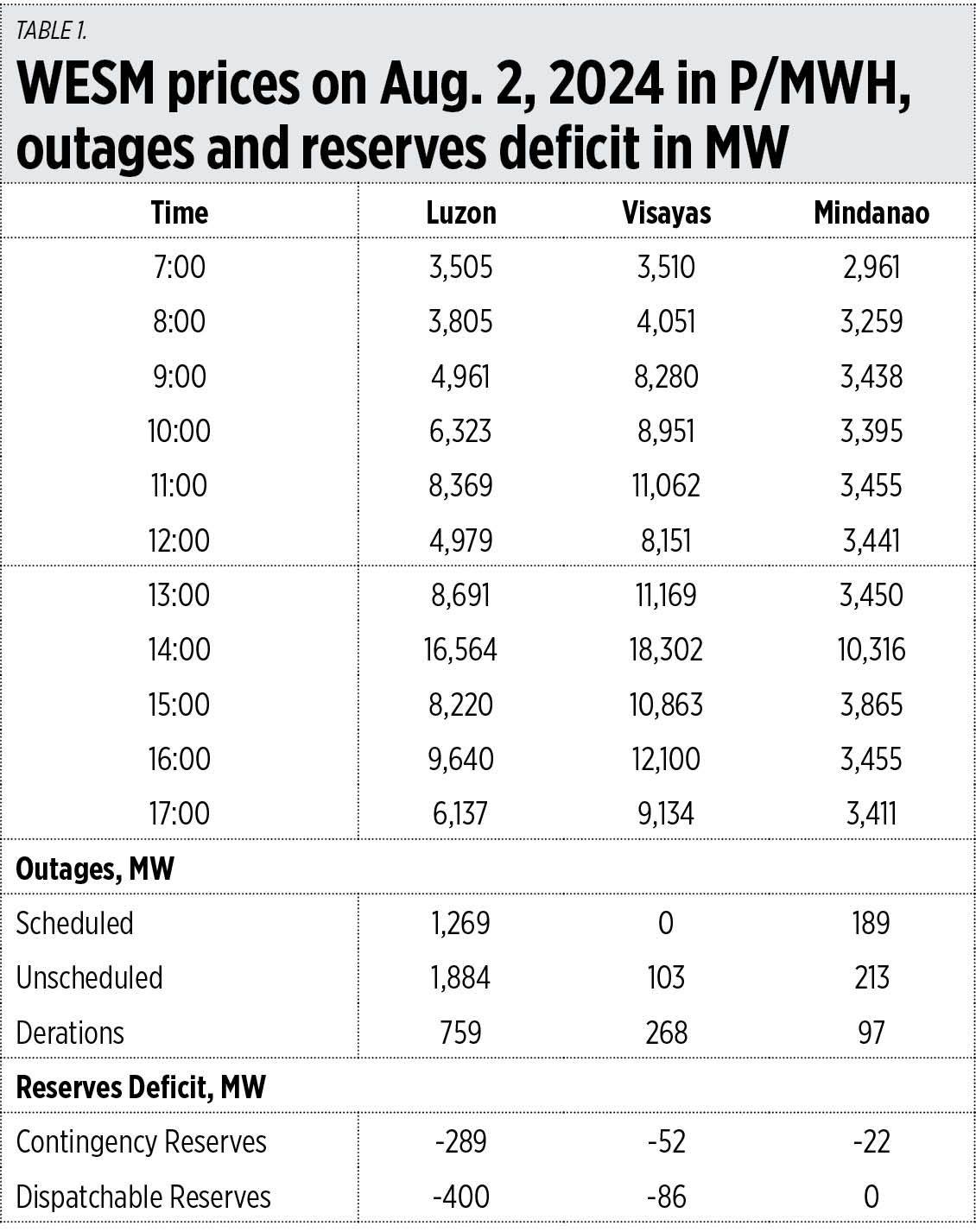
Three, delaying the bidding will expose the consumers to an “unnecessary burden in the amount of billions of pesos in the form of higher power rates” as noted by Jose Ronald V. Valles, Meralco SVP and Head of Regulatory Management. The wild swing in prices within a period of 10 hours on Aug. 2 is proof of this.
Four, the claim of high price volatility of imported LNG and coal also applies to the ING Malampaya gas price because it is pegged at Dubai crude oil prices. Dubai, WTI, and Brent oil prices have experienced wild price fluctuations and volatility at almost the same periods as the price volatility of LNG and coal, like in 2008, 2011-2014, and 2022 (see Table 2).
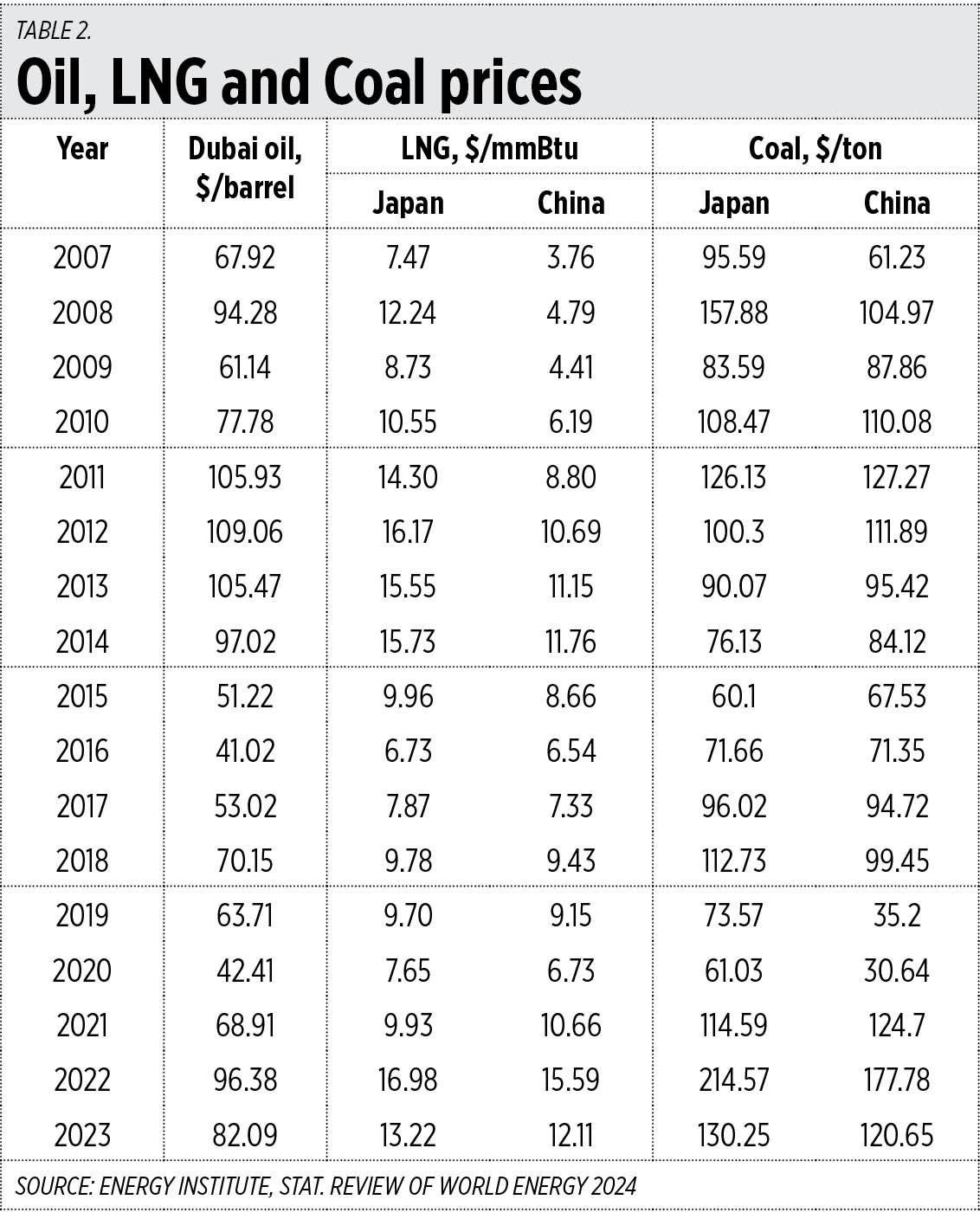
So, favoring ING and demonizing imported LNG and coal based on an argument of price volatility is not a valid argument as it has no basis.
Five, the Philippines need long-term cheap electricity to power its industrialization dream. The industry sector comprises 30% of the country’s GDP, the manufacturing sub-sector comprises 20% of GDP, and recently these sectors were growing slowly partly due to expensive electricity. With the ongoing degrowth and deindustrialization in Europe, we should expect that many businesses there will move to Asia — including the Philippines — and cheaper electricity should be one of the attractions we can offer them.
Data from the Independent Electricity Market Operator of the Philippines (IEMOP) shows that electricity generation and consumption in gigawatt/hours (GWh) was growing at 14% to 24% over the last two years. Meralco electricity sales, also in GWh, had muted growth last year but high growth this year (see Table 3).
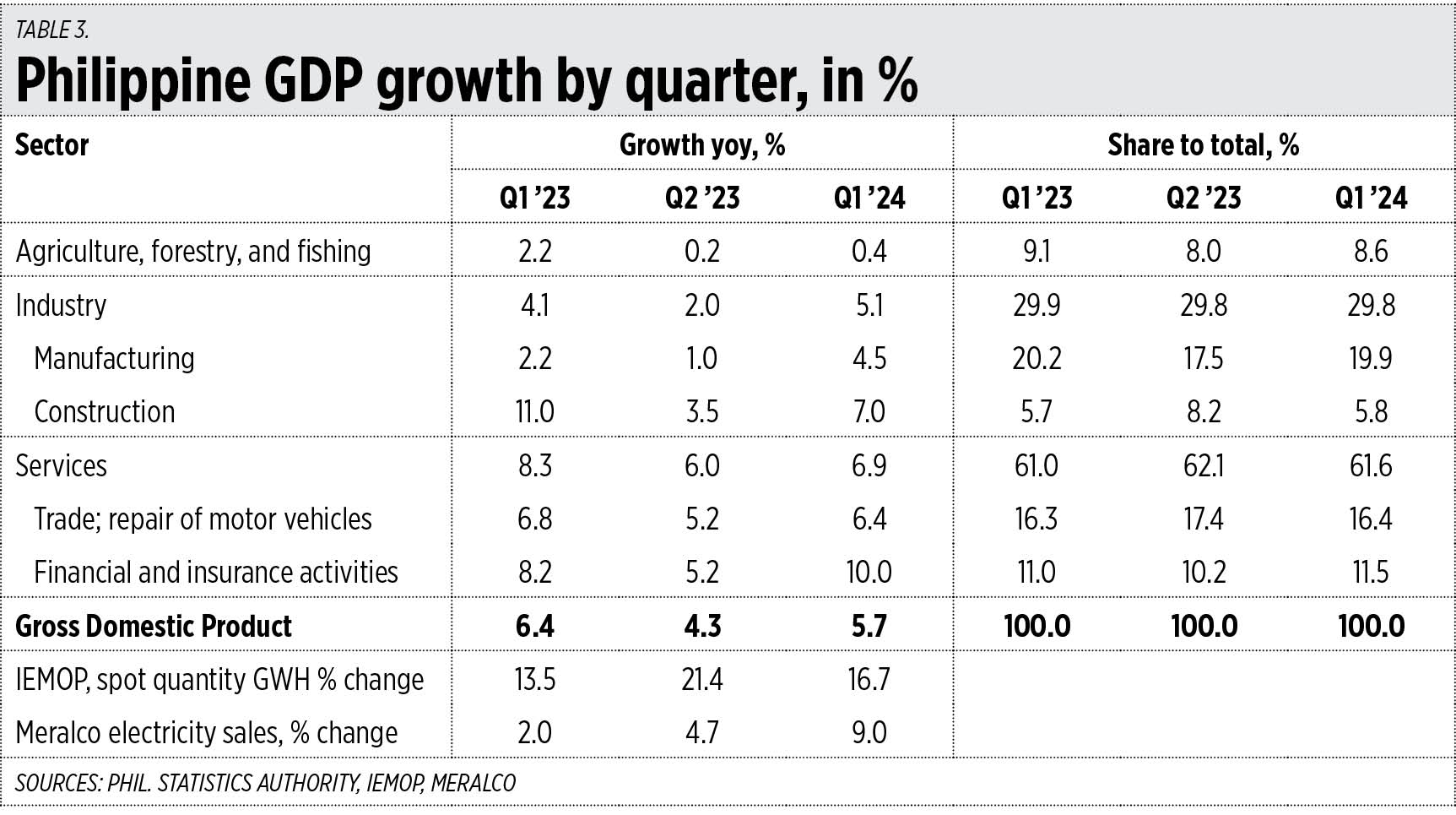
Related to my projection in this column last week that GDP growth in the second quarter (Q2) of 2024 would range from 6% to 6.2%, the main reason I said so was because of the base effect — the low growth of only 4.3% in Q2 2023 — and this would allow for high growth in the current year. More particularly in the manufacturing and industry sectors (which had only 1% and 2% growth respectively in Q2 2023), I think they should be doing around 4% and 7% this Q2 2024. (The Philippine Statistics Authority will release the Q2 GDP data on Thursday, Aug. 8. — Ed.)
Six, Meralco is not the sole buyer of power from big generation companies (gencos) and big gas producers. WESM is also a big market for gencos with an ample supply of electricity to offer. WESM spot quantity was 4,060 GWh in the first half (H1) of 2022, and this jumped to 7,938 GWh in H1 2023, and further jumped to 12,447 GWh in H1 2024 (data from IEMOP).
Seven, lawyer Paris Real has correctly pointed out that the plaintiffs are not participants in the CSP as they are not gencos that will compete in giving low price offers to Meralco. And the legal entity that should handle this should be the Energy Regulatory Commission (ERC), not an RTC. The lawyer is correct because the ERC, as a quasi-judicial body, has powers similar to the courts on legal matters related to energy.
Twitter notes: Vivek Ramaswamy
Aug 29
I don't think Kamala is actually an ideologue. She's another cog in a system, just like Biden. We don't just want to defeat a candidate. We want to defeat a broken system.
Aug 30
We don't want to replace the left-wing nanny state with a right-wing nanny state. We want to SHUT IT DOWN.
Kamala’s interview last night was a reminder that we’re not running against a candidate. We’re running against a *system*. They require a candidate they can control, which means having original ideas is a disqualification. That’s exactly why we get Biden, then Kamala, and so on.
Aug 31
The problem isn’t that most politicians are too “ideological.” It’s that they’re not ideological *enough*. I respect someone who disagrees with me & truly believes it, rather than someone who agrees with me but lacks conviction.
Sep 3
When you stop talking to people who disagree with you, it becomes a lot easier to demonize them.
If you’re a single-issue voter on the economy, Kamala’s proposed tax on *unrealized* capital gains is a good reason on its own not to vote for her - and Republicans should be hammering this point much harder. Under Kamala’s plan, if you have an asset that the government says has appreciated by $1 million in value, you’ll owe $250,000 in taxes - even if you don’t want to sell it, and even if you *can’t* sell it.
That means you’ll be forced sell assets at fire sale prices even when you don’t want to sell, which depresses asset prices, which in turn spirals like a domino effect - because others are forced to sell those same assets at the same time. There’s no better way to trigger a market crash & economic depression, and startup founders will have to refocus their already-scarce bandwidth on esoteric tax planning instead of focusing on business growth.
Sure, they say the tax will initially only apply to people with a net worth of over $100 million, but the truth is a market crash and its effects will hurt ordinary Americans the most. And history shows that any new tax that begins with the so-called “ultra-wealthy” eventually finds its way to affect those who would never imagine describing themselves as such. Kamala’s megadonors will be able to pay expensive tax accountants to structure around it anyway, but it’ll be everyday citizens left holding the bag.
Sept. 4
* Kamala has attempted to *legislatively enact* single-payer healthcare, a ban on fracking, and a tax on unrealized capital gains. The party line that “she doesn’t favor that stuff anymore” isn’t just dishonest, it reveals that she’s really a cog in a bigger machine..
* Kamala Harris was one of the strongest proponents for a ban on fracking — so much so that when she was in California, she sued the OBAMA administration over granting fracking permits.
She didn't just favor the abolition of private health insurance — she was a CO-SPONSOR of the bill with Bernie Sanders for Medicare For All.
She said she would end the filibuster in the Senate to ram through the Green New Deal.
Sept. 5
I miss the country where we can disagree like hell & still get together for dinner at the end of it.
Millennials have every reason to be cynical. Our government started the Iraq War under false pretenses, bailed out the big banks, ran up the national debt, and told millions of 18-year-olds that college loans were their ticket to the American Dream.
But we can’t afford to be jaded. America is still the last best hope that we have.
Sept. 6
The U.S. isn't just an "economic zone," it's a nation bound by civic ideals. Our immigration policies should purposefully select for immigrants who share our national values: heightened civics exams, competence in English, no dual citizenship, and a demonstrated ability to improve America. That's the right way to do it.
Sept. 7
TRUTH.
1. God is real.
2. There are two genders.
3. Human flourishing requires fossil fuels.
4. Reverse racism is racism.
5. An open border is no border.
6. Parents determine the education of their children.
7. The nuclear family is the greatest form of governance known to mankind.
8. Capitalism lifts people up from poverty.
9. There are three branches of the U.S. government, not four.
10. The U.S. Constitution is the strongest guarantor of freedoms in history.
Twitter notes, July 2011 (b), July 13, 2011
Twitter Notes, July 2011 (c), July 14, 2011
Twitter Notes, July 2011 (d), August 06, 2011
Twitter Notes, August 2011 (a), August 17, 2011
BWorld 728, Fiscal consolidation, DBM reforms, and global growth
Fiscal consolidation, DBM reforms, and global growth
August 1, 2024 | 12:02 am
My Cup Of Liberty
By Bienvenido S. Oplas, Jr.
I will cover three topics today, so we go straight to the numbers.
On July 29, the Department of Budget and Management (DBM) released the budget materials for 2025. These include the National Expenditure Program (NEP), the Budget of Expenditures and Sources of Financing (BESF), Staffing Summary, and the President’s Budget Message.
I will now compare the projections in the fiscal program in BESF 2024 vs BESF 2025. Although the Obligation budget is the same in both documents, the projected disbursements differ — P5.63 trillion for 2024 and P5.75 trillion for 2025, or higher by around P126 billion in the latter. Consequently, the projected deficit is higher by P127 billion.
More borrowings were needed this year than initially projected last year. Our interest payment is jumping like a kangaroo: from P503 billion in 2022, it rose to P628 billion in 2023, is projected to be P763 billion this year, P848 billion in 2025, and up to P1.06 trillion in 2027, or an average increase of P111 billion/year on interest payment alone, with principal amortization not included yet.
The outstanding public debt is projected to increase by P1.3 trillion/year on average, from P13.418 trillion in 2022 to P14.616 trillion in 2023 to P17.354 trillion in 2025 (see Table 1).
DBM REFORMS TOWARDS FISCAL CONSOLIDATION
Fiscal consolidation should have the end goal of reducing the public debt stock, reducing the annual interest payment, and reducing overall interest rates as government competition for funds decline, and in the process facilitate sustained economic growth and high job creation. From the DBM social media accounts, I see that among their major reforms are: Public Financial Management (PFM), Early Procurement Activities (EPA), cash budgeting, and the National Government Rightsizing Program (NGRP).
PFM means more fiscal transparency through the principles of aggregate fiscal discipline (spending within one’s means), allocative efficiency (spending on the right priorities), and operational efficiency (spending with the greatest value-for-money). EPA is meant to ensure the timely implementation of government projects — the procuring entities (PEs) can commence with the procurement once the proposed budget has been made, in the case of the National Government when the National Expenditure Program (NEP) has been submitted to Congress. Cash budgeting is meant to ensure the availability of cash resources for priority development projects, quicken the government’s budget utilization, promote discipline since agencies will only propose projects and programs that are implementation-ready.
The NGRP is meant to streamline national government agencies through regularization, merging, restructuring, abolition, or transfer of government agencies to create a more efficient bureaucracy. As an advocate of minimal government and bureaucracy, my favorite among the four are PFM and NGRP. Government should learn to live within its means, and control spending and borrowing that are not supported by existing revenues. Better yet, live below the means, have a fiscal surplus when there is no economic crisis and reduce the debt stock. NGRP is self-explanatory.
DBM Secretary Amenah F. Pangandaman says that “fiscal consolidation remains an important goal for DBM and the Development Budget Coordination Committee. Allocate public resources to projects, physical and social infrastructures with the greatest positive impact to the people in raising their productivity, facilitate stronger economic performance to outgrow the debt, achieve the medium-term goals of Deficit/GDP ratio of 3.7% and Debt/GDP ratio of 56% or lower by 2028.”
DEGROWTH IN EUROPE
Last Monday and Tuesday, several European countries reported their 2nd quarter (Q2) 2024 GDP performance. I consolidated their Q1 and Q2 data into first half (H1) GDP growth this year. Few have growth above 1%, most are below 1% and some have even contracted like Germany, Austria and Ireland. In contrast, many East Asian countries have had growth of 2.8% to 6+% over the same period (see Table 2).
It is ironic that many European countries are busy with “Save Ukraine” or “Save the planet” policies but cannot save their own economies from degrowth and deindustrialization. East Asians (except Japan) are busier saving their economies and manufacturing from degrowth and blackouts by keeping their use of fossil fuels or hydrocarbon power plants high or rising.
The Philippines’ Q2 2024 GDP will be reported on Aug. 8. I predict growth of 6% to 6.2%. I will explain the numbers here next week.