Showing posts with label Francisco Duque. Show all posts

Thursday, August 30, 2012

Fat-Free Econ 22: Three Years of Drug Price Control Policy

* This is my article yesterday in TV5's news portal,
http://www.interaksyon.com/business/41795/fat-free-economics-three-years-of-drug-price-control-policy
---------

The drug price control policy turned three years old in mid-August. The Maximum Retail Price or MRP was imposed through Executive Order No. 821 and Advisory Council Resolution 2009-001 - both issued in July 2009 and took effect August 16, 2009.

The imposition was driven by a political emergency and not a health emergency, as the Presidential and local elections were just nine months away back then.

Prevailing drug prices data at that time contradicted the necessity of imposing price regulation. Competition among various brands from different drug manufacturers and drugstores was healthy at that time, such that consumers had various options for their needs.

Three examples of drugs are given below. Data came from Tomas Marcelo “Beau” Agana, who is president of the Philippine Chamber of Pharmaceutical Industry. Beau prepared a PowerPoint for the public hearing of the Congressional Oversight Committee on Republic Act No. 9502 last May at the Senate. But due to limited time, Beau was unable to present it. The event became a “public speaking” -instead of a public hearing - by Rep. Ferjenel Biron and Sen. Manny Villar, as both were pushing their respective bills creating a new bureaucratic layer, the Drug Price Regulation Board.

First is amlodipine, an anti-hypertension drug. While the leading brand, Norvasc by Pfizer, was selling for around P38 for the 5 milligram tablet, similar drugs were selling for P25, P15, P11 and P10. Consumers had choices, but the politics of envy centered on Norvasc. So their solution was more politics, more government coercion.


Source: Agana, May 2012. Primary data for the second chart - prices of different brands - is from the Drugstore Survey, March 2012.

Beau showed that for the average retail price for various brands of amlodipine, Philippine prices were cheaper than those in Indonesia, but more expensive than those in Malaysia, Singapore, Taiwan and Thailand.

Now consider this: some countries - such as Malaysia - do not slap taxes on medicines. Philippine taxes on medicines include an import tax of 3-5 percent and value-added tax of 12 percent - all of which result in a 15 percent price spike. If other taxes and fees are included - local taxes and fees and Food and Drug Authority fees - the government share could rise up to 20 percent of the retail price.

Then there are indirect taxes on medicines, namely the corporate income tax and the mandatory social security contributions by drug manufacturers, wholesalers and importers, and drugstores. Those taxes and fees, direct and indirect, are passed on to consumers.

Thus, the price difference of amlodipine between the Philippines and Malaysia could pretty much approximate the difference in tax treatment they both applied (or not applied) on medicines and on corporations: 12 percent VAT in the Philippines vs. zero in Malaysia; and 32 percent CIT in the Philippines vs. 20 percent for the first RM 500,000 and 28 percent on the balance.

Second case is co-amoxiclav, an anti-infection drug. Before the MRP policy three years ago, the leading brand, Augmentin by GSK was selling for nearly P83 for the 625 milligram bottle. But consumers had other options that were selling for only P59, P47, or P35.


Comparing again with some Asian countries, drug prices here for co-amoxiclav were similar with those in Indonesia and Thailand. The price difference with Malaysia because of a different tax treatment appears to explain why they are cheaper in Malaysia.

Comparing with prices in Singapore, VAT in the city-state stands at only 5 percent and CIT at 17 percent, or almost half that in the Philippines.

The third case is simvastatin, a drug against high cholesterol and certain cardiovascular diseases. See the different prices for different brands.


And here are other drugs and their respective price ranges. Again, basic data is from the Drugstore Survey, March 2012.


The bottomline for all these data is clear: there is competition, there are various options for the consumers, and therefore government intervention in drug price setting was unnecessary and unjustified. Only then Senator Mar Roxas (who pushed for the policy in the Senate) and then President Gloria Arroyo knew why the MRP was imposed.

When the MRP was being cooked and debated, Roxas was desperate to raise his low approval rating for the May 2010 Presidential elections, while Arroyo signed the EO to steal the show from him. Then Health Secretary Francisco Duque was also looking at the possibility of running for the Senate, but did not push through with the plan because of the Arroyo administration's poor showing in surveys.

In short, the MRP imposition in August 2009 was a political gimmick for political ends by politicians looking at the elections just nine months away. While their political horizon was short term, the social and economic damage was long term. EO 821 has no sunset provision.

A year after the MRP was imposed, the key sponsors of the policy had dropped the drug sector like a hot potato: Arroyo won a congressional seat, Roxas was appointed transport and communications secretary, and Duque was appointed head of the Civil Service Commission.

Two weeks ago, I attended the emergency meeting of the DOH Advisory Council for RA 9502, the Cheaper Medicines Law, and the important question requiring an answer was: What should the DOH do, to deal with repeated if not rising cases of water-borne diseases like leptospirosis due to flooding? Should the government impose another round of MRP on drugs used to treat those diseases?

Luckily the lesson of the past three years of MRP is clear in the minds of the Advisory Council members. Competition among different brands and drugstores provides the poor some access to cheap drugs, whereas price control has upset the market for the same.

Below is data presented during the said meeting. The drug against leptospirosis, doxycycline, has various brands with a wide price range. The prices are in pesos per 100 milligram capsule.


So consumers have the option of buying at P169, P74, P49, P5 or P2. Furthermore, many drugs against diseases that arise during calamities are given away not only at low prices, but sometimes for free through donations from various civil society and charitable organizations like the Red Cross, Rotary, Mason, Lions, JCI, etc. The DOH also has its own stock of medicines for distribution to the poor.

Competition, not more government coercion. Deregulation, not more government regulation and taxation. The public and the politicians would be better off if they will heed this simple lesson from the three years of drug price control.
--------

See also:
Drug Price Control 25: Top 10 Articles on Google Search, April 03, 2012
Drug Price Control 26: Conflict of Interest in Drug Price Regulation Legislation, May 13, 2012
Drug Price Control 27: Letter to Sen. Pia Cayetano, May 15, 2012
Drug Price Control 28: On Cong. Biron and Sen. Villar Bills, July 14, 2012
Drug Price Control 29: MRP Attempt Over Anti-Leptospirosis Drug, August 16, 2012 

Fat-Free Econ 8: Drug Price Regulation is Wrong, May 04, 2012
Fat-Free Econ 9: Drug Pricing Bureaucracy is Not Cool, May 11, 2012
Fat-Free Econ 18: Healthcare Corruption and Physician Entanglement, July 30, 2012

Wednesday, September 28, 2011

Drug price control 18: Wikileaks and former US Amb. Kenney on price control

(This is my article yesterday in the lobbyist.biz, with original title, Wikileaks on Drug Price Control)

Wikileaks is becoming more popular as it becomes more controversial. Leaking to the public what are supposedly secret and classified documents of the US government and its embassies abroad is yummy to the public.

Some of the wikileaks documents that are freely available on the web now are the supposed cable reports by former US Ambassador to the Philippines, Kristie Kenney, on the drug price control policy that has adversely affected many multinational companies, mostly American and Europeans.

One report is this, Philippines Imposes Pharma-ceutical Drug Price Controls created September 11, 2009. I am posting two of the seven paragraphs of the report here and supply some data and my own observations.

Local Drug Firms Also Not in Favor

5. Contacts at domestic generics pharmaceutical firms and drug distributors profess that the majority of local drug companies are against the new pricing regime. These controls have significantly reduced their cost advantage over brand-name medicines, and some claim they will lose market share as former generics consumers choose to pay the smaller additional cost to purchase cheaper brand name pharmaceuticals.

As a member of the DOH Advisory Council on Price Regulation (now called the DOH Advisory Council on Healthcare), I can confirm that this is true. I was there in several meetings from June to 2009 onwards of the Council, and the President of the Philippine Chamber of Pharmaceutical Industry (PCPI) and a few other federation leaders were very explicit in opposing the price control policy. Why?

Consider drugs A, B and C, same molecule and generic category, from companies 1 (multinational), 2 and 3 (locals) respectively. Drug A is branded innovator drug while B and C are branded generic drugs by the locals. Before price control, A’s price is P30 per tablet, B’s is P18 and C’s is P13. At this price range, they all serve specific markets and buyers, they all make sufficient profit, and they can comfortably co-exist and compete with each other.

After price control, A’s price becomes P15. B’s price is now the “expensive drug” and C’s price is not that far from A. To keep up with competition and retain their buyers, prices of B and C must significantly go down too, say to P10 and P6 respectively. Everyone is now adversely affected, their profitability is significantly reduced, if not eroded. What if C’s price cannot be brought down to P6-P7 without incurring losses? Then it will be forced to quit the market, temporarily or permanently (and company 3 must lay off some personnel if they cannot introduce new other products) while the number of drugs available to the consumers has declined.

Below is data from Watsons’ Drugstore. I am very thankful to their Director for Health Business Unit for giving me the go signal to share this to the public.


With a few exceptions, growth rate in both value and volume of the price-controlled innovator drugs by the multinational pharma has significantly increased to 22-23 percent this year over the previous year. And sales of those drugs 2010 were higher than their 2009. Which means one important thing: people, at least for the Watsons’ customers, have shifted to the innovator drugs and most likely, away from the generic drugs in the same molecular and generic category.

The Generics Act of 1988 was enacted precisely to promote the local generics. The price control policy of 2009 was enacted precisely – though implicitly – to promote the innovator drugs. These policies are clearly contradictory and both policies are implemented at the same time by the DOH.

Back to the wikileaks report. There are some points in the final paragraph, the supposed commentary of the US Ambassador, that need clarification.

Comment

7. Although the government conducted public consultations on the implementation of this law, industry officials have a point about the lack of thorough scientific or economic studies underlying the government's actions to halve the price of these medicines. On the other hand, there is intense pressure for the current government to reduce medicine prices as the election season is nearing (reftel A), and calls for affordable medicines increase from civil society groups (reftel B). Prescription medication prices in the Philippines are the second highest in Asia (next to Japan), in a country where about a third of the population subsists below the official poverty line. In this instance, some multinational companies failed to recognize that cheaper medicine for the masses is an emotional and political issue. When price controls were placed on several of their most profitable products, it affected some companies' whole business model. Investment, and therefore, job creation by research pharmaceutical companies in the Philippines, will continue to be inhibited by such government market interventions. Furthermore, Philippine civil society's and government's success in lowering prices might encourage further interventions.

KENNEY

It is true that the DOH Advisory Council has met several times prior to the actual price control policy in August 16, 2009, especially on June 5, 2009, on whether a price control policy should proceed or not. There was also no list of drugs that were “candidates” for price control. Weeks before that, there was sustained, intensive and heavy pressure by then former Senator, former Presidential aspirant, Mar Roxas, to proceed with drug price control.

But to the big surprise of the members of the Council, by June 8, 2009, former DOH Secretary Francisco Duque and former Sen. Roxas already have the list of drugs to be put under mandatory 50 percent discount and presented to media. The criteria for selecting those 22 molecules were also illegal – they cannot be found in the Cheaper Medicines Law (RA 9502) nor in its implementing rules and regulations (IRR). The new four criteria were jointly designed by the IMS and DOH. There was also no scientific or economic basis for imposing a flat 50 percent discount – not 25 or 38 or 70 percent on specific drugs.

The supposed commentary above mentioned the high prices of drugs in the country. To a certain extent, true. But it failed to mention that government taxes on medicines – 5% import tax + 12% VAT + local government taxes – also contribute to high medicine prices here.

It is good that wikileaks has released these classified US government documents publicly. I am not sure though if these are indeed 100 percent correct, or some sentences and paragraphs were added or omitted. Nonetheless, my comments and data above stand, whether the stated document is correct or altered.
-------

See also Part 17: Wikileaks on the planned Pfizer drugs withrawal, September 22, 2011.

Thursday, September 22, 2011

Drug price control 17: Wikileaks on the planned Pfizer drugs withrawal

Where there is political and economic coercion by governments, there is also product and service non-availability or withrawal by the affected players and companies. The stronger the coercion, the plentier the amount of goods and services that are non-available in the market.

A clear example are the highly-repressive governments of North Korea, Myanmar, Venezuela, Congo and many other African countries. Private companies, especially multinationals, would hardly consider setting up businesses in those countries as the political threat of price control, product confiscation, raids and other forms of harassment are very clear and real. Contrast that with free trade economies like Hong Kong (unilateral free trade policy actually), where almost anything and everything is available from so many countries and territories.

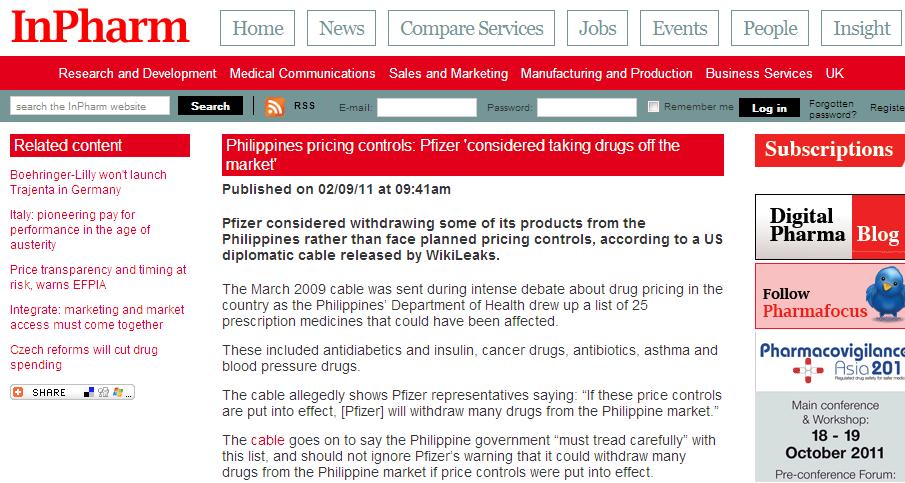
While searching google on "drug pricing", I saw this article from InPharm, Philippines pricing controls: Pfizer 'considered taking drugs off the market', dated September 2, 2011. It said,

Pfizer considered withdrawing some of its products from the Philippines rather than face planned pricing controls, according to a US diplomatic cable released by WikiLeaks.

The March 2009 cable was sent during intense debate about drug pricing in the country as the Philippines’ Department of Health drew up a list of 25 prescription medicines that could have been affected....

The article referred to a Wikileaks cable, PHILIPPINES CLOSER TO DRUG PRICE CONTROLS, so I visited the site.

It's about the supposed cable of then US Ambassador to the Philippines, Kristie Kenney (I follow her on twitter, and just 3 days ago, she mentioned me and replied to my tweet on the subject of Rule of Law :-)) to the US Secretary of State, dated March 5, 2009. The cable said,

1. Summary. The Philippine Department of Health has listed 34 prescription medications that will be subjected to price controls under the Cheaper Medicines Act (reftel) enacted last year. The main impetus for the rapid imposition of price controls came from advocacy groups and non-governmental organizations. Local representatives of international drug companies participated in consultations on maximum retail prices, but warn that some of the controlled prices are lower than the costs of making the drugs, which could force them to withdraw many drugs from the Philippine market. End summary...

4. We met with several directors of the Pharmaceutical and Health Association of the Philippines, the trade association of foreign drug companies, who noted that the main impetus for the rapid imposition of price controls came from advocacy groups and non-governmental organizations. While the Association acknowledged that it has been invited to consult with the Health Department, it also noted that some member companies had not participated. The Association is also concerned that the final list of drugs subject to price control may contain more than 25 medications.

5. In addition, the Association asserts that the Health Department has been pressuring companies to sell drugs in small packages that can retail for 100 pesos, or around USD 2, offering to
exempt such drugs from price controls. In many cases, this can amount to a handful of tablets needed for one cycle of a course of doses. Representatives of Pfizer warned us that for certain
antibiotics, small doses can promote antibiotic-resistant bacteria, and claimed that it is being pressed to sell antibiotics that currently cost over 1000 pesos for the 100-peso fixed price. Pfizer said that if these price controls are put into effect, it will withdraw many drugs from the Philippine market.

Comment
-------

6. The Philippine press has recently featured stories noting that drug prices have not fallen since the Cheaper Medicines Act came into effect, creating pressure for more immediate action from the government. However, the Philippine government must tread carefully and should not ignore Pfizer's warning that it could withdraw many drugs from the Philippine market if price controls are put into effect. Pfizer's withdrawal of medicines from Thailand following laws on compulsory licensing clearly demonstrates the risks. Post will continue to remind Health Department officials that expecting pharmaceutical companies to sell products for less than it costs to produce them could prove counterproductive.

Wow. I have read other Wikileaks cable release supposedly also from then US Ambassador Kenney about her opinion about now PNoy Aquino when the latter was still a Senator. There were questions about the validity and authenticity of those "cable leaks." So I will also not take the above cable leak as 100 percent true.

But assuming for the same of argument, that the above communication was indeed true, I will not be surprised of the wording of the former Ambassador. Pfizer as (or any other) US-based company that pays plenty of taxes to the US government, would naturally seek the assistance of its own government to talk to the host (Philippine) government when the policy of the latter will adversely affect its business. The same way that some Philippine-based company/ies sought the assistance of Philippine Congress and the Executive branch in crafting the Cheaper Medicines Law (RA 9502) and amended the Intellectual Property Code so that certain patent protection of innovator drugs by some multinational pharma companies can possibly be tweaked and dishonored via provisions on compulsory licensing, special CL, early working, exhaustion of rights and government use.

While I was a member of the DOH Advisory Council on Price Regulation (now it's called the DOH Advisory Council on Healthcare), the DOH body that was referred to by Ambassador Kenney, I was not aware of the first 3 Council meetings and consultations from January to April 2009. And that was the period stated in the above cable.

I started attending only on its 4th meeting in early June 2009. I have a long discussion of what transpired in the 4th and 5th meetings of the Council on June 2009, see my book, Health Choices and Responsibilities (published January 2011, 233 pages) and turn to pages 2-7, also pages 72-73.

Anyway, these issues are now water under the bridge. Pfizer did not withraw its innovator drugs that were hit by price control (Norvasc (amlodipine), Lipitor (atorvastatin) and Azithromycin (anti-biotic), what else) and opted to absorb the losses and resorted to deep cost-cutting measures including laying off a few hundred employees.

But what will not go away is the damage done by government intervention -- particularly the Philippine Senate, the Committee then headed by former Sen. Mar Roxas, the DOH then headed by former Sec. Francisco Duque, and the former President Gloria Macapagal Arroyo -- in drug pricing. As I wrote here in the past, price control is price dictatorship.

This damage to the business environment, at least in the health sector as far as foreign investment is concerned, is long-term. And the fact that the price control policy is still not lifted until now even if all the 3 main political personalities involved are no longer in their offices, makes the damage last longer.
-------

See also Part 16: More on Cong. Biron's Bill, September 01, 2011, and
Part 12: Blog posts on page 1 of Google, Yahoo and Bing, August 14, 2011