Showing posts with label Local Government Code. Show all posts

Thursday, June 27, 2013

UHC 15: On DOH Plan to Recentralize Healthcare

The quest for government-initiated and centralized universal health care (UHC) can be dizzying for all sectors -- patients/public, private healthcare professionals and providers, government health agencies, the legislature and everyone else. This is because when government centralizes or almost  monopolize healthcare, competition, price differentiation, market segmentation and service innovation is often sacrificed or killed.


A famous physician, expert and consultant on UHC and NCDs, also a friend, Dr. Tony Leachon, posted this story from GMA News the other day, in his fb wall,


In a speech during the Department of Health's (DOH) 115th anniversary celebration, Aquino said his administration is determined to attain its goal of universal healthcare for all Filipinos by 2016….
"Last year mayroon tayong Sin Tax, mayroon tayong Responsible Parenthood, ngayon naman ho ay pakikiugnayan ng mas hindi masalimuot ang ating pakay," he added. Aquino, in his speech, said his government was able to enroll some 20 million more Filipinos to the national health insurance program during his first three years in office.
He also boasted of his administration's efforts to expand benefit packages for Filipinos suffering from heart diseases, aside from those with "catastrophic diseases" such as breast cancer, prostate cancer and acute leukemia.
The president likewise pledged to build more new health facilities in far-flung regions of the country, and the rehabilitate old hospitals.
"Hindi tayo titigil hangga’t may mga kababayan pa rin tayong ni hindi nakakakita ng espesyalista sa tanang-buhay nila. Kaya naman sa huling dalawang taon ng ating administrasyon—binawasan ho ako ng isang taon, siguro ‘yong writer ko po ay gusto na ring lumipat ng trabaho—target nating i-upgrade at gawing mas moderno ang 7,325 na mga ospital, klinika, at pagamutan," he said. DOH Secretary Enrique Ona, meanwhile, said his department will propose a law that will facilitate the efficient delivery of health services to distant towns in the country. 
"Kami ay nahirapan nang husto na ipaabot sa ating local health units 'yung tulong ng DOH kasi devolved ang ating health system down to the towns. Sabi namin, pag-aralan on how we can improve the devolution of healthcare," he said in an interview after the event. 
He likewise said he wants a legislation that will "improve the governance" of public hospitals under the DOH.

Among the comments raised by Doc Tony's friends were the following:

(a) Do not neglect the human resource aspect of modernizing health facilities, otherwise we willl have ghosts running our hospitals.
(b) Maldistribution and unemployment of healthcare professionals are serious issues.
(c) There is an over-supply of nurses and there is maldistribution of doctors, maybe even an under-supply of physicians.
(d) Start an Advanced Practice Nursing/ Nurse Practitioner program. Can be piloted with a very good nursing program. It will provide job security and provide additional primary care providers especially in underserved areas.
(e) "Hindi tayo titigil hangga’t may mga kababayan pa rin tayong ni hindi nakakakita ng espesyalista sa tanang-buhay nila." -- Why do the people need to see a specialist? Specialist in what? Why can't they be seen by primary care physicians or nurses? If nurses are trained to render primary care... agree ako jan.

I commented that the move now by the DOH is towards more nationalization and recentralization of public healthcare. But centralized programs often result in centralized expectations and centralized disappointment. Then I asked Doc Tony since he has worked in both private and public hospitals and other healthcare facilities, what are the efficient incentive systems that encourage HC professionals to provide really caring service to patients, so they get well and become economically productive.

Doc Tony replied that HC professionals should be compensated well to stay with a well planned career plan.

That is precisely my point. Very often in government hospitals and HC facilities, the doctors are paid flat rate, whether they see 20 or 200 patients a day, the pay is the same. So the tendency is to provide quickie prescription, little or no patient counselling, then call the next patients after 3 or 5 minutes. When government centralizes, nationalizes and monopolizes healthcare, service differentiation, market segmentation and service innovation is often sacrificed or killed. Government service is meant to uniformize, harmonize and monotonize the public, and sub-optimal health outcome is the result.

In the food sector, there is zero government carinderia or restaurant, zero government supermarket or talipapa, zero or little government farms, and yet people are eating. There are various products for various people with various budget and needs. Service innovation, price differentiation and market segmentation allows the various food producers/sellers to meet with certain food consumers.

In contrast in the health sector, (1) there are tens of thousands of government rural and barangay health centers, (2) tens of thousands of government-sponsored botika, (3)hundreds of government hospitals (DOH, LGUs, PGH, AFPMC, etc.), (4) there are free medicines and entitlement programs for the poor, (5) drug price control policy, (6) mandatory price discounts to senior citizens and persons with disabilities (PWDs), (7) government health insurance monopoly, and health problems are not declining but rising. Expectations rise, disappointment and discontent rise. Centralization and monopolization is wrong.

In another thread, there are good experiences in private-provided healthcare like the case of Dr. Meo Santos-Cao. She said, 
when I had my practice here in Laguna (up to 2006). I did not even register as provider with PhilHealth. I always made sure that this fact was clear to my patients. They paid me directly, usually before discharge from the hospital, but sometimes upon post-hospitalization check-up in my clinic if they had difficulty raising money. And since I didn't have to wait for 3-6 months for PhilHealth to pay me, I always charged much lower than other MDs here.  
I practiced general med. I did minor surgeries, checked on pregnant women and assisted normal deliveries. While it's customary for those services to be provided by specialists (surgeons and OB-Gyne), I had no qualms doing those because I was capable, had training and licensed to practice. In so doing, I gave patients an alternative to expensive services of specialists. In 2005, OBs charged 15k for a normal vaginal delivery, part was paid for by PhilHealth and the bulk out-of-pocket. Whereas, I charged only 6k for the same service, all out of patient's pocket. Malaki pa rin ang natipid ng pasyente. The important point here is that patients must know that they have options and that they cannot be held hostage by the prevailing system. Bottom line pa rin, as Marco pointed out, patient and provider must agree on the service and its cost.

I like the stories that Doc Meo shared, it's about private contract between a service provider (her as a physician) and service consumer (the patients) with no tertiary or external intervention (the state like PhilHealth, especially). The result is fine. If the patients are not happy, no need to rally or demonstrate in the streets to demand that the state should regulate Dr. Meo Cao or whoever. They simply refuse to come back, tell their friends that Dr. Cao is a lousy doctor. But this did not happen, they keep coming back, meaning they are happy with the services provided by Dr. Meo Cao.

Another physician friend also shared that "...with unjust compensation, doctors would opt not to operate lalo na kung difficult cases, the new Philhealth scheme doesnt take into account case difficulty. Di ka na properly compensated, mas malaki pa risk sa license mo, pagod ka pa. I dont think this is in the best interest of the patient. It takes forever for Philhealth to pay the MD and hospital, and only an instant to disqualify patients na may minor delinquencies sa continuity ng payment."
http://funwithgovernment.blogspot.com/2011/10/philhealth-watch-9-physicians-talk.html


On another note, I changed the subject of this thread from "Socailized Healthcare" to simply UHC. See also:

Tuesday, September 18, 2012

Health Transparency 10: Depoliticizing Health, Corporatizing Government Hospitals

Health and education, unlike food and clothing, are among the most politicized services in many countries around the world including the Philippines. The extent of government involvement in healthcare in the Philippines for instance, runs from the barangay or village level (barangay health workers, rural health units, etc.) to the municipality and city to provincial (city and provincial health offices, hospitals) to national (DOH, PhilHealth, FDA, etc.) up to the multilateral and bilateral (WHO, UN, WB, USAID, DFID, etc.) levels.

When we talk about health transparency, we refer not only to all those government agencies and offices of course, but also to the various stakeholders and players in the health sector -- the corporations (pharma manufacturers, wholesalers, drugstores, hospitals, HMOs, etc.), academe and civil society organizations. But unlike corporate entities that are subject to competition among themselves and regulation by the government, the public or government sector is the largest, the most extensive, the most bureaucratic and the most politicized, naturally. So the big challenge in health transparency is how to make the various government agencies be more transparent, be more accountable, and if only possible, be shrinkable if they do not perform their mandate and the various public expectations of them.

I am posting below three recent articles by a friend who also writes a weekly newspaper column, Reiner Gloor of the Pharmaceutical and Healthcare Association of the Philippines (PHAP). Reiner writes in BusinessWorld, a big business newspaper here in the country. His three articles here are on:

1. Governance in Health, August 23, 2012,
2. Health in the Reform Agenda, August 30, 2012, and
3. To corporatize or not to corporatize, September 06, 2012.

All of these topics were tackled under the (DOH) "Secretary's Cup" discussion series in various places and dates.


The first article is about the role of local government units (LGUs) in healthcare delivery; the second is about the linkage and the need for collaboration between healthcare providers including the government, and patients or the public. And the third is about the need for public-private partnership (PPP) in currently government-owned and controlled hospitals that lack resources and managerial skills to make them more financially stable and less dependent on politics and politicians.

Of course I do not believe that public health can be depoliticized. When government implements various healthcare service provision from the barangay up to the national level, involvement and intrusion by politicians and administrators is inevitable.So the move towards corporatizing -- not privatizing as commonly misunderstood -- of certain government hospitals is a move to lessen the politics of healthcare.

Below are the three papers by Reiner. Enjoy.
-----------

(1) Governance in health


Posted on 06:16 PM, August 23, 2012

Medicine Cabinet -- Reiner W. Gloor


(First of a series)


IN COUNTRIES where democracy is strong, public discourse is crucial as it provides citizens the capacity and opportunity to talk about and debate relevant issues to spark action and bring about necessary change. This belief that public discourse results in political action is based on the so-called public sphere theory, one which is necessary in realizing comprehensive health reforms in the country.

Towards this end, the Secretary’s Cup has been launched in search for common judgment on proposed reforms in this era of universal healthcare. Apart from the monthly talk series by the country’s health luminaries, town hall meetings and inter-collegiate debates have been put in motion specifically focusing on governance.

However, public discourse operates in opposites, particularly in the health sector. We see this in the ongoing debate on the reproductive health bill and the proposed “corporatization” versus “privatization.”

But does it always have to be “versus”?

Governance, being one of the six building blocks of a health system, is not synonymous to government. Former health secretary Alberto Romualdez explained that governance is “not just about government, but deals with how the government and other institutions arrive at decisions and implement them towards meaningful changes that are beneficial to the people.” The government’s role, thus, is to aim at building consensus and forming partnerships, replacing the operative word “versus” with “and,” paving the way for synergism and constructive, not oppositional, relationships.

In strengthening health governance, it is imperative to discuss the pros and cons of health devolution in the era of universal healthcare, the role of the proposed corporatization of government hospitals in boosting health services at the local government level, and applicability of the no balance billing to local hospitals.

Dr. Gideon Lasco, a member of the Universal Health Care Study Group of the University of the Philippines National Institutes of Health, endeavored to elaborate on these current issues in time for the Secretary’s Cup debate on governance.

Thursday, January 19, 2012

Decentralization 9: Ben Diokno Says Recentralize

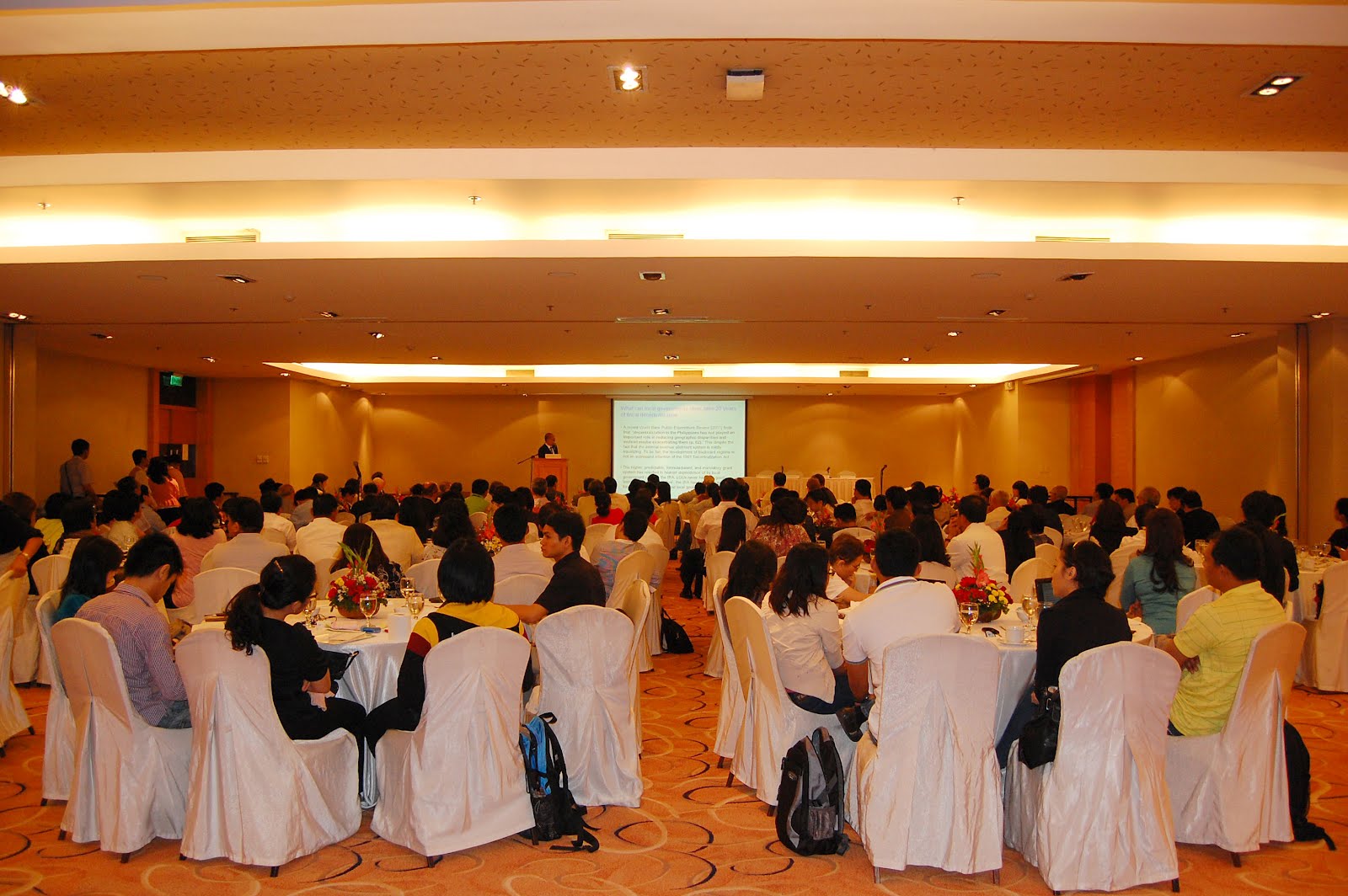
I attended the PIPER forum on "Fiscal Decentralization After 20 Years" last Monday, January 16, at Crowne Plaza Galleria Hotel, Ortigas Center. It was a whole day forum and many known personalities in the academe, Philippine government and foreign aid involved in decentralization were there.

Session one was a presentation by Dr. Benjamin "Ben" Diokno (sitting 3rd from right) of UPSE, also former DBM Secretary, and consultant to the WB, ADB, EC, USAID, among the biggest foreign aid institutions advocating more and bigger governments, more taxation and social redistribution.

The 3 scheduled reactors to his presentation were former DOF UnderSecretary Milwida "Nene" Guevarra, DILG UnderSec. Austere Panadero, and NAPC UnderSec. Jude Esguerra. Hah, the Institute for Popular Democracy (IPD) guys Joel Rocamora and Jude Esguerra, among others, have joined the government big time. Well, they have been advocating reformed but big government for many years now, so their position fits with their advocacies.

Jude did not arrive though, also USec Panadero, but he sent one of his senior staff to read his reaction paper. Then open forum started. I wanted to ask a question, but I saw some more popular personalities raising their hands, I said I better listen to them and ask my questions later, perhaps in the next session or panel.

Prof. Ben Diokno, my teacher twice at UPSE (undergrad in 1983 or '84, then PDE in 1998) used these slides as the theoretical framework in analyzing decentralization. The two benefits and advantages of decentralization, vs. its costs and disadvantages.


He noted that the Local Government Code (LGC) of 1991 was the most sweeping law changing intergovernmental structure and fiscal rules in the Philippines.

As seen in the graph here, the internal revenue allotment (IRA) given by the national government to the local government units (LGUs) have drastically increased since 1991. Unit on the vertical axis is percentage, not money. The table below explains why -- before the LGC, LGUs' share to internal taxes was only 20 percent, increased to 40 percent after the LGC. Besides, there has been considerable economic growth in the 90s, temporarily slowed down by the Asian financial crisis of 1997-98, and growth has slowly picked up, resulting in more internal tax revenues by the government, which leads to more IRA for LGUs.

These two tables are helpful and self explanatory. The biggest gainer among the four types of LGUs in the country were the barangays or villages, from only 10 percent to 20 percent of total IRA share. There are now more than 42,000 barangays nationwide.


The number of cities has drastically increased as more progressive and more populous municipalities have been converted into cities. Cities have higher tax rates than municipalities so the city government were earning higher than municipal governments. More revenues are supposed to make things lighter for city governments, but it seems that all of them, no exception, are saying that they need more money -- from their local residents, from the national government, and from foreign aid through more borrowings.

This is something new to me: "creeping recentralization" of certain agencies, especially the DOH and the DSWD. But the recent huge increases in the budget of these two agencies would prove correct the term used by Ben Diokno.

The CCT seems to be the single biggest program of the DSWD. The WB and ADB pitched in huge money for this program, they expect huge interest income from those loans too in the coming years. I am not a fan of the CCT program. Old programs are education and health for the poor, housing and credit for the poor, agrarian reform and irrigation for the poor, etc., not enough they say. So they added cash transfer for the poor, and soon, more condoms and pills for the poor. My longer discussion about the CCT, Welfarism 9: Conditional Cash Transfer (CCT), November 12, 2010.

The DSWD is the "outlier" here among the agencies which devolved their functions after 1991. From only 0.58 percent of total expenditures net of interest payment before the LGC, to 2.46 percent last year, such a big jump. The UN and its partner foreign aid banks, namely the WB and ADB, are hurrying the Philippines to reach its MDG targets which are supposed to be attained by 2015 or just three years from now. The DSWD plus the DOH are the main agencies that they see will greatly expand government and state welfarism.

The big drop in the number of employees in DA and DOH means big increase in the number of employees among LGUs doing agricultural extension work and healthcare services.

Here now are the major messages of Prof. Ben Diokno: decentralization was a failure in reducing disparities among communities and LGUs, and the big transfer of resources from the national government via IRA made many LGUs become lazy in raising their own local revenues.


Twenty years after the LGC and fiscal decentralization, some 75 percent of provincial governments' total revenues were coming from IRA. For municipal governments, it's slightly higher at nearly 79 percent of their total revenues. It's only the cities, especially those in Metro Manila, that were more creative, and sometimes more extortionist, in raising local taxes. Big cities like Makati, Manila and Quezon are I think only about 10 percent dependent on IRA. These cities have invented dozens upon dozens of local taxes, fees and fines slapped on residents, business locators, and non-residents but do business in their cities. For instance, there are cradle to grave fees to pay: birth certificate fee, residence fee, marriage certificate fee, death certificate fee, etc.

Prof. Diokno is saying further that decentralization was a failure in arresting high poverty incidence in the country. Thus, there is need to recentralize this function, more jobs for the national government. So back to central planning at the national level via national government agencies (NGAs) like NEDA, DOF-DBM, DOH, DSWD, DA, DENR, etc.


Being a non-fan of bigger local governments, I will not shed big tears for his proposal. My problem is that since many LGUs will oppose his proposal, we ordinary mortals, aka the taxpayers in the private sector, will be caught in the crossfire of fight between LGUs and NGAs for more taxes, more fees, more fines -- from our pockets. Let us remember that the government, national or local, is a penniless institution that becomes very powerful and very rich only by getting lots of money from our income, from our savings, from our investments, from our hard work and self-reliance.

Clear message from him, once again: Centralization, not decentralization, is the answer to poverty reduction and other social and political goals of the government.

I am no fan of centralization of powers to the NGAs and bureaucracies, I am no fan of decentralization either that results in ever-expanding LGUs with their ever-expanding rules of more restrictions, more regulations and prohibitions, and ever-expanding taxes and fees. Personal and parental responsibility is becoming an increasingly alien topic for them as they think that many if not all things should be government responsibility.


In her reaction, Nini Guevarra countered that decentralization has also produced many outstanding LGU leaders in the country. She cited some of them who were in that conference -- former Bulacan Governor Roberto "Obet" Pagdanganan, Albay Governor Joey Salceda, and Valenzuela Mayor Sherwin Gatchalian. But she recognized that many LGUs really lack accountability, so DILG Sec. Robrero has imposed a performance indicator system for LGUs which can be one of the new basis for the release of the IRA. She observed that while CCT has encouraged more children from poor families to attend schools, there is also lack of classrooms and teachers in poorer villages and municipalities. She thinks that there are bad LGU leaders because they don't have enough good role models.

During the open forum, Ms. Amina Rasul, a leader of a Mindanao-based NGO, lamented that autonomy of certain regions has not been given enough attention both by the presenter and the reactors. That autonomy, more than ordinary decentralization, is what is needed by more LGUs. Nini Guevarra argued that there is bad governance in the ARMM (Autonomous Region of Muslim Mindanao) due to bad politics by the national government (NG), but she added that there are a few good LGU leaders there.

Former NEDA chief and UPSE Dean Felipe Medalla asked how can we have good LGUs when we have lousy NG leaders. He also cited the claim of Cong. Mandanas of Batangas, that the NG owes LGUs some P500 billion in additional IRA because the IRA is based on total internal revenues of the NG, and about 80 percent of Bureau of Customs (BOC) collections are actually internal, not external taxes. And the NG has been using internal tax collections by the BIR only and excluded BOC internal tax collections.

I believe we simply need small and limited government, both at the national and local levels. The government should focus on promulgating the rule of law -- the laws against killing, murder, stealing, plunder, rape, extortion, carnapping, kidnapping, and many other criminal acts. It's a big and very important function but there is obvious government failure there. All malls, all private schools and universities, all villages and condo buildings, all churches, all big shops and restaurants, all banks, etc. are using private security guards to protect their property and customers from criminals. This is one clear and glaring example of distrust by the citizens and entrepreneurs of government failure, of both NG and LGUs in stamping out criminality in society.

Government, both national and local, should step back in heavy intervention, regulation and taxation in entrepreneurship and job creation by the private sector. The latter can take care of that. It is in the promulgation of the rule of law, of the protection of private property rights, protection of citizens against criminal elements, both private and government, that is sorely lacking.

I will discuss in the next paper, Prof. Gilbert Llanto's presentation on the assignment of functions and inter-government fiscal relations.
---------

See also: