Showing posts with label LGUs. Show all posts

Sunday, November 01, 2015

Business taxes, Makati vs. Taguig

Compare business permit taxes for small companies in Makati vs. Taguig.

In Makati (I took these photos sometime in April 2015), Barangay + City taxes and fees = P1,900 + P23,785 = P25,685.


In Taguig, posted by friend in facebook last July 2015 after she registered her new company. I covered the name of her firm.

City hall taxes and fees = P2,253. Only 1/10 of what Makati City hall collects, wow. Among the reasons why many business locators in Taguig Fort Bonifacio do not want Makati City Hall to have power over them. Taxes and fees are a lot higher.


Meanwhile, I wrote this on August 04, 2011.

Fragmentation vs. Consolidation of local governments

A friend asked me about my thoughts on whether there should be more fragmentation or more consolidation of local government units (LGUs) in the Philippines.

Being an advocate of less government, more personal responsibility and free market, my quick answer is more consolidation of LGUs, not the creation of new ones. But before expanding further, here is a rundown of the number of LGUs in the country.

I read in one publication that as of June 30, 2007, the following are the number of LGUs:

Provinces -- 81
Cities -- 131
Municipalities -- 1,497
Barangays -- 41,994

I don't remember the source of those numbers. I checked with DBM's Budget of Expenditures and Sources of Financing 2012, LGUs section, I counted 80 provinces and 122 cities. I also learned that only Pateros remains a municipality in Metro Manila, the 16 other LGUs are now cities.

I once discussed with my Indonesian friend my idea that with more than 21,000 islands and islets (vs. the Philippines' 7,100+) covering 4 time zones, Indonesia should break up into several countries and republics in order to spare the far away provinces and islands from the bureaucratism of the central government in Jakarta. He reminded me that despite its size, Indonesia has only 33 provinces vs. the Philippines' 80. Good point there.

Many politicians tend to view an LGU as a "mini-republic". A Congressman who finishes his 3-terms limit (3 years per term) and cannot fight another candidate for Governor with a good chance of winning, and does not want to run for Mayor of any of the cities or municipalities, would tend to propose the creation of a new province in an existing province so that he can run there as a provincial Governor with a good chance of victory. At some point, this is one reason why the number of provinces nationwide has expanded.

To create a new LGU, say a new province out of an existing big province, or a new city out of an existing big city, would mean doubling the number of local government officials (elected and appointed) and other lower-level personnel.

The Union of Local Authorities of the Philippines (ULAP) boasted sometime in 2006 that they have 1.7 million membership nationwide. The Civil Service Commission (CSC) at that time said there were only 400,000+ LGU personnel nationwide. I think the ULAP figure included personnel down to the barangay level while the CSC figure did not include barangay personnel, as well as temporary or contractual personnel in municipalities, cities and provinces, vut I'm not sure of these.

A friend of mine who was an HR official of the Paranaque City Hall once told me that the city government alone has more than 5,000 employees, both permanent and contractual. Excluded from that figure are officials and employees of the many barangays in the city. That was several years ago. The city would probably have 6,000 personnel by now.

Paranaque is a big city, like the cities of Manila, Makati, Quezon, Cebu, Davao, Baguio, Dagupan, etc. These big cities would have around about 5,000 or more personnel each. If we assume that an average city would have about 2,000 personnel, multiplied by 122 cities, that's around 244,000 personnel.

The municipalities. If we assume that an average municipality would have around 1,000 personnel, multiplied by 1,500 nationwide, that's around 1.5 million people.

Provinces would have bigger number of personnel than cities. If they would have 2,500 people each on average, multiplied by 80 provinces, that's another 200,000 personnel.

The barangays. I think there are at least 20 officials in each barangay (8 elected, at least 7 appointed, like the barangay secretary, treasurer, health officer, tanod head, etc.). Some barangays have more than a hundred employees, to include traffic officers, barangay tanods, brgy office staff, etc. At 20 personnel x 42,000 barangays, that's another 840,000 personnel.

These numbers are rough estimates. I will try to find other papers that can give more definitive figures. But assuming that the above estimates are close to their actual numbers, that's a total number of 2.78 million officials and personnel in LGUs alone.

Is it advisable to keep expanding this number through the creation of more LGUs, aside from the natural increase of existing LGUs by virtue of natural expansion of the bureaucracy?

Excluded from the above estimates are employees of national government agencies (soldiers, teachers, policemen, firemen, social workers, etc.) in the Executive branch. Then there are several hundred thousand more employees from the Judiciary (Supreme Court to lower courts), the Legislature (Senate, Congress, Batasan + district office staff, electoral tribunals), the Constitutional bodies (COA, CSC, COMELEC, CHR, Ombudsman, etc.).

Then there are several tens of thousands (or hundred thousand plus?) personnel of government corporations and financial institutions (BSP, SSS, GSIS, Pag-IBIG, PhilHealth, PAGCOR, PCSO, NPC, DBP, LBP, MWSS, etc.)

Then there are also several thousand personnel in the foreign aid and multilateral government bodies like the UN, WB, ADB, etc.

Government, from national down to local government, even not counting those working in the multilaterals, is the biggest employer in the economy. Probably about 12 to 15 percent of the total employed people in the country.

Since most functions in government are regulatory in nature, like telling people that they cannot start a bakeshop or barbershop or foodshop, unless they get the signatures and permits first of people from the barangay municipal/city hall to the national agencies like the BIR, SSS, DTI, SEC, etc., it is NOT good to expand government. From the local to national government.

Saturday, April 14, 2012

Fat-Free Econ 6: Foreign Aid and Tricycles

Note: this is my article yesterday in TV5's news portal,
http://www.interaksyon.com/article/29289/fat-free-economics-foreign-aid-public-debt-and-tricycles)

There is a new loan from the Asian Development Bank (ADB) for the Philippine government worth $300 million to manufacture and distribute some 100,000 electric tricycles (e-trikes) nationwide.

My beef about these 100,000 new tricycles is one, what we need in this country is more high passenger volume vehicles like buses and trains, not more tricycles. Small-population economies like Singapore, Hong Kong and Taiwan do not even have tricycles or jeepneys, how much more an economy with a population approaching 100 million in about two years.

But the local government units (LGUs) ensured the perpetual existence of tricycles by granting them route monopolies. Route A from the municipal proper to Barangay A is to be monopolized by tricycle operators and drivers association (TODA) A. Jeepneys, air-con vans or mini-buses are banned and prohibited from putting up any competition to the tricycle monopoly A. The same goes for TODA B, TODA C, etc. for route monopoly B, route monopoly C and so on.

If LGUs do not create route monopolies for tricycles, then competing public transportation like air-con vans in urban centers, and jeepneys in rural areas can easily fill the transport gap that is monopolized by tricycles. Tricycles would follow a natural death if ordinary folks and commuters are simply given more choices, more options in public transport, not more monopolies.

A second issue is the additional public debt that we would incur from creating these monopolies. Interest payments alone constitute around 20 percent of the annual budget of the national government, principal amortization excluded.

A third concern is if e-trikes are really cute, really financially viable, why not leave it to the market and see if operators will take on the business even without a taxpayers' subsidy. We taxpayers will pay for those 100,000 new tricycles through NEDA-DOE-DOF and LGUs. And the beneficiaries are most likely the political supporters of mayors and governors in the recipient LGUs, as well as supporters of the current administration. If these e-trikes will get zero taxpayers subsidy, then thank you. Unfortunately, I have not seen any document saying that this is the case considering that there is heavy government involvement in the planning and implementation of this project.

A fourth issue is the electricity bill of those e-trikes, which will be borne again by taxpayers through LGU recharging stations. If operators or their drivers will recharge at home, then thank you. If it's us taxpayers, no thank you.

A fifth issue is maintenance and replacement of old and depreciated lithium batteries. Will this be charged to taxpayers, or to private operators with zero tax subsidy?

A sixth issue is the endless rent-seeking and energy/transportation rackets all in the service of "saving the planet." I have three questions for the defenders and propagators of this campaign:

One, where are those scientific data showing that natural factors -- the sun, galactic cosmic rays, water vapor, clouds, volcanoes, other natural greenhouse gases (GHGs) -- are ruled out, are categorically denied, as drivers and contributors to the earth's climate change?

Two, is there no such thing as global cooling, only global warming? No natural climate cycles of warming-to-cooling and back, only "unprecedented, unequivocal man-made warming?"

Three, was there no medieval warm period (MWP) of nearly 600 years of warmer temperatures than the past century's warming? Was there no little ice age that followed after the MWP and preceded the past century's warming?

Any bright idea - if it is indeed a bright one - will survive and prosper if it is financed through voluntary exchange in the market, not through tax subsidies. The system of reward and punishment, of expansion and bankruptcy, is the best regulator and disciplinary tool among market players.

If things are provided at heavy subsidies, there is little incentive to make them sustainable. Instead, people would become complacent, and the original project will be slowly abandoned.

From e-trikes to e-jeepneys and e-buses, only political rent-seekers and their political supporters stand to gain. It is a dubious yet vicious cycle with no end in sight.
--------

Meanwhile, here is the ADB's youtube propaganda of those e-trikes,
http://www.youtube.com/watch?v=n1mVrZJZCOQ

And here are some details on this project at the ADB website,


Loan NameMarket Transformation Through Introduction of Energy Efficient Electric Tricyles
CountryPhilippines
Project Number43207- 02
Source of Funding/Amount[Proposed]
Clean Technology Fund-IBRDUS$1.00  million
Ordinary Capital ResourcesUS$300.00  million


The interest rate and other terms for this new fiscal irresponsibility project is not included in the above project data sheet.
--------

See also:
Foreign Aid 12: WB Corruption of Civil Society, March 23, 2011

Fat-Free Econ 3: Mining and Environmentalism, March 15, 2012
Fat-Free Econ 4: Unemployment, Good and Bad News, March 22, 2012
Fat-Free Econ 5: Property Rights and Policy Lefts, April 04, 2012

Thursday, January 19, 2012

Decentralization 9: Ben Diokno Says Recentralize

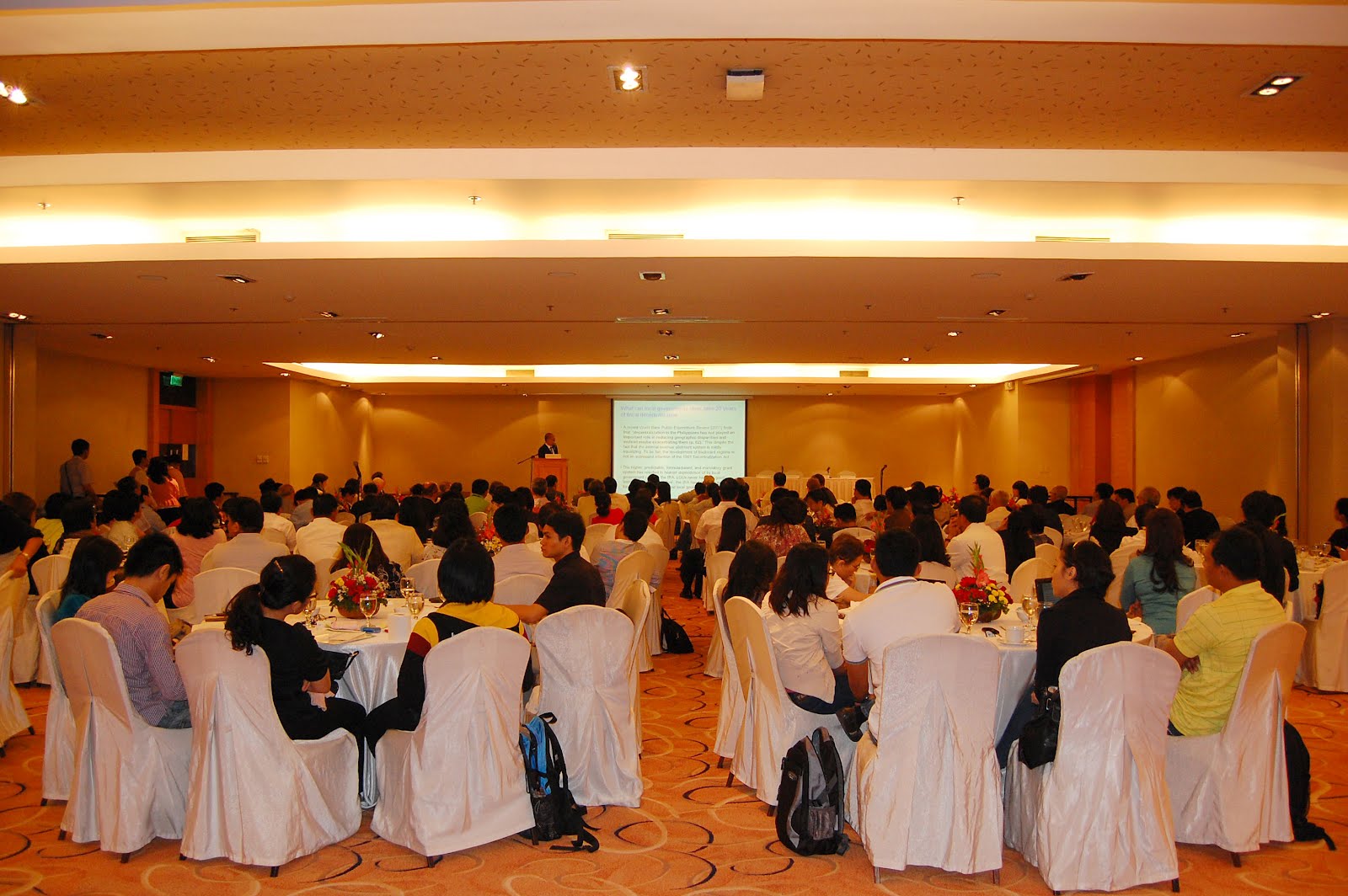
I attended the PIPER forum on "Fiscal Decentralization After 20 Years" last Monday, January 16, at Crowne Plaza Galleria Hotel, Ortigas Center. It was a whole day forum and many known personalities in the academe, Philippine government and foreign aid involved in decentralization were there.

Session one was a presentation by Dr. Benjamin "Ben" Diokno (sitting 3rd from right) of UPSE, also former DBM Secretary, and consultant to the WB, ADB, EC, USAID, among the biggest foreign aid institutions advocating more and bigger governments, more taxation and social redistribution.

The 3 scheduled reactors to his presentation were former DOF UnderSecretary Milwida "Nene" Guevarra, DILG UnderSec. Austere Panadero, and NAPC UnderSec. Jude Esguerra. Hah, the Institute for Popular Democracy (IPD) guys Joel Rocamora and Jude Esguerra, among others, have joined the government big time. Well, they have been advocating reformed but big government for many years now, so their position fits with their advocacies.

Jude did not arrive though, also USec Panadero, but he sent one of his senior staff to read his reaction paper. Then open forum started. I wanted to ask a question, but I saw some more popular personalities raising their hands, I said I better listen to them and ask my questions later, perhaps in the next session or panel.

Prof. Ben Diokno, my teacher twice at UPSE (undergrad in 1983 or '84, then PDE in 1998) used these slides as the theoretical framework in analyzing decentralization. The two benefits and advantages of decentralization, vs. its costs and disadvantages.


He noted that the Local Government Code (LGC) of 1991 was the most sweeping law changing intergovernmental structure and fiscal rules in the Philippines.

As seen in the graph here, the internal revenue allotment (IRA) given by the national government to the local government units (LGUs) have drastically increased since 1991. Unit on the vertical axis is percentage, not money. The table below explains why -- before the LGC, LGUs' share to internal taxes was only 20 percent, increased to 40 percent after the LGC. Besides, there has been considerable economic growth in the 90s, temporarily slowed down by the Asian financial crisis of 1997-98, and growth has slowly picked up, resulting in more internal tax revenues by the government, which leads to more IRA for LGUs.

These two tables are helpful and self explanatory. The biggest gainer among the four types of LGUs in the country were the barangays or villages, from only 10 percent to 20 percent of total IRA share. There are now more than 42,000 barangays nationwide.


The number of cities has drastically increased as more progressive and more populous municipalities have been converted into cities. Cities have higher tax rates than municipalities so the city government were earning higher than municipal governments. More revenues are supposed to make things lighter for city governments, but it seems that all of them, no exception, are saying that they need more money -- from their local residents, from the national government, and from foreign aid through more borrowings.

This is something new to me: "creeping recentralization" of certain agencies, especially the DOH and the DSWD. But the recent huge increases in the budget of these two agencies would prove correct the term used by Ben Diokno.

The CCT seems to be the single biggest program of the DSWD. The WB and ADB pitched in huge money for this program, they expect huge interest income from those loans too in the coming years. I am not a fan of the CCT program. Old programs are education and health for the poor, housing and credit for the poor, agrarian reform and irrigation for the poor, etc., not enough they say. So they added cash transfer for the poor, and soon, more condoms and pills for the poor. My longer discussion about the CCT, Welfarism 9: Conditional Cash Transfer (CCT), November 12, 2010.

The DSWD is the "outlier" here among the agencies which devolved their functions after 1991. From only 0.58 percent of total expenditures net of interest payment before the LGC, to 2.46 percent last year, such a big jump. The UN and its partner foreign aid banks, namely the WB and ADB, are hurrying the Philippines to reach its MDG targets which are supposed to be attained by 2015 or just three years from now. The DSWD plus the DOH are the main agencies that they see will greatly expand government and state welfarism.

The big drop in the number of employees in DA and DOH means big increase in the number of employees among LGUs doing agricultural extension work and healthcare services.

Here now are the major messages of Prof. Ben Diokno: decentralization was a failure in reducing disparities among communities and LGUs, and the big transfer of resources from the national government via IRA made many LGUs become lazy in raising their own local revenues.


Twenty years after the LGC and fiscal decentralization, some 75 percent of provincial governments' total revenues were coming from IRA. For municipal governments, it's slightly higher at nearly 79 percent of their total revenues. It's only the cities, especially those in Metro Manila, that were more creative, and sometimes more extortionist, in raising local taxes. Big cities like Makati, Manila and Quezon are I think only about 10 percent dependent on IRA. These cities have invented dozens upon dozens of local taxes, fees and fines slapped on residents, business locators, and non-residents but do business in their cities. For instance, there are cradle to grave fees to pay: birth certificate fee, residence fee, marriage certificate fee, death certificate fee, etc.

Prof. Diokno is saying further that decentralization was a failure in arresting high poverty incidence in the country. Thus, there is need to recentralize this function, more jobs for the national government. So back to central planning at the national level via national government agencies (NGAs) like NEDA, DOF-DBM, DOH, DSWD, DA, DENR, etc.


Being a non-fan of bigger local governments, I will not shed big tears for his proposal. My problem is that since many LGUs will oppose his proposal, we ordinary mortals, aka the taxpayers in the private sector, will be caught in the crossfire of fight between LGUs and NGAs for more taxes, more fees, more fines -- from our pockets. Let us remember that the government, national or local, is a penniless institution that becomes very powerful and very rich only by getting lots of money from our income, from our savings, from our investments, from our hard work and self-reliance.

Clear message from him, once again: Centralization, not decentralization, is the answer to poverty reduction and other social and political goals of the government.

I am no fan of centralization of powers to the NGAs and bureaucracies, I am no fan of decentralization either that results in ever-expanding LGUs with their ever-expanding rules of more restrictions, more regulations and prohibitions, and ever-expanding taxes and fees. Personal and parental responsibility is becoming an increasingly alien topic for them as they think that many if not all things should be government responsibility.


In her reaction, Nini Guevarra countered that decentralization has also produced many outstanding LGU leaders in the country. She cited some of them who were in that conference -- former Bulacan Governor Roberto "Obet" Pagdanganan, Albay Governor Joey Salceda, and Valenzuela Mayor Sherwin Gatchalian. But she recognized that many LGUs really lack accountability, so DILG Sec. Robrero has imposed a performance indicator system for LGUs which can be one of the new basis for the release of the IRA. She observed that while CCT has encouraged more children from poor families to attend schools, there is also lack of classrooms and teachers in poorer villages and municipalities. She thinks that there are bad LGU leaders because they don't have enough good role models.

During the open forum, Ms. Amina Rasul, a leader of a Mindanao-based NGO, lamented that autonomy of certain regions has not been given enough attention both by the presenter and the reactors. That autonomy, more than ordinary decentralization, is what is needed by more LGUs. Nini Guevarra argued that there is bad governance in the ARMM (Autonomous Region of Muslim Mindanao) due to bad politics by the national government (NG), but she added that there are a few good LGU leaders there.

Former NEDA chief and UPSE Dean Felipe Medalla asked how can we have good LGUs when we have lousy NG leaders. He also cited the claim of Cong. Mandanas of Batangas, that the NG owes LGUs some P500 billion in additional IRA because the IRA is based on total internal revenues of the NG, and about 80 percent of Bureau of Customs (BOC) collections are actually internal, not external taxes. And the NG has been using internal tax collections by the BIR only and excluded BOC internal tax collections.

I believe we simply need small and limited government, both at the national and local levels. The government should focus on promulgating the rule of law -- the laws against killing, murder, stealing, plunder, rape, extortion, carnapping, kidnapping, and many other criminal acts. It's a big and very important function but there is obvious government failure there. All malls, all private schools and universities, all villages and condo buildings, all churches, all big shops and restaurants, all banks, etc. are using private security guards to protect their property and customers from criminals. This is one clear and glaring example of distrust by the citizens and entrepreneurs of government failure, of both NG and LGUs in stamping out criminality in society.

Government, both national and local, should step back in heavy intervention, regulation and taxation in entrepreneurship and job creation by the private sector. The latter can take care of that. It is in the promulgation of the rule of law, of the protection of private property rights, protection of citizens against criminal elements, both private and government, that is sorely lacking.

I will discuss in the next paper, Prof. Gilbert Llanto's presentation on the assignment of functions and inter-government fiscal relations.
---------

See also:

Monday, September 20, 2010

Decentralization 6: Local Fees and LGUs' Independence from NG

Posting two related articles that were published in the weekend tabloid, People's Brigada News on different dates....

(1) Local Fees and Decentralization

March 11, 2010

Political decentralization does not automatically mean less government in the lives of the average citizens. Rather, it could mean less central or national government but more local government taxes, fees and regulations in the lives of ordinary citizens.

Last weekend, I went to Cebu City to speak in a forum organized by the Economics Department of the University of San Carlos (USC). Among the things that I noticed in Cebu were the high prices of fuel products. As of March 7, 2010, the price of diesel there was P37.81/liter, unleaded gas was P48.20/liter. That same day when I went back to Manila, the price of diesel was P33.80 a liter, unleaded gas was P44.20 a liter. In short, fuel prices in Cebu City were P4.00 more expensive compared to Manila prices. Why is this so?

Fuel prices in provinces north of Metro Manila are usually P0.50 to P1.00/liter more expensive, for both diesel and gasoline. In Bacolod and Iloilo cities, prices are usually P1.00/liter more expensive than Manila prices. Such price differential is usually due to transportation cost of bringing the fuel products to the provinces.

But why is the price differential in Cebu up to P4 a liter? This is grossly unfair for the Cebuano motorists and passengers.

My hypothesis is that the Cebu provincial and/or City governments imposed a separate fuel tax or fuel surcharge on top of existing import tax + excise tax + VAT by the national government.

Another thing that I noticed in Cebu, was the multiple fees that the local government imposed on passengers who enter the Cebu south bus terminal. I went there on my way to visit my relatives in Barili, a town south of Cebu City. Here are the fees that I observed:

a) taxi/car entrance fee P10,
b) passenger terminal fee P5,
c) toilet fee if one will pee P2,
d) buses parking fee, I do not know how much it is now, but more than a year ago, it was around P80/bus.

Of course the terminal operator -- the provincial or city government -- also collects from the rental of many stalls and food shops inside the terminal. The local government, therefore, collects lots of money from the bus terminal alone. In fairness, the terminal is relatively clean, not air-con but with electric fan, with tv in some sections. But the collections seem to be many, I think.

A friend from Cebu told me that the various fees are also being collected at the provincial Capitol. Like parking fee for cars, and blood pressure fee inside the Capitol clinic, P10/person, if the person is not an employee of the Capitol, for people undergoing some medical check up.

If one will check Cebu's city and provincial revenue codes, one might be surprised at the long list of government services with fees. Like marriage fee, marriage certificate fee, annulment fee, birth certificate fee, baptism fee, death certificate fee, burial fee, and so on. From womb to tomb, there is a fee!

Of course the local governments there will counter that they also provide free services to the poor, like free hospitalization or free coffin to the really poor. And the practice of collecting local taxes and fees from womb to tomb is also being done by other big cities and provinces in the country.

But it is baffling to think how come that so many “government services” are now not free, that average citizens have to pay many local taxes and fees, on top of national taxes and fees. Isn’t collecting just a few taxes and fees a form of public service already, so that average citizens will be able to keep more of their earnings for themselves and their family.

I am not really a fan of political decentralization or devolution, although I am not a fan either of centralization of powers by the national government. Bus terminals can be operated by private enterprises at a lot more passenger-friendly way with zero additional cost to passengers, compared to government operators. Look at those malls. People can enter and exit those malls anyday anywhere, zero entrance fee and zero toilet fee. And still the mall operators make money.

But then some local governments are not after better services to the public, but to collect more revenues from the public. A number of bureaucracies just exist for themselves.


(2) LGUs' Independence from National Government

September 18, 2010

In many political discussions and public administration literatures, decentralization and the relative independence of local governments from the central or national government is hailed as a virtue. It implies that the politicians and administrators of local governments can act more independently from politicians and administrators of the national government, especially the Office of the President.

The share of local governments from Internal Revenue Allotment (IRA) as percentage of their total receipts and revenues is a good indicator of how independent or dependent a local government is. Below are some relevant figures.

Projected revenues of selected big cities for 2010, in P million (except %)

City: Share from IRA / Local receipts / IRA dependence in %

Makati: 731 / 6,592 / 11.1%
Pasig: 748 / 4,202 / 17.8%
Pasay: 506 / 2,323 / 21.8%
Muntinlupa: 573 / 2,236 / 25.6%
Taguig: 723 / 2,325 / 31.1%
Paranaque: 670 / 2,129 / 31.5%
Manila: 1,747 / 5,122 / 34.1%
Quezon: 2,738 / 6,661 / 41.1%

Cebu: 1,041 / 2,120 / 49.1%
Cagayan de Oro: 841 / 1,039 / 80.9%
Iloilo: 548 / 625 / 87.7%
Antipolo: 855 / 678 / 126.1%
Davao: 2,566 / 1,701 / 150.9%

Source: DBM, BESF 2011, Table F.15, http://www.dbm.gov.ph/BESF2011/F/F15.pdf

Among the big cities in the country, Makati, Pasig and Pasay are the least dependent from IRA transfers from the national government. In contrast, the cities of Antipolo and Davao are among those cities that are generally dependent on such transfers.

But while “less dependence” from national government’s transfers may be a virtue, it may also mean that the local government is becoming too harsh on some businesses that are located in their territory by imposing too many business taxes and fees.

Local governments should attract more businesses to locate in their territory because such businesses will create more jobs. When people have jobs, they become less dependent on both national and local governments for welfare.
-------

See also: Decentralization 5: Privatization and Civil Society, February 22, 2010

Monday, February 22, 2010

Decentralization 5: Privatization and Civil Society

I am posting two related articles below.


(1) Decentralization and Privatization
(posted in "People's Brigada News", a weekend tabloid distributed in southern Metro Manila)

Decentralization and devolution of power from the national or central government to local government units (LGUs) is a favorite topic and advocacy of many LGU leaders and academics. The main reason is that LGU leaders know more about the needs and priorities of their citizens than those in the national government and in Metro Manila.

In October 2008, I went to Gummersbach, Germany, to attend the international seminar on “Local Government and Civil Society”, sponsored by the Friedrich Naumann Foundation (FNF) at the Theodor Heuss Akademie. One of our readings prior to flying to Germany was a paper by a German political scientist, Dr. Monika Ballin, entitled “Local Government and Civil Society”.

Dr. Ballin made a number of definitions and points that I liked very much. Among these are the following:

One, local government is a local, non-national authority, with local responsibility and limited autonomy and is part of the organizational structure of the State. But local government with a high degree of autonomy is always in strong opposition to centralistic political movements and authoritarian structures.

Two, the principle of subsidiarity applies. Responsibilities as much as possible should be done at the lowest level, and only when a responsibility exceeds the capacity of one level that the next higher level should be entrusted.

Three, decentralization and privatization. Responsibilities need to be shifted from the top down, and responsibilities which are not in the national or local sphere have to be privatized. Local authorities must have their own sources of funding to assert their fiscal autonomy.

And Four, civil society is the final stage of a functioning local government. If all means of decentralization, deregulation and privatization have been implemented and citizens have been involved as comprehensively as possible, civil society has emerged. There will be a “Lean State” where State structure exists only where it is absolutely necessary, and the State at any level is not carrying out any task and duty which private businesses or citizens themselves can do for society.

The purpose of political decentralization and devolution is to shift some responsibilities from national to local governments. Unfortunately, for many countries, this did not result in greater individual freedom and citizen empowerment and self-administration, but greater power, regulation and intervention by local governments.

Most LGUs got drunk with the new regulatory powers vested on them by decentralization policy. Thus, while various national government agencies have already imposed a number of taxes and fees for businesses and ordinary citizens, LGUs also created and imposed their own new set of taxes and fees. The main reason given by LGU leaders why they did so is because they also assumed more responsibilities and expenditures that used to be funded by the national government.

What was overlooked by many LGU leaders and their supporters in the intelligentsia, is that the smallest unit to assume responsibility for the citizens is not the barangay or village, a political unit and is part of the entire State apparatus. Rather, it is the individual, the households, as well as their voluntary organizations – like neighborhood associations, sports clubs, civic and rotary clubs, student organizations, labor unions, and so on.

Thus, if the principle of subsidiarity is to be applied strictly, then most responsibilities should fall on private individuals, parents, firms, and citizens’ voluntary organizations, not on either national government or LGUs. This is part of a transition from decentralization to privatization. And by privatization I do not mean the transfer of function from a government unit to a private corporation only. Not exactly. It can be an NGO, a cooperative, a sports and civic club, a church organization, and so on.

There are certain functions that are better handled by the national government, and not by LGUs or by individuals and their voluntary organizations. This includes the promulgation of the rule of law. A law against killing applies whether the crime happened in Luzon or Visayas or Mindanao. The heavy hands of the State should run after criminals, murderers, rapists and kidnappers. Another law, the law against stealing. It should apply whether the theft is the President or a Governor or the poorest of the poor.

Most social welfare functions for special cases are better handled by LGUs. Like public education for the very poor and those with physical and mental disabilities, especially if the parents are poor.

But the bigger challenge to raise responsible individuals who understand their rights and responsibilities as citizens of a particular society, rests with the parents and guardians of minors, the private individuals, not government. We may call this as “privatization of citizen responsibility.”


(2) Civil Society and Politics

A state of civil society is supposed to be higher than a state of democratic governance. And yet we see majority of civil society organizations (CSOs) and non-government organizations (NGOs) that work and behave like adjunct of the government (local, national and multilateral) and political parties. Why has this happened?

Before exploring that question, let us define what “civil society” is. I am taking the liberal, German liberal specifically, definition of the concept, which is rather radical

A German liberal intellectual has defined it as:

“Civil society is the final stage of a functioning local government. If all means of decentralization, deregulation and privatization have been implemented and citizens have been involved as comprehensively as possible, civil society has emerged. There will be a “Lean State” where State structure exists only where it is absolutely necessary, and the State at any level is not carrying out any task and duty which private businesses or citizens themselves can do for society.”

There you are. A state of civil society is a state where individuals know their rights, freedom and responsibilities, as well as the freedom and responsibilities of other people. In so doing, they assume as much responsibilities as possible in managing their own lives, their households, their communities, their school and offices, their church and other voluntary organizations. It is a state of minimal government, both national and local.

See my longer discussion of this as well as the original paper by Dr. Monika Ballin, “From local government to civil society”, http://www.minimalgovernment.net/media/mg_20080821.pdf

A close concept of civil society is the principle of subsidiarity. This principle states that “Responsibilities as much as possible should be done at the lowest level, and only when a responsibility exceeds the capacity of one level that the next higher level should be entrusted.”

Now the lowest level of social, political and economic unit in any society is not the village or barangay. It is the individual. Thus, things that are better done by the individuals, their households, their villages, their sports, church and civic organizations, should be left with them. Only when certain functions they cannot deal with, say neutralizing an organized and armed gang of robbers, drug pushers, carnappers, killers and other criminals, then they pass that function to local government (barangay, city/municipality, or province). When the local governments cannot handle certain functions, then the national government should take over.

An example of functions that cannot be handled efficiently by individuals and their voluntary organization, and the local governments, is maintaining an air force and navy to neutralize sophisticated, highly organized and well-armed criminal groups like sea bandits that sea-jack passenger and cargo boats.

So now, why did I say that so many CSOs behave and act like adjunct of the government and political parties? Because instead of asserting individual freedom and responsibility, instead of correcting repeated government failures, such groups push for even bigger government responsibility, intervention and regulations.

An outstanding example is the party-list system in the Philippines. The Constitution provided for the participation of “marginalized sectors” in the House of Representatives by allotting up to 20 percent of all seats in the House, to be occupied by party-list Congressmen/women. This provision shows that the Constitution itself doubts the sincerity of the legislative district-based Congressmen/women that they will indeed protect the interests of the “marginalized sectors”. Thus, these party-list House seats need to have their representatives there too.

Distrust begets distrust. In the coming May 2010 elections, 300+ party-list groups applied, saying they are from the marginalized sectors. Wow, so many marginalized groups! Does it mean that all past legislations including budgetary appropriation by both district-based and party-list Congressmen/women were all failures in reducing the number of “marginalized sectors”?

Out of the 300+, the Commission on Elections (COMELEC) authorized 187. Repeat, 187 party-list groups and voters will choose only 1.

My point here is that all those party-list groups are CSOs, one way or another. Instead of pressuring existing political parties and party-lists why things remain foul, they all joined the political complexity.

Include also so many CSOs that whenever certain social problems arise, their standard proposal is “more government regulation”, or “more government subsidy”, or “more taxes from the rich”, or “create a new department/bureau”, and so on. And there is the implicit pressure that they hope that the leaders of CSOs will be appointed as heads of those new offices or be appointed to replace other officials.

What happens now to advancing the principle of subsidiarity, of individual freedom and responsibility? Nothing. We are all hooked to supporting the least corrupt politicians among candidates whom average voters suspect were engaged in some dirty arrangements as past government officials.

CSOs should go back to their roots. Their leaders are not politicians, they are not part of political parties, they are not representatives of the corporate world. They are voluntary organizations that thrive only on voluntary support by members and private donors.
--------

See also:  Decentralization 4: Local Taxes and Provincial Airports, May 30, 2009

Saturday, May 30, 2009

Decentralization 4: Local Taxes and Provincial Airports

Posting here two related articles...

(1) Local Taxes and Decentralization

The Congressional Planning and Budget Department (CPBD), the economic think tank of the Philippines’ House of Representatives, recently produced a paper entitled “Public Sector Government and Decentralization in the Philippines”, authored by the office Executive Director, Dr. Romulo “Jun” Miral, Jr. CBPD was my former office for 9 years in the last decade, and Jun is my friend.

The paper was reported in at least one newspaper, “House think-tank pushes stronger taxing powers for local governments” by Iris Gonzales, May 10, 2009.
http://www.philstar.com/Article.aspx?articleId=465956&publicationSubCategoryId=66

Jun argued that local governments must be given stronger taxing powers or at least commensurate to the expenditure functions assigned to them, that while major expenditure functions have been devolved to local governments, the National Government (NG) continues to have exclusive authority over productive and broad based taxes.

Jun wrote further, “Government resources continue to be centralized, resulting in common pool problems and local governments remain very dependent on National Government transfers and the direct provision of devolved services. This undermines local autonomy and government accountability.”

The NG collects huge amount of money from income tax (personal and corporate), value added tax (VAT), import tax, excise tax (alcohol, tobacco and petroleum products, the so-called “public bads”), documentary stamp tax, franchise tax, travel tax, motor vehicle tax, etc. The various NG agencies also collect their own charges and fees – passport fee, driver’s license fee, NBI fee, police clearance fee, terminal fee, irrigation fee, etc.).

Local government units (LGUs) collect mainly real property tax (RPT), community residence tax (individual and corporations), business license taxes and fees (fire department fee, health and sanitation permit fee, garbage collection fee, building and electrical permit fee, business plate fee, etc.).

If one will visit a typical business enterprise (say a restaurant or computer shop), one will notice about a dozen compliance certificates from various NG agencies and LGUs, and business plates. The business plates issued by the barangay or village, and city or municipality, would normally include the name and face of the barangay captain, and city or municipal Mayor, respectively. That will give someone who is aspiring to become a start-up entrepreneur, the maze of government bureaucracies that he/she will face every single year. Consider also the monthly, quarterly and annual taxes and fees to be paid to all of those agencies, the cost of compliance, and one can possibly be terrified and would rather decide to operate as an informal and small or micro enterprise.

Back to LGU-NG taxation. Jun is proposing that to achieve a more effective government decentralization, the NG and LGUs can do joint taxation of major taxes such as income tax. I am glad that unlike many economists in the NG and multilateral institutions like the IMF, WB and ADB, Jun did not propose further gouging the pockets of Filipino taxpayers. Instead, he proposed that “To accommodate the additional taxes to be imposed by local governments without increasing the overall burden on taxpayers, NG tax rates could be commensurately reduced.”

I would add that some NG taxes should be abolished or drastically cut. This will have two important positive impact. First, it will put the Philippines on the league of modern Asian economies who are attracting big investors and entrepreneurs via tax competition – Hong Kong, Singapore and Dubai. Malaysia and Brunei are attempting to join this league too. Second, the “savings” by individual and corporate taxpayers will allow them some breathing space to pay any additional taxes and fees to be collected by LGUs. A competition among LGUs can happen – who has the best peace and order situation, who has the cleanest streets and parks, who has the most competitive and reasonable local taxes, etc. And people and firms can “vote with their feet” by moving to LGUs that offer the most business-friendly policies and projects. And leave those cities or municipalities or provinces whose LGUs have parasitic and extortionary policies.

But this is easier said than done. Many agencies in the NG, especially the Office of the President and Congress, are experienced parasites. They will never let go of those multiple and duplicating taxes and fees that feed their entrenched bureaucracies and give them enough arbitrary powers that force entrepreneurs to kneel before them and make “amicable settlements”.


(2) Globalization and Provincial Airports

While most people have elaborate definition of globalization, I have a simple one: Globalization = Mobility. Mobility of people, capital, technology, culture, sports and music across the country and across the globe.

Such mobility of people, their goods and services across islands, countries and continents, is facilitated by various modes of transportation – land, sea and air. For long distances covering hundreds or thousands of kilometers away, air transportation is the most cost effective and time saving. For the Philippines, an archipelago and geographically detached even from its nearest neighboring country, the presence of various airlines – both domestic and international, is very crucial. By extension, the presence of various international airports is equally crucial. International airlines can only come in if there are good and reliable international airports that can handle their huge airplanes and huge volume of passengers and cargo.

For a country with more than 7,000 islands and a population of nearly 92 million (12th largest in the world), and an estimated 8 million to 9 million living abroad, there should be plenty of international airports across the country. Currently there are only nine: 4 in Luzon (NAIA, Clark, Subic and Laoag), 3 in Mindanao (Davao, Gen. Santos and Zamboanga) and 2 in the Visayas (Mactan-Cebu and Kalibo). Some of these international airports do not get frequent international flights, like the one in Kalibo.

I think more international airports should be developed out of existing domestic airports. In particular:

1. Tuguegarao airport to serve the Cagayan Valley region and neighboring provinces in the Cordillera region.

2. Legaspi or Naga airport to serve the Bicol region which has a big population too and has several island-provinces like Masbate and Catanduanes.

3. Iloilo airport to serve Panay Island’s four provinces plus the island-province of Guimaras. Kalibo airport serves mostly the tourists going to Boracay island. It’s not a big and modern airport but it has a long runway that can accommodate big airplanes, unlike the airport in Caticlan.

4. Bacolod-Silay airport to serve Negros Occidental and Negros Oriental provinces. The former is among the five biggest provinces in the country in terms of population outside of Metro Manila.

5. Tacloban airport to serve the Eastern Visayas region and its six or seven provinces.

6. Cagayan de Oro or Butuan airport to serve the Northern Mindanao and Caraga regions, including the island-province of Camiguin and Siargao island. Both islands are famous for tourism.
.
By saying international airports, the above-proposed airports need not serve flights going to and from the US, Europe and Australia. What is important is to accommodate flights going to and from the country’s selected Asian cities like Hong Kong, Singapore, Seoul, Tokyo, Taipei, Bangkok and Kuala Lumpur. One or two flights a week for any or all of those Asian destinations would be enough. And if one is going to several destinations in North America, Europe, Australia-NZ, South America and Africa, all those Asian cities mentioned have direct flights to the big cities of the above-mentioned continents.

Recently, the Regional Development Council of Western Visayas asked the Civil Aviation Authority of the Philippines (CAAP), formerly the Air Transportation Office (ATO), to open the Iloilo airport to international flights. The Council also told CAAP that it wants to retain at least 10% of the P200 per passenger airport terminal fee. I have been to Iloilo airport several times as my wife is from Iloilo City, and I can say that this airport is modern enough – typical glass and steel structure of modern architectures, and should be able to handle limited international flights. For now, I have several points to make.

One, if a national bureaucracy like CAAP will drag its feet for long, like in deciding whether to allow international flights at the Iloilo airport or not, then local governments will have no way of implementing their collective plan and program. This is another proof that decentralization of political and economic powers is not yet fully implemented. Certain bureaucracies in Metro Manila still decide what is good or bad for those in the provinces.

Two, CAAP gets the entire terminal fee collections of provincial airports. I did not know this before. I thought ATO, now CAAP, gets only a certain percentage from the terminal fee collections from those provincial airports. This is a huge collection, actually. Last year, toll and terminal fee collection was P215 million, and is projected to rise to P236 million.

Three, airports need not be owned and operated by governments. A consortium of private corporations including airlines should be allowed to buy and develop existing airports, or create a new one. Anyway, there are several government agencies that can regulate such privately-owned airports, including the CAAP, the provincial and city or municipal governments, and perhaps the Civil Aeronautics Board, among others.

To help encourage provincial and regional development, let the local government units compete with each other in developing and modernizing their own infrastructure facilities (roads, airports, seaports, etc.), improve the peace and order situation, and even engage in tax competition when necessary. The goal is to attract plenty of investors and visitors who will create plenty of jobs and entrepreneurial opportunities for their people.

The continuing centralization of power in the hands of certain national government agencies is a hindrance to the development of some local governments, a hindrance to faster globalization and economic integration of the people in the provinces with other cities and countries around the globe.
-------

See also: Decentralization 3: Challenges to Local Government, November 18, 2008

Saturday, August 30, 2008

Decentralization 2: From Local Government to Civil Society

A German political scientist, Dr. Monika Ballin, wrote a short paper entitled “Local Government and Civil Society.” That paper is mainly for the participants of an online seminar of the same title, sponsored by the Friedrich Naumann Foundation for Liberty. The seminar started last week, running for two more weeks, and I was lucky to be selected among the 68 participants from many countries, mostly from Asia, Latin America, Africa, and a few from Europe.

I like a number of definitions and points raised by Dr. Ballin in her paper. Among these are the following:

One, local government is a local, non-national authority, with local responsibility and limited autonomy and is part of the organizational structure of the State. But local government with a high degree of autonomy is always in strong opposition to centralistic political movements and authoritarian structures.

Two, the principle of subsidiarity applies: responsibilities as much as possible should be done at the lowest level, and only when a responsibility exceeds the capacity of one level that the next higher level should be entrusted.

Three, decentralization and privatization: responsibilities need to be shifted from the top down, and responsibilities which are not in the national or local sphere have to be privatized. Local authorities must have their own sources of funding to assert their fiscal autonomy.

And Four, civil society is the final stage of a functioning local government. If all means of decentralization, deregulation and privatization have been implemented and citizens have been involved as comprehensively as possible, civil society has emerged. There will be a “Lean State” where State structure exists only where it is absolutely necessary, and the State at any level is not carrying out any task and duty which private businesses or citizens themselves can do for society.

I say “Amen” to all four points, especially the last one. The four core advocacies of our think tank, MG Thinkers, Inc. – small government, small taxes, free market, individual responsibility – unsurprisingly fit in these ideals and goals of civil society. Less government responsibility (and less taxes and bureaucracies), more individual, parental and enterprise responsibilities.

The purpose of political decentralization and devolution is to shift some responsibilities from the national to local governments. Unfortunately, for many countries, this did not result in greater individual freedom and citizen empowerment and self-administration, but greater power, regulation and intervention by local governments. I do not think this is consistent with liberalism philosophy.

In a number of economic competitiveness studies done by various institutions, like “Economic Freedom of the World” (EFW) by Fraser Institute, or “Doing Business” annual reports by the World Bank and International Finance Corporation (IFC), or “Paying Taxes” annual reports by the WB and Price Waterhouse Coopers (PWC), it’s those small economies with small local governments units (LGUs) that have the fewest taxes and business regulations, like Hong Kong, Singapore and Maldives. While some countries with plenty of LGUs, even though they have decentralization or devolution law like the Philippines, have the most number of taxes and business regulations (eg. http://www.doingbusiness.org/documents/Paying_Taxes_2008.pdf).

This is because of duplicating business requirements, taxes and fees being collected, by both the national government and LGUs (provinces, cities or municipalities, and barangays or villages). The devolution of certain social services from the central government to LGUs like public health care, basic education and agricultural extension has emboldened many LGUs to create new taxes and fees, new rules and regulations – on top of taxes and fees, rules and regulations created and collected by national government agencies.

From the discussion by Dr. Ballin, to which I fully agree, the spirit of attaining a condition of civil society is not decentralization per se, but “degovernmentization” of many social functions, of ridding government and State intervention when individuals are free and responsible enough to be fully accountable and answerable for their actions and inactions. This is consistent with Friedrich Hayek’s observation that freedom and responsibility are closely intertwined, that a person cannot enjoy freedom unless he is ready to take responsibility for his life, his family and his community. That fear of responsibility is fear of freedom itself.

When I first mentioned the term “degovernmentization” to some friends here in Manila, their immediate reaction and question was “Are you proposing abolishing government?” No.

“Decentralization” does not mean abolition of the central government, but merely the transfer of some functions from the central to local government. “Deregulation” does not mean abolition of all regulations by government, but reduction of too many regulations, liberalizing the economy to facilitate entry of new economic players. “Demonopolization” does not mean abolition of the incumbent monopoly corporation, but allowing other players and competitors so that the previous monopolist becomes one of the many players. So “Degovernmentization” does not mean abolition of the government, but reduction of many functions and responsibilities currently handled by national or central government, and local governments, and giving such responsibilities back to the citizens, as individual and parental responsibilities.

There will always be a role for the State, a function that individuals and small communities cannot perform effectively. In its most basic and limited role, the State has the function to protect the citizens’ right to life, right to private property, and right to liberty. There will always be bullies, lazy and irresponsible people who will attempt to sustain their existence and that of people close to them by robbing other people their three rights mentioned above. These are the terrorists and murderers, robbers and hold-uppers, carnappers and pirates, rapists and kidnappers, and so on. Thus the State exists to become a “bigger bully,” better armed and equipped, than this group of people. The State also needs to maintain a credible and independent justice system that can render impartial and quick judgment on cases that involve critical disputes between and among the citizens.

The concept of “civil society” though is among those most misunderstood in the world today. Many people who regard themselves as belonging to civil society are actually in the forefront of advocating for more government regulations, trade protectionism, and higher taxation (the usual slogan, “tax the rich!”). In their hearts and mind, there is deep hatred of markets and big corporations, deep suspicion of assigning individual and parental responsibility, deep disrespect of inequality and diversity among people. So what those “civil society leaders” want is an even bigger government, and prevent the emergence of real civil society where citizens’ self-administration of their own lives, households, communities and workplaces, are respected and encouraged.

On another note, the ongoing renewed military conflict between the secessionist Islamic army and the government armed forces in southern Philippines, is mainly a result of never-ending claims by the former for political and economic control of many provinces and cities that they claim to be their “ancestral domain.” Political decentralization under the Local Government Code (1991) did not work to solve this problem. Another law and political structure, creating the Autonomous Region in Muslim Mindanao (ARMM) was enacted and implemented, but after more than a decade, the same problems resurface.

The ultimate goal of the rebel Islamic army in the south is a separate State, an Islamic State with its own geographical area of control. It does not want decentralization or a stronger and “autonomous” local government because it will still be part of the administrative apparatus of the Philippine State.

Asserting a “civil society agenda” at this time in the current conflict in the south is a secondary issue. Because the main issue is the assertion of the Islamic rebels to have their own central government, while the central government of the existing Philippine State is ambivalent at least, or opposed to this move at most.

Civil society by nature relies on the voluntary acts of citizens for self-administration. Even the financial backbone to sustain voluntary organizations (from corporations to cooperatives, labor federations, student councils, neighborhood or village associations, churches, sports clubs, civic clubs, etc.) comes from voluntary contribution. Civil society therefore, is pacifist and non-coercive. And it is this non-coercive nature that directly and explicitly separates it from organs of government, where almost all of them were created and sustained by non-voluntary means through taxation.

Both sides in the south, the Islamic rebels and the Philippine State, though fighting, have a common trait: to foster or expand the coercive nature of their respective governments, and in the process, kill or stop the emergence of civil society.

Wednesday, July 25, 2007

Decentralization 1: It's Still More Government

I am no fan of so-called "decentralization" or "devolution" from national to local government units (LGUs). Both in principle and practice. Whether centralization or decentralization, it's the same bottom lineof MORE government and bureaucracies. The only difference is that in centralization, it's the national politicians and bureaucrats who make and implement the rules, while in decentralization, it's the local politicians and bureaucrats who do.

Below is from a friend, also from UP. He was a 3-termer councilor in a town in Pampanga, now a municipal administrator. He's got lots of insights on local govt. administration, governance, taxation, etc. For instance, he noted the wastage of our taxes on barangay leaders. The barangay chairman in pangasinan where our farm is located also narrated to me that many of his fellow brgy chairmen really enjoy being treated to red-lights entertainment (DOM style) when they go out for seminars in the cities:
Nonoy, I've been reading the essays you've been sending me. Kaya lang I don't have the time to comment on them dahil I'm loaded with a lot of work and I'm usually preoccupied with meetings, trainings and workshops.

I feel mas marami akong trabaho ngayon compared to when I was in the legislature. As municipal administrator, I'm the one who practically runs our LGU. Oh boy, it's a stressful job.

And I've been the object of relentless attacks by people who're getting hurt by the reforms and changes that I've been introducing. I have received numerous hate mails through SMS and the regular postal service. Nasty notes have been pasted on to my windshield and other stuffs lke that. It's the price I continue to pay because I got rid of excess fat and overlapping of functions,because I said "Enough of patronage hiring!" Can you blame me then if I move around with my favorite hand gun?

It is seldom noticed, Nonoy, na malaki ang waste of taxpayers' money sa mga local governments. Halimbawa, taun-taon na lang ang daming seminars and workshops ang nilulunsad ng DILG sa buong kapuluan. Ang funding ng mga iyan ay nanggagaling sa general fund ng mga municipio. Yet magtataka ka na sa kabila ng mga paulit-ulit na trainings ay di pa rin marunong bumalangkas ng badyet ang mga barangay, maging ang mga bayan. Eh paano sa halip na mag-aral ang mga delegado, they find it more convenient to visit a red light district, a local casino or some other places of amusement. Pag-usapan na lang natin ito when we get to sip a bottle of wine- - pag medyo maluwag-luwag ang sked natin.

Jun

Another friend, Bruce, made this reaction to Jun's comments:
What more proof do you need that you are doing something? Those politicians and bureaucrats that are HATED are the ones that are doing something. Those that are loved by everyone, or at least those that do not generate strong feelings, are not doing squat.

Enough of this talk of "unity" or trying to get along. Politics is about getting things done. Winners and losers. Pissing off the criminals and the corrupt officials and making great enemies. If you are a politician without great enemies, you are a politician who has done nothing of note.

Reagan, Thatcher, Bush 43 are all hated because they all had tremendous impact upon people and the world. People don't hate Pres. Jerry Ford because he did little (and for good reason - Watergate).

Will GMA be hated or will she be inconsequential?

By the way, only with strong enemies will you have strong supporters. Again, witness Reagan and Thatcher. By his enemies, you can judge him. I don't trust anyone who is not hated by the Marcoses and the Estradas.

Below is a personal testimony by an American of his experience in just renewing his car's registration in Fairfax, Virginia, can beastounding for some guys in poorer countries who thought that American bureaucracy is among the most efficient and least interventionist inthe world.

Car registration in the Philippines is not decentralized or devolved to LGUs. It's done by a national bureaucracy called the Land Transportation Office (LTO). The process is not as bureaucratic as the one in Virginia as narrated by the author, Mr. Daniel Mitchell. One difference here is that there's a regulation that amounts to a new tax. All vehicles, before they can be registered annually, have to go through a "smoke emission test" and show that it "passes". The fee for this is P300 (US$6.7 at P45/$ exchange rate). Even if your car is newly-purchased, you still have to go through this test and pay the fee. "Failure" rate in this test is very very small, but the government is still doing it anyway.

The fangs of LGU bureaucracy in the Philippines can be felt inbusiness registration, not in car registration. Read this testimony here, http://www.cato.%20org/pub_display.%20php?pub_id=,
and understand why the author considers himself alibertarian.

Below is a portion of his personal testimony
------------

Great Moments in Local Government
by Daniel J. Mitchell

I became a libertarian in high school and college thanks to Ronald Reagan's eloquent commentary against big government. I remain a libertarian because of Virginia's Department of Motor Vehicles.

... I went online to find out about renewing the registration, and was horrified to discover that I had to make a visit to DMV because my registration had lapsed... I woke up early so that I could avoid a three-hour line at the DMV office and managed to see someone after a wait of just 15 minutes. But when I attempted to register, I was told that Fairfax County had placed a hold on my registration because of unpaid taxes. I would like to claim that I was being a principled tax protester, but I meekly pay my car taxes...at leastwhen I'm aware that a bill is due. I don't know whether to blame the Post Office or the vehicle bureaucracy, but there are no letters from Fairfax County in my inbox.

... there is no coordination between Fairfax County and the state government. So I had to surrender my spot at the counter and go look at a sign with numbers for various local tax offices. I called Fairfax County's automated system, filled with naive thoughts about making an automated payment and then taking care of my registration.

I was surprised to learn that Fairfax County thinks I have four cars. Unfortunately, the system does not tell you the cars you ostensibly own, or which car has the unpaid tax bill. But the amount was not very large, so I was willing to pay it - even if it was for a car I didn't own. Like any sensible person, my top goal was to avoid having to make a repeat visit to the DMV.... I opted out of the automated system and eventually got to speak to live bureaucrat. For reasons that I will never understand, though,the bureaucrats can only process payments if you have a Discover card.

... I will now have to visit the Fairfax County tax office and then make a secondvisit to the DMV. And if that is all that I have to do, I willconsider myself lucky. But there is a silver lining to this dark cloud. I now am fullyre-energized in my disdain for government....

--------

A friend asked me why I don't agree with decentralization, and If I believe there is still a need to elect local government officials. I have clearly stated from the paper above, devolution or decentralization just retains big government. There was also nothing that I mentionioned there that I am in favor of a monolithic central or national government.

I still believe there is a role for LGUs, particularly in maintaining peace and order. I believe that there should be more barangay tanods and less policemen. I've seen the effectivity of barangay tanods in maintaining peace and order in many barangays. The tanods know most if not all residents in their barangay. The policemen, their central command coming from the national government, are often lazy, busy mostly in "anti-terrorism" campaigns and in defending the President from street demonstrators.

There should still be provincial governors, city/municipal mayors, and barangay chairmen, and their respective coteries of councilors. But the powers of these LGUs should be limited, particularly on imposing many regulations and restrictions in business and entrepreneurship. Just observe how the city government of Makati behaves for instance.

You want to rent a space in a building for your office. Before you can start anything, get barangay clearance, location clearance, MACEA clearance, then various permits in city hall (fire dept. permit, electrical permit, mechanical permit, sanitary permit, pay real property tax, etc.) before the mayor's business permit can be granted.

Once you have the business permit, you need "renovation permit" before you touch anything on the space on that building, and I heard another MACEA permit. And before you bring your office furnitures and supplies, you need a "permit to occupy" again from city hall. I am not a contractor or building/interior designer, so I don't have the details of various permits and regulations required by the local government bureaucracies.

Is this a desirable set up of "decentralized government"?
No way man. My concept of "decentralized" government is minimal government.
Very little if not zero government role in business regulation.
Regulate criminals and robbers and rapists, Yes.
But regulate, even over-regulate, entrepreneurs, No.

And if we think changing this bureaucratic procedures in local governments is easy, think twice. Or think a hundred times. Once LGUs or any other government entity have tasted power, especially the power to regulate other people's lives, the hunger for more power can only increase, not decrease. The power to tinker with even minute details of our lives, like how much we can keep from our monthly income, how much one can renovate his house and how soon he can start it, makes bureaucrats desire for more power.