Showing posts with label Ben Diokno. Show all posts

Thursday, June 01, 2017

BWorld 133, Dissecting Dutertenomics' overspending plan

* This is my article in BusinessWorld last Tuesday.


During the BusinessWorld Economic Forum held last May 19, Budget Secretary Benjamin E. Diokno showed two interesting charts: (1) sustained overspending and borrowings, budget deficit/GDP ratio from -0.9% in 2015 to -2.7% in 2016 then -3.0% from 2017-2022. And yet (2) debt/GDP ratio was expected to decline from 44.8% in 2015 to 40.2% in 2017 and further down to 36.7% in 2022.

Is this possible? That one overspends and over-borrows and yet the debt/GDP ratio will keep falling?

DBM, NEDA, and MalacaƱang say yes because the projected taxes/GDP ratio will increase via the proposed Tax Reform bill of 2017. Sec. Diokno said in the same forum that “We will continue to guard against underspending, the Waterloo of the previous administration.”

“Underspending” for me should mean that expenditures are lesser than revenues, resulting in a fiscal surplus. When expenditures are larger than revenues but the deficit is only at -1% or below -3% of GDP, that is still overspending, not underspending. So the previous administration did not really underspend, just that it did not go into an uncontrolled spending spree.

Here are relevant numbers about the Philippines’ fiscal position and levels of outstanding public debt, and comparative debt/GDP ratio of seven ASEAN countries (see table). 

The numbers above show three important facts:

One, the average deficit in the previous administration, 2010-2015 was only P185 B/year or -1.8% of GDP, benign and considered as “underspending” by many fiscal hawks, especially when compared with deficit in 2009 (last year of the Gloria Macapagal-Arroyo administration) and 2016 (first year of Duterte administration).

Two, low annual budget deficit and borrowings in the same period means the country’s outstanding debt stock has risen only mildly, with the average of P260 B/year.

Three, partly a result of this, the Philippines’ debt/GDP ratio over the same period showed significant decline, similar to the experience of Myanmar while other neighbors posted deficits, owing to increased borrowing.

Fewer borrowing means less debt service payments for both principal and interest. It was during the same six-year period that Philippines’ GDP growth was 6.2% per year, much higher than Thailand’s 3.7%, Indonesia and Malaysia’s 5.7%, Vietnam’s 6.0%.

In the same BW Economic Forum, the DoTr showed that these projects will be ODA (government loans) funded, not PPP.

1. PNR North Railway (Manila-Clark), construction Q4 2017 -- Q4 2021, P255 B.

2. PNR South Railway (Manila-Bicol), construction Q3 2018 -- 2021, P270 B (originally a PPP).

3. Mega-Manila subway (Phase 1, QC-Taguig), construction Q4 2019 -- 2024, P225 B.

4. Edsa-Central Corridor Bus Rapid Transit BRT (Edsa, Ayala, Ortigas, BGC, NAIA), construction Q1 2019 -- Q1 2021, P38 B.

Other big projects were identified but it wasn’t specified whether these would be funded by official development assistance (ODA) or via Public-Private Partnership (PPP). In December 2016, DoF Secretary Sonny Dominguez already indicated that infrastructure projects under the Duterte administration will avoid PPP whenever possible. And the massive China and Japan ODAs came into the picture.

Then there are tweaks in some major projects, from PPP to ODA. Like the PNR South Railway and the Kaliwa Dam project in Quezon province of Maynilad Water. What would pre-qualified players like San Miguel do with this policy reversal?

The Dutertenomics’ spending plan is detrimental to taxpayers in general and the investment environment in particular, for the following reasons.

1. Bigger annual budget deficit would mean more government loans, higher public debt stock, and will lead to higher taxes now and the future to service those huge loans to be contracted. Soon the P6/liter increase in oil excise tax will not be enough, it will further rise.

2. Massive shift from PPP (private investment) to ODA of major infrastructure projects will result in more loans which mean more public debt, more taxes, and fees in the future.
--------------

See also: 
BWorld 132, Global commodity prices, trade and growth, May 27, 2017

Monday, October 17, 2016

BWorld 87, Economic, fiscal and energy policies of the Duterte administration

* This is my article in BusinessWorld last October 07, 2016.


The new administration of President Rodrigo Duterte will turn 100 days old this week. The basis for its assessment is still sketchy and raw, so one way to further assess it later is to see some baseline figures when it assumed office.

Stratbase-Albert del Rosario Institute (ADRi) conducted a forum last Sept. 28 on “Raising the Next Tiger: The New Administration’s Economic Priorities” at The Tower Club in Makati. The main speakers were Mr. Aekapol Chongvilaivan, Country Economist, Philippines Country Office, Asian Development Bank (ADB); Department of Budget and Management (DBM) Secretary Ben Diokno; and Bangko Sentral ng Pilipinas (BSP) Deputy Governor for Monetary Stability Sector, Diwa Guinigundo.

The various reactors and discussants included Mr. George Barcelon, president of the Philippine Chamber of Commerce and Industry (PCCI); Mr. Calixto Chikiamco, president of the Foundation for Economic Freedom (FEF); Ambassador Donald Dee, president of the Employers Confederation of the Philippines (ECOP); and Mr. George Chua, president of the Financial Executives of the Philippines (FINEX).

These four reactors particularly mentioned the high prices and limited capacity of the Philippine’s energy sector. They pointed out that this factor, among others, reduces the country’s competitiveness compared to our ASEAN neighbors. Mr. Chikiamco and Mr. Chua in particular mentioned the problem of pushing more renewables wind and solar into the national grid as contributing to rising electricity prices and even affecting the grid stability.

Below are some numbers presented during the forum. I added the data on electricity generation (in terawatt hours) to further contextualize the points made by the four mentioned discussants (see Table 1). 


Sec. Diokno did not give comparative data for some ASEAN countries, only the Philippines’ fiscal data. He only emphasized the bigger focus of Duterte administration to expand and improve the country’s infrastructure to address the Philippines’ low rank in global competitiveness surveys.

Public spending by the national government for infrastructure are as follows: P165B in 2010, P175B in 2011, P216B in 2012, P307B in 2013, P346B in 2014, P576B in 2015, P756B in 2016, and P861B proposed in 2017. These numbers indicate a sustained increase in infrastructure spending from 2015 until next year.

So as baseline data: First, the Philippine economy has been growing rather fast until 2015 and the challenge is how to sustain this expansion. Second, overall global competitiveness is good enough but ranking in infrastructure quality is low. And third, growth of our power generation remained low, only 46% after one decade. In contrast, Indonesia’s power capacity has expanded nearly twice after a decade while Vietnam’s has expanded more than three times.

The big challenge therefore is to allocate more public resources for infrastructure development.

To get the additional funds, the new government will have to discontinue -- or at least significantly cut the budgets -- of some programs and projects that have questionable impact on poverty alleviation. These funds should then be reallocated to help bankroll more infrastructure projects.

Second, attract more private players and investors in coal and natural gas power generation, in road tollways, in seaports and airports, in rail-based urban transportation. This process is non-burdensome to taxpayers because these public goods are funded via user-pay principle.

For instance, only those who regularly use NLEx and SLEx pay for the capital expenditure and maintenance of those roads, not taxpayers who live far away who hardly ever use these roads.

It is also good that the President has explicitly declared that we cannot turn our back in using cheaper and stable energy from fossil fuels like coal and natural because of our fast rising energy demand that require 24/7 power. It is not possible to sustain fast growth without cheaper and stable electricity supply. Energy precedes economic development, it is not vice versa.

In the presentation by Mr. Guinigundo, he showed important reform measures from 1993 to 2016. I will show here some, especially those referring to enhancing more economic competition, liberalization and deregulation (see Table 2).


If we remove the uncertainties of murders and disrespect for due process related to the ongoing “war on drugs,” the Duterte administration is starting on good and relatively stable macroeconomic platform. It just needs to sustain the momentum while hastening development and expansion of public infrastructure, especially in roads and energy.
---------------

See also:
BWorld 74, Pres. Duterte's anti-corruption programs and Transparency Intl., July 30, 2016 
BWorld 84, Eliminate red tape in the Philippine energy sector, October 08, 2016 
BWorld 85, Drugs war morphed into war on critics of President Duterte? October 11, 2016
BWorld 86, Philippine industrial policy, October 15, 2016

Thursday, January 19, 2012

Decentralization 9: Ben Diokno Says Recentralize

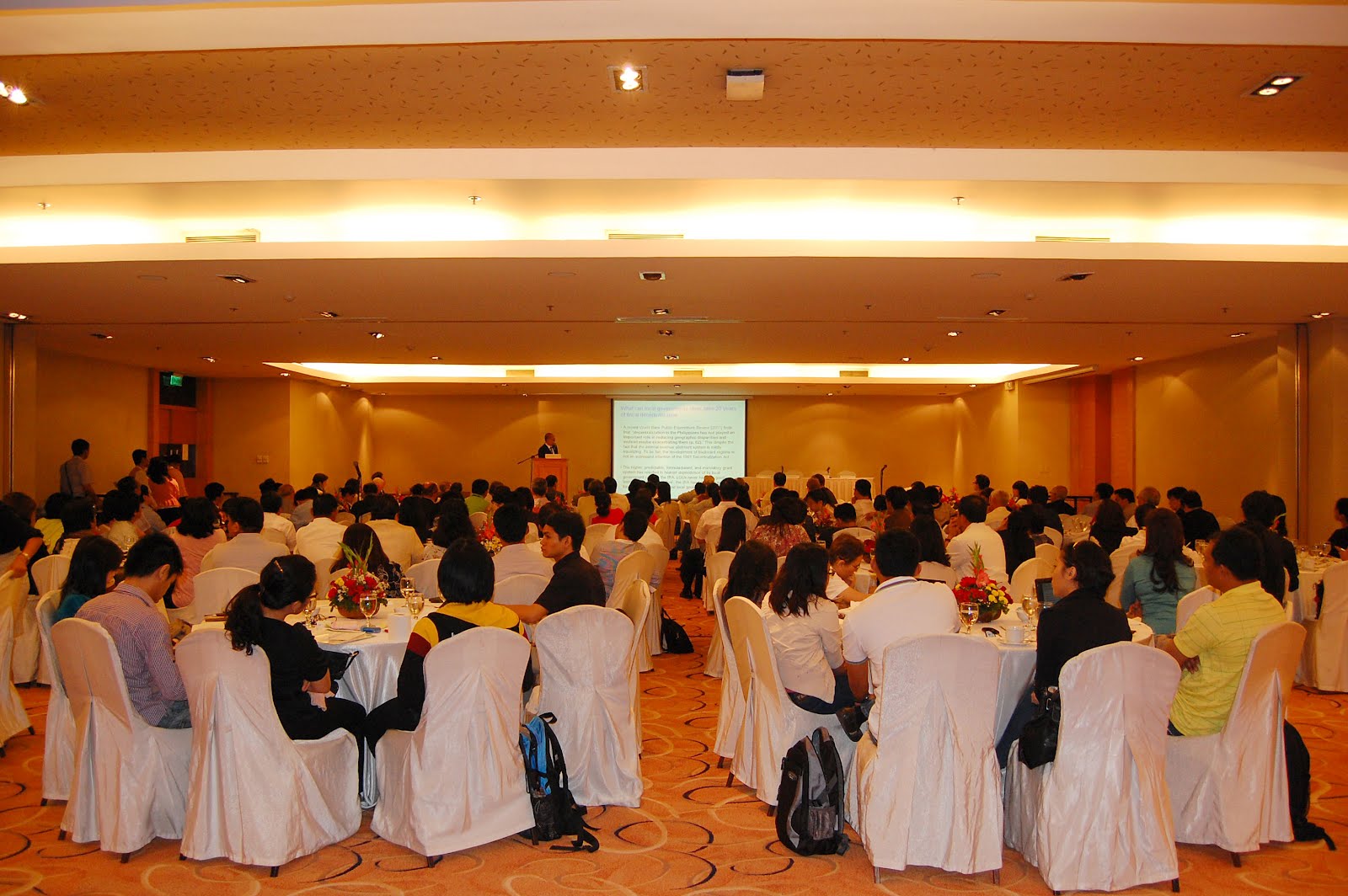
I attended the PIPER forum on "Fiscal Decentralization After 20 Years" last Monday, January 16, at Crowne Plaza Galleria Hotel, Ortigas Center. It was a whole day forum and many known personalities in the academe, Philippine government and foreign aid involved in decentralization were there.

Session one was a presentation by Dr. Benjamin "Ben" Diokno (sitting 3rd from right) of UPSE, also former DBM Secretary, and consultant to the WB, ADB, EC, USAID, among the biggest foreign aid institutions advocating more and bigger governments, more taxation and social redistribution.

The 3 scheduled reactors to his presentation were former DOF UnderSecretary Milwida "Nene" Guevarra, DILG UnderSec. Austere Panadero, and NAPC UnderSec. Jude Esguerra. Hah, the Institute for Popular Democracy (IPD) guys Joel Rocamora and Jude Esguerra, among others, have joined the government big time. Well, they have been advocating reformed but big government for many years now, so their position fits with their advocacies.

Jude did not arrive though, also USec Panadero, but he sent one of his senior staff to read his reaction paper. Then open forum started. I wanted to ask a question, but I saw some more popular personalities raising their hands, I said I better listen to them and ask my questions later, perhaps in the next session or panel.

Prof. Ben Diokno, my teacher twice at UPSE (undergrad in 1983 or '84, then PDE in 1998) used these slides as the theoretical framework in analyzing decentralization. The two benefits and advantages of decentralization, vs. its costs and disadvantages.


He noted that the Local Government Code (LGC) of 1991 was the most sweeping law changing intergovernmental structure and fiscal rules in the Philippines.

As seen in the graph here, the internal revenue allotment (IRA) given by the national government to the local government units (LGUs) have drastically increased since 1991. Unit on the vertical axis is percentage, not money. The table below explains why -- before the LGC, LGUs' share to internal taxes was only 20 percent, increased to 40 percent after the LGC. Besides, there has been considerable economic growth in the 90s, temporarily slowed down by the Asian financial crisis of 1997-98, and growth has slowly picked up, resulting in more internal tax revenues by the government, which leads to more IRA for LGUs.

These two tables are helpful and self explanatory. The biggest gainer among the four types of LGUs in the country were the barangays or villages, from only 10 percent to 20 percent of total IRA share. There are now more than 42,000 barangays nationwide.


The number of cities has drastically increased as more progressive and more populous municipalities have been converted into cities. Cities have higher tax rates than municipalities so the city government were earning higher than municipal governments. More revenues are supposed to make things lighter for city governments, but it seems that all of them, no exception, are saying that they need more money -- from their local residents, from the national government, and from foreign aid through more borrowings.

This is something new to me: "creeping recentralization" of certain agencies, especially the DOH and the DSWD. But the recent huge increases in the budget of these two agencies would prove correct the term used by Ben Diokno.

The CCT seems to be the single biggest program of the DSWD. The WB and ADB pitched in huge money for this program, they expect huge interest income from those loans too in the coming years. I am not a fan of the CCT program. Old programs are education and health for the poor, housing and credit for the poor, agrarian reform and irrigation for the poor, etc., not enough they say. So they added cash transfer for the poor, and soon, more condoms and pills for the poor. My longer discussion about the CCT, Welfarism 9: Conditional Cash Transfer (CCT), November 12, 2010.

The DSWD is the "outlier" here among the agencies which devolved their functions after 1991. From only 0.58 percent of total expenditures net of interest payment before the LGC, to 2.46 percent last year, such a big jump. The UN and its partner foreign aid banks, namely the WB and ADB, are hurrying the Philippines to reach its MDG targets which are supposed to be attained by 2015 or just three years from now. The DSWD plus the DOH are the main agencies that they see will greatly expand government and state welfarism.

The big drop in the number of employees in DA and DOH means big increase in the number of employees among LGUs doing agricultural extension work and healthcare services.

Here now are the major messages of Prof. Ben Diokno: decentralization was a failure in reducing disparities among communities and LGUs, and the big transfer of resources from the national government via IRA made many LGUs become lazy in raising their own local revenues.


Twenty years after the LGC and fiscal decentralization, some 75 percent of provincial governments' total revenues were coming from IRA. For municipal governments, it's slightly higher at nearly 79 percent of their total revenues. It's only the cities, especially those in Metro Manila, that were more creative, and sometimes more extortionist, in raising local taxes. Big cities like Makati, Manila and Quezon are I think only about 10 percent dependent on IRA. These cities have invented dozens upon dozens of local taxes, fees and fines slapped on residents, business locators, and non-residents but do business in their cities. For instance, there are cradle to grave fees to pay: birth certificate fee, residence fee, marriage certificate fee, death certificate fee, etc.

Prof. Diokno is saying further that decentralization was a failure in arresting high poverty incidence in the country. Thus, there is need to recentralize this function, more jobs for the national government. So back to central planning at the national level via national government agencies (NGAs) like NEDA, DOF-DBM, DOH, DSWD, DA, DENR, etc.


Being a non-fan of bigger local governments, I will not shed big tears for his proposal. My problem is that since many LGUs will oppose his proposal, we ordinary mortals, aka the taxpayers in the private sector, will be caught in the crossfire of fight between LGUs and NGAs for more taxes, more fees, more fines -- from our pockets. Let us remember that the government, national or local, is a penniless institution that becomes very powerful and very rich only by getting lots of money from our income, from our savings, from our investments, from our hard work and self-reliance.

Clear message from him, once again: Centralization, not decentralization, is the answer to poverty reduction and other social and political goals of the government.

I am no fan of centralization of powers to the NGAs and bureaucracies, I am no fan of decentralization either that results in ever-expanding LGUs with their ever-expanding rules of more restrictions, more regulations and prohibitions, and ever-expanding taxes and fees. Personal and parental responsibility is becoming an increasingly alien topic for them as they think that many if not all things should be government responsibility.


In her reaction, Nini Guevarra countered that decentralization has also produced many outstanding LGU leaders in the country. She cited some of them who were in that conference -- former Bulacan Governor Roberto "Obet" Pagdanganan, Albay Governor Joey Salceda, and Valenzuela Mayor Sherwin Gatchalian. But she recognized that many LGUs really lack accountability, so DILG Sec. Robrero has imposed a performance indicator system for LGUs which can be one of the new basis for the release of the IRA. She observed that while CCT has encouraged more children from poor families to attend schools, there is also lack of classrooms and teachers in poorer villages and municipalities. She thinks that there are bad LGU leaders because they don't have enough good role models.

During the open forum, Ms. Amina Rasul, a leader of a Mindanao-based NGO, lamented that autonomy of certain regions has not been given enough attention both by the presenter and the reactors. That autonomy, more than ordinary decentralization, is what is needed by more LGUs. Nini Guevarra argued that there is bad governance in the ARMM (Autonomous Region of Muslim Mindanao) due to bad politics by the national government (NG), but she added that there are a few good LGU leaders there.

Former NEDA chief and UPSE Dean Felipe Medalla asked how can we have good LGUs when we have lousy NG leaders. He also cited the claim of Cong. Mandanas of Batangas, that the NG owes LGUs some P500 billion in additional IRA because the IRA is based on total internal revenues of the NG, and about 80 percent of Bureau of Customs (BOC) collections are actually internal, not external taxes. And the NG has been using internal tax collections by the BIR only and excluded BOC internal tax collections.

I believe we simply need small and limited government, both at the national and local levels. The government should focus on promulgating the rule of law -- the laws against killing, murder, stealing, plunder, rape, extortion, carnapping, kidnapping, and many other criminal acts. It's a big and very important function but there is obvious government failure there. All malls, all private schools and universities, all villages and condo buildings, all churches, all big shops and restaurants, all banks, etc. are using private security guards to protect their property and customers from criminals. This is one clear and glaring example of distrust by the citizens and entrepreneurs of government failure, of both NG and LGUs in stamping out criminality in society.

Government, both national and local, should step back in heavy intervention, regulation and taxation in entrepreneurship and job creation by the private sector. The latter can take care of that. It is in the promulgation of the rule of law, of the protection of private property rights, protection of citizens against criminal elements, both private and government, that is sorely lacking.

I will discuss in the next paper, Prof. Gilbert Llanto's presentation on the assignment of functions and inter-government fiscal relations.
---------

See also:

Friday, January 06, 2012

Decentralization 8: PIPER Forum on Fiscal Decentralization

Fiscal decentralization is an important part of political devolution and decentralization. A local government unit (LGU) that has relative administrative autonomy and independence from the national government (NG) but has no fiscal independence from NG will be less empowered and hence, not really independent from it.

I have written several papers in the past about decentralization but they are more on the level of political philosophy, like the relationship between local governments and civil society, decentralization and privatization. Here are my past papers on the subject:


I still have to explore more specifically on fiscal decentralization. Thus, I was happy to see the forthcoming Philippine Center for Economic Development (PCED) Institute of Public Economics and Regulation (PIPER) (in partnership with GIZ (Deutsche Gesellschaft fuer Internationale Zusammenarbeit)) policy forum on “Fiscal Decentralization after 20 Years: What have we got to show? What have we learned? Where do we go from here?”


The line up of speakers and reactors is impressive. Here's the program.

8:00 – 9:00 am Registration

9:01 – 9:30 am Opening Remarks
Sec. Cayetano W. Paderanga, Jr.* (Director General, NEDA and Chair,PCED Board of Trustees)
Dr. Herwig Mayer (Program Manager , GIZ Decentralization Program)

9:31 – 10:30 am SESSION 1: A 20-YEAR RETROSPECTIVE
Speaker: Dr. Benjamin E. Diokno (Professor, UP School of Economics and Former Secretary, DBM)
Reactors: USec. Austere Panadero (Undersecretary, DILG - Local Government)
USec. Jude Esguerra (Undersecretary, NAPC)
Dr. Milwida Guevara (CEO, Synergeia Foundation)

10:31 – 10:45 am Coffee Break

10:46 – 11:46 am SESSION 2: ASSIGNMENT OF FUNCTIONS AND INTERGOVERMENTAL FISCAL RELATIONS
Speaker: Dr. Gilberto M. Llanto (Senior Research Fellow, PIDS and Former Deputy Director General, NEDA)
Reactors: Hon. Sherwin Gatchalian (Mayor, Valenzuela City)
Dr. Roberto de Vera (Professor, School of Economics, UA&P)

11:47 am – 1:30 pm Lunch Break with a Roundtable Discussion
Host/Moderator: Dr. Andreas Lange (Chief Advisor for Local Planning, GIZ)
Conversationalists: Gov. Jose Ma. Clemente S. Salceda (Governor of Albay)
USec. Mario Relampagos (Undersecretary, DBM – Operations)
Hon. Jesse M. Robredo* (Secretary, DILG)
Dr. Enrique T. Ona* (Secretary, DOH)
Sen. Ferdinand R. Marcos, Jr.* (Chair, Local Government, Senate)
Cong. George P. Arnaiz* (Chair, Local Government, House of Representatives)
Hon. Roque Tiu* (Board Member, Province of Leyte)

1:31 – 2:30 pm SESSION 3: GOVERNANCE AND ACCOUNTABILITY
Speaker: Dr. Paul Hutchcroft (Professor, Australian National University)
Reactors: Ms. Leonor Briones* (Lead Convenor, Social Watch Philippines)
Ms. Malou Mangahas (Reporter, Philippine Center for Investigative Journalism)

2:31 – 3:30 pm SESSION 4: INTERNATIONAL PERSPECTIVE
Speaker: Dr. Jan Werner (Professor, BITS Iserlohn, University of Applied Sciences, Germany)
Reactors: Dir. Janet B. Abuel (Director IV, DBM – Regional Office I)
Dr. Eduardo Gonzalez (Professor, UP Asian Center)

3: 31 – 3:45 pm Coffee Break

3:46 – 4:00 pm Closing Remarks
Dr. Arsenio M. Balisacan (Dean, UP School of Economics and Executive Director, PCED)

*To be Confirmed

The Chairperson of PIPER is Dr. Ben Diokno, my former teacher in UPSE, undergrad in the early 80s, and in PDE in 1997-98. I know his bias, generally he is for more government intervention and welfarism ala-UN or WB/ADB style, something which I do not support. But nonetheless, I am attending this forum. It is free and open to the public but has limited capacity. Interested parties may inquire from piper.secretariat@gmail.com, or at tel. (02) 9279686 loc 333, Pam Lomaad.

Monday, February 08, 2010

Abolish Income Tax 6: Income tax and VAT trade-off

The income tax system in the Philippines is one classic example of the absence of the rule of law. The rule of law says that rules, laws, regulations and prohibitions apply to all people, no one is exempted and no one can grant an exemption.

A quick look at how the law on income tax is being implemented would immediately show that it is one of the most hypocritical laws in the country. Many rich people do not pay the “correct” personal income tax of 32 percent top marginal rate. Among them are businessmen, professionals, corrupt government officials, those in the informal sector, and personnel and consultants of foreign aid bodies (UN, WB, ADB, IMF, USAID, etc.). The bulk of personal income tax collection by the government, especially the Bureau of Internal Revenue (BIR) comes from fixed-income earners.

So if those who are supposed to pay are not paying and the burden of heavy taxation falls on the helpless workers who are subject to mandatory withholding tax, might as well abolish income tax system. Or drastically cut it to a rate that is not burdensome to the people, rich and poor alike, in order to reduce the level of hypocrisy and the extent of tax evasion.

Taxes and government spending were among the major topics discussed by the 3 speakers on the panel, “Debt and Deficits” during the UP Academic Congress, Beyond 2010: Leadership for the Next Generation last Monday, February 1, at the UP College of Law, http://www.econ.upd.edu.ph/?p=906.

The speakers were Professors Felipe Medalla of the UP School of Economics (UPSE) and former NEDA Director-General from 1998-2000; Prof. Benjamin Diokno of UPSE, former DBM Secretary in 1998-2000, and Prof. Leonor Briones of UP National College of Public Administration and Governance (UP NCPAG).

The two former cabinet secretaries were suggesting that to avoid a fiscal crisis in the near future, revenues have to increase significantly, and one such measure is to raise the VAT from the current 12 percent to 15 percent, while reducing income tax from the current 32 percent (personal income) and 30 percent (corporate income) to 25 percent.

I support the move to shift government revenues from income to consumption. As discussed above, many rich people do not pay income tax and the BIR cannot fully implement that law anyway. People hide their income as much as possible, while they flaunt their consumption: their new cellular phone, new computer, new shoes and clothes, new car and appliances, and so on.

So if people voluntarily show off their consumption, even their profligacy, then collecting higher VAT would be easier. And with reduced income tax, fixed-income earners will have higher take-home pay, which means higher savings and/or higher consumption.

What can greatly compensate for the initial revenue losses of the government as income tax rates (personal, corporate, others) decline, will be the entry of thousands of entrepreneurs and businessmen from abroad who want to escape their high-taxes regime in their home countries and are looking for low-tax economies to put up new businesses, or to transfer their existing businesses.

Of total income tax collections by the BIR in 2008, personal income tax comprised 59 percent of total BIR collections; VAT comprised 22 percent, and other taxes 19 percent.

An earlier panel also on February 1 lecture, was a session on “Jobs and the Cost of Doing Business in the Philippines.” The speakers were Dr. Cielito Habito from the Economics Department of the Ateneo de Manila University and former NEDA chief from 1992-98, and Dr. Cayetano Paderanga of UPSE, former NEDA chief before Dr. Habito.

I noted during the open forum, that one major reason why there are not enough jobs in the country and the cost of doing business is high, is because there are many planners in the government, both at the national and local government units. Planners tend to create distortions in the incentives and disincentives system in society because it is simply impossible to predict how people would behave if certain regulations and restrictions were put in place by the government.

Thus, to remedy the situation, we might consider abolishing a number of planning agencies in the government, like NEDA and the Department of Agriculture (DA), for socio-economic and agriculture planning, respectively.

Consider the food sector. There is no government carinderia, no government restaurant, no government supermarket, and yet people are eating. There are no central planners suggesting or dictating how many thousands of pizza and hamburger, or how many kilos of “sisig” and “kaldereta”, to be produced everyday across the country at what price, at what servings and topping, and so on. Product differentiation and market segmentation allow food producers and sellers to target certain group of consumers and consumers do the same to the various food producers and sellers.

The two speakers were hesitant of course, to support my proposal to abolish, or at least drastically reduce the size and functions of those bureaucracies. What was important for me was to articulate the perspective of less government intervention to allow more competition in the market, to allow personal, parental and community responsibility in running their own lives.

Reforms in both taxation policies and government spending are necessary to combat the endemic corruption in Philippine public administration and to discipline, if not discourage, unwarranted expansion in the size and power of the various bureaucracies that tend to restrict individual freedom.
-----

See also:
Part 5, Consumption taxes, other government fees, November 25, 2009
Part 4, Ayn Rand and income tax, November 02, 2009, and
Part 2, VAT and tax extortion, August 01, 2008

Thursday, October 08, 2009

Abolish Income Tax 3: Taxes and Congress

There’s a new document posted in the UPSE website, "Fiscal imperative for next administration" by Romy Bernardo, http://www.econ.upd.edu.ph/alumni/?p=351

Dr. Felipe Medalla, Dr. Dante Canlas and Dr. Ben Diokno (all UPSE faculty members) were proposing to hike value added tax (VAT) from 12% to 15%, and income taxes (personal and corporate, I think) to be cut to 25%. Currently, personal income tax is up to 32% and corporate income tax is 30% (was 35% from 2005 to 2008).

Personally, I will support a VAT hike from 12% to 15%, or even 18%, if income taxes – both personal and corporate taxes -- are abolished, zero. The WB-IFC "Doing Business" annual report shows that supposedly capitalist Philippines has more taxes than socialist China and Vietnam. There are too many taxes that the Phil. government can collect and recoup whatever "losses" from a zero income tax policy, two of which will be the higher VAT and higher excise taxes.

Dr. Medalla, Dr. Canlas, and Mr. Bernardo are among the FEF fellows. But one of their co-fellows, Peter Wallace, will applaud any move towards a zero income tax policy.

I am not aware of any country in the world that has zero income tax (there are a few, maybe 5 or 8, states in the US which have zero state income tax). So you can just imagine the number of entrepreneurs, Filipinos and foreigners, and corporations that will be rushing to do business in the Philippines and create millions of new jobs. Of course there are other factors that investors consider (infra, peace and order, rule of law, etc.) but the factor on taxation alone will be a major incentive for them to come in.

Got 2 comments from the above points:
1. “The people will not stand for more taxes and no candidate will stand for more taxes. Abolishing Congress would be nice. Massive instant savings.”
2. “Increasing VAT would be regressive. Plus, it would also encourage the underground ‘cash economy.’”

Most people don't declare their real income, or don't file income tax at all. Smugglers, kidnappers, robbers, prostitutes, drug pushers, most in the informal sector, corrupt government officials, showbiz stars, etc. Check for instance how much the President’s husband Mike Arroyo and family pay in income taxes. Even the son, Cong. Mikey, cannot even declare a proper SALN. Also, those working in foreign aid and multilateral institutions -- UN, WB, ADB, IMF, OECD, USAID, etc., are not subject to mandatory income tax deduction. A few of them pay income tax, but most don't. So properly collecting income taxes is a big problem.

This makes income tax policy a huge hypocrisy: collect from a few, especially the fixed income earners, but not collect from the many, especialy the well-off.

On the other hand, even smugglers and robbers and corrupt government officials show off their consumption: new house, new car, new mobile phone, new laptop, new travel, new jewelries, recent dinner in expensive hotels and resto, etc. All such action are captured by VAT. The rich and the big time officials and consultants of the WB, USAID, UN, etc., don't eat in “turo-turo” or carinderia where there is no VAT collection. They eat in Greenbelt, Eastwood, other more fancy places where VAT collection is automatic and mandatory.

So VAT is progressive. They spare the poor, and collect from the rich. Income tax is the reverse. It mainly collects from the fixed income earners, collect little from the rich.

On abolishing Congress, it’s not a wise move. We cannot abolish Congress. All new legislations, say abolishing income tax, or abolishing certain departments and ad-hoc offices under the Office of the President (OP), etc. will require legislation. So we need legislators. Whether we go for big or small government, big or small taxes, etc.

What should be abolished is the party-list system in Congress. It's another hypocrisy. Even the COMELEC is complaining with the 300+ groups that want to be considered as a political party for the "marginalized" sectors. Cockers (Sabungero at magmamanok), they fight each other who is the marginalized between the two of them. If there are so many groups who still feel marginalized despite the huge number of congressmen, senators (plus departments and agencies under the executive branch to "fight poverty"), then all of them must be a failure, somehow. So we have to choose who will represent the “marginalized” groups, the district-based (well-defined territorial coverage) or the party-list (nationwide coverage) congressmen. I say retain the former, abolish the latter.

Never fails. Any government policy to attract "participation" by the public almost always attract the most shrewed, the most opportunist segments of society. That is why you seldom see intelligent people in business jumping into politics. But politics and politicians are always jumping into endless business regulation and extortion.

Two more reactions from friends:
3. "I think zero income tax would be too drastic. I'd settle for 18% income tax and 15% VAT", and
4. "Is there anything in the Public Finance literature that proposes zero income tax policy?"

Between 0 to 18% income tax, both personal and corporate, I will still be happily supporting it, but VAT should NOT increase even by 0.5% if there is no corresponding income tax cut. That is why I never supported the people and groups who pushed the 12% VAT with no income tax cut in the 2004 debate.

Zero income tax is not a far-out proposal. I'm not the original proponent of that. I have heard or read it before, And at least 3 local newspaper columnists are proposing it -- Peter Wallace of Manila Standard, John Mangun of Business Mirror, and Rene Azurin of BusinessWorld.

The World Taxpayers Association (WTA) is pushing for low, flat tax. At least 7 countries now have 10% flat tax policy. Until about 3 years ago, the tax competition rate was at 12%. Then other countries became more aggressive than them, hence the 10% rate. I will not be surprised if 3 yrs from now, some countries will have 8% flat income tax rate.

Below is data from WTA. Year in parenthesis is the period of effectivity of such flat income tax in those countries.

Kyrgyzstan (since 2006) 10%
Kazakhstan (2007) 10%
Macedonia (2007) 10%
Mongolia (2007) 10%
Albania (2008) 10%
Bulgaria (2008) 10%
Serbia (2008) 10%
Georgia (2005) 12%
Macau 12%
Belarus (2009) 12%
Russia (2001) 13%
Hong Kong (1947) 15%
Ukraine (2004) 15%
Iraq (2004) 15%
Montenegro (2007) 15%
Mauritius (2007) 15%
Czech Republic (2008) 15%
Romani (2005) 16%
Slovak (2004) 19%
Jersey and Guernsey (1940) 20%
Estonia (1994) 20%
2010 19%
2011 18%
---------

See also Part 1, Low flat tax and economic growth, June 27, 2008, and
Part 2, VAT and tax extortion, August 01, 2008