Showing posts with label public debt. Show all posts

Wednesday, March 14, 2018

Pol Ideology 73, On BIG powerful government

I am reposting another good article by a friend, Eric Jurado. Enjoy.


Do you believe in a powerful government?

One of the most important differences between the Left and the Right is how each regards the role and the size of the government.

The Left believes that the state should be the most powerful force in society. Among many other things, the government should be in control of educating every child; should provide all health care; and should regulate often to the minutest detail how businesses conduct their business. In Germany, for instance, the government legislates the time of day stores have to close. In short, there should ideally be no power that competes with Government. Not parents, not businesses, not private schools, not religious institutions—not even the individual human conscience.

Conservatives, on the other hand, believe the government’s role in society should be limited to absolute necessities such as national defense and to being the resource of last resort to help citizens who cannot be helped by family, by community, or by religious and secular charities.

Conservatives understand that as governments grow in size and power, the following will inevitably happen:

1. There will be ever-increasing amounts of corruption. Power and money breed corruption. People in government will sell government influence for personal and political gain. And people outside government will seek to buy influence and favors. In Africa, Latin America, and the Philippines, government corruption has been the single biggest factor holding nations back from progressing.

2. Individual liberty will decline. With a few exceptions, such as an unrestricted right to abortion in America, individual liberty is less important to the Left than to the Right. This is neither an opinion nor a criticism. It is simple logic. The more control the government has over people’s lives, the less liberty people have.

3. Countries with ever expanding governments will either reduce the size of their government or eventually collapse economically. Every welfare state ultimately becomes a Ponzi Scheme, relying on new payers to pay previous payers; and when it runs out of the new payers, the scheme collapses. All the welfare states of the world, including wealthy European countries, are already experiencing this problem to varying degrees.

4. In order to pay for an ever-expanding government, taxes are constantly increased. But at a given level of taxation, the society’s wealth producers will either stop working, work less, hire fewer people, or move their business out of the country.

5. Big government produces big deficits and ever increasing—and ultimately unsustainable—debt. This, too, is only logical. The more money the state hands out, the more money people will demand from the state. No recipient of free money has ever said, “Thank you. I have enough.”

Unless big governments get smaller, they will all eventually collapse under their own weight—with terrible consequences socially as well as economically.

6. The bigger the government, the greater the opportunities for doing great evil. The twentieth century was the most murderous century in recorded history. And who did all this killing? Big governments. Evil individuals without power can do only so much harm. But when evil individuals take control of a big government, the amount of harm they can do is essentially unlimited. The Right fears Big Government. The Left fears Big Business. But Coca-Cola or SM can’t break into your house or confiscate your wealth—only Big Government can do that. As irresponsible as any Big Business has ever been at times, it is only Big Government that can build concentration camps and commit genocide.

7. Big government eats away at the moral character of a nation. People no longer take care of other people. After all, they know the government will do that. That’s why citizens of freer countries like America give far more of their money and volunteer far more of their time to charity than do Europeans at the same economic level.

Without the belief in an ever-expanding government, there is no left. Without a belief in limited government, there is no right.

Eric Jurado covers economic and political issues with liberty as his guiding star.
--------------

See also:

Thursday, June 01, 2017

BWorld 133, Dissecting Dutertenomics' overspending plan

* This is my article in BusinessWorld last Tuesday.


During the BusinessWorld Economic Forum held last May 19, Budget Secretary Benjamin E. Diokno showed two interesting charts: (1) sustained overspending and borrowings, budget deficit/GDP ratio from -0.9% in 2015 to -2.7% in 2016 then -3.0% from 2017-2022. And yet (2) debt/GDP ratio was expected to decline from 44.8% in 2015 to 40.2% in 2017 and further down to 36.7% in 2022.

Is this possible? That one overspends and over-borrows and yet the debt/GDP ratio will keep falling?

DBM, NEDA, and MalacaƱang say yes because the projected taxes/GDP ratio will increase via the proposed Tax Reform bill of 2017. Sec. Diokno said in the same forum that “We will continue to guard against underspending, the Waterloo of the previous administration.”

“Underspending” for me should mean that expenditures are lesser than revenues, resulting in a fiscal surplus. When expenditures are larger than revenues but the deficit is only at -1% or below -3% of GDP, that is still overspending, not underspending. So the previous administration did not really underspend, just that it did not go into an uncontrolled spending spree.

Here are relevant numbers about the Philippines’ fiscal position and levels of outstanding public debt, and comparative debt/GDP ratio of seven ASEAN countries (see table). 

The numbers above show three important facts:

One, the average deficit in the previous administration, 2010-2015 was only P185 B/year or -1.8% of GDP, benign and considered as “underspending” by many fiscal hawks, especially when compared with deficit in 2009 (last year of the Gloria Macapagal-Arroyo administration) and 2016 (first year of Duterte administration).

Two, low annual budget deficit and borrowings in the same period means the country’s outstanding debt stock has risen only mildly, with the average of P260 B/year.

Three, partly a result of this, the Philippines’ debt/GDP ratio over the same period showed significant decline, similar to the experience of Myanmar while other neighbors posted deficits, owing to increased borrowing.

Fewer borrowing means less debt service payments for both principal and interest. It was during the same six-year period that Philippines’ GDP growth was 6.2% per year, much higher than Thailand’s 3.7%, Indonesia and Malaysia’s 5.7%, Vietnam’s 6.0%.

In the same BW Economic Forum, the DoTr showed that these projects will be ODA (government loans) funded, not PPP.

1. PNR North Railway (Manila-Clark), construction Q4 2017 -- Q4 2021, P255 B.

2. PNR South Railway (Manila-Bicol), construction Q3 2018 -- 2021, P270 B (originally a PPP).

3. Mega-Manila subway (Phase 1, QC-Taguig), construction Q4 2019 -- 2024, P225 B.

4. Edsa-Central Corridor Bus Rapid Transit BRT (Edsa, Ayala, Ortigas, BGC, NAIA), construction Q1 2019 -- Q1 2021, P38 B.

Other big projects were identified but it wasn’t specified whether these would be funded by official development assistance (ODA) or via Public-Private Partnership (PPP). In December 2016, DoF Secretary Sonny Dominguez already indicated that infrastructure projects under the Duterte administration will avoid PPP whenever possible. And the massive China and Japan ODAs came into the picture.

Then there are tweaks in some major projects, from PPP to ODA. Like the PNR South Railway and the Kaliwa Dam project in Quezon province of Maynilad Water. What would pre-qualified players like San Miguel do with this policy reversal?

The Dutertenomics’ spending plan is detrimental to taxpayers in general and the investment environment in particular, for the following reasons.

1. Bigger annual budget deficit would mean more government loans, higher public debt stock, and will lead to higher taxes now and the future to service those huge loans to be contracted. Soon the P6/liter increase in oil excise tax will not be enough, it will further rise.

2. Massive shift from PPP (private investment) to ODA of major infrastructure projects will result in more loans which mean more public debt, more taxes, and fees in the future.
--------------

See also: 
BWorld 132, Global commodity prices, trade and growth, May 27, 2017

Thursday, August 11, 2016

Cicero, welfarism and fiscal irresponsibility

Words of wisdom from a Roman philosopher, Cicero (106 - 43 BC) nearly 2,100 years ago. There are minor differences in these two quotes, should be a result of different translations.

The budget should be balanced, the Treasury should be refilled, public debt should be reduced, the arrogance of officialdom should be tempered and controlled, and the assistance to foreign lands should be curtailed, lest Rome become bankrupt. People must again learn to work, instead of living on public assistance. - Cicero, 55 BC

The case of the Philippines on budget balance -- recent years and administrations, it never happened. National budget, P3.0 trillion this year, P3.35 trillion in 2017, perhaps about P0.3 trillion will be borrowed. http://www.bworldonline.com/content.php?section=Nation...

A consequence of always on budget deficit, always borrowing, is high interest payment alone.

PH government debt interest payment alone, principal amortization not included yet, in P billion:
2008, P272.22;  2009, P278.87
2010, P294.24;  2011, P279.00
2012, P312.80;  2013, P323.43
2014, P321.18;  2015, P309.36 

Sige, utang lang ng utang ah.

The "freedom from debt" campaigners but have little or no "freedom from (endless) borrowings" philosophy are concerned too about the P6.4 trillion (as of around end-2015) PH public debt.

Living beyond our means is justified in period of fiscal/economic crisis, natural disasters like huge earthquakes, landslides, volcanic eruption, etc. Governments must borrow to replace damaged roads, bridges, etc. In period of no crisis, no disasters, we should live BELOW our means, have surplus and pay back old loans, and build up savings and reserves for future emergencies.

Anywhere in the world today, very few countries and governments do this. Majority are on the spend-spend-spend, borrow-borrow-borrow, tax-tax-tax policies. And that is how almost all governments in the planet are heavily indebted. With public debts of 40%, 100%, 200% of GDP.

Too many politicians, NGOs, consultants, academics, etc. are corrupted by foreign aid -- from the UN, WB, ADB, IMF, USAID, etc. There is endless drama on poverty and inequality so that there will be endless flow of foreign aid.

When poverty was defined as "earning only $1/person/day" many years ago, poverty rate then was high. After 1-2 decades of growth in many countries, hundreds of millions were lifted from poverty, and there was corresponding adjustment to $1.5 or $2/day/person, and so poverty remains high again. When poor people move up the income ladder and are no longer poor based on that definition, foreign aid officials and consultants will likely revise the definition of poverty as earning $3/day/person and conclude that poverty remains high and horrible, and so horrible amount of foreign aid and tax money from rich countries should be needed.

One of my academic friends from UP shared this story with me and other friends. After a USAID-funded poverty research that he conducted, he presented it to USAID officials here in Manila. His opening statement,

"I am not sure about the outcome of these policy recommendations we made. But one thing I am sure of is that before this project, I was somehow poor. After this project, I am no longer poor." And the USAID people were laughing; funny but true.

Add caption
More quotes from Cicero:

1. Laws are silent in time of war... No one has the right to be sorry for himself for a misfortune that strikes everyone.

2. Freedom is a man's natural power of doing what he pleases, so far as he is not prevented by force or law.

3. What gift has providence bestowed on man that is so dear to him as his children?

Saturday, July 18, 2015

BWorld 11, China's stockmarket and central planning

* This is my article in BusinessWorld Weekender yesterday.

HIGH DEBT, private and public, will always create financial turmoil, today or tomorrow. The ongoing fiscal drama in heavily indebted Greece will continue for many months to come, whether it will stay using the Euro or not. And recently, it was China’s turn with the recent near-crash of its stock markets in Shanghai and Shenzen, and partially affecting the markets in Hong Kong.

Unlike the markets in the US, Japan, UK, Germany and other democratic countries, the case of China will always be internally conflicting. It is a dictatorship that abhors political competition and yet it wants to mimic economies that allow market competition.

HIGH PUBLIC DEBT
Officially, China has a gross public debt/GDP ratio of only 41% in 2014, manageable and just slightly higher than the debt/GDP ratio of Taiwan and South Korea (38% and 36%, respectively). But China has more debt than what it will officially admit.

A report by McKinsey Global Institute recently said that China’s total borrowings (individuals + companies + local and central governments + state enterprises) was 282% of GDP in 2014. This is very high for a non-industrialized economy like China.

There is high-margin lending (borrowed funds for stocks investment), reaching $323 billion last month alone, invested in the stock market by many novice, first-time stock investors numbering in tens of thousands.

STOCK MARKET BUBBLE
From 2010-2014, China’s stock market capitalization/GDP ratio averaged only about 45%. By June 12 this year, it rose to almost 100%, showing a huge asset price bubble in the first half of this year.

In comparison, this ratio is mildly increasing in the US (around 140% in 2014) and Japan (nearly 100% in 2014) from 2011 up to the present. 

Figure 1 (from Bloomberg)


The bubble started last year when government media repeatedly announced that stocks were cheap, with the implicit understanding that the central planning authorities can control prices from falling. Millions of novice and first-time stock investors came in droves, China’s market capitalization tripled and reached $9.8 trillion, according to a Bloomberg report last June 30.

From 2011 to mid-2014, Shanghai’s price-to-earnings (P/E) ratio was only around 12. By late 2014-mid-2015, this rose to 26, more than double in less than one year.

BUBBLE CRASHED
Why did the bubble burst so suddenly? There are several explanations and hypotheses for this.

One is that China is experiencing a GDP growth slowdown of “only” 7% or less, compared to 9-12% per year for the last three decades or more. Two, some government stimulus programs to shield China from various global turmoil have to end. Three, finance also follows the law of gravity: the speed and height of price rise is somehow directly proportional to the speed and depth of price decline.

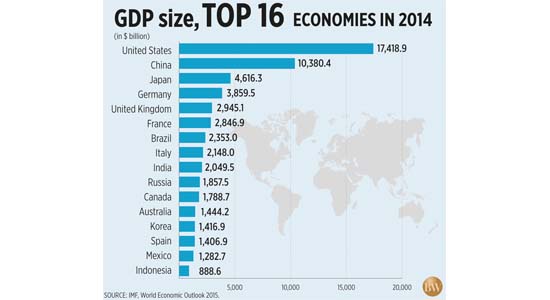
The magnitude of the stock price decline was $3.9 trillion, according to the Bloomberg China Market Cap index. That was equivalent to the GDP size of Germany, larger than the GDP sizes of UK or France or Brazil, and twice the GDP of Russia. 

Figure 2.

The bulk of China stock investors are the more than 90 million individuals who make up about 80% of the market, according to a survey of households.

The stocks crash was worse than the US property crisis in 2008-09, although in terms of global interconnection and contagion, the US financial turmoil last decade had a larger impact. Significant deterioration in the public debt of Greece, Spain, Portugal, Ireland, Cyprus, Italy, etc. occurred in 2009 and 2010, obviously a result of contagion from the US.

Compared to the Greece debt problem, this is much larger. Greece’s GDP size in 2014 was only $238 billion, and its total public debt was about $320 billion.

CENTRAL PLANNING FIGHTS BACK
China’s government responded with several measures. One, the central bank cut interest rates, hoping that more savings from the banks will go to the stocks market. Two, some stock traders and speculators were investigated with threats of prosecution for stock rumor mongering. Three, a number of planned initial public offerings (IPOs) were suspended. Four, outright stop in trading.

From Bloomberg reports:

“At least 1,301 companies have halted trading on mainland Chinese exchanges, locking up $2.6 trillion of shares, or about 40 percent of China’s market capitalization. The China Financial Futures Exchange raised margin requirements for sell orders on CSI 500 index futures, while the central bank will provide “ample liquidity” to the stock market. China Securities Finance Corp. said it will buy more shares of small- and mid-cap companies.” (July 8)

“Official measures to support shares became more extreme during the week as declines deepened. They include a ban on stockholders and executives from selling stakes in listed companies for six months, an order for companies to buy equities and an investigation by the nation’s public security bureau into short-selling.” (July 10)

LESSONS FOR SOUTHEAST ASIA
Emerging economies in the region like the Philippines can draw lessons from this latest episode in regional and global economics.

1 Moral hazards. When a central planning government rallied the public to invest in the market, many investors with little or zero experience in the market came believing they couldn’t lose money since the government is big enough to guarantee returns or bail them out later.

2 Adverse selection. Millions of new novice investors have picked up the wrong timing, at a time when fiscal uncertainty hounds the EU and China was experiencing growth slowdown. Adverse selection often results in adverse results.

3 Debts and uncertainty. As public and private debts become bigger and bigger, the economic uncertainty also becomes bigger. People will never know who can pay back and when, and who will default.

4 Corporate fundamentals. Investors should do hard analyses of the fundamentals of companies whose stocks they are buying, and not just wait for cues and pronouncements from government. It can be a case where as government intervenes more, it creates more panic and price volatility.

5 Central planning and central disappointment. Central planning cannot and will not cure and control everything, including stock price ups and downs, boom and bust. Central planning works mainly to postpone small busts to become huge busts and bursts. Authoritarianism can never be compatible with free markets.

6 Role of government. The state and its various agencies, from local governments to different regulatory agencies to monetary authorities, should focus on ensuring fair market rules rather than guaranteeing outcomes.

Bienvenido S. Oplas, Jr. heads a free market think tank in Manila, Minimal Government Thinkers, Inc., and is also a fellow of South East Asia Network for Development (SEANET), a regional center based in Kuala Lumpur advocating economic freedom in the region.
--------------

See also: 

Saturday, July 11, 2015

BWorld 10, Greece crisis, pension and rule of law

* This is my article in BusinessWorld Weekender, July 9.

Greece’s debt crisis and lessons for thePhilippines

AFTER piling more than 300 billion euros of public debt, Greece could not pay some of the maturing obligations. It defaulted paying $1.6 billion to the International Monetary Fund (IMF) last week.

How did Greece and its people dig this deep hole of debt?

By living beyond their means, by overspending each year without exception, for decades. It also did not follow many of the conditions of its lenders, especially on spending cuts and revenue increases, a.k.a. “austerity” measures.

SPICY-G DEBT

Below are the heavily indebted EU economies of the European Union, especially the SPICy-G countries (Spain, Portugal, Ireland, Cyprus, Greece) that have adopted the euro. The United Kingdom is part of the EU but does not adopt the euro and is excluded in this list. Germany is not exactly heavily indebted, but it is the main lender to its highly indebted neighbors, so it is included here for comparison. (See Figure 1)

The turning point for these indebted countries was the housing and properties bubble burst that started in the United States in 2008. By 2009, the contagion affected many EU economies. The SPICy-G countries suffered significant increase in their debt/GDP ratio from 2009-2013. But all of them have somehow stabilized by 2014 by biting the bitter bullet of austerity measures, except Greece.

PENSIONERS AT 26, 51 YEARS OLD

When majority of Greece voters supported the socialist-leaning Syriza Party headed by Alexis Tsipras in January 2015, they also supported Mr. Tsipras’s agenda to fight austerity measures that were stipulated in previous bailout funds.

Among the factors why Greece’s public finance is heavily compromised is their generous retirement and pension system, which required additional public borrowings. In December 2014, Greek Labor Minister Yiannis Vroutsis reported to the parliament, as quoted by news reports:

“In the public sector, 7.91% of pensioners retire between the ages of 26 and 50, 23.64% between 51 and 55, and 43.53% between 56 and 61. In IKA (Social Security Fund), 4.44% of pensioners retire between the ages of 26 and 50, 12.83% retire between 51 and 55, and 58.61% retire between 56 and 61. Meanwhile, in the so-called health funds, 91.6% of people retire before the national retirement age limit.”

So people then can opt for early retirement at age 26 and get monthly pension from the state. Wow. Until 2009, the mandatory retirement age in Greece was only 58 years old with 80 percent of that sector getting pension payments. Workers then were even agitating for a lower retirement age. They did not succeed, of course, as Greece plunged in deeper debt, and in the pension reforms in 2010, the mandatory retirement was raised to 61, then 65.

A Filipino friend went to Greece a few years ago and stayed for four months. He observed that people had time to rally almost daily, demanding higher salaries but lesser work hours. Their lunch break was from 12 noon until 3-4 pm.

Last Sunday, July 5, the Greek majority voted NO to austerity measures that their country’s leaders earlier agreed upon with creditors. That vote may find resonance in that country’s being the birthplace of democracy. But the Tsipras government and its supporters effectively do not want to pay many of their huge debts, money that were used mainly to pay for the salaries and perks of government personnel and finance various welfare and pension subsidies.

THE PHILIPPINES AND SOUTHEAST ASIAN DEBT

Unlike in the critical 1980s, the Philippines today is much like its neighbors in the ASEAN. They are nowhere near the situation of Greece or the SPICy countries. The level of public indebtedness in ASEAN is just one-half or even one-fourth of those in the SPICy-G. The Philippines and Indonesia, in particular, have relatively low debt/GDP ratio. The denominator, the GDP, is rising faster than the numerator and, hence, the ratio for the Philippines is consistently declining. (See Figure 2)


LESSONS FROM THE GREEK FISCAL CRISIS

1. SHORT WORK: Early retirement with pension may be cool but it will punch a big hole in the annual budget, as the number of workers decreases while the number of pensioners increases, requiring additional public borrowings.

2. RULE OF LAW: If you borrow money, pay it. The bigger the debt, the stricter will be the conditions set by creditors. Follow those conditions whenever possible, do not blackmail creditors with emotional cries of “unjust, cruel conditions,” then demand that the terms be changed midway.

3. HUMILITY: If you cannot pay your debt on schedule, humbly ask for reconsideration and debt restructuring. It was you who begged for those loans in the past, not the creditors.

4. SAVINGS: If you can live beyond your means resulting in overspending and borrowings, learn also to live below your means on other years, cut spending and aim to have fiscal surplus and pay back some of those loans.

5. PRIVATIZATION: Other than more taxation and fees, substantial revenues can be realized through privatization of state-owned corporations and banks, wide land holdings, and other assets.

6. ROLE OF GOVERNMENT: Limit it to setting fair rules for all players and become an impartial referee in disputes, enforce the rule of law. Governments should refrain from being businessman-trader and business regulator at the same time. B. Oplas, Jr.


Bienvenido S. Oplas, Jr. heads Minimal Government Thinkers, a free-market think tank in Manila, and is also a fellow of the Kuala Lumpur-based South East Asia Network for Development (SEANET), which advocates economic freedom in the region.
-----------

See also: 

Wednesday, July 08, 2015

Fiscal Irresponsibility 30, Grexit is another socialist failure

Hey Joe, what's happening? An economy that has been on budget deficit for decades should not aspire to have a fiscal surplus? Always living beyond one's means, never living below one's means? Populist but lousy, Joe.

These are screen shots of Joe Stiglitz's tweets last night. The man is playing populist politics here. Tsipras and the Greek majority have declared loudly and clearly that they won't aspire for fiscal surplus, that endless deficit and borrowings are cool and their entitlement mentality is correct. Simply because they are in the Eurozone, they shd be entitled to e ndless bail outs by other Euro economies. Lousy and opportunist thinking.

I replied to Joe Stiglitz on twitter. I doubt if he will bother to respond, the man's head is full of ego and populism.

This chart is from zero hedge's tweet yesterday. This is one reason why Greek debt mess isn't spreading to other banks. 

Greece debt keeps rising and Joe Stiglitz thinks the debt should continue rising via more EU bailout funds. The creditors are irresponsible and insensitive while the debt addict, the debtor is right and cool? Lousy.

Here is a breakdown  of Greece debt, from CNN Money, February 2015. 


No sympathy for Greece leftism and socialism. EU regional central planning is better for its national central planning. Equally heavily-indebted Cyprus, Ireland and Portugal managed to escape a full blown fiscal crisis because they heeded EU's austerity conditions. Greece did not, and things are worsening, not improving. Chart from Bloomberg. 


Tsipras and the rest of Greek socialists, other international socialists, should be ashamed of this development. News from Business Insider, 'Events are nowspinning out of control' in Greece
July 07, 2015.

Varoufakis resigned in the middle of the night on Sunday, and news broke that Tsipras and Varoufakis' replacement — Euclid Tsakalotos — would head to Brussels for an emergency meeting on Tuesday. When they showed up at the meeting on Tuesday, they didn't have a plan.

A report from Reuters on Tuesday indicated that Greece's banks only have 2 days of cash left. And this after ATM withdrawals have been limited to 60 euros per day for over a week now.


"In a tense and at times emotional meeting, Tsipras’s European peers told him he’d failed to appreciate the efforts the continent’s voters and taxpayers had made to help the Greek people and blamed him for escalating tensions across the region. Six officials agreed to share their knowledge of the private talks while asking not to be named because of the sensitivity of the historical moment.

“Party time at the expense of others in Greece has come to an end,” Lithuanian President Dalia Grybauskaite said. “Europe and the euro area are surely unprepared to pay for the irresponsible behavior of the new Greek government.”

Hard choice but realistic advice from a friend, a true blue economist, Dr. Butch Arroyo:

"There's a minuscule chance that a deal can be worked out by Sunday, but it's just that-- minuscule. Greece should now declare a general default and wipe out their debts 100%. Nationalize the banks, introduce a new drachma, force conversion of euro deposits into new drachma, get their public finances under control with sensible expenditure cuts and more serious efforts to curb tax evasion-- essentially self-directed austerity. To cushion the economic blow the government should seek aid and investment from expatriate Greeks (privatize those ports and utilities) and try to get direct financial support from potentially sympathetic countries like China, India, the US, the trade surplus countries of the Middle East and Southeast Asia, and maybe even Russia. The EU should in turn own up to their own failings and facilitate this exit by at the very least not taking any punitive measures such as rescinding Greek membership in the European economic community, and by providing humanitarian aid. The monetary union never made sense for Greece, and Greece didn't make sense for the monetary union. But they can and should remain in the EU--just not the eurozone. Preserving their membership in the European common economic area and EU nationality of their citizens will help in the coming adjustment.

It's looking to be a very hard road ahead for the Greeks. But on the upside their young citizens can now hope for growth at the end of the hardship. It has been done before-- Argentina in 2002 and before that Malaysia in 1998 were able to survive being cut off from world capital markets and were able to grow again within four years of their crisis. Much will have to change internally to get there. I only hope for them that the Tsipras government or whatever government comes after can rise to the enormous challenges ahead."

I agree with Butch. The Greeks should end their hypocrisy and opportunism of getting money from the Eurozone countries while ignoring the conditions set by their Euro creditors. Call it a spade. If they must ignore the austerity conditions, they should be consistent and ignore, dump the Euro as well. They will get more respect from other countries if they become more realistic than continuing the hypocrisy.

The Greek majority should kick out socialist thinking in their minds. Tsipras and Varoufakis are just the embodiment of their socialist aspiration. They can never socialize wealth forever. They can only socialize poverty forever.
-----------

See also: 
Drug Price Control 23: Greece's Pharmacy Nightmares, January 13, 2012 
Weekend Fun 34: Greece to Become a Social Network, May 19, 2012 

Fiscal Irresponsibility 21: Eurozone Debt, GDP and Unemployment, March 06, 2012 
Fiscal Irresponsibility 24: More on the PIIGS and European Debt, May 16, 2012

Saturday, June 20, 2015

Fiscal Irresponsibility 29, On the so-called DBM "Underspending" in 2014

A physician friend posted this report last week. Many of his friends (except me of course) blasted the "underspending". The report says, 

Abad attributed the sluggish spending mainly to the "structural weaknesses within national government agencies and government owned-or-controlled corporations (GOCCS), (42 percent); peculiar problems of small agencies (30 percent); savings generated from lower interest payments and net lending (14 percent); others reasons beyond the control of the agencies (12 percent); refocusing of efforts to Yolanda rehabilitation and recovery (1 percent); and, unutilized funds due to the Supreme Court decision on the Priority Development Assistance Fund and the Disbursement Acceleration program (DAP), (1 percent).

The budget for 2014 was P2.4 trillion.

Among the unreleased appropriations for agencies in 2014 were for major departments such as Department of Education (P2.2 billion); Department of Public Works and Highways (P26.3 billion); Department of Agriculture (P2.6 billion); Department of Agrarian Reform (P5.8 billion); and Department of Environment and Natural Resources (P1.9 billion).

The headline of course is wrong. No administration in the country since Marcos (then Cory, FV Ramos, Erap, Gloria, PNoy) knows how to "underspend", to have fiscal surplus during period of no crisis and pay previous debts incurred during crisis or financial turmoil years. Each year, government over-spends, expenditures > revenues, always, resulting in annual budget deficit and annual borrowings. Here is the annual budget deficit, 2000-2014. Average around P180 B a year.


With annual deficit, there is annual and endless borrowings. The PH public or government debt stock keeps rising by an average of P192 B a year from 2004-2014, with or without a crisis. Meaning the PH government, regardless of administrations, just keeps the spend-spend-spend, borrow-borrow-borrow policy. 


Source: Bureau of Treasury.

Governments must learn to underspend, to have fiscal surplus during non-crisis years and pay back some old debts. 

Another physician friend commented that the DOF and DBM "do not want to invest in more health human resource in the face of a growing population. The primary care coaltion is lobbying for more Health human resource, with decent and attractive compensation, and the government answers with a small govt paradigm, cutbacks and contractualization disguised as "rationalization ".imagine what we could have done with P303 billion in advancing universal health care."

Hmmm, "a small govt paradigm, cutbacks and contractualization", he could be referring to Hong Kong. The PH is definitely among the big government models. Combine the cost of national govt + local govt + government corporations (GOCCs, like SSS, GSIS, PhilHealth, PagIBIG) + cost of compliance of various regulations, the cost is big.

Besides, P192 billion a year net increase in public debt stock with or without a crisis is not enough? How much do they want, P300 B year, P500 B a year, increases in public debt?

The "underspending" of P303 billion in 2014 was not directly used to pay our public debt, but rather, it represented money that should have been borrowed and the borrowing by that amount did not materialize. 

It is understandable that the health sector will lobby to use that "underspent" P303 billion for more  health spending, like hiring more health human resource as "we don't even have 1 midwife or nurse per barangay."

One problem is that DepEd cries "we need more money", DA and DAR cry, "we need more money", DILG and PNP cry, "we need more money", DPWH and DOTC cry "we need more money", etc.

Another comment suggested that "Underspending is not a sign of good governance. It's a sign of bad budgeting and neglect of duty."

This is one clear proof that it is not only the government officials and legislators who love fiscal irresponsibility, but many in the public too, including many professionals. For them, government annual over-spending, living beyond its means, endless borrowings, is a virtue so long as the money goes to their favorite sector/s.

Consider this: A person who earns P100k a month but spends P110k a month, with or without health emergencies and borrows P10K a month on average will be called "mayabang", "maluho", "magarbo", "hindi marunong magtipid", "palautang", other unkind adjectives.

But when a government does the same, it is ok, it is fine, it is good governance. There is double standard and double talk here. In this example, that irresponsible individual can finance his endless borrowings by selling some of his assets and properties, or resort to stealing from other people, then pay his debts. An irresponsible government can finance its endless borrowings also through large-scale privatization of its assets and corporations, or resort also to stealing -- from the pockets of future taxpayers. Whether they steal from current or future people, it is a criminal act.

Finally, about this "more public spending in healthcare means better health outcome" hypothesis or theory. I am really curious about the case of Manila city. It has a total of 10 government hospitals -- 6 city hospitals, 3 DOH hospitals, and 1 UP PGH. Per sq. km. of land, it has the most number of government hospitals and hence, has the most number of government doctors, nurses and other health professionals in the country.

In addition, it has barangay health centers + clinic within city hall + private hospitals giving subsidized treatment to indigent residents of the city.

Is there an existing study/ies showing that the residents of Manila City are the healthiest people in the PH? I doubt it, but in case there is one, I want to see that paper.
------------

See also: 

Monday, February 09, 2015

Fiscal Irresponsibility 28: Greece's Public Debt and Populism

The most indebted, most fiscally irresponsible government in Europe, Greece has been hugging international news recently because of its huge public debt, and the huge bail out money given by many governments to  it. This useful chart was sent by a friend, Luz. I think she got this from The Economist, am not sure.


Three years ago, Greece's debt/GDP ratio was already above 150 percent. No sensible economy would dare touch that zone unless the bulk of such debt are domestic, like Japan's.


source: Intl. Business Times,February 25, 2014

Regional economic community (EC) and blocs like the ASEAN EC (AEC) can learn lessons from the case of Greece and the European EC (EEC) so that such mistakes should not be imitated and repeated. Subsidizing a spend-spend-spend, borrow-borrow-borrow economy to protect the regional currency and stability of the whole bloc creates huge moral hazards (dependency, entitlement mentality, related) problems.


(Note: I copied that link and chart this morning. When I checked it tonight, it says "404.Page not found", so Bloomberg took  it down, for some reason/s)

Why is Greece in this deep trouble"
An article from BBC has a good explanation:

Greece was living beyond its means even before it joined the euro. After it adopted the single currency, public spending soared. Public sector wages, for example, rose 50% between 1999 and 2007 - far faster than in most other eurozone countries. The government also ran up big debts paying for the 2004 Athens Olympics.

And while money flowed out of the government's coffers, its income was hit by widespread tax evasion. So, after years of overspending, its budget deficit - the difference between spending and income - spiralled out of control.


source: BBC, Eurozone crisis explained, November 27, 2012

A populist, anti-austerity, socialist-leaning government won last month led by new PM Alexis Tsipras. He talked tough, suggesting that he would call for huge discounts in paying the public debt. But the Finance Ministers of Germany, France, other huge EU lenders countered, "Greece must pay."

With some twist, PM Tsipras agrees to honoring its debt and some spending cuts like "trimming ministerial benefits like cars and selling one of the prime minister's aircraft." Good move then, 


The main problem here and in many other countries is government over-spending, living beyond its means, over-subsidies, over-welfarism and populism. For decades. 

Huge debt is nothing but accumulated wastes and profligacy. If previous spending financed by debt was productive, then the economy should be able to have a balance if not fiscal surplus, and pay back old debt.  

The big question of how to pay that mountain of debt is not so  much addressed to the  new Greek leadership, but the Greek people themselves. Is it too much to ask for huge public spending cuts, especially in  subsidies and  pension, if their government does not have the resources to sustain funding them? If they say Yes, then are they prepared to pay more taxes, more regulatory fees, more mandatory contributions, more fines and penalties?

Most likely people will  say No, or "Yes but tax only the super rich". But the very rich have many ways to adopt. Like negotiating  their way out as they have access to the  best law firms, accounting and  PR firms. Or they can  simply leave the country with their wealth. This already happened in France, when PM  Hollande imposed the 75 percent income tax on people who earn 1 million  Euro a year or more. Many super rich French businessmen surrendered their French passports and  acquired new  ones in Switzerland, Belgium, UK, Russia, etc.

A highly welfarist and  populist government invites lots of corruption. First, in corrupting the people's values, the culture of state dependency and entitlement thinking. Second. in corrupting politicians, legislators and the bureaucracy's values, that over-taxing other people  is ok, it  is  fine,  in  the name of fighting inequality and pampering the culture of envy.

Governments should shrink, spending, taxation and bureaucracies. The public must reclaim their bigger role in  running their own  lives, and the finances to sustain their own lives, their households and communities.
------------

See also: 
Fiscal irresponsibility 12: More on US debt default, July 28, 2011

Saturday, December 06, 2014

Welfarism 30: Big Government and Corruption of People's Values

Last Thursday, I went to De La Salle University (DLSU) main campus in  Manila to speak at a class on Development Studies, handled by my wife.

I put here the IPN logo because looking back, IPN  has greatly helped our think tank in guiding us to some policy discussions and advocacies, plus giving us some modest donations. Recognizing their support to us.


Welfarism in my presentation is defined as the political and social belief that individual and parental responsibility should be subsumed or substituted by more government responsibility in improving people’s welfare. So, from education to healthcare, from unemployment allowance to  food stamps, from housing to train fare, from seeds to agri credit, an endless program of subsidies, all financed via high taxes/fees/fines/penalties and endless borrowings.

Welfarism therefore, is giving more powers to governments and their  officials,  elected and appointed. Giving them more spending power and taxation power. Below, an illustration.


Some data, taken from the IMF, World Economic Outlook (September 2014) Database.


Some data on the Philippine government's public debt was also shown. Another illustration below.


Shrinking government -- huge spending on welfarism, taxation, bureauccratism, etc. -- can actually lead to more citizens welfare.


The full 17-slides presentation is available in slideshare. My concluding notes, plus some photos taken by Lee, one of the students who introduced me to the class. Thanks Lee.

1. Welfarism and populism is wrong. Individual and parental/ guardian responsibility should not be subsumed by more government responsibility.

2. Welfarism results in corruption of the people’s values, creates more state dependency and sense of entitlement. The income and investments of hard working people are not entirely theirs, other people are “entitled” to  get a big portion  of it.

3. Governments around the world remain big, or keep expanding. Local, national and international/multilateral government agencies. This means their appetite for more taxes, fees, fines and penalties keep expanding.

4. Existing taxes, fees, fines are no longer sufficient to sustain huge spending by governments. Endless borrowing is  the norm.

5. Almost all governments around the world are indebted, they vary only in the extent of indebtedness. The more welfarist and populist the government, the more  indebted it is.

6. Being indebted is not bad per se. In  cases of  emergencies  and natural  calamities (ex. Big earthquake in 1990, Mt. Pinatubo eruption in 1991), borrow.

7. But  when there are no clear emergencies, governments should have balance budget at least, fiscal surplus if possible and pay back some debt. This is not happening, in most governments worldwide.

8. Fiscal responsibility, governments should learn to live within their means, do not engage in endless borrowings, do not mortgage the future of the next generations.

9. But we must not renege those debt payment, pay them all. The hugeness of the debt and its interest payment is a constant reminder to the current and future administrations that endless borrowing is wrong.

10. Reduce taxes especially personal and corporate income tax, leading to zero income tax. Governments have many other taxes and fees to collect, have many assets to privatize.

11. The promise and hypothesis of “expanding government leads to expanded  welfare” is hardly happening. In most cases, the opposite happens, backward-bending case of diswelfare as government  size keeps expanding.
-----------

See also: