Showing posts with label central planning. Show all posts

Thursday, June 22, 2017

BWorld 139, State central planning vs household decentralized planning

* This is my column in BusinessWorld last week.


“The curious task of economics is to demonstrate to men how little they really know about what they imagine they can design... Planning leads to dictatorship because dictatorship is the most effective instrument of coercion and the enforcement of ideals and, as such, essential if central planning on a large scale is to be possible.”-- Friedrich Hayek

The bigger the socioeconomic unit like a state, the less central planning should be. And the smaller the socioeconomic unit like a household, the bigger the planning should be. The family is a good example of this. Parents take care of their children until they grow up. Once the kids feel they are independent enough, they move out of the house. And moving out is an expression or an attempt at independence of the kids from the nitty-gritty of support and intervention by the parents or guardians.

In contrast, in many countries including the Philippines, as the population expands and as the needs and aspirations of the growing population further diversifies, the state bureaucratizes further and regulates and imposes more taxes. Meaningful decentralization and federalism is muted by high taxes and regulations from the central or federal government so that the states, provinces, and cities are left with little leeway for tax adjustments and regulations.


 The current tax reform program of Dutertenomics known as TRAIN (Tax Reform for Acceleration and Inclusion) is generally based on envy. While its income tax cut for the low income earners is good and commendable, its tax hike for upper middle class and the rich is not. And the government will hike the taxes of many other products and services including those consumed by the poor and lower middle class -- cars, petroleum products, sugar-sweetened beverages, more services that will be covered by VAT.

This government therefore, its politicians and bureaucracies, feel that they have more entitlement to the income and wealth of the upper middle class and the rich. The implicit message is that if people aspire to become upper middle class and rich, the state will go after them, demonize them if they resist paying more taxes. And this is where the advice of Friedrich Hayek above becomes appropriate.

During the BusinessWorld Economic Forum last May 19, 2017 at Shangri-La at the Fort, one of the impressive speakers in the afternoon session was Ms. Vicky Abad of Kantar. She discussed what are the income ranges of upper and lower middle class households and their aspirations. Below is the income class differentiation she made. ONCR means Outside of the National Capital Region (NCR) or Metro Manila (See table).


Three things are worthy of note in Ms. Abad’s presentation.

One, middle class households in C1, C2, and D classes comprise some 72% of the population or nearly three out of four households. Those in D should include previously bicycles- or jeep-riding people who now drive motorcycles or second, third-hand cars.

Two, while middle income class C1 and C2 are big consumers of fast-moving consumer goods (FMCG) or consumer packaged goods, the class D households drive about 62% of the FMCG market in value contribution.

Three, the key, constant driver of middle class aspirations is being able to provide for the needs of family. Family basic needs, health, and savings are the top three concerns. Followed by friends/bayanihan, car and house, value of work, and social status/rewards like travel.

Many of these things are not sufficiently provided by the government. There is public education, yes, but many middle class including government officials and personnel bring their kids to private schools and universities. There is public health but these people go to private hospitals and clinics when they are unwell. There is public peace and order by the police but these people employ lots of private security agencies to secure their villages, schools, shops, banks, buildings. There is public welfare department but many people still dig deep into their pockets and savings to help their fellow Filipinos struck by severe natural calamities.

With this wide gap between government taxation and low quality of public services, and the rising aspirations of the people, government central planning should decline, and households should be given more leeway, more take home pay via deep income tax cut across the board. Household planning should prevail over state central planning.


Bienvenido S. Oplas, Jr. is the head of Minimal Government Thinkers and a SEANET Fellow. Both are members of Economic Freedom Network (EFN) Asia.
----------------

See also: 
BWorld 136, Income tax and the politics of envy, June 12, 2017 
BWorld 137, ASEAN trade expansion and RCEP, June 20, 2017 

BWorld 138, PPP vs ODA, Part 2, June 21, 2017

Saturday, January 28, 2017

Climate Tricks 60, Alarmism by the socialists and global ecological central planners

Socialists and trying-hard anti-capitalism ideologues in facebook, youtube, etc. who also severely enjoy facebook capitalism, youtube capitalism, keep harping about "man-made" warming/climate change (CC) and thus, demand more government and UN ecological + energy central planning.

Like this report posted by Arcy Garcia.

As usual, palusot pero hindi lusot. Why?
1. No charts of temperature anomaly, only sketches and drawings.
2. Title is 4.5 B years, fine, but the sketches start only in past 20,000 years.
3. "Earth's warming at unprecented levels", no chart or table to show; unprecedented, no precedent? Scam statement.

And for the nth time, I've been asking Arcy and other "planet saviours":

(1) Planet Earth is 4.6 B years old, when, what period that there was no CC?
(2) What was it before this "man-made" CC -- less rain, no rain, more rains? less flood, no flood, more flood? less snow, no snow, more snow? Less dogs, no dog, more dogs? 

And for the nth time, Arcy and all climate evangelists have no answer. No climate alarmist has ever answered those questions honestly.

Some paleo-climate data showing warming-cooling cycle in the past. The climate alarmists close their eyes if the data do not support their "man-made" CC religion. 140k years ago. 


400k years data. 

1 million years data.  These guys have faith, strong faith in the words of Al Gore and the UN. 


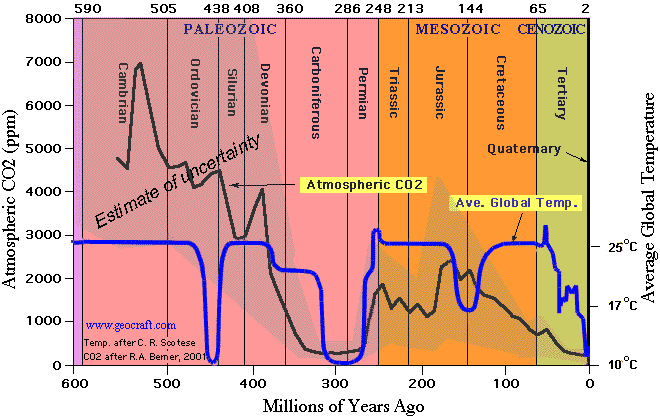
65 million years data. 
https://wattsupwiththat.files.wordpress.com/2012/10/tempvsco267m.gif

543 million years data.


700 million years data.


Finally, here's the 4.6 B years timescale. Warming-cooling, endless natural cycle.

What the data and charts above show is that even if 100% of all power plants in the world are from fossil fuels, global cooling will still happen. And even if 100% of all energy in the planet is from hydro, wind, other renewables, global warming will still happen. But then religionists and climate evangelists will always have zero appreciation for data. Only faith, strong faith in the words of Al Gore and UN bible. 

Why? Money, money, money. Hypocrisy-robbery.


Huge extortion racket, via governments, the UN and other multilaterals.
--------------

See also:

Saturday, February 27, 2016

BWorld 46, China's debt, central planning and central crashes

* This is my article in BusinessWorld yesterday.


"The curious task of economics is to demonstrate to men how little they really know about what they imagine they can design.” -- Friedrich Hayek.

One of the characteristics of centrally planned economies like China is that officials and planners centralize many resources, which creates centralized expectations from the people, and since planners’ egos cannot really plan and control all factors, this often results in centralized economic dislocation, disappointment, and anger.

Take the case of China’s debt.

Officially, China has a gross public debt/gross domestic product (GDP) ratio of only 41% in 2014, manageable and just slightly higher than the debt/GDP ratio of Taiwan and South Korea (38% and 36%, respectively). But China has more debt that what it will officially admit.

A report by McKinsey Global Institute (MGI) said that China total borrowings (individuals + companies + local and central governments + state enterprises) was 282% of GDP in 2014, higher than the debt ratio of the US, Germany, Canada, and other big economies. (See Graph 1)


High debt, private and public, will always create financial turmoil, today or tomorrow. Especially in a dictatorship that abhors political competition and yet wants to mimic economies that allow market and political competition.

This was discussed in “The Chinese Financial Crises and their Impact on Asia,” one of the panel discussions during the recently-concluded “Asia Liberty Forum” in Kuala Lumpur, Malaysia from Feb. 18-20. The session was chaired by Prof. Christopher Lingle of the Universidad Francisco Marroquin in Guatemala. The speakers were Dr. Carmelo Ferlito, IDEAS Senior Fellow, Malaysia and Adjunct Faculty Member at INTI International College Subang, Malaysia, Andrew Shuen of Lion Rock Institute, Hong Kong, and Dr. Mao Shoulong, Renmin University, also of Unirule Institute, China. These three independent think tanks -- IDEAS, Lion Rock, and Unirule are all members of the Economic Freedom Network (EFN) Asia. (See Graph 2)


In his presentation, Carmelo Ferlito noted that from 2003-2008, China’s total debt was stable to declining at 170% of GDP, then by 2009, it exploded and kept rising. He further noted that “a lot of this debt is sitting in local governments or state-owned enterprises. There is assumption that government can let its “zombie” entities stumble on as debt-paying vehicles or maybe occasionally let a couple default without any systemic contagion.

But now the Chinese government again began buying stocks to prop up its plummeting stock market, that is unsustainable.”

LESSONS FOR SOUTHEAST ASIA

With the continuing financial turmoil in China that started last year, there are lessons to be explored for emerging economies in the region like the Philippines.

1. Fiscal and household irresponsibility will snap. As public and private debts become bigger, economic uncertainty will also rise as those debts should be repaid. People will never know who can pay back and when, and who will default.

2. Moral hazards. A central planning government tends to attract less-studied behavior by the public. As a result, people with low financial literacy may be encouraged to gamble their savings at the stock market, thinking that the government will bail out anyway.

3. Central planning leads to central disappointment. Central planning cannot and will not cure and control everything, including stock prices, booms and busts, debt spirals, and inflation. Central planning can only postpone small busts until these become bigger and burst. Authoritarianism can never be compatible with free markets.

The great Nobel prize economist and political philosopher, Friedrich Hayek, has some words to say about central planners. It is important that economists and planners outside communist China should heed them.

“No man or group of men possesses the capacity to determine conclusively the potentialities of other human beings and that we should certainly never trust anyone invariably to exercise such a capacity.” -- The Constitution of Liberty (1960), Chapter 6, “Equality, Value and Merit.”

Bienvenido S. Oplas, Jr. is the President of Minimal Government Thinkers, a member of the Economic Freedom Network (EFN) Asia, and a fellow of South East Asia Network for Development (SEANET).  minimalgovernment@gmail.com
--------------

See also:
BWorld 11, China's stockmarket and central planning, July 18, 2015
BWorld 43, More on WESM, PEMC and DOE, February 14, 2016
BWorld 44, Why the Philippines should join the TPP, February 19, 2016 
BWorld 45, Asia Liberty Forum and property rights, February 20, 2016

Wednesday, December 16, 2015

EFN Asia 54, Sethaput Narueput on economic freedom and poverty

Reposting a good article here by Sethaput, posted in EFN Asia website last week. My short comments about his paper:

1. The World Bank (WB), along with the Asian Development Bank (ADB), IMF, OECD, UN, etc. are government clubs and associations, NOT clubs of corporations (big or small) or NGOs or other civil society organizations. Its funding come from governments, its leadership is nominated and approved by governments, its programs and lending are for governments. Thus, words like "government", "state", "tax", "regulation" are expected to dominate its literatures. It should not be a surprising finding.

2. Sethaput's observation here is spot on, bulls-eye. The UN, WB, all other multilaterals are institutions of global central planning. People and officials there think they know a lot, they have lots of numbers, they can plan and control things. I think the top officials there have messianic and megalomaniac views of themselves.

"... international experts to be experts in any country they work on, armed with examples of “international best practice” and able to ignore local history and conditions. Unfortunately this problem is by no means limited to the World Bank. Probably the most egregious example of the technocratic illusion of supply-driven solutions to poverty is the United Nations Millennium Development Goals or MDGs. Soviet-style central planning may be dead even in Russia today, but its ethos still lives on in the international development community."
------------

ECONOMIC FREEDOM AND POVERTY: REFRAMING THE DEBATE

Wednesday, 9 December 2015
Sethaput Suthiwart-Narueput, Thailand Future Foundation[1]

In the 352 pages and over 250,000 words in its flagship 2001 World Development Report (WDR), Attacking Poverty, the World Bank mentions the word “freedom” 12 times. By contrast, the words “government” and “state” are mentioned about 450 and 350 times, respectively. Such an omission and imbalance is particularly surprising in light of some of the Bank’s own findings. Stating at the outset that “the poor are the true poverty experts,” the Bank conducted many interviews of the poor as background for the WDR and found that the poor repeatedly described their well-being in terms of five related dimensions, one of which was “freedom of choice and action.”[2]

Why isn’t economic freedom–or its core elements of personal choice; security of person and property; voluntary exchange; freedom to enter markets and compete–at center stage in policy discussions given its critical and empirically documented role in fostering growth and reducing poverty? Why isn’t it given greater attention in policy discussions by governments, international organizations, and even civil society at large?

While the omission by governments is understandable but regrettable, the omission by international organizations tasked with poverty reduction such as the World Bank is less so. In his thought-provoking book The Tyranny of Experts, Bill Easterly states that

The conventional approach to economic development, to making poor countries rich, is based on a technocratic illusion: the belief that poverty is a purely technical problem amenable to such technical solutions as fertilizers, antibiotics, or nutritional supplements…The technocratic illusion is that poverty results from a shortage of expertise, whereas poverty is really about a shortage of rights. The technical problems of the poor…are a symptom of poverty, not a cause of poverty…[the] cause of poverty is the absence of political and economic rights, the absence of a free political and economic system that would find technical solutions to the poor’s problems.[3]

Having previously worked at the World Bank myself for close to a decade, I can readily testify to the enormous appeal that such a technocratic illusion has for a large international bureaucracy. It allows for vast amounts of resources to be deployed towards producing more outputs which can be centrally monitored and verified (e.g., more schools and hospitals regardless of whether they are wanted or really result in improved educational and health outcomes). It allows for international experts to be experts in any country they work on, armed with examples of “international best practice” and able to ignore local history and conditions. Unfortunately this problem is by no means limited to the World Bank. Probably the most egregious example of the technocratic illusion of supply-driven solutions to poverty is the United Nations Millennium Development Goals or MDGs. Soviet-style central planning may be dead even in Russia today, but its ethos still lives on in the international development community.

More puzzling is why discussions of economic freedom aren’t more center stage for civil society and the public at large. Or to put it more starkly and specifically, why is there such a distrust of free markets in Asia even though they have delivered such prosperity to the region?

Saturday, July 18, 2015

BWorld 11, China's stockmarket and central planning

* This is my article in BusinessWorld Weekender yesterday.

HIGH DEBT, private and public, will always create financial turmoil, today or tomorrow. The ongoing fiscal drama in heavily indebted Greece will continue for many months to come, whether it will stay using the Euro or not. And recently, it was China’s turn with the recent near-crash of its stock markets in Shanghai and Shenzen, and partially affecting the markets in Hong Kong.

Unlike the markets in the US, Japan, UK, Germany and other democratic countries, the case of China will always be internally conflicting. It is a dictatorship that abhors political competition and yet it wants to mimic economies that allow market competition.

HIGH PUBLIC DEBT
Officially, China has a gross public debt/GDP ratio of only 41% in 2014, manageable and just slightly higher than the debt/GDP ratio of Taiwan and South Korea (38% and 36%, respectively). But China has more debt than what it will officially admit.

A report by McKinsey Global Institute recently said that China’s total borrowings (individuals + companies + local and central governments + state enterprises) was 282% of GDP in 2014. This is very high for a non-industrialized economy like China.

There is high-margin lending (borrowed funds for stocks investment), reaching $323 billion last month alone, invested in the stock market by many novice, first-time stock investors numbering in tens of thousands.

STOCK MARKET BUBBLE
From 2010-2014, China’s stock market capitalization/GDP ratio averaged only about 45%. By June 12 this year, it rose to almost 100%, showing a huge asset price bubble in the first half of this year.

In comparison, this ratio is mildly increasing in the US (around 140% in 2014) and Japan (nearly 100% in 2014) from 2011 up to the present. 

Figure 1 (from Bloomberg)


The bubble started last year when government media repeatedly announced that stocks were cheap, with the implicit understanding that the central planning authorities can control prices from falling. Millions of novice and first-time stock investors came in droves, China’s market capitalization tripled and reached $9.8 trillion, according to a Bloomberg report last June 30.

From 2011 to mid-2014, Shanghai’s price-to-earnings (P/E) ratio was only around 12. By late 2014-mid-2015, this rose to 26, more than double in less than one year.

BUBBLE CRASHED
Why did the bubble burst so suddenly? There are several explanations and hypotheses for this.

One is that China is experiencing a GDP growth slowdown of “only” 7% or less, compared to 9-12% per year for the last three decades or more. Two, some government stimulus programs to shield China from various global turmoil have to end. Three, finance also follows the law of gravity: the speed and height of price rise is somehow directly proportional to the speed and depth of price decline.

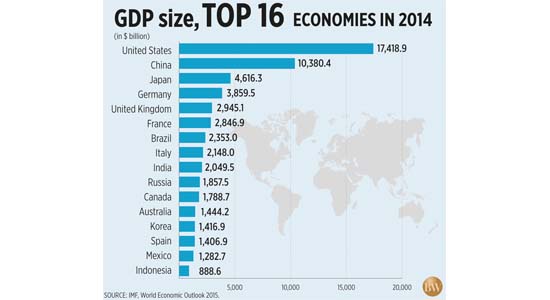
The magnitude of the stock price decline was $3.9 trillion, according to the Bloomberg China Market Cap index. That was equivalent to the GDP size of Germany, larger than the GDP sizes of UK or France or Brazil, and twice the GDP of Russia. 

Figure 2.

The bulk of China stock investors are the more than 90 million individuals who make up about 80% of the market, according to a survey of households.

The stocks crash was worse than the US property crisis in 2008-09, although in terms of global interconnection and contagion, the US financial turmoil last decade had a larger impact. Significant deterioration in the public debt of Greece, Spain, Portugal, Ireland, Cyprus, Italy, etc. occurred in 2009 and 2010, obviously a result of contagion from the US.

Compared to the Greece debt problem, this is much larger. Greece’s GDP size in 2014 was only $238 billion, and its total public debt was about $320 billion.

CENTRAL PLANNING FIGHTS BACK
China’s government responded with several measures. One, the central bank cut interest rates, hoping that more savings from the banks will go to the stocks market. Two, some stock traders and speculators were investigated with threats of prosecution for stock rumor mongering. Three, a number of planned initial public offerings (IPOs) were suspended. Four, outright stop in trading.

From Bloomberg reports:

“At least 1,301 companies have halted trading on mainland Chinese exchanges, locking up $2.6 trillion of shares, or about 40 percent of China’s market capitalization. The China Financial Futures Exchange raised margin requirements for sell orders on CSI 500 index futures, while the central bank will provide “ample liquidity” to the stock market. China Securities Finance Corp. said it will buy more shares of small- and mid-cap companies.” (July 8)

“Official measures to support shares became more extreme during the week as declines deepened. They include a ban on stockholders and executives from selling stakes in listed companies for six months, an order for companies to buy equities and an investigation by the nation’s public security bureau into short-selling.” (July 10)

LESSONS FOR SOUTHEAST ASIA
Emerging economies in the region like the Philippines can draw lessons from this latest episode in regional and global economics.

1 Moral hazards. When a central planning government rallied the public to invest in the market, many investors with little or zero experience in the market came believing they couldn’t lose money since the government is big enough to guarantee returns or bail them out later.

2 Adverse selection. Millions of new novice investors have picked up the wrong timing, at a time when fiscal uncertainty hounds the EU and China was experiencing growth slowdown. Adverse selection often results in adverse results.

3 Debts and uncertainty. As public and private debts become bigger and bigger, the economic uncertainty also becomes bigger. People will never know who can pay back and when, and who will default.

4 Corporate fundamentals. Investors should do hard analyses of the fundamentals of companies whose stocks they are buying, and not just wait for cues and pronouncements from government. It can be a case where as government intervenes more, it creates more panic and price volatility.

5 Central planning and central disappointment. Central planning cannot and will not cure and control everything, including stock price ups and downs, boom and bust. Central planning works mainly to postpone small busts to become huge busts and bursts. Authoritarianism can never be compatible with free markets.

6 Role of government. The state and its various agencies, from local governments to different regulatory agencies to monetary authorities, should focus on ensuring fair market rules rather than guaranteeing outcomes.

Bienvenido S. Oplas, Jr. heads a free market think tank in Manila, Minimal Government Thinkers, Inc., and is also a fellow of South East Asia Network for Development (SEANET), a regional center based in Kuala Lumpur advocating economic freedom in the region.
--------------

See also: 

Thursday, August 29, 2013

Pork Barrel 6: Spontaneity and Friedrich Hayek

* This is my article last Monday in thelobbyist.biz.
-----------

After the Priority Development Assistance Fund (PDAF0 has been abolished by the President last Friday, August 13, 2013, there is an unprogrammed amount of P25.4 billion in the proposed 2014 budget. If explicit pork barrel is indeed abolished, the budget should be lower by that amount. But this is not the case.

According to DBM Secretary Butch Abad, legislators can introduce their priority projects, subject to certain guidelines as mentioned by the President last Friday, into the budget. Meaning those projects will be inserted into agency budgets and the size of the proposed budget has remained the same, not declined. This practice is often called as “Congressional Insertion.”

The budget submitted by DBM to Congress after the President’s State of the Nation Address (SONA) is a compilation of financial requests from four groups: (a) provincial and regional offices of an agency like  DA, DILG, DTI, etc., (b) Central offices of those agencies and Departments, (c) local government units (LGUs), and (d) NGOs, people’s organizations via “participative budget consultations" like the recent Bottom up Budgeting (BuB) scheme.

Once the budget is discussed and heard in Congress, legislators can disapprove some proposals and projects, say projects coming from Mayors, Governors  and NGOs who are not friendly or non-ally of the legislators. Then they can increase the budget of certain projects which can benefit their friends and allies, like in municipalities and cities that supported them in the last election. It is the prerogative of the legislators to do this because they are empowered by the Constitution to scrutinize and pass a budget law every year. 

This Congressional Insertion is one form of soft or implicit pork barrel. Thus, pork barrel can never be truly be abolished, without expecting the national government to shrink in size and budget. Only a truly independent and activist legislature can control and disallow wasteful or excessive spending by the Executive branch.
---------

The citizens’ “Million March” in Luneta on August 26 is unique because it is largely spontaneous. While Edsa 1 revolution in 1986 was also spontaneous, big politicians and political groups later set the tone and direction of the protest movement. Besides, it was directed against a particular leader, the former President Marcos.

The “Million March” is different. It is not directed against a particular leader, say President Noynoy Aquino, but against corruption in general and corrupt officials in government, especially among the legislators implicated in the Napoles pork scandal. And there are no grand speakers with grand speeches and promises, no plackards and streamers, no dominant political color or political group organizing it.

The  spontaneity and lack of central organizers with central planning thinking makes the “Million March” exciting and unpredictable. The activist public have become wary of the usual protest leaders and groups. They suspect that these groups are no different from the politicians that they criticize. So the public is now opting and experimenting the politics of spontaneity.

Big politicians, big political groups and big government do not like this kind of arrangement. They are used to dealing with centralized action so they can focus their politics of compromises, and bribery if necessary, on the leaders of those movements.

Famous Austrian economist and political philosopher, Friedrich Hayek, extolled the value of spontaneity in his book, The Constitution of Liberty (published 1962). He wrote,

Liberty is essential in order to leave room for the unforeseeable and unpredictable. Because every individual knows so little that we trust the independent and competitive efforts of many to induce the emergence of what we shall want when we see it….
Freedom means the renunciation of direct control of individual efforts that a free society can make use of so much more knowledge than the mind of the wisest ruler could comprehend… Freedom granted only when it is known beforehand that its effects will be beneficial is not freedom. Freedom means that many things will be done which we do not like. Our faith in freedom rests on the belief that it will, on balance, release more forces for the good than for the bad.

Hayek was referring to the evil of central planning in running societies and governments. Leave the individuals to run their own lives, their own households and communities, so long as the government is there to implement the rule of law – few, general laws and prohibitions that apply to all, no one is exempted and no one can grant an exemption. Like the laws against murder, stealing, abduction, land grabbing, extortion, destruction of properties.

The politics of central planning as practiced by many governments around the world, armed with huge annual budget as authorized by their legislators and the legislators getting their own pork in exchange for passing such budget laws, works against individual freedom and facilitates corruption. Corruption not only in wasteful or stolen spending, but corruption of values of the people, that they can relegate certain personal and parental responsibility in running their own households, and pass them as government responsibility.
-----------

See also:

Tuesday, October 30, 2012

Pol. Ideology 38: Central Planning vs. Free Market

My article in interaksyon.com, Poverty, Planning and Populism has attracted the attention of some lovers of central planning and more government. Below are our exchanges, dated October 28 to 30, 2012:
---------

Carlo Lacanilao What this article failed to mention is that this is the very economic framework that sets the objective structural barriers to achieving prosperity; and - while, shifting the blame on the poor - forgets that poverty in itself shapes, conditions, and constrains, individual freedom and responsibility.

Nonoy Oplas ·  More on "shifting the blame, and credit, on the individual", rich and poor alike, not just the poor.

Lean Porquia ·  Time and again, economists failed to see that the Philippines does not have material conditions to become industrialized. Look at the policies implemented and how they affect millions of poor Filipinos (contractual status, export-labor policy, value added tax, two-tier wage system, privatization of social services). The stubbornness of the current system is the biased favor for the entrenched wealthy elite rather than protect the interest of the majority poor people. The key in resolving the problem, turn it upside down.

Nonoy Oplas · It is often easy to blame all other external factors and excuse the individual for his accountability to himself, his family and community. And precisely why central planning in labor, trade, other policies do not jibe with encouraging more entrepreneurship and individual creativeness.

Lean Porquia ·  Individual accountability is actually enshrined in collective and centralized planning. Has every individual performing for the economy. The thing with your point that it does not jibe with encouraging entrepreneurship is actually persistent in the current status quo. Bakit po ba, well protected and small and micro entrepreneurs with the kind of policies implemented right now? It's very ironic that your idea is very much conservative to the point that even European countries are turning against trade liberalization and is gearing for protectionism. The only countries who survived the recent crisis are those with solid centralized economic planning. Please consider that.

Nonoy Oplas ·  Yes, much of Europe is protectionist, there is free trade only among EU member countries. Protectionism or central planning in international trade, restricts or kills individual freedom. Imagine a situation where there is a national or Filipino cell phone manufacturer and the PH government will restrict importation of iPhone, Samsung, HTC, other foreign brands. It will be a very lousy situaton. We are lucky that such type of protectionism is non-existent in our economy.

Carlo Lacanilao Nonoy Oplas: Granted that that there has to be accountability attributed to individuals but, we know for a fact that, it is collective action that changes society (history) - not individuals. So we go back again to the economic providing hindrances to the achievement of individual creativeness by restricting the spread of mass development and by doing so reserves the fullest of development gains to the benefit of the very few.

"Protectionism or central planning in international trade, restricts or kills individual freedom" <- It's a flimsy assumption that a planned economy will be inefficient considering how meticulous major corporations are when it comes to their own business plans. Planning is not an an end in itself but a means to determine what is essential. The freedom - that word again - to determine by social need rather than the bottom line. To produce more hospitals or more rice or more corn rather than cellphones. Under Hayekian economic libertarianism this is left to those whose drive and interest is solely motivated primarily by profit.

Nonoy Oplas · Where there is more central planning, there are more problems than solutions. Look at healthcare: there are hundreds of govt hospitals (under DOH, UP PGH, AFP hosp., provincial hospitals, city govt hospitals), there are tens of thousands of govt. rural health centers, there is government health insurance monopoly (PhilHealth), thousands of DOH-sponsored Botika ng Barangay, there is drug price control policy, there are free medicines for the poor, etc., and yet health problems are never ending.

Compare that in the food sector: there is not a single government restaurant or carinderia, no government supermarket or grocery store, and yet people are eating. The big difference? There are rigidities under central planning while there is flexibility under free market. Someone eating a P20 spaghetti in a carinderia does not feel that he will die or will get food poisoning compared to someone eating a P200 or P500 pasta in a fine resto.

Carlo Lacanilao It is not the number of hospitals that's causing this problem. It is how these hospitals are managed based on the budget being given compared to other spending (military, debt-servicing, and other palliative programs). Cuba with its economic embargo has a very low if not the lowest child-mortality rate. Let's look at Sweden where, although private healthcare exists, is still mainly funded by the government: "life expectancy at 79/83 for men/women; 5% are aged 80 and above compared to EU member states; maternal mortality at 6 out of 1,000 babies and fewer than 1 out of 100,000 die in birth."

I don't even understand your pasta economics. What is certain is that there are fewer and fewer individuals who can afford that 20-peso spaghetti in a carinderia - preferring the 7 to 10 peso chicken or beef noodles - how much more the 200-500 peso kind. If you think that won't add to the health problem, then who are we kidding?

Nonoy Oplas ·  Sweden, UK, Germany, US, France, etc., they hold on economically despite heavy public debt and expensive welfarism mainly because of their adherence to the rule of law. In countries where rule of law implementation is weak and where rule of men rather dominates -- like the PH and many other poor countries -- having more and big government often leads to more wastes and corruption. That is how the free market fills the gap of large scale government failure.

Maintaining peace and order, protecting private properties, is mainly a government and police function. But in PH, the ones who guard our schools and universities, malls and shops, airports and seaports, villages and condos, hospitals and banks, are ALL private security agencies. Without this market-supplied security scheme, the country could be more underdeveloped as criminality and robbery will be rampant.

Carlo Lacanilao You have taken the discussion from central planning to health and then to food and now to peace and order "supplied by private security agencies" but there seems to be no satisfactory answer as to why central planning per se has no place in economic governance except in saying there are conditions for such and such country that don't exist in this country, therefore central planning is...

Systemic economic issues will not be resolved by more of the same policies which engendered the problems in the first place but by recognizing that such a system no longer works. It will require more than market reforms to correct this.

Also, the main argument remains: it is the current economic policies (neoliberalism) that has riddled the world not just in the grip of one crisis after another under the illusion that markets correct themselves (failing to underscore that the correction in itself is planned and was made possible due to the heavy bailout from govt); it is this economic libertarianism that has perpetuated poverty at the mercy of multinational corporations and investment bankers. Truly, in this state of things, they are the ones who are most free.

Lean Porquia · Nonoy Oplas centralized economic planning does not equal to restriction. that's the failure of your argument.

Nonoy Oplas · @Carlo, have to cite cases where central planning fails and where free market succeeds. To add more examples and cases: No government shirts and clothing corporations, no govt shoes and sandals corporations, no central planning how many running shoes, basketball shoes, golf shoes, cycling shoes, at what designs, and yet the market provides. Those who over produce at little demand lose money, those who produce at high demand make lots of money. Corporate expansion and bankruptcy are 100 percent part of business risks and market competition. Capitalism without failure is like religion without sin, that is why any form of government bail out to failing corporations is wrong, more statism than free market.

@Lean, central planning also means the government will confiscate certain percentage of our income and savings -- prevents us from spending more of our own money where we really need them -- and govt will give such money to cronies or wasteful govt corporations which tend to lose more than they earn.
--------

Meanwhile, I posted this poster in my facebook wall with this note, "Right. A bright idea does not need coercion to get implemented. An idiotic or moronic idea does."

That is why central planners love coercion and government enforcement. Whether people like their idea or not, they have to obey that idea, they have to finance that idea, even if it is an idiotic one.

A friend, Carlos Tapang, commented on it:
Take, for example, Obama's idea to produce an electric car. GM took the challenge only because they are (were?) partly owned by government. The Volt came into being at much fanfare. Last time I heard, it's still not selling. If it were really a good idea, it would not have required government incentives or prodding.

Obama promised that products that are good for the environment are not only good for the environment, they are supposed to provide jobs. Solyndra, a solar power company, took in half a billion dollars of investment the Obama's administration. It went bankrupt, leaving the taxpayers with a hefty bill to pay.
----------

See also:
Pol. Ideology 32: On Shrinking Government, June 19, 2012
Pol. Ideology 33: Anarchy or Minarchy, July 13, 2012
Pol. Ideology 34: More on Anarchy or Minarchy, July 17, 2012
Pol. Ideology 36: On Capitalism, Akbayan, Drugs Legalization and Toqueville, October 10, 2012
Pol. Ideology 37: Collectivism, Conservatism and Liberalism, October 12, 2012

Monday, October 29, 2012

Fat-Free Econ 28: Poverty, Planning and Populism

* This is my article in TV5's news portal last Saturday,
http://www.interaksyon.com/business/46631/fat-free-economics-poverty-planning-and-populism
--------

The fight against poverty is the most financially enriching endeavor for government officials, their consultants as well as the foreign aid community.

Trillions of dollars of taxpayers’ money every year are being siphoned off from the income and savings of the more productive sectors of societies in different countries, and diverted to the coffers of governments and multilateral institutions, before the monies are channeled to hundreds of different agencies and bureaucracies, for distribution to the poor.

The most elaborate and the grandest central plan to fight poverty worldwide is the Millennium Development Goals blueprint by the United Nations, supported and implemented by governments, foreign aid bodies like the World Bank and Asian Development Bank, and many NGOs.

By forcibly socializing and collectivizing resources and plans into the hands of those poverty fighters, individual freedom and responsibility has, directly or indirectly, been disregarded or even disrespected.

On November 3-4, I will join a small group of free-market advocates from around the world who will gather at the Harbour Plaza Resort City in Hong Kong for a round table discussion on populism and the religion of “All Powerful Government.” The forum is organized by the Lion Rock Institute, Hong Kong’s first and only free-market think tank.

The discussion would take off from The Road to Serfdom, a bedrock defense of free-market thinking by the Austrian economist and political philosopher Friedrich Hayek.

Hayek is a strong advocate of individual freedom and responsibility and the rule of law. An individual has the freedom to be industrious and responsible, and the freedom to be lazy and irresponsible. It is mainly individual choice that can set the future and destiny of a person and that of his/her household and immediate community. In his book, Hayek wrote:

“Individualism, in contrast to socialism and all other forms of totalitarianism, is based on the respect of Christianity for the individual man and the belief that it is desirable that men should be free to develop their own individual gifts and bents…

“Perhaps the greatest result of this unchaining of individual energies was the marvelous growth of science. Only since industrial freedom opened the path to the free use of new knowledge, only since everything could be tried – if somebody could be found to back it at his own risk – has science made the great strides which in the last 150 years have changed the face of the world. The result of this growth surpassed all expectations. Wherever the barriers to the free exercise of human ingenuity were removed, man became rapidly able to satisfy ever-widening ranges of desire.

“The effect of this success was to create among men a new sense of power over their own fate, the belief in the unbounded possibilities of improving their own lot…”

This is something that the various poverty fighters generally do not consider. They did not ask how much of the poverty that they are trying to fight and solve was due to personal reasons, in contrast to poverty caused by nature, by manmade calamity and by government failure. What the poverty fighters do is to have a grand and elaborate plan backed up by centralized resources to be implemented from the top down. Hayek further wrote:

“’Planning’ owes its popularity largely to the fact that everybody desires, of course, that we should handle our common problems with as much foresight as possible. The question is whether we should create conditions under which the knowledge and initiative of individuals are given the best scope so that they can plan most successfully; or whether we should direct and organize all economic activities according to a ‘blueprint’, that is, ‘consciously direct the resources of society to conform to the planners’ particular views of who should have what’.

“Liberalism regards competition as superior not only because in most circumstances it is the most efficient method known but because it is the only method which does not require the coercive or arbitrary intervention of authority. It dispenses with the need for ‘conscious social control’ and gives individuals a chance to decide whether the prospects of a particular occupation are sufficient to compensate for the disadvantages connected with it.”

The LRI event will be followed by a bigger forum, the Economic Freedom Network Asia Conference, to be held in Crowne Plaza Hong Kong Kowloon East Hotel on November 5-7.

With the theme, “How Welfare Populism Destroys Prosperity,” the forum will have several hundred international participants and will be sponsored mainly by the Friedrich Naumann Foundation for Liberty. 

Political populism - pandering to the lobby of the noisy sectors and to the deep desire of many politicians to win votes through welfarist programs - has created huge havoc in the fiscal condition of many governments. It has also caused more uncertainty in the global macroeconomic environment and has corrupted the attitudes and work ethic of many individuals.

Many people now begin to think that for whatever social or economic issues, more government is the solution. And that is how many societies and governments have elaborately planned and created various “poverty-fighting” programs - from education and books to healthcare and medicines, housing and relocation, MRT subsidy and fuel discounts, tractors and credit, multiple business regulations and taxes on the well-to-do, cash transfers, and very soon, condoms and pills.

It may not be a far out possibility that governments may soon introduce iPad and Samsung Galaxy tablets. After all, many governments and politicians are specialists in the “spend-tax-borrow” philosophy.
By shelving more individual freedom and responsibility, by having more central planning and political populism, governments are contributing to poverty.


See also:
Fat-Free Econ 24: Government Fat and Public Expectations, September 21, 2012
Fat Free Econ 25: Property Rights and the Cybercrime Prevention Law, October 01, 2012
Fat-Free Econ 26: US Public Debt and the November Elections, October 10, 2012
Fat-Free Econ 27: Sin Tax and Nannyism, October 22, 2012

Hayek 12: Friedrich Hayek's 20th Death Anniversary, March 26, 2012
(has links to Hayek 1 to 11, discussion on some chapters of Hayek's book, "The Constitution of Liberty")
Hayek in Asia 2: Shanghai Austrian Economics Summit 2012, April 15, 2012

Hayek 13: Friedrich Hayek's 113th Birthday, May 09, 2012

Sunday, October 14, 2012

Welfarism 22: CCT, 4Ps and Central Planning


More government central planning, more wastes and inefficiencies. This is once more exhibited in the Conditional Cash Transfer (CCT) or Pantawid Pamilyang Pilipino Program (4Ps) program of the government.

My economist friend from UP, Jhiedon Florentino, rode a taxi and engaged the taxi driver to a fruitful conversation. Well, it’s more of probing the mind of one of the average persons in this country on what they think of certain government policies like the CCT. Jhie is down to earth enough to listen to the man’s frank ideas and witty remarks. Then he posted their conversation in his facebook wall last October 12-13, 2012. One more reason why fb is both an entertaining and educational platform in the planet today – at zero politics, zero taxes involved.

“Me” here refers to Jhiedon. The taxi driver is from Malinta, Valenzuela City, Metro Manila. Jhie posted this in a 4-parts installment in his fb wall. There are comments after each part. I put all the comments and exchanges after part 4. I also made short English translation to some points, for the non-Filipino readers of this blog. Thanks to Jhie for allowing me to post this in my blog. Six pages pages long, enjoy!


Part 1:
Manong Tx driver: ...d naman namin hinihingi maging 4Ps, pero binigyan kami...

Me: lahat sa sitio ninyo 4Ps manong?
Manong: Di ko nga maintindihan, yung mga taong dapat makaavail, hindi nakakakuha, yung mga nagbabasura...

Me: sa tingin ninyo manong, bakit....
Manong: sa katamaran na pumunta, di nila alam, at iyong iba mga wala namang mga IDs. Tapos aatend ka ng mga meeting, malayo...

Me: nakaatend na kayo manong ng mga meeting
Manong: oo, nung minsan nagkasakit si misis

Me: anong pinagusapan ninyo nung FDS manong
Manong: naku, FAMILY PLANNING ang pinaguusapan nung pumunta ako....

(Translation: Driver said they did not ask for the 4Ps but government gave them the money. He did not understand why the less poor got the money but the very poor like garbage scavengers got nothing, they are lazy to walk long and attend meetings, or they do not have any ID. He attended one meeting, the topic was about family planning) 

Wednesday, April 11, 2012

PH Population 3: Census 2010 by Province

The National Statistics Office (NSO) release the results of the May 2010 nationwide census of Philippine population only last week, April 04, 2012. I will limit commentary here and make a separate discussion later why there was a big delay in the release of the results even if the NSO has submitted the census results to the Office of the President by late 2010. For now, I will just give the data.

For a complete list of provinces and chartered cities' population, see here,
http://www.census.gov.ph/data/pressrelease/2012/PHILS_summary_pop_n_PGR_1990to2010.pdf

A. Above 2 Million
1. Cavite
3.09
2. Bulacan
2.92
3. Pangasinan
2.87
4. Laguna
2.67
5. Cebu
2.62
 + cities of Cebu,
1.55
  Mandaue, Lapu-lapu
6. Rizal
2.48
7. Negros Occ.
2.40
  + Bacolod City
0.51
8. Batangas
2.38
9.  Pampanga
2.01
  + Angeles City
0.33


B. Between 1-2 Million
1. N. Ecija
1.96
2. Camarines Sur
1.82
3. Iloilo
1.81
  + Iloilo City
0.42
4. Quezon
1.74
  + Lucena City
0.25
5. Leyte
1.57
  + Taclocan City
0.22
6. Isabela
1.49
7. Bukidnon
1.30
8. Negros Or.
1.29
9. Tarlac
1.27
10. Bohol
1.26
11. Albay
1.23
12. N. Cotabato
1.23
13. Cagayan
1.12


C. Nearly 1 Million


Palawan + Puerto
0.99
  Princesa City
Zambo. Del Norte
0.96
Zambo. Del Sur
0.96
  + Zamboanga City
0.81
Davao del Norte
0.95
Maguindanao
0.94
Lanao del Sur
0.93
Lanao del Norte +
0.93
   Iligan City
Davao del Sur
0.87
Misamis Or.
0.81
  + Cag. De Oro City
0.60


Central planners in government -- local, national and multilaterals, foreign aid -- always look at population data with keen interest. They need to plan how many schoolbuildings, hospitals, public markets, etc. to build, how many public school teachers, public health professionals to hire, and so on. Politicians plan their campaign strategies based on population statistics per precinct, per sitio, per barangay, per municipality or city, per province.
-------

See also:
PH Population 1: as of August 2009
PH Population 2: Projections 2010 by Province, August 04, 2010