Showing posts with label Arcy Garcia. Show all posts

Sunday, July 02, 2017

Climate Tricks 62, Climate religionism of Arcy Garcia

Some people have deep faith in the anthropogenic global warming (AGW) or "man-made only" warming and climate change (CC), deep faith like religion. Natural global warming-global cooling cycles, or nature-made warming and CC is taboo for them, no such thing, it violates their religion and will never never accept it even if hard data and graphs are in front of them.

Among such climate religionists is Arcy Garcia. Arcy is a friend way back in the late 80s when I was still a socialist. While we have some similar beliefs like respect for human rights and opposition to Du30's no-due-process, no rule of law and violent drugs war, his socialist and anti-capitalist angsts prevail. A typical anti-capitalist ideologue who super-enjoys facebook capitalism, youtube capitalism, google and internet capitalism, etc.

What he does, he would tag me in fb arguing the usual UN-Al Gore hypothesis that AGW is so scary-alarming-worrying-frankensteining and the only solution is more UN, more governments to control, over-regulate and over-tax and later on kill fossil fuels, and they can "fight CC".

Initially I engaged him, then he would run away when faced with dozens of paleo-climate data dating back to tens of thousands or millions of years ago. Then after a few days or weeks, he would tag me again and argue the same AGW alarmism and so I would show him again lots of hard data, paleo-climate data showing that global warming is not unprecedented, there were many precedents of GW.

I would ask him and other climate alarmists of these simple questions, and they would have zero answer, or the usual sound of silence.

1. Planet Earth is 4.6 billion years old, when was the time, what period, that there was NO climate change?

2. What was it like before this "man-made" warming/CC -- less rain, no rain, more rains? less flood, no flood, more floods? less snow, no snow, more snow?


3. Of the recent global warming from the mid-1800s to roughly the last decade, how much of it was man-made vs nature-made? 100-0? 80-20? 51-49?

Then he would run away. And repeat the process --> tag, argue briefly, run away; tag, argue briefly, run away.

Today, he did the same, posting this.


I advised and reminded him of his lousy style. He can continue his climate religionism and alarmism in his own wall, sure he has many follower-climate religionists who will cheer him. But he puts it again in my wall with the usual plan to run away when confronted with hard data, so I told him of his climate kaduwagan at kabobohan (climate stupidity and cowardice).

I asked him again just one question -- Planet Earth is 4.6 billion years old, when was the time, what period, that there was NO climate change?

His slippery answer, “Masyadong malayo 4b years. Mas kapani paniwala yung unti unting pag atras.”

Palusot pero hindi lusot. There is data for 4+ billion years but he won't accept it because it disproves their religion -- that there was no previous CC, no warming precedents, "this GW and CC is unprecedented" they argue. 

More data here, https://wattsupwiththat.com/paleoclimate/. Zero discussion, just dozens of charts and data and their sources.

After this, I am sure that whenever he finds another alarmist article, he will post it again in my fb wall, then he will run away again.

But then again, AGW is religion, based on faith and belief. People who believe in a God do not ask for charts or graphs or tables or equations, they just have faith, simple. This is AGW religionism, "man-made CC only" religion and cultism. And they use governments, the UN, the foreign aid like WB and ADB, for their religion. And vice versa, governments-UN-foreign aid use the religion to extract more political power, more global ecological central planning, more multi-trillion dollars climate money from taxpayers and energy consumers so they can "save the planet."
----------------

See also:
Climate Tricks 59, Trump's climate advisor to reverse US government alarmism, January 20, 2017 
Climate Tricks 60, Alarmism by the socialists and global ecological central planners, January 28, 2017 

Climate Tricks 61, Hysteria and tantrums over Trump's withrawal from Paris Agreement, June 02, 2017

Saturday, January 28, 2017

Climate Tricks 60, Alarmism by the socialists and global ecological central planners

Socialists and trying-hard anti-capitalism ideologues in facebook, youtube, etc. who also severely enjoy facebook capitalism, youtube capitalism, keep harping about "man-made" warming/climate change (CC) and thus, demand more government and UN ecological + energy central planning.

Like this report posted by Arcy Garcia.

As usual, palusot pero hindi lusot. Why?
1. No charts of temperature anomaly, only sketches and drawings.
2. Title is 4.5 B years, fine, but the sketches start only in past 20,000 years.
3. "Earth's warming at unprecented levels", no chart or table to show; unprecedented, no precedent? Scam statement.

And for the nth time, I've been asking Arcy and other "planet saviours":

(1) Planet Earth is 4.6 B years old, when, what period that there was no CC?
(2) What was it before this "man-made" CC -- less rain, no rain, more rains? less flood, no flood, more flood? less snow, no snow, more snow? Less dogs, no dog, more dogs? 

And for the nth time, Arcy and all climate evangelists have no answer. No climate alarmist has ever answered those questions honestly.

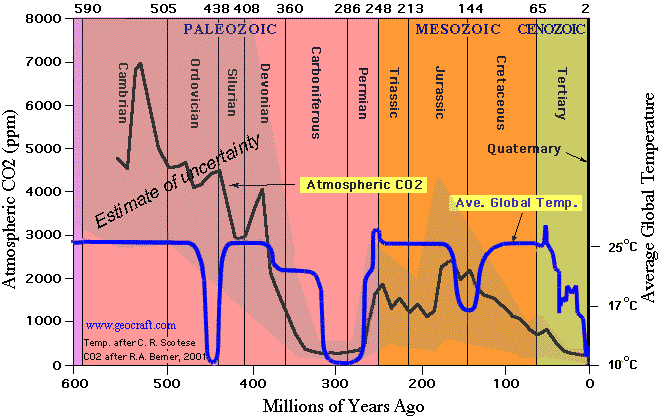
Some paleo-climate data showing warming-cooling cycle in the past. The climate alarmists close their eyes if the data do not support their "man-made" CC religion. 140k years ago. 


400k years data. 

1 million years data.  These guys have faith, strong faith in the words of Al Gore and the UN. 


65 million years data. 
https://wattsupwiththat.files.wordpress.com/2012/10/tempvsco267m.gif

543 million years data.


700 million years data.


Finally, here's the 4.6 B years timescale. Warming-cooling, endless natural cycle.

What the data and charts above show is that even if 100% of all power plants in the world are from fossil fuels, global cooling will still happen. And even if 100% of all energy in the planet is from hydro, wind, other renewables, global warming will still happen. But then religionists and climate evangelists will always have zero appreciation for data. Only faith, strong faith in the words of Al Gore and UN bible. 

Why? Money, money, money. Hypocrisy-robbery.


Huge extortion racket, via governments, the UN and other multilaterals.
--------------

See also:

Tuesday, August 06, 2013

Mining 29: On Open Pit Extraction, Tampakan and SDMP

A friend, Arcy Garcia, posted this poster in facebook soliciting anti-Tampakan mining signatures from the public. It says that "Almost 4,000 hectares of lush rainforest will be cleared and dug."

I commented on it saying that this is misinformation. If you have a 4,000 hectares mining permit area, you don't clear cut and dig a hole in all of it in one year. Usually you clear only 100 hectares or less, dig and dig for 10 years or so, then close it with top soil, plant trees as stipulated in the contract with MGB-DENR, then you clear and dig again on another 100 hectares or so.

I checked the website of the Tampakan project, owned by Sagittarius Mines, Inc. (SMI). My above statement is not even correct. Their plan is to have the copper and gold ore extraction in just one area, projected to be about 2.5 kms.  Wide, 3 kms. long and about 0.8 km deep, after 17 years of operation.


Arcy asked why it should be open pit mining, and not underground or tunnel mining. Personally I am in favor of open pit mining because it is less costly, so the company will have excess funds to build a school, a hospital, and housing for the employees and their dependents, roads and street lights for the rest of community. It is also less dangerous to workers compared to tunnel mining.

People opposed to any form of large corporate metallic mining often cite the case of the Boac, Marinduque mining and the huge mine tailings disaster. True that it was indeed a big environmental disaster, I saw the tv clips many years ago but I am not updated what what penalties were done to the mining company there.

There are only 35 large metallic mining operations nationwide. Except for the Padcal tailings destruction last year after heavy rains in Northern Luzon where Benguet Mining was heavily penalized by the MGB and LGUs, there are no other reports of mine tailings going to river systems. All of them are still contained and many have already dried up. I saw two tailings pond in Rio Tuba in southern Palawan. One active and one closed/dried up, here are the photos, http://funwithgovernment.blogspot.com/2013/03/mining-8-rio-tuba-mining-in-south.html

Nickel mining there has been  in operation since the 1970s and it seems there was zero incidence of mine tailings going to the river. Barangay Rio Tuba is more developed than Bataraza town proper, a few kilometers away. Dozens of people are applying for work in Rio Tuba every month, even as street sweepers to reduce dust pollution so they can have stable source of income. In nearby barangays and towns where there is no mining, life is poor and pathetic.

The Mining Act of 1995 or RA 9502 itself, not the BIR nor LGUs, mandates the large metallic mining firms to spend on Social Develoment and Management Project (SDMP, like hospital, public school, roads, skills training, etc.) on top of paying national and local taxes and fees. In a sense it is a good law. If LGUs and the national government (NG) will just get the money from dozen plus types of mining taxes and fees, most likely they will not do their job properly.

Take Bataraza town proper -- no hospital, old public schools with possibly no computers, no internet, ugly street roads. In Brgy. Rio Tuba, there is a private hospital, private school, with huge Apple computers with internet, and still free to the public, especially to employees and their dependents. Politics and politicians have their own dynamics and special interests that are off tangent with the community interest.

Back to Tampakan. It is projected to cover nearly 10,000 hectares, but not all, not even one-fourth (1/4) of that area will be cleared and dug. Here’s the project map. It is projected to give jobs to max of 10,000 employees during the project construction, and about 2,000 jobs in regular operation.


Metallic mining is a highly capital intensive business project. Workers there hardly touch the rocks and soil that contain the metallic objects. Bulldozers, backhoes, trucks and other big machines do. It therefore creates skilled labor, like drivers, operators and mechanics of those huge trucks and machines. Then another batch of workers who will do the forest rehabilitation of mined out areas.

But I think that instead of covering that 800-meters deep hole, it would be more economical, more practical, to covert that deep hole as a lake or dam, to catch excess water and flash flood during heavy rains. After the rainy season, that man-made lake can become a tourism area with lots of outdoors, fishing and water sports facilities.

There are concerns about killing related to the Tampakan project. It is a criminal act that must be pursued and the criminals should be penalized. Whether killing happened in a mining area or in a ktv bar or in a private house drinking session, the details are less important. Any act of killing or attempted murder should be penalized.

Meanwhile, here's a case of small scale mining, black sand mining in Cagayan, http://m.philstar.com/414576/show/04970f8def02819662bf82bae224afe6/

This is one example how some LGUs can be partners in crime of those private interests, local or foreign. It is impossible for anyone to have bulldozers and other capital equipment mining and quarrying without connivance and approval by LGUs and the local police.
--------------

Friday, July 19, 2013

Mining 27: Ensuring Responsible Mining from Small and Large Projects

A friend, Arcy Garcia, posted in his facebook wall my recent paper, Mining 26: Presentation at Rotary Club of Taguig Fort Bonifacio, and invited his friends from the Alyansa Tigil Mina (ATM) and Philippine Misereor Partnership, Inc. (PMPI) to comment on it. Only one commented, Mr. Samson Pedragosa, and I’m glad he did, as Samson has some constructive ideas how to further encourage responsible mining, not kill it.

Below are our exchanges from July 16-19, 2013 , with permission from Arcy and Samson that I will use their comments. Thanks Arcy, Samson. This is six pages long including photos, nearly 3,000 words, enjoy.


Arcy Garcia sa mga kasama sa ATM, PMPI at iba pang kasama natin sa paglaban sa iresponsableng pagmimina, pwede ba nating sagutin isa-isa ang artikulong ito? ang may akda ay isa sa mga ginagalang kong tao, kahit pa man malinaw sa kanya na siya ay pro-capitalism at neo-liberalism....

Samson Pedragosa This presentation assumes that mining in this country is done responsibly. I have serious reservations about the sildes on Rio Tuba. Like the writer, I have been too the place, not once but many times. But I agree with the author that no mining is not an option. Choosing where to mine should be done, again responsibly. The author also used the so-called "stone age argument" about cars and laptops, etc. This argument reeks of arrogance and deserve to be responded with the eat-your-ore-till-you-choke reposte that does not add anything positive on the discourse on mining versus conservation ek-ek. Between mining and agriculture, the choice is clear. Finally, not to tax mining and instead settle for spoons and forks, well, you be the judge. And Chile, where in the world is that? It may be just a narrow strip of land but it is part of one of the biggest landmass in this planet (American Continent). The Philippines? We are just a string of islands and islets serving as the first line of defense from the wrath of the Pacific Ocean.

Nonoy Oplas Hi Samson, to your points.
1. This presentation assumes that mining in this country is done responsibly.
--> Wrong. If you imply me suggesting that "all miining done responsibly", I made zero statement about that. Please provide an exact quote where I made a statement to that effect.

2. "stone age argument"... reeks of arrogance and deserve to be responded with the eat-your-ore-till-you-choke reposte
--> the photo is shown there -- "STOP MINING!!!" Those people can modernize with zero mining.

3. Between mining and agriculture, the choice is clear.
--> Commenting without reading. It's there, "Should be no conflict between the two. But labor productivity and income per worker is larger in LSMM..."

4. not to tax mining and instead settle for spoons and forks,
--> The exact sentence is "People benefit from it (mining) even if taxes are zero... cellphones and laptops, cars and airplanes...they all came from mining."

5. Chile, where in the world is that?
--> $40 B mining exports per year could be "nothing" to some people. But here, a $20 B per year OFW remittance is already a big thing. Chile earns twice from that remittances, even if they export not a single citizen anywhere around the world.

--> $67 B in new investments until 2017, on top of existing investments, vs. $12 B investments in PH. Yes, all those numbers and money are nothing, cool.

Saturday, April 27, 2013

Labor Econ 11: Employees Forever vs. Entrepreneurship

Whenever I hear or read labor organizers and leaders complaining of how much businessmen and capitalism are "exploiting" and persecuting workers, I would reply that no one is putting a gun on their heads so that they will become employees and workers forever. There is always a way out, like becoming a micro entrepreneur -- have a stall or shop and sell anything that he/she likes, goods or services; drive a taxi or jeepney and own his time. Be a farmer (vegetables, fruits, chicken, goats, etc.) and grow food and sell the extra. The options are many.


Last Tuesday, April 23, 2013, I have another discourse with a socialist friend, Arcy Garcia, in his facebook wall. Arcy is a friend way back in the 80s when I myself was a socialist too. Copy-pasting our entire, raw exchanges. Posting with his permission.
----------

nagpapatawa si herrera. alam niya pala na ang dahilan kung bakit hindi pumupunta rito at nag-iinvest ang mga negosyante ay dahil sa mataas na presyo ng kuryente, corruption, etc. ngunit ang mensahe niya sa manggagawa ngayong Mayo Uno ay: tumanggap tayo ng mababang sahod...basta pumunta lang ang nagosyante sa atin. kapag kumikita na, saka tayo himingi ng taas ng sahod! nagpapatawa...

Nonoy Oplas Ang mga manggagawa ba, dapat habang buhay nakatunganga manghingi ng trabaho, tapos manghingi ng mataas na sweldo, sa malalaking kapitalista? Bakit maraming tao na dating mahirap at hindi ganito ang pag iisip. Nagtayo ng sariling negosyo, maski tindero/ra sa palengke, tricycle driver, waiter, at sa sipat at tyaga, umunlad ang buhay?

Arcy Garcia bro., kapag may magtatayo ng negosyo, dapat, isa-alangalang niya na kaya niyang pasahurin nang makatao ang bawat manggagawa. 2 lang naman ang options bro: kapag manggagawa- kunin sa sahod lahat ng pangangailangan niya, o magtulungan ang negosyante atgobyerno upang tiyaking kayang paaralin , damitan, at paglaruin ang pamilya ng isnag manggagawa. sa ngayon, ang manggagawang sasahod ng minimum wage- walang maasahan sa gobyerno sa transport, edukasyon, medical services (dahil privatized na lahat ) kasama ng kuryente, tubig, etc. etc. paano mabubuhay ang mga 'yan? kung ang usapin ay magnegosyo- nagkalat na yan bro- pati nga mga barker, 3-3 sa bawat terminal...hindi tamad at nakatunganga ang mahihirap. pero ano ang napala nila?

Arcy Garcia trabaho ng gibyerno na atuusin ang bansa niya upang may tamang kapaligiran sa pagnenegosyo- upang lumihkha ng trabaho- hindi yan ginagawa ng ating pamahalaan; ang option mo- kapitalismo! nasaan? wala ngang investors dito. ang mga investors na pumupunta rito, ang alam lang yata, kumita, kahit patayin ang mga manggagawa at sirain ang kapaligiran- basta kumita lang sila- habang pinarurusahan sila ng gobyerno sa buwis at mga walang katapusang red tape.

Nonoy Oplas dictatorship pala ang gusto mo Arcy. Didiktahan ng gobyerno mga negosyante, malaki or maliit, kung magkano sweldo (wage control), magkano presyo (price control), magkano upa (rent control), magkano pamasahe (fare control). Kahit ano basta command and control. Saka mahirap yan puro expectations from the outside like govt. More expectations, more disappointment. Mabuti pa yong mga maliit na negosyante na dating ordinaryong trabahador lang, umunlad ang buhay.

May kakilala ako, 2nd yr HS lang natapos. Naging kargador, nagtitinda ng panggatong, tapos naging trabahador sa construction. Sa sipag at tyaga, naging medium size na negosyante na, glass fabrication and supply, madami sya trabahador, inaalagaan nya. Ayaw lang nya ini-english sya kasi nga di sya nagtapos man lang ng HS. Siguro kung ordinaryong trabahador lang sya, hanggang ngayon nagra rallly at nagmumura lang ng kapitalismo ito, sa halip na maging maliit na kapitalista mismo.

Arcy Garcia hindi bro. hindi dictatorship. may buwis- dapat inuuna ng gobyerno ang medical services, education at mobility (hindi lang para sa manggagawa kundi para sa negosyo rin...moving supplies and products); sa akin, ang mga CBA na nakatuon lang sa taas ng sahod ay mali. kasi hindi dapat obligasyon ng kumpnya na buhayin ang buong pamilya ng manggagawa- nagbabayad sila ng buwis (ang kumpanya); kaya dapat magkatulong sila na buhayin ang mga pamilya...pero hindi rin katwiran ng negosyo na kahit ano pwede nilang gawin- may responsibilidad sila. ang economy, dapat nasa ilalim ng ecology- hindi baligtad.

oks yung halimbawa mo.. may sister-inl law rin ako ngayon na nagnegosyo, nagsimula sa pakilo-kilong manok- ngayon- malinaw na siya ang may pera sa kanilang magkakapatid- pero hindi yan para s alahat. ang marami- ang mas mayorya- trabaho ang kailangan..

Nonoy Oplas Yes, entrepreneurship and risk taking is not for everyone. Pag negosyante ka, iisipin mo lahat: (a) government (national and local) regulations, taxes, fees and penalties, (b) suppliers who can provide good quality products and services at a good price, reliable supply when needed, (c) consumers who can leave you and stop patronizing you anytime, (d) competitors who will outdo your product quality and/or pricing, (e) overhead costs like office rental, electricity and water, (f) labor who may be good or bad, honest or thieves, obedient or militant, (g) mandatory social contributions like SSS, PhilHealth, Pag-IBIG, HMO, etc., (h) other external factors.

Pag worker ka, isa lang isipin mo, yong inutos sa yo ng boss mo, di mo iisipin suppliers, customers, competitors, govt bureaucrats, politicians, Meralco, etc.

Arcy Garcia tama. kaya nga oks lang sa akin na sahod lang ang tatanggapin ng isnag manggagawa. alam kong mas maraming iniisip ang may ari-o kapitalista, maliit man o malaki. naraansan ko yan sa mga solo-parents na on-organize namin noon. maliwanag na may ilan lang na may kapasidad na magnegosyo. may grupo nga nagsabi sa amin na ang gusto lang nila ay magtrabaho. may sahod araw-araw. loans kasi mula sa isang seed fund yung nasa ngo namin.

Nonoy Oplas Isa ko pang friend, may ari ng Pan de Pidro. Dating aktibista din sa UP, palaging nasa kalsada. kulang na lang mamundok. Naging empleyado, sumubok mag negosyo sa palaisdaan, umunlad tapos nalugi. Sumubok sa consulting, umunlad nalugi. Sumubok sa PR andlobbying, umunlad lumubog. Huling subok sa paggawa ng tinapay, saka umunlad. Puro trial and error. Ang mahina ang puso at dibdib, malulugi, at bumalik bilang empleyado. Kaya pag job creator na, wag naman sisihin at i-demonize ng kung ano ano. Subukan nyo maging job creator para makita nyo.

Arcy Garcia kaya oks lang sa akin na mas malaki ang take home pay ng manager, o ng may ari o ng kapitalista. At hindi ko dinedemonize ang enterpreneur. pero kailangang mabuhay nang wasto ang lahat. hindi lang yung may ari.

sa mga unions, ang lagi kong paalala kapag may CBA nego- huwag hingin lahat sa economic provisions nyo sa kumpanya. yan ang recipe for bankruptcy. ang gobyerno may obligasyon sa inyong buhayin din kayo- singilin ang locakl government sa mga services (educ, medical services, etc)- na mula sa buwis ng mga tao at ng mga korporasyon sa lugar...

 may nakita akong CSR summit- diyan ako hindi bilib. yung panglagay nila sa CSR, idagdag na lang nila sa sahod ng mga manggagawa- mas magging mabuti pa ang image nila... pambobola lang ang CSR...
---------

See also:
Labor Econ 8: SWS on Unemployment Survey, June 08, 2012

Saturday, May 05, 2012

Labor Econ 6: Labor Rights and Employee Forever

This is my article today in the online magazine,
http://www.thelobbyist.biz/perspectives/less-gorvernment/1305-labor-rights-and-employee-forever.
Below the article is a long comment from a friend, Arcy Garcia, a former buddy in BISIG in the late 80s when I was still a socialist. Then my short reply to him.
-----------

Labor rights, like human rights, is an important concept that has both philosophical, Constitutional and legal basis. But like any other entitlements, rights are always coupled with responsibilities. Otherwise, such rights can be abused.

Every International Labor Day (May 1) each year is marked by rallies and demonstrations by militant labor unions and their allies from various sectors, asking for various demands from the government. Foremost of such demands is an across-the-board hike in minimum wage nationwide.

Normally, such demand should be raised at the negotiating table between a labor union or employees organization, and the management of private enterprises, not in the streets. The people who hired the workers – and turned down other job applicants – are the managers and owners of private enterprises, not the government or media or other NGOs.

Militant workers’ groups though argue that not all workers are organized and have a labor union to represent them in collective bargaining with management. Or they may have one but they are not skilled or trained enough to negotiate fairly with management, so they keep receiving low salaries. Thus, they want the government – via Congress or the Department of Labor -- to issue a law or Administrative Order that will force and coerce private enterprises to raise the minimum wage to a level that is demanded by the militant labor groups. In addition, the articulate labor leaders also want government to mandate and coerce the private employers to give various new or higher allowances and mandatory contributions for the social security of the workers.

These labor groups want rigid labor laws, or inflexible multiple laws that attempt to protect workers against possible "capitalist exploitation". Since workers do not own the means of production but only their labor and talent, and given the difficulty of workers to find a new or alternative job, then they are subject to capitalist exploitation and must be protected by the state.

Among the rigid labor laws that are generally applied in many countries are:

(a) High minimum wage, even the most unskilled workers should receive this salary.
(b) Security of tenure, protection from arbitrary dismissal and lay-off, even if some employees are displaying inefficiency or laziness and declining productivity, or even if the company is losing money.
(c) Long mandatory leaves with pay (vacation leave, maternity leave, sick leave, etc.); private health insurance on top of government-run health insurance.
(d) Higher employers’ contribution on certain government-owned corporations and financial institutions (SSS, PhilHealth, Pag-IBIG, etc.).
(e) High separation pay and retirement benefits, and so on.

In short, a policy of "expensive to hire and retire, difficult to fire."

These are indeed important and wonderful protection of workers. But those who have no jobs, or those who work in the informal sector, are not covered by these rigid labor laws.

A common result of this situation is high unemployment and underemployment rates. There are several alternatives for some employers, among them:

1. Instead of hiring five workers, a company would just hire one, two or three people, train and equip them so they can do the work of five people.

2. Hire some people on contractual or temporary, short-term (say five months) basis, just a month or few weeks before a period of mandatory regularization of workers. Or hire trainees and part-time students.

3. A company will close its office in a particular city and move to another city, or another country, where the cost of production and labor is lower, all other things being equal.

4. Use robots and machines for certain tasks that were previously done by people.

Many people do not consider this as result of rigid labor laws, but as additional reason to make the laws become even more rigid and more "pro-labor". That is, since unemployment is already high, the more that the government should protect workers from being laid off.

Another impact of "expensive to hire, difficult to fire" policy is that many employees are encouraged to become "employee forever" as their entrepreneurial spirit is discouraged. If the laws are stacked against being an entrepreneur and job creator, and in favor of employees and job seekers, why aspire to be an employer? Why not become an employee forever, get promoted to senior levels and enjoy the benefits of various "pro-labor" policies.

Better yet, become a politician or appointed government bureaucrat, and be the regulator of those businessmen, give them a hard time everything they seek business permit application or renewal, possibly extort some money or personal favour from them before they give their signatures and permission as regulators.

As of the latest labor force survey in the Philippines, January 2012, some 2.9 million Filipinos have no jobs, plus 7.0 million of those who have work are looking for additional work (the “underemployed”), mainly to augment their low income. Meaning almost 10 million Filipinos are either unemployed or underemployed, this is a big number.

Strictly speaking, employment is not a right. It is a privilege. Only those who have some ambition, are willing to endure some hard work, and continue to learn new skills, will be able to find work or be able to employ themselves, mainly as micro- or small entrepreneurs. There are those who do not want to work, or some work little then complain a lot, they later resign or are fired from work. Thus, employment is a privilege, it is not an entitlement or a right.

It is important therefore, for the government, national and local, to liberalize, not choke, the labor environment so that more private entrepreneurship and job creation will be encouraged. While it is desirable to get a high-paying and secure jobs, such may not be easily available, while "low-paying", unsecured jobs may not be glamorous but are easy to find.

The “easy to hire, easy to fire” policy may look heartless, but sometimes it is better in encouraging job creation than the “difficult to hire, difficult to fire” policy. If entrepreneurs will have a hard time firing their lazy and unskilled workers, they would rather hire very few people only and leave many job-seekers to remain unemployed. In a competitive business environment, employers will be forced to give good pay and various benefits to their efficient and hard-working employees so that the latter will not leave them to work in other companies or to become start-up entrepreneurs themselves. And those employees who would otherwise are lazy, will be forced to do their work well so that they will not be fired easily.

Labor laws that workers demand to protect themselves from "capitalist exploitation" will be the same laws that will prevent them and their children from being easily hired someday, or will hound and prevent them to become start up entrepreneurs and job creators someday.

Monday, February 27, 2012

Welfarism 16: Bailing Out Lazy and Irresponsible People

Welfarism need not mean government-sponsored welfare and dole-outs; it can also mean private-funded subsidies, like parents or siblings or relatives to prop up lazy and irresponsible people.

When I posted Migration and Freedom 16: Mobility and the Heckscher-Ohlin Theorem in one of my discussion yahoogroups, a friend Floro commented and here are our brief exchanges. Another friend, Jules, also briefly joined. Then another exchange on universal healthcare. This is long, 9 pages including the photos.
-------------

Floro: Thanks Noy! Paano naman yung mga masisipag kong kamag anak na magsasaka sa probinya? Hindi sila tamad pero low skilled sila kasi di nakapag- aral? Nahahati ng nahahati mga lupa nila bawat henersayon! Pababayaan na lang ba natin silang mamatay? Gusto rin nila mag migrate kahit sa dirty, dangerous and difficult jobs pero maski pamasahe para kumuha ng birth certificate e wala sila. Ano gagawinnatin sa mga taong tulad nila? Paano sila sa mundo ng walang welfare system? Paano sila kung wala ring kwenta ang gobierno ma may Department of Social Welfare?

Nonoy: Thanks Floro.
My quickie reply to your questions ha.

1. Hindi sila tamad pero low skilled sila kasi di nakapag- aral?

--> May mga alam akong HS or elementary graduate lang, rice farmers din. but they don't spend 100% of their days and time in rice farming. They are also into cattle or pig farming, part-time carpenters, tricycle drivers, during dry season they plant tomato, onions, sitaw (stringbeans), other vegetables. These skills do not require a college degree or even a 2-years voc-tech training.

2. Nahahati ng nahahati mga lupa nila bawat henersayon! Pababayaan na lang ba natin silang mamatay?

--> It's expected that their land holding per capita will decline because they have kids. A two hectares land owned by a farmer with five kids is 0.33 hectare per person. When the 5 kids marry and have kids too, the two hectares can be divided by say, 20 people or 0.1 hectare per person.

--> Before we can say, "pabayaan ba natin silang mamatay", I think the prior question will be "pabayaan ba nilang mamatay sarili at pamilya nila?" There are many things to do aside from rice farming. In fact, I have NOT seen any rice farmer who only knows rice farming as his sole skill. They are generally mult-skilled people, like the ones I mentioned above.

3. Gusto rin nila mag migrate kahit sa dirty, dangerous and difficult jobs pero maski pamasahe para kumuha ng birth certificate e wala sila. Ano gagawin natin sa mga taong tulad nila?

--> No one is stopping anyone from voluntarily helping other people. There are hundreds of charity and voluntary organizations, foundations, NGOs, etc. that are willing to help if the proper information between those who really need help is transmitted to them.

--> the NSO and the LCR offices of municipal/city governments should therefore bring down the fee to get a birth certificate. Btway, do you know that in many cities, there are cradle-to-grave fees to pay? Birth certificate fee, residence certificate fee (annual), marriage certificate fee, death certificate fee, burial fee.

4. Paano sila sa mundo ng walang welfare system? Paano sila kung wala ring kwenta ang gobierno ma may Department of Social Welfare?

--> Welfare system is mainly given by the households and family/clan. Even lazy and irresponsible people (drink and party as often as they can even if they have no or unstable job) are supported, fully or partially, by some of their family members.

--> Government welfare system essentially encouraged irresponsibility. A public education system is supposed to help citizens to become productive and skilled. Thus, it should be one time only, as the adults and parents are supposed to be productive already and should be able to take care of themselves and their households. But this does not happen.

Jules: It seems that a welfare state, cradle to grave welfare, works only when only a few people are "on welfare." If they are trainable(willing to learn new skills), imbued with high sense of personally accountability and responsibility, I dont see any reason why they wont find a job.


Overated yang college diploma na yan, basta marunong magbasa, magsulat, mag add/subtract/divide/multiply. College graduate nga, hindi naman maasasan at makapgkakatiwalan, panis din!

Thursday, January 05, 2012

Inequality 10: On Urban Congestion

Urban congestion is happening in almost all countries around the world. Hundreds of thousands, or millions of people, are cramped and congesting themselves in a relatively small land area. So residential condo buildings have to be high to accommodate more people on small land space. Skyways, tunnels, subways, elevated ramps have to be constructed to reduce or eliminate traffic build-up in major road intersections.

One friend in facebook, Arcy Garcia, posted below in his fb wall. See the succeeding exchanges. Arcy gave me implicit permission to post the exchange in this blog. We also have an earlier discourse about capitalism vs. socialism, see Political Ideology 8: Diskurso sa Kapitalismo, Sosyalismo at Gobyerno last November 15, 2011.
-------

ganitong mga proyekto ang halimbawa ng bultuhang SOP, at paggaya sa development model ng Kanluran-semento, bakal, semento. yayaman na naman ang mga contractor. at para na naman sa mga pribadong sasakyan tulad ng skyway..magastos. sisirain na naman ang mga bundok at delikado sa lindol. at lalong nag-aanyaya na magsiksikan tayo sa mga lungsod. ang kailangan ay efficient na public mass transport system- at pagtatayo ng mga ikabubuhay sa mga probinsiya na nakakalat...upang lumuwag ang Metro manila at iba pang siksik na lungsod. Chairperson Tolentino, kuha mo?

www.interaksyon.com
The Metro Manila Development Authority is planning to build elevated roads or skyways alongside esteros (creeks and streams) in the next two years to ease traffic congestion in the metropolis.

 ·  ·  ·  · Tuesday at 4:33pm · 


  • Arcy Garcia 


    sana maka-isip naman at makapagbalangkas kayo diyan sa MMDA ng isang makataong siyudad.....konsultahin nyo naman ang mga arkitekto at inhenyerong matitino, at hindi mga taga construction companies....Jun Palafox, yung magaling na arkitektong intramuros, etc; balikan nyo mga plano ni Imelda (kahit maganda yun, may mga kakaibang plano yun!); yung holistic; yung kasama ang watershed ng Rizal, at katubigan sa north NCR- para maisama ang climate change effects sa plano.

    Tuesday at 6:11pm · 


  • Nonoy Oplas Arcy, anywhere in the world, people want to congest in big cities. Kaya they are building skyscrapers, skyways, subways, tunnels under the river under the mountain -- HK, Bangkok, Taipei, Seoul, KL, Tokyo, Jakarta, Sing, Beijing, etc. Gusto talaga ng mga tao nagsisiksikan, wala namang tinutukan ng baril sa ulo para isiksik nila sarili nila sa big cities, they went there on their own di ba.
    Yesterday at 10:49am · 
  • Floro 


    Mga kapatid, may mga pull factors kung bakit siksikan tayo sa siyudad!Kailangang madevelop ang ibang lugar para mabawasan ang tao sa mega cities tulad ng Manila at Cebu. Agree ako sa efficient Mass Transport. Yung Countryside Development hinid umuubra kasi binubulsa and CDFs. YUng tulay sa probinsiya imbes na malaki ginagawa ay mga overflow na kayang sirain ng baha. Para magkaroon ng bagong project ulit! Ang decongestion mangyayari lamang kung madevelop ang ibang regions at magkaroon ng economic opportunities sa ibang lugar! Anf irony, puro pulpul na politko at mga sipsip sa pulitiko ang mga naiiwan sa mga probinsya na binoboto naman ng mga nabubuhay sa patronage largesse na galing sa corrupt na systema. Edukasyon ng masa ang kaialngan ngunit di natin magawa. Siguro ang pwede lang ay rebolusyon na kinatatakutan natin!

    Yesterday at 11:12am · 

  • Nonoy Oplas 


    Madali naman siguro mag rebolusyon doon sa may gusto. Hahawak sila ng baril, magsisigaw sa kalsada, tapos barilin mga sundalo, politiko at pulis, pati mga sibilyan na di naniniwala sa causa nila, pipilitin mag contribute at pag ayaw, siguro babarilin din. Sa HK, Tokyo, Seoul, Bangkok, etc., super-siksikan mga tao, sisiw mga flyovers natin kumpara sa kanila, pero doon, walang nagtatawag ng rebolusyon, bagkus lalong lumalaki at dumadami tao sa mga syudad nila.

    Yesterday at 11:15am · 

  • Arcy Garcia 


    Noy, dahil nga sa akala nila, andun ang trabaho. pero pag tumagal, nakikita nila na kulang na kulang pala. pero siyempre, sa anyo ng develoipment model ng buong daigdig (na kapitalista), mas ok na sa siyudad kaysa naman sa bukid at probinsiya. kaya nga dapat even development. dapat gobyerno manguna sa pagdevelop sa ibang lugar na hindi pa developed. para hindi tayo magsiksikan dito. hindi dahil ganyan ang Bangkok, Taipei, Suingapore at Malaysia, ganun na rin tayo dapat. naniniwala akong may isang mas matino at mas makataong kaunlarang modelo kaysa sa tinatahak ng mga bagong yumayaman (ngunit hindi ibig sabihin agad ay umuunlad) na mga bansang Asyano. Lalong hindi ang modelo ng US at UK. sa dulo, agrikultura ang dapat pagtuunan ng pansin ng bansang ito upang tugunan ang kahirapan- hindi mas maraming higanteng tulay, fly-overs, skyways, etc; at mga higanteng gusali.

    Yesterday at 1:12pm · 

  • Arcy Garcia tama ka Fkoro. countryside development. kailangang seryosong paunlarin at ituon ang kaunting pera natin sa lalawigan. pagpapaunlad ng agrikultura ang unang assignment ng administrasyong ito. (na sa kasamaang-palad ay hindi niya ginagawa).
    Yesterday at 1:13pm · 

  • Nonoy Oplas 


    The convenience is larger than inconvenience in people congestion in big cities. For instance, you live in mandaluyong bec your office is in makati, your children's schools are in pasig and QC, etc. Matraffic, true, but it's shorter compared to living in Laguna or Rizal then work in makati. Maski mahihirap, gusto nila sa big cities kasi madaming opportunidad basta masipag ka lang: maging jeepney or taxi driver, waiter, salesladies in malls, etc. No one is forced and coerced to live in big and congested cities, one can always go to the smaller provinces.

    Also, if things are still convenient in Metro Manila, then its population will not just be 10-12 million, it will swell to 15 M or more. Congestion and its inconvenience are the "natural" checks by which people will decide, "will I swap my conveniece here in the province with M.Mla's congestions but bigger econ opportunities there?"

    Yesterday at 2:59pm · 
  • Ado  


    ‎@ Oplas, sa HK, Bangkok, Taipei, Seoul, KL, Tokyo, Jakarta, Sing, Beijing, etc.. tama ka maganda ang development diyan kasi hindi mga kupal ang namumuno... dito sa atin nangangarap ng kung anu-anu eh wala naman pondo.. Kung sana ang Gobyerno nalang ang nagpagawa ng NLEX, SLEX at Skyaway sana taong bayan ang makikinabang sa 65m na collection diyan araw-araw at pwede pondohan ang guni2 ni Tolentino... Ang TransCo kumikita ng 35B na net income ang gobyerno yearly benenta pa.. ngayon sila Henry Sy ang nakikinabang..

    Yesterday at 3:09pm · 

  • Nonoy Oplas 


    Ado, sa tutoo lang, madaming pera ang gobyerno. Every year, ang interest payment binabayad nila sa public debt, both foreign and domestic, is about P330 B per year, average for 2010-2012. Klaro na may pera ang gobyerno, pero ang mentalidad, utang pa ng utang total future admins naman ang magbabayad. Dyan pa lang talo na tayo.

    Kaya Ars, be careful what you wish for. When you wish for more govt involvement, govt will give you and me more debts, more pork barrel for legislators, more corrupt officials.

    Yesterday at 3:15pm · 
  • Ado  Pag ang pera mo ay pangbayad lang sa utang hindi mo pera yan, pera na galing buwis ni Juan de La Cruz.. marami din pera ang mga GFI natin pero kanino pinapautang? sa mga capilista at mga Politiko na nagpapahirap sa taong bayan at mga manggagawa.. Hindi malinaw ang direction ng ating gobyerno..
    Yesterday at 3:31pm · 

  • Arcy Garcia 


    Precisely Pareng Nonoy, dahil nga wala nang kabuhayan, wala pang matinong social services at edukasyon, hindi pa convenient. Pero hindi ba dapat gobyerno ang nag-iisip kung paano ikalat ang convenience at ikabubuhay. kapag kapitalista langtulad ni Henry Sy ang hahayaan nating magpasiya- pati Bagiou at maliliit na burol, tatayuan niya ng SM Mall, kahit pa man magkalubug-lubog tayo sa baha. kasi siya, safe sa kanyang palasyo...

    15 hours ago · 

  • Nonoy Oplas 


    Pero di ba ginagawa ng malalaking kapitalista ngayon tulad nila henry sy, gokongwei, ayala, etc. Nasa davao, cebu, bacolod, iloilo, baguio, pangasinan, CDO, Bulacan, Tarlac etc na ang SM, Robinsons, ayala malls, etc. Yong SM sa Rosales, pangasinan, nalubog ng todo sa baha nong 2009, typhoon pepeng. Pag sila nagkalat ng malls or subdivisions or call center bldgs nila, walang taxes kinukuha sa atin. Pag gobyerno namudmod ng pork barrel sa mga congressmen at manuhol sa mga goernors and mayors, puro tax money natin yon. Eh kung ginastos lang nila yon sa mga personal na bagay at pamumulitika, wala rin. 
    Meanwhile, not only the mall developers, but also the various franchised companies (jollibee, chowking, mang inasal, starbucks, generics pharmacy, etc. are in many provinces now, not only in big cities but also in small cities and municipaliities. ALL at no cost to us taxpayers. It's really the govt that really wastes than spend wisely our money.
    7 hours ago · 

It may sound "heartless" to justify urban congestion where social inequality is more pronounced and more visible. But the point is that people flock on their own to urban centers voluntarily -- poor, middle class, rich, government agencies -- because of various convenience: proximity to better healthcare facilities, educational and cultural institutions, commercial and financial centers, airports and seaports, trains, etc.

It's also a case of people voting by their feet, beyond the ballot and elections. Moving from the provinces or rural areas to big urban centers, and/or moving to other countries, where they think better economic and social opportunities will be more available to them.

Government central planning in business and economic development should be avoided as much as possible. Government should focus on promulgating the rule of law. Go after thieves and carnappers, both private and government. Go after kidnappers, killers and murderers, both private and government. Go after extortionists and land grabbers, both private and government. Go after scammers and violators of transactions and contracts, both private and government.

When people are assured that what they enter into will be transparent and respected up to the future, they will have peace of mind. They can invest in rural agri-business, resorts and tourism centers in far away areas, other business enterprises, knowing that contracts with various people and enterprises will be upheld, knowing that corruption and extortion in government is minimal or zero. Then rural development as advocated even by those who dislike urban congestion will slowly materialize.
--------

See also: