That's my own understanding or definition of CSR. I don't believe that a company has the "responsibility" to provide scholarships to poor students, conduct medical missions, reforestation, etc. while it bleeds its employees with super low wages and dangerous working conditions, or produce lousy or over-priced products and services to its customers. Any PR services like giving scholarships, medical missions, etc. should be done after satisfying the three (or four) important players in the company. My previous articles on the subject are here,
CSR as "mandatory requirement" = extortionism, April 05, 2006
CSR of a company is to make profit, March 03, 2011.
Nonetheless, drawing up a CSR varies from one company or industry association to another, there is no single "CSR for all companies" in a given industry, sector or country. And it's good to have variety and diversity in how companies and private enterprises define their own CSR.
During the Mining Conference 2012 in Sofitel Hotel last September, a presentation by the Institute for Development and Econometric Analysis (IDEAS), CSR Mining Scorecard Initiatives: Zooming in on the CSR Industry Scorecard, these slides were among those shown.
CSR of the Chamber of Mines of the Philippines (COMP), and its CSR Guidebook. Each of the six pillars of the Code have "elements" and details.

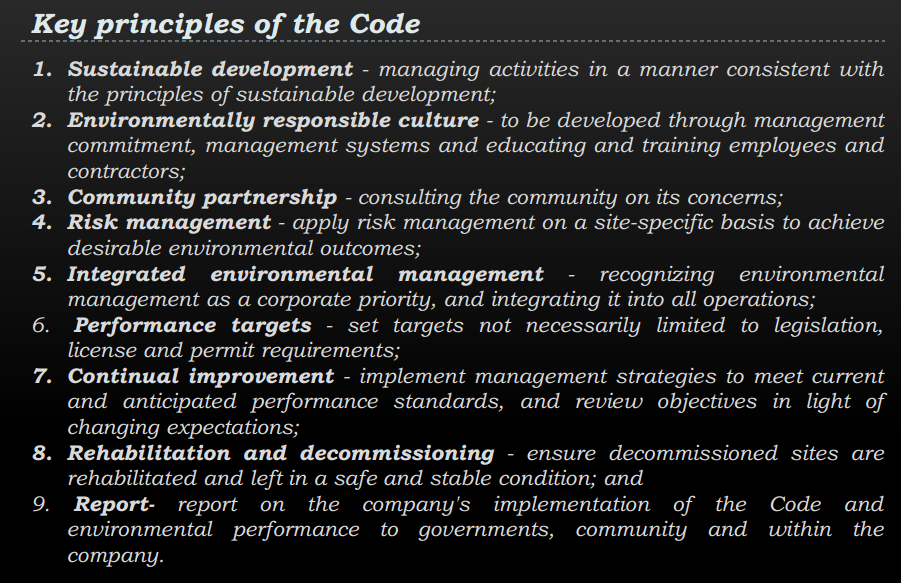
The “Australian Minerals Industry Code for Environmental Management” or "The Code‟ of 1996. This is to ensure that the country's practices in uranium mining, milling and rehabilitation meet world-class standards.
And South Africa's “Broad-based Socio-economic Empowerment Charter” (BBSEE), with a vision of "A globally competitive mining industry that draws on the human and financial resources of all South Africa's people and offers real benefits to all South Africans."

Then it has a scorecard for SA's mining industry focusing on human resource development, and employment equity.
What caught my attention in Australia's Code is that "The Worldwide Fund for Nature (WWF) stepped in to review the Code in 1999, coming up with a scorecard to have a more concrete basis in reviewing performance and adherence of companies to the Code."

