Friday, May 06, 2011

PhilHealth Watch 5: Healthcare and Civil Society

Total health expenditures (THE) is composed of spending by the (a) national government (NG), (b) local governments units (LGUs), (c) social health insurance (PhilHealth), (d) corporate or personal health insurance like HMOs, and (e) out of pocket (OOP) spending.

Here is the distribution of THE, 1997 vs, 2005. PhilHealth was created in 1995 after the defunct and heavily corrupted government MediCare went bankrupt.

(Click on the graph to see a larger image) The two charts above show that: (a) OOP spending remained at 47 to 48 percent of THE, (b) NG spending declined from 20 percent in 1997 to 16 percent in 2005, (c) LGUs’ spending also declined from 18 percent to 13 percent over the same period, while (d) Social health insurance rose marginally from 5 percent in 1997 to 11 percent in 2005.

Quick questions:

1. After 10 years of PhilHealth existence by 2005, its share in THE remains a small 11 percent, what does it imply?

2. High OOP spending even after combined government involvements by DOH, LGUs and PhilHealth, this means what -- market failure or government failure?
-----

Yesterday, there was a meeting by the Coalition for Health Advocacy and Transparency (CHAT) in Quezon City. CHAT is a coalition of health NGOs, research and advocacy NGOs, that believe in more transparency, more accountability in government healthcare policies including drug pricing policies. It is the civil society component of Medicines Transparency Alliance (MeTA) Philippines.

Among the participants yesterday, from left: Mr. John Morales of Botika-Binhi, me, Angelito Mendoza of Ayos na Gamot sa Abot-kayang Presyo (AGAP), and Roberto "Obet" Pagdanganan, MeTA Philippines Chairman. He is also a former Governor of Bulacan, former DAR Secretary, former PITC Chairman.

Gov. Obet talked about the Thailand model of universal health coverage and why it is working, with about 98 percent of the population covered by health insurance. He said that Thailand's Ministry of Health (MOH) and the Social Health Insurance Office give hospitals and health facilities in the provinces a fixed amount of money, xx Baht per year, to take care of the health needs of everyone in that province. The private and government hospitals and clinics give good quality out-patient services to patients, give them free medicines. The hospitals will earn more if patients are not confined and recover at home.

In the Philippines, the hospitals will earn more if patients are confined as they collect both from the patients and/or their private HMOs, and from the government-run PhilHealth. He believes that there are sufficient money and resources to provide universal healthcare for all without huge extra budget and higher mandatory premium for PhilHealth, if the design is appropriate, like the one in Thailand.

Vanni Villafuerte (left most in this picture), provided some philosophical discussions, like CHAT's "theory of change" and the principle of subsidiarity. He said that civil society organizations like CHAT are different from government (like the Department of Health, PhilHealth, local governments, etc.) and also different from industry (pharma companies, foreign and local; private hospitals, drugstores, HMOs, etc.).

I like his discussion. I added that each group has its vested interests. Government agencies' vested interests are to create more regulations, even more taxation of medicines and health regulatory fees. Innovator pharma companies have interests in intellectual property right (IPR) protection of their new drug inventions while some big generic pharma companies (especially local) have interests in early busting if not confiscation of the IPRs of the innovator companies. Ordinary patients and the public have interests in more healthcare choices, in cheaper, good quality healthcare.

The principle of subsidiary, I added, is actually a radical idea. It says that services and functions that can be done more efficiently by the lower social units should not be given to higher social units. For instance, those that can be done by the barangay or village should not be passed on to the city or municipality; those that can be done better by the cities should not be passed on to the province. And those that can be more efficiently done by the provinces should not be passed on to the national government. The principle of subsidiarity will result in really meaningful political decentralization.

But more than decentralization, subsidiarity principle says that functions that can be done better by individuals and their civil society organizations (like CHAT and its member-NGOs) should not be passed on to government, whether local or national. Thus, extending the principle of subsidiarity will result in smaller government and bigger role for civil society groups, individuals and households.

We do not need government, local or national government, for instance, to remind people that heavy smoking is bad for their health. Even if government will confiscate more money from the pockets of those who work hard and take good care of their body, so that government will have more money to treat those who have lung cancer, throat cancer, tuberculosis and other diseases directly related to heavy smoking, overall health outcome will remain bad or poor.

So the role of civil society groups, for me, goes beyond fiscalizing and watching government against corruption and wastes of taxpayers' money. It's more of reminding people, the ordinary citizens, that many "social services" like good healthcare can be more efficiently done by the individuals themselves, like telling people that over-smoking, over-drinking, over-eating, over-sitting, over-fighting, etc. are not good for their body.
----

See also PhilHealth Watch 3: Market failure vs. Government failure in health insurance, October 13, 2010

Thursday, May 05, 2011

The Philippines' tallest building

I am a fan of extremes. Extreme speed, like the fastest cars, fastest motorcycles, fastest drivers, fastest cyclists, fastest sprinters, runners and marathoners; extreme height like the tallest buildings, highest swimming pool and restaurant, tallest bungee jump, and so on. Or extreme strength like the strongest weightlifters, strongest and fast boxers, world's strongest man competition, and so on.

That is why in business or the economy, I believe those with extreme talent and efficiency, those with extreme ambition, should not be penalized by society -- governments and the various groups calling for "equality".

The fastest sprinter and runners are not alone. They have a huge team of support professionals, like their various coaches, sports physicians, masseurs, dieticians, and so on. The fastest cars and drivers on Formula 1 are able to make it because of several dozen support professionals in their teams. Notice that a pit stop would involve about 18 men for one car alone, to allow the car and the driver to change all 4 tires, to refuel nearly 100 liters, in just 8 seconds or less.

Builders of the tallest buildings in each country are on the category of extreme people. They have to assemble the most talented architects and engineers, get the most stable and strongest construction materials available, to build the tallest residential or office condo in each country.

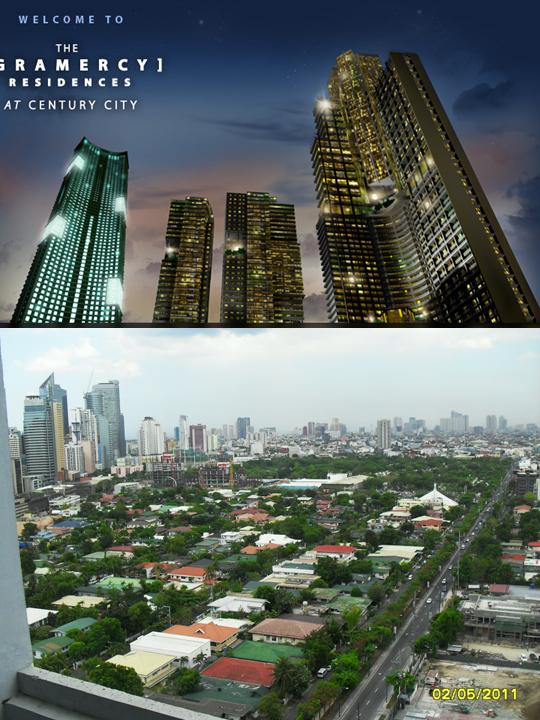
Anyway, this building still under construction in Makati City, should be the tallest building in the Philippines once it's finished. It's the Gramercy Residences, owned by Century Properties, along Kalayaan Ave., Makati City. I took these photos last weekend. This 76 storeys structure is too high if viewed near its foot.

Another view, from the 25th floor of Millennium Plaza, a building beside it. My sister in law lives in a studio in this building.

Another set of residential buildings on one side near the Gramercy, the A-venue Suites. These buildings are finished already.


Top view from the website of the Gramercy. It's the building on the right.

Lower photo is that of Bel Air village and some of the buildings along Sen. Puyat Ave. (formerly Buendia Ave.) A good view in front of the Gramercy.


I am not rich to buy any unit in those modern and tall condo buildings, I can only write about them. And this post is not an "endorsement" of the condo. Rather, this post is to further drive my point: some guys with extreme talent and extreme ambition were never inspired by governments, the UN and their endless mantra for "social equality". To force equality would mean over-regulating, over-taxing those with extreme ambitions in order to subsidize those who have little or zero ambition in life. Also to sustain a huge army of people in the bureaucracy whose main "skill" is to over-regulate the ambitious and over-subsidize the zero- or non-ambitious.

Healthcare Competition 6: United States

Healthcare and health financing is and will always be, an important topic anywhere. Economically, politically, scientifically, emotionally. It is understandable. Since late last week until today, my two daughters were sick. Life is abnormal for me whenever one of them will get sick as they are still young. So while I discuss health policy issues in this blog as objectively or academically as possible, I can be emotional when any of my family members, from my old and weak parents down to my young kids, would get sick.

Someone named Tony Shin suggested a site that gives good graphics about US healthcare spending. Four charts were posted there.


source: http://www.businesspundit.com/us-healthcare-vs-the-rest-of-the-world/,
http://www.medicalbillingandcoding.org/medical-costs-1/

The chart artist/s added that "Not only does the US spend more than other countries. Our spending is way off the charts. Most wealthy nations spend similarly on healthcare. Americans spend much more." The basis for this statement and the above image is this chart below.


Average health expenditure per person in 2007 was $7,290 in the US, while only between $2,450 to $3,900 for the six other countries mentioned. That's between 2x to 3x per capita spending, quite a lot.

A number of persons who have some personal knowledge or experience about the US healthcare system that I have talked to, say that the culprit is medical "over-diagnosis" system. Which is a result of expensive health insurance, both for patients and medical professionals. I read that average cost of legal insurance paid by physicians is $250,000 a year. That's a lot. US physicians have to pay this amount to protect themselves from the legal hassle of being sued someday. For instance, an OB-Gyne can be sued of medical malpractice by someone whom that physician has assisted in giving birth 18 years ago  

A Filipino physician friend who has migrated to the US told me the difference between the US and Philippine medical practice as something like this, say for someone who has a simple cough.

In the Philippines (and many other countries), a physician would physically examine the lungs (stethoscope), the tounge, throat, blood pressure, pulse rate, etc., aside from asking a few questions. In the US, a physician would request a blood test, X-ray, even a CT scan, before he will give drug prescriptions and other advice. Those diagnostic tests are the paper trails that a physician will hold on in case a patient might sue him later for whatever medical malpractice charges. And those diagnostic tests would easily shoot up the cost of healthcare, while the physician will charge high to reflect the high insurance premium they pay for the insurance industry against possible medical malpractice litigations in the future.

My Filipino physician friend added that if one sees a person lying unconscious on the street or being hit by a car, he/she cannot just assist the patient because if something happens further to that patient due to mishandling by the good but untrained samaritan, the latter can be sued in court by the patient later.

A highly litigious society like the US, supposedly to protect patients, can actually hurt patients and their family members because of those legal issues and high medical costs.

One more proof why inviting government to have bigger role and intervention in healthcare delivery can create more adverse, unintended consequences to the public.
-------

See also:
Healthcare competition 1: Switzerland, August 28, 2010
Healthcare competition 2: Singapore, August 29, 2010
Healthcare competition 3: Hong Kong, September 02, 2010
Healthcare Competition 4: Solving Info Assymetry, September 08, 2010
Healthcare Competition 5: Thailand, September 24, 2010


Healthcare Monopoly 1: France and Canada, September 05, 2010
Healhcare Monopoly 2: United Kingdom, February 17, 2011

APTU meeting in Bangkok, part 2

In Part 1 of this discussion, I briefly introduced the Asia Pacific Taxpayers Union (APTU) and some of its member-organizations, and the World Taxpayers Association (WTA).

I was not able to attend the APTU meeting in Bangkok last week due to financial constraints. And it was good that I did not go there because my two daughters got sick and I have to bring them to a doctor on those days that they were meeting in Bangkok.

Mr. You of Japan Taxpayers Association (JTR) sent me this group picture below.


From left, 2nd row: Ms. Gulyaim Nurbekova of Kazakhstan Taxpayers Association, Mr. You of JTR, Mr. Bjorn Tarras-Wahlberg, WTA Sec-Gen. and APTU Chairman, Mr. Fengiang Liu of Beijing International Taxation Research Society (BITRS), Mr. Raymond Ho of Momentum 107-HK, Mr. Jaya Naidu from Australia. In front is Mr. Kim SunTaek of Korea Taxpayers Association. Beside him are English translators of Mr. Kim, Mr. Liu, and... I don't know the 2 other ladies :-)

From several email exchanges where I was cc'd, it was a good meeting, good. Below is a portion of the presentation made by Bjorn.


Many countries are now competing at 10 percent flat income tax rate. Since this trend in tax competition is likely to continue, not reverse, then we should be seeing income tax rates going down to 6-7 percent or lower in some countries in the coming years.

Below is another slide from Bjorn. Georgia is stepping hard on the tax competition pedal.


Next year, Georgia's personal income tax will go down to only 7 percent and it will abolish taxes on dividends and interest income. It has also abolished capital gains tax. All other things being equal, it should be safe to assume that more and more foreign investors and professionals will be trooping to Georgia to do business there.

The governments of the Philippines and many other countries should think hard of this tax competition currently on-going. Higher taxes will either discourage businesses, or businesses will still come provided various loopholes and tax credits can be availed of. Or higher taxes will encourage government corruption, more tax cheating and avoidance, with the likely connivance of several officials and personnel of tax collection agencies themselves.

Tuesday, May 03, 2011

Free Trade 16: Price Equalization vs. Export Subsidies

Free trade simply means freedom of people to trade with other people. It is not the freedom of government trade officials, or the freedom of international trade bureaucracies (UN, WTO, foreign aid bodies), to determine and negotiate "in behalf of the people" how much restrictions, prohibitions and limitations to international trade can be relaxed in exchange for something.

The ugliness of trade protectionism is illustrated by this graph below. This is from a paper entitled "Obstacles to free trade: Thrashing protectionist logic" that I presented at the 3rd Asian Liberty Forum, September 11, 2006, Corus Hotel, Kuala Lumpur, Malaysia. It was jointly sponsored then by the Atlas Economic Research Foundation and the Friedrich Naumann Foundation (FNF).


Import tariff and taxes immediately raise the price of imported goods, making these as expensive as, if not more expensive than, the locally-produced substitutes. Having Protected price (Pp) higher than Free trade price (Fp), many consumers who would have patronized the imported goods are discouraged; but the protectionists get lower sales volume or quantity (Pq) as consumers buy less.

The bigger the gap between Pp and Fp, the higher the motivation to do smuggling. Trade smugglers are usually from among the politicians in power, or their friends. Thus, if the goal of the state and the protectionist business interests is to raise revenues for the government and to protect the local industries, smuggling defeats it. So more protectionism means more government corruption, especially in countries where the rule of law is not clearly respected and promulgated.

If free trade is respected worldwide, then over the long term, commodity price equalization (CPE) will happen, assuming that transport/shipping and related costs are low or zero. Below is an illustration of CPE.

Consider three group of countries:

Country A has rice surplus production every year (wide and flat riceland, good irrigation, few typhoons, good technology, small population).
Country B has rice deficit every year (mountainous and degraded land, poor irrigation, lots of typhoons, poor technology, big population).
And Country C produces no rice (industrialized and urbanized, imports many of its food requirement).


If trade is disallowed or at least restricted, country A will have very low rice price because of over-supply. Country B will have expensive rice because of under-supply. And country C will have very expensive rice. With free trade, there should be rice price equalization among the 3 as whatever surplus in A will be bought and imported by B and C.

Lots of discussions and negotiations at the World Trade Organization (WTO) are unnecessary if people fully understand what free trade really is. If I need a laptop, I do not make any conditionality to any laptop producer anywhere in the world, like they should not be hiring child labor, they should not be discriminating against women labor, they should be engaged in massive tree planting somewhere, and so on. None of that. I just want value for my money, a good laptop at my limited budget.

But the trade bureaucracies, like climate bureaucracies, labor bureaucracies, from national governments to multilateral institutions, have their own interests that are often in conflict with consumer interests. It is to the interest of these bureaucrats, in cahoots with protectionist, monopolist, and leftist interests, that real free trade will not happen. Otherwise, they will become jobless and powerless.


The folly of export subsidies and domestic support

One of the big ironies or contradictions in public policies by statists and economic central planners is that while they repeatedly announce they want cheaper and stable price for their citizens, they also dislike it when governments of other countries will do it for them.

When government of rich countries provide export subsidies and domestic support to their own farmers and manufacturers, their goal is to make their expensive exports become cheaper to consumers of other countries. So when the governments of France, Germany and the US will subsidize their exporters (using their own taxpayers' money of course) so that such exports will become cheaper to consumers in the Philippines and other poorer countries, why would the Philippine government complain?

Here's a graph that I developed while pondering on the craziness of export subsidies on one hand, and anti-dumping and/or countervailing duties on the other.


The goal of export subsidies and domestic support by rich countries is to make their exports cheaper abroad. That is, to bring down from Price 1 to Price 3. This way, they can help maintain their being an export powerhouse status and in the process, create more jobs at home. Consumers of poorer countries should be happy with this scheme.

But protectionist interests, anti-globalization and statist sentiments plus the itch to intervene by certain government bureaucracies, find this arrangement as "unfair". Thus, they invented anti-dumping laws, counter-vailing duties, or new import taxes to make the supposedly cheaper imported goods become expensive again. Isn't that idiotic?

Not satisfied with such idiotic idea of bringing up Price 1 to Price 3 again, they may even slap counter-vailing duties to exports by other poorer countries (China, Vietnam, India...) so that what could have been an even lower Price 4 will become more expensive, to Price 3 level.

Statists, protectionist businessmen, government trade bureaucrats, and even private/academic trade consultants, never run out of inventing or re-inventing new schemes to make free trade and real consumer empowerment an impossible dream.
------

On August 28, 2010, I wrote this:

Free Trade and Globalization Favored Asia

Free trade favors the efficient producers and penalizes the less efficient and protectionist-seeking ones. Or put another way, free trade penalizes the complacent and the lazy. And it is not the concept or theory itself that gives the verdict, but the people themselves, the consumers and buyers.

Over the past few years, natural increase in population and growing material wealth afforded by global capitalist competition enabled hundreds of millions of people to move across countries and continents. And when people move, their goods and services also move with them, or follow them. A number of Asian economies benefited from this new development.

A new graph from The Economist, August 24, 2010 issue, showed this interesting table, the world's largest container ports, 1989 vs 2009.

The figures are very revealing, that many Asian cities benefited from freer trade -- at least compared to the protectionism several decades ago -- and expanded consumption capacity of more people around the world. The paper made this observation:

Singapore has now nabbed the top spot and every other big port in 1989 has moved down the list. Twenty years ago more than half of the top 20 container ports were in America or Europe reflecting imports into both regions from around the globe. Now, Asia's strength as an exporter is more in evidence. Fourteen of the top 20 container ports are in that region, with eight in China.

Rightly so. Comparing the growth of the biggest port in Asia in 1989, Hong Kong, vs. the biggest port in Europe, Rotterdam, and the biggest port in North America, Los Angeles, over the same year, forward to 2009:

1. Hong Kong, from 4.5 million twenty-foot equivalent units (TEUs) in 1989 to 20.9 M TEUs in 2009, 4.6x increase.
2. Rotterdam, from 3.9 M TEUs to 9.7 M TEUs over the same period, 2.5x increase.
3. Los Angeles, from 2.1 M TEUs to 6.7 M TEUs, 3.2x increase.

And since Dubai and UAE is part of the Asian continent, then only 5 of the top 20 biggest ports in the world are non-Asian (Rotterdam, Antwerp, Hamburg, LA and Long Beach).

One may wonder how come that Singapore with only about 4.7 million people, would have the biggest port in the world?

The quick answer would be tourism and foreign investmentts. If I remember it right, Singapore gets about 10 to 12 million tourists and visiting investors every year. Those tourists stay in hotels (big demand for construction and capital goods) and do a lot of shopping (big demand for consumer goods). Just like in Hong Kong, Singapore imports by containers, and "exports" by hundreds of millions of shopping bags from departing tourists.

Singapore, Shanghai and Hong Kong should be prime examples of the beauty of free trade, and why countries should embrace free trade and more capitalist competition. Not trade protectionism and bigger state business regulations and restrictions.
---------

See also:

Bin Laden and the State

Capturing state power, or sabotaging a state that they cannot control, is the dream of all statists around the world. Change, for better or for worse, can only be done via the state, nothing else.

The Twin Towers in NYC were among the important symbols of global capitalism in general, and US capitalism in particular. By destroying the two towers, Osama Bin Laden (OBL) and his Al Qaeda warriors sent a strong message that they intend to kill more people, civilians preferably, so that they can sabotage US capitalism and state imperialism in the short-term, and establish a radical Islamic brotherhood worldwide over the long-term.

Most radical statists would target government structures, military and police agencies in particular, and kill as many government officials, soldiers and policemen as possible, not civilians. But OBL and his warriors, and several other terrorist groups around the world, would prefer to kill civilians -- you and me, our family and friends, non-combatants -- to achieve their short- and long-term goals.

(These pictures from NYT) Now OBL is dead. Good for you, ultra-terrorist. By aspiring to kill more civilians worldwide, you got the ire of civilians like me.

The BIG government of the US, is the main enemy of many terrorists, communists, and other statists on the other side of the fence. BIG states, whether democratic or totalitarian, always result in more coercion and subjugation of the individual. They only differ in the extent or level of coercion.

It is important that people express their views as openly as possible. This reduces the need to go for violent means of criticizing or attacking BIG governments. Killing civilians, blowing up big civilian structures, are wrong and criminal. We civilians can give credit to a BIG and armed government, like the US government, if it does its important job of protecting the citizens' right to liberty, right to private property, right to live peacefully.

It's another thing though, when that same BIG government will invade other countries for oil or other business and political interests. Or support many dictatorial governments abroad that kill many of its citizens, provided that such dictators will remain friendly to it.

And this is how OBL' statism exhibited another failure. They criticized only the US government's foreign policy and "imperialism", but they are silent of the monarchies and absolute dictatorships that rule the Middle East, Africa and other regions.

Monday, May 02, 2011

Tornadoes, tropical storms, and climate conference

(This is my article today in thelobbyist.biz)

It never fails. Any “extreme” weather events anywhere around the world, the warming camp always blame “man-made warming” and its cousin, “man-made climate change”. The most recent “extreme” weather were the violent tornadoes that hit a number of states in the US. So far, 250 people have been confirmed dead.

Are the violent tornadoes rising and getting “more extreme” that many warming fanatics say? This table below is a quick answer, data from the US government itself.

source: National Climatic Data Center
http://lwf.ncdc.noaa.gov/img/climate/research/tornado/tornadotrend.jpg

What about the tropics, are they right to say that the number of severe storms are rising? This second table provides the answer.

source: Dr. Ryan Maue, “Global Tropical Cycle Activity”,
http://www.coaps.fsu.edu/%7Emaue/tropical/

So the warming fanatics are lying when they say that violent tornadoes in the northern hemisphere, and the number of storms and hurricanes in the tropics, are increasing. Because based on the warming religion, because of “unprecedented, unequivocal global warming”, those weather events are supposed to become more frequent.

This coming June 30 to July 1, the Heartland Institute will sponsor the 6th International Conference on Climate Change (6th ICCC) in Washington, DC, USA. Details about the event can be found here, http://www.heartland.org/events/ICCC2011/index.html.

Heartland has been instrumental in exposing these shenanigans where political science is much stronger than their climate science. The past five ICCCs that it has sponsored, especially the 1st (2008, NYC), 2nd (2009, NYC) and 4th (2010, Chicago), were hands down success.

The United Nations has several dozen tentacles of international bureaucracies. The most famous of which in the climate debate are the Intergovernment Panel on Climate Change (IPCC), Framework Convention on Climate Change (FCCC), the UN Environmental Program (UNEP), and the World Meteorological Organization (WMO).

The UN headquarter is in NYC. So when Heartland organized the first two ICCCs in NYC, attracting some 700 international speakers and participants that openly question and challenge the UN reports and activities on climate, Heartland also invited key officials and lead authors of the UN IPCC, Al Gore and other warming leaders, the UN should have sent 100 or more out of its “thousands of warming scientists” to square off with those “ungrateful skeptics” who oppose saving the planet.

But no. The UN and top leaders of the warming camp have one standard reply to invites to big, open debates: the sound of silence. Not a single shadow from among the IPCC lead authors showed up.

Let us hope that they will have the balls to show up and challenge the skeptics of the “man-made warming” hypothesis.

Our think tank, Minimal Government Thinkers, Inc., again is among the international co-sponsors of the ICCC. We are the only Philippine-based organization that partners with Heartland and other climate realist groups in exposing the non-truths and half-truths of the warming hysteria and climate alarmism.

We invite our friends to attend the 6th ICCC. Especially those who are based in the US.

Let us put a stop to all these heavy politics of climate alarmism. Climate change is purely natural, in a warming-cooling-warming-cooling cycle. It is never man-made. Even if everyone in this planet will drive a car, global cooling is going to happen. Even if everyone will ride bicycles and all cars, buses and airplanes are thrown away, global warming is going to happen.

Sunday, May 01, 2011

Alzheimer's, getting old, and new drugs

Alzheimer's is a cruel disease. Some friends of mine swear to it as their parents have that disease. The parents who gave them life, them who sacrificed a lot to give them good education, comfortable living, brought them to many memorable places and people, slowly forget those things. What's worse, they slowly forget about themselves, and their children.

Alzheimer's disease is the progressive deterioration of mental functions. Starting from limited and declining attention span to behavior change to forgetfulness.

There is one good advocacy group, the Alzheimer's Association based in the US. They produce good information materials and data about the disease. Among such data include:
* An estimated 10 million baby boomers will develop Alzheimer's.

* Starting this year, more than 10,000 baby boomers a day will turn 65. As these baby boomers age, one of out of eight of them will develop Alzheimer’s – a devastating, costly, heartbreaking disease. Increasingly for these baby boomers, it will no longer be their grandparents and parents who have Alzheimer’s – it will be them.

* "Alzheimer’s is a tragic epidemic that has no survivors. Not a single one," said Harry Johns, president and CEO of the Alzheimer’s Association. "It is as much a thief as a killer.

The Association recently produced a new report, Generation Alzheimer's: The Defining Disease of the Baby Boomers . Some data from the report says:

* 5.3 million people (in the US) have Alzheimer's
* costing some $172 billion a year
* it is the 6th leading cause of death in the US.

This data is too graphic: while the percentage change in deaths from cancer, heart diseases, stroke and HIV is declining or in the negative territory, the change in death for people with Alzheimer's is increasing. Period covered was 2000 to 2008.

As I consistently argued in this blog and in my other writings, as diseases evolve, as lifestyle evolve, treatment should evolve, continuously, no let-up. Such treatment range from new medications to new knowledge of assistance by those who take care of Az patients. I also repeatedly argue that the role of private enterprises, the competition among them, is what will provide the continuing and long-term solution to various health problems that mankind will see. It's not more government regulations, more government provision of healthcare, more government taxation to finance those often choking regulators and bureaucrats, and expensive healthcare subsidies and entitlements.

I checked with innovation.org to see the extent of medicine innovations that are in development. This is a welcome news -- some 98 new drugs in various phases of R&D are in the pipeline. Data is from 2010 Report: Medicines in Development for Alzheimer's Diseases.

As I noted in my earlier paper, Going back to our roots, my father is now 83 years old, my mother is 77. I am glad that so far, they do not show symptoms of the Az disease. But a number of senior Filipinos that we sometimes fondly call as "ulyanin" (forgetful, irritable) may be showing symptoms of Az, whether mild or moderate. Severe cases would easily lead to death as the mind and body would ultimately shut down.

One important public health policy debate today or someday will be, by how much government healthcare expenditures should be devoted to Az disease treatment. Unlike mostly lifestyle-related diseases like lung cancer, heart diseases and diabetes, Az disease is due to nature, our biological clock ticking fast.

The cost of treatment of this and other diseases should be kept as low as possible. It can be done through more treatment and medicine innovation, and the fierce competition among innovator companies, and later on, among generic companies.
-----

Related articles on innovation here will be:

On intellectual property abolition, part 3,
IPR and medicines, part 8