Showing posts with label Joshua Lipana. Show all posts

Tuesday, April 23, 2013

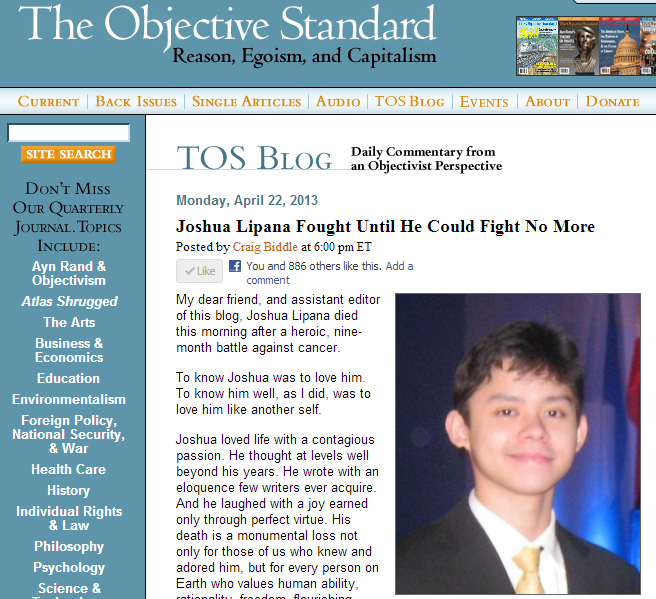
Joshua Lipana, Filipino Objectivist and Free Marketer

A sad day for the free market movement in the Philippines. One of the youngest, most articulate, most promising leader among different shades of free marketers in the Philippines, Joshua Lipana, died today at age 21 or 22. He fought cancer for several months now.

His last postings in his facebook wall were:
154,000 WBC down to 13,970 WBC. Chemo is working. (April 13, 2013) 
Operations done. No more 2 litres in my right lung. I feel much better. No more drowning sensation. I want to live. (April 4, 2013)
I heard of him first sometime in 2010 then I started visiting his blog, http://joshualipana.com/. After several email exchanges, I requested for a meet up, along with Froilan, the owner of The Vincenton Post, http://fvdb.wordpress.com/ These two young men are among the prominent leaders in promoting Objectivism and Ayn Rand's philosophy in this country.

Last April 12, 2011, we met up at Starbucks, Shangrila Mall, Ortigas. When I saw him personally, I thought he was only a high school student. He said he was 19. We discussed lots of things -- from objectivism to libertarianism (anarchy, minarchy, other shades), intellectual property rights (IPR), RH bill (now a law). He was very articulate and passionate. He and Froilan are young guys with big, bright minds.


After Starbucks, we went down to a bar on one side of the same mall. And we discussed more until late evening. We should have been exchanging ideas for about 6 hours that day.


I told him and Froilan that I wanted a part 2 of our meeting and discussions. We tried several skeds but they never materialized. Until I learned that Joshua was fighting cancer.

At a young age, Joshua was the Assistant Editor of The Objective Standard (TOS) since October 2011 until he died. After high school, he did not go to college, deliberately, as he wanted to write more about objectivism and the free market, and he thought that pursuing a college degree might be a distraction from his passion.


His blog is not regularly updated as he was busy with TOS. But even if he was fighting cancer, he managed to publish several articles, below.

Subway Founder Fred Deluca Decries the Regulatory StateTOS Blog, March 6, 2013.

The Light Brigade Shines for CapitalismTOS Blog,  February 24, 2013
(LTE)Kerry’s past exploits are tellingThe Washington Times, December 27, 2012.
Medical Device Tax: Immoral and ImpracticalThe Objective Standard Blog, December 10, 2012.


Rest in Peace, my friend. I am very sad.

There should be a big reason for us why you left early...

* See also Filipino free market blogs, part 3, April 14, 2011

Thursday, August 23, 2012

Filipino Free Market Blogs 4

How is the free market movement going in the Philippines?

There are several qualitative and anecdotal discussions and proof that shows it is alive and kicking. By how much?

Until now I can only think of one measurement, and that is the global traffic rank of Filipino free market blogs via www.alexa.com. As of today, here are the top five and their respective global ranks:


As there are several hundred million blogs and websites worldwide, to land in the first six million would be a privilege. Here are other free market-oriented Filipino blogs but have relatively low (above 20 million) or no rank assigned by alexa.

1. Carlos Tapang, http://ctapang.wordpress.com/
2. Joshua Lipana,  http://joshualipana.com/
3. Laisse Faire Filipino,  http://filipinofreedomfighter09.blogspot.com/
4. Minimal Government Thinkers, Inc. http://www.minimalgovernment.net/
5. Monkey Society, libertarian Buddhist blog,  http://monkeysocietyblog.blogspot.com/
6. New Commonwealth, http://libertadfilipinas.wordpress.com/

I think there are other free market-leaning blogs and websites by Filipinos, whether based here or abroad. I hope to find and read them someday.

Wednesday, March 14, 2012

Fat-Free Econ 2: Determinants of Private Consumption Expenditures

Before my additional discussions, may I post a comment from a friend, Joshua Lipana, to my article last week in interaksyon.com, Macroeconomics for Micro Concerns,
http://www.interaksyon.com/article/26322/fat-free-economics-macroeconomics-for-micro-concerns and my reply to him:
--------

Joshua Lipana ·  · Assitant Editor, TOS Blog at The Objective Standard
I disagree extremely with the assertion that the police force should not be government funded. It is true that private security firms are good, but they cannot replace the cops in going after criminals. Having no government police force would result in gang warfare.

In particular, "competing governments" is what I see being implied here with the assertion that the police force should be replaced by private security firms. To quote Ayn Rand, "[S]uppose Mr. Smith, a customer of Government A, suspects that his next-door neighbor, Mr. Jones, a customer of Government B, has robbed him; a squad of Police A proceeds to Mr. Jones’ house and is met at the door by a squad of Police B, who declare that they do not accept the validity of Mr. Smith’s complaint and do not recognize the authority of Government A. What happens then? You take it from there."
  • Nonoy Oplas · University of the philippines
    Hi Josh, I never wrote or implied that "the police force should not be government funded." I believe there should still be a lean government police force, especially in cases of disputes bet or among private security agencies, the govt justice and police forces will serve as the final arbiter or referee. But in most cases of crime prevention and deterrence, private security forces do a better job than the govt police. I cannot expound on these issues too long in my paper as the focus is on macroecon, the components of Y = C+I+G+(X-M), thanks.
  • Joshua Lipana ·  · Assitant Editor, TOS Blogat The Objective Standard
    Hi Nonoy, thank you for clarifying. Whether or not you meant to, the way you wrote it implied privatization of the police force as the ultimate goal. But I'm glad to hear otherwise.
  • Nonoy Oplas · University of the philippines
    I'm no anarchist, I'm a miniarchist, that's why. But I believe that the PNP should be shrank significantly, but not abolished. Crime prevention is better done at the barangay level, the barangay tanods. PNP can focus on highly organized, well-armed criminals like carnappers, kidnappers, bank robbers, private armies.
  • Joshua Lipana ·  · Assitant Editor, TOS Blogat The Objective Standard
    Thanks for further clarifying. I agree with much of that, only I don't think it should necessarily be shrank. If you cut government spending elsewhere, you could continue to fund the PNP without much problem. And if you cut enough from government education and welfare, you could even raise the entire budget for the cops and the entire AFP.
  • Nonoy Oplas · University of the philippines
    I'm no fan of expanding the AFP and PNP. For me, external military threat is next to zero, so the reason for keeping a big AFP is mainly for pol patronage and rent-seeking by the AFP officials. The main deterrent to crime in gated villages, schools, malls, etc. are private security guards. For non-gated villages, it's the brgy tanods. I think a G/GDP ratio of 3-5 percent (vs the current 10-12 percent) is good because there is also a big govt share in the I/GDP ratio, public investments like road infra, school bldgs, etc. The ratio of LGU spending over GDP is also rising.


Let me now expand the discussion on the components of Y = C + I + G + (X-M) as my article in interaksyon.com has space constraints.

       GNP = GDP + net factor income from abroad (NFIA) - errors and omissions.

NFIA includes OFW remittances net of repatriations by foreigners here. It is big and thus, GNP appears larger than GDP. Errors and omissions (standard deviation) are, I think, where some manipulations are made to project a higher than actual GNP, done by an administration in power. In this dual treatment of national income,

GDP = production (both goods and services) within the national territory by both locals (ie, Filipinos) and foreigners.

GNP = production by locals only, both in the home country (ie, Philippines) and abroad.

Since Private Consumption Expenditures (PCE) or simply C constitutes a big portion of Y (73 percent of GDP on average): Government should NOT introduce plenty of distortions like high income tax and high consumption tax (VAT or sales tax) at the same time because this siphons off resources from private individuals' pockets to government pocket. Government pocket in many cases, is a huge black hole. Funds either disappear or are not spent well.

Let us now introduce additional equations:

       C = a + (b x Yd) 

where:
a = autonomous consumption. Even those with zero income like babies, children, mentally or physically handicapped, the lazy, etc.) would still consume food, electricity, healthcare, etc.

b = marginal propensity to consume (MPC). Not all of disposable income (Yd) goes to consumption, some will go to savings to finance current and future investments.

      Yd = Y - T

Disposable income (Yd) is aggregate income (Y) minus taxes (T), or simply after-tax income.

The bigger or the plentier the T, the lower the disposable income (Yd), the lower the potential C, and GDP will be affected negatively. Keynesians or plain lovers of more government can argue that T will go to government spending (G) and it is supposed to bring some "stimulus" to the Y. But given the distortionary impact on C and the black hole nature of many G, a big portion of Tand G simply becomes a huge deadweight loss on the economy.

Many other taxes, existing or proposed, impact negatively on investments (I), not just C. These include proposals like "tax hot money more, more". These guys are not aware that there are at least two existing direct taxes that affect portfolio investments or hot money -- documentary stamp tax (DST) and capital gains tax (CGT). There is a 3rd and indirect tax, and that's endless government borrowing to plug some blackhole spending like interest payment and endless pork barrel. More government domestic borrowing means government is competing with private borrowers for limited pool of excess local savings. And this will result in higher domestic interest rates (i), which discourages I somewhere.

Introducing a 4th tax, the "Tobin tax" on portfolio investments therefore, is one cute way to bring down potential I.

Meanwhile, I posted a shorter version of this paper sometime in December 2010. There was one comment then, below:

From Anonymous: You wrote: More government borrowings means higher interest rates (i). US national debt has increased about 11 fold since 1980 and interest rates have gone to historic lows over that period. So plain and simple, your opinion above is refuted by fact. The US government creates the money it spends - it does not need to borrow or tax. Interest rates are set by the Fed, usually on short end of curve but their operations can set interest rates anywhere on the curve.

There are two important factors why more government borrowings may not result in higher domestic interest rates. One has been mentioned by the Anonymous commenter, the Fed simply printed more money, more dollars, an expansionary monetary policy, for the US federal government to spend and spend. And two, when the government (in this case, the US government) would borrow abroad and use foreign savings, not local savings. The impact would be a rise in global interest rates, all other things being equal.

Ever-rising public debt due to uncontrolled rise in the size of government, ie, higher G, will have impact on: (1) higher domestic interest rates (for domestic borrowings to finance its annual budget deficit), and (2) higher domestic inflation rates, as a result of more printing of money if local production of goods and services cannot cope with the percentage increase in money supply.

The rise in (1) and (2) above will ultimately affect negatively C and GDP.

Lesson: BIG government is bad. Further expanding it simply worsens it.

* See earlier paper, Fat-Free Econ 1: Macroeconomics for Micro Concerns, March 08, 2012.