Showing posts with label Objectivism. Show all posts

Tuesday, April 23, 2013

Joshua Lipana, Filipino Objectivist and Free Marketer

A sad day for the free market movement in the Philippines. One of the youngest, most articulate, most promising leader among different shades of free marketers in the Philippines, Joshua Lipana, died today at age 21 or 22. He fought cancer for several months now.

His last postings in his facebook wall were:
154,000 WBC down to 13,970 WBC. Chemo is working. (April 13, 2013) 
Operations done. No more 2 litres in my right lung. I feel much better. No more drowning sensation. I want to live. (April 4, 2013)
I heard of him first sometime in 2010 then I started visiting his blog, http://joshualipana.com/. After several email exchanges, I requested for a meet up, along with Froilan, the owner of The Vincenton Post, http://fvdb.wordpress.com/ These two young men are among the prominent leaders in promoting Objectivism and Ayn Rand's philosophy in this country.

Last April 12, 2011, we met up at Starbucks, Shangrila Mall, Ortigas. When I saw him personally, I thought he was only a high school student. He said he was 19. We discussed lots of things -- from objectivism to libertarianism (anarchy, minarchy, other shades), intellectual property rights (IPR), RH bill (now a law). He was very articulate and passionate. He and Froilan are young guys with big, bright minds.


After Starbucks, we went down to a bar on one side of the same mall. And we discussed more until late evening. We should have been exchanging ideas for about 6 hours that day.


I told him and Froilan that I wanted a part 2 of our meeting and discussions. We tried several skeds but they never materialized. Until I learned that Joshua was fighting cancer.

At a young age, Joshua was the Assistant Editor of The Objective Standard (TOS) since October 2011 until he died. After high school, he did not go to college, deliberately, as he wanted to write more about objectivism and the free market, and he thought that pursuing a college degree might be a distraction from his passion.
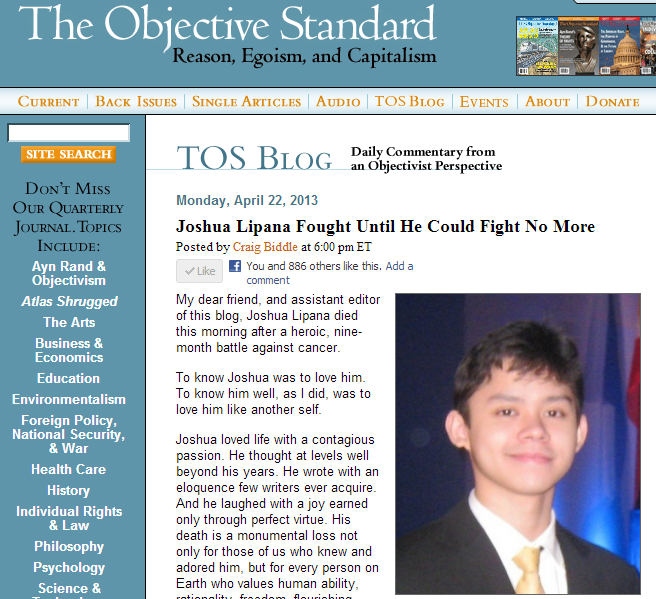

His blog is not regularly updated as he was busy with TOS. But even if he was fighting cancer, he managed to publish several articles, below.

Subway Founder Fred Deluca Decries the Regulatory State, TOS Blog, March 6, 2013.

The Light Brigade Shines for Capitalism, TOS Blog,  February 24, 2013
(LTE)Kerry’s past exploits are telling, The Washington Times, December 27, 2012.
Medical Device Tax: Immoral and Impractical, The Objective Standard Blog, December 10, 2012.


Rest in Peace, my friend. I am very sad.

There should be a big reason for us why you left early...

* See also Filipino free market blogs, part 3, April 14, 2011

Thursday, October 18, 2012

Rule of Law 17: Justice Without Discrimination

I like this posting today in facebook by FNF Pakistan, reposting it.
#####

These were the last written words we have received from Hasan Jafarey, who died two days ago. He wrote his perception during our IAF Alumni Meeting in September:

Why I am liberal 
Principles of liberalism pertinent to Pakistan
By Hassan Jaffarey

1. Rule of law

The most important function of the Rule of Law is to provide for justice to all without discrimination. This is the only glue that can provide for harmony and equality. When a sense of justice and the existence of a just society exists in polity and the polity is assured that it will be meted out justice in its relations and affairs with equality for all whether rich or poor, high or low, and without racial, ethnic or religious prejudice that society is set on a firm and sustainable foundation for progress and emancipation and empowerment.

Pakistan lacks this sense of justice among its polity. There is a perception and actual reality that the rule of law is not applied equally for all. Different sets and parameters govern different individual and groups in different ways. The disharmony and the application of the rule of law has led to a sense of frustration and alienation in the people of Pakistan as a whole.

It is therefore of paramount importance that a strict application of the rule of law is implemented in Pakistan. The people of Pakistan demand this and not implementing it is a sure recipe for disaster. To achieve this judicial reform backed up by the force of law is required from the lowest ties to the highest in the country.

2. Tolerance

Pakistan is in dire need of having a tolerant society. The absence of the rule of law contributes to intolerance in the Pakistani Society as a disgruntled polity, surfaces its latent frustration and anger upon one another.

Tolerance does not mean giving up one’s beliefs but contributes to accommodate in diversity of opinion and trying to understand other people’s point of view. Respecting the non-violent expression of dissent contributes to a multicultural polity. There should be unity in diversity. Division should be able to grow together. Respect for others gains in respect for each other. It reinforces the environment for a peaceful coexistence. Liberty, indeed, must be with responsibility. My freedom ends where other persons’ freedom begins. This is the recipe for peace and Pakistan needs it badly.
# # # # #

Meanwhile, I gave a lecture yesterday at my wife's two classes in political science at De La Salle University (DLSU), where she is handling four classes this trimester.

The first class was a Freshmen block of International Studies majors, and the second class was a Freshmen block of athletes of the university. Cool guys.

My powerpoint contained  26 slides, showing only half here. The content I lifted from my previous blog posts here under the "Pol. Ideology" discussion series.

Friday, October 12, 2012

Pol. Ideology 37: Collectivism, Conservatism and Liberalism

This will be a continuation and expansion of my earlier paper, Pol. Ideology 15: Socialism, Conservatism and Liberalism posted last March 08, 2010. It is about a discussion paper by Stefan Melnik on Political Values -- Review of Basics, written possibly in 2008-09. These are the three major political mainstreams and the value systems that they preach.
Socialism and its cousin ideology, communism, highlights or focuses on equality and forced collectivism. Equality of outcome, social justice, income redistribution, social security, state welfare and forced solidarity. These are the synonyms of their heavy focus on equality and forced collectivism. Too much individual liberty and private property are not good, according to this philosophy, so they have to be limited and heavily regulated by the state, leading to social or communal ownership of the means of production, central planning by the state and its lower organs and government agencies.

Conservatism focuses on order, tradition and conservation of existing social units.  Thus it highlights discipline, authority, hierarchy, the conservation of the nation, the family, morality. There are some similarities with socialism like the big role of state authority, distrust of spontaneity and importance of managed order. But there are also differences as there is primacy given to non-government social units like the family, clan and private enterprises.

Liberalism focuses on liberty or freedom, individual liberty specifically and individual responsibility. Liberty and responsibility are closely and strictly intertwined, one is not possible without the other. With more individual liberty, spontaneity, diversity and inequality are inevitable. Tolerance of such diversity and spontaneity among people, their right and choice to be industrious or be lazy, their private property ownership, are part of human rights that are to be respected under strict respect of the rule of law, equal application of the law on unequal people.

Tuesday, November 29, 2011

Pilipinas Forum 21: On Ayn Rand and Keynes

This is among the philosophical discourses in pilipinasforum@yahoogroups nearly 8 years ago. Postings in the  PF are raw and written informally, but the content are generally serious. Unlike other PF series here, there are just a few exchanges here, and only more than 5 pages long. Enjoy.
---------

Ayn Rand and Keynes

January 8-10, 2003

Ayn Rand will generally disagree with a Keynesian approach of uplifting human welfare. A rice farmer and fisherman can pursue their individual interests (surplus of their produce they sell to the market) and they end up providing rice and fish in our dinner tables - - welfare for both producers and consumers. This short article below by Ayn Rand (I got from my other egroups) will elucidate this philosophy...

A seemingly perennial and prolonged (1998-2003 and counting...) budget deficit situation is anti-individualism, anti-market, anti- self-interest. Why? A government which can hardly distinguish which public services promote efficiency and which ones promote complacency, even laziness and monopoly, is being kept afloat by sustained borrowings. Its philosophy is: never mind today's debts, tomorrow's taxpayers will pay them.

Should we discourage, even scare, a large segment of the productive sectors of our society -- them tax-paying professionals, entrepreneurs, other skilled workers -- with high tax rates and complicated tax system in the future, so the inefficiencies of the past will be paid?

- Nonoy Oplas
-------

INTRODUCING OBJECTIVISM

By Ayn Rand

At a sales conference at Random House, preceding the publication of Atlas Shrugged, one of the book salesmen asked me whether I could present the essence of my philosophy while standing on one foot. I did as follows:

1. Metaphysics: Objective Reality
2. Epistemology: Reason
3. Ethics: Self-interest
4. Politics: Capitalism

If you want this translated into simple language, it would read: 1. "Nature, to be commanded, must be obeyed" or "Wishing won't make it so." 2. "You can't eat your cake and have it, too." 3. "Man is an end in himself." 4. "Give me liberty or give me death."

If you held these concepts with total consistency, as the base of your convictions, you would have a full philosophical system to guide the course of your life. But to hold them with total consistency — to understand, to define, to prove and to apply them — requires volumes of thought. Which is why philosophy cannot be discussed while standing on one foot — nor while standing on two feet on both sides of every fence. This last is the predominant philosophical position today, particularly in the field of politics.