Where there is lack of competition, there is generally lousy service and/or expensive prices. A monopoly (single producer) or oligopoly (few producers) have little incentive to really improve their service or bring down prices. Consumers have little or no option anyway but buy from them, so why spend big money to innovate hard?
There's a good article by a friend, Harry Santos, in his blog today, Why is the Internet Slow in the Philippines. I went to his primary data source, netindex.com and here is the ranking of 170 countries covered as of April 11, 2011. Click on the picture to get a large image.
South Korea has the fastest internet connection all over the world with a whooping 36.64 Mbps. It is followed by Sweden, Lithuania, Aland Islands, Romania, Latvia, Netherlands and so on.
Among other Asian countries, here are their ranks and internet speed, in Mbps:
16. Singapore, 16.48; 17. Japan, 15.94; 23. Taiwan, 13.58;
45. Vietnam, 7.99; 48. Macau, 7.60; 65. Thailand, 4.97;
72. Mongolia, 4.60; 74. China, 4.38; 93. Malaysia, 3.00;
95. Brunei, 2.96; 124. Nepal, 1.98; 125. Philippines, 1.98
129. Cambodia, 1.83; 137. Pakistan, 1.54; 139. India, 1.53;
144. Indonesia, 1.41; 150. Sri Lanka, 1.28, 153. Afghanistan, 1.17;
156. Laos, 1.07; 164. Bangladesh, 0.78.
So one will naturally ask, Why are internet speed in S. Korea, Singapore and Japan, much faster than in the Philippines? Aren't we supposed to have fast internet connection because we are gunning to be no. 1 worldwide in business process outsourcing (BPO) business?
Harry said that S. Korea has 29 competing internet service providers (as of 2002) fiercely competing with each other. The Philippines has only 6 major players, 3 of which are owned by the Manny Pangilinan group -- Smart, PLDT and now SUN. See my related article, Telecom oligopoly 1: Smart takeover of Sun.
I've been suspecting that Pangilinan and his companies are now the new cronies of the past and present administration. Our economy is structurally allergic to fierce competition due to the 1987 Philippine Constitution that disallows the entry of foreign investments and players in many sectors of the economy, and the legislative franchising system for utilities and media. Then add the strong protectionist lobby by various local vested interests, from business groups to NGOs and media, business cronyism is not difficult to happen.
For NGOs, other civil society groups and academic institutions that seek corporate funding for many of their activities, be wary when those corporate interests that thrive on cronyism will be asking for certain "favors" from you later on.
Related article will be UN bureaucracies -- too many, part 2, it's about the plan of some bureaucrats and bureaucracies at the UN to regulate the internet.
A discussion venue about the role (and misrule) of big government and high taxes. Also a second website of Minimal Government Thinkers.
Showing posts with label South Korea internet. Show all posts
Wednesday, April 13, 2011
Telecom oligopoly 2: Slow internet in the Philippines
Labels:
internet,
Manny Pangilinan,
PLDT,
Smart,
South Korea internet,
Sun,
telecom oligopoly
Tuesday, November 23, 2010
North and South Korea conflict
Today, the North and South Korean military traded artillery fires, with at least 3 dead in the south, a soldier and two civilians. There were also unconfirmed reports that the South has sent some fighter planes to the North. Here's one report from the NYT.
North Korea's communist government wants an even bigger communist territory. Dictators want a bigger number of people to enslave. This is one big malady of communism and BIG governments.
South Korea's democratic government does not need additional territory to conquer. Hundreds of big S. Korean corporations -- producing telecomms and electronics/appliances to cars, ships and consumer products -- are successful in putting up branches and offices in many countries around the world. The S. Korean people are free to travel and migrate to many countries around the world.
The N. Korean people and state-owned corporations do not have that privilege. The N. Korean government's concept of any expansion is only via military occupation of the south, ultimately.
How short are the N. Koreans? This picture of a N. Korean spy beside an American (left) and S. Korean (right) soldiers provide somehow an answer. When people are starving or are not eating enough, they tend to become shorter, smaller, if not become outright malnourished.
Meanwhile, what could be the solution to the N-S. Korean conflict? Not a war, as much as possible. They went to war in 1950-53 already, and both sides lost. A serious war, should it happen between the two, will however, result in a lopsided loss to the North given the level of economic and technological advancement of the South. But still, a war is a war and millions of Koreans on both sides will die, a prospect that is not acceptable and tolerable.
I am not familiar about the politics and the various international diplomacy options in the Korean peninsula. Nonetheless, I still hope that a serious war will be averted. I'd like to see a "Fall of the Berlin Wall" type of democratization in N. Korea.
-------
Update: November 24, 2010
The exchange of artillery fire between North and South Korean army seemed to have eased, but the tension remains. The South's fighter planes did not fly yesterday but they were ready to fly and pound Northern targets. See the NYT report here. It should be safe to assume that the North's fighter jets were also ready to fly and attack then. It is good that no further escalation of the conflict happened, and it should not happen as much as possible.
Before the shooting yesterday, the major clash between the two Koreas was the sinking of a S. Korean warship Cheonan last March. The North denied that it was them who torpedoed and sank the ship, resulting in the death of all sailors in the ship, but there was no other possible reason to explain the sinking.
Prior to the shooting yesterday, the North was warming up to the South, especially after a huge flooding that affected the North in early September this year. The North asked for food and other supplies. It also initiated some moves that tended to divert the public's attention away from the sinking of the S. Korean ship. And suddenly, the shooting started between the two sides.
One of our friends in the free market movement in the world is the Center for Free Enterprise (CFE, http://eng.cfe.org) based in Seoul, S.Korea. Its President, Dr. Chung-ho Kim, is a good friend of mine since 2005.
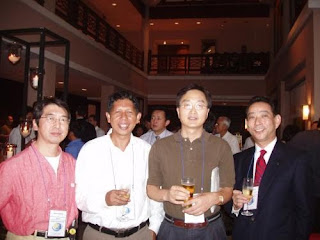
Our picture here during the Atlas round table discussion on Friedrich Hayek's book, "The Constitution of Liberty", held in Phuket, Thailand, September 2005. From left: Dr. Hiroshi of the Institute for Free Economy, Japan; me, Chung-ho, and Mr. You of the Japanese for Tax Reforms.
Last November 9-10, 2009, Chung-ho and I were among the Asian free market delegates to the Atlas Freedom Dinner and conference held in Mayflower Rennaisance Hotel, Washington DC. The event was the commemoration of the 20th year of the Fall of the Berlin Wall, the collapse of communism in Europe.
Chung-ho was one of two freedom fighters who gave the "Toast to Freedom" that night witnessed by more than 300 people. Chung-ho said something like this.
Chung-ho received a long standing ovation for his short but emphatic statement.
With the recent development in the Korean Peninsula, it seems far out that a peaceful reunification of the two Koreas, similar to the reunification of the two Germanys after the fall of the Berlin Wall in November 1989, would happen soon. Such belligerence destroys whatever confidence building that were started in the past.
You don't build confidence by sinking a war ship for no reason at all and making not a single apology after that. You don't build confidence and trust by firing artilleries. You don't build confidence by bragging that you have plenty of centrifuges for your nuclear arms build up.
Communism and statism sucks. This should be a constant and painful reminder to people who harbor that socialism or communism is the way to "humanize the world."
------
North Korea's communist government wants an even bigger communist territory. Dictators want a bigger number of people to enslave. This is one big malady of communism and BIG governments.South Korea's democratic government does not need additional territory to conquer. Hundreds of big S. Korean corporations -- producing telecomms and electronics/appliances to cars, ships and consumer products -- are successful in putting up branches and offices in many countries around the world. The S. Korean people are free to travel and migrate to many countries around the world.
The N. Korean people and state-owned corporations do not have that privilege. The N. Korean government's concept of any expansion is only via military occupation of the south, ultimately.
How short are the N. Koreans? This picture of a N. Korean spy beside an American (left) and S. Korean (right) soldiers provide somehow an answer. When people are starving or are not eating enough, they tend to become shorter, smaller, if not become outright malnourished.Meanwhile, what could be the solution to the N-S. Korean conflict? Not a war, as much as possible. They went to war in 1950-53 already, and both sides lost. A serious war, should it happen between the two, will however, result in a lopsided loss to the North given the level of economic and technological advancement of the South. But still, a war is a war and millions of Koreans on both sides will die, a prospect that is not acceptable and tolerable.
I am not familiar about the politics and the various international diplomacy options in the Korean peninsula. Nonetheless, I still hope that a serious war will be averted. I'd like to see a "Fall of the Berlin Wall" type of democratization in N. Korea.
-------
Update: November 24, 2010
The exchange of artillery fire between North and South Korean army seemed to have eased, but the tension remains. The South's fighter planes did not fly yesterday but they were ready to fly and pound Northern targets. See the NYT report here. It should be safe to assume that the North's fighter jets were also ready to fly and attack then. It is good that no further escalation of the conflict happened, and it should not happen as much as possible.
Before the shooting yesterday, the major clash between the two Koreas was the sinking of a S. Korean warship Cheonan last March. The North denied that it was them who torpedoed and sank the ship, resulting in the death of all sailors in the ship, but there was no other possible reason to explain the sinking. Prior to the shooting yesterday, the North was warming up to the South, especially after a huge flooding that affected the North in early September this year. The North asked for food and other supplies. It also initiated some moves that tended to divert the public's attention away from the sinking of the S. Korean ship. And suddenly, the shooting started between the two sides.
One of our friends in the free market movement in the world is the Center for Free Enterprise (CFE, http://eng.cfe.org) based in Seoul, S.Korea. Its President, Dr. Chung-ho Kim, is a good friend of mine since 2005.
Our picture here during the Atlas round table discussion on Friedrich Hayek's book, "The Constitution of Liberty", held in Phuket, Thailand, September 2005. From left: Dr. Hiroshi of the Institute for Free Economy, Japan; me, Chung-ho, and Mr. You of the Japanese for Tax Reforms.Last November 9-10, 2009, Chung-ho and I were among the Asian free market delegates to the Atlas Freedom Dinner and conference held in Mayflower Rennaisance Hotel, Washington DC. The event was the commemoration of the 20th year of the Fall of the Berlin Wall, the collapse of communism in Europe.
Chung-ho was one of two freedom fighters who gave the "Toast to Freedom" that night witnessed by more than 300 people. Chung-ho said something like this.
In Berlin, they had the wall that separated West and East Germany then. When former US President Ronald Reagan went to Europe in the late 90s, he told Mr. Gorbachev of Russia, "Mr. Gorbachev, tear down the wall."
In Korea, it's not a wall, it's a fence, that separates North and South Korea. As President of the Center for Free Enterprise in S. Korea, I urge Mr. Kim Jong Il of North Korea, "Mr. Kim, tear down the fence. Let your people enjoy freedom and democracy. Let the people of the two Koreas be reunited."
Chung-ho received a long standing ovation for his short but emphatic statement.
With the recent development in the Korean Peninsula, it seems far out that a peaceful reunification of the two Koreas, similar to the reunification of the two Germanys after the fall of the Berlin Wall in November 1989, would happen soon. Such belligerence destroys whatever confidence building that were started in the past.
You don't build confidence by sinking a war ship for no reason at all and making not a single apology after that. You don't build confidence and trust by firing artilleries. You don't build confidence by bragging that you have plenty of centrifuges for your nuclear arms build up.
Communism and statism sucks. This should be a constant and painful reminder to people who harbor that socialism or communism is the way to "humanize the world."
------
2 comments:
- Filipinofreedomfighter said...
- Governments have killed well over 200 million people in the 20th century alone according to statistician RJ Rummel. North Korean socialism would probably have already have collapsed if not for the foreign aid they get from stupid Western governments who are threatened by North Korea's military force. History has proven that the best way to take out communist regimes is to leave them alone.
- 11:41 AM

- Nonoy Oplas said...
- Thanks FFF. On the other hand, the continued existence of N. Korea is a daily reminder to socialists and socialism-leaning people in democratic countries the ugliness and stupidity of a socialist country. We just wonder why they remain enamored to the ideals of socialism, of state ownership of the means of production, of killing the profit motive.
Subscribe to:
Posts (Atom)

