Saturday, September 16, 2023

BWorld 634, BRICS energy and Philippine hosting of FIBA games

BRICS energy and Philippine hosting of FIBA games
August 29, 2023 | 12:02 am

My Cup Of Liberty
By Bienvenido S. Oplas, Jr.
https://www.bworldonline.com/opinion/2023/08/29/541936/brics-energy-and-philippine-hosting-of-fiba-games/

Two important events occurred last week. One was the BRICS (Brazil, Russia, India, China, S. Africa) summit that ended on Aug. 24, and they announced membership expansion to six other countries starting January 2024. No. 2 was the start of Federacion International de Basketball (FIBA) World Cup on Aug. 25 at the Philippine Arena.

BRICS EXPANSION

The original five BRICS member-countries were already huge in population. With the addition of six more countries, the bloc will now be called BRICS-11 and would have a combined population of 3.64 billion people as of 2022 — a huge consumer market.

— Table 1 compares some basic economic and energy data on BRICS, the expanded members, G7 industrialized countries and the ASEAN-6. Here are the basic facts as of 2022.

One, in terms of population, BRICS-11 is 4.7x larger than G7 and 6.1x larger than ASEAN-6.

Two, in GDP size, G7 is still larger than BRICS-11 in nominal values but in purchasing power parity (PPP) values, it is 1.2x larger than G7. The Philippines is now a trillion-dollar economy in PPP values along with Vietnam, Thailand and Malaysia.

Three, in total electricity generation, BRICS-11 is 1.8x larger than G7. China alone with 8,849 terawatt-hours (TWH) is larger than G7 combined. This is mainly because BRICS and ASEAN countries have significantly expanded their conventional fossil fuel plants, while G7 has pulled back.

Four, oil consumption of BRICS-11 at 34.4 million barrels per day (bpd) is now larger than G7. In ASEAN-6, Singapore and Thailand have nearly three times each larger than the Philippines. They are huge airport and international trading hubs in the region.

Five, in proven oil reserves, Iran, Saudi Arabia and the United Arab Emirates (UAE) are OPEC-member countries and now that they are with BRICS-11, their combined oil reserves of 709 billion barrels are three times larger than G7. One would say that BRICS expansion is primarily an energy security project, and secondarily an economic integration project.

Six, in coal consumption the original BRICS (except Brazil, which is mainly hydro) with 115,600 petajoules (PJ) have powered their GDP expansion and electricity generation mainly from coal, while G7 countries have significantly pulled back from coal. Check my Aug. 17 column titled “Energy realism: Decarbonization and deindustrialization.” Good thing that ASEAN-6 has a similar energy policy as the original BRICS except Singapore, which is mainly using other fossil fuels — oil-gas (see Table 1).

The long-term economic and energy implications of BRICS-11, which may become BRICS-20, etc. in the coming years, is more energy security for them and their economic allies, more stable energy and consumer prices. The G7 and allies with their continued anti-fossil fuels and decarbonization rhetoric will likely continue their high energy and consumer prices. The Philippines and other developing countries should stay away from the G7 and western climate and energy agenda, prioritize faster economic growth and job creation for its people.

FIBA WORLD CUP

The FIBA Basketball World Cup is held every four years. The first and last time the Philippines hosted it was in 1978 or 45 years ago. This year, the Philippines through the Samahang Basketbol ng Pilipinas (SBP) is co-hosting it with Japan and Indonesia for the group elimination games, but the quarterfinals to final games will be hosted only by the Philippines.

I watched the opening games at the Philippine Arena in Bulacan on Aug. 25. I brought my 12-year-old daughter Bien Mary and two Filipino-German boys Simon and Luis, sons of our friends who live in Bavaria, Germany and now on vacation here.

The crowd was huge — more than 38,000 — a new attendance record in FIBA World Cup history. The previous record was about 32,600 in Canada in 1994. My daughter, who does not watch basketball, became an instant fan of the game. Simon and Luis were surprisingly happy to see for the first time a World Cup basketball live — the entertainment between the games, the atmosphere and energy of Gilas Pilipinas fans and the games of the four teams/countries. They said they will not forget the day and they have shared their experience and observations with their friends in Germany and other countries.

Experiences like these can be translated into more tourism and more good vibes about the Philippine economy. Kudos to SBP for hosting the FIBA World Cup and hats off to SBP President Al Panlilio and SBP Chairman Emeritus and member of the Central Board of the FIBA, Manuel V. Pangilinan or MVP. Good job, sirs.

When foreign visitors watch live international sports competitions like FIBA games, they watch not only the games and the arena; they also see our hotels, our malls, our musicians, dance troupes and other entertainers. They see the country and the always-smiling Filipinos. Tourism later translates into trade and investments, economic growth and job creation.

Because of our geography — detached from mainland Asia, an archipelago that requires flight-hopping from one big island to other islands — plus other factors, our tourism arrivals are not as big as those in Indonesia, Malaysia and Vietnam (Table 2).

Tour de France is the most popular sport in the world in terms of live audience, estimated at 23 million people on the roads for three weeks. The last French cyclists who won the Tour were Bernard Hinault and Laurent Fignon in 1978-1985 except 1980. All other winners in the past three decades were from other countries. But Tour de France continues mainly because of the sports tradition and tourism revenues, and not so much hoping that another French cyclist or team will win the Tour.

Same for hosting this FIBA tournament — the goal should be to help boost tourism and investments in the country. So far, Gilas Pilipinas has lost their two games with the Dominican Republic and Angola. Our players did their best, but the two other teams played better. Nonetheless, it is the hosting of the FIBA games that matters more than our team winning the games.

I like this observation by Joe Zaldariaga in his column “Sports: A game changer for the economy” (Philippine Star, Aug. 10). He wrote:

“The hosting of this event is more than a celebration of basketball as a cherished national passion; it’s an invitation from the Philippines to the world. As the nation welcomes the international basketball community, it sends a clear signal that it’s ready to step onto the global stage as a prime destination for international business.”
-------------

See also: 
BWorld 631, Energy realism: Decarbonization and deindustrialization, August 27, 2023
BWorld 632, Financing Growth, August 30, 2023 
BWorld 633, Some trends in de-dollarization and implications for developing countries, Sept. 04, 2023.

Mining 65, The Mining Philippines 2023 Conference

Next week, the big annual mining conference will take place at Edsa Shangrila Hotel.


I will be one of the speakers on Day 2 last panel, among the most important panel discussions -- about mining tax. 


USec Cielo Magno is out of the DOF already, I don't know who will replace her to speak in behalf of the DOF. Anyway here's the event program for two days, https://app.glueup.com/event/mining-philippines-international-conference-and-exhibition-81637/

Some of the photos and memes made by UP Miners during Mining Conf 2015 where I was also one of the speakers.


Monday, September 04, 2023

BWorld 633, Some trends in de-dollarization and implications for developing countries

August 24,  https://www.bworldonline.com/opinion/2023/08/24/541229/some-trends-in-de-dollarization-and-implications-for-developing-countries/ 

De-dollarization is the process of countries slowly moving away from using the US dollar. Two ways they do it, via central banks reducing their US dollar reserves in favor of gold and other major currencies, and using currencies other than the US dollar to settle some international payments in trade, tourism and so on.

Since around the middle of 2022, the term “de-dollarization” has been cropping up more often. For instance, here are some reports and opinion pieces that came out this month: “US dollar’s decline could benefit Asian economies” (Asia Times, Aug. 4), “De-dollarization: Why countries are seeking alternate currencies” (CGTN, Aug. 5), “De-Dollarization: What Is It, and Is It Happening?” (Investopedia, Aug. 16), “The Real Cost of De-Dollarization” (Project Syndicate, Aug. 16), “China urges BRICS to become geopolitical rival to G7” (Financial Times, Aug. 21), “Is the dollar finally on its way out?” (East Asia Forum, Aug. 21), “De-dollarization is irreversible — Putin” (RT, Aug. 22), “Trends, Reasons and Prospects of De-dollarization” (South Center, August 2023).

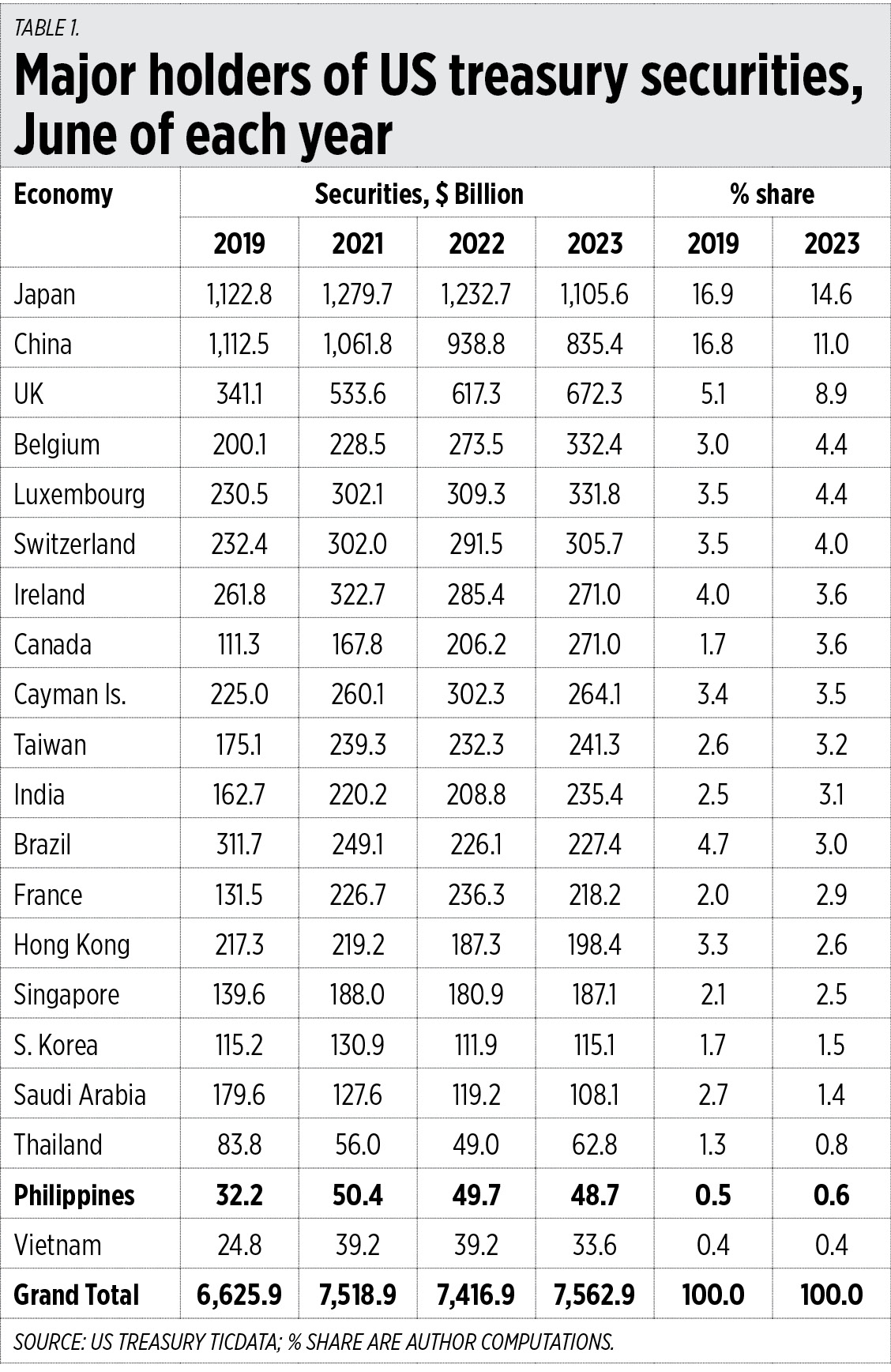
To see how valid this observation or process is, I checked the country origin of US treasury securities — the total has increased from $6.626 trillion in June 2019 to $7.563 trillion in June 2023. The biggest lenders to the US government are Japan and China, Japan alone provided 17% of the total in 2019 but this has declined to 14.6% in 2023.

The BRICS (Brazil, Russia, India, China, South Africa) are either reducing their lending to the US, or not lending, or there is no data from them about this (Russia, South Africa). The US has imposed economic sanction against Russia since 2014 when it annexed Crimea, then strengthened the sanctions in 2022. The share of China, India, Brazil, and Hong Kong has declined from 27.3% in 2019 to 19.7% in 2023. Saudi Arabia’s share has declined by half, from 2.7% to 1.4%.

The Philippines, Thailand, and Vietnam also have exposure to US debt but their combined share is small, 2.2% in 2019, down to 1.8% in 2023 (See Table 1).

On Aug. 2, Fitch downgraded its US credit rating from AAA to AA+ mainly due to “the expected fiscal deterioration over the next three years, a high and growing general government debt burden, and the erosion of governance relative to ‘AA’ and ‘AAA’ rated peers over the last two decades that has manifested in repeated debt limit standoffs and last-minute resolutions.”

The world’s big exporters of energy and mineral products include Russia, Qatar, Iran and Iraq. Note that they are non-lenders or minor lenders to the US.

One common narrative during the Russia-Ukraine war is that Russian exports of energy and minerals have declined because of the heavy economic sanctions imposed by the US and NATO allies. This is not true, it is fake news. Russian exports expanded from $249 billion in 2021 to $350 billion in 2022. The Russian market has changed, from its European neighbors to India, China, and Turkey, which refine Russia’s crude oil and export the refined oil products to Russia’s European neighbors. The Europeans now suffer from higher energy prices and higher overall inflation.

But the major winners and gainers from the sanctions against Russia are the US itself, which expanded its LNG exports to Europe, the United Arab Emirates (UAE), whose exports have expanded 5.3 times from 2017 to 2022, Saudi Arabia, Canada, and Norway (See Table 2).

The Philippines, Vietnam, and Thailand remain small players in energy and mining exports. The Philippines has failed to benefit from the higher prices of gold, copper, and silver over the last three years because of our anti-mining policies, especially the anti-open pit mining policies. And we endured high oil-gas prices when we could have a new domestic gas supply aside from Malampaya if the service contract there had been extended much earlier.

The main lesson for the Philippines and other developing countries is that we should reduce our dependence on the US dollar as forex reserves and as currency payment in our trade with other countries. We should have more gold reserves, more yen, yuan, won and other Asian currencies as reserves.

The US credit rating downgrade by Fitch is among the most recent proof of cracks in the US economic and financial power. It has too much public debt, has a high annual budget deficit, has been engaged in many costly and unproductive wars abroad, and is even preparing for a big war with China over Taiwan.

The Philippines needs more trade, more investments, more tourism, more peace based on commerce and not based on missiles. We need more cargo ships, not battle ships. More diplomats and traders, not more generals and admirals.
---------------

See also: 
BWorld 630, GDP growth resilience, and the finance and budget lecture at the PDE reunion, August 26, 2023
BWorld 631, Energy realism: Decarbonization and deindustrialization, August 27, 2023
BWorld 632, Financing Growth, August 30, 2023.

Climate 104, Global boiling, wow

Among the recent papers that invalidate the "catastrophic" man-made/anthropogenic Gorebal warming narrative,

German Scientists: Global Warming A “Corrupt”, Fear-Mongering Scheme “Headed By Super-Rich”
By P Gosselin on 23. August 2023
https://notrickszone.com/2023/08/23/german-scientists-global-warming-a-corrupt-fear-mongering-scheme-headed-by-super-rich/


"Their goal is to introduce a CO2-emission tax, like the sin-emission model in the Middle Ages, in which all the states, the politicians and corrupt scientific institutions make money. Their approach is fear and panic mongering by claiming that the end of the world is coming and that it is due to man burning fossil fuel."

New study suggests global warming could be mostly an urban problem
Sept. 1, 2023
https://www.ceres-science.com/post/new-study-suggests-global-warming-could-be-mostly-an-urban-problem

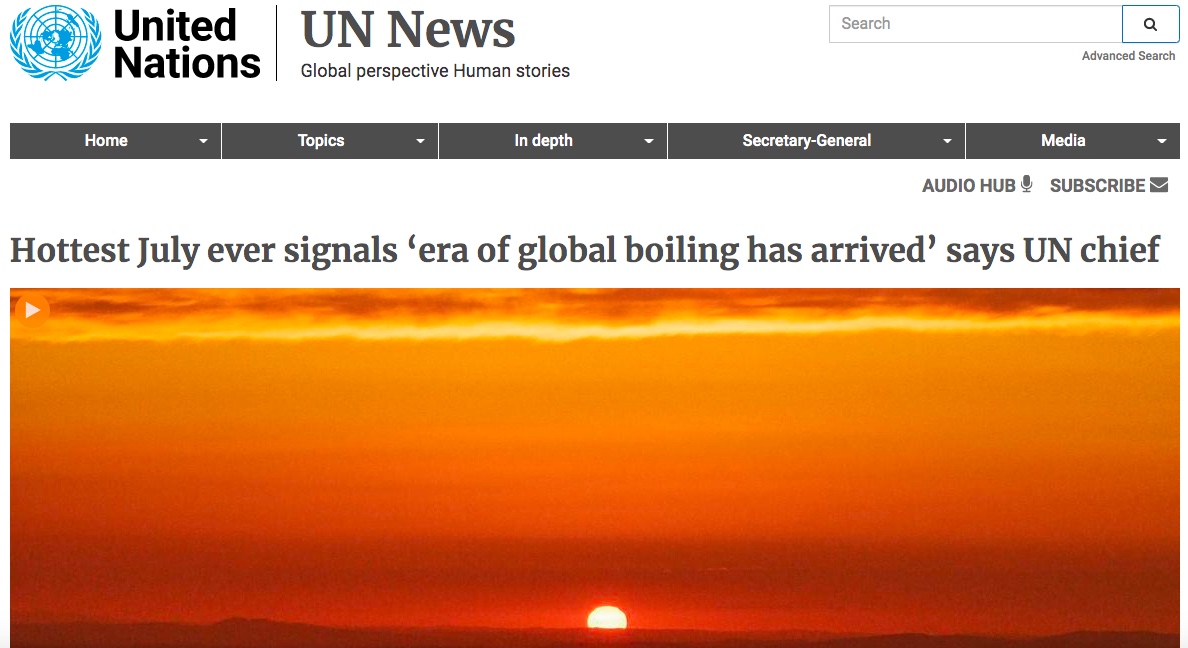
Now another climate paper from the UN, talking not about Gorebal warming but Gorebal "boiling", wow.


Speaking at UN Headquarters, the Secretary-General underscored the need for global action on emissions, climate adaptation and climate finance. 
He warned that “the era of global warming has ended” and “the era of global boiling has arrived.”

Here is the climate realist, not alarmist, position.

https://clintel.org/wp-content/uploads/2023/08/WCD-version-081423.pdf

There is no climate emergency

Climate science should be less political, while climate policies should be more scientific. Scientists should openly address uncertainties and exaggerations in their predictions of global warming, while politicians should dispassionately count the real costs as well as the imagined benefits of their policy measures.

Natural as well as anthropogenic factors cause warming
The geological archive reveals that Earth’s climate has varied as long as the planet has existed, with natural cold and warm phases. The Little Ice Age ended as recently as 1850. Therefore, it is no surprise that we now are experiencing a period of warming.

Warming is far slower than predicted
The world has warmed significantly less than predicted by IPCC on the basis of modeled anthropogenic forcing. The gap between the real world and the modeled world tells us that we are far from understanding climate change.

Climate policy relies on inadequate models
Climate models have many shortcomings and are not remotely plausible as policy tools. They do not only exaggerate the effect of greenhouse gases, they also ignore the fact that enriching the atmosphere with CO2 is beneficial.

CO2 is plant food, the basis of all life on Earth 
CO2 is not a pollutant. It is essential to all life on Earth. More CO2 is favorable for nature, greening our planet. Additional CO2 in the air has promoted growth in global plant biomass. It is also profitable for agriculture, increasing the yields of crops worldwide.

Global warming has not increased natural disasters
There is no statistical evidence that global warming is intensifying hurricanes, floods, droughts and suchlike natural disasters, or making them more frequent. However, there is ample evidence that CO2-mitigation measures are as damaging as they are costly.

Climate policy must respect scientific and economic realities
There is no climate emergency. Therefore, there is no cause for panic and alarm. We strongly oppose the harmful and unrealistic net-zero CO2 policy proposed for 2050. Go for adaptation instead of mitigation; adaptation works whatever the causes are.

OUR ADVICE TO THE EUROPEAN LEADERS IS THAT SCIENCE SHOULD STRIVE FOR A SIGNIFICANTLY BETTER UNDERSTANDING OF THE CLIMATE SYSTEM, WHILE POLITICS SHOULD FOCUS ON MINIMIZING POTENTIAL CLIMATE DAMAGE BY PRIORITIZING ADAPTATION STRATEGIES BASED ON PROVEN AND AFFORDABLE TECHNOLOGIES.
---------------

See also:
Climate 101, Degrowth and Darkness Economics, Fr. Villarin lecture, May 15, 2021
Climate 102, Climate money expectation, from $100 B/year to trillion+ per year, October 28, 2021
Climate 103, Ozone level variation due to natural, not man-made factors, June 26, 2023.

Wednesday, August 30, 2023

BWorld 632, Financing Growth

Financing growth
August 22, 2023 | 12:02 am

My Cup Of Liberty
By Bienvenido S. Oplas, Jr.
https://www.bworldonline.com/opinion/2023/08/22/540822/financing-growth/

(1st of a series)

This column will produce a new series on Financing Growth. The take-off point is the successful UP School of Economics program in development economics alumni association homecoming lecture last Saturday titled “A Conversation with finance and budget secretaries on financing sustained economic growth.”

Finance Secretary Benjamin E. Diokno and Budget Secretary Amenah F. Pangandaman discussed the recent and medium-term economic performance and targets of the economic team and Marcos administration.

GDP GROWTH IN Q2 2023

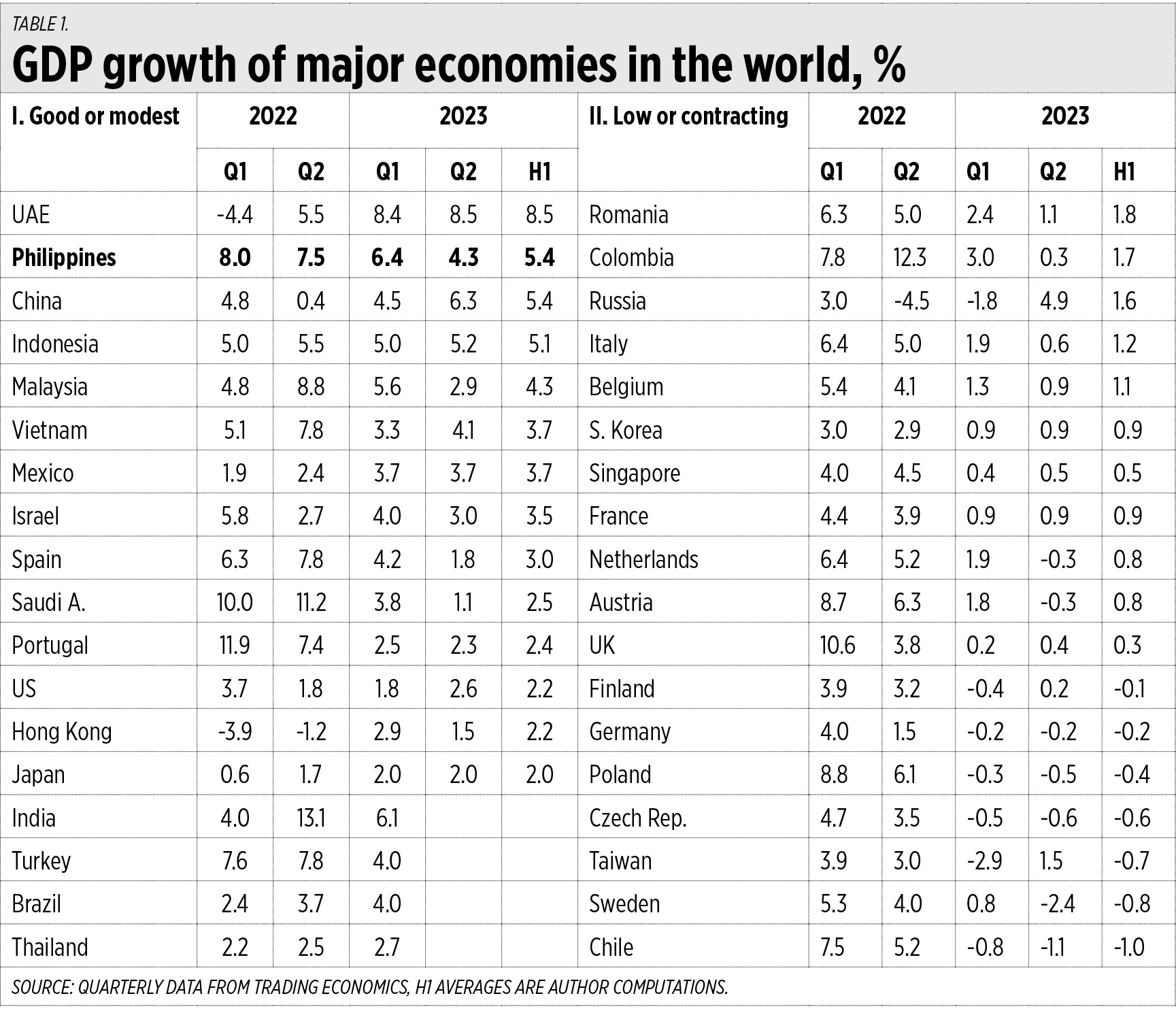
Of the top 50 largest economies in the world in GDP size in 2022, 32 have reported their second-quarter 2023 GDP data. The top three fastest-growing in the first half or average for Q1 and Q2 2023 were the United Arab Emirates (UAE), Philippines and China. But UAE and China have fast growth in 2023 on low base or low growth in Q1 and Q2 of 2022, whereas the Philippines has fast growth in 2023 on high base or high growth in 2022. So it would appear that of these 32 major economies in the world, the Philippines has the most dynamic and resilient growth.

And of these 32 economies, 11 have low H1 growth of below 2%, while seven have contractions of 0.1% to 1% including Germany — the largest economy in Europe — Sweden, Poland and Taiwan. I added four countries with modest or high growth in Q1 but no Q2 data yet (Table 1).

The global and regional economic environment in 2023 is worse than in 2022. A growth of 3% or higher now looks fast already. The Philippines growing at 5.4% in H1 was already an outstanding performance.

BIG INFRASTRUCTURE

Secretary Diokno and Secretary Pangandaman discussed an optimistic short- to medium-term economic and fiscal outlook. Below are four sets of data presented by the two secretaries, among the many data they discussed and for brevity, I compressed these sub-tables into one.

Sub-table I shows the growth target of the Development Budget Coordination Committee (DBCC), and projections by the ASEAN+3 Macroeconomic Research Office and the three multilaterals — ADB, IMF and WB. The four institutions’ projections for 2023 are within the DBCC target, but for 2024, the three multilaterals have lower projections than DBCC but still high — 5.5% or higher.

Sub-table II shows that all the five credit rating companies either upgraded or affirmed and sustained their previous ratings for the Philippines since President Ferdinand R. Marcos, Jr. assumed power in July 2022. The most recent were made by Fitch, from BBB- to BBB stable in May, and by R&I, from BBB+ stable to BBB+ positive early this month. The next goal is to move from BBB+ to A and I think that is highly possible.

Sub-table III shows the medium-term fiscal projections like reducing the public debt/GDP ratio, deficit/GDP ratio and keeping the infrastructure spending/GDP ratio between 5-6% yearly. I also think these are doable, although I wish that deficit/GDP ratio was below 3% by 2028.

Sub-table IV shows an ambitious infrastructure program of P1.3 trillion until 2028, led by more roads and bridges. Both secretaries highlighted two main sources of funding other than the budget and new borrowings from multilaterals — more public private partnerships (PPP) and the Maharlika Fund (Table 2).

BusinessWorld reporter Keisha B. Ta-asan was at the lecture and she wrote two stories, “Diokno: Tuition-free college education unsustainable” (Aug. 20), “DBM chief says Q2 GDP growth would have been higher if not for gov’t underspending” (Aug. 21). Good to see you there, Keisha.

PDE ALUMNI HOMECOMING

Even if it was a Saturday afternoon of a long weekend, the UPSE auditorium was full during the lecture by the two secretaries. The bulk of the audience came from PDE alumni batches of the 1970s and 2010s.

After the lectures and open forum with the two secretaries, dinner was served courtesy of the Philippine Center for Economic Development of UPSE. Then came the PDE homecoming program. Mai Valera-Co, president of batch 46th, and I were the co-MCs. There were lots of fun games, raffle prizes and giveaways to all alumni who came, plus food and beer. Our batch also gave an entertainment number — economic carols composed and sang in December 1997.

For that very successful event, the two secretaries’ lecture and PDE homecoming, I want to thank the following.

Our corporate sponsors who gave donations in kind, in alphabetical order: Alas Oplas & Co. CPAs., Astoria Hotels and Resorts, Gallerie Joaquin, iOptions Ventures Corp., Japan Tobacco, Inc., Manila Electric Co., Nestlé Philippines, Philip Morris Fortune Tobacco Corp., Robinsons Retail and San Miguel Corp.

Friends who represent the companies above: Marycris (also my sister), Jeffrey, Jack, Pidro, Robert, Joe, Arlene, Noel, Robina and Ferdie. Thank you guys, more blessings to your companies.

Of those 10 corporations, only iOptions Ventures is province-based, in Palawan. Pidro was my dormmate at the UP Narra dormitory in the 1980s, a very kind man and he formed the Palawenyo Savers, the CSR arm of iOptions that provide scholarships and nurture rural-based entrepreneurship like developing small organic farm systems, biochar production including carbonized rice hull and liquid smoke.

For the organizing team, special thanks to UPSE Dean Joy Abrenica (also our teacher in PDE in 1997-1998), Rose San Pascual, Chelle Magboo, many other staff of UPSE, my co-MC Mai Valera-Co, PDE Alumni Association convenor Monching Bacani and most importantly, former UPSE faculty and PDE Director Ruping Alonzo (RIP) who is well-loved and remembered by so many PDE graduates from various batches.

Thank you all. Fantastic lectures and homecoming. We will do it again next year.
------------

See also: 
BWorld 629, On ratings upgrades and the budget of state universities, August 25, 2023
BWorld 630, GDP growth resilience, and the finance and budget lecture at the PDE reunion, August 26, 2023
BWorld 631, Energy realism: Decarbonization and deindustrialization, August 27, 2023.

Deindustrialization 18, Germany recession and degrowth

More stories about Germany here. Enjoy.
-------------

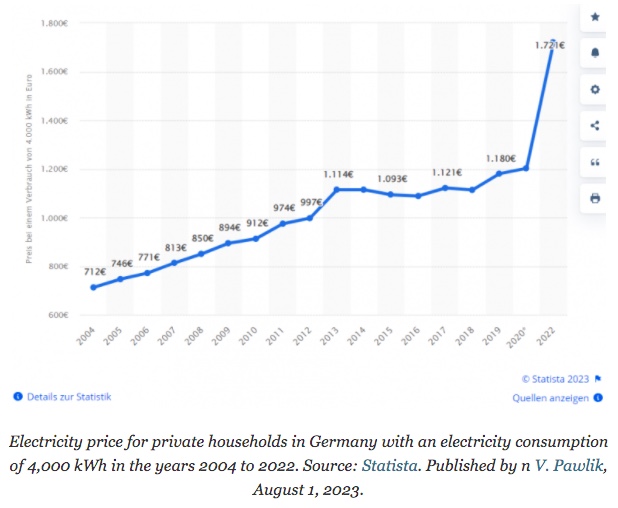
German consumers 'pay the highest electricity prices in Europe'
The Local 7 Jun, 2021
https://www.thelocal.de/20210607/german-consumers-pay-the-highest-electricity-prices-in-europe

German energy prices are so high they’re driving companies to relocate, industry body says
Hannah Ward-Glenton June 21, 2023
https://www.cnbc.com/2023/06/21/high-german-energy-prices-are-seeing-some-companies-relocate-bdi.html

Germany: The return of the 'sick man' of Europe?
Henrik Böhme August 1, 2023 
https://www.dw.com/en/germany-economy-weakens-2023/a-66403943

De-industrialization begins
August 4, 2023
https://www.faz.net/aktuell/wirtschaft/unternehmen/lanxess-schliesst-moeglicherweise-zwei-betriebe-de-industrialisierung-beginnt-19081123.html

Offshore Wind Farms Altering Marine Ecosystems: “Sufficiently Potent To Redirect Existing Currents”

By P Gosselin on 20. August 2023
https://notrickszone.com/2023/08/20/offshore-wind-farms-altering-marine-ecosystems-sufficiently-potent-to-redirect-existing-currents/

German Scientists: Global Warming A “Corrupt”, Fear-Mongering Scheme “Headed By Super-Rich”
By P Gosselin on 23. August 2023
https://notrickszone.com/2023/08/23/german-scientists-global-warming-a-corrupt-fear-mongering-scheme-headed-by-super-rich/


Germany is struggling to move away from its ‘sick man of Europe’ image

German economy stagnates in Q2 after winter recession
Reuters August 25, 2023
https://www.reuters.com/markets/europe/german-economy-stagnates-q2-after-winter-recession-2023-08-25/

Germany’s Ministry Of Economic Projects Gas, Electricity Prices To Rise To Painful Levels
By P Gosselin on 26. August 2023
https://notrickszone.com/2023/08/26/germanys-ministry-of-economic-projects-gas-electricity-prices-to-rise-to-painful-levels/

Germany: Record amount of shrinkflation and deceptive packaging helps hide inflation from consumers
Over 1,000 products have utilized deceptive packaging to hide price increases in the last five years
JOHN CODY August 29, 2023
https://rmx.news/article/germany-record-amount-of-shrinkflation-and-deceptive-packaging-helps-hide-inflation-from-consumers/

‘Germany Is Run by Idiots,’ Says Top Female AfD Politician
August 29, 2023
https://www.youtube.com/watch?v=fmMJGLdFkaA

"If you live in a country where you are fined for fishing without a license, but not for crossing the border illegally without a valid passport, then you have every right to say that this country is run by idiots."

Germany suffering due to obsession with green energy and bureaucracy, industry federation president claims
Federation of German Industries President Siegfried Russwurm criticized the federal government for lacking the courage to break outdated rules
THOMAS BROOKE  August 29, 2023
https://rmx.news/germany/germany-suffering-due-to-obsession-with-green-energy-and-bureaucracy-industry-federation-president-claims/

“We have to be honest about what CO₂-free energy will cost in the long term – not just wind and solar power, but including the necessary backup capacities when the sun and wind are not delivering,” he added...

“Massive investments in grids are required for power distribution – all of this parallel to the expansion of wind and solar capacity many times over."

Germany begins dismantling wind farm for coal
German energy giant RWE has begun dismantling a wind farm — to make way the expansion of its Garzweiler open-pit mine
By WESTER VAN GAAL  August 29, 2023.
https://euobserver.com/green-economy/157364

--------------

See also:
Deindustrialization 15, Germany turning from Greens to AfD, June 22, 2023
Deindustrialization 16, UK expensive electricity, coal to avoid blackout, July 08, 2023
Deindustrialization 17, Germany recession, ESG problems, August 17, 2023.

Sunday, August 27, 2023

BWorld 631, Energy realism: Decarbonization and deindustrialization

August 17, https://www.bworldonline.com/opinion/2023/08/17/539962/energy-realism-decarbonization-and-deindustrialization/

(Part 4)

The rush for “net zero” emissions and decarbonization is evident in Europe while many Asian countries are not so enamored with this rush. I have put together a chart showing how the United Kingdom and Spain are in a mad rush towards decarbonization by ditching their coal consumption, compared to China’s more considered conversion and Vietnam’s rejection of decarbonization.

The percentage of coal/total power generation from 1992 to 2022 are as follows: UK, 60% to 2%; Spain, 41% to 3%; China, 75% to 61%; and Vietnam, 9% to 39%. As countries reduce their coal consumption, their overall power generation either declines or flatlines (See Table 1).

To cover more countries, I added Germany and France to the “rush-to-net-zero” decarbonization countries, and India and the Philippines to the “no-rush” decarbonization countries. The coal/total generation of these countries for 1992 to 2022 are as follows: Germany, 55.1% to 31.3%;   France, 8.1% to 0.7%; India, 68% to 74.3%; and the Philippines, 6.9% to 59.6%.

In Table 2 one sees their average economic performance from 1983 to 2019, up to the first half of 2023. The UK, Spain, Germany, and France are generally crawling with just 1% to 3%. In contrast, China, Vietnam, India, and the Philippines were humming along with 3% to 11%, except for the Philippines’ 1% average growth in the 1980s to the early 1990s. This can be explained by the political upheavals in the mid-1980s, the coup attempts in the late ’80s, and severe blackouts plus a volcanic eruption and a major earthquake in 1990-92.

The rush to decarbonization of G7 industrialized countries simply leads to their piecemeal path to deindustrialization.

Of course, there are many reasons and factors why countries grow slowly or fast, but the fast expansion of total power generation is a big factor. Many big investments will not come to a country that suffers from frequent blackouts and has expensive electricity.

There were a number of interesting and beautiful reports in the energy sector recently. See these reports in BusinessWorld written by my favorite energy reporter, Ashley Erika O. Jose:

“No net-zero target in Philippine Energy Plan” (July 23), “NGCP fully committed to completing projects” (July 26), “Energy dep’t counting on extra 8,000 MW in capacity by 2028” (July 26), “RE transition won’t happen ‘overnight’ — DoE” (July 30), “Meralco seeks replacement power for San Miguel’s terminated supply deal” (Aug. 2), “Meralco looks at nuclear power as long-term solution” (Aug. 3), “AboitizPower in talks with US nuclear supplier” (Aug. 10), “August power rates down on lower generation charge” (Aug. 10), “ERC suspends order allowing NGCP to pass on franchise tax” (Aug. 10).

I particularly like the reports on “No net-zero target,” that Meralco and Aboitiz Power are looking into setting up nuclear power plants someday, and the Energy Regulatory Commission’s (ERC) suspension of the National Grid Corp. of the Philippines’ (NGCP) practice of passing their franchise tax on to the consumers.

Coal remains the single biggest power insurance of the Philippines against frequent blackouts and underdevelopment. Existing coal plants should expand, from Luzon to the Visayas to Mindanao.

On nuclear power, France used generate 75% of its total power from nuclear plants, resulting in an ample and cheap supply of electricity. It had very bright and beautiful lights at night, a huge amount of electricity to export to neighbors in Europe, and no nuclear accidents. Then they embraced net zero with an exit plan for many of its nuclear plants. Then energy prices and overall inflation started rising. The Philippines should embark on nuclear power generation, including the revival of the Bataan Nuclear Power Plant, and setting up small modular reactors (SMRs) for big island-provinces.

Regarding the new ERC order to the NGCP, I think this is the first time that the ERC had the courage to issue that kind of order. The NGCP is levied with a 3% franchise tax in lieu of corporate income tax and other taxes and this should not be passed through to the consumers. Consumers pay extra on top of capex and high profit of NGCP — they should not pay for the franchise tax. Bravo, ERC.

See also the previous columns on “energy realism” series: “Energy realism: Raising consumption and economic growth” (Part 1, June 29), “Energy realism: G7, BRICS, and other big Asian economies” (Part 2, July 6), and, “Energy realism: Oil-coal consumption and NGCP’s delayed projects” (Part 3, July 13).
-------------

See also: 
BWorld 628, Inflation deceleration, G7 deindustrialization, and deficit reduction, August 24, 2023
BWorld 629, On ratings upgrades and the budget of state universities, August 25, 2023
BWorld 630, GDP growth resilience, and the finance and budget lecture at the PDE reunion, August 26, 2023.

Pol. Ideology 86, Endless crisis narratives and authoritarianism

On endless crisis narratives -- food/hunger crisis, population crisis, HIV/AIDs crisis, NCDs/smoking crisis, garbage/plastic crisis, climate crisis, virus/health crisis, other "end of time" and similar catastrophy scenario -- all these suggest that we need a "saviour", and 99% that saviour is more government, more multilaterals, more authoritarianism.

Overall, people are rational, they won't jump into mutual destruction. That's why we have zero world war since 1945 or nearly 8 decades ago. The doomers will lose and rationality will prevail.

A friend talked about the anti-Christ in BRICS expansion. I replied to him that many anti-Christ now are actually in the US, UK and other western countries. See for instance this outright reversal of nature, transgender surgeries tripled in the US, data for 2016-2019 only, could be worse in 2022-2023.
https://www.zerohedge.com/political/transgender-surgeries-us-nearly-tripled-3-years

In contrast, Putin the non Christian is banning transgender mutilations.
https://apnews.com/article/russia-lgbtq-transgender-procedures-banned-21b88f53b9a74a646400d63ce93bde6f

Respecting nature means men are men, women are women.

Respecting nature means natural immunity should be trusted, not "vax immunity."

Respecting nature means climate cycle of warming-cooling should be recognized.

Note that "end of time" religious narrative can lead to dictatorship. Like Muslims or Buddhists or Jewish or militant christians etc asserting their end of time version over the rest of humanity.

For me, any "end of time" would be about 10 B years more. Planet earth is about 4.6 B yrs old, all our energy and life sustenance come from the Sun. Like 12 hours of sunlight, evening light from the Moon as reflected light from the Sun, photosynthesis by plants and crops, water evaporation and condensation cycle via Sun heat, etc.

The projected timeline where our Sun will spend out all its solar energy is about 10 B years.

Virus alarmism is political science that masquerade as medical science.

Climate alarmism is political science that masquerade as climate science.

Hunger/population alarmism is political science that masquerade as agriculture science.

All about politics and political science.

Meanwhile, see these recent interesting papers.

Understanding The Parasitic Cooperation Between Globalists And Leftists
Brandon Smith August 18, 2023
https://alt-market.us/understanding-the-parasitic-cooperation-between-globalists-and-leftists/

The Road to Totalitarianism (Part 3)
CJ Hopkins August 24, 2023
https://consentfactory.org/2023/08/24/the-road-to-totalitarianism-part-3/

WHY WOULD THEY WANT TO SOLVE IT?
Author Administrator  August 25, 2023
https://www.theburningplatform.com/2023/08/25/why-would-they-want-to-solve-it/

The war on terror must never be won, because the Department of Homeland Security and all the parasites that live off that bloated cow need your money. Joe Rogan points out the same narrative when it comes to homelessness. Bureaucrats and departments in all these Democrat shitholes don’t want to solve the homelessness problem. They would be out of jobs. Everything is a racket.

https://twitter.com/WallStreetSilv/status/1694575314129531060

From Covid To Climate Change: Vehicles For Global Authoritarianism
Brandon Smith August 26, 2023
https://alt-market.us/from-covid-to-climate-change-vehicles-for-global-authoritarianism/

"The covid agenda and the climate change agenda are very similar in that they rely on a core fallacy. The lie is that these events are actually dictated by human behavior, and thus human behavior must be controlled in the name of the “greater good.” The idea goes beyond this, though, into the realm of collectivism... every single person must have their lives micromanaged by the state to prevent some kind of chain reaction that leads to catastrophe for the precious bug colony."

Biden's 'Booze Czar' Floats New Possible Guidance Of Only Two Beers A Week
Tyler Durden AUG 27, 2023 
https://www.zerohedge.com/medical/bidens-booze-czar-floats-new-possible-guidance-only-two-beers-week
--------------

See also:
Pol Ideology 82, Reflections of a former Marxist on property, December 18, 2021
Pol. Ideology 83, The end of liberalism and return of militarist-protectionism? April 12, 2022
Pol. Ideology 84, Capitalism and prosperity, June 28, 2022
Pol. Ideology 85, Austrian Economics and marginal utility, January 06, 2023.