Showing posts with label Rio Tuba. Show all posts

Monday, July 21, 2014

Mining 40: MICC and its Proposed 79 Percent Effective Tax Rate

Early this month, the Mining Industry Coordinating Council (MICC) has proposed  an effective mining tax rate of 79 percent. From BWorld, July 07, 2014,

“We are dismayed that the MICC has moved forward with a proposed increased tax policy without taking into consideration comments and observations not only from the mining industry that will be directly affected by said policy but by authoritative third parties,” CoMP said.

The MICC proposed a payment of 10% of gross revenue, or 55% of the Adjusted Net Mining Revenue, whichever may be higher.

Perhaps the MICC, in particular the Department of Trade and Industry (DTI), environmental militants and LGUs want the big, legal mining firms to become illegitimate "small scale" miners, them who pay zero tax to the BIR, only small fees to LGUs, do not undertake any CSR or reforestation after mining.

I heard that the MICC bills are DTI versions, Am curious, why did they stop at 79% effective tax rate, why not 89% or 99%? Kunin na lahat ng gobyerno?

More news stories below.

From Sun Star, July 13, 2014

Julian Payne, president of the Canadian Chamber of Commerce in the Philippines,... called for actions to make investments in mining competitive with that in other countries.... government should review the recent "no-go zones" in maps that have been published, which, he said "make 85% of the country off limits to minerals exploration." http://www.sunstar.com.ph/.../review-tax-plan-mining...

From Philippine Star, July 11, 2014

The MICC approved in May the imposition of either a 10 percent tax on gross revenues or a tax of 55 percent on adjusted net mining revenues (ANMR) plus a percentage of windfall profit, whichever would give higher revenues to the government.

ANMR pertains to the difference between gross sales and direct cost (direct mining cost and administrative expenses).

Contractors shall still be liable to pay real property tax, stock transaction tax, documentary stamp tax, withholding tax on passive income, as well as regulatory fees and charges.

Incentives to mining investments shall be limited to duty-free importation of specialized capital equipment and five-year amortization of pre-operating expenses....

The Canadian business chamber is also urging the replacement of the MICC by a new Consultative and Advisory Council on Mining (CACM) which would have a wider stakeholder representation in government, private sector and business groups.

From the PDInquirer, July 07, 2014

“There are other countries with more reasonable tax structures and are equally [if not better] endowed than the Philippines,” (COMP) said.

“The results of our financial modeling indicate that the government share under such proposal will be much higher than [those of] large mineral producing jurisdictions such as Canada, Queensland (Australia), Peru, South Africa, Chile and Papua New Guinea.”

Since July 2012, only one or first mining exploration permit has been issued? See 1st mining permit issued, Manila Standard, July 01, 2014, Mining is really "evil." The production and manufacturing of cell phones, watches, laptops, tv, cars, buses, etc., all products of mining, should be limited to restrict the march of this "evil" industry. 

A friend from EITI commented that "the social cost of mining is different from mining in Canada, Peru or Australia. Mining tax which constitutes the bigger chunk of social benefit from mining should outweigh social cost."

My friend saw Rio Tuba nickel mining that responsible mining -- zero mine tailings in rivers and sea; rehabilitation and reforestation of mined out areas, giving livelihood projects to nearby communities even if the people there are not employees, etc. -- is happening. Only large-scale corporate mining can do that. What reallly causes high "social cost of mining" is small-scale mining. Zero tax payment to BIR, zero reforestation and rehabilitation after deep and wide quarrying, zero education/ healthcare/ housing programs for employees, etc. So by pushing for heavy taxation of large-scale, legal mining, government and the militant NGOs are pushing some of these companies to sub-contract the work to "small-scale" while reporting small revenues that are subject to 79 percent tax rate, exclusive of the cost of mandatory CSR projects to communities.

I think if government will further raise mining taxes, only the corrupt players will survive. The tax assessors and collectors will extort money while the players will pay and bribe them, in exchange for understatement of revenues and hence, the taxable income. The honest big players will slowly fade away.
-------------

See also: 

Tuesday, July 16, 2013

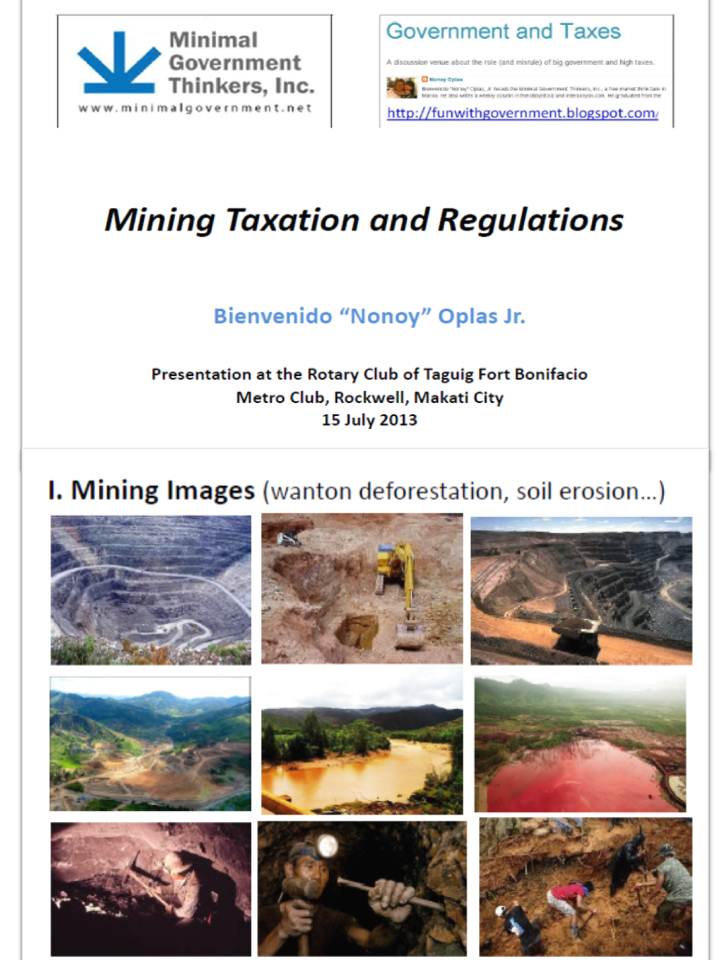
Mining 26: Presentation at Rotary Club of Taguig Fort Bonifacio

Last night, I gave a talk at our Rotary Club of Taguig Fort Bonifacio. My clubmates were happy to see these data and insights. One member suggested to have a bigger forum on the subject with speakers from opposing sides, to be sponsored by the club. Good proposal, supported by many other club members.


Friday, May 03, 2013

Mining 17: Palawan, Samar, Surigao and Mine Tailings

There is one lively exchange on mining in the facebook wall of a friend, JB Baylon. The original exchanges were made last February 19, 2013. Then the other day, one of JB's friends, that we will just call Mr. U, made strong anti-mining comments and called those who posted about mining in Australia and people wearing precious stones as "morons". It's personal attack of course, shooting the messenger, not the message.

I am posting the raw, unedited exchanges, except the less substantial comments. With explicit permission from JB and implicit permission from the others. To see the raw exchanges, check here on JB's fb wall. The three photos below are a screen shot + images from the sites mentioned. Six pages long, 3,200+ words, so get your snacks and enjoy reading.
-----------

February 19, 2013

Time and again I have asked university students "How many of you have signed a petition against mining?" and MANY hands go up. Then I ask them "How many of you have been to a mine?" - and almost NO hand is raised. As a self-proclaimed "political commentator and social observer" the results amaze me and sadden me and thrill me all at the same time - I am amazed because people (whatever age) are willing to SIGN petitions based solely on what they have heard; saddened, because this tells me that when you (an individual, an organization, even a corporation) are up against a well-entrenched campaign to impugn your character and you don't have a chance to show people the real you, then you will most likely be judged by what media tells people about you. And thrilled, because each and everyone I have accompanied to see the mining operation I work for has returned from the visit a little better informed and more open to the idea that there is a valid distinction between mining operations on one hand and responsible mining operations on the other - just like in almost any family there is the proverbial black sheep among the white. THE PROBLEM IS, we cannot afford to bring 100 million Filipinos to see how we do business - and yet many media practitioners consistently REFUSE our invitation to go - afraid perhaps that they will have to eat their words and admit that they have not been totally fair?? Today I extended an invitation through a friend to organize a visit for a network, and was told that the response was "lukewarm". Why? For this I am grateful to those who have accepted my invitation to go and who have remained free, after to visit, to say or not say (or write or NOT write about) what they feel about our operations. At the very least i hope the trip provided them a different point of view from the general impression that our industry sometimes unfairly labors under. Indeed my warning to those who join me on the trip is this : Be prepared to have many if not all of your pre-conceived notions about mining companies challenged, if not totally over turned. And I know that that can be a very unsettling proposition!

Paul Alli I am from Samar, and I know what the mining companies have done to its environment: pillage and plunder while destroying its environs. Meanwhile the Samarenos are still majority poor. No wonder they call us "Warays" because its English translation is "nothing". I can document cases in Samar where they have undervalued copper, manganese, and chromite exports to other countries, thanks to the DENR,LGUs and Bureau of Customs in cahoots with the mining companies. I am also working with another case in Surigao. A land belonging to a tribe. Its chieftain told me that until now the 29 mining companies operating in their tribal land has not given them royalties from their mining operations.

JB Baylon We should come down hard on anyone and everyone who violates the law. It is as simple as that. And I am not surprised about what you said about government being in cahoots...this is true in many industries. Unfortunately there is no short cut: prosecute the guilty. Unfortunately also we cannot jump from your experience there to make it a general rule. I am just sorry if Samar has gotten the raw end of the deal for years. Who are the companies and who are the owners?

Paul Alli I cannot name names here..you know the law nowadays. I will send you a separate email if you want.

JB Baylon Paul Alli yes please...private message me so I can give you my email address. This should be part of our cleansing the political-economic system...

Grace Arre-Carandang Hi JB, I likewise would have said no to mining years ago due to lack of knowledge about it. Having moved to Australia, it didn't take long for me to understand that mining is one of the propellers of this nation's economy. It brings in billions of dollars of export income from supplying minerals and resources globally (iron ore, coal, nickel, copper, just to name a few). It provides work for millions (including immigrants) and supports communities all across the country. If they have turned mining into a successful industry from where it started 150 years ago, our nation can do it too.

Tess Leano People who are against mining should never wear precious stones (diamonds, ruby, sapphire,etc) and metals (platinum, gold, silver, etc) because of obvious reasons - they are mining products!

JB Baylon Aimee Grace B Tapeceria Grace Arre-CarandangTess Leano thank you very much for your comments. as I said there are irresponsible miners and there are responsible ones and the problem is that the sins of the former are typecast as sins of everyone. Responsible miners should get their act together and themselves help call the irresponsible ones to account -- but guess what: there is so much politics and corruption involved that someone (an ex-military official) told me that illegal mining is the new JUETENG. So that's what we are up against here....

May 1, 2013…

Mr. U. People commenting here about mining in Australia and wearing stones and what not are morons. I live in Surigao where mining is rampant. Some of our rivers there are now dead due to laterite. Australia is a huge country where they can mine far from where the people live. In our place our mountains are right beside our towns, our agriculture, our fishponds where we catch our fish. They are connected to our beaches. "watershed" areas are not to be mined. We tried to stop the cutting of our trees and yet we support mining? Parang sinasabi mo sa barbero, "manong hindi nyo po puedeng putolin ang buhok ko pero puede nyo po i scrape yung scalp ko." Ganon ba tayo ka tanga? By the way JB have you been to Surigao? if not, better go there and look for yourself the bad effects of mining that you trying to defend. It is not rocket science to understand what's good and bad. Here is a video http://www.youtube.com/watch?v=uG2Un59hgMA.

Sunday, March 31, 2013

Mining 10: Urban Tailings vs. Mining Tailings

This is a continuation of my earlier article, Rio Tuba Mining in South Palawan last March 17, 2013. Among the most commonly-cited reasons why many people dislike mining in general and large-scale mining in particular, are the mine tailings -- or mining dumps, slimes, tails, residues that look ugly and discolor rivers and seas. Four photos below I got from the facebook wall of JB Baylon, posted March 16, 2013.

Urban tailings, or upland farm tailings or mud, coming from Pasig River and its upland tributaries like portions of Laguna Lake and Marikina River.


Manila Bay, mouth of Pasig River
Compare it with Rio Tuba River below, where mineral ore extraction is also happening 24/7 so long as it's not raining. No mine tailings.

Rio Tuba River, Bataraza, Palawan
The bay area where the mining ores are stockpiled before they will be loaded to waiting ships. Those in orange hills are tarp cover to reduce or control any dust pollution when the wind blows from the sea. Those not covered yet are still under solar drying to reduce moisture content, or dry enough and are slowly being transported to the ships.


Mining ores ready for transport to waiting ships
Another ore stockpile area below. It is sandwiched between an agri farm and a thick layer of mango forest by the bay. Again, no trace of mine tailings.


Another ore stockpile area in Rio Tuba

Sunday, March 17, 2013

Mining 8: Rio Tuba Mining in South Palawan

I am here in Puerto Princesa City, the provincial capital of Palawan province. I joined a small group of people brought to Rio Tuba Nickel Mining Corporation (RTNMC) by Jose Bayani "JB" Baylon last Friday. JB is a friend and a classmate in one or two subjects in UP Diliman undergrad in the 80s, He is now one of the VPs of Nickel Asia Corporation (NAC), a Filipino-Japanese corporation based in Manila, that owns RTNMC and six other nickel mining and processing firms in the country.

So last Friday whole day, we were in RTNMC, a big bararangay in the southernmost Bataraza municipality, Palawan. This is about six hours by bus, and five hours by car, 260 kilometers, from Puerto Princesa. Yesterday, we went to Puerto Princesa, and this afternoon will fly back to Manila.

I joined JB's team because I have heard, read, and saw powerpoint presentations about "responsible mining" but have not actually seen one. So the opportunity came, I grabbed it.


Total mining claim of RTNMC is 5,265 hectares covering 11 of 22 barangays of Bataraza town. After 38 years in operation (actual nickel operation started in 1975), the company has mined only 658 hectares but only about 25 hectares are actively being mined and quarried every year. The other mined out areas? They have been rehabilitated and covered with trees again. More of that later.

Among my interests is how a mining company contains those ugly and unsightly "mine tailings" that spill into rivers and the sea downstream. We were brought to this abandoned, "mission accomplished" mine tailings area. This is where another NAC subsidiary and sister corporation of RTNMC, the Coral Bay Nickel Corporation (CBNC), engaged in the manufacture and export of nickel /cobalt mixed sulfide materials, dumps its mine tailings. 


When those tailings were still fresh, they looked like thick reddish blood of a monster or other giant animals, contained in an area by thick walls of soil and rocks up there, right beside the active mined areas, so they did not spill into creeks and then to Rio Tuba River, and ultimately into the Sulu Sea.


These dried tailings now look like this. Huge blocks of hardened red soil, not as soft as ordinary soil, but neither as hard as rocks. Even if they have dried up and solidified already, the thick walls of enclosure around them were retained and not removed, until now. I went down about 1.5 meters from where we were standing, where our service vehicles were parked, to this area.

Those unsightly cogons and other grass varieties now grow on these dried tailings. In some areas, various tree species just grew naturally, not planted by man. But for faster transformation from an ugly mine tailings area into productive agri land, the company put thick layers of ordinary soil on them. Several hundred trips of huge trucks carrying ordinary soil to be devoted here.