Showing posts with label Mining Act of 1995. Show all posts

Tuesday, March 20, 2018

BWorld 196, Mining tax and TRAIN

* This is my column in BusinessWorld last week, March 15, 2018.


“Government does not tax to get the money it needs; government always finds a need for the money it gets.”
 — Ronald Reagan, former US president

Under the Mining act of 1995 (RA 7942), mining firms pay, among others, an excise tax 2% of sales. For many years and decades, this has been deemed “too low” despite the presence of many other taxes, fees, royalties, mandatory contributions, obligatory community expenditures.

So under the new law Tax Reform for Acceleration and Inclusion (TRAIN), RA 10963, the mining excise tax has been raised from 2% to 4%. And this was a belated insertion because this idea was not present in both House and Senate bills before the Bicameral Committee meetings.

Now there is TRAIN 2 bill in Congress and the Department of Finance (DoF) has voiced out that it wants all tax reforms ratified by December 2018. The DoF wants a “comprehensive mining tax that will give the government a bigger share of miners’ revenues.” Translation: another round of mining tax hikes.

Philippine mining taxation is not exactly modest or low. Globally, it is somehow midway based on taxes, fees and royalties paid to the government, national and local. Or high if mandatory and obligatory expenditures for communities are included, like the Social Development Management Program (SDMP) that amounts to hundreds of million pesos yearly.

One international non-governmental organization, the Natural Resource Governance Institute (NRGI), produces an annual report called the Resource Governance Index (RGI) that measures how good or bad the governance of extractive industries are — oil, gas and mining (metallic and nonmetallic). The index is constructed using a framework of 149 critical questions answered by 150 researchers, drawing upon almost 10,000 supporting documents. Scores are on a scale of zero to 100 at each level of the index.

The RGI is composed of three components and several sub-components:

1. Value Realization — sub-components are licensing, taxation, local impact, and state-owned enterprises.

2. Revenue Management — national budgeting, subnational resource revenue sharing and sovereign wealth funds.

3. Enabling Environment — open data, political stability, control of corruption, rule of law, regulatory quality, government effectiveness, voice and accountability.

The RGI 2017 report was released last year covering 89 country-level assessments (in eight countries, both oil-gas and mining sectors were assessed). In the table below, I did not include countries in the oil-gas sectors, also low-score African, S. American countries after S. Africa, but I included low-score ASEAN countries to have a regional overview (see table).

So in the overall score, the Philippines ranked 21st out of 89 country-assessments, it belonged to the top, which is good. In the component Value Realization, it scored a midway 55 and in sub-component taxation, it scored high at 60. Which means that the statement “Philippines mining taxation is low” is not correct.

In that report, I was surprised to see that there is a government-owned Philippine Mining Development Corporation (PMDC). It is not involved in actual mining exploration and extraction though, perhaps one of those white elephants among the remaining government-owned and controlled corporations (GOCCs).

Among the big state-owned mining firms in the world are Codelco (Chile, 2016 revenue was $11.69 billion), Erdenes Mongol (Mongolia, $1.25 billion 2016 revenues) and Antam (Indonesia, $680-million revenues).

Aside from TRAIN’s tax-tax-tax in the sector, there are other proposals that seem idiotic and too interventionist. Like a bill in Congress, HB 5674, requiring a legislative franchise as prerequisite to the issuance of a Mineral Agreement or Financial and Technical Assistance Agreement (FTAA) for any mining project in the Philippines. Why bring in the legislators and politicians on top of national and local bureaucracies inspecting and investigating companies even before they can do mining exploration and extraction?

Then there are other bills declaring this and that province to be a “mining free zone and providing penalties therefor.” Example: HB 6727 for Nueva Vizcaya. Not all provinces have big mining potential and even in provinces which have such potential, not the entire province is resource-endowed.

Mining is either good or bad. If it is bad, people should stay away from using materials that use mining products so that they can reduce or avoid creating new demands for mining. Like cars, TV, mobile phones, computers, watches, electrical wires and cables.

If mining is good, then get the good practices in other countries and have them applied here. But blanket prohibitions like “no open-pit mining,” “no mining in this province,” “over-tax mining” should be avoided because they are based on emotions, not reason and economics.

Government should prioritize reason and economics in its legislation and implementation. Create values and consumer products from nature, create lots of jobs for the people, generate taxes for its social-economic programs.
------------

See also: 

Saturday, May 06, 2017

BWorld 126, Why mining is appropriate for certain areas and provinces

* This is my article in BusinessWorld on April 21, 2017.


Biodiversity of living things is more common in the tropics compared to those in the northern and southern hemisphere. Geological diversity of nonliving things is more common in the Pacific countries as there are more volcanic and earthquake movements in the “Pacific Rim of Fire” than the rest of the planet.

That is why for almost all commodities -- copper, gold, molybdenum, silver, nickel, bauxite, zinc, lead, etc. -- countries in the Asia-Pacific Economic Cooperation (APEC) are the dominant suppliers and exporters. Volcanic gases and molten rocks are the main producers of mineral products below the ground.

There is a good study on the mineral potentials of APEC economies published more than two years ago. Some definitions of the terms used in the table below:

1. Mineral rent is the difference between the value of production for a stock of minerals at world prices and their total costs of production.

2. Mining Contribution Index (MCI) is calculated based on aspects of mining and metals contribution to national economies, composite for three variables: (a) Mineral export contribution in 2010 as percent of total merchandise exports, (b) Increase/decrease in mineral export contribution 2005 to 2010, and; (c) Mineral production value as a percentage of GDP in 2010.


The above numbers show the following:

1. Countries on the “ring side” of the Pacific Rim generally have higher MCI -- Australia, Chile, Papua New Guinea, Peru -- than those a bit far from the Rim. Thus, while China has the biggest mining rent in 2013, it has low MCI.

2. The Philippines’ low mining rent and output is mainly a result of the policy and taxation environment that is generally not attractive to more big corporate mining but the country has high MCI. It is the world’s 2nd biggest producer of nickel, next only to Indonesia.

3. Employment in mining is generally low relative to total population because the industry is very capital intensive. Workers hardly use spades and other manual tools; they use huge trucks, loaders, bulldozers, and other machines. Thus, the Philippines’ 0.22% that is being looked down by many anti-mining groups as being “not job-creating enough” is actually higher than those in Indonesia, Canada, Mexico and USA.

The Philippines is one of the most mineral-rich countries in the planet, the archipelago being largely a product of volcanic movement rising from below the sea millions or billions of years ago. Thus, mining potential is very high even utilizing only a small portion -- less than 1% -- of the country’s total land area.

Recently, DENR Secretary Gina Lopez has launched a series of lectures and public fora advocating “more investments in biodiversity than in mining.” This is after she ordered the closure of 22 mines and suspended five others, and ordered a P2-million bond by mining companies per hectare of “disturbed” agricultural lands before they can haul their mineral stockpiles.

The Secretary has not produced any realistic numbers of biodiversity investments while the Chamber of Mines of the Philippines (CoMP) has projected at least $30 billion of big mining investments in the next 10 years if the policy environment has improved and stabilized.

In my agro-forestry farming experience in a farm in Bugallon, Pangasinan since two and a half decades ago, I saw how mahogany trees we planted would grow well in a relatively rich soil but would have stunted growth, many even die, just about 50-100 meters away in land with high silica deposit and potentials. This further shows that mineral-rich lands and mountains are generally less conducive for agriculture and even for forestry because the soil has very low nitrogen and phosphorous levels.

The government should optimize the high mining potential of the Philippines -- to create more jobs, generate more exports and economic output, give more community projects that mining companies are mandated to provide.

Big government presence in mining is justified only in laying down rules that apply to all, big and small-scale miners. Big mining companies in particular are expected to strictly follow existing rules especially those provided by the Mining Act of 1995.


Beyond that, there should be less government interventions and taxation, there should be less political harassment and business uncertainty, especially with many mining closures and suspensions.
--------------

See also: 

Tuesday, July 16, 2013

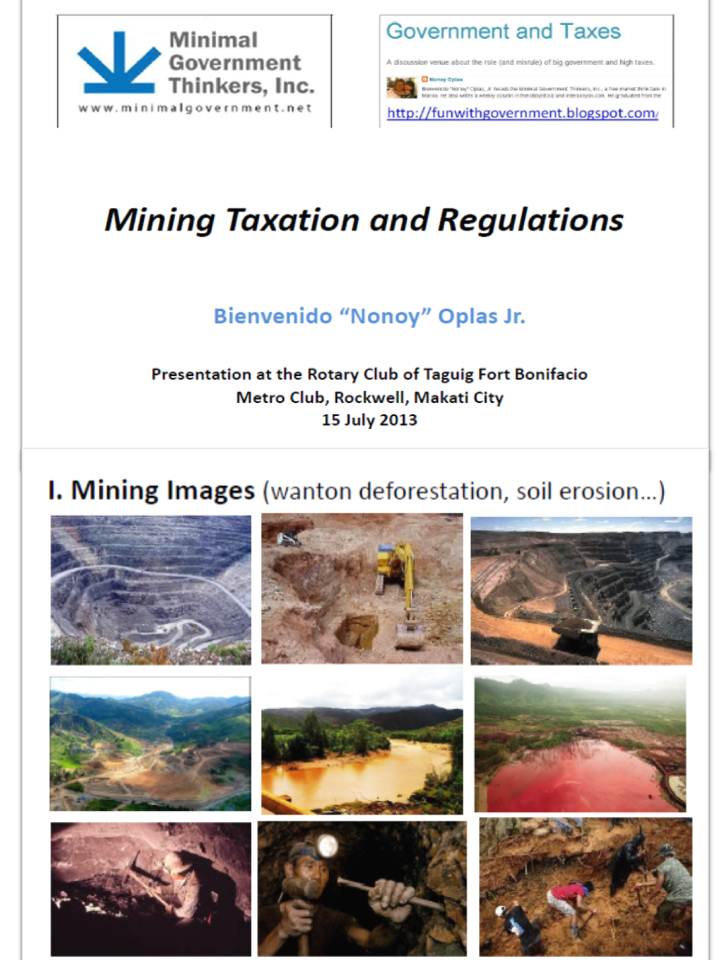
Mining 26: Presentation at Rotary Club of Taguig Fort Bonifacio

Last night, I gave a talk at our Rotary Club of Taguig Fort Bonifacio. My clubmates were happy to see these data and insights. One member suggested to have a bigger forum on the subject with speakers from opposing sides, to be sponsored by the club. Good proposal, supported by many other club members.


Tuesday, June 25, 2013

Mining 24: Casino-Hontiveros Mining Socialism is Off Tangent

Today is part 2 of the oral debate at the Supreme Court between the anti-corporate mining groups led by former Party-list Congressman Teddy Casino and Congresswoman Risa Hontiveros, and the Chamber of Mines of the Philippines (COMP). The former simply wants the government to confiscate as much money and revenues from the big mining corporations as possible because of their exploitation of the country’s mineral and forest resources, while being silent about similar exploitation by  the so-called “small scale mining” groups and individuals.

While data on various payment in taxes, fees, royalties and penalties made by large mining companies are available (See Mining Taxation and Government), there is zero data available for taxes and other payment by the small scale metallic (gold especially) mining. See also this comparison of mining taxation policies of Chile vs. the Philippines.


The petitioners want the SC  to declare Secs. 80 and 81 of RA 7942 as unconstitutional and then what, the SC will make its own tax rates in mining and insert them as the new Secs. 80 and 81 of this law? Can the SC legislate taxes and tax rates? This is not possible unconstitutional itself because such function is assigned by the Constitution exclusively to Congress, the House and Senate crafting a synchronized bill, and must be signed by the President.

I am wondering why these ex-legislators simply cannot wait for the new 16th Congress to convene just four weeks from now and introduce an amendment to RA 7942, say government should get 90 to 95 percent of the net revenues of big mining companies and go for explicit mining socialism. Teddy Casino and Risa Hontiveros are socialists anyway, I do not think they will deny their affinity with near- or full-socialism and have social and economic equality in society, demonize and over-tax the rich, over-subsidize the poor including the lazy and irresponsible.

Below are some news reports on this subject.


Philippine Star, June 21, 2013

COMP argued that since the La Bugal ruling – the longest in Supreme Court history which took six years for the high tribunal to deliberate on – there has been no material change in the circumstances of the Philippine mining industry.

“There is no compelling reason for the high tribunal to abandon its previous ruling,” COMP said in its motion.

Sec. 80 stipulates that the government share in mineral production sharing agreement (mpsa) is limited to excise taxes.

Sec. 81,on the other hand, limits the government’s share in Financial and Technical Assistance Agreement  (FTAA) to taxes, fees and royalties.

COMP said about P173 billion ($4 billion) in mining investments have been poured into the country since 2004 following the high court’s ruling, making the industry a significant contributor to national development, added COMP….

Sun Star, June 24, 2013

Debates started last April as the SC wanted to know whether the mineral production sharing agreement (MPSA) is unconstitutional for allowing an inequitable sharing of wealth (Section 80) and the government surrenders control and beneficial use of mineral resources under the financial and technical assistance agreement (FTAA) under Section 81.

The Chamber of Mines of the Philippines (COMP)… also said an equitable revenue sharing in mining is a question for the legislative and executive branches of government to decide....

GMA News, June 24, 2013

In a press conference in Manila, Erwin Quinones of the SOS-Yamang Bayan, one group opposed to the law, said that they wanted an "Alternative Minerals Management Bill", in which mining activities are "regulated and needs-based."

Quinones said the alternative mining law should also pave the way for the creation of a "minerals management council" that would ensure the Philippine Government's interests are protected.

"In its present form the so-called revenue regimes of the Mining Act reveals that with its many fiscal incentives and tax holidays, it is a one-way assurance for mining companies get their profits while the Government and the Filipino people bear the brunt of the social and environmental risks," the groups said.

Philippine Daily Inquirer, June 25, 2013

… In its 38-page comment in intervention, the Chamber of Mines asked for the dismissal of the petitions for certiorari and prohibition filed by Hontiveros and her copetitioners, citing three reasons.

These were: That the arguments raised by petitioners had already been passed upon and disposed of against petitioners in the case La Bugal-B’laan Tribal Association v Ramos, which the Supreme Court made a landmark ruling; that the high court should stand by its ruling here; and that the legislative and executive branches should decide on the question of what is an equitable revenue sharing from mining.

The chamber also said the petitioners had not shown any compelling reason to abandon the La Bugal B’laan case as it described their arguments to be a “mere rehash of those already overruled” in the same case.

It also held that there was no actual case or controversy in which to relitigate the case and that petitioners did not complain that they had been injured because of these provisions.
-------------

See also:
Mining 21: Chile Policies, May 21, 2013 

Mining 22: Philippines as EITI Candidate, June 05, 2013 

Mining 23: On the Proposed 10 Percent Gross Revenue Tax, June 06, 2013

Thursday, April 18, 2013

Mining 14: Teddy Casino's Environmentalism

Yesterday, Teddy Casino, Senatorial candidate of Bayan Muna/Makabayan Coalition, posted this in his facebook page,

We recently challenged provisions of the Mining Act of 1995 in court.

Ang pagmimina ay dapat bahagi ng isang National Industrialization Policy para matiyak na napapakinabangan ng mga Pilipino ang ating yamang mineral, at minimal ang negatibong epekto nito sa kapaligiran at mga komunidad.
Read the full statement: http://ow.ly/k6Ibm 

I commented on it, I wrote that “Government collects about 43% of the net revenues of big metallic mining firms. But government collects zero from small-scale metallic mining, and 9% from net revenues of non-metallic mining firms, http://funwithgovernment.blogspot.com/2013/03/mining-7-mining-taxation-and-government.html

A supporter of Casino defended him, below are our exchanges:

Leon Dulce Para-Sa Kalikasan But its contribution overall is only 0.91% to GDP, 2.5% in total investments and 0.38% to total employment. At hindi lang taxation ang usapin sa large-scale mining.
http://www.businessmirror.com.ph/index.php/news/nation/10114-mining-act-assailed-by-ngos-anew

Nonoy Oplas The contribution of mining to GDP is similar to raw agriculture. Chicken sold at wholesale price would cost only about P100 each on average, that's the agri share to GDP. When the same chicken is sold as litson manok and sold at P212 (Andok's or Baliwag litson), the P112 value added is counted as service sector share to GDP.

Copper, nickel, iron, when sold as ordinary stones or soil, is priced relatively low. But without these mineral products, there will be no construction and steel industry, no electricity and power industry, no tv/cellphones/radio/various electronics industry.

Leon Dulce Para-Sa Kalikasan Minerals are finite and should be utilized based only on the needs of the people, with the environmental and socio-economic concerns of communities in mind, and with a national industrialization plan in mind.

But as it stands, ores and huge profits are exported while the people are left with literally crumbs. And poison. Look at Padcal Mines in Benguet. Look at Citinickel Mines in Palawan. These are just recent cases. Paano yung long-standing and unresolved like Marcopper?

Mining by TNCs are not bringing in the revenue and safety as advertised. Mining should the public's, no one else.

Please read the article linked above in sir Teddy's caption before rehashing the tired, old lines about "no laptops if no mining."

Nonoy Oplas I read Casino's statement and it's lousy. As I noted above, tax payment by small scale metallic mining in 2010 was zero vs. P12 billion by big metallic mining, constituting 43% of their net revenues. Why is Casino silent on zero taxes, all extraction only by so-called "small scale" mining but are actually "big politicians mining".

Mineral deposits are infinite. Magma, gases and geological movement from the planet's core to the mantle up to the crust, mineralizes ordinary rocks and soil. That is why countries in the Pacific Rim of Fire have more mineral deposits than those in Africa, Europe, S. America and N. America atlantic side. A mining engineer from UP Diliman showed slides about this, http://funwithgovernment.blogspot.com/2013/03/mining-8-supreme-court-hearing-on-ra.html

Leon Dulce Para-Sa Kalikasan Ooh, geologists and mining engineers! Let's wait for the millions of years needed to renew minerals through the continental drift. In the meantime, let's be contented with the poverty incidences that remain highest in mining-affected communities, according to UPSE economists.

Lousy.

Nonoy Oplas I saw Rio Tuba Nickel Mining in southern Palawan. That small barrio has more shops, more cemented roads, wide street lights, a La Salle-administered private elementary and high school and it's free for all of its students, a modern private hospital and it's free for all patients. So the "poverty incidences that remain highest in mining-affected communities" is fiction story by some emotional environmentalists. A few kilometers outside Brgy Rio Tuba, even in the municipal proper of Bataraza, there is more poverty, more unemployment, zero hospital available. See the photos and you will fume more 

Tuesday, April 16, 2013

Mining 13: Timeline of Policies

This afternoon, there will be an oral argument and debates at the Supreme Court in Baguio City. Two petitions by Risa Hontiveros, et al challenge the constitutionality (for the second time) of RA 7942 or the Philippine Mining Act of 1995, particularly Sec. 80 and 81 of the law.


In the SC website, it says,
Petitioners argue that: (1) section 811 of the Mining Act of 1995 is unconstitutional because: (1) it violated the rule on delegated legislation; (2) the Secretary of the DENR (public respondent) acted with grave abuse of discretion resulting to lack or excess of jurisdiction in the issuance of DAO 07-12; and (3) both section 81 of the Mining Act and DAO 07-12 are unconstitutional because they allow inequitable sharing of wealth contrary to Article XII, Section 1, par. 1 and Section 2, par. 1 and 4 of the 1987 Constitution.

Will watch the results of the debate later today and tomorrow.

Meanwhile, below is a short timeline of various policies governing the mining industry in the country. I saw a rappler report on timeline mining. It was highly incomplete though as there are many other DENR Administrative Orders (DAO) and Department Memorandum Circulars (DMCs) affecting the industry. I skipped several DAOs and DMCs in producing this list.

Presidential Decree 1899, January 23, 1984
Defining small-scale mining as "artisanal", thus disallowing sophisticated equipment, involving minimal investments in infrastructure and processing plants, and relies on manual labour.

Republic Act 7076, June 27, 1991
People’s Small Scale Mining Act of 1991, "Minahang Bayan." Forms the Provincial/City Mining Regulatory Board that supervises small scale mining operations alongside the chiefs of the Environment Department and Mining Bureau.

Department Administrative Order (DAO) 1991-66, December 27, 1991 
Declaring certain parcels of Agusan-Davao-Surigao Forest Reserve as non-forest land open for small-scale mining. Parts of Diwalwal gold-rush area in Davao region was open to small-scale mining.

DAO 1992-34, July 14, 1992
Implementing Rules and Regulations (IRR) of RA 7076. 

RA 7942, “Philippine Mining Act of 1995”,  March 3, 1995 
Liberalizes foreign investments in the sector, involves the Local Government and Indigenous Cultural Communities in minerals exploration. Followed by a Financial and Technical Assistance Agreement (FTAA) with foreign-owned Western Mining Corporation Philippines (Tampakan mine).

DAO 1995-23, August 15, 1995
Implementing Rules and Regulations (IRR) of RA 7942. 

Jun. 19, 1995 
La Bugal-B'laan Tribal Association questioned the Constitutionality of RA 7942 and its IRR, particularly the FTAA, which allows foreign ownership, before the Supreme Court.

DAO 96-40,
Revised IRR of RA 7942.

Proclamation No. 297, November 25, 2002 
Establishing the 8,100-hectare Diwalwal Mineral Reservation.

Joint MC DENR-DTI 2003-02, September 10, 2003
Establishment of a Mining Investment Assistance Center.

SC ruling, RA 7942 as unconstitutional, January 2004
The Supreme Court en banc said the Mining Act of 1995 is unconstitutional since it allows foreigners to engage in mining through FTAAs, which is contradictory to the 1987 Philippine Constitution. 

SC reverses, declares RA 7942 as constitutional, December 2004
The Supreme Court reversed previous decision on the unconstitutionality of the Mining Act. Associate Justice Artemio Panganiban pens a resoution that says "full control is not anathematic to day-to-day management, provided that the State retains the power to direct overall strategy". This gives the government a go-signal to issue FTAAs.

DAO 2007-15, July 19, 2007
Amendments to DAO 96-40.

DMO 2009-01, January 30, 2009
Delegating the authority to issue Mineral Ore Exports Permit to the Provincial Governors concerned.

DMO 2010-08, June 29, 2010
Consolidated DAO re IRR of RA 7942.

DMO 2011-01, January 18, 2011
Suspension of acceptance of all mining applications.

EO 79, July 06, 2012
Institutionalizing and implementing reforms in the Philippine mining sector.
Imposes a moratorium on new mining contracts, creates the Mining Industry Coordinating Council (MICC). identify no-go areas for mining. (7 pages)

DAO 2012-07, September 10, 2012
Implementing Rules and Regulations (IRR) to EO 79 (16 pages)

DMO 2013-01, February 21, 2013
Increasing the minimum capital requirements for mining applicants – EP, MA, FTAA.
Authorized capital from P10 million to P100 million.
Paid up capital from P2.5 million to P6.25 million.

DAO 2013-10,  February 21, 2013
Increasing fees for mining applications.
Exploration Permit (EP) from P60/hectare but not less than P50,000 per application, to P300/hectare but not less than P200,000 per application.
Mineral Agreement (MA) from P60/hectare but not less than P50,000 per application, to P300/hectare but not less than P300,000 per application.
FTAA from P60/hectare but not less than P190,000 per application, to P300/hectare but not less than P500,000 per application.
-----------

See also
Mining 9: Supreme Court Hearing on RA 7942, March 27, 2013
Mining 10: Urban Tailings vs. Mining Tailings, March 31, 2013

Mining 11: Big Projects in the US, UK, Canada and Australia, April 04, 2013 
Mining 12: Political Risks vs. Natural Risks, April 09, 2013