Showing posts with label Laffer Curve. Show all posts

Monday, April 10, 2017

BWorld 121, The PH tax reform bill and tax policies in East Asia

* This is my article in BusinessWorld on March 24, 2017.


The current tax reform proposal of the Duterte administration promises to improve the Philippines’ competitiveness mainly by reducing income tax rates and cutting exemptions in value-added tax (VAT) and other fiscal incentives. The proposal has somehow created three myths in taxation.

1. REDUCING THE INCOME TAX RATE CAN LEAD TO REVENUE LOSS.
No, for two reasons. (a) The Laffer Curve is a good reminder that tax revenues can go down as tax rates increase. High taxes are disincentives to honest business and that is why many companies are hiring good law and accounting firms to either take advantage of legal loopholes and reduce tax payments, or find technicalities bordering on dishonest tax payment. And (b) Hong Kong and Singapore are good examples that low income tax rates do attract more local and foreign businesses, which further expand the tax base.

2. THE NEED TO RAISE EXCISE TAX FOR VEHICLES AND OIL PRODUCTS TO COMPENSATE FOR REVENUE LOSS IN INCOME TAX CUT.
No, for two reasons. (a) Vehicles and oil products are necessary for more business creation -- petroleum is a public good, after all. Petroleum allows huge trucks, buses, airplanes, and ships to transport more people and goods, activities which again expand the tax base; and (b) raising the oil tax (by P6/liter across the board) further raises the cost of doing business in the country.

In the table, the Philippines is third highest in tax payment as percent of commercial profit.

While the taxes on profit and corporate income is comparable to many of its neighbors, its “other taxes” like VAT, documentary stamp tax, franchise tax, capital gains tax, excise tax, etc. charge high rates. So raising the excise tax on vehicles and oil products is a raise on “other taxes” and that will dent the attractiveness of lower income tax.

3. NO NEED TO LOWER VAT, JUST REDUCE THE NUMBER OF EXEMPTIONS.
No. For two reasons: (a) Many industries and sectors have succeeded in their lobby for VAT exemption precisely because the 12% is high; and (b) among ASEAN countries, the Philippines, at 12%, has the highest VAT rate%; five countries have only 10% (Cambodia, Indonesia, Laos, Thailand, and Vietnam), Singapore 7%, Malaysia 6%, Myanmar 5%, Brunei 0.

See the column on tax post filing index (PFI), distance to frontier (DTF), 100 being the highest score. The Philippines has a low score of 49.8 mainly due to VAT non-refund policy. Economies with scores of 63 and above either do not have VAT or have VAT but have low compliance time with paying their corporate income tax (CIT) (see table).


So a good compromise will be to bring the VAT back to 10% and remove all exemptions except for raw agricultural and fishery products.

Another observable point from the above numbers is that many countries in Asia (and other continents) were socialistic in their income tax policy, started after World War II until the 1980s. For instance in 1980, Malaysia, Thailand, and Taiwan have income tax rates of 60%, Philippines has 70% and South Korea has almost 90%. The faster pace of globalization from the late 1980s onwards made many governments realize that the Laffer Curve indeed is correct, that the higher the tax rate, the lower will be the business activities and overall tax revenues.

To plug endless fiscal irresponsibility also known as endless and yearly budget deficit that require endless search for higher taxes, certain public spending and subsidies must be cut and certain government offices and bureaucracies must shrink or be abolished. Governments should learn to live within their means, even live below their means, especially during years without crises so they can have fiscal surpluses and pay their ever-rising public debt stock.

Bienvenido Oplas, Jr. is the head of Minimal Government Thinkers and a Fellow of SEANET. Both institutes are members of EFN-Asia.
-------------
See also: 

Saturday, June 04, 2016

Tax Cut 25, Presentation at Ateneo Ignite's Tax Exchange

I made this presentation at Ateneo  more than two months ago. The 24-slides presentation is available at my slideshare account. I will show a few slides here.


I got this photo from Mon Abrea, a famous tax consultant and tax simplification advocate. This  is after the event.


Our tax system is among  the highest, most envy-inspired in Asia. Data from WB-PWC's Paying Taxes 2016 Report.


These + other tables mean…

Tax wise, PH is NOT an attractive place to do business in the ASEAN. Highest total tax rate (TTR) in the region plus complicated and bureaucratic procedures. Only developed welfare countries Australia and Japan, and socialist China have higher TTR than PH.

Although in number of hours, VN proves it is indeed a socialist and bureaucratic state; in number of payments, ID’s bureaucracies are most notable.

Tax competition among ASEAN countries is happening. BR, SG and CM keeping  their low TTR, MM significantly cut its TTR last year. Only MY is dueling  with PH in high TTR.

The time to cut the PH’s (a) number of taxes and forced contributions, and (b) income tax rates, was yesterday. So we need to move fast today and tomorrow.

So if we can not significantly cut income taxes, one alternative is...


Proposal 3: National income tax is zero, allow provinces to impose income tax.

“No tax on work.” Survival and prosperity of societies are based on work of people. Work should not be penalized and discouraged with taxes, the way governments discourage smoking and drinking with more taxes.

National income tax is zero, or 5% max. National government to keep collecting consumption-based taxes (VAT, excise, franchise, vehicle registration, other taxes) and regulatory fees, while devolving more functions to provincial governments.

Provinces can impose income tax. Let there be tax competition, governance competition among them.

Concluding Notes

Tax and governance competition, infrastructure and security competition among provinces will empower the people and companies to vote with their feet.

Of 3 proposals, most feasible is #1, cut income tax rates to 20% or lower. Higher Q, wider tax base, will compensate for the reduction and propel higher TR.

Proposal #3 will attract the advocates of federalism and more decentralization and denationalization.

Proposal #2 will attract the more daring politicians, business and civil society leaders. Long-term view.

All 3 proposals can lead to more individual freedom, freer markets and limited government.
--------------

See also:

Thursday, August 15, 2013

Mining 30: Some Conceptual Considerations in Mining Tax

* This is my article today in Mining Week
----------

There are several proposals to amend the mining tax policy as contained in RA 7942 or the Mining Act of 1995. The dominant proposal so far is to have a 10 percent tax (7 percent on gross revenue + 3 percent on windfall income) on gross profit (ie, net of operating costs) to replace the two percent excise tax and royalties. The government says it will raise an additional P10 billion a year on average.

Another proposal, raised by Prof. Winnie Monsod, is to have the Malampaya gas revenue sharing where the government and Shell/private developers get a 60-40 percent of the gross profit, respectively, be applied to mining too.

There are several considerations, theoretical and empirical, in deciding whether to raise, retain or cut taxes in metallic mining, or any other sectors in general. Here are some.

One, there is a limit to raising taxes. There is an “optimal” tax rate where government tax revenues can be larger than if government will further touch the “maximum” tax rate. As the tax goes higher, either people will reduce working and hence, gross output will decline, or people will resort to under-report actual production. And government (national and local) tax assessors and collectors will be happy to accommodate such under-reporting in exchange for a bribe. This situation is demonstrated by the Laffer Curve.

Figure 1. Optimal tax rate in the Laffer Curve


This curve is saying that government tax revenue is larger if the tax rate is only on that “revenue maximizing point” (RMP) rather than go for 50 or 80 or 100 percent. At higher tax rates, under-reporting of production, if not under-working, is likely to happen, so that the tax base declines and hence, revenue collection declines.

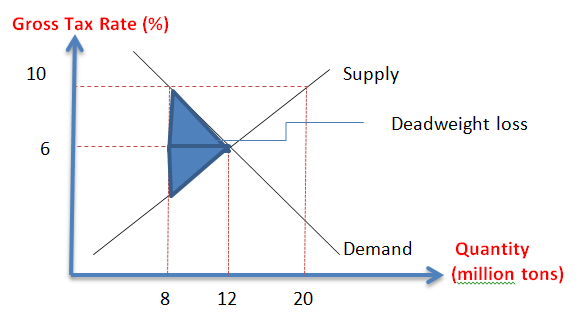
Two, there are “deadweight losses” to society as the tax rates go up. Deadweight loss is an economic term that means “excess burden” or “inefficiency in resource allocation” because of monopolistic pricing including government higher tax imposition, externalities and price controls. For instance, people will buy only a few units of a particular commodity even if they actually needed more, because of its high price. Or people will buy more than what they need and end up wasting or losing the excess units bought, because of government subsidy that result in artificially low price. Such non- or reduced purchase of certain essential items, or over-purchase of certain items resulting in wastes, are called excess or unnecessary burden, or simply “deadweight loss.”

In this hypothetical graph that this author has developed, let us assume that corporate income tax + excise tax + royalty tax + certain other taxes would be equivalent to about six percent of the gross revenues of large-scale mining companies, and consider it as a temporary equilibrium tax rate . Mining output at that rate is 12 million tons, composite for various types of metals.

If the government will raise it to 10 percent or higher to collect more tax revenues, it can result in an area on the left of the RMP of the Laffer curve and hence, result in higher revenues, or it could be on the right side of RMP and hence, result in lower revenues.  

Figure 2. Possible Effects of Higher Tax Rate in Mining


A decline in reported production from 12 to 8 million tons is possible if (a) existing local mining companies will reduce production even temporarily due to lower international prices of certain metals while local costs (wages, mandatory social contributions, electricity, fuel, taxes, fees, etc.) are rising. Or (b) simple under-reporting of actual production by some companies.

Currently, large scale metalling mining companies (LSMM) are already paying high taxes and fees to both national and local governments. In 2010 for instance, LSMM companies paid 43 percent of their net revenue to the government.

Figure 3. Taxes and Fees Collection from Philippine Mining, 2010


Source: Dr. Artemio Disini, COMP, presentation at the Philippine Economic Society (PES) Conference, November 27, 2012, PICC, Manila.

The numbers above would imply that there may be no need to amend RA 7942, especially on the taxation aspect. But since many sectors and legislators are driven by the politics of envy, a hike in mining tax may be inevitable.

The bigger issue in the mining industry is not raising the tax, but implementing the rule of law. That mining enterprises, large- or small-scale, local or foreign, should pay the established tax rates and regulatory fees; that environmental rehabilitation is strictly implemented after a mined out area; that mine tailings are securely impounded and isolated away from creeks, rivers, lakes and the sea; that certain community development projects are implemented to the host villages or barangays of the mining companies.
--------------- 

See also:

Tuesday, July 16, 2013

Mining 26: Presentation at Rotary Club of Taguig Fort Bonifacio

Last night, I gave a talk at our Rotary Club of Taguig Fort Bonifacio. My clubmates were happy to see these data and insights. One member suggested to have a bigger forum on the subject with speakers from opposing sides, to be sponsored by the club. Good proposal, supported by many other club members.


Monday, April 08, 2013

Fat-Free Econ 41: Cut Income Taxes

* This is my article yesterday in interaksyon.com. The "movie editor" that I referred here is Manny Castaneda, my co-cast in the late 80s political satire program, "Sic O Clock News" aired in IBC 13 and directed by the late Marilou Diaz-Abaya.
----------

Mid-April each year is the deadline for filing income tax payments made the previous year for both individuals and corporations.  A friend, a local movie director, commented in his Facebook wall, “April, buwan ng pagbabayad ng tax. Personally, it's like throwing my hard earned money into a toilet bowl. Wala naman itong silbi sa buhay ko.”

This sentiment is common, especially among fixed income earners. For them, surrendering up to 32 percent or nearly a third of their monthly income to the government through the mandatory withholding tax is a painful reality that they have learned to accept. That is why a proposal for a low flat income tax is worth looking into, and for the following reasons:

One, a flat tax rate of 15 percent or lower would attract many investors from the rich countries of Asia, North America and Europe to do business and create jobs in the Philippines. The country's two dynamic neighbors -- Hong Kong and Singapore -- benefit from a low flat tax rate.

Table 1. Top marginal income tax rate for selected countries
 table1
Source: Economic Freedom of the World (EFW) 2012 Report

The investors in Europe and North America are already paying high taxes and yet their governments are still heavily indebted. Which means that taxes there will rise further, or new taxes will be created to generate the revenues required to pay off debt. Many investors want to jump ship, looking for attractive economies abroad where they can put invest their money and talent.

Two, Philippines' 32 percent top tax rate for individuals and 30 percent for corporations appear to be in the region of declining revenues on the Laffer curve. This curve shows that as tax rates rise, actual revenues decline as people either reduce work and rest more, or find various loopholes to avoid paying more taxes. In Table 1, note that countries that reduced their income tax rates since three decades ago have some of the world's most dynamic economies. Their governments realize that very high income tax rates are not good.

Three, a cut in the Philippines' income tax to a flat rate of 15 percent or lower can be compensated by raising the value-added tax (VAT) from 12 percent to 15 percent. Many rich people either pay very small taxes or none at all. Like many professionals, businessmen, showbiz stars, corrupt government officials, drug lords, gambling lords, land grabbers and other criminals. But these people flaunt their wealth -- their new house/s, cars, watches and jewelries, laptops and cell phones, clothes and shoes, travel and so on. All these things usually are captured by the VAT system.

Government has many other sources of revenue, which apart from VAT also include excise tax, vehicle registration tax, travel tax, real property tax, to name  a few. Then there are various transaction taxes like documentary stamp tax, franchise tax, common carriers tax, bank earnings withholding tax, capital gains tax. And there are various fees: passport fee, driver's license fee, terminal fee, business permit fee, and so on.

Table 2. Philippine Government Revenues, in Billion Pesos
table2

Sources: Bureau of Treasury and BESF 2012-2013

Four, a low flat (or single-rate) income tax is not a novel idea, having existed in many countries. For instance, those that have 10 percent flat rates are Albania, Belarus, Bulgaria, Kyrgyztan, Kazakhstan, Macedonia, Mongolia and Serbia. Macau imposes 12 percent and Russia, 13 percent. Those that have 15 percent rates are the Czech Republic, Georgia, Iraq, Mauritius, Montenegro and Ukraine. Hungary and Romania impose 16 percent, while Estonia and Slovakia, 18 percent and 19 percent, respectively.

At least two Senatorial candidates in next month's elections -- Senator Ralph Recto and former Manila City councilor Greco Belgica -- are proposing to cut the country’s income tax rate.

Recto was the main author of Republic Act No. 9337 or the Expanded Value Added Tax (EVAT) Law. When he ran for re-election in the 2007 elections, he lost mainly because of a political backlash against his role in pushing that law. This time, Recto is playing a “taxpayers’ friend” role by proposing an income tax cut -- to what rate we have yet to divine.

Belgica proposes a “flat tax of not more than 10 percent of individual or corporate income only.” His proposal makes sense but his chances of becoming a senator next month, like many lesser-known candidates, are nil.
-------------

See also:
Fat-Free Econ 15: IMF and Freedom From Debt, July 01, 2012

Monday, March 19, 2007

Tax Cut 4: Tax Competition Among US States, the Laffer Curve

There is a very interesting news below -- a movement towards abolition of income tax, retention of consumption taxes to finance a smaller government, among a number of US states. If this trend will continue, Washington DC, the capital of the federal government, will be seen by many US states as a parasite: while many states are engaged in tax competition like abolition of income tax, the White House and its coterie of legislators are busy enacting new taxes (like taxing US citizens even if they are working and living abroad!) because they are busy making wars elsewhere, or promising endless foreign aid, or government to government transfer of taxpayers' money.

The free market movement in the world will become stronger if the free marketers in the US and Europe will succeed in shrinking their governments, in reducing the taxes and interventionist powers of their governments. A bloated US (and European) government is among the most convenient excuse given by politicians, bureaucrats and consultants in poorer countries, why taxes and government presence in many facets of the citizens' lives, should remain high. For instance, big foreign aid will require big local counterpart funding.
----------

http://online.wsj.com/article/SB116969533548687229.html
Rich States, Poor States
January 25, 2007

If you're searching for the next big thing in American politics, it's wise to keep an eye on the states. Here's one possibility: the abolition of state income taxes.

In Georgia, Missouri and South Carolina, Governors and state legislatures are drafting serious proposals to repeal their income taxes to promote economic development. St. Louis, one of America's most distressed cities, may overturn its wage/income tax as a way to spur urban revival.

And in Michigan, the legislature is in the last stages of phasing out its hated business income tax -- the most onerous in the land. "States are now in a ferocious competition to attract jobs and businesses," says economist Arthur Laffer, who is advising several Governors and legislators on the issue, "and one of the best ways to win this race is to abolish the state income tax."

...But the biggest target is the income tax. Newly re-elected South Carolina Governor Mark Sanford is talking of reviving his plan to phase out the income tax over 18 years. Mr. Sanford ran into opposition from the legislature in his first term, but he tells us that "I still consider this one of my top priorities and if the legislature wants to do it, I would be ecstatic."

Georgia may beat Mr. Sanford to the punch. House Republicans in Atlanta have announced that one of their top priorities is to use the half-billion-dollar budget surplus as a downpayment to "dismantle the current tax code."

House Republican Majority Leader Jerry Keen tells us the debate in Atlanta is between a flat-rate income tax and a plan that would "do away with the personal income tax but broaden the sales tax by eliminating 107 exemptions. We're committed to a pro-growth tax plan that announces to the country that Georgia is open for business."

...The idea of financing state services without an income tax is hardly radical. Nine states today -- Alaska, Florida, Nevada, New Hampshire, South Dakota, Tennessee, Texas, Washington, and Wyoming -- manage well Without one. With a few exceptions, the non-income tax states are America's Most prosperous. Meanwhile, the high income tax states, which tend to be congregated in the Northeast, keep surrendering jobs, people, and voters to the South and West...
---------


On the Laffer Curve and Optimal Tax Rate

The Laffer curve is a graph showing an optimal level of tax rate where government revenues reach maximum level. If the tax rate further increases, say from 30% to 40%, revenues go down as people would rather reduce work and have more sleep and leisure since more income means more taxes to be surrendered to the government. Or people would rather misdeclare their income to evade paying more taxes, or bribe tax collectors, resulting in lower revenues than projected.

The concept was developed by an American economist, Prof. ArthurLaffer. He further argued that lower taxes result in lower prices, higher demand, leading to higher production and hence, bigger economic pie and higher taxable base. We can add that lower taxes or tax cuts are tantamount to pay hike to everyone whose monthly and yearly income are automatically deducted with government withholding taxes. Thus, pay hike means more pockets for the people, more spending power, more demand and consumption, and so on.

Taxes are always distortionary. You remove 1/3 to ½ of a productive person's monthly income and savings, purportedly for whatever welfarist and missionary functions by the state, you immediately alterthe working, spending and savings attitude of that person. For instance, instead of bringing his family to dream vacations in thePhilippines (Boracay, Coron-Palawan, Puerto Galera, Baguio, etc.) twice a year – that creates jobs to many people living and working there – they only go there once every 2 years. Because the equivalentvalue of his expenses for such holiday was confiscated by the government. And government, once it holds the money, can decide whether to improve the justice system that will benefit everyone, or improve the chances for re-election of the incumbent politicians through endless pork barrel or charter-change campaigns.

So, since taxes are distortionary because they are forced collections, taxes should be few and small. That is, the distortions should be few and small.

In a way, you can have 2 (or more) Laffer curves, depending on yourpurpose. For instance:

Laffer curve 1 – a level of tax rate that will finance the current and projected levelof government expenditures. For statist and interventionist politicians, plus their coterie of equally statist consultants, staff and bureaucrats, retain the current government expenditures of 50-60%of GDP (the current level in many western & northern European countries), then devise a tax rate that will somehow give you a tax & "non-tax" (but still compulsory payment to government, like driver's license fee, passport fee…) revenues of 50-60% of GDP.

Laffer curve 2 – a level of tax rate to really unburden taxpayers and finance a government that is just focused on a few, limited, andimportant function – protect lives, properties, and individual liberties of the citizens. Because the more functions and welfarism that a government intends to do, the more taxes, fees and penalties itwill collect and confiscate from the citizens.

The Laffer curve concept is a beautiful guide to remind governments when they should stop confiscating a big portion of the income and savings of their citizens. It is also a good reminder to socialists, welfarists, and other advocates of wanton confiscation of income andsavings of productive people, that there is a limit to such philosophy based on forced equality, if not envy.