Showing posts with label tax cut. Show all posts

Thursday, March 15, 2018

BWorld 190, TRAIN, inflation and the stock market

* This is my column in BusinessWorld on February 22, 2018.


At first there were bureaucracies, endless subsidies, and new taxes; second were price hikes due to the new taxes; third, monetary control measures to minimize price hikes; and fourth, investment funds react to these monetary controls, especially regarding the exchange and interest rates.

That in a sense, is how a nonfinance researcher like me would attempt to connect the dots. The first and third actions are government interventions while second and fourth are market reactions to these interventions.

Since I am not a stock market analyst, I chose to attend the BusinessWorld Stockmarket Roundtable held Tuesday at Makati Shangri-La Hotel. After all, it was a good opportunity for researchers and investors to know more about the stock market.

There were four speakers that afternoon. Augusto “Gus” Cosio, Jr., president of First Metro Asset Management, Inc.; April Lynn Tan, vice-president and head of Research of COL Financial Group, Inc.; Justino “Jun” Calaycay, Jr., head of Research and Engagement Department of Philstocks Financial, Inc.; and Michael “Mike” Gerard Enriquez, chief Investment officer of Sunlife Financial.

Gus Cosio argued the following points, among others: (1) the TRAIN’s personal income tax cut will put more cash in the pockets of salaried people, good for current account, savings account (CASA); (2) rise in short-term interest rates are good for net interest margin (NIM) expansion; (3) rise in prices will raise demand for working capital; (4) decline in required reserves will reduce intermediation cost; (5) better macro growth means fewer troublesome loans; (6) never put all your hopes on one or two stocks and invest in a basket of stocks.

Mike Gerard Enriquez started being less optimistic and enumerated sources of potential disruptors in the stock markets: (1) faster hikes in US Federal rates and balance sheet reduction, (2) faster pace of peso depreciation, the worst-performing Asian currency at the moment, (3) higher inflation due to new taxes, (4) worsening current account deficit, and (5) risk in government implementation of reforms. Overall though he is optimistic and expressed the need to expand the number of listed companies at the PSE.

April Tan highlighted the following points, among others: (1) market correction in January was expected due to hike in US bond rates, (2) the correction was a good opportunity to accumulate stocks at more attractive valuations, (3) weaker peso and higher taxes are inflationary and can adversely affect consumer spending, (4) but inflation is not a long-term but a short-term issue, (5) historically, equity markets have gone up with higher rates, and (6) long-term economic prospects remain positive with favorable demographics, high remittances from OFWs and growing BPO sector.

Jun Calaycay discussed these considerations, among others: (1) the Bangko Sentral ng Pilipinas is expected to raise interest rates 1-2 times this year, (2) higher inflation from TRAIN is felt more by people on the ground, (3) despite these, Philippine economy will continue to expand, (4) good prospects this year are construction and allied services, power and energy sectors.

I learned several lessons, especially for a nonfinance guy like me. My concerns and research work are focused on government policies that distort the normal incentives system if markets are left more freely.

Encouraging more portfolio investments and foreign direct investments (FDI), more big infrastructure projects via integrated PPP and not “hybrid” PPP and without tax hikes à la TRAIN — all these took place during the past administration.

For instance, there was a big increase in the Philippine stock market capitalization in one decade, 3.5 times expansion in 2015 or 2016 level as against the 2006 level while other neighbors managed to expand less than 2 times. And the Philippines’ market capitalization was at the median level of 80+% of GDP, comparable to South Korea level (see table).


Inflationary pressures coming from tax hikes while retaining high tax rates elsewhere (VAT, corporate income tax/CIT, withholding tax, etc.) can adversely affect consumer spending, which, in turn can affect overall macroeconomic performance.

That is why the coming TRAIN 2 should aim for significant tax cuts in CIT and VAT while reducing the number of exemptions and tax holidays. A nontax-hungry TRAIN can tame inflation, stabilize the credit markets and expand the stock markets.
--------------

See also:

Sunday, February 11, 2018

Tax Cut 31, Talk at Deloitte TRAIN forum, January 2018

Last month, I gave a talk about the new tax-tax-tax law of the Philippines called TRAIN, signed in December 2017. Audience were accountants, auditors, managers of medium to large corporations plus officials and staff of Deloitte. I said that I entitled my paper as such because I believe that the TRAIN law is a lousy and ugly law.


The audience (100+) smiled, others wondered. My concluding notes:

* PIT cut  rate should be a social goal and a public service in itself. Earning P500,000 (little less than $10,000) or higher per year and be slapped with 32% income tax is  confiscatory, immediately qualifies the government as creator of poverty. No need to raise or create new taxes somewhere.

* Instead of raising the top PIT rate to 35%, TRAIN should have cut it to 20% max, to (1)  be more comparable with MY, SG rates and (2) decentralization preparation, allow state govts to have their own income tax, excise tax, etc.

* Society should reward people who become rich and wealthy via entrepreneurship and efficient professional work, not demonize and over-tax them. We should have more millionaires and billionaires, not less; we should have more super-rich people, not less.

* Federalism can be more attractive to the people, central national government should learn to step back, tax less, regulate less, bureaucratize less, people and investors in the provinces have more leeway, more opportunities to craft their own political and economic identity.

“I hope we once again have reminded people that man is not free unless government is limited. There's a clear cause and effect here that is as neat and predictable as a law of physics: as government expands, liberty contracts.”

-- Ronald Reagan, former US President.


Thank you for that opportunity, Senen, Deloitte officials.
------------

See also:
Tax Cut 28, On Trump's planned 15% income tax, January 23, 2017 
Tax Cut 29, Culture of exemptions and culture of envy, February 06, 2017 

Tax Cut 30, Trump's 20% CIT, deregulation, October 09, 2017

Monday, October 09, 2017

Tax Cut 30, Trump's 20% CIT, deregulation

When the White House proposed a drastic corporate income tax cut (from 39% to 20%), 25% for single proprietorship, they did not suggest a tax hike somewhere to "compensate for lost revenues" like the Dutertenomics' tax-tax-tax.

Copy-pasting portions of these press releases and short blog posts from the WH.


"* The U.S. corporate tax rate has been higher than the OECD average for almost 20 years.
The average total corporate tax rate among OECD nations is 24 percent, while the United States is nearly 40 percent.

* The U.S. average corporate tax rate is almost 10 points higher than China’s, according to the Congressional Budget Office." -- Sept. 29, 2017.

"Our plan is based on four simple principles: reducing taxes for working families, simplifying the tax code, cutting taxes for businesses large and small, and making it possible for American companies to bring profits home to America to create jobs and opportunities here."
-- VP Mike Pence, Oct 03, 2017.

"In 1989, the year the Berlin Wall fell, the average statutory corporate tax rate imposed by central and sub-central governments in the OECD was 43 percent. In 1989, the comparable rate in the U.S. was about 39 percent. In the time since the Wall fell, the OECD average corporate tax rate has trended downwards to its current 24 percent, about half of its 1989 level. The U.S. corporate tax rate, however, is still stuck in the same place it was when the Berlin Wall crumbled almost 20 years ago.

There is now a broad consensus in this country that it is time to “Tear down this rate.”
-- Kevin Hassett, Chairman of the Council of Economic Advisers.

"The America First Tax Plan will bring historic tax relief to the American people through a framework that is “based on four key ideas,” said the President. First, the plan will cut taxes for every day, hardworking Americans, taking the burden off the middle class. Second, the tax code will be dramatically simplified, allowing Americans to file their tax returns on a single sheet of paper. Third, the business tax rate will be lowered to 20 percent, making business in America competitive again. And finally, the “American Model” will encourage businesses to return from overseas, bringing trillions of dollars to the economy." -- Sept. 28, 2017. 

Good summary of support from the Editorial Boards of WSJ, NYPost, WTimes, WExaminer, Inv Business Daily, National Review. Nothing from NYT, WaPo, CNN, BBC, etc. Perhaps they love more taxes, more regulations, more welfarism, more statism or state worship.

Accompanying drastic tax cut is drastic deregulation and de-bureaucratism.

"* In 2000, completing paperwork for Federal regulation cost an estimated $236 billion (up from $143 billion in 1980). Assuming the same proportion of compliance officers’ salaries out of total paperwork cost, the cost of paperwork increased to $881 billion in 2015.

* Regulation is especially burdensome for small businesses: the cost per employee of complying with regulations was higher for small firms ($11,724) than it was for firms with over 100 employees ($9,083)...

* There were approximately 45,000 more pages in the Federal Register, which reflects the flow of new regulations, than 40 years prior." -- October 02, 2017. https://www.whitehouse.gov/blog/2017/10/02/how-deregulation-can-increase-economic-growth

I wonder why many "libertarians" and free marketers would be silent or even implicitly attack this tax cut plan by Mr. Trump as "favoring the rich" or "favoring Trump businesses". Perhaps the quick answer is that many libertarian-anarchists argue that "taxation is theft" and hence, the tax rate should not be 39%, not 20%, not even 1%, but zero. Zero taxes, zero government as we know it.

Fine, if one is talking to students or fellow anarchists. But if one is involved in public policy debates, engaging government officials, legislators, etc. is necessary and inevitable. It is not possible to advocate "zero government" while engaging government for lesser regulations, lower and fewer taxes, lower non-tariff barriers in trade, and so on.

For now, I just like what I see in the Trump fiscal policies.
---------------

See also:

Tax Cut 27, The Furusato tax in Japan as possible model in citizen empowerment, October 14, 2016 
Tax Cut 28, On Trump's planned 15% income tax, January 23, 2017 
Tax Cut 29, Culture of exemptions and culture of envy, February 06, 2017 

Trump's Joint Address at US Congress today, March 01, 2017
BWorld 136, Income tax and the politics of envy, June 12, 2017 
Tax-tax-tax, Free-free-free, August 09, 2017

Monday, April 10, 2017

BWorld 121, The PH tax reform bill and tax policies in East Asia

* This is my article in BusinessWorld on March 24, 2017.


The current tax reform proposal of the Duterte administration promises to improve the Philippines’ competitiveness mainly by reducing income tax rates and cutting exemptions in value-added tax (VAT) and other fiscal incentives. The proposal has somehow created three myths in taxation.

1. REDUCING THE INCOME TAX RATE CAN LEAD TO REVENUE LOSS.
No, for two reasons. (a) The Laffer Curve is a good reminder that tax revenues can go down as tax rates increase. High taxes are disincentives to honest business and that is why many companies are hiring good law and accounting firms to either take advantage of legal loopholes and reduce tax payments, or find technicalities bordering on dishonest tax payment. And (b) Hong Kong and Singapore are good examples that low income tax rates do attract more local and foreign businesses, which further expand the tax base.

2. THE NEED TO RAISE EXCISE TAX FOR VEHICLES AND OIL PRODUCTS TO COMPENSATE FOR REVENUE LOSS IN INCOME TAX CUT.
No, for two reasons. (a) Vehicles and oil products are necessary for more business creation -- petroleum is a public good, after all. Petroleum allows huge trucks, buses, airplanes, and ships to transport more people and goods, activities which again expand the tax base; and (b) raising the oil tax (by P6/liter across the board) further raises the cost of doing business in the country.

In the table, the Philippines is third highest in tax payment as percent of commercial profit.

While the taxes on profit and corporate income is comparable to many of its neighbors, its “other taxes” like VAT, documentary stamp tax, franchise tax, capital gains tax, excise tax, etc. charge high rates. So raising the excise tax on vehicles and oil products is a raise on “other taxes” and that will dent the attractiveness of lower income tax.

3. NO NEED TO LOWER VAT, JUST REDUCE THE NUMBER OF EXEMPTIONS.
No. For two reasons: (a) Many industries and sectors have succeeded in their lobby for VAT exemption precisely because the 12% is high; and (b) among ASEAN countries, the Philippines, at 12%, has the highest VAT rate%; five countries have only 10% (Cambodia, Indonesia, Laos, Thailand, and Vietnam), Singapore 7%, Malaysia 6%, Myanmar 5%, Brunei 0.

See the column on tax post filing index (PFI), distance to frontier (DTF), 100 being the highest score. The Philippines has a low score of 49.8 mainly due to VAT non-refund policy. Economies with scores of 63 and above either do not have VAT or have VAT but have low compliance time with paying their corporate income tax (CIT) (see table).


So a good compromise will be to bring the VAT back to 10% and remove all exemptions except for raw agricultural and fishery products.

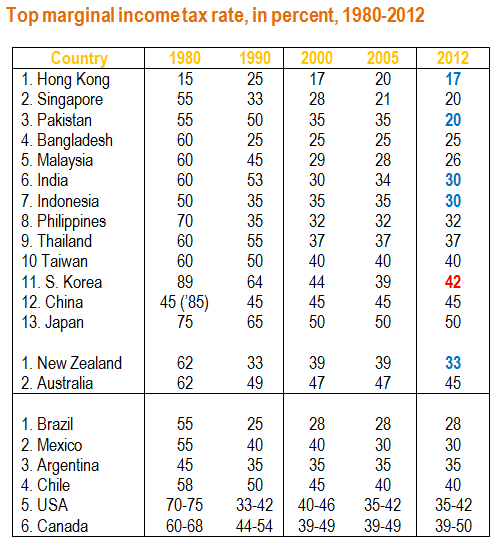
Another observable point from the above numbers is that many countries in Asia (and other continents) were socialistic in their income tax policy, started after World War II until the 1980s. For instance in 1980, Malaysia, Thailand, and Taiwan have income tax rates of 60%, Philippines has 70% and South Korea has almost 90%. The faster pace of globalization from the late 1980s onwards made many governments realize that the Laffer Curve indeed is correct, that the higher the tax rate, the lower will be the business activities and overall tax revenues.

To plug endless fiscal irresponsibility also known as endless and yearly budget deficit that require endless search for higher taxes, certain public spending and subsidies must be cut and certain government offices and bureaucracies must shrink or be abolished. Governments should learn to live within their means, even live below their means, especially during years without crises so they can have fiscal surpluses and pay their ever-rising public debt stock.

Bienvenido Oplas, Jr. is the head of Minimal Government Thinkers and a Fellow of SEANET. Both institutes are members of EFN-Asia.
-------------
See also: 

Monday, January 23, 2017

Tax Cut 28, On Trump's planned 15% income tax

These are some news reports and my brief notes last January 11-12, 2017, posted in my fb wall. 

"if the Trump administration follows through on a pledge to cut the corporate income-tax rate from 35 percent to 15 percent, and slash individual rates..." https://www.bloomberg.com/news/articles/2017-01-10/trump-s-tax-cuts-could-jumpstart-global-economy-world-bank-says 

That's huge. Tax competition, not tax harmonization, is the way towards higher global growth.

"The first Trump tax cut will be the repeal of most or even all of the nearly 20 tax increases that funded Obamacare, which total about $1 trillion over the next decade. These are taxes on your health insurance, hospitals (both charitable and for-profit), medical devices, drugs, capital gains, your Health Savings Accounts and Flexible Savings accounts, out-of-pocket medical bills, and even a steep “indoor tanning tax.” https://medium.com/.../the-trump-tax-cuts-will-be-huge...

"The trillion dollars in higher taxes have restricted health care choice, increased costs, made saving more difficult, and granted government more control over care at the expense of individual control. Below are just some of the tax wins that will come from repealing ObamaCare:
1. Individual and Employer Mandate Taxes
2. Taxes on Health Insurance, Prescription Medicine and Medical Devices
3. High Medical Bills Income Tax ... http://www.foxnews.com/.../grover-norquist-why-repeal...

"When I walk down the street, and a mugger ... doesn't take my wallet, he didn't give me my wallet," Norquist analogized. "This idea when the government fails to steal your money ... and tax it, that it gave it to you is nonsense. It's not a gift."

Grover Norquist also highlighted a reduction in the corporate tax rate as a major pillar of GOP tax reform efforts. "We're going to take the corporate rate from 35 percent to either 15 or 20 [percent]. I like 15 better." http://www.cnbc.com/.../heres-why-trump-and-gop-leaders...

"The incoming administration should expand its tax package when it formally takes office. As Ronald Reagan did with his tax reform in 1986, it should reduce the brackets to two: in this case, 25% and 10%; it should also cut the levies on capital gains from 23.8% (this includes a 3.8% ObamaCare add-on) to 15% or less." -- Steve Forbes, http://www.forbes.com/.../why-trumps-tax-cuts-should.../...

"His plan would significantly reducemarginal tax rates onindividuals and businesses, increase standard deduction amountsto nearly four times current levels, and curtail manytax expenditures. His proposal would cut taxes at all income levels, although the largest benefits, in dollar and percentage terms, would go to the highest-income households. The plan would reduce federal revenues by $9.5 trillion over its first decade before accounting for added interest costs or considering macroeconomicfeedbackeffects. The plan would improve incentives to work, save, and invest. However, unless it is accompanied by very large spending cuts, it could increase the national debt by nearly80percent of gross domestic productby 2036, offsettingsome or all of the incentive effects of the tax cuts." -- AN ANALYSIS OF DONALD TRUMP’STAX PLANJim Nunns, Len Burman, Jeff Rohaly, and Joe RosenbergDecember 22, 2015, http://www.taxpolicycenter.org/.../analysis-donald.../full


Now, what if the budget deficit balloons?
Good question. It's tax cut + spending cut. Lots of federal agencies are planned to be starved of excess funding

I think this is part of the "drain the swamp" program. Too many regulations, too many regulators, too many consultants and lobbyists, now they are uneasy or angry. http://www.reuters.com/.../us-usa-congress-regulations...

"an agenda that cuts regulations across a broad swath of critical sectors, enacts tax reform that slashes personal and corporate taxes, and calls for at least $1 trillion in improvements for bridges, roads and other public projects...

In raw numbers, that would push 2017 growth to 2.4 percent and 2018 up to 3.6 percent. By way of comparison, the economy has grown an average of about 1.6 percent a year under President Barack Obama, the worst recovery since the Great Depression. Obama is the first president since Herbert Hoover not to see at least 3 percent growth for a calendar year." http://www.cnbc.com/.../donald-trump-plans-will-double... 
------------

See also:

Saturday, June 04, 2016

Tax Cut 25, Presentation at Ateneo Ignite's Tax Exchange

I made this presentation at Ateneo  more than two months ago. The 24-slides presentation is available at my slideshare account. I will show a few slides here.


I got this photo from Mon Abrea, a famous tax consultant and tax simplification advocate. This  is after the event.


Our tax system is among  the highest, most envy-inspired in Asia. Data from WB-PWC's Paying Taxes 2016 Report.


These + other tables mean…

Tax wise, PH is NOT an attractive place to do business in the ASEAN. Highest total tax rate (TTR) in the region plus complicated and bureaucratic procedures. Only developed welfare countries Australia and Japan, and socialist China have higher TTR than PH.

Although in number of hours, VN proves it is indeed a socialist and bureaucratic state; in number of payments, ID’s bureaucracies are most notable.

Tax competition among ASEAN countries is happening. BR, SG and CM keeping  their low TTR, MM significantly cut its TTR last year. Only MY is dueling  with PH in high TTR.

The time to cut the PH’s (a) number of taxes and forced contributions, and (b) income tax rates, was yesterday. So we need to move fast today and tomorrow.

So if we can not significantly cut income taxes, one alternative is...


Proposal 3: National income tax is zero, allow provinces to impose income tax.

“No tax on work.” Survival and prosperity of societies are based on work of people. Work should not be penalized and discouraged with taxes, the way governments discourage smoking and drinking with more taxes.

National income tax is zero, or 5% max. National government to keep collecting consumption-based taxes (VAT, excise, franchise, vehicle registration, other taxes) and regulatory fees, while devolving more functions to provincial governments.

Provinces can impose income tax. Let there be tax competition, governance competition among them.

Concluding Notes

Tax and governance competition, infrastructure and security competition among provinces will empower the people and companies to vote with their feet.

Of 3 proposals, most feasible is #1, cut income tax rates to 20% or lower. Higher Q, wider tax base, will compensate for the reduction and propel higher TR.

Proposal #3 will attract the advocates of federalism and more decentralization and denationalization.

Proposal #2 will attract the more daring politicians, business and civil society leaders. Long-term view.

All 3 proposals can lead to more individual freedom, freer markets and limited government.
--------------

See also:

Saturday, March 26, 2016

Tax Cut 24, Tax reform forum in Ateneo

This coming Tuesday, 29 March, I will be one of four speakers in this event jointly sponsored by the Ateneo de Manila IgnITE Movement, in partnership with four other groups: Ateneo Economics Association, UP School of Economics Student Council (UP SESC), Center for Strategic Reform of the Philippines (CSRP), and Tax Reform Philippines.
  
It is also supported by the Tax Management Association of the Philippines (TMAP) and the OGP Fiscal Reform Coalition.

Briefly, my concept of "tax reforms" are in favor of taxpayers and not of the state or government. So minimum or zero income tax as much as possible and government can levy various consumption-based taxes (VAT, GST, excise tax, travel tax, amusement tax, property tax, vehicle registration tax,...) plus various regulatory fees.

I will discuss my two papers published in BusinessWorld, (1) A simple model of raising tax revenues if rates are cut, and (2) PH splitting into many new island-nations.


The latter is to encourage tax competition, governance competition, national stupidity reduction, among many new island-nations. This will spare the rest of the PH of plunderers and mass murderers like the Marcoses, Binays, Duterte as their "national leaders." 

A "national stupidity reduction" is simply reducing the geographical area that megalomaniacs, notorious central planners and dictatorship-prone politicians -- and their consultants and supporters -- can rule. This way, their chance of ruling the entire PH is significantly reduced because some if not many of them can be defeated in other (new) island-nations. My friend Bernard Ong called this process as “geofencing of nuts”. :-)
-----------

See also:

Thursday, December 17, 2015

BWorld 33, Computing rise in tax revenues if rates are cut

* This is my article in BusinessWorld last Tuesday.


Among the most important liberal economic policies that the Aquino administration should have pursued -- to remain consistent with its party affiliation, the Liberal Party (LP) -- is to cut income tax rates in the Philippines. Unfortunately, the President failed to appreciate the importance of this measure.
  
While some LP leaders pursued this measure, top party officials and the Department of Finance Secretary took the limited view that tax cut means lower tax revenues. Hence, they objected the measure.

Below is a simple model, not an econometric one, to estimate potential higher tax revenues by cutting income tax.

Tax revenues (TR) is a product of tax rate (t) multiplied by the quantity (Q) or number of taxpayers, individuals and corporate.

(1) TR = t x Q.

Assuming that there is only one form of tax, the income tax for individuals and enterprises, then there are two ways to raise TR:

(i) raise t or keep it at a high rate and hope that Q will remain the same or further rise, or

(ii) reduce t and watch Q to expand faster than the decline in t.

Now there are many types of taxes other than direct income tax:

(a) consumption-based taxes, such as value-added tax (VAT), excise tax, travel tax, amusement tax, etc.;

(b) property-based taxes such as real property tax or RPT collected by local government units (LGUs), vehicle registration tax, franchise tax, etc.;

(c) indirect income taxes such as bank interests withholding tax, capital gains tax, estate tax, documentary stamp tax, etc.;

(d) product-based taxes such as royalties and excise tax for extractive industries -- mining, natural gas, geothermal, coal, petroleum, etc.;

(e) LGU taxes such as barangays, business permit taxes, community tax, etc.;

(f) others.

Then there are many types of mandatory fees and permits:

(a) National: drivers license fees, passport fees, airport terminal fees, NBI clearance fees, police clearance fees, professional clearance fees, etc.

(b) LGUs: residence tax/cedula, barangays, city/municipality/provincial permits and fees.

So there are various types of tax rates, to be noted as

t1 -- direct income taxes

t2 -- consumption based taxes

t3 -- property based taxes

t4 -- indirect income taxes, and so on

So the government’s TR goal can be summarized as:

(2)  TR = ∑ [(t1 x Q1) + (t2 x Q2) + t3 x Q3) + …]

For the income tax cut campaign, it can be shown that reducing t1 from 32% (individual) and 30% (corporate) to only 25%, or 20% or 15%, will result in a higher number of individuals paying their taxes correctly.

The rise in Q1, number of people and companies who will pay individual and corporate income taxes will be expected from the following:

(ET) Existing Taxpayers who underdeclare their real income and report lower income to pay lower taxes;

(NT) Individuals who never declare any income even though they earn;

(FA) Filipino potential taxpayers abroad, professionals and entrepreneurs who work and do business abroad than here, partly due to lower tax rates and higher income opportunities there, and they will return home;

(FT) Foreign Taxpayers, professionals and businessmen abroad especially in high-taxes welfare states of the European Union and North America, who want to leave their country and do business in Asian economies with lower tax rates.

(ET + NT) are local groups surfacing, (FA + FT) are foreign-based groups coming here. Together, they will significantly raise Q1 and hence, TR can increase even if t1 has decreased. Or:

(3) Q1 = ET + NT + FA + FT.

Examples and hypothetical case studies:

At t1 = 32%, if average tax collection is P250,000/person/year and Q1 is at 8 million people, then:

(4) TR1 = t1 x Q1 = P200,000 x 8M = P1.4 trillion

If t1 declines from 32% to 20%, corresponding to average payment of P120,000/person and Q1 rises from 8 million to 14 million people, then:

(5) TR1’ = t1’ x Q1’ = P120,000 x 14M = P1.68 trillion.

Now Q2 should also rise because Q1 (equation 3) has increased.

At 12% VAT, assuming that average VAT payment per person is P20,000/year, and there are 50 million people who pay VAT,

(6) TR2 = t2 x Q2 = P20,000/person/year x 50M = P1 trillion

Assuming that VAT is raised from 12% to 14% and average VAT payment rises from P20,000 to P25,000/person/year, and there are now 53 million VAT taxpayers, then:

(7) TR2’ = t2’ x Q2’ = P25,000 x 53M = P1.23 trillion

So TR collection via status quo, from equations (4) + (6):

(8) TR1 = P1.4T + 1.0T = P2.4 trillion.

Vs. TR collection via income tax cut, from equations (5) + (7):

(9) TR2 = P1.68T + P1.23T = P2.91 trillion.

There is an increase in TR by P510 billion or P0.51 trillion.

Again, the above numbers are hypothetical and made only to illustrate the point that reducing income tax rate can actually increase, not decrease, total TR of the government. The challenge now is to find out what would be the projected:

(i) increase from Q1 (individuals) to Q1’ if individual income tax is cut from 32% to 25% or 20% or other lower rates;

(ii) increase from Q1 (corporations) to Q1’ if corporate income tax is cut from 30% to 20% or other lower rates;

(iii) increase from Q2 to Q2’ if VAT remains at 12%;

(iv) increase in average VAT collection per person if VAT is raised from 12% to 14%, and corresponding change from Q2 to Q2’.

If these numbers are generated and estimated, then the realistic projected increase in TR as a result of income tax cut can be shown and quantified.

Meanwhile, members of the LP can proudly declare that they are consistent in pursuing liberal economic policies -- liberate the individual and private enterprises from overbearing and heavy taxes, fees, royalties, charges and penalties.


Bienvenido S. Oplas, Jr. is the head of Minimal Government Thinkers, and an economic consultant at the Alas, Oplas and Co. CPAs. minimalgovernment@gmail.com
--------------

See also:

Sunday, May 10, 2015

Tax Cut 23: Tax Competition in Asia, Hikes in Europe

This is the continuation of my essay almost eight years ago, Retreat of High Income Tax Philosophy (September 19, 2007). Here are the numbers, and notice the significant drop  in tax rates from 1980 to 1990, then to 2000, for many countries -- except Hong  Kong, which started with low rates.

Marked in blue are tax cut of at least three percent from 2005 to 2012.
Marked in red are tax hikes of at least three percent for the same period.


Not included in the table above for Asia are four ASEAN countries due to incomplete time  series data from 1980 but here are their income tax rates as of 2012: Brunei zero, Cambodia 20 percent, Myanmar 30 percent, Laos, not included in  the EFW Report.

While many in Asia have blue marks (except in S. Korea), meaning there is tax competition, it's the reverse in Europe,


Source: Gwartney, James and Robert Lawson, Economic Freedom of the World, 2014 Report. Published by The Fraser Institute (www.freetheworld.com) 
--------------

See also:

Monday, May 04, 2015

Abolish Income Tax 10: Presentation in March 2007

This is the paper I presented in forum on “In Search of a National Consensus”, sponsored by the Barangay San Lorenzo Business Association (BSLBA) Makati, at My Cinema, Greenbelt 3, Makati City, March 30, 2007. The six  other speakers that day were (1) Bjorn Tarras-Wahlberg, Sec. Gen. of the World Taxpayers Association (WTA), (2) Dr. Dennis Gonzales of Ateneo de Manila University, (3) Dr. Rolando Dy of the  University of Asia and the Pacific (UA&P), (4) Dr. Rene Azurin of the University of the Philippines (UP), (5) Mr. Billy Esposo, columnist at the Philippine Star, and (6) Mr. Bernie Lopez, columnist at Business World..

The head of BSLBA that time was Mr. Veredigno "vernie" Atienza, who  was also the President of the Philippine Taxpayers Union (PTU), and he appointed me that time as PTU Secretary-General, while I was also the President of Minimal Government Movement (MGM).
--------------

Why income taxes can be abolished,Consumption taxes as main government revenue source

Bienvenido “Nonoy” Oplas, Jr.

A. Philosophy/Principle

1. Economic activities by productive individuals and enterprises always (a) create jobs, and (b) expand production of food, housing, clothing, transportation, other human needs. Hence, they already serve welfare functions to society, and they should not be penalized with income taxes and bureaucratic licenses and permits.

2. There are plenty of consumption-based taxes already in place. In particular: (a) value added tax or VAT, (b) sales tax, (c) excise tax, (d) import tax, (e) vehicle registration tax, (f) real property tax, (g) percentage tax, (h) amusement tax, (i) travel tax, among others.

3. In addition, various bureaucracy-generated taxes, like (a) documentary stamp tax, (b) franchise tax, (c) bank earnings witholding tax, (d) insurance premium tax, (e) business permit tax, (f) fire code tax, and so on.

4. Very bureaucratic, discretionary, costly and corruption-prone to fully enforce income tax collections since people do not want to divulge their true income; cheaper to hire good accountants and lawyers and bribe revenue collectors than pay the full income tax liability. What the current income tax laws only affect are the fixed-income earners like teachers, office employees, soldiers, and so on.

5. Welfare loss to society = income taxes paid + cost of compliance (hiring accountants, lawyers, other business consultants) + cost of bribery (to avoid paying taxes or bring down their tax liabilities).

6. In addition, many people who live off on taxes, like those working in multilateral institutions (UN, WB, IMF, ADB), in other governments’ foreign aid bodies and embassies, are exempted from mandatory witholding income taxes. The more reason that those working in the private sector, those who derive their income not from taxes of other people but on business sales, should be spared from paying income tax. 

B. The Numbers

1. Collections from income tax (P Billion, except %)


* Not included here are (i) “non-tax revenues” like various fees and charges, Bureau of Treasury (BTr) income, privatization proceeds, and (ii) local government taxes and fees.

(Source: Budget of Expenditures and Sources of Financing (BESF), 2007)

2. GDP computation

Gross Domestic Product (GDP) is the sum of household consumptions (C), government consumption (G), private and government investment (I) and net exports (X-M). Alternatively, GDP is also computed as the sum of gross value added (GVA) of agriculture, industry and services sectors. Or:

GDP = C + I + G + (X-M), or
GDP = GVA Agri + GVA Industry + GVA Services.

Nominal GDP figures were:
2003, P4.316 B;  2004, P4.859 B;  2005, P5.419 B; 2006, P6.025.

3. Assumptions when income taxes, at least personal income tax, is zero:
(a) informal or underground economy will fall from 43% ** (WB estimates) to around 20% of  GDP (or 80% formal economy); and
(b) GDP growth will be higher as household consumption (C) will increase. And C comprises nearly 75% of GDP; and
(c) VAT to be augmented by a national sales tax, composite consumption tax of 12%; and
(d) all other consumption-based taxes are retained; exemptions to VAT retained.

(** Note: Main culprit for the high incidence of informal sector is the high and multiple taxes and fees, the many permits and licenses to secure with various government agencies, both national and local government units)

4. Projected revenue collections under zero income tax, expanded consumption taxes, on a P8 trillion GDP:

(a) Taxable national income = (nominal GDP) x (formal economy)
= (P8 trillion) x (0.80) = P6.4 trillion

(b) Projected collections from VAT & sales tax alone
= (taxable income) x (12% VAT & sales tax)
= (P6.4 trillion) x (0.12) = P768 billion.

This is equivalent to projected collections of (i) income tax + (ii) general sales & VAT. Projected revenue from (i + ii) in 2007 is P628 billion. As discussed earlier, there are other tax revenues which will not be affected by this initiative, like proceeds from excise tax, franchise tax, property tax.

C. Conclusion

1. One major impact of zero income tax, especially on personal income, is large-scale job creation. A household with combined witholding tax of say, P6,000/month will experience an equivalent “wage increase” of the same amount. That amount will be used to hire a “yaya” (nanny) or housemaid, or increase food consumption if the family size is big, creating new jobs in the food production sectors.

2. In addition, many employees who dream of becoming employers and job creators someday will make it easier to realize their dreams. They do not have to borrow much money as they can save their de facto “pay rise” in the form of zero income tax, for bigger equity in their entrepreneurial project someday.

3. Society’s human resources will be reallocated to more productive use. There will be lesser tax collection bureaucrats, lesser demand for tax consulting services (accounting, legal, PR, etc.) as the taxation system is more simple. If those bureaucrats and income tax consulting guys are into productive enterprises instead, then society’s production of more goods and services will expand, further creating more job opportunities.

4. People often hide their source of income, or how much they’re earning. But they flaunt their consumption – big house, big or fast cars, expensive clothes and cellphones, throwing parties, frequent travels and vacation, and so on. Taxing people on their consumption is much easier to administer because they give clear hints of what are their consumption preferences.

5. Low-income people who paid no or low income tax and low consumption tax before will not be worse off in a new situation where consumption taxes are higher. With plenty of job opportunities around, moving to high-paying jobs should be easier if one has sufficient ambition and industriousness.

6. Ultimately, consumption tax and other taxes must come down; some will have to be abolished too (as income taxes remain zero) – in a regime of small government, and bigger personal responsibilities and bigger role for voluntary organizations and civil society.

D. Timetable

1. The main goal of this taxpayers’ movement is a law that will abolish income tax, and shift revenue collection to consumption-based taxes.

2. To lessen drastic revenue adjustments, that law need not provide outright drop in income tax rate from the current 32% to zero in one year. A phase-in period of gradual reduction from 32% to zero in a period of 5 to 10 years as sales tax increase is being worked out will be instituted.

3. Meanwhile, the immediate task is to expand the number of individuals and organizations who will support this single goal. Existing organizations can affiliate with PTU. Or individuals who do not belong to any organization can form their own local taxpayers association or union (say, Pasig Taxpayers Association) and affiliate with PTU.

4. If we are strong enough, we can push a bill this year, and expect a law within 2 to 3 years (2008 or 2009).
---------------

See also:
Abolish Income Tax 6: Income tax and VAT trade-off, February 08, 2010
Abolish Income Tax 7: Rene Azurin, Peter Wallace, John Mangun, August 19, 2011 

Abolish Income Tax 8. From low flat tax to zero income tax, September 30, 2011 

Abolish Income Tax 9: Tax Revolt Against Government Corruption, September 29, 2013

Wednesday, October 08, 2014

Tax Cut 20: On the Excise Tax on Gasoline, Various Regulatory Fees

Prof. Amado "Bong" Mendoza of the UP Political Science Department wrote another good article yesterday on tax policy.


Part of his paper mentioned a low tax-GDP ratio (T/GDP) of only 12 percent in 2011, in reference to other data and points raised by WB consultant and now UPSE visiting Prof. Rosa Maria Alonso  Terme. I commented that those measurements of low T/GDP ratio are wrong because such measurement counts only the collections of the BIR + BOC in computing T. It excludes other collections: 

1. Collections by local government units (LGUs) of various taxes (real prop. tax, residence tax, various business taxes) and regulatory fees (sanitation fee, fire dept fee, bldg permit fee, Mayor's permit fee,...).

2. Collectios of various regulatory fees by other agencies: DFA's passport fee, DOT/PTA's travel tax, NAIA's terminal fee, DOTC's vehicle registration tax, driver's license fee; PNP's police clearance fee, DOJ's NBI clearance fee, NSO's birth cert fee, death cert fee, marriage cert fee, and so on.

3. Collections of various fines and penalties by both national and local governments. More prohibitions in society, more violations to catch and penalize, more revenues to collect.

4. Collections of mandatory and forced monthly contributions by the SSS, GSIS, PhilHealth, PagIBIG, etc.

If these various payment to government, by hook or by hook, are included in the tax collections by BIR + BOC, a T/GDP ratio of 25 percent or higher is possible.

Singapore, Hong Kong, other governments with no or little LGUs have tax revenue that are almost equal to total revenues. In governments with many LGUs, many government corporations and financial institutions, many departments having their own collections and mandatory fees system, the total revenues are much much larger than the usual T/GDP ratio. It is an old trick by the WB, IMF, ADB, other foreign aid bodies to justify and rally a rah-rah-rah, more-taxes-rah campaign and lobbying.

Talking about government provision of public goods, the best "quality public goods" that the PH or any government can give its citizens is to have rule of law. The law rules over governors and governed, administrators and administered. The law applies equally to unequal people, no one is exempted and no one can grant an exception. Thus, the law against stealing and robbery, the law against killing and murder, the law against abduction and rape, the law protecting private property, applies to all. 

Then people will have peace of mind and have high respect for government. When there is government failure in rule of law promulgation, then one can expect government failure in many of its avowed welfarist functions. All other axation to justify multiple, endless welfarist functions lose their value.

Some sectors are proposing that taxes on petroleum products should be raised further. They are echoing the old WB and other foreign aid lobbying. They are wrong of course because petroleum is a useful product, it should not be penalized with more taxes. If people think that petroleum is a socially-bad product and hence, must be taxed as high as possible to discourage its frequent use, then they may be suggesting implicitly that we should ride carabaos, horses or bicycles to work or bring our kids to school so that we will use less or zero petroleum products. 

But petroleum is a socially-useful product. Government should in fact reduce taxes on it, and in particular, abolish the excise tax on gasoline, only VAT, import duties and related taxes should apply.

The main arguments by those advocating for more, higher petroleum tax, are: (1) Gasoline pollutes and creates traffic; increasing the tax will alleviate these twin problems; (2) Gasoline is mainly consumed by the rich and the middle class; hence a higher tax on gasoline is progressive; and (3) Petroleum products are imported, and scarce resources.

I disagree with these arguments of course.

1. Non-gasoline transportation of goods and cargo (via carabaos, horses, cows, etc.) creates more animal dung and urine pollution, creates more traffic as they move very slow. To transport Dagupan bangus or Batangas tilapia to Manila via animals will take several days, the bangus and tilapia reach Manila either rotten or in dried fish form.

2. Gasoline is used by tricycle drivers, taxi drivers, and other non-rich people. Besides, what is wrong with the middle class and rich driving a car? People work hard to have more convenience in life and this is not a bad or criminal goal. Those who demonize car ownership may consider not owning or driving one and ride bicycles only.

3. All imported products from mobile phones, laptops, flat tv, buses, boats, medicines, processed foods, etc. are also scarce. The price of a product or service is a reflection of its scarcity or non-scarcity. Gold and diamond are very scarce to find and hence, their prices are very high. Air is non-scarce, it is abundant hence, its price is zero. Unless one is into scuba diving, then air in scuba tank has a price and not free.

So government should either abolish the excsie tax on gasoline, or all other imported goods should be slapped with excise tax too.

Many environmentalists and anti-capitalism activists who demonize fossil fuel capitalism are actually car-owners too; they frequently ride planes for their meetings and activities across the country or around the world. And all airplanes use that "bad" (if not "evil") product called petroleum.

Back to the basic function of government -- yes, there is a need for government. Promulgate the rule of law. Of what use to a poor man that he gets free PhilHealth card, free education for the kids, free conditional cash monthly, subsidized train rides, etc. but his tricycle or 2nd-hand jeep or car can be easily stolen by other people; or the kids can be easily abducted and raped or murdered; the small piece of land he inherited or bought can be easily land grabbed by influential people?

Protection of private property, protection of human life, government role is needed and recognized, and taxation to allow government to do this job is needed. All other functions are secondary or unnecessary, as most functions can be provided by the private sector under a voluntary exchange system. Thus, the various taxes and mandatory fees to justify those secondary or non-necessary government functions should be significantly cut, if not abolished.
-----------

See also:
Tax Cut 16: Conserving Fishery Resources by Taxing Demersal Fish Catch?, May 27, 2013 

Tax Cut 17: BIR vs. Physicians, March 06, 2014

Tax Cut 18: On 10% Flat Tax, Greco Belgica and GDP Growth, March 27, 2014

Tax Cut 19: Letter to Sen. Sonny Angara Re. SB 2149, June 06, 2014