Showing posts with label tax competition. Show all posts

Wednesday, March 14, 2018

BWorld 189, Distortions in TRAIN 1 should be corrected by TRAIN 2

* This is my column in BusinessWorld last February 19, 2018.


The new Philippine tax law, the Tax Reform for Acceleration and Inclusion (TRAIN), has reduced personal income tax but it also created new economic distortions like higher oil and coal tax, higher sugar tax, and expanded VAT coverage.

The actual pass-through effect of TRAIN 1 will be fully felt by March 2018 but the uncertainties and expectations of even higher prices have triggered many sectors to adjust the prices of their goods and services upwards last month so that the inflation rate rose to a high 4.0% in January 2018 vs 3.3% in full year 2017.

We are still thinking about the implementation and implications of TRAIN 1 but then TRAIN 2 is already in Congress and the DoF and MalacaƱang hope that it will become a law before end-2018.

TRAIN 2 is focused on two things: (a) reduction of the corporate income tax (CIT) from 30% to 25% by 2022, and (b) reduction of the various tax exemptions and tax holidays. The DoF recognizes that the Philippines has the highest CIT in the ASEAN, even higher than those by developed East Asian neighbors. This represents a disincentive to businesses unless they get various tax exemptions or reduction and thus, the plan to cut CIT. Levels of foreign direct investment (FDI) inward stock are also shown in the table below.


These numbers show that the Philippines has (a) the highest CIT, (b) among the highest VAT or GST, (c) among the highest in withholding tax for dividends and interest income, and (d) has the highest withholding tax for royalties. I discussed these numbers in my recent talk at Deloitte’s TRAIN seminar last week February 15 at Ascott BGC.

The DoF notes that the country’s Revenue Productivity, computed as [(tax revenue/GDP) / CIT rate], is very low, only 12% in 2015. This is similar to Indonesia’s 11% and far out from Singapore’s 21%, Vietnam’s 29%, and Thailand’s 31%.

So aside from the Philippines Constitutional restrictions of 40% maximum equity participation of FDIs in many sectors, these high tax rates have contributed to its FDI inward stock being the lowest in the region. Well, there was significant improvement in recent years actually, the level has more than tripled in 2016 compared to 2010, but it is still low compared to what its emerging and developed neighbors get.

TRAIN 2 should target a CIT of 20% or lower soon instead of 25% by 2022 coupled with reductions in various tax holidays and exemptions, for two important reasons.

One is that regional and global tax competition is real and not fictional or drama. Singapore’s CIT of 17% is positioned near Hong Kong’s 16.5%. Vietnam’s CIT until 2015 was 22%, became 20% in 2016. Malaysia’s CIT until 2015 was 25%, became 24% in 2016. Japan’s CIT until 2014 was 25.5%, became 23.4/23.9 in 2016. And the US’s CIT until 2017 was 35%, became 21% in 2018.

If the Philippines’ CIT would decline to 25% by 2022 and be on a par with Indonesia’s 25%, Indonesia may have cut its CIT to only 24% or lower by then.

The big US cut in CIT has sent ripples to many countries around the world as many US companies located abroad are considering downsizing their operations there and strengthen their operations back in the US. These include some US companies in Singapore where the tax difference has declined from 18% (35% vs 17%) to only 4% (21% vs 17%). If Singapore would initiate a tax cut to 16% or 15% to dissuade these US and even European companies from going to the US, this will start a new round of tax competition within the ASEAN.

Two, national taxes in CIT, withholding tax and VAT should significantly decline because the Duterte administration is serious in pushing hard its federalism agenda. Some of the soon federal states will also create their CIT, VAT, and withholding taxes on top of existing national taxes. This will be dangerous for businesses as they will pay high national taxes plus high state or regional taxes. If TRAIN 2 will aim for only 25% CIT and some future states will also impose another 5% CIT, the overall CIT can go back to 30%.

The government should not be too tax-hungry because capital and people are more mobile these days. The distortions of TRAIN 1 of higher national taxes should be corrected by TRAIN 2 significant CIT cut. This will be good for entrepreneurship and job creation.

Bienvenido S. Oplas, Jr. is President of Minimal Government Thinkers, a member-institute of Economic Freedom Network (EFN) Asia.
--------------

See also:

Friday, December 29, 2017

BWorld 171, Global vs national tax reforms

* This is my column in BusinessWorld last December 13.


“The problem is not that the people are taxed too little. The problem is that government spends too much.”
— former US President Ronald Reagan

Until 1980, much of the world’s countries and governments were socialistic in their taxation and spending policies. For instance, the top marginal income tax rates that year were 60% in Malaysia and Thailand, 70% in the Philippines, 75% in Japan, 89% in South Korea, 70-75% in the US, and 83% in UK.

Then the Reagan-Thatcher era in the ’80s changed this, they cut their respective tax rates by half. Both were advocates of limited government and free market as indicated by Reagan’s statement above. He also once described role of many governments as “if it moves, tax it; if it keeps moving, regulate it; if it stops moving, subsidize it.” Ms. Thatcher on the other hand once said that “the problem with socialism is that you eventually run out of other people’s money.”

In the Philippines, former President Cory Aquino and other world leaders in the ’80s also joined to institute drastic income tax cut.

Fast forward today. The Duterte administration initiated drastic personal income tax cut, which is a good thing. The problem is that it also increased taxes elsewhere as it expanded public spending big time. The average increase in the national government budget of the previous administration was around P250-300 billion/year. Dutertenomics easily doubled this level: P670B increase in the first year (from 2016’s P2.68 trillion to 2017’s P3.35 trillion), another P420B increase next year with 2018 budget of P3.77 trillion.

Among the global NGOs that fight high and multiple taxes, big and wasteful public spending, is the World Taxpayers Association (WTA).

Formed in 1998 as Taxpayers Associations International, it was renamed as WTA IN 2000. It has many members from over 60 countries promoting lower tax rates, limited government, and more individual freedom.

The WTA held its regional forum and meeting last week, Dec. 9-10 at Rembrandt Hotel Bangkok, Thailand. I went there and I was the only participant with an institute from ASEAN countries. Other participants were from China, Hong Kong, South Korea, Japan, India, Nepal, Australia, UK, Sweden, US and Canada. Former WTA Sec. Gen. Bjorn Tarras-Wahlberg, current WTA Chairman Troy Lanigan who is also the president of Canadian Taxpayers Foundation (CTF), and current WTA Sec. Gen. Cristina Berechet were there.

Among the biggest members of WTA and represented in the Bangkok meeting are the Korea Taxpayers Association (KTA) with 1.2M dues-paying members, CTF with 117,000+ members, Taxpayers Alliance (UK) with 75,000+ members, others.

The Philippine government seems to be the most tax-hungry among the 10 members of the ASEAN as reflected in the total tax rate (TTR) as % of commercial profit. This is reported by the Price Waterhouse Coopers (PWC) in its “Paying Taxes” annual reports. TTR is the sum of corporate taxes + labor taxes (mandatory contributions for employees’ SSS, health, housing insurance, etc) + other taxes and fees (by other national and local government agencies).

On the country list, I chose members of the proposed Regional Comprehensive Economic Partnership (RCEP), composed of ASEAN 10 countries + 6 regular dialogue partners China, Japan, South Korea, India, Australia, New Zealand; then the two tiger economies in the region, Hong Kong and Taiwan. Also included are the biggest economies in North America (US and Canada) and Europe (Germany and UK). Of the 22 countries covered, only four (indicated by *) have experienced increase or deterioration in TTR (see table). 


The good news is that over the past five years, many countries and governments have learned to cut their various taxes and fees collected from corporate job creators. The bad news is that after such decrease, the level of TTR remains high.

Take the Philippines.

Its TTR has declined from 46.4% of firms’ commercial profit in 2012 to 42.9% in 2017, that’s the good news. The bad news is that this 42.9% is the highest in the ASEAN, even higher than socialist Vietnam.

So can the Duterte TRAIN help remove this dubious image of the Philippines having the most tax-hungry policies in the ASEAN and other neighboring countries?

With new tax hikes affecting the prices of cars, oil, electricity, and sweetened beverages; high VAT affecting many goods and services, the answer seems to be an ugly NO.

Dutertenomics could have improved this situation by cutting the VAT from 12% to 8% or lower with zero exemption except raw agri and fishery products. But Dutertenomics is focused on spend-spend-spend with little regard for the inflationary pressure of its tax-tax-tax policies.
---------------

See also:

Saturday, March 26, 2016

Tax Cut 24, Tax reform forum in Ateneo

This coming Tuesday, 29 March, I will be one of four speakers in this event jointly sponsored by the Ateneo de Manila IgnITE Movement, in partnership with four other groups: Ateneo Economics Association, UP School of Economics Student Council (UP SESC), Center for Strategic Reform of the Philippines (CSRP), and Tax Reform Philippines.
  
It is also supported by the Tax Management Association of the Philippines (TMAP) and the OGP Fiscal Reform Coalition.

Briefly, my concept of "tax reforms" are in favor of taxpayers and not of the state or government. So minimum or zero income tax as much as possible and government can levy various consumption-based taxes (VAT, GST, excise tax, travel tax, amusement tax, property tax, vehicle registration tax,...) plus various regulatory fees.

I will discuss my two papers published in BusinessWorld, (1) A simple model of raising tax revenues if rates are cut, and (2) PH splitting into many new island-nations.


The latter is to encourage tax competition, governance competition, national stupidity reduction, among many new island-nations. This will spare the rest of the PH of plunderers and mass murderers like the Marcoses, Binays, Duterte as their "national leaders." 

A "national stupidity reduction" is simply reducing the geographical area that megalomaniacs, notorious central planners and dictatorship-prone politicians -- and their consultants and supporters -- can rule. This way, their chance of ruling the entire PH is significantly reduced because some if not many of them can be defeated in other (new) island-nations. My friend Bernard Ong called this process as “geofencing of nuts”. :-)
-----------

See also:

Wednesday, January 06, 2016

BWorld 36, What if the Philippines splits into many new island-countries?

* This is my article in BusinessWorld yesterday.


This piece will attempt to provide an outlook for the Philippines many decades from now, a view different from articles and analyses seeking to explain what happened during the previous year and what to expect for the next.

In particular, this will be an outlook of the Philippines if it splits up into many new, small island countries.

There are two reasons for considering this view, however unthinkable it may be for some.

First point: There are dozens of other small countries with very small populations and small land areas yet they continue to exist as a country, and even become prosperous and wealthy. (See Table)


Second point: After traveling over land and sea for the past two weeks in several provinces and islands outside Luzon -- Oriental Mindoro, Panay Island (Aklan, Capiz, Iloilo, Antique provinces), Guimaras, and Negros Occidental -- I have come to realize that their growth potentials could be unleashed by they are allowed to set their own “national” policies -- from international trade and taxes to local programs and subsidies.

In the table, columns 2 and 3 show how some countries -- despite the small size of their land areas and populations -- persist, and even thrive, as nation-states, thanks to their own airports, seaports, education and health care facilities.

Columns 4 and 5 show their level of economic wealth and Internet connectivity. These are among the indicators of their prosperity despite their size. Column 6 shows the wide variety or divergence of income tax policy. At least four of these small countries have zero income tax while some have rates ranging from 39% to 44%.

Consider these four Asian economies: Hong Kong, Singapore, Brunei and Bhutan. Despite their small land area and population, they have food security, fiscal and energy sustainability, dependable infrastructure, and high Internet connectivity. They can manage on their own.

Why can’t the Philippines’ individual islands do the same?

Hong Kong will not be as dynamic and rich if it was just one of the many provinces of China. British colonialism has diversified and isolated it from the bureaucratism of China, before and after the communist takeover in 1949. Hong Kong for instance, could set a low income tax of only 17% vs. China’s 45%.

Singapore will not be as dynamic and rich if it was just one of the many states of Malaysia. Singapore opted for secession, not federalism. Singapore could set its own lower income tax of only 20% vs. Malaysia’s 26%.

Brunei too, would not have become as dynamic in energy development if it was just one of the many states of Malaysia or Indonesia. It is too far from Kuala Lumpur or Jakarta, and getting exploration and development permits alone from these national capitals would already be a bureaucratic headache. Brunei also has an income tax of zero vs. Malaysia’s 26% or Indonesia’s 30%.

Bhutan has its unique geography and cultural life that allows it to slowly prosper. It set its own income tax of 25% vs India’s 31%.

The economic potentials of current Philippine provinces and islands will be larger if their political and business leaders are given the chance to act as national leaders, not as provincial leaders beholden to the high officials and policies of the national or central government in Metro Manila.

A break up into many small countries does not mean animosity among them. Singapore’s secession from Malaysia did not result in any armed confrontation between them. Trade and freer mobility of goods and people/services has cemented friendship and long-term economic partnership between them.

There are many avenues for inter-country cooperation within the region. Like the Association of Southeast Asian Nations (ASEAN), the ASEAN Economic Community, Regional Comprehensive Economic Partnership, Asia-Pacific Economic Cooperation, World Trade Organization, membership at the Asian Development Bank (ADB) and World Bank, and so on. Presidents, Prime Ministers, Cabinet Secretaries or Ministers regularly see each other, several times a year.

With the continued expansion of the Philippine government especially at the national or central agencies, there is little chance that it will agree to a significant income tax cut, or reduction of various taxes, fees, royalties, penalties and mandatory contributions.

On the contrary, it will only be thinking of ways to retain those multiple taxes, if not raise them further. The “fiscal tragedy of the commons” can only worsen in the coming years, not reduce or lessen.

One way to break this tragedy is to create economic competition among many countries, or, in this case, islands.

For instance, it is possible that some island states can have an income tax rate of 32% or higher, but it is also possible that other island states can have zero to 10% income tax and attract lots of entrepreneurs, professionals, and workers from other islands and other countries around the world.

The perspective of having new, many small countries out of the Philippines’ many islands and provinces, is not short-term; it is long-term. Its viability or nonviability should be explored by local scholars and actors from various sectors of the country. It is a good way to start the new year.

Bienvenido S. Oplas, Jr. is the head of Minimal Government Thinkers, and a Fellow of the South East Asia Network for Development (SEANET).
-------------

See also:

Sunday, May 10, 2015

Tax Cut 23: Tax Competition in Asia, Hikes in Europe

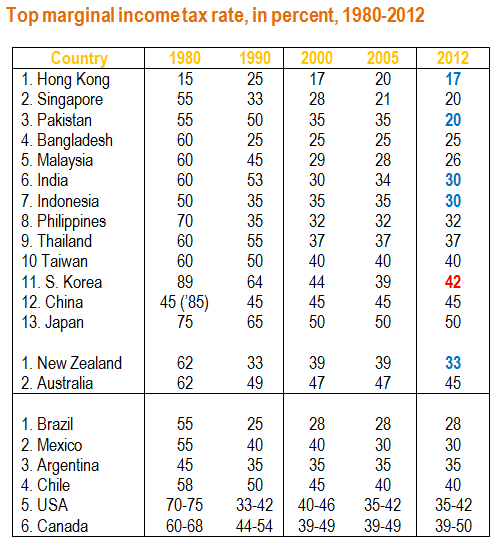
This is the continuation of my essay almost eight years ago, Retreat of High Income Tax Philosophy (September 19, 2007). Here are the numbers, and notice the significant drop  in tax rates from 1980 to 1990, then to 2000, for many countries -- except Hong  Kong, which started with low rates.

Marked in blue are tax cut of at least three percent from 2005 to 2012.
Marked in red are tax hikes of at least three percent for the same period.


Not included in the table above for Asia are four ASEAN countries due to incomplete time  series data from 1980 but here are their income tax rates as of 2012: Brunei zero, Cambodia 20 percent, Myanmar 30 percent, Laos, not included in  the EFW Report.

While many in Asia have blue marks (except in S. Korea), meaning there is tax competition, it's the reverse in Europe,


Source: Gwartney, James and Robert Lawson, Economic Freedom of the World, 2014 Report. Published by The Fraser Institute (www.freetheworld.com) 
--------------

See also:

Wednesday, March 25, 2015

Tax Cut 22: ASEAN Taxation and Philippine Fiscal Incentives

As the Philippine government becomes more fiscally irresponsible and tax-hungry as it cannot raise existing taxes easily without getting new political backlash, it turns its eyes on certain tax holidays and other fiscal  incentives that it deems to be "depriving" the government of more revenues.

Yesterday, I co-facilitated a small group discussion at the UP School of Economics, organized by my former student org, Economics Towards Consciousness (UP ETC).


Before asking my co-facilitator, Prof. Amado "Bong" Mendoza of the UP Political Science Department to speak, I gave this brief intro about ASEAN taxation and tax competition. Data from KPMG, WB and Price Waterhouse (PWC). Below, the PH has the highest corporate income tax, highest withholding tax, and highest VAT or GST, also among the highest personal income tax, in the 10-countries ASEAN.


The PH also has the second most bureaucratic tax system in the ASEAN, next to Vietnam.


What do these numbers tell us?

1. Tax wise, the PH is NOT an attractive place to do  business in the ASEAN. High and multiple taxes, complicated and bureaucratic procedures. Neighboring countries except Vietnam offer less complicated, lower taxes.


2. Tax competition among ASEAN member countries is happening, they are cutting their tax burden, except in Malaysia. PH tax burden and cost is declining too, but not low enough compared to many of its neighbors in the region.

And those were among the reasons why various fiscal  incentives were introduced in the PH, to help attract more investors given  the non-attractive overall tax regime.

PH Fiscal Incentives Rationalization bills in Congress, mainly pushed by the Department of Finance (DOF). They argue that it is necessary to reduce or remove some of those incentives, raise more tax revenues to finance the annual deficit, build more infrastructures to prepare for AEC and regional integration, amortize new and old public debt, and so on.

Monday, December 15, 2008

Tax Cut 9: Flat Tax, 26 Countries Now

A friend, Bjorn Tarras-Wahlberg of the World Taxpayers Association (WTA) sent me this updated list of countries that have flat, low income taxes.

Flat income taxes 2009
from 1 to 26 countries in 15 years

Kyrgyzstan (since 2006) 10%
Kazakhstan (2007) 10%
Macedonia (2007) 10%
Mongolia (2007) 10%
Albania (2008) 10%
Bulgaria (2008) 10%
Serbia (2008) 10%
Georgia (2005) 12%
Macau 12%
Belarus (2009) 12% New
Russia (2001) 13%
Hong Kong (1947) 15%
Ukraine (2004) 15%
Iraq (2004) 15%
Montenegro (2007) 15%
Mauritius (2007) 15%
Czech Republic (2008) 15%
Romani (2005) 16%
Slovak (2004) 19%
Jersey and Guernsey (1940) 20%
Estonia (1994) 20% Lowered
2010 19%
2011 18%
Iceland (2007) 22,5%
Lithuania (1994) 24%
Jamaica (1984) 25%
Latvia (1994) 25%
Trinidad & Tobago 25%

Why flat income taxes?
1. Simple and fair
2. Promotes economic growth
3. Promotes tax competition
4. Neutral to inflation

Why mostly in the new democracies?
1. Liberal values with more individual freedom
2. Wish to get rid of socialistic high taxes
3. Wish to reduce the black economy
4. Wish to promote economic growth and increased tax revenues with lower taxes (see Russian example)
5. No heavy package of social welfare

Copyright: Bjƶrn Tarras-Wahlberg, CEO, World Taxpayers Associations 2008-12-05. Any news to: BTW@worldtaxpayers.org +46 70 325 00 11.

Meanwhile, I am posting 2 short papers on taxes early this year.

(1) Taxes vs. Subsidy

May 26, 2008


A Malaysian friend, Wan Saiful Wan, head of Malaysia Think Tank London, shared with us a news story, "Making the rich pay more for fuel", May 23, 2008. The article went this way:


"Malaysia's rich will have to pay more for heavily subsidised items including fuel as part of a new two-tier scheme to reduce government spending, reports said today. "We need to have a good system for those who deserve the subsidy, such as the lower and middle-income groups," Second Finance Minister Nor Mohamed Yakcop was quoted saying by the Star daily."

I think the headline was wrong. It says "Government wants to tax the rich" when the story says the "government wants to reduce subsidy to the rich". These 2 -- taxes and subsidy -- are different things. The first is taking money away from the people. The second is giving money to the people, the money coming from various taxes.

My take on this and almost any other issues on other sectors is that subsidies should be kept to the minimum – and taxes should be kept to the minimum too. You encourage something, you'll have more (consumption) of it; you discourage it, you'll have less of it. That's one of the "7 Principles of sound public policy" made by Larry Reed. So you provide more fuel subsidies, you encourage more fuel consumption. You tax oil, you discourage more fuel consumption.

If oil taxes around the world are removed, or at least drastically cut by one-half of their current rates, especially in European and North American countries, retail price of oil will drastically go down, which will encourage more fuel consumption, which will result in ever-higher world crude prices, perhaps shot up to $200 a barrel within a year or less. But at least people will not complain of the artificially high retail oil prices caused by oil taxes. They can complain of high retail price because of the high crude oil prices, high cost of refinery, high cost of transporting refined oil, etc.

If government revenue from oil taxes will decline if not evaporate, where will government get money to build new roads, or improve and expand existing ones? Road, especially expressways, should be on user-pay via toll roads. Roads can be privatized. So that the more you use the road, say you drive 100 kms a day on average, the more you will pay toll fees. If you use less, say only 20 kms a day, you pay less. This still discourages high fuel consumption. The rich who have more meetings, more places to visit and work, will pay more on toll roads and fuel. There is still "equity" there.


(2) On Tax Registration

April 01, 2008

Many firms and enterprises in developing countries operate in the informal sector or the "underground economy". There's one paper on Bolivia that says that on average, formality leads to higher profit. This is especially true for mid-sized firms but not for both smaller and larger enterprises.

Many small- and micro-level enterprises in developing countries indeed remain to be informal. This is because business registration in those countries are very bureaucratic and time-consuming, and the fees are plentiful too.

For medium-level enterprises, formal business and tax registration helps increase profit because the owners and managers of such enterprises can concentrate on their business, and worry less on extortion and harassment by the state's tax and trade bureaucrats.

* See also Tax Cut 8: Comparing HK and Philippine Taxes, March 04, 2008

Monday, March 19, 2007

Tax Cut 4: Tax Competition Among US States, the Laffer Curve

There is a very interesting news below -- a movement towards abolition of income tax, retention of consumption taxes to finance a smaller government, among a number of US states. If this trend will continue, Washington DC, the capital of the federal government, will be seen by many US states as a parasite: while many states are engaged in tax competition like abolition of income tax, the White House and its coterie of legislators are busy enacting new taxes (like taxing US citizens even if they are working and living abroad!) because they are busy making wars elsewhere, or promising endless foreign aid, or government to government transfer of taxpayers' money.

The free market movement in the world will become stronger if the free marketers in the US and Europe will succeed in shrinking their governments, in reducing the taxes and interventionist powers of their governments. A bloated US (and European) government is among the most convenient excuse given by politicians, bureaucrats and consultants in poorer countries, why taxes and government presence in many facets of the citizens' lives, should remain high. For instance, big foreign aid will require big local counterpart funding.
----------

http://online.wsj.com/article/SB116969533548687229.html
Rich States, Poor States
January 25, 2007

If you're searching for the next big thing in American politics, it's wise to keep an eye on the states. Here's one possibility: the abolition of state income taxes.

In Georgia, Missouri and South Carolina, Governors and state legislatures are drafting serious proposals to repeal their income taxes to promote economic development. St. Louis, one of America's most distressed cities, may overturn its wage/income tax as a way to spur urban revival.

And in Michigan, the legislature is in the last stages of phasing out its hated business income tax -- the most onerous in the land. "States are now in a ferocious competition to attract jobs and businesses," says economist Arthur Laffer, who is advising several Governors and legislators on the issue, "and one of the best ways to win this race is to abolish the state income tax."

...But the biggest target is the income tax. Newly re-elected South Carolina Governor Mark Sanford is talking of reviving his plan to phase out the income tax over 18 years. Mr. Sanford ran into opposition from the legislature in his first term, but he tells us that "I still consider this one of my top priorities and if the legislature wants to do it, I would be ecstatic."

Georgia may beat Mr. Sanford to the punch. House Republicans in Atlanta have announced that one of their top priorities is to use the half-billion-dollar budget surplus as a downpayment to "dismantle the current tax code."

House Republican Majority Leader Jerry Keen tells us the debate in Atlanta is between a flat-rate income tax and a plan that would "do away with the personal income tax but broaden the sales tax by eliminating 107 exemptions. We're committed to a pro-growth tax plan that announces to the country that Georgia is open for business."

...The idea of financing state services without an income tax is hardly radical. Nine states today -- Alaska, Florida, Nevada, New Hampshire, South Dakota, Tennessee, Texas, Washington, and Wyoming -- manage well Without one. With a few exceptions, the non-income tax states are America's Most prosperous. Meanwhile, the high income tax states, which tend to be congregated in the Northeast, keep surrendering jobs, people, and voters to the South and West...
---------


On the Laffer Curve and Optimal Tax Rate

The Laffer curve is a graph showing an optimal level of tax rate where government revenues reach maximum level. If the tax rate further increases, say from 30% to 40%, revenues go down as people would rather reduce work and have more sleep and leisure since more income means more taxes to be surrendered to the government. Or people would rather misdeclare their income to evade paying more taxes, or bribe tax collectors, resulting in lower revenues than projected.

The concept was developed by an American economist, Prof. ArthurLaffer. He further argued that lower taxes result in lower prices, higher demand, leading to higher production and hence, bigger economic pie and higher taxable base. We can add that lower taxes or tax cuts are tantamount to pay hike to everyone whose monthly and yearly income are automatically deducted with government withholding taxes. Thus, pay hike means more pockets for the people, more spending power, more demand and consumption, and so on.

Taxes are always distortionary. You remove 1/3 to ½ of a productive person's monthly income and savings, purportedly for whatever welfarist and missionary functions by the state, you immediately alterthe working, spending and savings attitude of that person. For instance, instead of bringing his family to dream vacations in thePhilippines (Boracay, Coron-Palawan, Puerto Galera, Baguio, etc.) twice a year – that creates jobs to many people living and working there – they only go there once every 2 years. Because the equivalentvalue of his expenses for such holiday was confiscated by the government. And government, once it holds the money, can decide whether to improve the justice system that will benefit everyone, or improve the chances for re-election of the incumbent politicians through endless pork barrel or charter-change campaigns.

So, since taxes are distortionary because they are forced collections, taxes should be few and small. That is, the distortions should be few and small.

In a way, you can have 2 (or more) Laffer curves, depending on yourpurpose. For instance:

Laffer curve 1 – a level of tax rate that will finance the current and projected levelof government expenditures. For statist and interventionist politicians, plus their coterie of equally statist consultants, staff and bureaucrats, retain the current government expenditures of 50-60%of GDP (the current level in many western & northern European countries), then devise a tax rate that will somehow give you a tax & "non-tax" (but still compulsory payment to government, like driver's license fee, passport fee…) revenues of 50-60% of GDP.

Laffer curve 2 – a level of tax rate to really unburden taxpayers and finance a government that is just focused on a few, limited, andimportant function – protect lives, properties, and individual liberties of the citizens. Because the more functions and welfarism that a government intends to do, the more taxes, fees and penalties itwill collect and confiscate from the citizens.

The Laffer curve concept is a beautiful guide to remind governments when they should stop confiscating a big portion of the income and savings of their citizens. It is also a good reminder to socialists, welfarists, and other advocates of wanton confiscation of income andsavings of productive people, that there is a limit to such philosophy based on forced equality, if not envy.