Showing posts with label inflation. Show all posts

Saturday, June 02, 2018

BWorld 217, Dutertenomics, TRAIN and high inflation

* This is my article in BusinessWorld, May 30, 2018.


“There is no art which one government sooner learns of another than that of draining money from the pockets of the people.”

— Adam Smith, The Wealth Of Nations (1776), Book V, Chapter II, Appendix to Articles I & II.

Two columns in BusinessWorld on May 28 jointly defended Dutertenomics’ Tax Reform for Acceleration and Inclusion (TRAIN). These are “Eight former Finance secretaries support TRAIN 2” by Romy Bernardo of FEF and “Coolly explaining inflation” by Men Sta. Ana of AER.

I will quote some phrases from the two pieces and explain the title of this piece.

(1) “TRAIN has been unfairly blamed for the elevated inflation rate we are currently experiencing. By our estimates, fully two thirds of last April’s 4.5% inflation rate is typical of a rapidly expanding economy. The remaining is due mainly to the sharp increases in key imported commodities specifically oil, the realignment of currency exchange rates and a robust increase in domestic demand.” (Bernardo)

(2) “The higher inflation rate we are seeing is mainly a result of the increase in global crude oil prices. The Dubai crude oil price has increased to $68.43 per barrel in April 2018… The tax reforms resulting in higher fuel tax and higher prices of cigarettes and sugary drinks of course have contributed to inflation. But its effect accounts only for 0.4 percentage point of an inflation rate of 4.5%.” (Sta. Ana)

So the main explanation of Dutertenomics and its supporters as to why the Philippines has recently posted an outlier inflation rate are (a) high world oil prices, high sin taxes, (b) rapidly expanding economy, but the impact of (a) is very small while (b) is substantial.

If this is true, then other countries that bore the brunt of high oil prices and incurred elevated growth levels should also have rising inflation rates.

But this is NOT true and did not happen as shown in a chart covering Asian emerging and developed economies and the two biggest economies of America and Europe.

On (a), many countries even experienced lower inflation in January-April 2018 compared to December 2017 level despite the rise in world oil prices — UK, Germany, Malaysia, Pakistan, India, Indonesia, South Korea, and Singapore. Others have inflation differential of only 0.2% to 0.6% while the Philippines’ differential was 1.2% or 1.3% depending on the CPI base year used.

On (b), several countries that have reported growth momentums from 2016-2017 and were projected to grow at least 5.3% in 2018 experienced negative or low inflation differentials compared to December 2017 levels — Malaysia, Pakistan, India, Indonesia, Vietnam, China. These countries show that low inflation and fast growth can occur at the same time, no trade off expected (see table).


So are supporters of the TRAIN being less honest?

Moreover, their clamor for higher oil/LPG/coal taxes is directly proportional to their silence in calling for fare hike adjustments. They know 100% that higher oil prices will result in demand for higher fares/tariff by jeepneys, taxi, buses, UV express, trucks, etc.

And since January 2019 is fast approaching, another round of oil/lpg/coal tax hikes will come, prompting another round of demands for hikes in fares, electricity, and wages.

With this in mind, TRAIN supporters should be equally vocal in telling the LTFRB and DoTr to grant the fare hikes very soon, before the second round of energy tax hikes begin, then re-run their numbers on inflation impact and targets.

But there is sound of silence in this aspect.

If government will not grant the necessary fare hikes soon, PUV operators will cut costs elsewhere, like forcing bus drivers and mechanics to work longer hours at little or no extra pay, or using less-reliable but cheaper spare parts, or using old tires. Then we wait for more road accidents and government will blame the PUV operators then penalize them with huge fines or franchise cancellations.

(3) “We also believe that the corporate income tax (CIT) regime, burdened by the highest standard rate among ASEAN countries, at 30%, is in urgent need of reform. We strongly support the reduction of corporate income tax alongside the rationalization of tax incentives.” (Bernardo)

True, there is an urgent need for the Philippines to cut the CIT because our 30% is the highest in East Asia: Indonesia, China and South Korea 25%, Taiwan, Thailand and Vietnam 20%, Hong Kong and Singapore 16.5-17%.

But TRAIN 2 wants to cut the CIT to only 25% by 2022 or end of Duterte’s term while it will reduce or remove many fiscal incentives by 2019 if they succeed in having TRAIN 2 law this year.

So Dutertenomics is being less honest again on the extent of the Philippines’ taxation distortion.

Aside from the Philippines having the (1) highest CIT of 30% in East Asia, it also has the (2) highest withholding tax on dividends OF 15/30%, (3) highest withholding tax on interest of 20%, (4) highest withholding tax on royalties of 30%, (5) highest VAT/GST of 12%.

One big result of this is that the Philippines has the lowest FDI inward stock (inflows less outflows through the years) of only $64B in 2016 vs. $115B of Vietnam, $122B of Malaysia, $186B of S. Korea and Japan, $189B of Thailand, $235B of Indonesia, $1,096B of Singapore, $1,354B of China and $1,590B of Hong Kong.

A more economically realistic and politically acceptable CIT under TRAIN 2 would be 15%, or max 20% in exchange for reduction/abolition of many fiscal incentives. And such cut should be done in 2019 assuming that TRAIN 2 becomes a law in 2018, and not 2022.

Finally, the last point is that the implicit purpose of TRAIN’s tax-tax-tax strategy is to pay for loans-loans-loans from China and its crony contractors involved in Build-Build-Build as many previously integrated PPP were reversed to become hybrid PPP.


Bienvenido S. Oplas, Jr. is President of Minimal Government Thinkers, a member-institute of Economic Freedom Network (EFN) Asia.
----------------

See also:

Wednesday, May 23, 2018

BWorld 213, Disruption, inflation and taxation

* This is my column in BusinessWorld last May 17, 2018.


Disruptors tend to be successful in three ways: (1) They dramatically lower historic prices through new cost structures…”
— Accenture, “Disruption need not be an enigma,”
February 2018

“Inflation is taxation without legislation.”
— Milton Friedman, 1974

Disruption is good for consumers. It unsettles many incumbent and entrenched players which may have been lording over the market for decades with expensive and substandard products and services.

Disruptors are often the newcomers, or old players using new and modern production methods that drastically change how things are done.

Inflation is immediately tamed by disruption, ceteris paribus or all other things being equal or held constant. Consumers are given new choices and they tend to flock to products and services with lower prices or similar prices but better quality or more add-ons.

The institutionalization of freer trade in 1995 with the creation of the World Trade Organization (WTO) has contributed to lower prices across many countries.

As a result, prices in Asia in 1995-1999 were significantly lower than prices in 1990-1994 except in Thailand and Indonesia which were badly hit by the Asian financial turmoil of 1997-1998. Then prices generally declined in the succeeding decades until 2017 (see Table 1).

Higher taxation and more government regulations however, have the opposite effect of market disruption. When a country imposes drastic tax hikes, that country experiences significant inflationary pressure and reverses the gains of disruption.

This is particularly true in the Philippines when it enacted the Tax Reform for Inclusion and Acceleration (TRAIN) law of 2017.

While personal income tax rates have declined, many products (oil, LPG, coal, sugary food and drinks, etc.) and services were slapped with higher excise tax and/or expanded VAT.

While all countries and economies were hit by rising world oil prices, many incurred even lower prices.

But in this case, the Philippines is an outlier.

Inflation jumped even after the sudden rebasing of the consumer price index (CPI) from 2006 to 2012. The two richest economies of North America and Europe are included to widen the scope of comparison, year to date (Ytd) vs. December 2017 as base year (see Table 2).

  
Note that the outlier inflation rate in the Philippines this year does not yet include fare hikes by land transportation companies and providers (jeepneys, taxi, UV express, buses). If such fare adjustments are granted — and they should be — then the country’s inflation will rise even higher.

The Bangko Sentral ng Pilipinas (BSP) noted this unexpected level of price increases and it raised local interest rates to encourage people to spend less and save more and hence, help reduce inflationary pressure.

Rice protectionism and NFA importation monopoly are also slowly being abandoned and the rice import quota will soon be replaced by tariffs and cheaper rice from our ASEAN neighbors will soon become more available to consumers and this will help reduce inflation.

The bad news is that January 2019 is fast approaching and there will be a second round in oil and coal tax hikes. This means another round of inflationary pressure, fare hike pressure, and even larger inflation spikes.

This is a clear case of higher taxation reversing the gains of innovation and disruption in the Philippines. Government as negative disruptor is not good. The TRAIN 2 bill should be an instrument to reverse these disagreeable provisions of TRAIN 1.


Bienvenido S. Oplas, Jr. is President of Minimal Government Thinkers, a member-institute of Economic Freedom Network (EFN) Asia.
-------------

See also:

Thursday, May 10, 2018

Dutertenomics, GDP growth and inflation

Duterte and his Dutertenomists are deceptive. #TRAIN law alone has siphoned off more money from private pockets to government pockets esp the high oil tax, coal tax (round 1), sugar tax, etc. More tax revenues, more govt spending (13.8% growth) allowed higher Q1 2018 GDP growth of 6.8%. But look at household consumption, slowed down to 5.6%. And Dutertenomists are silent about the need to raise fares -- jeepney, taxi, UV express, buses, truckers, etc. Those fare hikes should be granted and see the impact on household consumption, impact on #inflation.

And now this, $71/barrel, another oil price hike. And January 2019 is near, oil tax hike, coal tax hike Part 2 will be slam dunked upon us. #DOF #NEDA #DBM #BSP


If Dutertenomists, DOF and its NGO front Action for Economic Reforms (AER) are very vocal and noisy about the need to raise oil taxes, they should be equally vocal and noisy to grant the fare hikes too, so that entrepreneurs in the land transport business (jeeps, taxi, UV express, buses, etc.) can pass on the cost of their advocacy. But they are silent. Hoping to reduce the damage of high oil taxes to inflation and household spending.

The decline in household spending would have been steeper and bigger if the estimated 100,000 mainland Chinese gamblers/workers new migrants were not here?
Chinese Money Triggers a Dizzying Rally in Manila Property
Bloomberg News
May 4, 2018, 12:00 AM GMT+8

Tuesday, April 03, 2018

Post-Holy week penitence

Belated holy week penitencia. High taxes and politics never fail to inflict pain on the public. At least five instances here. 
(this photo I got from SunStar)

(1) Economist sees nearly 6% inflation in May-June
Czeriza Valencia (The Philippine Star) - March 28, 2018

“(Alvin) Ang said inflation for 2018 is expected to peak in May to June which coincides with the opening of the new school year and the financial preparations for such, during which inflation is expected to peak “close to six percent.”

“The effect of TRAIN (Tax Reform for Acceleration and Inclusion) is still not fully felt, so this is a continuing impact of TRAIN. The full-blown impact of TRAIN will be in May to June so  there will be two more months of adjustments,” he said.

Malacanang horror-comedy...

(2) 'Apostle' Andanar likens Duterte to Jesus
Updated as of Oct 06 2016 11:42 PM

And the "Jesus of the Philippines" has this mouth....

(3) Duterte: Yan mga NPA naglalaway sa mga baril natin, tayo sa babae lang

(4) DOTR horror-comedy. Sec. Tugade, nagpapara ng bus to lecture the driver of his violation – bus overloading. But the bus is near empty (March 30, 2018)

(5) As recommended closure nears, fate of almost 30k Boracay workers hangs in balance
Published March 30, 2018 4:10pm

Boracay closure for 6-12 months, I think there is plan by Duterte business cronies to force the bankruptcy of some or many resorts there, the non-chain hotels especially, then local cronies + China Communist Party cronies will come in big swoop, gobble up the fledgling and losing resorts, then Boracay will be "open to the world" again.

On rising inflation, this comedy is not from Malacanang but from TRAIN rah-rah boys Action for Economic Reforms (AER). Governmentt and NGO, they speak and argue the same language, blurred difference bet govt and "non-govt", jokers. http://bworldonline.com/inflation-become-bogeyman/

Notice that this rising inflation does not include yet fare adjustments by jeepneys, bus lines, truckers, shipping lines, airlines. I think Malacanang and LTFRB/MARINA/CAB will not grant those fare hikes this year, "CSR" na lang daw ng oil companies. Then by January 2019, another oil price hikes by TRAIN law, then rah-rah boys will produce again another article of "inflation bogeyman", ayos. Govt and "non-govt", they speak the same.

Ateneo Economics Department should produce more Alvin Ang who can objectively see the inflationary pressure of energy tax hikes. Another Ateneo economist and former NEDA chief has been pushing hard for higher electricity price hikes via huge coal tax, P600/ton (vs P50/ton in 2018, P100 in 2019, P150 in 2020). Make coal power become expensive, silent on natgas which is another fossil fuel, because he is a Board of Director of FirstGen and silent about it, does not disclose it when he writes. Unlike Romeo Bernardo who honestly and transparently discloses his affiliations with Ayala, Aboitiz Power, Phinma Energy, before he opens his mind about energy policies.

Friday, March 16, 2018

BWorld 193, TRAIN, inflation and emerging DOE price control

* This is my column in BusinessWorld on March 5, 2018.


More countries are reporting their January 2018 inflation rate and it is becoming clearer that majority of them have reigned in the inflationary pressure of the big rise in world oil prices. West Texas Instrument (WTI) prices, for instance, rose from $43.2/barrel in 2016 to $50.9/barrel in 2017, and $63.7/barrel in January 2018.

Of the 13 major Asian economies in the table, 10 have experienced a decline in their inflation rate compared to their December 2017 level and only three, including the Philippines, have experienced an increase. But the rise in the Philippines was big 0.7 percentage points (see table).


The big question is: Why is the Philippines the outlier in Asia in inflation rate movement?

The proximate reason is the recent tax law, RA 10963, known as the Tax Reform for Acceleration and Inclusion (TRAIN). The cut in personal income tax was good, but it was more than negated by the tax hike in oil and other commodities — coal, sugar beverage, etc. The anticipated pass-on effects of such tax hikes should be big.

How about Japan, which experienced a 0.3% point increase? There are two possible explanations.

One, it is experiencing a re-inflation trend after deflation in 2016 of -0.1%, then 0.5% in 2017. Two, it has a tax reform bill in 2018 that includes a 15% tax credit for corporations if their workers have higher pay of at least 3%, and if domestic investment in depreciable assets is equal to or more than 90% of depreciation. This means there will be expected higher household consumption due to higher salaries for workers and managers, and higher re-investments.

TRAIN’S IMPACT ON ELECTRICITY PRICES

The effect of TRAIN on electricity prices would be felt in four avenues.

1. Oil tax hike (for peaking plants in WESM), about 1 centavo/kWh.

2. Coal tax hike (P10/ton to P50/ton in 2018), another 1 centavo/kWh.

3. VAT application on electricity transmission charge, about 6-7 centavos/kWh.

4. Rise in universal charge (a big hike in electricity cost for many islands and provinces running on gensets/oil, subsidy passed on nationwide), perhaps another 1 centavo/kWh.

Sources for the first three points are Meralco as reported in the papers.

EMERGING DOE PRICE CONTROL

Last January, the Department of Energy (DoE) directed all distribution utilities (DUs) to require their power suppliers, the generation companies (gencos) to explain any additional charges that will arise from TRAIN.

Then last February, the DoE suggested that gencos should absorb the initial cost of higher oil and coal taxes. Meaning there will be no pass-on to the consumers. This was never done before.

In addition, the DoE also mandated the oil companies extend subsidies to public utility vehicles (PUVs) as a “cost cushioning mechanism.” This is another no pass-on policy.

These are price control measures. These are ugly policies to make the ugly tax hikes under TRAIN appear “less ugly” and “non-inflationary.”

TRAIN DOUBLE TALK

The architects and apologists of TRAIN are confused and are engaged in double-talk.

First, they make cheaper oil and coal become expensive, then deny the potential big inflationary pressure of such a measure.

Second, when inflationary pressure is higher than their projected and concocted figures, they blame speculators and not the law that created speculation.

Third, TRAIN exhibited favoritism and cronyism for renewable energies (REs) like wind-solar because their feed-in-tariff (FiT) revenues from WESM, then FiT-All, were again exempted from VAT. Natural gas is also fossil fuel but TRAIN did not slap it with excise tax, only oil and coal.

Fourth, TRAIN’s architects deny that additional revenues were largely meant to favor Chinese contractors and suppliers because many big projects that were already under the integrated PPP were reversed and put under “hybrid” PPP to be financed by ODA and foreign loans from China.

Fifth, they now propose price control measures in energy and other sectors to make TRAIN look “less ugly” and “non-inflationary.”

The Communist Party of China and Xi Jinping’s “thoughts on socialism” could be a rising influence in the economic and energy policies of the Philippines. This is wrong.

The Philippines should stay the course of more market reforms, not more state interventions and taxation. China’s communism and dictatorship is a lousy “model” that should never be entertained by the Philippines and other developing economies.


Bienvenido S. Oplas, Jr. is President of Minimal Government Thinkers, a member-institute of Economic Freedom Network (EFN) Asia.
--------------

See also:

Thursday, March 15, 2018

BWorld 190, TRAIN, inflation and the stock market

* This is my column in BusinessWorld on February 22, 2018.


At first there were bureaucracies, endless subsidies, and new taxes; second were price hikes due to the new taxes; third, monetary control measures to minimize price hikes; and fourth, investment funds react to these monetary controls, especially regarding the exchange and interest rates.

That in a sense, is how a nonfinance researcher like me would attempt to connect the dots. The first and third actions are government interventions while second and fourth are market reactions to these interventions.

Since I am not a stock market analyst, I chose to attend the BusinessWorld Stockmarket Roundtable held Tuesday at Makati Shangri-La Hotel. After all, it was a good opportunity for researchers and investors to know more about the stock market.

There were four speakers that afternoon. Augusto “Gus” Cosio, Jr., president of First Metro Asset Management, Inc.; April Lynn Tan, vice-president and head of Research of COL Financial Group, Inc.; Justino “Jun” Calaycay, Jr., head of Research and Engagement Department of Philstocks Financial, Inc.; and Michael “Mike” Gerard Enriquez, chief Investment officer of Sunlife Financial.

Gus Cosio argued the following points, among others: (1) the TRAIN’s personal income tax cut will put more cash in the pockets of salaried people, good for current account, savings account (CASA); (2) rise in short-term interest rates are good for net interest margin (NIM) expansion; (3) rise in prices will raise demand for working capital; (4) decline in required reserves will reduce intermediation cost; (5) better macro growth means fewer troublesome loans; (6) never put all your hopes on one or two stocks and invest in a basket of stocks.

Mike Gerard Enriquez started being less optimistic and enumerated sources of potential disruptors in the stock markets: (1) faster hikes in US Federal rates and balance sheet reduction, (2) faster pace of peso depreciation, the worst-performing Asian currency at the moment, (3) higher inflation due to new taxes, (4) worsening current account deficit, and (5) risk in government implementation of reforms. Overall though he is optimistic and expressed the need to expand the number of listed companies at the PSE.

April Tan highlighted the following points, among others: (1) market correction in January was expected due to hike in US bond rates, (2) the correction was a good opportunity to accumulate stocks at more attractive valuations, (3) weaker peso and higher taxes are inflationary and can adversely affect consumer spending, (4) but inflation is not a long-term but a short-term issue, (5) historically, equity markets have gone up with higher rates, and (6) long-term economic prospects remain positive with favorable demographics, high remittances from OFWs and growing BPO sector.

Jun Calaycay discussed these considerations, among others: (1) the Bangko Sentral ng Pilipinas is expected to raise interest rates 1-2 times this year, (2) higher inflation from TRAIN is felt more by people on the ground, (3) despite these, Philippine economy will continue to expand, (4) good prospects this year are construction and allied services, power and energy sectors.

I learned several lessons, especially for a nonfinance guy like me. My concerns and research work are focused on government policies that distort the normal incentives system if markets are left more freely.

Encouraging more portfolio investments and foreign direct investments (FDI), more big infrastructure projects via integrated PPP and not “hybrid” PPP and without tax hikes à la TRAIN — all these took place during the past administration.

For instance, there was a big increase in the Philippine stock market capitalization in one decade, 3.5 times expansion in 2015 or 2016 level as against the 2006 level while other neighbors managed to expand less than 2 times. And the Philippines’ market capitalization was at the median level of 80+% of GDP, comparable to South Korea level (see table).


Inflationary pressures coming from tax hikes while retaining high tax rates elsewhere (VAT, corporate income tax/CIT, withholding tax, etc.) can adversely affect consumer spending, which, in turn can affect overall macroeconomic performance.

That is why the coming TRAIN 2 should aim for significant tax cuts in CIT and VAT while reducing the number of exemptions and tax holidays. A nontax-hungry TRAIN can tame inflation, stabilize the credit markets and expand the stock markets.
--------------

See also:

Wednesday, March 14, 2018

TRAIN is inflationary so PSA rebased the CPI to 2012=100


The TRAIN law is inflationary so when Philippines inflation rate has shown significant increase (3.3% in December 2017, 4.0% in January 2018, 4.5% in February 2018), the Philippine Statistics Authority (PSA) suddenly rebased the consumer price index (CPI) from 2016 = 100 to  2012 = 100.

Zero Hedge quickly noticed this on that day, February 06, 2018. It published,

"Philippines Changes Inflation Calculation After CPI Shows Overheating Economy"
by Tyler Durden
Tue, 03/06/2018 - 11:36


Tyler Durden wrote, "the country's latest CPI print showed that the economy was overheating - which would force the central bank to hike rates, something it has long resisted - the country had a radical solution: change how CPI is calculated."

This is abnormal, of course. Iwas-pusoy sila DOF-DBM-NEDA Dutertenomists. When they were peddling the TRAIN bill, they promised that it won't be inflationary, just mild uptick in prices. When TRAIN became a law, they realize that they could not hide the high inflation impact of their tax architecture, they were proven to be wrong, at worst dishonest. Hence, finding other ways to make the ugly and inflationary TRAIN to become "less ugly" and "less inflationary."

Compare how PH inflation rate in 2006 = 1000 vs 2012 = 100. Malinaw ang iwas-pusoy ng Dutertenomics. "Less inflationary" si 3.9% vs 4.5%.


Until January 2018 inflation report, PSA was using 2006=100.

Summary Inflation Report Consumer Price Index (2006=100): January 2018
Reference Number: 2018-023
Release Date: Tuesday, February 6, 2018
YEAR-ON-YEAR

By February 2018 inflation report, PSA suddenly changed to 2012 = 100. Magaleeeng.

Summary Inflation Report Consumer Price Index (2012=100): February 2018
Reference Number: 2018-039
Release Date: Tuesday, March 6, 2018

Starting March 2018, the PSA will release the rebased CPI series as announced in the press release number 2018-031 dated 22 February 2018. Data users can expect two sets of the CPI as the new series shall be issued simultaneously with the 2006-based series until June 2018. The CPI series for July 2018 onwards shall be 2012-based.
YEAR-ON-YEAR

Saturday, February 24, 2018

BWorld 187, Asians’ freedom from high inflation and regulations

* This is my article in BusinessWorld on February 12, 2018.


“Bad times make good policy and good times make bad policy. If you want to introduce important reforms, wait for bad times and the politicians will listen to you.”
— Chatib Basri, former Indonesia Minister of Finance

That was among the important advice and reflections based on experience given by one of the keynote speakers in the recent Asia Liberty Forum (ALF) 2018 held in Mandarin Oriental Jakarta, Indonesia last Feb. 10-11. Dr. Basri spoke on “How to do Reform in an ‘Imperfect World’: The Case of Indonesia.”

The ALF is an annual liberty conference sponsored by the Atlas Foundation (US) and co-sponsored by other organizations and independent think tanks. In this year’s event, the local host and co-sponsor is the Center for Indonesian Policy Studies (CIPS), a great and dynamic free market think tank.

Dr. Basri is a friend since 2004 when I first attended the Economic Freedom Network (EFN) Asia Conference in Hong Kong in October 2004, sponsored by the Friedrich Naumann Foundation for Freedom (FNF) and co-sponsored by the Lion Rock Institute. I was impressed by his silent, cool, and reflective composure.

He became Finance Minister from May 2013 to October 2014 when the term of former Indonesian president Susilo Bambang Yudhoyono was completed. Upon his appointment, at least one Indonesian newspaper headlined “Free marketer becomes Finance Minister.”

He started his presentation with this quote from Jean Claude-Juncker, EU President:

“We all know what to do, we just don’t know how to get re-elected after we’ve done it.”

Other statements he made in the ALF2018 were:

“One reason Indonesians are religious is because of the Government. You submit your business application to the Government, then pray to God.”

“We failed to explain the benefits of free trade to the people. The success of Asia was the success story of globalization.”

“When political power is not favorable and limited, create a success story which enables the people to see and experience positive changes, pick one that is easy to implement but the marginal gain is high, then move to more complex reforms.”

“To help the poor, Indonesia liberalised rice imports. Prices fell.”

Another keynote speaker in day 1 was Suraj Vaidya, Chairman of the South Asian Association for Regional Cooperation (SAARC) Chamber of Commerce, also Chairman of the Samriddhi Prosperity Foundation in Nepal.

Mr. Vaidja quoted Frederic Bastiat’s famous line, “If goods cannot cross borders, soldiers will.”

That statement was true in the past, remains true in the present, and will be true in the future. Trade is the best global peace maker since people and goods crossing borders create goodwill among societies, discouraging criminals, terrorists, and prohibited substances.

Both Dr. Basri (introduced and interviewed by Rainer Heufers, CIPS executive director) and Mr. Vaidja (introduced and interviewed by Ronald Meinardus, FNF Regional director for South Asia) mentioned the role of free trade and free markets in fighting high inflation many goods and services that are unaffordable to the poor.

And this brings us to the issue of controlling high inflation in the continent.

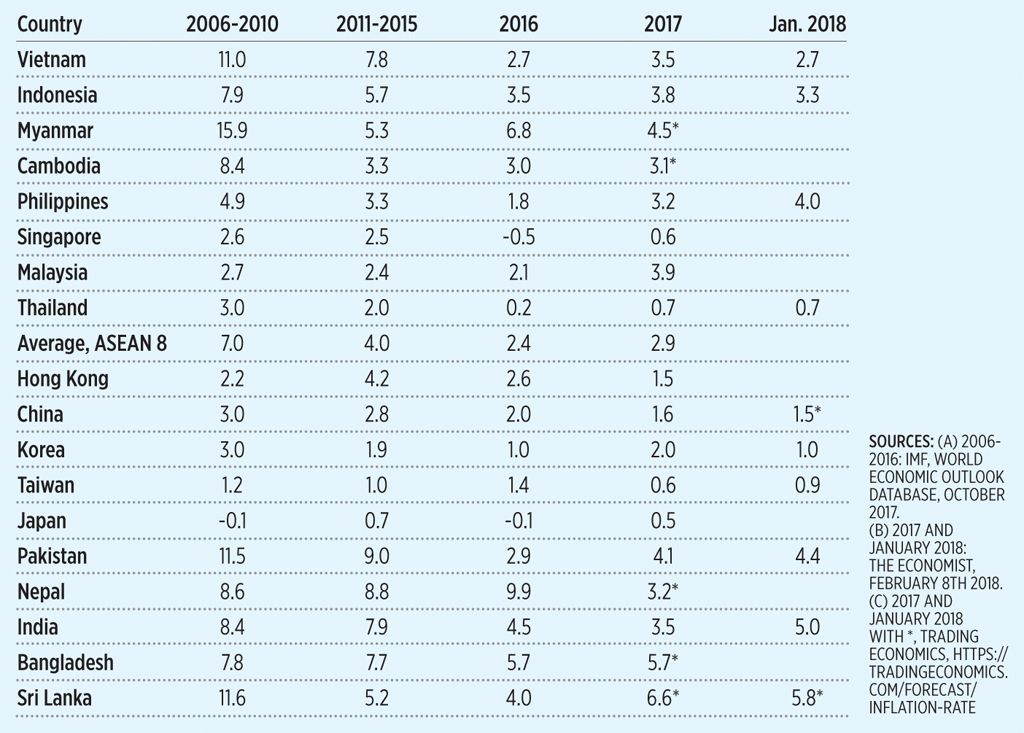
Data from the last 12 years show that average inflation rate has been declining.

For the ASEAN 8 for instance, it went down from 7% in 2006-2010 average to 4% in 2011-2015 average, and only 2.4% in 2016 but slightly went up to 2.9% in 2017 (see table).


The rise in average prices in 2017 was partly due to the rise in world oil prices.

For instance, the West Texas Intermediate (WTI), a grade of crude oil used as a benchmark for pricing, went up from $43/barrel in 2016 to $51/barrel in 2017.

For the Philippines however, there was a spike in consumer prices in January 2018. From 3.3% in both November and December 2017, it went up to 4%.

Other countries with available data showed a decline in prices by January 2018 except in India (was already 5.2% in December 2017), Pakistan (4.6% in December 2017) and Taiwan (1.2% in December 2017).

So the Philippines is the “outlier” here, experiencing higher inflation when most neighbors have declining prices. Why?

The most proximate explanation is the TRAIN law signed in December 2017. While there is a decline in personal income tax rates, there are tax hikes in oil products, sugar tax, among others.

The Philippines is entering a period of increasing government intervention, taxation, and regulation. This is not good for the people and private enterprises.
 -------------

See also:

Tuesday, September 30, 2008

Inflation and CBs 5: Capitalism Without Failure is Like Religion Without Sin

Capitalism without failure is like religion without sin. The statement is from a CATO scholar, Gerald P. O'Driscoll Jr., in his paper, "Treasury's Thieves". Perhaps people should keep that in mind before they conclude that the current financial turmoil in the US, which is spreading to financial markets abroad, marks the beginning of the "end of capitalism".

The current financial "meltdown" should happen. If the meltdown does not happen today, then it should happen tomorrow, or next week, or next year. And it should continue, if only to weed out the irresponsible corporate leaders and the cheaters.

What should not happen is a government bail-out of collapsing and imploding big banks and firms. In this case, the proposed US government bailout for the financial sector to the tune of $700 billion -- not counting the projected budget deficit of more than $480 billion by the end of 2008 of the federal government alone (many states, cities and counties have their own sets of budget deficits).

So why is government bailout not justifiable? Three important reasons.

One, make those responsible for a corporate collapse be accountable for their mistakes. Hence, they should pay the price for their irresponsibility and misbehavior. Those who should sink must sink. And taxpayers' money should not be used to bail out irresponsible corporate guys.

Two, governments by themselves have no money on their own to bail out failed enterprises except for what governments confiscate from the income and savings of the hardworking citizens in the form of various taxes, charges regulatory fees and fines, or by printing money endlessly through their central banks, which can push inflation upwards endlessly, and thereby rob again the responsible citizens of the real value of their income, savings and investments.

And three, the US Fed's and other central banks' (like the Europe CB) large-scale bailout pool and consequent monetary policies will be distortionary. In cases like this, producers and manufacturers are forced to watch the behavior of the Fed or any central bank on whether it will raise or lower or keep existing interest rates, or protect the currency from further depreciation or appreciation, rather than watch the behavior of consumers (if their preferences and buying pattern are changing or not) or the behavior of competing producers from other countries (if they are producing better quality goods and services or selling at lower prices or a combination of both).

High inflation is caused mainly by lower supply relative to demand. So to address high inflation, expand supply relative to the size of demand. But central bank bureaucrats think they can solve the world's price problem by centralizing monetary tools in their hands, and squeeze money supply by tightening credits and raising interest rates -- which in the process choke many entrepreneurs and producers, both big and small.

The term "socialism for the rich" (under a longer phrase, "profits are privatized but losses are socialized") is wrong. The proposed multi-billion dollar bailout can be aptly called "socialism for the irresponsible" because only irresponsible and envious people would love socialism. Under socialism, the lazy and the envious will still eat, will still have allowances, and will be entitled to free "quality" education, health care, housing, etc. because social equality is non-negotiable.

For the socialists or trying-hard socialists, personal and corporate responsibility or irresponsibility do not count much. What matters to them is more "government responsibility" . So, corporate irresponsibility of officials of those big firms don't count much, those firms are "too big to fail", they should not sink, and their officials need not go to prison.

Some people ask, "Who are the irresponsible? Who defines 'irresponsibility' and who should penalize them?" There can be a BIG political battle on the definition of "irresponsible" because among the most irresponsible institutions involved in the current financial "meltdown" is the BIG US government itself.

It is easy to spot an irresponsible guy or institution: they live beyond their means, consistently. They spend much bigger than their income or revenue, consistently. Or worse, they spend and ask for more subsidies even if they have no income, nor have any plan to work and have regular income. A person who in his late 20s or 30s still depends his parents' allowance is irresponsible. A bank that lends to many people, who it perfectly knows have no jobs or no stable jobs and income, is irresponsible. A government on budget deficit, for one, two, five decades or more, is irresponsible.

So, how should they be penalized? The penalties for cases like failed companies are already in the books of any country's legal system. Bank or corporate officials who lose their stockholders' money should go to prison, or the cemetery perhaps -- in the case of those unlucky to be caught by really mad and impoverished investors.

After the US government announced the huge bailout fund that it seeks from the US Congress, the US stock markets were battered once more, the US dollar was knocked down further, and even world oil prices were up once more.

Why? It's the distrust on the US government, distrust on any fiscal "stimulus" by a bailout scheme because of the big taxes and fees that will be confiscated from the pockets and monthly salaries of US citizens in the coming months and years.

A friend shared that the proposed Treasury bailout plan has this provision:
Sec. 8. Review. Decisions by the Secretary pursuant to the authority of this Act are non-reviewable and committed to agency discretion, and may not be reviewed by any court of law or any administrative agency.

Dictators hate for their work and decision to be reviewed and questioned. "Non-reviewable" clause by any court or any agency speaks of the absence of accountability and transparency, absence of personal and official responsibility, for any mistakes in the future. If they are not dictators, then they should be fully transparent and fully accountable for their actions and policy decisions. If they do not want to be accountable for any future mistake, then they should not initiate such bailout move in the first place.

The pattern and the dangers are there: individual responsibility is meaningless under a socialist or trying-hard socialist framework. Everything is "government responsibility" . The primacy of the collective over the individual, always. And in their books, to have order in the collective, each individual -- except the administrators and governors of the collective -- must surrender a big portion of their income, their savings and their personal liberty, to the collective. Then there will be order in society, harmony and equality. Perhaps equality in misery.

Again, corporate failures and bankruptcies, as well as expansion and becoming big, are part of the game under a capitalist set-up. Market failures almost always result in market solutions, unlike government failures that almost always result in more bureaucracies and offices to find out how much have been wasted and stolen already.

Here at home, if Metrobank or BDO or BPI would "collapse" someday for whatever reason, taxpayers should not support any bailout by the government, whether through the the central bank (BSP) or congressional appropriation. Let any big but misbehaving ship sink if it must -- that's fair game, and this alone will put enough pressure and discipline on existing banks, corporations and enterprises not to act irresponsibly. Government has little or no role on private contracts between stockholders or owners and corporate officials, except with its usual role of a parasite -- collecting high and dozens of different taxes when one or two taxes will suffice.

* See also: Inflation and CBs 4: Subsidies and Money Printing, August 17, 2008

Thursday, August 07, 2008

Inflation and CBs 4: Subsidies and Money Printing

The Philippines last month experienced its highest inflation rate over the past 17 years. The Filipinos had to grapple with the 12.2% average increase of commodity prices in July 2008 compared to their year ago price levels. Double-digit inflation rate always hurts.

High commodity prices mean there are a lot more consumers of those commodities than producers. Another way of looking at this is that the capacity of producers to produce more is lower than the capacity of the consumers to consume more. High commodity prices therefore favor producers and penalize consumers.

Why this thing happened – and will continue in the years to come – is a problem that is created mainly by the incentives and disincentives system in society. If there are lots of subsidies to consume more, then more consumption will happen. Or if people experience increases in income, whether from their own effort or bonanza from remitted income from abroad by their kins, more consumption can happen. If there are lots of taxes, regulations and bureaucracies in producing more, then less production will happen. And a worst-case situation can happen when "demand-pull" inflation (consumers are spending a lot) and "cost-push" inflation (cost of production and cost of bureaucracies are soaring) occur at the same time.
The solution therefore is to remove disincentives in more production, remove subsidies in more consumption, and let some of the consumers become producers themselves.

Some people argue that "inflation is caused solely by printing more money." The argument is that too much money chasing too few goods and services is causing high inflation. This is wrong. There are dozens of causes why prices rise, or why inflation happens. For instance:

1. A supertyphoon wipes out all potential agricultural harvests in one province or region. This abrupt cut in food supply will cause food prices to rise in that province or region and the neighboring places.

2. Mr. Warren Buffet and Bill Gates suddenly decided to give away $30 billion of their savings to all poor people in Delhi, Jakarta, Hanoi, Pnom Penh and Manila. Tens of millions of poor people suddenly awash with cash, will go on spending splurge say within one week. The price of most products and services that the poor will consume will rise, at least temporarily, if there is no corresponding increase in the supply of the commodities that they buy.

3. Government over-spends in a fiscal year, borrows money left and right to finance the budget deficit (revenue is lower than expenditures) . This raises interest rates since government competes with private borrowers, both individuals and corporations. High interest rates cause high cost of capital, that investors will pass on to the consumers. Or high interest rates discourage some potential investors – lack of new investment and production results in higher prices since the supply is not increased.

4. High world oil prices due to geopolitical instabilities (a war in the Middle East, imposition of economic sanction on a major oil exporting country, etc.) push retail oil prices to increase, fares will increase, transportation cost of bringing food products from the province to the cities will increase, etc.

There are many other instances and cases why inflation can occur. Over-supply of money due to huge printing of money by a central bank or monetary authority is only one of those reasons.

Fight inflation with more government subsidies.

This is among the "standard" policies adopted by many governments around the world. It pays to remain poor sometimes because dole-outs and subsidies are coming your way. But subsidies seldom, if ever, contribute to increasing an economy's productive capacity. Subsidies are money confiscated by the State from some productive and hard-working citizens, then it turns around to distribute that money first to its own personnel (politicians and bureaucrats) and second to the intended beneficiaries – the poor. In a sense, subsidies perpetuate the retention, if not expansion, of a group of people who are neither producers nor traders, not even scientists or technologists who help producers improve their productivity or reduce crop losses.

The bigger the number of people who administer the subsidies (those in government) and receive the subsidies (the poor, especially the lazy and irresponsible) , the heavier it is for the productive and hard-working people to sustain them. That is why taxes and government fees remain high and plenty, and taxes are among the biggest inflation-generator s in an economy. More subsidies, more taxes, more inflation. And a vicious cycle is created and perpetuated.

Global inflation: is globalization in a rut?

Not a bit. The current growth meltdown experienced by the US and its major trade and investment partners in the industrialized world is a necessity. It should happen, and I'm glad it is happening. Irresponsible investors and individuals should suffer and go bankrupt, they should become poor. Before, they got saved, their irresponsibility was rewarded with subsidies and huge bail-outs. As one CATO scholar noted, capitalism without failure and bankruptcy is like religion without sins.

What we are seeing are adjustments and adaptation. The irresponsible get punished; the responsible survive, if not thrive. But there is one big entity that is both irresponsible and yet does not go bankrupt: government.

* See also: Inflation and CBs 3: "Bank of Last Resort", March 18, 2008

Tuesday, March 18, 2008

Inflation and CBs 3: "Bank of Last Resort"

I am not in favor of a central bank like the Fed, bailing out certain banks because they're "too big to fail". The Fed provided a credit line of around $30 B to Bear Stearns, which was bought by JP Morgan for only $2/share when less than a month ago it was trading at $90/share.

Then I read that had the Fed not acted so, other bigger banks like Lehman Brothers would be next to possibly free fall. And possibly threaten others like UBS, City and Morgan Stanley. Could this be true? I feel that the above-mentioned banks were too gigantic to be dragged down.

I hope that the next banking reform there will be that the Fed will just concentrate on setting monetary policy, no “bank of last resort” function, no bank supervision and bail-out function?

The private banks themselves should put up their own “bank of last resort”, use their own money that will be used to put up and maintain such bank. When that bank decides to bail out one or a few banks, it’s the bankers’ money that will be on the line, not the public’s. This will hopefully remove any “moral hazard” problem in banking.

On another note, a number of economic analysts are discussing how to stop inflation, and how central banks (CBs) or federal reserves can help to attain this goal. CB’s tight interest rates and other contractionary monetary policies over the long term, cannot reign in inflation. If interest rates are high to “warn” people not to spend too much, then entrepreneurs who have to borrow to start a new business or expand an existing one will have difficulty, the high cost of capital they will pass on to consumers, which can set inflationary pressure itself.

Central banks are among the remnants of central planning thinking of socialist school of thought. Central bankers maybe a “necessary evil” at the moment but nonetheless, they are unproductive bureaucrats who can better help the economy fight huge inflation spikes by becoming entrepreneurs who produce more goods and services, the best way to fight huge price spikes.

* See also: Inflation and CBs 2: Panama has no Central Bank, February 20, 2008

Wednesday, February 20, 2008

Inflation and CBs 2: Panama has no Central Bank

One of the hallmarks of HK's free market economy is that its monetary authority (or central bank or federal reserve) does not print the national currency. The HK dollar is printed not by its monetary authority, but by private banks -- HSBC, Citibank i think, and one more bank. The monetary authority just function as it is -- to set monetary policy (levels of interest rate, money supply, exchange rate and international reserves, etc.).

But there's one economy that looks more free marketer than HK in monetary policy -- Panama. It has no central bank or monetary authority. No national currency, they're using the US$. And in some big infrastructure projects, like expanding the capacity of Panama Canal, the government will raise not a single tax rate, but rather use revenues from the canal to do the job.

To see more about this, see Andrew Work's article, "Panama -- the HK of Latin America?"
http://www.lionrockinstitute.org/

In earlier short articles, I have argued that central banks are shrinkable if not abolishable, if their main concern is "inflation targetting". High inflation rate, and high prices of commodities and services in an economy, is mainly a result of trade protectionism and less mobility of commodities around the world. When the price of some goods are high in country A when such goods are wide available elsewhere, that country's protectionism is the culprit. Conversely, when the price of other goods in that same country A are dirt cheap when these goods are expensive elsewhere, again that country's or other countries' protectionism is the culprit.

The level of money supply in the economy is not much a factor, though loose money supply can push prices up (ie, too much money chasing too few goods and services). But it's those central-planning thinking central bank bureaucrats that manipulate money supply and interest rate levels. And their manipulation can distort the price signal in an economy if market players are better left on their own to respond to changes in consumer demand and producer supply.

When central bank officials or bureaucrats say thay want to "cool off" an "over-heating" economy, they mean they want to control "over-spending" and high borrowings by the people because this can lead to high inflation. So what they usually do, is they raise interest rates -- to encourage savings and discourage high spending and borrowings. Then they say that they have controlled high inflation.

I am not in favor of this kind of intervention. When people have lots of money to spend, let them do so; someone's consumption is somebody else's production and services.

* See also: Inflation and CBs 1: Central Banks Can Be Anti-Globalists, June 29, 2006

Thursday, June 29, 2006

Inflation and CBs 1: Central Banks Can Be Anti-Globalists

When the price of certain goods and services is rising, the old but realiable law of supply and demand has an explanation. This means either or both of two things happen:
a) Fast growth in demand relative to their supply due to increase in consumers' income, change in their tastes and preferences, other reasons; and/or
b) Shrank or decreased supply (both local and global supply) relative to stable or increased demand due to natural disasters that wiped out harvests, big fires/terrorist attacks that destroyed the production plants, and other reasons.

These temporary "market failures" also create market solutions. A rise in the price of certain goods and services would invite entrepreneurs and businessmen to go and supply those commodities to cash in potentially high profits, even temporarily.

Now comes central banks (Federal Reserve, Bangko Sentral, etc.) and their inflation-targeting policies and philosophies. When a central bank rushes in to "control inflationary pressure" in the economy, it has lots of tools in its wings that it can manipulate: reduce money supply by raising overnight rates of commercial banks, raise their required reserves (RRs), among others. When this happens, this also squeezes short-term credits to entrepreneurs who would have otherwise put up new firms, or expand existing companies' operations, to supply certain goods and services that experience supply gap or reduction, whether temporarily or permanently.

It is possible to have hyper-inflation (very high rise in prices) in some commodities and deflation (reduction in prices) in other commodities, all happening at the same time. For instance, a hyper-inflation in school supplies (say the 2 largest manufacturing plants and suppliers were gutted by fire) and a deflation in burgers, pizza and softdrinks (say Coke, Pepsi, McDonald, Burger King, Jollibee, dozen other companies engaged in a sudden and fierce price war). In this case, there is no need for national government or central bank interventions to stabilize prices.

Recently, the Bank for International Settlements (BIS), also known as central bankers' bank (not the IMF), cautioned central banks around the world to prepare to raise interest rates due to (i) rising global inflationary pressure, and (ii) vulnerability to "bang" in market turbulence. Let's take these one by one.

The main drivers of global inflationary pressure are (a) high and volatile oil prices, and (b) still insufficient trade liberalization across countries. There aren't much the world can do on (a) partly because some poor countries have experienced fast economic growth (think of China and India alone) and their people are buying vehicles and boats and appliances left and right. Oil refineries are also not catching up fast enough (no thanks to hurricanes Katrina and others) to supply big demand. There are other reasons for the high world oil prices.

On (b), many countries, or more appropriately, politicians and trade negotiators of those countries, would only blame their counterparts in other countries, that is why they are closing off a big portion of their economies from foreign imports of certain commodities. That is, they are depriving their citizens of more options. These imported commodities (which are just surplus production in the exporting countries, are cheaply produced there) could have reduced inflation, even result in temporary deflation, for the sectors/commodities of the importing countries if only they allowed those goods to enter. Again, no need for national governments and central banks to come and intervene.

Central banks, the BIS and US Fed particularly, think they must make borrowers poorer by raising their cost of borrowing; by making the cost of money for business expansion that should help boost supply that should fight inflationary pressure, more expensive. After all, they are waging a holy war against global inflationary pressures.