Showing posts with label Atlas. Show all posts

Saturday, February 24, 2018

BWorld 187, Asians’ freedom from high inflation and regulations

* This is my article in BusinessWorld on February 12, 2018.


“Bad times make good policy and good times make bad policy. If you want to introduce important reforms, wait for bad times and the politicians will listen to you.”
— Chatib Basri, former Indonesia Minister of Finance

That was among the important advice and reflections based on experience given by one of the keynote speakers in the recent Asia Liberty Forum (ALF) 2018 held in Mandarin Oriental Jakarta, Indonesia last Feb. 10-11. Dr. Basri spoke on “How to do Reform in an ‘Imperfect World’: The Case of Indonesia.”

The ALF is an annual liberty conference sponsored by the Atlas Foundation (US) and co-sponsored by other organizations and independent think tanks. In this year’s event, the local host and co-sponsor is the Center for Indonesian Policy Studies (CIPS), a great and dynamic free market think tank.

Dr. Basri is a friend since 2004 when I first attended the Economic Freedom Network (EFN) Asia Conference in Hong Kong in October 2004, sponsored by the Friedrich Naumann Foundation for Freedom (FNF) and co-sponsored by the Lion Rock Institute. I was impressed by his silent, cool, and reflective composure.

He became Finance Minister from May 2013 to October 2014 when the term of former Indonesian president Susilo Bambang Yudhoyono was completed. Upon his appointment, at least one Indonesian newspaper headlined “Free marketer becomes Finance Minister.”

He started his presentation with this quote from Jean Claude-Juncker, EU President:

“We all know what to do, we just don’t know how to get re-elected after we’ve done it.”

Other statements he made in the ALF2018 were:

“One reason Indonesians are religious is because of the Government. You submit your business application to the Government, then pray to God.”

“We failed to explain the benefits of free trade to the people. The success of Asia was the success story of globalization.”

“When political power is not favorable and limited, create a success story which enables the people to see and experience positive changes, pick one that is easy to implement but the marginal gain is high, then move to more complex reforms.”

“To help the poor, Indonesia liberalised rice imports. Prices fell.”

Another keynote speaker in day 1 was Suraj Vaidya, Chairman of the South Asian Association for Regional Cooperation (SAARC) Chamber of Commerce, also Chairman of the Samriddhi Prosperity Foundation in Nepal.

Mr. Vaidja quoted Frederic Bastiat’s famous line, “If goods cannot cross borders, soldiers will.”

That statement was true in the past, remains true in the present, and will be true in the future. Trade is the best global peace maker since people and goods crossing borders create goodwill among societies, discouraging criminals, terrorists, and prohibited substances.

Both Dr. Basri (introduced and interviewed by Rainer Heufers, CIPS executive director) and Mr. Vaidja (introduced and interviewed by Ronald Meinardus, FNF Regional director for South Asia) mentioned the role of free trade and free markets in fighting high inflation many goods and services that are unaffordable to the poor.

And this brings us to the issue of controlling high inflation in the continent.

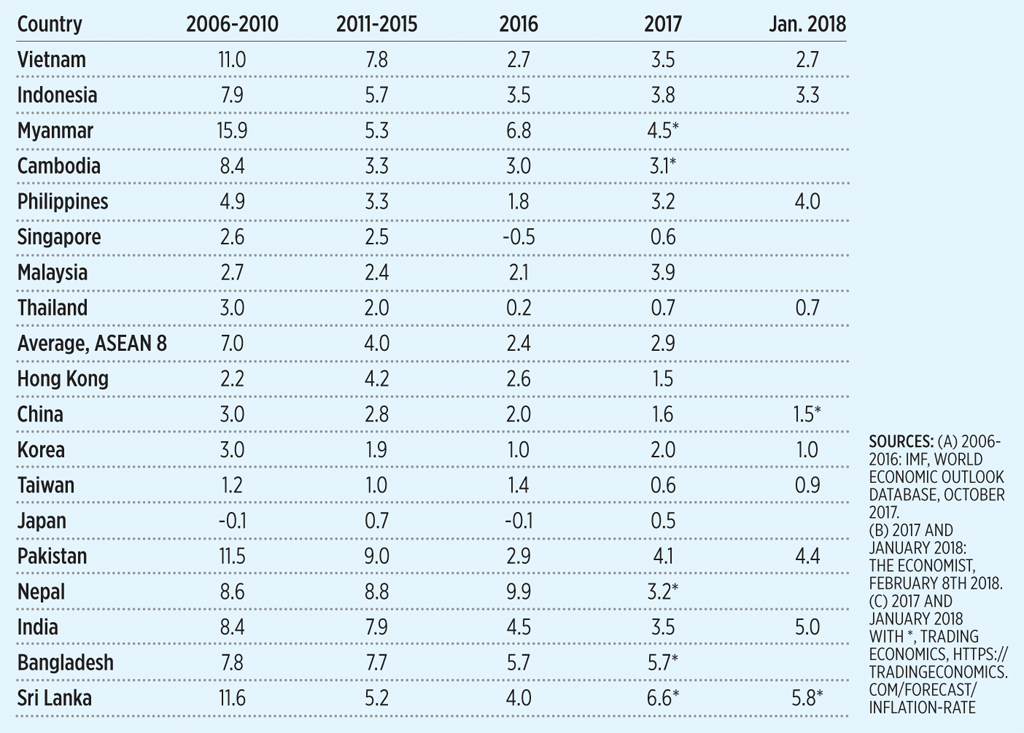
Data from the last 12 years show that average inflation rate has been declining.

For the ASEAN 8 for instance, it went down from 7% in 2006-2010 average to 4% in 2011-2015 average, and only 2.4% in 2016 but slightly went up to 2.9% in 2017 (see table).


The rise in average prices in 2017 was partly due to the rise in world oil prices.

For instance, the West Texas Intermediate (WTI), a grade of crude oil used as a benchmark for pricing, went up from $43/barrel in 2016 to $51/barrel in 2017.

For the Philippines however, there was a spike in consumer prices in January 2018. From 3.3% in both November and December 2017, it went up to 4%.

Other countries with available data showed a decline in prices by January 2018 except in India (was already 5.2% in December 2017), Pakistan (4.6% in December 2017) and Taiwan (1.2% in December 2017).

So the Philippines is the “outlier” here, experiencing higher inflation when most neighbors have declining prices. Why?

The most proximate explanation is the TRAIN law signed in December 2017. While there is a decline in personal income tax rates, there are tax hikes in oil products, sugar tax, among others.

The Philippines is entering a period of increasing government intervention, taxation, and regulation. This is not good for the people and private enterprises.
 -------------

See also:

Friday, February 16, 2018

ALF 10, Conference 2018 in Jakarta, Indonesia

The Asia Liberty Forum (ALF) 2018 conference ended successfully last week. Venue is the beautiful Mandarin Oriental Jakarta, the hotel is facing the Jakarta Central circle, Thamrin. Plenty of participants from many countries. Hats off to Atlas and the Center for Indonesian Policy Studies (CIPS).


Opening remarks on Day 1 was given by Atlas President and CEO, Brad Lips (below) then Saidah Sakwan, Chairperson of CIPS.


Then the Cornerstone Talks with six speakers. From left: Amartuvshin Dorj (Mises-Mongolia),
Hizkia Respatiadi (CIPS), Eunhee Park (Teach North Korean Refugees/TNKR, S. Korea), Nila Tanzil (Taman Bacaan Pelangi, Indonesia), Terry Kibbe (Free the People, USA) as moderator, Barun Mitra (Liberty Institute, India) and Razeen Sally (LKY School of Public Policy, National University of Singapore; he's Sri Lankan). ALL good speakers.


Then the first Keynote address by Suraj Vaidya, Chairman of the SAARC Chamber of Commerce and Samriddhi Foundation, Nepal. He talked why free trade is good and will significantly reduce poverty in many developing countries.


 Suraj and FNF Regional Director for South Asia, Ronald Meinardus (3rd from right) flanked by participants an speakers from India, Nepal, Afghanistan, US. Ronald introduced Suraj, then interviewed him on stage.


Some of the nearly 300 participants.


Among the pretty faces in the crowd, a local participant.


A photo with Adinda Tenriangke Muchtar (Suara Kebebasan, Indonesia) and Pett Jarupaiboon (EFN-Asia, FNF, Bangkok, Thailand).


More pics to follow...
(All photos I got from the Atlas fb page)
--------------

See also:

Wednesday, January 31, 2018

BWorld 182, Asia Liberty Forum 2018 in Jakarta

* This is my column in BusinessWorld last January 22, 2018.


“There is no evidence that fuel and electricity subsidies benefited the poor. There is no evidence that trade protection benefited the poor. Elimination of subsidies if compensated by reduction of cost doing business (corruption) will help the poor.”

— Muhamad Chatib Basri,
presentation about Indonesia energy and food subsidies,
EFN Asia conference September 2004, Hong Kong

Those conclusions were made by Dr. Chatib “Dede” Basri in his presentation, “Can subsidy and protection do any good for the poor?” at the Economic Freedom Network (EFN) Asia conference in 2004. At that time, he was a faculty member of the University of Indonesia and individual member of EFN. He used an econometric model and the Grosman and Helpman (G-H) model (trade protection is the result of bargaining between government and various lobby groups). The inevitable conclusion of his paper was that market reforms and the reduction, if not removal of dependence by the poor on the state will actually help them and taxpayers over the long term.

Dr. Basri later became Minister of Finance from May 2013 to October 2014 when the administration of Indonesian President Susilo Bambang Yudhoyono ended. Dr. Basri will be among the keynote speakers in the Asia Liberty Forum (ALF) this coming Feb. 10-11 at Mandarin Hotel Jakarta, Indonesia. The event is sponsored by the Atlas Foundation and co-hosted by the Center for Indonesian Policy Studies (CIPS).

Aside from Dr. Basri, other important speakers in this year’s conference will be the following:

1. Saidah Sakwan, chairwoman, CIPS; also a commissioner of the Indonesian Business Competition Commission (KPPU).

2. Brad Lips, CEO of Atlas Network, Washington DC, USA.

3. KH Yahya Cholil Staquf, general secretary of Nahdlatul Ulama (NU) Supreme Council, world’s largest Muslim organization with 50+ million members.

4. Siegfried Herzog, Regional director for Southeast and East Asia, Friedrich Naumann Foundation for Freedom (FNF), Thailand.

5. Suraj Vaidya, chairman of SAARC Chamber of Commerce and also chairman of Samriddhi Foundation, Nepal.

6. Rainer Heufers, executive director of CIPS.

7. Razeen Sally, Prof. at Lee Kuan Yew School of Public Policy, National University of Singapore.

8. Ronald Meinardus, Regional director, FNF South Asia, India.

9. Parth Shah, president of the Centre for Civil Society, India.

10. Lorenzo Montanari, exec. director of Property Rights Alliance (PRA), Washington DC, USA.

11. Barun Mitra, founder and Director of Liberty Institute, India.

12. Junjie Ma of Unirule Institute, Beijing, China.

There are many other interesting speakers to talk on many topics — policy reforms to broaden support for classical liberal principles, education policy, Ease of Doing Business Index, Protection of private property rights, Intellectual Property Rights (IPR), micro-enterprises, entrepreneurship in e-commerce, state-owned enterprises (SOEs).

Are Asian economies getting more market-oriented or state-distorted? Is there greater rule of law now or greater rule of men? Are public institutions more protective or more confiscatory of private property rights?

There are many studies and annual reports that track and monitor various indicators and parameters to help answer these and related questions. Among the important annual reports are Fraser Institute’s Economic Freedom of the World (EFW) reports, Heritage Foundation’s Economic Freedom Index (EFI), PRA’s International Property Rights Index (IPRI), World Bank’s Doing Business, and World Economic Forum’s (WEF) Global Competitiveness Index (GCI).

The GCI is composed of 12 pillars and the first pillar are Institutions. These are composed of 21 sub-pillars like property rights, IPR protection, diversion of public funds, public trust in politicians, irregular payments and bribes, judicial independence, favoritism in decisions of government officials, burden of government regulation, efficiency of legal framework in settling disputes and challenging regulations, transparency of government policy making, and reliability of police services.

I checked the latest WEF 2017-2018 report for East Asian economies and compared with the report two years ago for pillar #1, Institutions (see table).


So for Institutions, the numbers above show three important results: One, out of the 144 countries and economies covered, many East Asian nations land in the first half (i.e., 1st to 72nd), 11 of the 15 economies mentioned above. Singapore and Hong Kong are in the top 10.

Two, the biggest gainers in global ranking are India (+21!), South Korea, China, and Laos. And three, the biggest loser in ranking is the Philippines, dropping 17 places or notches.

In the WEF Executive Opinion Survey 2017, the most problematic factors for doing business in the Philippines were: (1) inefficient government bureaucracy, (2) inadequate supply of infrastructure, (3) corruption, (4) tax regulations, and (5) tax rates.

For Asian countries outside the first half like Thailand, Vietnam, Philippines and Cambodia, there is an immediate need to improve the rule of law and further debureaucratize, deregulate and depoliticize the economy.
-------------

See also:

Wednesday, March 01, 2017

BWorld 112, Asia Liberty Forum 2017 in Mumbai

* This is my article in BusinessWorld last February 15, 2017.


Mumbai, India -- The title of this piece is from JP Narayan of the Lok Satta Party in India, who made that comment during the Asia Liberty Forum (ALF) that was held from Feb. 10 to 11, 2017 in Mumbai.

That remark seems to apply in many countries where the rule of law is weaker and the rule of men -- especially those in charge of several forms of regulations -- are stronger. These are the types of people who also impose restrictions and prohibitions on their political enemies and ordinary folk but exempt themselves, their friends, supporters, and families.

Below are other insightful quotes and comments from other speakers during the ALF. The conference was jointly sponsored by the Center for Civil Society (India), Atlas Network, John Templeton Foundation, Smith Family Foundation (USA), and the Friedrich Naumann Foundation for Freedom (Germany).

1. “The word ‘Freedom’ has been lost because we mean ‘freedom from’ while an enormous number of people mean ‘freedom to.’” -- Linda Whetstone, Network for a Free Society (UK).

That quote is correct and the confusion may be rooted from the common definition of freedom as “freedom from coercion” (by the State or government, clan, church, gang, etc.) and is similar to Friedrich Hayek’s definition of liberty as “absence of coercion.” Linda also added that “Trade and exchange is not a zero sum game... both sides can be better off.”

2. “Inequality is not the issue; what bothers people is the ‘psychological threat to my perceived status.’” -- Tom Palmer, Atlas Network.

Again, I agree.

Take note that free people are not equal and equal people are not free. Freedom allows people to be super-efficient or be super-mediocre or absolutely irresponsible in their own lives. This personal decision automatically results in material inequality among people. The only equality that matters is equality before the law, or the equal application of the law on unequal people. Thus, the law against robbery should apply to all, from the President to the richest people to middle class, down to the poorest people.

3. “What we have in India is a PPP -- Perpetually Planned Poverty” -- Rajesh Jain, Free a Billion (FAB).

This is a funny but brutal parody and satire of an otherwise famous catchword in the Philippines and other countries of PPP (Public-Private Partnership) for big infrastructure projects. Rajesh was referring to various laws and restrictions by the government of India that he also called as “like air, it is all around you in India.”

4. “Top communist individuals in this country come from the upper class of society... Capitalism and Caste cannot coexist.” -- Chandra Bhan Prasad, a public intellectual and commentator, India.

He is referring to the various privileges and perks that cronies and state-protected corporate interests enjoy but are withheld from the rest of society. This is true because competitive capitalism is driven only by endless innovation and is anathema to state protectionism.

5. “Demonetization is the biggest assault on property rights in India... Nehru nationalized industries, Indira nationalized banks, and Narendra Modi nationalized private cash holdings.” -- Barun Mitra, Liberty Institute, India.

In November 2016, the Modi government pursued demonetization, a policy to remove all 500 and 1,000 (about $15) rupees from circulation to supposedly curtail the huge black market economy and counterfeit currency that funds illegal activities. These are exactly the currencies that hundreds of millions of poor Indians hold because of their low income and government has disallowed use of these. Very autocratic indeed.

6. “Globalization of capital is the most liberating force particularly for the poor.” -- Christopher Lingle, Universidad Francisco Marroquin, Guatemala

Contrary to common belief that globalization only favored big capitalists and businesses, globalization has benefitted the poor more in the form of (a) being employed locally by foreign investors that were otherwise prevented from coming in, (b) being employed abroad as they were assigned by their multinational firms or being hired by competing foreign firms, (c) being stockholders through time of both local or foreign firms as enterprise competition intensifies.

7. “Regulatory focus is to tap down on innovation because nobody understands something new. Lack of rule of law leads to adverse selection. Legitimate firms exit, leaving only bad actors.” -- Susan Thomas, Indira Gandhi Institute for Development Research, India.

This is true. The implicit or explicit purpose of regulation is to limit and restrict innovation that can lead to business disruption and more income inequality. Some regulations simply kill innovation and we do not see or realize it because it was not initiated in the first place. Lack of rule of law means high rule of men; only friends and cronies of rulers will prosper while the non-cronies will remain small or exit the market.

8. “There is a messianic belief among regulators that if there is any money made in India it must be taxed. Also underlying core belief among regulators that India is the fastest growing economy so the world owes us investments.” -- Sudeepto Deb, Minerva Consulting, India.

This attitude by regulators of tax-tax-tax whenever there is perceived new income seems to apply in many other countries too. Former US President Ronald Reagan has a good summary of this when he said: “If it moves, tax it; if it keeps moving, regulate it; if it stops moving, subsidize it.”

9. “There are only two political philosophies: liberty and power.” -- Simon Lee, cofounder of Lion Rock Institute, Hong Kong.

Ultimately, yes. It is a battle between state-worshippers and regulators and the public or regulated parties who want more economic freedom. There are in-betweens of course, like people who move from the regulated to becoming regulators and vice versa.

There were many other useful comments and ideas during the conference but there is not enough space for this column. I am simply thankful to the Economic Freedom Network (EFN) Asia for giving me the travel grant to attend the event.


Bienvenido S. Oplas, Jr. is the head of Minimal Government Thinkers and a Fellow of SEANET. Both institutes are members of EFN Asia.
----------------

See also:

Saturday, January 09, 2016

ALF 4, Conference 2016 in Kuala Lumpur

Aside from the Economic Freedom Network (EFN) Asia annual conferences, the second biggest annual event for free market leaders, scholars and advocates in the region is the Asia Liberty Forum (ALF). Good opportunity to meet many like-minded people in the region plus friends from the US and Europe.


Main sponsors this year are the Institute for Democracy and Econ. Affairs (IDEAS) in Kuala Lumpur, Atlas Economic Research Foundation in Washington DC, and Center for Civil Society (CCS) in Delhi.

The 1st and 2nd ALF in 2013 and 2014 were held in Delhi, India. The 3rd ALF in 2015 was held in Kathmandu, Nepal. This is the 4th ALF2016 and first time it will be held in South East Asia.

Good lineup of speakers, including Parth J Shah and Baishali Bomjan of CCS, Wan Saiful Wan Jan and Tricia Yeoh of IDEAS, Razeen Sally of NUS, Singapore, Ali Salman of PRIME, Pakistan, Tom G. Palmer of Atlas, Eamonn Butler of Adam Smith Institute in UK, and Leon Louw of Free Market Foundation, S. Africa.

Also Rainer Heufers of the Center for Indonesian Policy Studies (CIPS), Andrew Shuen of Lion Rock Institute in HK, Arpita Nepal and Robin Sitoula of Samriddhi Prosperity Foundation in Kathmandu.

I suggested a panel discussion about labor migration in Asia.  CIPS is producing a long paper on labor migration, although the focus is on the experience of the Philippines and Indonesia, the panel can be broadened to other countries, include also a discussion on refugees in Europe. So 4 possible speakers, one each from CIPS-Indonesia, from China, India and Germany.

China and India are the biggest recipients of overseas remittances annually, they also have the biggest number of overseas workers and professionals worldwide. The speaker from Germany can talk about the impact of huge number of refugees on the labor market there and the rest of Europe.

Congrats to the three think tanks -- IDEAS, CCS and Atlas -- for this great initiative.
------------

See also:

Tuesday, June 19, 2012

EFN Asia 10: Conference November 2012 in Hong Kong

The Economic Freedom Network (EFN) Asia has announced last week that the Annual Conference this year will be held in Hong Kong this coming November 5-8.

EFN Asia annual conferences are sponsored by the Friedrich Naumann Foundation for Liberty (FNF). My first exposure to EFN conferences was in 2004, also held in Hong Kong. When we formed Minimal Government in early 2004 -- not yet as a think tank, more of a small political movement for liberty and free market -- I have not met any free marketer yet outside of the Philippines, nor did I have any idea that there were existing regional and international network for free market.

When the Atlas Economic Research Foundation gave me an international fellowship for one month in the US in April 2004, I was amazed at the wide network of free market-oriented think tanks and groups worldwide. But I met only a few Asian free market leaders there. Like Parth Shah of the Center for Civil Society in India, Barun Mitra of Liberty Institute also in India, Andrew Work of Lion Rock Institute in Hong Kong, Jargal Dambadarjaa from Mongolia, Cuong Nguyen from Vietnam, and Ellen Cain of the Foundation for Economic Freedom here in Manila.

When the EFN Asia conference was held in Hong Kong six months after that, sometime in October 2004, Atlas, upon the initiative of its Vice President for Institute Relations, Jo Kwong, partnered with FNF and Jo Kwong brought to the HK conference some free market think tank leaders who were not members of the EFN Asia yet, including me. So the HK conference was my first exposure to the Asian free market network. Thanks to Jo Kwong and the FNF.

At the HK conference, I was able to meet free market thinkers from China like Dr. Mao Yushi of Unirule Institute, guys from NERI, Chinese Academy for Social Sciences (CASS) and the Cathay Institute for Public Affairs (CIPA) like Xingyuan Feng. From Indonesia I met Dr. Chatib "Dede" Basri, also from India Mohit Satyanand, from Pakistan Dr. Khalil Ahmad,  and many others.

Below, some of our photos in the HK conference in 2004. Upper left photo, from left: Ellen Cain of FEF, Colleen Dyble and Jo Kwong of Atlas, me, (I forgot the guy's name beside me) and James Lawson, co-author of the annual Economic Freedom of the World (EFW) annual reports.

Second row, left photo: Jo Kwong, me, Joe Lehman of Mackinac Center in Michigan, USA and Ugnius Trumpa of Lithuanian Free Market Institute. Bottom photo: Cuong Nguyen, Joe Lehman, Ellen Cain, Jargal Dambadarjaa, Parth Shah, me. Joe was a speaker in behalf of then Mackinac President Larry Reed who could not come.

Last row, from left: Cuong Nguyen, Joe Lehman, Ellen Cain, Jargal Dambadarjaa, Parth Shah, me.


I have also met many FNF officials in HK for the first time, like Dr, Hubertus Von Welck, then FNF Regional Director for East and South East Asia, Rainer Adam then Project Director Indonesia, Rainer Heufers from FNF Malaysia, Ronald Meinardus from FNF Philippines, Siggi Herzog who later replaced Ronald in heading FNF Philippines. Hubertus later moved to Africa and Rainer Adam took his post, until now. Siggi was promoted to become the  FNF Regional Director for South Asia and Jules Maaten replaced Siggi in heading the dynamic and fun-filled Philippine office.

The theme of the HK conference then was something like "The Role of Asian Governments in Economic Development". The original plan, I learned later, was to hold the conference in Beijing and FNF would not be mentioned as the main sponsor, but Unirule, NERI, CIPA and Atlas. But the Chinese government showed a not-so-happy attitude in hosting such a possibly controversial conference. Sensing difficulties in securing a permit from the government, and the consequent difficulty in getting a visa for international participants, the organizers have to move the venue to Hong Kong, just a few months before the scheduled dates.

This year, the conference theme will be How Welfare Populism Destroys Prosperity-The Populist Challenge to Economic Freedom. This is a good theme, just look at Europe, the US and Japan now. Heavy welfarism, forced equality and forced collectivism policies are punching huge holes in the public finance position of these countries, also huge holes in the pockets and savings of many taxpayers in these economies.


The Lion Rock Institute (LRI) will be the co-host of FNF in organizing this conference. Big work for LRI Executive Director Peter Wong and other LRI guys like Simon Lee, Andew Work, Andrew Pac Man, Nicole. LRI was also formed in 2004 along with MG. 


FNF and EFN Asia are the only institutes that consistently hold an important annual conference among free market-oriented think tank leaders and individuals in Asia. They are playing an important role in asserting the liberal, individual liberty, more personal responsibility, rule of law, and private property rights philosophies in our continent.

For interested think tanks, research institutes, especially the independent ones and not government-owned think tanks, that advocate free enterprise, free trade, rule of law, private property rights, check http://efnasia.org.

* Update: this article is also posted in the EFN Asia website,
http://efnasia.org/index.php?option=com_content&view=article&id=345:efn-asia-conference-2012-in-hong-kong&catid=1:latest-news&Itemid=4
---------

See also:
EFN Asia 1: From HK to Phuket to KL, September 16, 2006
EFN Asia 2: Hayek in Asia, September 20, 2010
EFN Asia 3: Conference in Jakarta, October 06, 2010
EFN Asia 4: Migration and Freedom, Jakarta Conference, October 09, 2010

Monday, June 09, 2008

Pol. Ideology 9: Liberty and Choice, Atlanta and HK Conferences

I attended two international conferences recently. First, the Atlas Liberty Forum in Atlanta, Georgia, USA last  April, and the Pacific Rim Policy Exchange in Hong Kong this week. One article per conference below.

(1) Liberty and Choice vs. Dictation and Extortion

April 30, 2008


The Atlas Economic Research Foundation (www.atlasusa.org), a think tank based in Arlington, Virginia, USA, held its 8th Liberty Forum in Atlanta, Georgia, USA last April 25-26, 2008. Atlas gave me a modest travel grant, so I was able to go there as one of the 300+ participants from many countries.

The Liberty Forum is an annual event organized by Atlas and held in several cities in the US. Its main purpose is to gather many leaders of free market-oriented think tanks and public policy institutes, as well as some scholars and corporate leaders who believe in individual liberty and free market, enable them to meet and network with each other. There are also lectures and fora on selected topics, like this year, one session was “Promoting freedom in difficult countries” and the speakers were from Iran, Ghana, Mongolia and Venezuela.

When we formed our own think tank here in Manila, the Minimal Government Thinkers, Inc., our goal is very clear and well-defined: to advance a society of free, responsible and self-reliant individuals who demand less government, less taxes and less regulations. In short, a society that gives utmost importance to individual liberty and choice, and fights dictation in many facets of our lives, dictation and regulations that often invite extortionary behavior from those who think individuals should be guided upon, even dictated upon, on how they should conduct their lives. Like how much they can keep from their monthly income, who should be over-taxed, who should be over-subsidized, and who should administer those taxation, regulation and subsidization.

That is how I and our think tank got known to fellow free market-oriented institutes in Asia and other continents of the world, like Atlas in the US and the International Policy Network in UK.

Here in the Philippines, the attempts by the state, from local to national government units, as well as from some multilateral institutions, to forcibly collectivize many aspects of our lives, is numerous. Many of which were successful and are simply being implemented, like those high and multiple taxes and fees, trade protectionism, regulations in starting and expanding a business, and so on.

A number of those forced collectivization attempts are still being planned and need institutionalization through legislation. Among these are various price control schemes for rice, petroleum, housing, wages and medicines.

This coming May 1, the President and the top legislative leaders want two new big laws: exempting the minimum wage earners from paying personal income tax, and enactment of the “cheaper medicines” bill. The former is very rationale, it even looks cute, except that the state will also adjust upwards the taxes for those earning above minimum wage.to “compensate for revenue losses”. The second is always a populist propaganda, and two schemes the Health Department and the House of Representatives have thought of, are “generics only, no branded drugs” in physicians’ prescription, and medicine price control.

If the latter bill becomes a law, it will have 2 perverse results. One is killing choice – physicians will have no more option to choose and prescribe a certain medicine brand that they think can cure their patients given their particular illness. And two, create an extortionary environment. If the President and/or the Secretary of the Health Department are corrupt, all they have to do is go to the biggest pharmaceutical companies (generics or branded) and tell them, “hey, we will put your best-selling drugs under price control, unless you pay us.”

The price system is always the best indicator of the usefulness and availability of a certain product or service. Cheap ones are always attractive, but there are dangers that those cheap goods are of bad quality and in the case of medicines, could be unsafe and fatal. Expensive products are unattractive, but they often bring with them reliable names or brands for their manufacturers and producers, which translate to effective and safe products.

There are many factors why a product becomes expensive. Among the prominent ones are one, government taxes and fees – they are always inflationary, they always make the taxed products become more expensive. Two, the high cost of product research and development (R&D) and innovation. Copycats are always cheap because their manufacturers did not spend a single amount in product development and innovation. Three, monopolistic or oligopolistic structure of the market; ie, the fewer the sellers, the greater the tendency of the few or lone seller to abuse the market and bleed the consumers.

Note that in 2 or all of the 3 major factors mentioned above, government is involved. R&D and the cost of innovation is always very costly because of strict government health, sanitary and environmental regulations.

And so, if government intervention is costly and make things expensive, why would we seek another set of government intervention – through wage control and higher taxation of skilled laborers, those earning above the minimum wage, and medicine price control, as well as killing choice for physicians and patients?

Not only are we hoodwinked of the excesses and distortions by past government intervention and dictation. We are also hoodwinked to believe that we need more of the same abuses and dictations.

If we value our individual liberty, not their liberty to dictate to us what is supposedly good for us, then let us say NO to their attempts and dangerous legislations.


(2) Individual Liberty in the Pacific Rim

Individual liberty is a subject that is often subsumed, if ever considered at all, under general concepts like collective liberty and national sovereignty. This is wrong because if liberty and freedom are to have serious meanings, they must redound to individual liberty. The collective is composed of individuals. If individuals are considered as plain adjuncts and appendages of the collective, then only the leaders of the collective have liberty and power to selectively choose what rights and liberty the individuals can have, and what rights and liberty they cannot have.

This subject is the theme of the recent “Pacific Rim Policy Exchange” held in Hong Kong on 04-05 June 2008. It was sponsored by four free market-oriented think tanks: the U.S.-based Property Rights Alliance, the Americans for Tax Reforms, U.K.-based International Policy Network, and Hongkong-based Lion Rock Institute.

The HK meeting was the second event after the first “Pacific Rim Conference” held in Honolulu, Hawaii in May 2007. It was jointly sponsored by the same institutes, plus the US State Policy Network and the Asia Forum-Japan. I have attended both conferences, courtesy of IPN sponsorship.

The HK event was composed of six panels or subjects, three per day. These were (1) Real property rights: traditional rights, formal protection and economic growth; (2) Taming the beast: accountability, deregulation and transparency; (3) Free market health care reform: keeping healthy with a healthy market; (4) Intellectual property rights: protecting the engine of innovation; (5) Adaptation or accommodation: energy production and its consequences; and (6) Globalization: trade, regulation and international markets. And the speakers came from China, India, S. Korea, Sri Lanka, Taiwan, Hong Kong, Australia, Canada, US, UK and Peru. Other participants came from other Asian countries.

Among the panels that attracted me most were those on real property rights, intellectual property rights, and taming the beast (the State). It’s very enlightening, or perhaps depressing, to know that many governments around the world are responsible for very complicated, time-consuming and costly procedures in registering property so that many real owners of land, for instance, do not have peace of mind in saying that they indeed have full control of their lands, whether to keep it for whatever use, or sell and exchange it for money or other real properties.

Protecting intellectual property – someone’s song composition, research data and methodology, technological invention, medical innovation, and so on – is also very important. If another singer can just steal a lesser-known musician’s songs and record them and claim them as his own composition, the latter would feel robbed. If other companies, including state enterprises, can just steal the formula of an effective and best-selling pharmaceutical product because they were allowed to do so by the State in the name of “national emergencies”, the company that invented that medical product (and spent many years and several hundred million dollars in R&D) would also feel robbed. And there are many governments, upon the prodding of some activist groups, itching to do this kind of intervention and legalized stealing.

To me, such unnecessary bureaucracies in registering real or physical properties, and disrespect of the IPR of an innovator company, are examples of “government failure”. I firmly believe that protection of the citizens’ right to life, right to dignity, and right to private property, are the State’s main function. Running and operating banks, power plants, pension funds, hospitals, universities, or engaging in rice trading and broadband deals, are secondary or unnecessary State functions because these are better left to the private sector in a deregulated and competitive business environment. There is pressure on private enterprises to perform well and satisfy customers in a competitive and level playing field, while there is complacency, resulting in mediocrity, when a service is under the hands of government. This is because private enterprises depend on revenues from customers who voluntarily come to get their services, while government enterprises depend on subsidies from taxes and fees that are forcibly collected from the people.

And how could one tame the beast? A speaker from Hongkong suggested to “declaw it, one claw at a time, and blind it, if you can”. I agree with this proposal, although achieving it is very difficult because the number of claws, those various regulations, seem to be increasing, not decreasing. And very often, those regulations are not transparent; one would not know them all, including the fees, hidden requirements, and the number of days, weeks, or months to wait, until he/she gets there, in front of the concerned regulatory office. Forcing the government, both national and local, to become more transparent should be a good challenge for citizens since the total cost of (a) taxes and fees + (b) cost of compliance can be high which siphons the people’s energy and resources away from actual productive undertaking.

Aside from the six panels, the conference also featured two luncheon speakers and two dinner speakers during those two days, and all of them were articulate speakers. But the most influential of them all was Jimmy Lai, founder of Next Media communications in HK. He was also the main character in a documentary called “The Call of the Entrepreneur” produced by the Acton Institute. The man had a typical rags-to-riches story due to non-typical character of super-hard work and strict business ethics. He was emotional in the documentary when he related how difficult his and his family’s life was, both in mainland China until he was a teen-age migrant worker in HK, and how his philosophy in life changed after he read Friedrich Hayek’s “The Road to Serfdom”.

Is democracy a political condition? Many people would nod in answering this question. But Jimmy Lai says NO, because for him, democracy is a moral issue. The freedom that people enjoy in a democracy is a deep moral right, something that they will not experience in a dictatorship where the citizens are worth nothing except as adjunct and slaves of the State and State leaders, the dictators. Most importantly, Jimmy Lai says that what matters most is individual responsibility, how individuals should conduct their lives. Yes, individuals have the option whether they can be ambitious and hard-working, or be lazy and dependent on family or State subsidies. So his message to the State, “Leave us alone.” Incidentally, the recently published book by the President of the Americans for Tax Reform foundation, Mr. Grover Norquist, has the same title, “Leave us Alone”.
---------

See also:

Pol. Ideology 5: Have Movements for Liberty Progressed? June 26, 2006
Pol. Ideology 6: Quotes from Adam Smith, February 04, 2007
Pol. Ideology 7: Individualism, Entitlement and Freedom, April 30, 2007
Pol. Ideology 8: Ideas on Liberty, September 15, 2007