Showing posts with label CIPS. Show all posts

Saturday, February 24, 2018

BWorld 187, Asians’ freedom from high inflation and regulations

* This is my article in BusinessWorld on February 12, 2018.


“Bad times make good policy and good times make bad policy. If you want to introduce important reforms, wait for bad times and the politicians will listen to you.”
— Chatib Basri, former Indonesia Minister of Finance

That was among the important advice and reflections based on experience given by one of the keynote speakers in the recent Asia Liberty Forum (ALF) 2018 held in Mandarin Oriental Jakarta, Indonesia last Feb. 10-11. Dr. Basri spoke on “How to do Reform in an ‘Imperfect World’: The Case of Indonesia.”

The ALF is an annual liberty conference sponsored by the Atlas Foundation (US) and co-sponsored by other organizations and independent think tanks. In this year’s event, the local host and co-sponsor is the Center for Indonesian Policy Studies (CIPS), a great and dynamic free market think tank.

Dr. Basri is a friend since 2004 when I first attended the Economic Freedom Network (EFN) Asia Conference in Hong Kong in October 2004, sponsored by the Friedrich Naumann Foundation for Freedom (FNF) and co-sponsored by the Lion Rock Institute. I was impressed by his silent, cool, and reflective composure.

He became Finance Minister from May 2013 to October 2014 when the term of former Indonesian president Susilo Bambang Yudhoyono was completed. Upon his appointment, at least one Indonesian newspaper headlined “Free marketer becomes Finance Minister.”

He started his presentation with this quote from Jean Claude-Juncker, EU President:

“We all know what to do, we just don’t know how to get re-elected after we’ve done it.”

Other statements he made in the ALF2018 were:

“One reason Indonesians are religious is because of the Government. You submit your business application to the Government, then pray to God.”

“We failed to explain the benefits of free trade to the people. The success of Asia was the success story of globalization.”

“When political power is not favorable and limited, create a success story which enables the people to see and experience positive changes, pick one that is easy to implement but the marginal gain is high, then move to more complex reforms.”

“To help the poor, Indonesia liberalised rice imports. Prices fell.”

Another keynote speaker in day 1 was Suraj Vaidya, Chairman of the South Asian Association for Regional Cooperation (SAARC) Chamber of Commerce, also Chairman of the Samriddhi Prosperity Foundation in Nepal.

Mr. Vaidja quoted Frederic Bastiat’s famous line, “If goods cannot cross borders, soldiers will.”

That statement was true in the past, remains true in the present, and will be true in the future. Trade is the best global peace maker since people and goods crossing borders create goodwill among societies, discouraging criminals, terrorists, and prohibited substances.

Both Dr. Basri (introduced and interviewed by Rainer Heufers, CIPS executive director) and Mr. Vaidja (introduced and interviewed by Ronald Meinardus, FNF Regional director for South Asia) mentioned the role of free trade and free markets in fighting high inflation many goods and services that are unaffordable to the poor.

And this brings us to the issue of controlling high inflation in the continent.

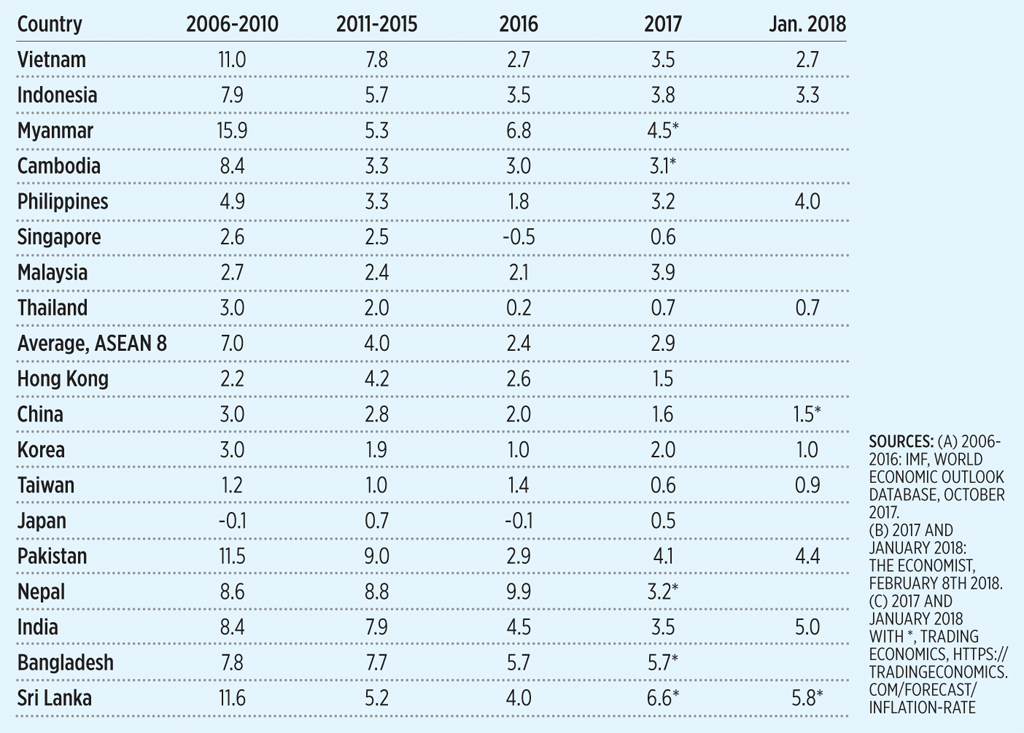
Data from the last 12 years show that average inflation rate has been declining.

For the ASEAN 8 for instance, it went down from 7% in 2006-2010 average to 4% in 2011-2015 average, and only 2.4% in 2016 but slightly went up to 2.9% in 2017 (see table).


The rise in average prices in 2017 was partly due to the rise in world oil prices.

For instance, the West Texas Intermediate (WTI), a grade of crude oil used as a benchmark for pricing, went up from $43/barrel in 2016 to $51/barrel in 2017.

For the Philippines however, there was a spike in consumer prices in January 2018. From 3.3% in both November and December 2017, it went up to 4%.

Other countries with available data showed a decline in prices by January 2018 except in India (was already 5.2% in December 2017), Pakistan (4.6% in December 2017) and Taiwan (1.2% in December 2017).

So the Philippines is the “outlier” here, experiencing higher inflation when most neighbors have declining prices. Why?

The most proximate explanation is the TRAIN law signed in December 2017. While there is a decline in personal income tax rates, there are tax hikes in oil products, sugar tax, among others.

The Philippines is entering a period of increasing government intervention, taxation, and regulation. This is not good for the people and private enterprises.
 -------------

See also:

Friday, February 16, 2018

ALF 10, Conference 2018 in Jakarta, Indonesia

The Asia Liberty Forum (ALF) 2018 conference ended successfully last week. Venue is the beautiful Mandarin Oriental Jakarta, the hotel is facing the Jakarta Central circle, Thamrin. Plenty of participants from many countries. Hats off to Atlas and the Center for Indonesian Policy Studies (CIPS).


Opening remarks on Day 1 was given by Atlas President and CEO, Brad Lips (below) then Saidah Sakwan, Chairperson of CIPS.


Then the Cornerstone Talks with six speakers. From left: Amartuvshin Dorj (Mises-Mongolia),
Hizkia Respatiadi (CIPS), Eunhee Park (Teach North Korean Refugees/TNKR, S. Korea), Nila Tanzil (Taman Bacaan Pelangi, Indonesia), Terry Kibbe (Free the People, USA) as moderator, Barun Mitra (Liberty Institute, India) and Razeen Sally (LKY School of Public Policy, National University of Singapore; he's Sri Lankan). ALL good speakers.


Then the first Keynote address by Suraj Vaidya, Chairman of the SAARC Chamber of Commerce and Samriddhi Foundation, Nepal. He talked why free trade is good and will significantly reduce poverty in many developing countries.


 Suraj and FNF Regional Director for South Asia, Ronald Meinardus (3rd from right) flanked by participants an speakers from India, Nepal, Afghanistan, US. Ronald introduced Suraj, then interviewed him on stage.


Some of the nearly 300 participants.


Among the pretty faces in the crowd, a local participant.


A photo with Adinda Tenriangke Muchtar (Suara Kebebasan, Indonesia) and Pett Jarupaiboon (EFN-Asia, FNF, Bangkok, Thailand).


More pics to follow...
(All photos I got from the Atlas fb page)
--------------

See also:

Wednesday, January 31, 2018

BWorld 182, Asia Liberty Forum 2018 in Jakarta

* This is my column in BusinessWorld last January 22, 2018.


“There is no evidence that fuel and electricity subsidies benefited the poor. There is no evidence that trade protection benefited the poor. Elimination of subsidies if compensated by reduction of cost doing business (corruption) will help the poor.”

— Muhamad Chatib Basri,
presentation about Indonesia energy and food subsidies,
EFN Asia conference September 2004, Hong Kong

Those conclusions were made by Dr. Chatib “Dede” Basri in his presentation, “Can subsidy and protection do any good for the poor?” at the Economic Freedom Network (EFN) Asia conference in 2004. At that time, he was a faculty member of the University of Indonesia and individual member of EFN. He used an econometric model and the Grosman and Helpman (G-H) model (trade protection is the result of bargaining between government and various lobby groups). The inevitable conclusion of his paper was that market reforms and the reduction, if not removal of dependence by the poor on the state will actually help them and taxpayers over the long term.

Dr. Basri later became Minister of Finance from May 2013 to October 2014 when the administration of Indonesian President Susilo Bambang Yudhoyono ended. Dr. Basri will be among the keynote speakers in the Asia Liberty Forum (ALF) this coming Feb. 10-11 at Mandarin Hotel Jakarta, Indonesia. The event is sponsored by the Atlas Foundation and co-hosted by the Center for Indonesian Policy Studies (CIPS).

Aside from Dr. Basri, other important speakers in this year’s conference will be the following:

1. Saidah Sakwan, chairwoman, CIPS; also a commissioner of the Indonesian Business Competition Commission (KPPU).

2. Brad Lips, CEO of Atlas Network, Washington DC, USA.

3. KH Yahya Cholil Staquf, general secretary of Nahdlatul Ulama (NU) Supreme Council, world’s largest Muslim organization with 50+ million members.

4. Siegfried Herzog, Regional director for Southeast and East Asia, Friedrich Naumann Foundation for Freedom (FNF), Thailand.

5. Suraj Vaidya, chairman of SAARC Chamber of Commerce and also chairman of Samriddhi Foundation, Nepal.

6. Rainer Heufers, executive director of CIPS.

7. Razeen Sally, Prof. at Lee Kuan Yew School of Public Policy, National University of Singapore.

8. Ronald Meinardus, Regional director, FNF South Asia, India.

9. Parth Shah, president of the Centre for Civil Society, India.

10. Lorenzo Montanari, exec. director of Property Rights Alliance (PRA), Washington DC, USA.

11. Barun Mitra, founder and Director of Liberty Institute, India.

12. Junjie Ma of Unirule Institute, Beijing, China.

There are many other interesting speakers to talk on many topics — policy reforms to broaden support for classical liberal principles, education policy, Ease of Doing Business Index, Protection of private property rights, Intellectual Property Rights (IPR), micro-enterprises, entrepreneurship in e-commerce, state-owned enterprises (SOEs).

Are Asian economies getting more market-oriented or state-distorted? Is there greater rule of law now or greater rule of men? Are public institutions more protective or more confiscatory of private property rights?

There are many studies and annual reports that track and monitor various indicators and parameters to help answer these and related questions. Among the important annual reports are Fraser Institute’s Economic Freedom of the World (EFW) reports, Heritage Foundation’s Economic Freedom Index (EFI), PRA’s International Property Rights Index (IPRI), World Bank’s Doing Business, and World Economic Forum’s (WEF) Global Competitiveness Index (GCI).

The GCI is composed of 12 pillars and the first pillar are Institutions. These are composed of 21 sub-pillars like property rights, IPR protection, diversion of public funds, public trust in politicians, irregular payments and bribes, judicial independence, favoritism in decisions of government officials, burden of government regulation, efficiency of legal framework in settling disputes and challenging regulations, transparency of government policy making, and reliability of police services.

I checked the latest WEF 2017-2018 report for East Asian economies and compared with the report two years ago for pillar #1, Institutions (see table).


So for Institutions, the numbers above show three important results: One, out of the 144 countries and economies covered, many East Asian nations land in the first half (i.e., 1st to 72nd), 11 of the 15 economies mentioned above. Singapore and Hong Kong are in the top 10.

Two, the biggest gainers in global ranking are India (+21!), South Korea, China, and Laos. And three, the biggest loser in ranking is the Philippines, dropping 17 places or notches.

In the WEF Executive Opinion Survey 2017, the most problematic factors for doing business in the Philippines were: (1) inefficient government bureaucracy, (2) inadequate supply of infrastructure, (3) corruption, (4) tax regulations, and (5) tax rates.

For Asian countries outside the first half like Thailand, Vietnam, Philippines and Cambodia, there is an immediate need to improve the rule of law and further debureaucratize, deregulate and depoliticize the economy.
-------------

See also:

Sunday, June 28, 2015

CSOs and State 22, CIPS' Community Schools Project in Indonesia

Here is another noble project worth supporting. Our friends in Jakarta, new independent think tank Center for Indonesian Policy Studies (CIPS) is launching a big project -- to develop NGO-administered community schools that will provide low cost but good quality education for some 36 M poor Indonesian kids. They are seeking donations for this project. In their special site for this project, CIPS wrote,

Low-cost community schools is a way to get more kids in classrooms.

Low-cost community schools are schools set up by community leaders and members to teach children from low-income families. Community schools use curricula that give parents and teachers more influence, so that schools provide their child the type of education they feel is most needed for better opportunities.

Students from low-cost community schools in Asia and Africa have even done better than their counterparts in government-run schools. Proving that quality education does not need to be expensive, and can be done.

For example, in India, poor families are willing to invest $2 a month to send their children to such community schools. Kids in these schools achieve higher scores in maths and english than children in public schools.

Being a think tank, CIPS will conduct a major study on how public basic education in Indonesia can be made more effective and less costly. The paper, when finished, will find its way in the hands of the Education Minister and Indonesian legislators. CIPS has a working relationship with some important policy makers in Indonesia.

It should be a good initiative that can be replicated in other big SE Asian countries with big population like the Philippines, Vietnam, Thailand and Myanmar. Here in the PH for instance, I think ALL high officials and consultants of multilaterals and foreign aid (UN (WHO, ILO, UNDP, UNICEF, etc), WB, ADB, USAID, etc.) plus high PH government officials and legislators, them who endlessly call for "more government spending in public education", do NOT bring their kids to public elementary and high schools, except in science HS. That alone is a clear admission by the eople working for those institutions that they have high distrust of the quality of public education.

I admire and support the CIPS for this project. Friends and readers, please consider giving a donation for this project. Thank you.
------------

See also:
CSOs and State 18: Civil Society as Lobbyists for More Government? Cigarette Warning Bill, March 02, 2014