Showing posts with label Chatib Basri. Show all posts

Saturday, February 24, 2018

BWorld 187, Asians’ freedom from high inflation and regulations

* This is my article in BusinessWorld on February 12, 2018.


“Bad times make good policy and good times make bad policy. If you want to introduce important reforms, wait for bad times and the politicians will listen to you.”
— Chatib Basri, former Indonesia Minister of Finance

That was among the important advice and reflections based on experience given by one of the keynote speakers in the recent Asia Liberty Forum (ALF) 2018 held in Mandarin Oriental Jakarta, Indonesia last Feb. 10-11. Dr. Basri spoke on “How to do Reform in an ‘Imperfect World’: The Case of Indonesia.”

The ALF is an annual liberty conference sponsored by the Atlas Foundation (US) and co-sponsored by other organizations and independent think tanks. In this year’s event, the local host and co-sponsor is the Center for Indonesian Policy Studies (CIPS), a great and dynamic free market think tank.

Dr. Basri is a friend since 2004 when I first attended the Economic Freedom Network (EFN) Asia Conference in Hong Kong in October 2004, sponsored by the Friedrich Naumann Foundation for Freedom (FNF) and co-sponsored by the Lion Rock Institute. I was impressed by his silent, cool, and reflective composure.

He became Finance Minister from May 2013 to October 2014 when the term of former Indonesian president Susilo Bambang Yudhoyono was completed. Upon his appointment, at least one Indonesian newspaper headlined “Free marketer becomes Finance Minister.”

He started his presentation with this quote from Jean Claude-Juncker, EU President:

“We all know what to do, we just don’t know how to get re-elected after we’ve done it.”

Other statements he made in the ALF2018 were:

“One reason Indonesians are religious is because of the Government. You submit your business application to the Government, then pray to God.”

“We failed to explain the benefits of free trade to the people. The success of Asia was the success story of globalization.”

“When political power is not favorable and limited, create a success story which enables the people to see and experience positive changes, pick one that is easy to implement but the marginal gain is high, then move to more complex reforms.”

“To help the poor, Indonesia liberalised rice imports. Prices fell.”

Another keynote speaker in day 1 was Suraj Vaidya, Chairman of the South Asian Association for Regional Cooperation (SAARC) Chamber of Commerce, also Chairman of the Samriddhi Prosperity Foundation in Nepal.

Mr. Vaidja quoted Frederic Bastiat’s famous line, “If goods cannot cross borders, soldiers will.”

That statement was true in the past, remains true in the present, and will be true in the future. Trade is the best global peace maker since people and goods crossing borders create goodwill among societies, discouraging criminals, terrorists, and prohibited substances.

Both Dr. Basri (introduced and interviewed by Rainer Heufers, CIPS executive director) and Mr. Vaidja (introduced and interviewed by Ronald Meinardus, FNF Regional director for South Asia) mentioned the role of free trade and free markets in fighting high inflation many goods and services that are unaffordable to the poor.

And this brings us to the issue of controlling high inflation in the continent.

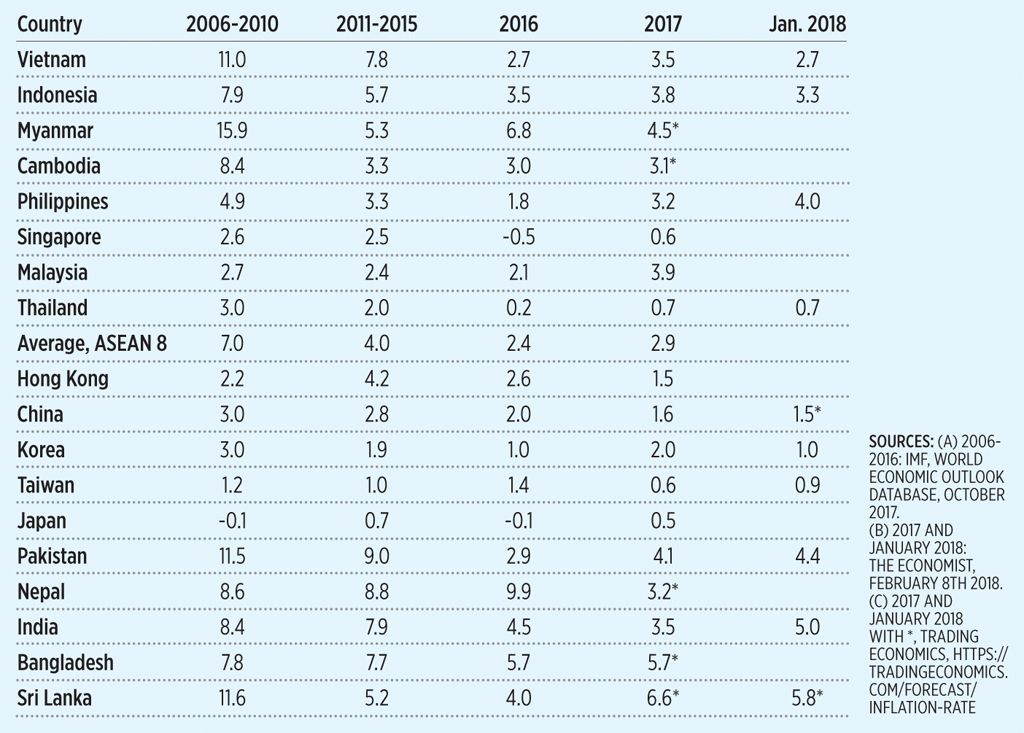
Data from the last 12 years show that average inflation rate has been declining.

For the ASEAN 8 for instance, it went down from 7% in 2006-2010 average to 4% in 2011-2015 average, and only 2.4% in 2016 but slightly went up to 2.9% in 2017 (see table).


The rise in average prices in 2017 was partly due to the rise in world oil prices.

For instance, the West Texas Intermediate (WTI), a grade of crude oil used as a benchmark for pricing, went up from $43/barrel in 2016 to $51/barrel in 2017.

For the Philippines however, there was a spike in consumer prices in January 2018. From 3.3% in both November and December 2017, it went up to 4%.

Other countries with available data showed a decline in prices by January 2018 except in India (was already 5.2% in December 2017), Pakistan (4.6% in December 2017) and Taiwan (1.2% in December 2017).

So the Philippines is the “outlier” here, experiencing higher inflation when most neighbors have declining prices. Why?

The most proximate explanation is the TRAIN law signed in December 2017. While there is a decline in personal income tax rates, there are tax hikes in oil products, sugar tax, among others.

The Philippines is entering a period of increasing government intervention, taxation, and regulation. This is not good for the people and private enterprises.
 -------------

See also:

Wednesday, January 31, 2018

BWorld 182, Asia Liberty Forum 2018 in Jakarta

* This is my column in BusinessWorld last January 22, 2018.


“There is no evidence that fuel and electricity subsidies benefited the poor. There is no evidence that trade protection benefited the poor. Elimination of subsidies if compensated by reduction of cost doing business (corruption) will help the poor.”

— Muhamad Chatib Basri,
presentation about Indonesia energy and food subsidies,
EFN Asia conference September 2004, Hong Kong

Those conclusions were made by Dr. Chatib “Dede” Basri in his presentation, “Can subsidy and protection do any good for the poor?” at the Economic Freedom Network (EFN) Asia conference in 2004. At that time, he was a faculty member of the University of Indonesia and individual member of EFN. He used an econometric model and the Grosman and Helpman (G-H) model (trade protection is the result of bargaining between government and various lobby groups). The inevitable conclusion of his paper was that market reforms and the reduction, if not removal of dependence by the poor on the state will actually help them and taxpayers over the long term.

Dr. Basri later became Minister of Finance from May 2013 to October 2014 when the administration of Indonesian President Susilo Bambang Yudhoyono ended. Dr. Basri will be among the keynote speakers in the Asia Liberty Forum (ALF) this coming Feb. 10-11 at Mandarin Hotel Jakarta, Indonesia. The event is sponsored by the Atlas Foundation and co-hosted by the Center for Indonesian Policy Studies (CIPS).

Aside from Dr. Basri, other important speakers in this year’s conference will be the following:

1. Saidah Sakwan, chairwoman, CIPS; also a commissioner of the Indonesian Business Competition Commission (KPPU).

2. Brad Lips, CEO of Atlas Network, Washington DC, USA.

3. KH Yahya Cholil Staquf, general secretary of Nahdlatul Ulama (NU) Supreme Council, world’s largest Muslim organization with 50+ million members.

4. Siegfried Herzog, Regional director for Southeast and East Asia, Friedrich Naumann Foundation for Freedom (FNF), Thailand.

5. Suraj Vaidya, chairman of SAARC Chamber of Commerce and also chairman of Samriddhi Foundation, Nepal.

6. Rainer Heufers, executive director of CIPS.

7. Razeen Sally, Prof. at Lee Kuan Yew School of Public Policy, National University of Singapore.

8. Ronald Meinardus, Regional director, FNF South Asia, India.

9. Parth Shah, president of the Centre for Civil Society, India.

10. Lorenzo Montanari, exec. director of Property Rights Alliance (PRA), Washington DC, USA.

11. Barun Mitra, founder and Director of Liberty Institute, India.

12. Junjie Ma of Unirule Institute, Beijing, China.

There are many other interesting speakers to talk on many topics — policy reforms to broaden support for classical liberal principles, education policy, Ease of Doing Business Index, Protection of private property rights, Intellectual Property Rights (IPR), micro-enterprises, entrepreneurship in e-commerce, state-owned enterprises (SOEs).

Are Asian economies getting more market-oriented or state-distorted? Is there greater rule of law now or greater rule of men? Are public institutions more protective or more confiscatory of private property rights?

There are many studies and annual reports that track and monitor various indicators and parameters to help answer these and related questions. Among the important annual reports are Fraser Institute’s Economic Freedom of the World (EFW) reports, Heritage Foundation’s Economic Freedom Index (EFI), PRA’s International Property Rights Index (IPRI), World Bank’s Doing Business, and World Economic Forum’s (WEF) Global Competitiveness Index (GCI).

The GCI is composed of 12 pillars and the first pillar are Institutions. These are composed of 21 sub-pillars like property rights, IPR protection, diversion of public funds, public trust in politicians, irregular payments and bribes, judicial independence, favoritism in decisions of government officials, burden of government regulation, efficiency of legal framework in settling disputes and challenging regulations, transparency of government policy making, and reliability of police services.

I checked the latest WEF 2017-2018 report for East Asian economies and compared with the report two years ago for pillar #1, Institutions (see table).


So for Institutions, the numbers above show three important results: One, out of the 144 countries and economies covered, many East Asian nations land in the first half (i.e., 1st to 72nd), 11 of the 15 economies mentioned above. Singapore and Hong Kong are in the top 10.

Two, the biggest gainers in global ranking are India (+21!), South Korea, China, and Laos. And three, the biggest loser in ranking is the Philippines, dropping 17 places or notches.

In the WEF Executive Opinion Survey 2017, the most problematic factors for doing business in the Philippines were: (1) inefficient government bureaucracy, (2) inadequate supply of infrastructure, (3) corruption, (4) tax regulations, and (5) tax rates.

For Asian countries outside the first half like Thailand, Vietnam, Philippines and Cambodia, there is an immediate need to improve the rule of law and further debureaucratize, deregulate and depoliticize the economy.
-------------

See also:

Saturday, January 25, 2014

EFN Asia 34: Chatib Basri on Subsidy and Protectionism for the Poor

My first exposure to international and regional free market network was in 2004. First in the US in April-May that year when I was one of the International Fellows of Atlas, then in Hong Kong September of that year, during the Economic Freedom Network (EFN) Asia Conference 2004, sponsored by the Friedrich Naumann Foundation (FNF) and co-sponsored by five Beijing- and Hong Kong-based institutes.

Among the great presentations in the HK conference was one by Dr. Chatib Basri, who was then a faculty member of the University of Indonesia and individual member of EFN, now Indonesia's Finance Minister.


This is his first slide after the title. I remember my eyes brightened at these clear and erudite words from two of the intellectual giants of the free market literature.


 The two questions that his paper wanted to explore and answer...


He presented short-run impact of eliminating fuel and electricity subsidies, which actually benefit the non-poor.

These slides are interesting, about bribes given by the public to certain government officials and bureaucrats as regulations are plentiful, complicated and costly.

Tuesday, May 21, 2013

EFN Asia 19: Chatib Basri as New Finance Minister of Indonesia

A friend whom I met during the Economic Freedom Network (EFN) Asia conference in Hong Kong in 2004, Chatib "Dede" Basri, has been appointed yesterday as the Finance Minister by Indonesian President Susilo Bambang Yudhoyono. 
Photo from: Jakarta Globe

In his presentation nine years ago in HK, I remember that two of his slides showed a quote from Adam Smith, 
[The rich] consume little more than the poor… They are led by an invisible hand … and thus without intending it, without knowing it, advance the interest of the society, and afford means to the multiplication of the species.
And from Milton Friedman, something like "The politicians and bureaucrats, they are led by an invisible hand and without intending it, without knowing it, advance their own interest over that of society."

I liked his presentation. He is a soft spoken yet highly articulate and intelligent guy. He got his PhD Econ from the Australia National University (ANU). During the EFN Asia conference in Kuala Lumpur in 2005, he was supposed to come too but he did not arrive. He was at that time, the Director of the Institute for Economic and Social Research Faculty, University of Indonesia.

Here are two news reports today from the Jakarta Globe.

Editorial: Free-Market Thinker to Lead Finance

By Jakarta Globe on 9:23 am May 21, 2013.
http://www.thejakartaglobe.com/opinion/editorial-free-market-thinker-to-lead-finance/


The appointment of M. Chatib Basri as the fourth finance minister under President Susilo Bambang Yudhoyono is a welcome move. The new minister has the requisite experience, but more importantly he understands the needs of the business community.

As he settles unto his new post after a successful stint at the Investment Coordinating Board (BKPM), Chatib will have to tackle several key issues immediately. These include keeping the budget deficit from exploding, dealing with the fuel subsidy issue and boosting tax collection.

These are not easy challenges, but Chatib has the experience, skills set and economic knowledge to make the right decisions.

The most pressing challenge will be to deal with ever-rising fuel subsidies. It is clear that the state cannot afford to fund fuel subsidies without causing serious damage to the state budget and macroeconomic stability. But managing the political implications of raising fuel prices will require skill and a significant amount of socialization.

On this score, his apolitical stance will stand him in good stead. Political parties cannot accuse him of politicking or favoring any side. But he will have to work hard to get legislation on his side.

Chatib is also probably the best person to improve the investment climate given his time at BKPM, where he cut red tape significantly. He will have to continue these efforts at the Finance Ministry. If he is able to streamline bureaucracy, he will have made a major contribution to improving both the investment as well as the business climate in the country.

A soft-spoken man, Chatib is nonetheless a forceful economic thinker. He is a free-market advocate who supports free enterprise, which is critical in ensuring that Indonesia remains an open economy. His appointment is good for the country and the economy.

Saturday, September 15, 2007

Pol. Ideology 8: Ideas on Liberty

Three years ago, I attended my second international conference about free market, the 1st Asian Resource Bank Meeting in Hong Kong, September 15, 2004. It was jointly sponsored by the Atlas Economic Research Foundation (USA), Unirule Institute of Economics (China) and the Friedrich Naumann Foundation (Germany).

Below are some papers discussed there.
--------

(1) Lunch Speaker, Dr. James Dorn, the China specialist of Cato Institute (www.cato.org). He talked about "Why Freedom Matters". In his presentation, he showed graphs, charts, tables, showing that stronger property rights enforcement and greater economic freedom results in greater wealth and faster poverty alleviation. Also the pattern of China's economic liberalization and growth. Below are the 5 Lessons/summary of his presentation. Also a quote from Havel...

Five Lessons
1. Private property, freedom, and justice are inseparable.
2. Justice requires limiting government to the protection of persons and property.
3. Minimizing the use of force to defend life, liberty, and property will maximize freedom and create a spontaneous market-liberal order.
4. Private free markets are not only moral; they create wealth by providing incentives to discover new ways of doing things and increase the range of alternatives.
5. Governments rule best when they follow the rule of law and the principle of non-interference (wu wei).
The market economy is "the only natural economy, the only kind that makes sense, the only one that can lead to prosperity, because it is the only one that reflects the nature of life itself."
-- Vaclav Havel
"Summer Meditations"


(2) Speech by Joe Lehman, Executive VP of the Mackinac Center for Public Policy in Midlands, Michigan, USA. April 2004, I attended the Mackinac Leadership Conference in their office, I have met Joe there, as well as Mackinac President Larry Reed.

Translating Ideas Into Success
(On Sept. 15 in Hong Kong, Joseph Lehman delivered the following speech to open the inaugural Asian Resource Bank, a meeting of Asian free-market think tank leaders sponsored by the Virginia-based Atlas Economic Research Foundation and the Beijing-based Unirule Institute of Economics. The remarks are a condensation of ideas presented at the Mackinac Center’s semiannual Leadership Conference, which has trained more than 300 national and international think tank executives in management, communications and fundraising. Contact Kendra Shrode for information on the next Leadership Conference.)
It’s a great privilege to address the very first Asian Resource Bank meeting this morning, make new friends, and reunite with familiar ones. Mackinac Center President Larry Reed asked me to express his warmest greetings to you. He told me he was so grateful that I could stand in for him today that he doesn’t mind if I borrow liberally from his material!
If you’ve been around think tank people very long, you’ve probably realized that not many of us can tell a good joke. In a lot of professions, that would be a real setback, but it doesn’t hold us back. We don’t have to come up with our own funny stories: We’ve got the whole government doing ridiculous things all the time for us to talk about.
We can even retell other people’s jokes; Will Rogers told that one more than 70 years ago. Telling jokes about the government helped make Will Rogers the best-known American humorist of his time. But government is not just funny – it’s a deadly serious enterprise. Some of you doubtless can testify first-hand to government abuse of the ugliest sort. Figuring out how to limit government – to make it the servant of the people and not the other way around – is a necessary work and a noble calling.
So how do we translate our ideas into success? How can we actually shape public policy with a mere notion – that freedom and free markets are the best way to organize society?
The Power of Ideas
We start by realizing that ideas are the most powerful force in the world. Power can be found in politicians, armies, activists and institutions. But the reason for their power is ideas, because ideas explain why people do the things they do.
What people believe determines how they behave, for whom they vote, the laws and rules they accept or reject and what kind of society they will work to adopt. Ideas determine whether a culture embraces free markets or socialism, democracy or dictatorship. Change ideas, and you change the world.
Political leaders may enact public policy, but they seldom generate the ideas that drive policy. Politicians usually act within a fairly narrow range of politically acceptable options. And they cannot operate outside that range without jeopardizing their political standing.
The range of credible ideas circulating in the intellectual marketplace determines the range of politically acceptable options. So if you have a think tank that changes the intellectual landscape, that think tank actually shifts the range of politically acceptable ideas. And that’s how think tank ideas have impact.
To take a simple example, if the generally acceptable income tax rate is 60 percent, it is very hard for a politician to say it should be 15 percent. A 15 percent tax is outside the window of political possibility. But if the tax is at 60 percent already, then 50 percent is easy to propose. Forty percent may be easy to propose if think tanks or others have done the research and shifted the intellectual climate of opinion. The 40 percent tax rate may not be enacted right away, but a politician can propose it without seeming crazy if intellectuals have paved the way.
Milton Friedman has said think tanks are at their best when they change what is politically possible.
We must remember we are engaged in a battle of ideas. In spite of political obstacles, we are not battling against personalities or people. We can win by promoting ideas that shift the very ground of battle.
Optimism
But even the very best ideas are apt to go nowhere without optimism. I have the privilege of working for probably the world’s most optimistic man. Larry Reed likes to tell the story of how he once lost control of his car on an icy road. As he was rolling over and over down an embankment, he swears the thought going through his head was this one: "At least I’m going to get a new car out of this!" Now that’s optimism!
Well, we don’t have to be pathological optimists to have every reason for optimism ourselves. We are winning the war of ideas.
We have watched the ideas of Soviet communism become discredited around the globe. The world’s most aggressive exporter of communism has crumbled. Liberalism is taking hold and gaining respect in dozens of former socialist strongholds. In my own country, about the only place you can find someone who still believes Marx was right is on college campuses!
Another reason for optimism is that the drift of ideas is in our direction. I don’t know about you, but I run into a lot more former socialists than former free-marketers. I can’t remember the last time someone said to me, "You know, I used to believe in free markets and individual liberty, but I’ve looked at the evidence, and now I think central planning is the way to go."
The final reason to be optimistic is simply that pessimism is self-fulfilling. What band of revolutionaries ever said, "It’s hopeless; we’re fighting a lost cause; but let’s spill our blood anyway?" An optimist is not blind to obstacles and setbacks, but he views them as momentary and finds ways to overcome them.
Entrepreneurship
The next ingredient for translating ideas into success is entrepreneurship. I don’t mean just talking and writing about it. I mean being an entrepreneur.
To really shift the window of political possibility, we have to get out of the purely academic mindset, where the goal is writing reports and studies. Our success is not measured by how much paper we push out the door. We succeed only if we actually shift policy in the right direction, and to do so requires an entrepreneurial approach.
Successful entrepreneurs are focused. They have lots of ideas, but they figure out their comparative advantage and spend their energy there. They don’t run in all directions trying anything that seems interesting.
This means that entrepreneurs are planners, but not in the sense of stifling creativity and flexibility. A good entrepreneur makes plans that avoid both rigid bureaucracy and unfocused, free-wheeling frenzies of activity.
Entrepreneurs are problem-solvers. They don’t just try to copy what works in other countries — they become the experts at applying freedom ideas and overcoming obstacles in their own countries.
Studies and seminars will always be staple products for a think tank. But sometimes you have to get creative.
The most powerful labor union of teachers in my state — the Michigan Education Association — routinely thwarted schools that wanted to save money by privatizing nonteaching jobs such as food, janitorial and bus services. Taking union dues from all the teachers was not enough. The teachers union wanted to force the school to hire only dues-paying cooks, janitors and bus drivers, too.
At the Mackinac Center, we had already published studies showing how much money the schools could save by privatizing, but the union was too powerful. We had to do something to weaken the union’s influence.
We brainstormed, and it occurred to us that the union had its own massive headquarters building with 500 employees. Surely the union did not employ their own unionized cooks, janitors and mail clerks. We decided to find out.
So, one of our policy analysts simply parked his car outside union headquarters and counted the various contractors’ trucks that entered the premises.
We learned that this union – the one that opposed it when schools privatized to save money – contracted with four outside firms for food service, custodial service, mail service and security. And in three of the four cases, the contract firms were nonunion!
We contacted the newspapers and state lawmakers and exposed the union’s hypocrisy. Schools were suddenly emboldened to oppose the union on privatization, and within a few months legislators gave schools explicit authority to privatize without the union’s approval.
If there were a think tank entrepreneur’s hall of fame, we would make that story our nomination!
Entrepreneurs are creative, but they build on the success of others. Don’t waste time comparing yourself to other think tanks or criticizing others in the movement. Learn what you can from them and apply it to your country’s unique marketplace of ideas.
Perseverance
The final ingredient is perseverance. Never giving up. Perseverance is the backstop of success.
Freedom is never won in an unbroken string of victories. It’s more like three steps forward and two steps back. We persevere by simply refusing to ever give up. There will be discouraging turns of events, unexpected setbacks and even seemingly overwhelming daily pressures.
But those are precisely the times to remember that we are on the front lines of a battle that is infinitely more important than any of our day-to-day struggles, disappointments, deadlines and duties. We can’t ever let those things distract us and divert our eyes from the prize.
In our office hangs a photograph that just screams "perseverance." I’m sure you’ve all seen the snapshot of a lone man in Tiananmen Square who is apparently stopping four Chinese tanks from advancing. That single image of perseverance has probably inspired more freedom fighting around the world than four tanks could ever hope to vanquish.
Let me close with the story of a man who personified perseverance. Some of you already know about William Wilberforce and the abolition of slavery.
Wilberforce was elected to the British Parliament in 1780. Seven years later, he decided to work to end British slavery.
At the time, slavery in the British Empire had broad political support and even intellectual defenders. People turned a blind eye to the cruelty of African slavery, which was considered essential to British military and economic success. Wilberforce was that rarest of politicians who stood virtually alone on principle.
He spoke against slavery in the House of Commons for the first time in 1789. Every single year for 18 years he introduced an abolition measure, and for 18 years they went nowhere.
He was ridiculed and called a traitor and a rabble-rouser. Once, even his friends deserted him when the opposition supplied his allies in Parliament with free theater tickets during a crucial vote. Through it all, Wilberforce worked tirelessly to turn the intellectual tide and public opinion against slavery.
Finally, on February 23, 1807, Parliament overwhelmingly approved a measure ending the slave trade in the empire.
This stunning achievement would have secured his place in history, but Wilberforce had not yet reached his ultimate goal of ending the practice, not just the trade, of slavery.
With his first victory taking 18 years to achieve, Wilberforce labored another 26 years, even after leaving Parliament, to end slavery. The prize was finally grasped on July 26, 1833, when Britain became the first major power to completely abolish the trade and practice of slavery everywhere in its dominion. Acclaimed as a victorious hero, Wilberforce died three days later.
We can transform policy with the power of ideas, optimism, entrepreneurship and perseverance. We must keep our eye on the prize – not better government, but less of it – and work with a persistence and passion worthy of our cause.


(3) A new friend then, Dr. Chatib "Dede" Basri, also presented a paper, I like the two quotes he used for his opening slides:

“People who intend only to seek their own benefit are led by invisible hand to serve public interest which was no part of their intention."

--Adam Smith


"People who intend only to serve public interest are led by invisible hand to serve private interest which was no part of their intention"

--Milton Friedman

Proof of Smith's statement are aplenty: the rice farmers, the carinderia owners, tiangge-tiangge operators, millions of other entrepreneurs and professionals...

Proof of Friedman's statement are also aplenty: hundreds of them in Malacanang, the Senate, House of Reps; thousands actually if you include many LGU leaders, the guys at the BIR, BOC, DPWH, DND, ...

A friend, Bruce Hall, made a commentary to my brief note above, he wrote:

I don't think that it is just the corrupt officials that are a problem. Even those who are uncorrupted end up serving private interests because there is no way they can ever see the entire big picture. Everyone has blinders on, has a particular perspective on events, that by necessity cuts out other people and perspective.


Do you remember the blackout that happened last year in huge chunks of the Northeast and Midwest US? All the coverage was about NYC while Ohio was basically ignored. Why? Because the journalists all live in NYC.


In the US a few years back, some Republican leaders tried to end funding for the Public Broadcasting System (the non-profit US network partially funded by government). It did not go very far largely because the Congressmenan and Senators were of the socio-economic group that watched PBS and therefore thought it valuable. Their votes on keeping the funding wasn't against the public spirit. They thought that EVERYONE supported PBS funding because EVERYONE that they knew did. Since they found PBS valuable, it must be objectively valuable to the entire public.


There are numerous other cases where good-hearted people make bad decisions because they take their necesarily limited particular experience and universalize it.


This is the problem with large bureaucracies, including large governments -- no matter how honest and dedicated the public servants, they are going to be biased towards their lifestyle and their lifestyle choices. At the very least, the first problems that they are going to address will be the problems they see in their daily lives. Problems where out in the boondocks will be unseen and unaddressed.
Thanks Bruce.

* See also:
Pol. Ideology 6: Quotes from Adam Smith, February 04, 2007
Pol. Ideology 7: Individualism, Entitlement and Freedom, April 30, 2007