Showing posts with label Indonesia. Show all posts

Saturday, February 24, 2018

BWorld 187, Asians’ freedom from high inflation and regulations

* This is my article in BusinessWorld on February 12, 2018.


“Bad times make good policy and good times make bad policy. If you want to introduce important reforms, wait for bad times and the politicians will listen to you.”
— Chatib Basri, former Indonesia Minister of Finance

That was among the important advice and reflections based on experience given by one of the keynote speakers in the recent Asia Liberty Forum (ALF) 2018 held in Mandarin Oriental Jakarta, Indonesia last Feb. 10-11. Dr. Basri spoke on “How to do Reform in an ‘Imperfect World’: The Case of Indonesia.”

The ALF is an annual liberty conference sponsored by the Atlas Foundation (US) and co-sponsored by other organizations and independent think tanks. In this year’s event, the local host and co-sponsor is the Center for Indonesian Policy Studies (CIPS), a great and dynamic free market think tank.

Dr. Basri is a friend since 2004 when I first attended the Economic Freedom Network (EFN) Asia Conference in Hong Kong in October 2004, sponsored by the Friedrich Naumann Foundation for Freedom (FNF) and co-sponsored by the Lion Rock Institute. I was impressed by his silent, cool, and reflective composure.

He became Finance Minister from May 2013 to October 2014 when the term of former Indonesian president Susilo Bambang Yudhoyono was completed. Upon his appointment, at least one Indonesian newspaper headlined “Free marketer becomes Finance Minister.”

He started his presentation with this quote from Jean Claude-Juncker, EU President:

“We all know what to do, we just don’t know how to get re-elected after we’ve done it.”

Other statements he made in the ALF2018 were:

“One reason Indonesians are religious is because of the Government. You submit your business application to the Government, then pray to God.”

“We failed to explain the benefits of free trade to the people. The success of Asia was the success story of globalization.”

“When political power is not favorable and limited, create a success story which enables the people to see and experience positive changes, pick one that is easy to implement but the marginal gain is high, then move to more complex reforms.”

“To help the poor, Indonesia liberalised rice imports. Prices fell.”

Another keynote speaker in day 1 was Suraj Vaidya, Chairman of the South Asian Association for Regional Cooperation (SAARC) Chamber of Commerce, also Chairman of the Samriddhi Prosperity Foundation in Nepal.

Mr. Vaidja quoted Frederic Bastiat’s famous line, “If goods cannot cross borders, soldiers will.”

That statement was true in the past, remains true in the present, and will be true in the future. Trade is the best global peace maker since people and goods crossing borders create goodwill among societies, discouraging criminals, terrorists, and prohibited substances.

Both Dr. Basri (introduced and interviewed by Rainer Heufers, CIPS executive director) and Mr. Vaidja (introduced and interviewed by Ronald Meinardus, FNF Regional director for South Asia) mentioned the role of free trade and free markets in fighting high inflation many goods and services that are unaffordable to the poor.

And this brings us to the issue of controlling high inflation in the continent.

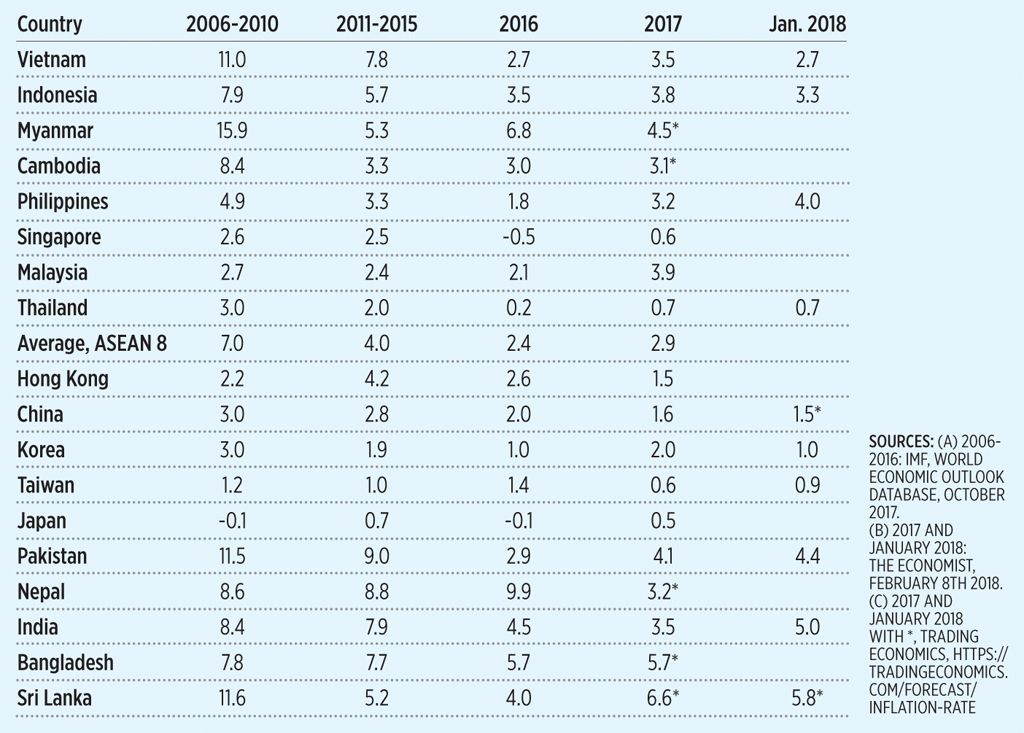
Data from the last 12 years show that average inflation rate has been declining.

For the ASEAN 8 for instance, it went down from 7% in 2006-2010 average to 4% in 2011-2015 average, and only 2.4% in 2016 but slightly went up to 2.9% in 2017 (see table).


The rise in average prices in 2017 was partly due to the rise in world oil prices.

For instance, the West Texas Intermediate (WTI), a grade of crude oil used as a benchmark for pricing, went up from $43/barrel in 2016 to $51/barrel in 2017.

For the Philippines however, there was a spike in consumer prices in January 2018. From 3.3% in both November and December 2017, it went up to 4%.

Other countries with available data showed a decline in prices by January 2018 except in India (was already 5.2% in December 2017), Pakistan (4.6% in December 2017) and Taiwan (1.2% in December 2017).

So the Philippines is the “outlier” here, experiencing higher inflation when most neighbors have declining prices. Why?

The most proximate explanation is the TRAIN law signed in December 2017. While there is a decline in personal income tax rates, there are tax hikes in oil products, sugar tax, among others.

The Philippines is entering a period of increasing government intervention, taxation, and regulation. This is not good for the people and private enterprises.
 -------------

See also:

Friday, February 16, 2018

ALF 10, Conference 2018 in Jakarta, Indonesia

The Asia Liberty Forum (ALF) 2018 conference ended successfully last week. Venue is the beautiful Mandarin Oriental Jakarta, the hotel is facing the Jakarta Central circle, Thamrin. Plenty of participants from many countries. Hats off to Atlas and the Center for Indonesian Policy Studies (CIPS).


Opening remarks on Day 1 was given by Atlas President and CEO, Brad Lips (below) then Saidah Sakwan, Chairperson of CIPS.


Then the Cornerstone Talks with six speakers. From left: Amartuvshin Dorj (Mises-Mongolia),
Hizkia Respatiadi (CIPS), Eunhee Park (Teach North Korean Refugees/TNKR, S. Korea), Nila Tanzil (Taman Bacaan Pelangi, Indonesia), Terry Kibbe (Free the People, USA) as moderator, Barun Mitra (Liberty Institute, India) and Razeen Sally (LKY School of Public Policy, National University of Singapore; he's Sri Lankan). ALL good speakers.


Then the first Keynote address by Suraj Vaidya, Chairman of the SAARC Chamber of Commerce and Samriddhi Foundation, Nepal. He talked why free trade is good and will significantly reduce poverty in many developing countries.


 Suraj and FNF Regional Director for South Asia, Ronald Meinardus (3rd from right) flanked by participants an speakers from India, Nepal, Afghanistan, US. Ronald introduced Suraj, then interviewed him on stage.


Some of the nearly 300 participants.


Among the pretty faces in the crowd, a local participant.


A photo with Adinda Tenriangke Muchtar (Suara Kebebasan, Indonesia) and Pett Jarupaiboon (EFN-Asia, FNF, Bangkok, Thailand).


More pics to follow...
(All photos I got from the Atlas fb page)
--------------

See also:

Tuesday, May 21, 2013

EFN Asia 19: Chatib Basri as New Finance Minister of Indonesia

A friend whom I met during the Economic Freedom Network (EFN) Asia conference in Hong Kong in 2004, Chatib "Dede" Basri, has been appointed yesterday as the Finance Minister by Indonesian President Susilo Bambang Yudhoyono. 
Photo from: Jakarta Globe

In his presentation nine years ago in HK, I remember that two of his slides showed a quote from Adam Smith, 
[The rich] consume little more than the poor… They are led by an invisible hand … and thus without intending it, without knowing it, advance the interest of the society, and afford means to the multiplication of the species.
And from Milton Friedman, something like "The politicians and bureaucrats, they are led by an invisible hand and without intending it, without knowing it, advance their own interest over that of society."

I liked his presentation. He is a soft spoken yet highly articulate and intelligent guy. He got his PhD Econ from the Australia National University (ANU). During the EFN Asia conference in Kuala Lumpur in 2005, he was supposed to come too but he did not arrive. He was at that time, the Director of the Institute for Economic and Social Research Faculty, University of Indonesia.

Here are two news reports today from the Jakarta Globe.

Editorial: Free-Market Thinker to Lead Finance

By Jakarta Globe on 9:23 am May 21, 2013.
http://www.thejakartaglobe.com/opinion/editorial-free-market-thinker-to-lead-finance/


The appointment of M. Chatib Basri as the fourth finance minister under President Susilo Bambang Yudhoyono is a welcome move. The new minister has the requisite experience, but more importantly he understands the needs of the business community.

As he settles unto his new post after a successful stint at the Investment Coordinating Board (BKPM), Chatib will have to tackle several key issues immediately. These include keeping the budget deficit from exploding, dealing with the fuel subsidy issue and boosting tax collection.

These are not easy challenges, but Chatib has the experience, skills set and economic knowledge to make the right decisions.

The most pressing challenge will be to deal with ever-rising fuel subsidies. It is clear that the state cannot afford to fund fuel subsidies without causing serious damage to the state budget and macroeconomic stability. But managing the political implications of raising fuel prices will require skill and a significant amount of socialization.

On this score, his apolitical stance will stand him in good stead. Political parties cannot accuse him of politicking or favoring any side. But he will have to work hard to get legislation on his side.

Chatib is also probably the best person to improve the investment climate given his time at BKPM, where he cut red tape significantly. He will have to continue these efforts at the Finance Ministry. If he is able to streamline bureaucracy, he will have made a major contribution to improving both the investment as well as the business climate in the country.

A soft-spoken man, Chatib is nonetheless a forceful economic thinker. He is a free-market advocate who supports free enterprise, which is critical in ensuring that Indonesia remains an open economy. His appointment is good for the country and the economy.

Tuesday, October 19, 2010

Migration and Freedom 5: Conferences on Liberty and Migration

(Note: this is my article for People's Brigada News last weekend. It should have been published two weekends ago, but I failed to submit it on time, so they posted it only last weekend.)
---------

Jakarta, Indonesia – Liberty is absence of coercion. A society that has less coercion, less regulations, restrictions and prohibitions, is more free. Whatever regulations and coercion that are instituted in society, these are meant to enhance individual freedom, not restrict it.

Advancing individual freedom and the free market is a continuing theme of the annual Pacific Rim Policy Exchange. The last conference was held in Sydney, Australia last week, September 28-30. I was one of the 80-plus participants from countries surrounding the Pacific Rim from four continents – North America, South America, Asia and Australia. I was given a travel scholarship by the main sponsor, the Americans for Tax Reforms. The other 3 sponsors of that activity were the Property Rights Alliance (PRA, US), Heartland Institute (US) and the Institute for Public Affairs (Australia). I was one of the panel speakers on the panel, “Getting free market messages out”.

After that, there was a one-day activity, “Pacific Rim Conference on Climate Change”, October 1, held in the same hotel, Sheraton on the Park, and was sponsored by the Heartland Institute. I also attended that conference.

This week, I attended another important forum, the Economic Freedom Network (EFN) – Asia Conference held in Sultan Hotel in the capital city of Indonesia, October 6-8, 2010. The theme of this year’s conference is “Migration and the Wealth of Nations”. The event was mainly sponsored by the Friedrich Naumann Foundation for Liberty (FNF) and co-sponsored by six other free market-oriented think tanks, three based in Indonesia, three based in the US, Canada and UK.

FNF invited me in the conference to be one of the 9 moderators in 9 panel discussions. I moderated the panel on “Preparing migrants before departure” and the two speakers in the panel were Dr. Arianto Patunru, Director of LPEM and Economics Professor at the University of Indonesia, and Zubair Ahmed Malik, former VP of the Pakistan Chamber of Commerce and Industry.

Migration happens because people want freedom. Economic, political, cultural, religious, personal freedom. People mobility across countries and continents is a perfectly rational human behavior. Restricting such freedom by individuals is not an appropriate role or function by governments. Unless some people have committed a crime against their fellows in their home country, then their freedom to move outside should be curtailed.

Liberty and migration will continue as people seek better lives for themselves, their families and their communities.

* See also Migration and Freedom 4: Filipino entrepreneur in Germany, June 04, 2009

Wednesday, October 06, 2010

EFN Asia 3: Conference in Jakarta

Here in Jakarta, Indonesia, for the Economic Freedom Network (EFN) - Asia annual conference, October 6 to 8, 2010, at Sultan Hotel. Arrived here this afternoon with 3 other Filipinos, all academic economists -- Dr. Alvin Ang (Univ. of Santo Tomas), Dr. Lawrence Dacuycuy (De La Salle Univ.) and Dr. Ernesto Pernia (Univ. of the Philippines). Ernie represents the Foundation for Economic Freedom (FEF), Lawrence represents the Philippine Economic Society (PES), both are local partners of FNF Philippines. Alvin is sponsored by Atlas. I was also sponsored by FNF and I represent our think tank, Minimal Government Thinkers, Inc.

All four of us are either panel speakers or panel moderators. Ms. Jyoti Sachavirawong, a friend and the overall conference manager, made sure that Filipino participants will wrack a part of their brains for this conference. :-)

The theme of this year's conference is "Migration and the Wealth of Nations". Sort of "modern Adam Smith" :-)

Well, migration is not exactly a "modern" phenomena, it's an old occurence dating back before the modern man (before the homo sapiens species). It's just that with globalization, migration and people mobility across countries and continents is becoming an ever-increasing phenomenon for many people in many countries. Adam Smith of course, is the author of the famous book, "The Wealth of Nations", among the classic work for people who believe in individual freedom and free market.

The conference program is here,

Going through the names of speakers and moderators, I think I personally know at least 1/3 of them. Some were fellow participants of the 4th Pacific Rim Policy Exchange in Sydney, Australia, last week.

This is my first time to be in Indonesia, so I was excited to see this city. Jakarta's international airport looks old -- well, not the usual steel and glass structures in many modern Asian airports these days -- like Manila's terminal 1. But the Jakarta airport is big.

Jakarta's road infrastructure is better than Manila's. I did not see potholes on the roads, for instance. But Jakarta's traffic is a lot worse than Manila's. We arrived at the hotel around 3:30pm local time, meaning non-rush hour, but traffic gridlock was bad. It's good that our taxi driver was very brave on the road, we sneaked through the gridlock by passing through the highway's shoulder made narrow by huge trucks and thousands of cars.

Of the 10 member-countries of the Association of South East Asian Nations (ASEAN), Indonesia has the biggest population, should be about 230 million now, while the Philippines is 2nd biggest at 94 million. So comparing their capital cities, Jakarta and Manila, would make some sense. Jakarta's population is about 20 million? Metro Manila's is 12 million. Among the megacities of the world.

Hectic days for me lately. Just last Sunday midnight, I arrived from Sydney, went straight to the hospital as my wife was scheduled to give birth that day to our second child. I arrived at the hospital around 1:30am of October 4, the baby was born around 4:30am, she's pretty.

I left the hospital early this morning, my wife and the baby are scheduled to check out later today. They should be home by now. Thanks to my mother in law and two sis-in-law, they help watch my family while I am away.
--------

See also:
EFN Asia 1: From HK to Phuket to KL, September 16, 2006
EFN Asia 2: Hayek in Asia, September 20, 2010
Jo Kwong rocks, February 09, 2010

Thursday, September 13, 2007

ASEAN 2: Regional Meetings, Indonesia's Military Businessmen

The Association of South East Asian Nations (ASEAN) is turning 40 years old this year. From a military alliance of some SEA countries, it has morphed and evolved into a dynamic economic bloc in this part of the world.

I think that without the persistent inclusion of their 3 rich neighbors in the north-east, namely China, S. Korea and Japan (what used to be "ASEAN + 3"), many heads of states of ASEAN-member countries could be dragging their butts on the issue of trade and investment liberalization. Our "rich confucian neighbors" have a very strong confucian ethic of hard work and entrepreneurship, values that somehow infect the businessmen and some politicians/bureaucrats of the laggard ASEAN member countries.

Of course a number of member-countries of ASEAN have their own dynamism themselves, their own ethic of hard work and entrepreneurship, like the Thais, Malaysians and Singaporeans.

Now, ASEAN has attracted more countries to become its "regular observers" in its annual summit meeting of its heads of state. It's now "ASEAN + 6" (China, Japan, S. Korea, India, Australia and NZ). Outliers like Myanmar and possibly Laos, should be dragged upwards economically along the way.

ASEAN meetings are plentiful. For instance, this year, the Philippines hosted at least 3 important ASEAN meetings: (a) ASEAN summit last January in Cebu, (b) ASEAN Ministerial meeting last July in Manila, and (c) ASEAN Economic Minsters Meeting last August in Makati.

Us Filipino taxpayers do not know how much from the money confiscated from our monthly earnings and from the taxes on the goods and services that we buy, were spent on all those expensive meetings. In addition, when these officials and bureaucrats come, we're like 3rd class citizens and motorists in our own country, judging from the way our local policemen and traffic "enforcers" edge or wipe us away from the roads when the cars and convoys of these bureaucrats would pass by.

Government bureaucrats -- national, regional, multilateral -- they think we owe the world to them. They suck.
--------

I wrote this last June 21, 2006:

Indonesia's Military Businessmen

Can soldiers be good businessmen? And that they can own or control more than a thousand companies in a poor country?

Well, the Indonesia military think they can, and so they own until today more than 1,500 companies in Jakarta, of which only about 6 of them are profitable. A story from the Financial Times today, June 21, "Indonesian military to divest some businesses" (By Shawn Donnan in Jakarta), says that

"Indonesia is scaling back plans to force its military to unload its business interests... Indonesia’s parliament in 2004 passed a bill requiring the powerful military, known as the TNI, to unload all the businesses it controlled within five years. Advocates of reform have long accused the TNI’s network of legal and illegal businesses of contributing to corruption, illegal logging and other crimes and of complicating life for foreign companies looking to invest in south-east Asia’s biggest economy.

"But in an interview with the Financial Times, Juwono Sudarsono, Indonesia’s defence minister, said Jakarta now expected to be able to force the military to divest just “six or seven” profitable businesses of the 1,500 it controls.

"The main reason for that, he said, was the 'meagre resources' of Indonesia’s defence budget with the civilian government providing just 48 per cent – or $2.8bn – of the 'minimum budget required' by the military."

This is the issue: soldiers are trained to fight wars, to control and defeat armed enemies of the state, both domestic and foreign. They are not trained in the detailed art of cost-minimization, revenue-maximization, and profit-optimization of business in a competitive environment. Very likely, military generals can make profit for their companies not in a competitive environment; they only make profit because they get all forms of subsidies from taxpayers, and various forms of protection from competition that deprive taxpayers of other choices.

In this case, the Indonesian (or other countries') "military-businessmen" are only moving in a dirty and vicious cycle: business through protectionism and endless subsidies results in a bad business environment, that discourages more private entrepreneurship, that shrinks potential tax revenues, that shrinks potential budget for various government services including defense, that makes them retain "military-businesses" that just live off on protection and endless subsidies...

The sooner that "military businessmen" (a contradiction in terms in the first place) realize this, the better for itself and the Indonesian economy. But the more they procrastinate in letting go of military business interests, the more inefficiencies and wastes they will inflict upon their countrymen.