Showing posts with label Risa Hontiveros. Show all posts

Tuesday, June 25, 2013

Mining 24: Casino-Hontiveros Mining Socialism is Off Tangent

Today is part 2 of the oral debate at the Supreme Court between the anti-corporate mining groups led by former Party-list Congressman Teddy Casino and Congresswoman Risa Hontiveros, and the Chamber of Mines of the Philippines (COMP). The former simply wants the government to confiscate as much money and revenues from the big mining corporations as possible because of their exploitation of the country’s mineral and forest resources, while being silent about similar exploitation by  the so-called “small scale mining” groups and individuals.

While data on various payment in taxes, fees, royalties and penalties made by large mining companies are available (See Mining Taxation and Government), there is zero data available for taxes and other payment by the small scale metallic (gold especially) mining. See also this comparison of mining taxation policies of Chile vs. the Philippines.


The petitioners want the SC  to declare Secs. 80 and 81 of RA 7942 as unconstitutional and then what, the SC will make its own tax rates in mining and insert them as the new Secs. 80 and 81 of this law? Can the SC legislate taxes and tax rates? This is not possible unconstitutional itself because such function is assigned by the Constitution exclusively to Congress, the House and Senate crafting a synchronized bill, and must be signed by the President.

I am wondering why these ex-legislators simply cannot wait for the new 16th Congress to convene just four weeks from now and introduce an amendment to RA 7942, say government should get 90 to 95 percent of the net revenues of big mining companies and go for explicit mining socialism. Teddy Casino and Risa Hontiveros are socialists anyway, I do not think they will deny their affinity with near- or full-socialism and have social and economic equality in society, demonize and over-tax the rich, over-subsidize the poor including the lazy and irresponsible.

Below are some news reports on this subject.


Philippine Star, June 21, 2013

COMP argued that since the La Bugal ruling – the longest in Supreme Court history which took six years for the high tribunal to deliberate on – there has been no material change in the circumstances of the Philippine mining industry.

“There is no compelling reason for the high tribunal to abandon its previous ruling,” COMP said in its motion.

Sec. 80 stipulates that the government share in mineral production sharing agreement (mpsa) is limited to excise taxes.

Sec. 81,on the other hand, limits the government’s share in Financial and Technical Assistance Agreement  (FTAA) to taxes, fees and royalties.

COMP said about P173 billion ($4 billion) in mining investments have been poured into the country since 2004 following the high court’s ruling, making the industry a significant contributor to national development, added COMP….

Sun Star, June 24, 2013

Debates started last April as the SC wanted to know whether the mineral production sharing agreement (MPSA) is unconstitutional for allowing an inequitable sharing of wealth (Section 80) and the government surrenders control and beneficial use of mineral resources under the financial and technical assistance agreement (FTAA) under Section 81.

The Chamber of Mines of the Philippines (COMP)… also said an equitable revenue sharing in mining is a question for the legislative and executive branches of government to decide....

GMA News, June 24, 2013

In a press conference in Manila, Erwin Quinones of the SOS-Yamang Bayan, one group opposed to the law, said that they wanted an "Alternative Minerals Management Bill", in which mining activities are "regulated and needs-based."

Quinones said the alternative mining law should also pave the way for the creation of a "minerals management council" that would ensure the Philippine Government's interests are protected.

"In its present form the so-called revenue regimes of the Mining Act reveals that with its many fiscal incentives and tax holidays, it is a one-way assurance for mining companies get their profits while the Government and the Filipino people bear the brunt of the social and environmental risks," the groups said.

Philippine Daily Inquirer, June 25, 2013

… In its 38-page comment in intervention, the Chamber of Mines asked for the dismissal of the petitions for certiorari and prohibition filed by Hontiveros and her copetitioners, citing three reasons.

These were: That the arguments raised by petitioners had already been passed upon and disposed of against petitioners in the case La Bugal-B’laan Tribal Association v Ramos, which the Supreme Court made a landmark ruling; that the high court should stand by its ruling here; and that the legislative and executive branches should decide on the question of what is an equitable revenue sharing from mining.

The chamber also said the petitioners had not shown any compelling reason to abandon the La Bugal B’laan case as it described their arguments to be a “mere rehash of those already overruled” in the same case.

It also held that there was no actual case or controversy in which to relitigate the case and that petitioners did not complain that they had been injured because of these provisions.
-------------

See also:
Mining 21: Chile Policies, May 21, 2013 

Mining 22: Philippines as EITI Candidate, June 05, 2013 

Mining 23: On the Proposed 10 Percent Gross Revenue Tax, June 06, 2013

Tuesday, April 16, 2013

Mining 13: Timeline of Policies

This afternoon, there will be an oral argument and debates at the Supreme Court in Baguio City. Two petitions by Risa Hontiveros, et al challenge the constitutionality (for the second time) of RA 7942 or the Philippine Mining Act of 1995, particularly Sec. 80 and 81 of the law.


In the SC website, it says,
Petitioners argue that: (1) section 811 of the Mining Act of 1995 is unconstitutional because: (1) it violated the rule on delegated legislation; (2) the Secretary of the DENR (public respondent) acted with grave abuse of discretion resulting to lack or excess of jurisdiction in the issuance of DAO 07-12; and (3) both section 81 of the Mining Act and DAO 07-12 are unconstitutional because they allow inequitable sharing of wealth contrary to Article XII, Section 1, par. 1 and Section 2, par. 1 and 4 of the 1987 Constitution.

Will watch the results of the debate later today and tomorrow.

Meanwhile, below is a short timeline of various policies governing the mining industry in the country. I saw a rappler report on timeline mining. It was highly incomplete though as there are many other DENR Administrative Orders (DAO) and Department Memorandum Circulars (DMCs) affecting the industry. I skipped several DAOs and DMCs in producing this list.

Presidential Decree 1899, January 23, 1984
Defining small-scale mining as "artisanal", thus disallowing sophisticated equipment, involving minimal investments in infrastructure and processing plants, and relies on manual labour.

Republic Act 7076, June 27, 1991
People’s Small Scale Mining Act of 1991, "Minahang Bayan." Forms the Provincial/City Mining Regulatory Board that supervises small scale mining operations alongside the chiefs of the Environment Department and Mining Bureau.

Department Administrative Order (DAO) 1991-66, December 27, 1991 
Declaring certain parcels of Agusan-Davao-Surigao Forest Reserve as non-forest land open for small-scale mining. Parts of Diwalwal gold-rush area in Davao region was open to small-scale mining.

DAO 1992-34, July 14, 1992
Implementing Rules and Regulations (IRR) of RA 7076. 

RA 7942, “Philippine Mining Act of 1995”,  March 3, 1995 
Liberalizes foreign investments in the sector, involves the Local Government and Indigenous Cultural Communities in minerals exploration. Followed by a Financial and Technical Assistance Agreement (FTAA) with foreign-owned Western Mining Corporation Philippines (Tampakan mine).

DAO 1995-23, August 15, 1995
Implementing Rules and Regulations (IRR) of RA 7942. 

Jun. 19, 1995 
La Bugal-B'laan Tribal Association questioned the Constitutionality of RA 7942 and its IRR, particularly the FTAA, which allows foreign ownership, before the Supreme Court.

DAO 96-40,
Revised IRR of RA 7942.

Proclamation No. 297, November 25, 2002 
Establishing the 8,100-hectare Diwalwal Mineral Reservation.

Joint MC DENR-DTI 2003-02, September 10, 2003
Establishment of a Mining Investment Assistance Center.

SC ruling, RA 7942 as unconstitutional, January 2004
The Supreme Court en banc said the Mining Act of 1995 is unconstitutional since it allows foreigners to engage in mining through FTAAs, which is contradictory to the 1987 Philippine Constitution. 

SC reverses, declares RA 7942 as constitutional, December 2004
The Supreme Court reversed previous decision on the unconstitutionality of the Mining Act. Associate Justice Artemio Panganiban pens a resoution that says "full control is not anathematic to day-to-day management, provided that the State retains the power to direct overall strategy". This gives the government a go-signal to issue FTAAs.

DAO 2007-15, July 19, 2007
Amendments to DAO 96-40.

DMO 2009-01, January 30, 2009
Delegating the authority to issue Mineral Ore Exports Permit to the Provincial Governors concerned.

DMO 2010-08, June 29, 2010
Consolidated DAO re IRR of RA 7942.

DMO 2011-01, January 18, 2011
Suspension of acceptance of all mining applications.

EO 79, July 06, 2012
Institutionalizing and implementing reforms in the Philippine mining sector.
Imposes a moratorium on new mining contracts, creates the Mining Industry Coordinating Council (MICC). identify no-go areas for mining. (7 pages)

DAO 2012-07, September 10, 2012
Implementing Rules and Regulations (IRR) to EO 79 (16 pages)

DMO 2013-01, February 21, 2013
Increasing the minimum capital requirements for mining applicants – EP, MA, FTAA.
Authorized capital from P10 million to P100 million.
Paid up capital from P2.5 million to P6.25 million.

DAO 2013-10,  February 21, 2013
Increasing fees for mining applications.
Exploration Permit (EP) from P60/hectare but not less than P50,000 per application, to P300/hectare but not less than P200,000 per application.
Mineral Agreement (MA) from P60/hectare but not less than P50,000 per application, to P300/hectare but not less than P300,000 per application.
FTAA from P60/hectare but not less than P190,000 per application, to P300/hectare but not less than P500,000 per application.
-----------

See also
Mining 9: Supreme Court Hearing on RA 7942, March 27, 2013
Mining 10: Urban Tailings vs. Mining Tailings, March 31, 2013

Mining 11: Big Projects in the US, UK, Canada and Australia, April 04, 2013 
Mining 12: Political Risks vs. Natural Risks, April 09, 2013

Friday, March 08, 2013

Election Watch 4: Senatoriables on Healthcare

Last Monday, March 04, I attended the “2013 Senatorial Elections: A Universal Health Care Forum” held at Traders Hotel, Manila. The event was jointly sponsored by the UHC Study Group, Pharmaceutical and Healthcare Association of the Philippines (PHAP), AIM-Zuellig Center for Asian Business Transformation, and the Journalism for Nation Building Foundation. There were many media people who came.

Three candidates from Team PNoy were invited (or accepted the invite?) that day, Ms. Risa Hontiveros of Akbayan Party, former Senator Ramon “Jun” Magsaysay, and Senator Francis “Chiz” Escudero. This coming Monday, March 11, three Senatorial candidates from team UNA will speak on the same topic, to be held at the same hotel.


Ms. Hontiveros said that there is need for more government involvement,  need for more regulations by the government of the health sector because “markets do not work” well for the poor patients. That Filipino health professionals like doctors and nurses should stay in the country as much as possible because of the high need for their expertise, especially in the rural areas.

During the open forum, I commented that her proposals are more socialistic and that it is not true that markets do not work. Markets do work. For instance, there are no government hotels, no government restaurants or carinderia, no government supermarkets, and yet people are eating. In health, there are thousands of barangay health centers, thousands of government-sponsored drugstores, hundreds of government hospitals, drug price control policies, a government health insurance monopoly, health budget of DOH and local governments are rising, and yet health problems are expanding.

I added that it is weird that there are socialist leaning in a liberal coalition under a liberal government. In theory, liberalism is the opposite of socialism, they are east and west or north and south apart. There is some similarity between socialism and conservatism but not with liberalism.

She replied that hotels cannot be compared with healthcare so that while there may be no government presence in hotel, there should be one in healthcare because health is a right, many poor patients cannot afford private healthcare. Her being a social democrat is not consistent with being in a liberal coalition because their goal is the same, a clean and responsive government. I did not pursue a follow up question as there were other hands that were raised at the open forum.

Next speaker was Mr. Magsaysay, who said that one problem of the government is the high overhead cost,a bloated bureaucracy, resulting in high red tape and business bureaucracies. There is need to privatize some government functions to reduce cost. There are about 500 district hospitals nationwide, and many are barely surviving, local physicians can help by banding together to run and manage the hospital themselves, ownership will still be with government.

I spoke again during the open forum, I asked if there is anyone in the PNoy coalition who raise concern about the high public debt. As of end-2012, the total public debt stood at P5.44 trillion, or nearly P57,000 for each Filipino, from babies to oldies. People normally do not owe this big and only government is capable of expanding this inefficiency and stupidity of ever-rising public debt. Then I asked if he is amenable to remove or abolish taxation of medicines.

He replied that reducing the debt is indeed an important issue, and that there should be no tax on medicines, electricity, water and other essential services. And said that he supports a minimal government principle. I like this guy.

The last speaker was Sen. Escudero, said that there are many laws already, and some P500 billion worth of unfunded laws. If one goal of the sin tax law is to discourage children and minors from smoking, there is already an existing law prohibiting this, but no one has been arrested for violating this law. He also supported the renationalization of healthcare. Preventive healthcare is more important than curative healthcare.

What he said about unfunded laws is so true. For instance, Congress creates various regional or municipal trial courts, or various drug rehabilitation centers or new secondary or vocational schools, and yet they are not funded in the annual budget. I asked him at the open forum if he is open to the possibility of limiting Congress’ appetite at drug price control and mandatory discounts like the 20 percent discount for senior citizens and persons with disability, plus non-inclusion of the 12 percent VAT on medicine prices. The result of this is that various players in the pharma sector – drugstores, wholesalers, manufacturers, hospitals – are passing the burden to each other. For some small drugstores, some close down or those surviving have stopped selling some medicines for the senior citizens because they are losing money. So what happens is that there is “cheap but not available medicines.”

He said that the discount for senior citizens should be retained but there are other measures to bring down medicine prices. For instance, medicines that have been approved by the US Food and Drugs Administration (FDA) should not be subjected to another set of regulatory approval by our FDA and this will bring down the cost for those imported medicines. What is needed only is an MOU between the country’s FDA and its counterparts abroad, no need for a new law.

I failed to clarify that any amendment to the senior citizens discount should target only the poorer ones and exclude the rich senior citizens. Many of those small drugstores are struggling financially, some have already closed, and they are forced to subsidize the rich oldies. I like his proposal on the FDA drug approval process.

Dr. Alberto "Quasi" Romualdez, former DOH Secretary and among the core group members of the UHC study group, gave the closing remarks. He emphasized the problem of health inequity in the country.

We should avoid welfare populism as much as possible. Populism often leads to despotism. If the mob and the populists want all sorts of freebies to be provided to them by government, then the productive sectors of society will be the modern slaves that must finance all those senseless freebies.
-------------

See also:
Election Watch 1: Anti Epal Photos, June 29, 2012
Election Watch 2: On Celebrities as Politicians, August 19, 2012
Election Watch 3: Defining Celebrities, Politicians and the State, August 30, 2012

Thursday, September 22, 2011

Inequality 9: CMFR Forum on Inclusive Growth

Sustainable Inclusive Growth (SIG) is being aggressively promoted these days as the next big goal of the government and the multilateral and foreign aid institutions. It is a relatively new but already abused term or topic. It was previously called "broad-based growth" or "bottom-up growth", all of which are accompanied by heavy lending by the foreign aid establishment (WB and ADB especially).

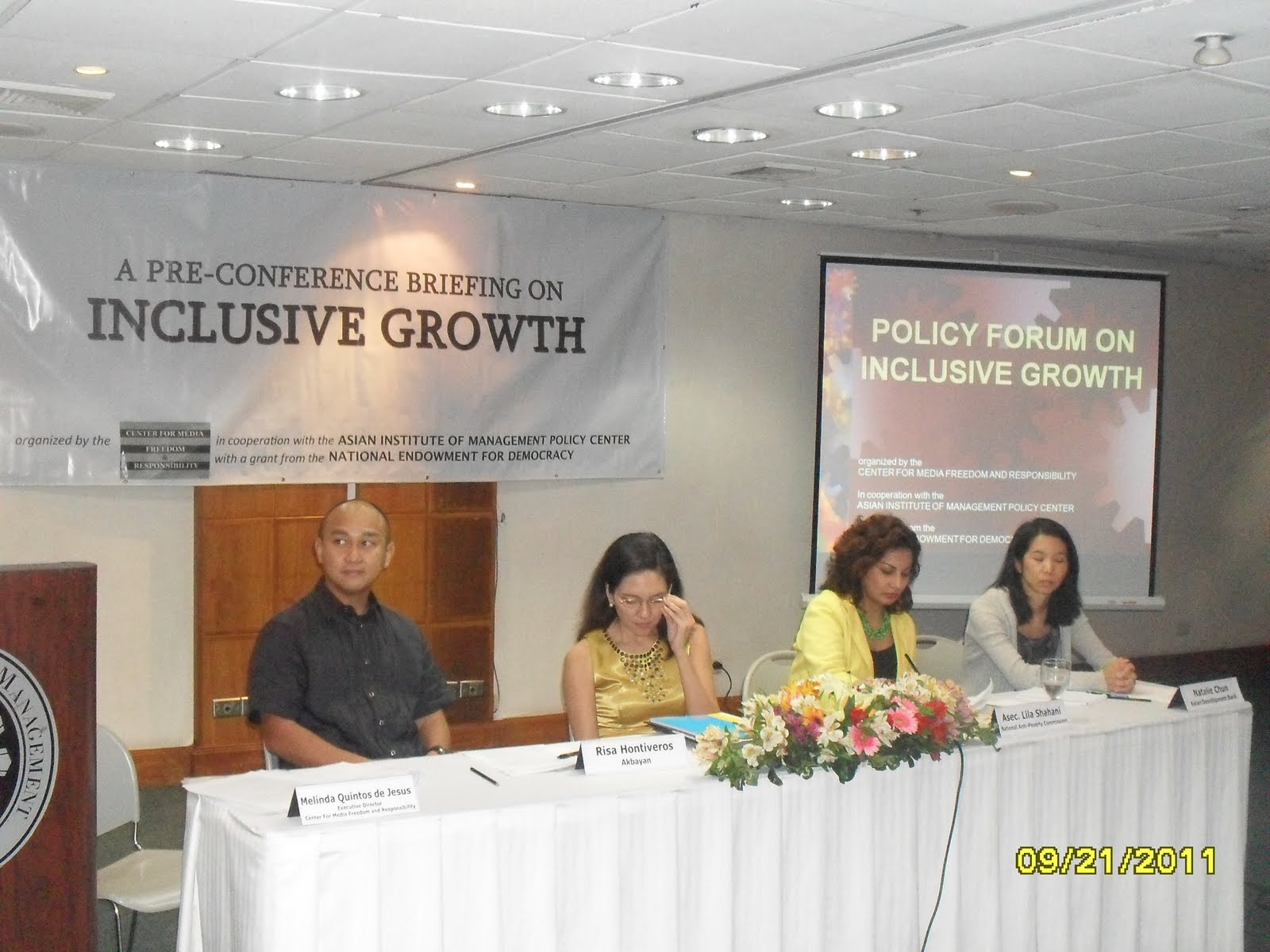
Yesterday, I attended the Pre-Conference briefing on Pathways to High and Inclusive Growth sponsored by the Center for Media Freedom and Responsibility (CMFR) held at the Asian Institute of Management (AIM), Makati. There were many participants from local media (GMA-7, BusinessWorld, inquirer.net, KBP, PPI, etc.) and NGOs.

The speakers were (from left) Dr. Ronald Mendoza of AIM Policy Center, Ms. Risa Hontiveros of Akbayan, Assistant Sec. Lila Shahani of the National Anti-Poverty Commission (NAPC), and Dr. Natalie Chun of ADB-ERD.

Ronald gave an overview of the main international conference that will happen tomorrow, a full day activity also to be held at the AIM. There are a number of high-profile speakers like the Secretaries of NAPC, DOLE, the Minister of Social Development of Mexico (to talk about the CCT in Mexico, the Swiss Ambassador, etc.

Risa talked about certain social legislations and regulations that she wished were on hand to help the poor and marginalized sectors. Akbayan is a diluted socialist party-list. I say diluted because the socialist group BISIG which I used to be an active member in the late 80s, is a big part of the coalition but there are also non-socialist groups within the Party.

Lila discussed the 4Ps or Pantawid Pamilyang Pilipino Program or the Conditional Cash Transfer (CCT) program and related matters, while Natalie talked about the role of foreign aid like ADB in funding social protection programs.

CMFR Executive Director Melinda Quintos-de Jesus (here speaking) was the MC and moderator of the open forum. As usual, I was the first to raise my hand during the open forum and argued the following.

While reviewing the various social protection, pro-poor employment, and related programs, I think the UN, the government and the foreign aid were just fooling us. We have education for the poor, healthcare and medicines for the poor, housing and MRT subsidy for the poor, agrarian reform and credit for the poor, seeds and farm animals for the poor, and now we have cash transfer for the poor, very soon we shall have condoms, pills and ligation for the poor. Maybe in the coming years there will be IPhone and IPads for the poor, cars for the poor? And look at the social inequity that all those past and present government programs were supposed to correct.

The main obstruction now to self-reliance and inclusive growth of the poor is government waste and irresponsibility. Take the Philippine public debt. Our interest payment alone for those public debt was P294 billion in 2010, P357 billion this year, and P333 billion in 2012. Principal amortization not included yet, only interest payment. When there was talk about imposing VAT on NLEX and SLEX, supposed to generate about P1 billion a year, or when the MRT subsidy of about P5 billion a year is proposed to be reduced, some people want to start a civil war already, and here is the government paying more than P300 billion a year on interest payment alone for its huge debt and annual budget deficit.

Such huge transfer of money from the poor and middle class taxpayers to the rich -- there is no poor among the bondholders, banks and other lenders to the government -- is a big hindrance to sustainable growth. The economic and financial turmoil in Greece, Spain, other European countries and the US are all rooted in high government debts.

(Note: Please check my earlier discussions when I gave a talk on this subject three months ago, Part 1 and Part 2, June 23, 2011)

The first to reply was Lila, she said that certain government programs and interventions indeed help the poor. She talked long but I didn't think it made much sense. Next to reply was Ronald who is also an economist. He said that at the heart of the things that I mentioned was the question of market and state, to what extent the government should provide for certain services to the public, and to what extend the market should be left alone to do its job.

Melinda gave me a chance for a follow up comment, thanks Melinda. I said that the "market and state" formulation is old. My focus is more on the division between personal responsibility vs. government responsibility. This week, there is a big UN meeting in NY where government leaders talk about addressing non-communicable diseases (NCDs) or lifestyle-related diseases. The communicable and infectious diseases like polio, flu, tb, etc. are now easily curable. So when people will drink and drink and have liver cancer or related diseases, they can just go to the government and demand that health is a right? Or when people smoke and smoke and have lung or throat cancer, or when they over-eat and over-rest and have hypertension, become fat, they also run to government to seek "health is a right" under universal healthcare? To me that is wrong.

Next to react to what I said was Vergel Santos, member of the CMFR Board of Directors and Chairman of the Editorial Board, BusinessWorld. He argued that the problem of the country is the ruling class and the elite, not government. They are too rich, the poor got nothing, government should run after their undeserved wealth, have real agrarian reform. Those who run away, government should go after them and impound their wealth, distribute to the poor.

Wow. I have no more chance to talk as there were others in the audience who were also raising their hands. I would have said that his proposal is absolving the government -- from the Constitution, Congress and Legislative franchising,government cronyism and business bureaucracies -- for creating monopolies and oligopolies, the guys and businesses who could be the object of his point. To continue demonizing the rich, especially those who became rich due to plain hard work, due to business efficiency and innovation, and asking government to run after their wealth to be distributed to the poor, is a proposal based on envy and heavy coercion.

Lila followed up on Vergel's comments, saying that the Filipino elites should indeed do more. Even Fil-Ams in the US, other well-off Filipinos abroad, should contribute their share and not turn their backs on the country.

My watch said it was already past 12 noon and my daughter was waiting for me in her kinder school since 12 noon. I bid Melinda a ba-bye and went out.

I shall go back to the big conference tomorrow anyway.
-------

See also:
Hayek 3: Inequality and Progress, May 19, 2009

Monday, August 08, 2011

Responsible parenthood cannot be legislated, Part 5

These are my twitter notes on the Reproductive Health (RH) and Responsible Parenthood (RP) bill between July 20 to 29, 2011. My debate actually with some of the guys mentioned here.

@cesdrilon @risahontiveros Rename RH bill into "RH Liberalization Act of 2011." No? Not liberalization? Then call it "RH Minimization Act".

@pinoygossipboy @PawieSharpei Social & pol. planning, econ & ecological planning, rural & urban planning, soon fam planning by d state, wow.

@indayevarona @ruffybiazon Educ, healthcare, housing, AR, credit , irrig. for the poor, now CCT for the poor, soon condoms for the poor.

@seclaudio @newsbreak_ph RH bill says govt responsib bigger than parental responsib, bit.ly/q2RTYF. State cant substit parental respon

@I_amHolo @risahontiveros I counted 12 sections of RH bill that explicitly say spend-spend-spend and imply tax-tax-tax, bit.ly/kcYcfN

@risahontiveros @newsbreak_ph @seclaudio No Risa, RH bill says tax-tax-tax bec govt will spend-spend-spend for population control policies

@newsbreak_ph @seclaudio See 2 charts fr The Economist mag,bit.ly/rmY4ff. Parental decision will prevail over govt fam. planning

@jonasbagas China spent big time on popn control, see bad result, projectns from UN, bit.ly/rmY4ff. Wholl take care of oldies, robots?

@risahontiveros @newsbreak_ph @RepLuzIlagan Taxpayers shd fund free educ, healthcare, housng, AR, credit, CCT, condoms, pills for d poor wow

@risahontiveros @newsbreak_ph @RepLuzIlagan Too many planners. They want more money fr our pockets so they can plan d family of other people

@newsbreak_ph Thnx. Here, bit.ly/rmY4ff China spent big time on popn control, bad result. Who'll take care of oldies, robots, commies?

@meGEMSON @newsbreak_ph "tama na pagiging makasarili" -- sige, kunin nyo lahat pera namin, panggastos sa popn control policies nyo. hooray!

@pmella @risahontiveros @newsbreak_ph @RepLuzIlagan Yes, free cars, yachts for d poor, provided they shd take free condoms, pills & ligation

@Jimparedes When d poor work hard to feed their fam, govt shd not impose too many bureaucracies, taxes, fees, fines & penalties vs d poor.

@newsbreak_ph Govt imposes many taxes & bureaucracies for d industrious. When people become poor, more taxes to control population of d poor

@seclaudio CBCP lobbied for religious educ in pub sch? Equally horrible. I criticize RH bill w/ zero reference to CBCP. My pts purely econ.

@seclaudio Had a looong debate in fb re RH bill w/ econ arguments,bit.ly/pnsxbS. ProRH have zero ans on costs of the bill. U have it?

@senmiriam If you can provide numbers re cost of RH bill, great. Most if not all pro-RH have zero ans to it, see bit.ly/pnsxbS, thanks

@seclaudio At P300 B per yr ave budget deficit, where do u stop proposing new spending when old spending proven ineffective & corrupted?

@seclaudio "spending massively for social services as prelude to econ take-off" Really, even if money wasted or stolen? moral hazards prob?

@seclaudio "This money can be raised several ways" Govt can easily find money? Then why borrow P300B/yr on ave? Pub debt near P5 trillion.

@seclaudio "deficit per se not bad" Why is govt sounding off new taxes soon to finance deficit? Endless borrowing to finance def is wrong.

@seclaudio Educ, health, housing, agri, pub works, MRT/jeep fuel subsidy for d poor, now CCT for d poor, soon condoms & ligation for d poor.

@seclaudio If we encourage more personal & household responsibility in running people's lives, then most "govt responsib" unnecessary.

@tweetnirizal @sagadasun Responsible parenthood cannot be legislated, bit.ly/pnsxbS. Been asking d cost of #RHBILL, got zero reply.

@SagadaSun @tweetnirizal Pathetic to consider d poor as baggage to be fed, clothed, shelterd. People are workers, entrepreneurs, taxpayers.

@SagadaSun @tweetnirizal More dangerous is fiscal irresponsib. US govt debt crisis now. RP govt deficit P300B/yr on ave. More debt for RH?

@SagadaSun @richard_cairo @tweetnirizal My critique of #RHBILLis mainly econ, zero religious reason,, see 2 charts, bit.ly/rmY4ff.

@SagadaSun @tweetnirizal Sex Ed, gender equality, etc shd be electives, not mandatory. Studnts good at sex subjectss but idiot in sci & math

@SagadaSun Good to hear you're miniarchist too, cheers. Reduce d role of d state, reduce central planning, incl planning d households.

@SagadaSun #RHBILL is central planning in popn. How many condoms & pills to buy, how many midwives to hire, how many maternity hosp to build

@SagadaSun Optimum popn size to be dictated by d state? If a household will exceed that "optimum" size, d state will penalize it?

@SagadaSun "no GOVT MONOPOLY on Sex Ed or RH", good. Keep that way, don' create new monopoly, new central planning, new taxes to financ them

@SagadaSun D state will determine what's "microecon efficiency at the family level"? Thats central, top to bottom planning.

@SagadaSun When d poor want to work hard to feed fam., state shd not impose endless bureaucracies, taxes, fees & fines that penalize d poor

@SagadaSun "you shouldn't make more babies than you can reasonably feed. govt can impose this" Thats central planning. Impose & control.

@SagadaSun How d state penalize d poor who want to stand on their own and not rely on state & politicians patronage, bit.ly/nYzIaJ

@SagadaSun I have a feeling #RHBILL to become a law. UN, WB, ADB, USAID, Congress, etc. money poured on that bill. Its a BIG govt project

@SagadaSun The State declares: whether u support #RHBILL or not, you pay lots of taxes for its implementation. That's "free choice"?

@SagadaSun "argument that big pharma interests are behind the RHBILL" where did this come from? I mentioned zero about Pharma.

@SagadaSun Central planning: State centralizes buying pills, injectibles, maternity lab eqpt, hiring new midwives, new sex ed teachers, etc

@SagadaSun "Isn't it Catholic Church that is guilty of "central planning"" I have zero sympathy for Cath church position on RH.

@SagadaSun "congruence bet "central planning" argument against RHBILL & Catholic Church practice!" I have zero sympathy for Church argument

@SagadaSun "Govt will sell condoms, pills and IUDS" Nope. Govt does not sell those, it gives out free, by confiscating our mo

@SagadaSun "Private Hospitals be banned from buying lab eqpt?" They can, they'll charge patients, they wont get fr our pockets by force, tax

@SagadaSun "same choice bet private & public sch for our children" No. Even if u send kids to priv sch, u still pay for pub sch, u pay twice

@SagadaSun I say for d 3rd time. I have zero, even neg. sympathy for church position on RH, why keep mentioning it in your debate w/ me?

@SagadaSun "Why arent 100% of patients in free govt hosp?" Bec people see wastes & bad serv in govt hosp, they pay extra to go to priv hosp.

@SagadaSun Then show why #RHBILL isnt central planning, zero need to mention church. I argue RH is central planning proj in popn by BIG govt

SagadaSun "govt doing Central Planning of Hosp" Yes, some central planning in health. Those who over-drink, over-smoke, we pay in govt hosp

@SagadaSun Central planning is social engg. Those who over-drink, over-eat, over-fight, dont take care of their body, will be treated.
-------

In my debate with the pro-RH groups, there are three things that I notice.

1. You ask them how much the bill will cost, initial year and succeeding years, you will get two types of reply. One is silence, no answer; and two is a rhetorical answer like "No one was asking how much it would cost when provisions for free elementary and high school education were included in it. How much are teen pregnancies, abortions and deaths of pregnant women costing us?" See Part 4, July 21, 2011.

2. You keep asking more questions, they answer how arrogant or insensitive the Catholic Church is. Even if you argue that your stand on the bill has zero reference, zero sympathy, for the Church position, they still think you are a mindless supporter of the church dogma.

3. And if you question this bill as another central planning project by the state, they will not dispel such argument, and lash back again at the church as a model of central planning. Maybe if they hate Bill Gates or Henry Sy or the Ayalas, they will also mention these guys as "model of central planning." They have difficulty focusing on the issue at hand and resort to diversionary arguments.

See also Part 3, May 22, 2011,