The essence of civil society is volunteerism, helping other people without coercion and mandatory action, with penalties if people will not help. The latter is the mark of uncivil society, where people are told what to do, and be penalized if they do not do what they are told to do. Rotary and other civil society organizations regularly show this spirit of civil society.
Our Rotary Club of Taguig Fort Bonifacio, RI District 3830, had a wonderful partnership with another club from Germany, the Rotary Club of Koln-Ville in Cologne. The latter's Club President, Stephan Zilkens, wrote to our Club President, Meann de Leon, asking how they can help some fishermen in Laguna Lake which they saw and read, were badly affected by a strong typhoon last year. Our club President replied to him, and the partnership was established.
Club Secretary Patty Mangundatu-Michener was a great partner to President Meann in identifying the project location, beneficiaries and local (barangay and city) officials who can make the project implemented quick.
It is a two-phase project. First the distribution of fish nets to affected fisherfolks, and Second, a knife fish processing, for the spouses of fishermen.
A discussion venue about the role (and misrule) of big government and high taxes. Also a second website of Minimal Government Thinkers.
Showing posts with label Rotary Club of Taguig Fort Bonifacio. Show all posts
Tuesday, June 03, 2014
Rotary Notes 7: Fish for Life Project in Taguig-Laguna Lake
Labels:
fish for life project,
Rotary Club of Koln-Ville,
Rotary Club of Taguig Fort Bonifacio,
Stephan Zilkens
Sunday, May 11, 2014
Pol. Ideology 55: Jules Maaten's Lecture on Liberalism
A very informative lecture given by Jules Maaten last Tuesday night at our Rotary Club of Taguig Fort Bonifacio, along with RC Makati Pio del Pilar.
Not many people were able to come though although they really wanted to hear Jules' talk. Like at least three from the Initiatives for Filipino Liberty (IFL) group, at least three from our club, and so on. So this blog post is for those who were not able to come and regular readers of this blog.
I like this quote from my favorite economist and philosopher, F. Hayek. Yes, allow people to decide things for themselves, to make mistakes, to excel.
Then he discussed what is Liberalism in Economics:
The last item is important. As Germany and many European and rich economies go deeper and deeper in public debt, with huge interest payment annually, the economic freedom and well being of the future generation is heavily compromised.
Not many people were able to come though although they really wanted to hear Jules' talk. Like at least three from the Initiatives for Filipino Liberty (IFL) group, at least three from our club, and so on. So this blog post is for those who were not able to come and regular readers of this blog.
At the onset, Jules defined Liberalism as:
* It is the philosophy of liberty
* It is a philosophy of empowerment
* Origin in protecting the individual
against institutions of power.
This quote from JS Mill, among the classical thinkers of liberal philosophy, is clear and direct.
Then Jules specified how the philosophy is applied, Liberalism in Politics:
* Protection of individual rights
* Equality of all human beings under the
law
* Balance and separation of powers
* Belief in liberal representative
democracy
* Balance between majority rule and the rights
of the minority
* Weary of (state) authority, but state is
rights guarantor
* Limitation and decentralisation of
government powers
* Separation of church and state
I like this quote from my favorite economist and philosopher, F. Hayek. Yes, allow people to decide things for themselves, to make mistakes, to excel.
Then he discussed what is Liberalism in Economics:
* Belief in free enterprise and free
markets with many players
* Protection of private property
* Support for free trade
* Privatisation of services better
provided by the private sector
* Competition, no private monopolies
* Role for state where market does not
function (education, environment, culture, social policies)
* Don’t leave debts to future generations.
The last item is important. As Germany and many European and rich economies go deeper and deeper in public debt, with huge interest payment annually, the economic freedom and well being of the future generation is heavily compromised.
Labels:
European Union,
FNF,
Friedrich Hayek,
Germany,
Jules Maaten,
liberalism,
Rotary Club of Taguig Fort Bonifacio
Thursday, September 12, 2013
IDEAS 4: Photos of Wan Saiful's Talk on the Politics and Economy of Malaysia
Before Wan Saiful Wan Jan, CEO of the Institute for Democracy and Economic Affairs (IDEAS) in Kuala Lumpur, gave his talk, I introduced him. No notes intro, I focused on Wan leaving his 17 years career in London and go back to Kuala Lumpur along with his wife and 3 kids, all born in London, to start a free market think tank there, when "free market" and "limited government" are strange concepts for many people in Malaysia and many other Asian countries given the huge role and presence of the government in the economy.
I met Wan in Atlanta, USA in middle of 2008 during the Atlas Liberty Forum. Then I would meet him and other Asian leaders of free market think tanks almost every year, usually during the Economic Freedom Network (EFN) Asia annual conferences. Last May, we were in Seoul then Jeju, S. Korea for the Jeju Forum for Peace and Prosperity. This coming October 21-22, we will meet again for the EFN Asia 2013 conference in Bangkok.
Wan's talk was hosted by our club, the Rotary Club of Taguig Fort Bonifacio, RI District 3830, headed by First Class President Meann de Leon. Our think tank, Minimal Government Thinkers, Inc., has no financial resources at the moment to organize fora and similar events. Our rotary club, of which I was a club Past President in RY 2006-2007, is a good host as we meet weekly anyway, often with a guest speaker. There is a "captive audience" already who are willing to listen to various speakers with various backgrounds and unique stories and ideas to share.
I posted the invite to Wan's talk to several free market facebook groups. Four came, from the Filipino Libertarian camp -- Francis, Philip, Harry and Ginny. Thanks guys.
President Meann giving the Certificate of Recognition to Wan.
The usual group photo after the talk.
Another group photo, for the boys :-)
Thanks Wan for imparting lots of useful information and observations about Malaysian economy and government, and elaborating the philosophy of free market, limited government, rule of law and individual freedom and responsibility.
See also:
Think tanks for liberty 1: IDEAS Malaysia, February 02, 2011
Welfarism 21: Is Malaysia a Welfare State?, July 18, 2012
IDEAS 2: Wan Saiful Talk in Manila, September 9, September 07, 2013
IDEAS 3: Wan Saiful's Presentation in Manila, September 11, 2013
I met Wan in Atlanta, USA in middle of 2008 during the Atlas Liberty Forum. Then I would meet him and other Asian leaders of free market think tanks almost every year, usually during the Economic Freedom Network (EFN) Asia annual conferences. Last May, we were in Seoul then Jeju, S. Korea for the Jeju Forum for Peace and Prosperity. This coming October 21-22, we will meet again for the EFN Asia 2013 conference in Bangkok.
Wan's talk was hosted by our club, the Rotary Club of Taguig Fort Bonifacio, RI District 3830, headed by First Class President Meann de Leon. Our think tank, Minimal Government Thinkers, Inc., has no financial resources at the moment to organize fora and similar events. Our rotary club, of which I was a club Past President in RY 2006-2007, is a good host as we meet weekly anyway, often with a guest speaker. There is a "captive audience" already who are willing to listen to various speakers with various backgrounds and unique stories and ideas to share.
I posted the invite to Wan's talk to several free market facebook groups. Four came, from the Filipino Libertarian camp -- Francis, Philip, Harry and Ginny. Thanks guys.
After Wan discussed the politics and economy of Malaysia, including the result of the 13th General Elections (GE13) last May, the discussion shifted to the philosophy of free market, rule of law, limited government, and individual freedom and
responsibility. This is where the Filipino libertarian guests asked several questions and gave also their own understanding of those concepts.
Wan discussed the level of "compromise" that he and his free market think
tank take in engaging both the government and the political opposition, along with other NGOs and media in Malaysia, without abandoning its core advocacies. IDEAS after all, belongs to the minarchy or limited government side of libertarian philosophy, not the zero government or anarchy side.
Wan was also asked what is Malaysia's experience under a
Parliamentary form of government, if it us true that a Parliamentary government is
more "flexible, easy to reform, less corrupt" etc as the
pro-Parliamentary camp would endlessly suggest. Wan said the form of government does
not matter. Rater, it's the size and degree of interventionism of government that matters a lot to the people and the private enterprises. In a parliamentary set up for instance, the Prime Minister can
appoint himself as the Finance Minister at the same time, so he can talk to
himself, propose a budget to himself and have it approved by the Administration
Parliament.
And here's what he said that can slam dunk persistent claims that a parliamentary government is "more stable and more predictable". Wan said that "under our Westminster-style parliament, our Constitution has been amended over 7,000 times since independence in 1957." They can change the Constitution more frequently than they can create new laws or amend existing laws, wow.
President Meann giving the Certificate of Recognition to Wan.
"You can't compare Christianity to christians.
You can't compare Islam to Muslims. You can't compare Capitalism to capitalists." This was his reply to a question regarding the monopolistic behavior of some businessmen and capitalists. Wan emphasized that their advocacy for free market is not a stand alone philosophy, but in conjuction with the three other principles -- rule of law, limited government, and individual freedom and responsibility. Free market does not mean zero government, there is a role for government, mainly to implement the rule of law, and to protect individual freedom (from aggressors, bullies, thieves, etc.) and respect or encourage more individual or personal responsibility in running their own lives.
Thanks Wan for imparting lots of useful information and observations about Malaysian economy and government, and elaborating the philosophy of free market, limited government, rule of law and individual freedom and responsibility.
------------
See also:
Think tanks for liberty 1: IDEAS Malaysia, February 02, 2011
Welfarism 21: Is Malaysia a Welfare State?, July 18, 2012
IDEAS 2: Wan Saiful Talk in Manila, September 9, September 07, 2013
IDEAS 3: Wan Saiful's Presentation in Manila, September 11, 2013
Labels:
free market,
IDEAS,
Malaysia,
Rotary Club of Taguig Fort Bonifacio,
rule of law,
Wan Saiful Wan Jan
Wednesday, September 11, 2013
IDEAS 3: Wan Saiful's Presentation in Manila
Wan's talk last Monday night here in Manila was great. Will post photos in my next blog post. Audience were mainly my clubmates in Rotary, plus friends in the free market movement here in Manila.
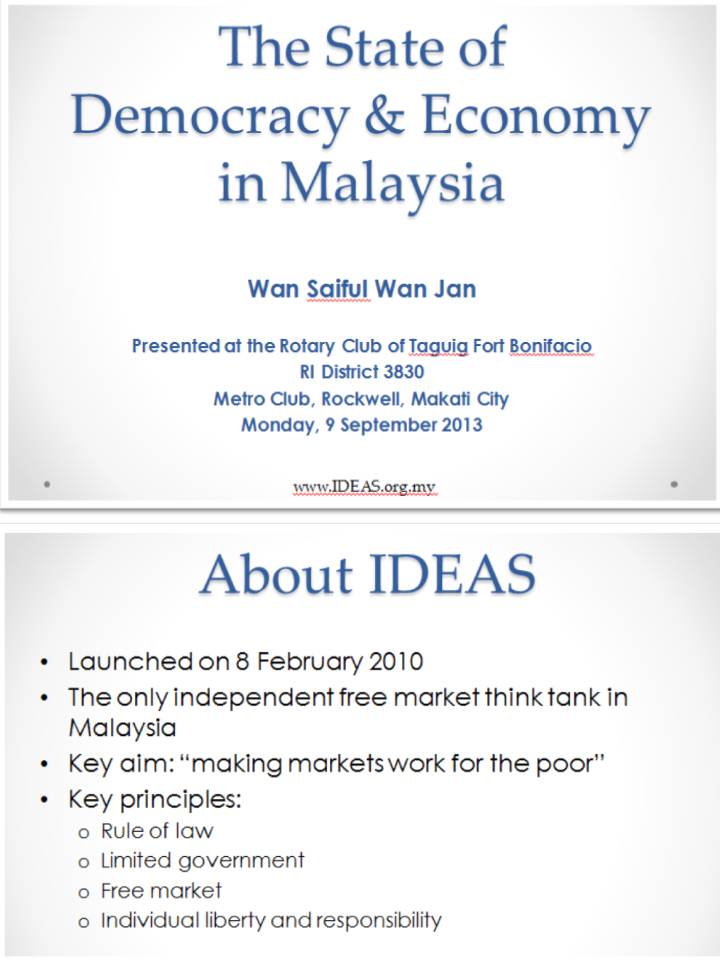
It's good that Wan briefly introduced what the Institute for Democracy and Economic Affairs (IDEAS) is. He said that often people look at free marketers as not too concerned with high inequality and the poor, so they made it clear that their goal is to "make markets work for the poor."
Wan showed also a map of Malaysia. You may also view the presentation in slideshare, here.
One principle in Malaysia before was the New Economic Policy (NEP). When Prime Minister Razak Najib came, he introduced the New Economic Model (NEM) and it is pretty liberal and free market leaning, to correct or reduce the distortions of heavy state involvement and welfarism in Malaysia. Wan gave examples of how Malay-bias the government policy is, at the disadvantage of non-Malays like the ethnic Chinese and Indians in the country.
The 13th General Elections (GE13) result last May however, has threatened the liberalization reforms that PM Najib wants to introduce. And even though the elections were conducted rather unfairly. When IDEAS released the result of their findings of the elections, their website crashed for more than a week due to heavy online traffic, people downloading the report, reading articles and interviews of Wan and other think tank leaders.
It's good that Wan briefly introduced what the Institute for Democracy and Economic Affairs (IDEAS) is. He said that often people look at free marketers as not too concerned with high inequality and the poor, so they made it clear that their goal is to "make markets work for the poor."
Both the administration and the opposition in Malaysia
know that IDEAS is free marketer and hence, not exactly their ideological ally.
But they see IDEAS as truly independent, receive no money or funding from the
government, so they entertain the 3rd party engagement of IDEAS in various
policy discussions.
Wan showed also a map of Malaysia. You may also view the presentation in slideshare, here.
One principle in Malaysia before was the New Economic Policy (NEP). When Prime Minister Razak Najib came, he introduced the New Economic Model (NEM) and it is pretty liberal and free market leaning, to correct or reduce the distortions of heavy state involvement and welfarism in Malaysia. Wan gave examples of how Malay-bias the government policy is, at the disadvantage of non-Malays like the ethnic Chinese and Indians in the country.
The 13th General Elections (GE13) result last May however, has threatened the liberalization reforms that PM Najib wants to introduce. And even though the elections were conducted rather unfairly. When IDEAS released the result of their findings of the elections, their website crashed for more than a week due to heavy online traffic, people downloading the report, reading articles and interviews of Wan and other think tank leaders.
Labels:
free market,
IDEAS,
Malaysia,
Razak Najib,
Rotary Club of Taguig Fort Bonifacio,
Wan Saiful Wan Jan
Saturday, September 07, 2013
IDEAS 2: Wan Saiful Talk in Manila, September 9
The CEO of the Institute for Democracy and Economic
Affairs (IDEAS, http://ideas.org.my/),
Mr. Wan Saiful Wan Jan, will
speak on "The State of Democracy and Economy in Malaysia", this
coming Monday, September 9, 2013, 7:30pm, at Metro Club, Rockwell, Makati City.
Hosted by our Rotary Club of Taguig Fort Bonifacio, RI District 3830. This is free,
open to the public, people will just pay for the meals they will order.
Wan is a friend way back in 2008. I met him first in
Atlanta, USA that year during the Atlas Liberty Forum. Then Atlas VP Jo Kwong
gave me a travel grant to attend that conference.
IDEAS is a big, dynamic and the only free market think
tank in Malaysia. Wan is well sought in Kuala Lumpur, meeting with Cabinet
Ministers and Parliamentarians on certain issues.
Wan will attend a regional conference in De La Salle University (DLSU), Manila next week, September 10-11, and since he is arriving early, I asked him to give a talk at our Rotary Club, he quickly said Yes. Wan can touch on many topics -- Sabah, petroleum economy,
a heavily state-owned economy, etc. All the big TV and radio stations, big
newspapers are owned by the government. Imagine that GMA7, ABS CBN2, TV5, Inquirer,
PhilStar, etc. are all owned by Malacanang?
Malaysia held its first ever open, general elections only
last May. The administration has faced for the first time too, a serious
opposition challenge. Needless to say, the entire government machinery was
mobilized to ensure that the administration would win, they did.
Below is a recent paper by Wan.
------------
The first time I heard the phrase 1Malaysia was a few
weeks before Dato’ Sri Najib’s blog (www.1malaysia.com.my) was launched. The
1Malaysia concept will forever be linked to Najib, even after someone else
replaces him as President of UMNO and Prime Minister. After all, this is his
brainchild.
At the event to launch the 1Malaysia logo on 27 June
2009, Najib said the following: “When the 1Malaysia concept was introduced,
many people asked what is the meaning and substance of 1Malaysia. I found that
in principle most Malaysians accepted the 1Malaysia concept. But while they
accept the 1Malaysia concept, they want to know what is the meaning of
1Malaysia.”
This speech, even though delivered four years ago, is
still true today. There are many people out there who would say very positive
things about 1Malaysia, but if you ask them what 1Malaysia actually means, you
will find that there is no one definitive answer.
Subscribe to:
Posts (Atom)