Showing posts with label lifestyle diseases. Show all posts

Monday, September 03, 2012

PhilHealth Watch 12: Assistance to Leptospirosis Patients

* This is my article yesterday in the online magazine,
http://www.thelobbyist.biz/perspectives/less-gorvernment/1348-philhealth-and-leptospirosis-patients
---------

Contribution to the Philippine Health Insurance Corporation (PhilHealth) is not strictly considered as a tax, similar to Pag-IBIG (housing), SSS and GSIS contributions, as they are dedicated funds and are not incorporated in the National Internal Revenue Code (NIRC).

But there is one thing that makes them very similar to ordinary tax measures: they are mandatory, obligatory or forcible payment to the government. Whether one believes in PhilHealth, SSS, Pag-IBIG or other mandatory contributions or not, these contributions are automatically deducted to one’s monthly pay. So that fixed income earners have no choice but to pay for these three mandatory contributions each month, on top of the monthly withholding personal income tax.

The Department of Health (DOH), the mother agency of PhilHealth, announced last week that

(P)ersons in areas affected by the heavy southwest monsoon rains and diagnosed with leptospirosis shall be automatically covered by the PhilHealth, including non-members…
According to PhilHealth Circular 39 series of 2012, non-members living in these flood-stricken areas shall also be accorded the benefits due the PhilHealth Sponsored Program members/beneficiaries. For non-members less than 21 years of age whose parents are neither member, one parent shall be automatically covered.
Being automatically covered as PhilHealth Sponsored program members mean that they shall not be required to pay premiums and that they shall be considered members for the period from August 1, 2012 to July 31, 2013, with a number card. This privilege shall be applicable for all admissions starting 7 August to the end of this month.

This would sound unfair to regularly-paying PhilHealth members as their contributions that can be considered as additional “health tax” are being used to support people who do not contribute to the fund. There is already the DOH budget that is partly financed by their regular tax payment (income tax, VAT, excise tax, import tax, etc.), or local government units that are financed by internal revenue allotment (IRA) and local taxes, that are supposed to help these people.

There is validity in this argument. Many regularly paying members in the formal sector complain that when they or their dependents are hospitalized, PhilHealth share or deduction to total hospital bill is sometimes small, that PhilHealth can be “stingy” to them who religiously pay monthly for many years while PhilHealth can be gallant in paying the hospitalization bill of those who do not contribute to the fund.

I share the above opinion. But I also recognize that leptospirosis, being an infectious and lethal disease, can be very costly to the poor whose houses are already submerged in floodwater for many hours or days. So social contribution like PhilHealth assistance can be a great support for these poor people.

The DOH reported that “a total of 2,471 leptospirosis cases were reported nationwide from January 1 to August 18 this year. This is 62% higher compared to the same time period last year (1,522 cases). There were 121 deaths…. hospital admissions of Leptospirosis in Metro Manila from August 5-22 already included 783 cases and 34 deaths.”

There is lesson for the government here in the light of endless budget deficit (revenues are lower than expenditures) and ever-rising public debt. The limited funding of the DOH and local government units’ healthcare programs should be focused on dealing with infectious or communicable diseases as well as children’s diseases. There are many infectious diseases that remain lethal until now aside from leptospirosis: dengue, malaria, menningococcemia, hand foot and mouth disease (HFMD), typhoid fever, cholera and many others.

Using taxpayers’ money and the health tax or PhilHealth mandatory contribution to treat lifestyle-related diseases by non-members is not fair. No one put a gun on people’s heads so that they should over-drink or over-smoke or over-eat or ovet-sit. Engaging in the said activities will hasten the onslaught of various type of diseases like cardiovascular, cerebrovascular, malignant neoplasm or cancer various types, tuberculosis and diabetes.

The implication for the above case is to further deregulate private health insurance schemes. If people can afford to consume high volume of alcoholic or tobacco or fatty food and drinks, then they should also have the resources to purchase additional private health insurance on top of their PhilHealth mandatory membership. This dual health insurance should drastically reduce their spending should they get hospitalized or become more sickly someday.

The important point is that DOH budget, PhilHealth fund, and LGUs’ health spending should be concentrated in dealing with various infectious and pediatric diseases. And even to help people with physical or mental challenges like the blind, the deaf, crippled, autistic and related cases.

Taxpayers and PhilHealth members who regularly pay their taxes and mandatory contributions would not feel being cheated this way.
--------

See also:
PhilHealth Watch 6: Bogus claims and robbery, June 15, 2011
PhilHealth Watch 7: Deregulate PhilSick, October 09, 2011
PhilHealth Watch 8: Alternatives to PhilSick Monopoly, October 13, 2011
PhilHealth Watch 9: Physicians talk about PHIC, October 16, 2011
PhilHealth Watch 10: Hospital Bill Deductions, December 29, 2011
PhilHealth Watch 11: Is PHIC an Insurance Company?, June 12, 2012

Thursday, March 08, 2012

Healthy Ageing 2: World Congress on Healthy Ageing

Healthy ageing is one of my important goals in life as I approach my 5th decade in this planet, and as my young daughters are growing up. I got married late, I need to keep a healthy body to prepare for my kids' future, with the help of my wife of course. I may not become rich after all, I have been rather lousy on expanding my personal finance, but I wish to remain healthy, and so far I have been successful in this.

I think healthy ageing is everyone's dream, except those who have adopted a defeatist attitude, either by emotional or biological constraints, and wish to move to the other life soon. To live a long and peaceful life, away from crippling diseases, especially those that can be prevented or controlled via healthy lifestyle, until human biology says that time is up.

I was happily surprised to hear from a good friend, Catherine Barr Windels, that there is now a Global Coalition on Ageing (GCA), http://www.globalcoalitiononaging.com/), and she's actively involved in it. Cathy is also the President of The Policy Workshop CapitalHQ, www.capitalhq.com.

Looking at the GCA website, I find this description rather cool:
The Global Coalition on Aging is committed to a vision where innovative market solutions enabled by progressive public policy create a framework for healthy and active aging. We will shape the public discussion on how policymakers, businesses and society at large can comprehensively address these new demographic realities and apply innovative solutions that recognize the opportunity of global aging.
Innovative market solutions, free market approach to healthy ageing, I like that. Now here's another eye opener for me. There are country association on healthy ageing, like the Malaysian Healthy Ageing Society (MHAS). I have not heard yet of such society or organization in the Philippines yet. Probably soon.

MHAS, probably in partnership with GCA, is organizing the 1st World Congress on Healthy Ageing,  http://www.healthyageingcongress.com/index.php.


This is cool. And the description clearly says it,
Healthy ageing is one of the major challenges for the world. The consequences of the demographic transition will have a tremendous impact on economy, health, social development and welfare of societies. Consequently, there is a need to enhance our knowledge about the promotion of good health among young and older people for a better quality of life in its later stages. Healthy ageing fostered by systematically planned health promotion efforts, was mentioned as early as 1998 as Target 5 in the WHO policy "Health for All in the 21st Century". Active ageing (according to the European Commission) includes life-long learning, working longer, retiring later and more gradually, being active after retirement and engaging in capacity-enhancing and health-sustaining activities. 
These are all lifestyle-change related, "healthcare is mainly personal responsibility" philosophy. So what is the role of government here? My bias towards limited or minimal government philosophy says leaving the various markets in healthcare -- health insurance, medicine innovation, healthcare (including hospitals/clinics) competition -- to offer various services to the aged and their family will do the trick. Since governments will still intervene no matter how we caution against such move, then government role should be limited to controlled subsidies to healthcare of the senior citizens.

Responsible people have their own savings, or have responsible family members, friends and relatives, or have network with health NGOs, civic and private charity organizations who can help them out.

Lifestyle-related diseases and hence, unhealthy ageing can be managed if not controlled. I salute these private initiatives like the GCA and the forthcoming 1st Global Congress. The various health departments or ministries of national governments, including the WHO and other multilateral agencies, should assure these private NGOs and civil society organizations (CSOs) that their intervention to "innovative market solutions" should be kept to the minimum, including taxation of health-related goods and services.

Btway, there will be one Filipino physician/scientist who will be among the panel speakers in that global conference, Dr. Antonio Dans, of the UP College of Medicine. Dr. Dans' papers on NCDs, like those published in The Lancet, are well-quoted by the DOH and WHO here.
-------

See also:
Healthy Ageing 1: The Caregiver Village, February 13, 2012
Lifestyle Diseases 6: Personal Care against NCDs, October 14, 2011
Lifestyle Diseases 7: Drinking and Healthcare, October 18, 2011
Lifestyle Diseases 17: On Cancer, COPD and NCD Risk Factors, March 05, 2012

Lifestyle Diseases 18: Addressing NCDs via Preventive Healthcare, March 05, 2012

Monday, March 05, 2012

Lifestyle Diseases 18: Addressing NCDs via Preventive Healthcare

Mainly lifestyle-related non-communicable diseases (NCDs) can be addressed via change in lifestyle and hence, preventive healthcare, not curative. Preventive approach shifts the burden of healthcare from the government to the individuals themselves, their households and civil society organizations (health and wellness groups, sports clubs, medical and nutrition associations, etc.). Whereas curative approach is mainly throwing more money, ie tax money, to problems that are more often than not, self-inflicted.

My cardiologist friend, Dr. Tony Leachon, has written several articles about NCDs posted in this blog. See for instance,

Below are some powerpoint slides he had made and presented in his talks. These are good supplementary materials and visuals to the DOH Presentation on smoking and tobacco tax hike, Tobacco Tax 7: DOH on NCDs and Tax Hike. A number of his slides were also used in the said DOH presentation.

I like the title, Shifting to Preventive Healthcare. The three risk factors are obviously lifestyle related -- high tobacco use, low intake of fruits and vegetables (more fried meat, etc.) and less physical activity (more couch potato in front of a computer or tv, etc.).


Many Asian economies are indeed getting wealthier. The rising problem of the people is that they are eating more expensive, more sweet and more fatty food and drinks like more soda, more ice cream. The result is more diabetes, more obesity. People work hard and they eat and party hard too.


My beef about these analysis by Dr. Antonio Dans, DOH, WHO and other known health analysts is that there is little or zero mention about personal responsibility aspect of healthcare. It is very often easy to blame the tobacco companies, the soda/softdrink/beer companies, the junk food manufacturers, the fastfood shops, the heavy ads in tv of these products, and so on. But somehow we have to look inwards and see what we individuals, parents and guardians do, to prevent children not to get addicted to junk food, softdrinks and sedentary life too early.


Articles like these by Dr. Leachon and Dr. Dans, campaigns by the DOH and WHO, the various health professional organizations, are helpful in reminding people again and again, good healthcare rests first and foremost in their own hands, not in government. They do not need the DOH and WHO to realize that having a clean house, a clean environment, washing hands properly before eating, drinking plenty of water and other liquid, having more vegetables and/or fruits everyday, among others, are simple but highly effective steps towards better health. More than cheaper or free medicines, more than cheaper hospitalization and free PhilHealth card.

Cheaper or free medicines are effective for infectious and communicable diseases, for pediatric diseases, for genetic and hereditary diseases. And even if those cheaper medicines -- will the government abolish taxes on medicines please? -- are made available for these illnesses, preventive healthcare still play a big and important role, at least not to exacerbate existing diseases.
-------

See also:
Lifestyle Diseases 1: Obesity, February 04, 2011
Lifestyle Diseases 2: Killer diseases in the Philippines, March 16, 2011
Lifestyle Diseases 3: Causes of Mortality in the Philippines, August 10, 2011
Lifestyle Diseases 4: The UN on NCDs, September 24, 2011
Lifestyle Diseases 5: NCDs Global Picture, September 30, 2011


Lifestyle Diseases 17: On Cancer, COPD and NCD Risk Factors, March 05, 2012

Lifestyle Diseases 17: On Cancer, COPD and NCD Risk Factors

Cancer -- there are probably 200 types as listed in wiki -- will remain a major killer disease into the future. Aside from natural human biology that allows certain diseases to advance as we grow older, human lifestyle can either prevent or exacerbate such disease advances.

Related to the DOH presentation on non-communicable diseases (NCDs), smoking and tobacco tax hike below, and powerpoint slides from Doc Tony Leachon on NCDs which I will post shortly after this, I am posting three papers by Mr. Reiner Gloor of the Pharmaceutical and Healthcare Association of the Philippines (PHAP) related to NCDS.

The first is on cancer. My older brother, my sister in law, my mother's cousin, two of our wedding godmothers, have all died of cancer. That is why I am really hoping that "magic" medicines will soon be developed that can really kill various cancer cells, especially for younger people in their productive period. My brother died at age 52 only.


The second and third papers are on COPD or chronic respiratory diseases, and on the four risk factors of NCDs. Like cancer, Reiner says COPD is also preventable via change in lifestyle, aside from medication and other treatment.


See, more personal and parental/guardian responsibility in healthcare, more than government responsibility; more preventive rather than curative healthcare, can make a big difference. It's another story of course when we grow older. No matter how healthy is our lifestyle, human biology says that reaching 100 years or older is more of an outlier, more of exception, rather than the rule. Medicines, innovator and generics alike, will help humanity prolong their lives but only to a certain extent. But with endless improvement in the pharmaceutical, medical and biological sciences, human understanding of various diseases and how they expand will improve and hence, their treatment and control will also improve. 
----------


(1) Many cancers can be prevented and cured


August 19, 2011

Medicine Cabinet -- Reiner W. Gloor


Cancer is one of the major noncommunicable diseases (NCDs) that will be given global attention when the United Nations General Assembly convenes for a High-level Summit in September. It is a leading cause of death worldwide which claimed more than 7.5 million lives in 2008. It is projected that it will continue to rise with an estimated 12 million deaths in 2030, a situation which could be a crucial concern.


Cancer knows no boundaries. Rich or poor, young or old, men or women. However, the burden for low- and middle-income countries is growing with more than 70% of the reported deaths occurring in them in 2008. Low- and middle-income countries also stand to be hardest hit by consequences of other major NCDs such as chronic respiratory diseases, diabetes, and cardiovascular diseases. A UN report explained that in developing countries, noncommunicable diseases and their risk factors worsen poverty, while poverty results in rising rates of such diseases.


In the interest of space, this column will discuss cancer in general as there could be more than a hundred types of cancer. This is due to the fact that cancer, also referred to as malignant tumor or neoplasm, can affect any part of the body. It arises from a single cell but transforms and progresses into malignant tumors.


The Philippine Cancer Society explained that cells grow, divide, and produce more cells as needed to keep the body healthy and functioning properly. However, the process goes wrong sometimes and cells become abnormal, forming more cells in an uncontrolled way. The extra cells form a mass of tissue, called a growth or tumor, which can be benign or malignant, meaning cancerous.

The World Health Organization (WHO) noted that “metastasis” is a defining feature of cancer. It is a process referring to the rapid creation of abnormal cells that grow beyond their usual boundaries, and which can then invade adjoining parts of the body and spread to other organs.

The WHO added that these changes are the result of the interaction between a person’s genetic factors and external agents such as physical carcinogens (ultraviolet and ionizing radiation); chemical carcinogens, such as asbestos, components of tobacco smoke, aflatoxin (a food contaminant) and arsenic (a drinking water contaminant); and biological carcinogens, such as infections from certain viruses, bacteria or parasites.

Aging is also a factor for the development of cancer. Other risk factors include smoking, alcohol, unhealthy diet, and chronic infections from hepatitis B virus, hepatitis C virus and some types of human papilloma virus (HPV).

According to the WHO, the main types of cancer are lung (1.4 million deaths); stomach (740,000 deaths); liver (700,000 deaths); colorectal (610,000 deaths); and breast (460,000 deaths).
The 2010 Philippine Cancer Facts and Estimates has provided a glimpse of the burden of the disease in the country.

According to the report, lung cancer is the most common cancer in men and the third most common in women. It added that four out of 100 men and one out of 100 women in the country would have had a likelihood of developing lung cancer before reaching the age 75. In 2010, the same report said that 6,987 men and 2,197 women succumbed to lung cancer.

Meanwhile, breast cancer is the leading cause of cancer deaths among Filipino women while cervical cancer ranked second. Colorectal cancers, on the other hand, is the third most common cancer in the Philippines.

On the brighter side, more than 30% of cancer can be prevented by avoiding risk factors such as tobacco use, obesity, unhealthy diet, low fruit and vegetable intake, physical inactivity, alcohol use, sexually transmitted HPV infection and air pollution, among others.

Sunday, March 04, 2012

Tobacco Tax 7: DOH on NCDs and Tax Hike

The Department of Health, along with WHO, officially recognizes the increasing risks of non-communicable diseases (NCDs) and since many of these are directly or indirectly caused by smoking, it is naturally expected to support proposed legislations raising the taxes on tobacco. I also think that very few people in this country ever oppose such move. I support it myself 100 percent. I think the debate is limited only on the level and rate of increase that should be taken.

DOH Sec. Enrique Ona made a presentation at the House of Representatives' Committee on Ways and Means last February 21, 2012, about the proposed hike in tobacco taxes. Below are his slides.

Upper right: as societies develop, death from infectious diseases decline while death from lifestyle-related and NCDs increase. There is clear recognition that people's unhealthy lifestyle increases the risk factors for NCDs. I have no question with these data and observations.


Below, incidence of death due to NCDs is the same in South East Asia including the Philippines, as that of the global average -- around 60 percent of total deaths. I have no question with these data except this observation: "tobacco use, unhealthy diet and physical inactivity... Disadvantaged sector is most affected."

The poorer and disadvantaged sector is now smoking more, eating more healthy food, and becoming more physically inactive. Which may imply that (a) they are earning more but spending more money on smoking, (b) they are earning more and eating more, but the unhealthy food, and (c) earning more and can afford to be more physically inactive. There are contradictions here. But we proceed.


Below: diseases of the young Meaning more young people are fat if not obese, more young people are smokers. Poorer countries are more susceptible to NCDs. This implies that people in the developing world are more sedentary, more addicted to fatty food, more smokers, more drunkards, and so on.

Now look at bottom right slide: "Lifestyle related disease is not a disease of affluence... One reason for greater death rates in the poor is that the poor smoke much more than the rich." I think there is a contradiction here. The poor are victims of NCDs because they smoke more than the rich, so why are they victims? Did anyone put a gun on the heads of the poor telling them to smoke one or two packs a day or more, otherwise they will suffer physical beating, or their heads will be blown away? I'm sure there is none.


My main critique of such analysis is that it acquits the poor of having more personal responsibility in running their own lives. If they smoke more, if they drink more, if they eat more fatty food than vegetables and fruits, and so on, they are victims of some "external forces" and hence, government must bail them out from such irresponsibility.

If government will say to the people, "Don't worry much being irresponsible to your body, when you get sick, I will take care of you", then we will have more smokers, more gamblers, more fat people.

Below, the poor have little or no access to prevention due to their low education. Is this an acceptable reason or alibi to acquit people of being irresponsible about their body? Maybe, but maybe not.

Now look at bottom right slide: DOH budget is P40 billion, but smoking related expenditures is 10x that at P400 billion. If the problem is this big, then perhaps raising the tax on cigarettes is not the answer, but outright banning of cigarettes, to close down all tobacco manufacturing plants, to disallow the planting of tobacco, etc.


The DOH is aware that outright banning of smoking is impossible to implement. If the demand is there regardless of the prohibitions by the government, then supply will find its way towards the consumers. Thus, certain leeway must be allowed for people to smoke. It's their own lives. Like people who do risky sports (rock climbing, cliff jumping, race car/motorcycle drivers, etc.)

Below, a study done in 1999 estimating that tobacco-related expenses and loss of productivity from 4 out of 40 smoking-related diseases, was P46.4 billion a year. That was a big amount then.


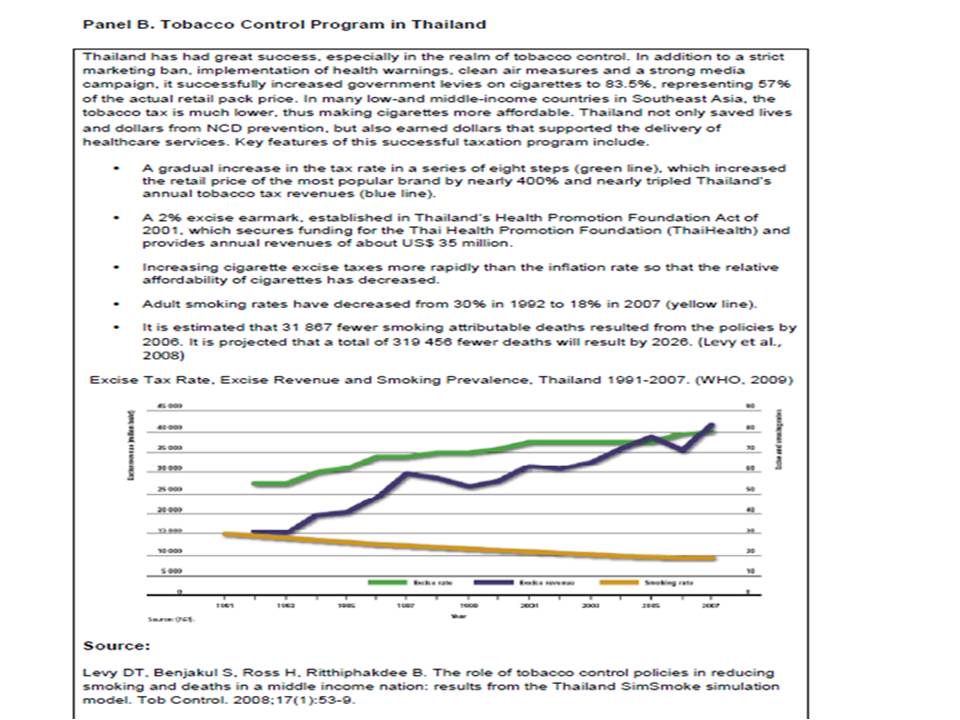
A study on tobacco control program in Thailand.


Table below shows that Philippine cigarette taxes are not exactly low or "among the lowest in the region. Of the 9 S.E. Asian economies, Philippine taxes are 4th highest.


Again, I reiterate my support to a hike in tobacco taxes in the country. If a 1,000 to 10,000 percent increase can be fully implemented and cigarette smuggling can be fully stopped and controlled, I will support that move then. Being a non-smoker ever since, I have no love affair with cigarette or cigar. But I think the probability that the government can fully control cigarette smuggling is as high as the probability of an average Grade schooler passing an exam on partial and differential calculus.  Thus, higher tax rates can only mean higher incidence of smuggling.


Many smokers will not be comparing Philippine tobacco prices vs. Singapore or Malaysia prices. Rather, they willl be comparing cigarette prices before and after the tax hike.

I wish the DOH and other groups and individuals pushing for tobacco tax hike, to be successful in this campaign. I also support a unitary or single tax rate to apply to all cigarette products. But more than government intervention via higher taxation to reduce smoking incidence, it is more important to remind people over and over again, that healthcare is first and foremost their own personal responsibility, not government's, especially for lifestyle-related diseases. Thus, the need for the government to step back in subsidizing personal irresponsibility via higher budget for NCDs. Infectious diseases and pediatric diseases remain dangerous that claim many young lives until now. That's where the bulk of our tax money for health should go.

If people have the money to buy a pack or two of cigarettes a day, then they should have the money to buy private health insurance on top of their PhilHealth membership which will soon become more expanded. Or at least save money for their future costly healthcare.
--------

See also:
Tobacco Tax 1: Telecom and Medicine Taxes Too, September 15, 2009 
Tobacco Tax 2: Higher Tax + Corruption = Lower Revenue, June 06, 2010
Tobacco Tax 3: When Supply is Killed But Demand Persists, November 15, 2010
Tobacco Tax 4: Finding the Optimum, Not Maximum Cigarette Tax, May 26, 2011
Tobacco Tax 6: On Cigarette Smuggling, February 27, 2012.

Friday, January 27, 2012

Lifestyle Diseases 15: Preventing Metabolic Syndrome

Another good article from a cardiologist-friend, also volunteer consultant to the DOH on non-communicable diseases (NCDs), Dr. Tony Leachon. Healthcare is first and foremost personal and parental/guardian responsibility, not government's. Especially for lifestyle-related diseases where people simply over-smoke, over-eat, over-eat and/or over-sit, and they later get various types of diseases like hypertension, high cholesterol, diabetes, lung/liver/throat/other types of cancer.

Let us guard our own health and that of our households, family and friends. And let us demand less government intervention in healthcare, like more drug price control, more free or highly subsidized medicines for NCDs, more taxes for bigger health subsidies, etc. Let government's intervention in healthcare be limited to infectious diseases, pediatric diseases, and support for people with mental and physical defect.
--------

Metabolic Syndrome: Losing Weight is Key

Anthony C. Leachon, M.D.

The metabolic syndrome is a constellation of 5 risk factors that are associated with increased risk for atherosclerotic cardiovascular disease (ASCVD.. One must have at least three metabolic risk factors to be diagnosed with metabolic syndrome.
• Large waistline. This also is called abdominal obesity or "having an apple shape." Excess fat in the stomach area is a greater risk factor for heart disease than excess fat in other parts of the body, such as on the hips.
• High triglyceride
• Low HDL cholesterol level
• Hypertension
• Diabetes Mellitus

The risk of having metabolic syndrome is closely linked to overweight and obesity and a lack of physical activity. We are in a period where there are more adults die than children, more people are obese than undernourished and more people live in cities than in rural areas.


Waist circumference should be the target of intervention in obese individuals.
Despres et al in 2001 stressed that intervention should aim for a modest reduction of 5% - 10% of initial body weight.

This has been shown to lead to marked reductions in blood pressure susceptibility, a marked improvement in the lipid profile and in insulin sensitivity, as well as improvements in other thrombotic factors and inflammatory markers.


So, just how do you become in control of your weight? The obvious answer is by controlling your diet. But, that answer only leads to another question. Just how does a person control their diet? It's this answer that is the key, and it can all be summed up with one single word... calories.Calories are everything. Let me repeat that. CALORIES ARE EVERYTHING.

Weight control is all about calories. Nothing else comes close. This is not a gimmick or a diet fad either. This is the proven science of the human body. Weight control is all about the battle between calories in and calories out. If they are both equal to each other, your weight will stay exactly the same. But, if one is higher than the other, your weight will change.If you consume more calories than you burn, you gain weight. If you burn more calories than you consume, you lose weight. And, if you both burn and consume the same amount of calories, your weight stays the same.


Obesity has been a great challenge in the modern world. After almost two decades, the USDA food pyramid is history. US First Lady Michelle Obama unveiled last Nov 2011, the USDA's update on America's visual nutrition guide, replacing the familiar - and much maligned - pyramid with a plate.


The new design incorporates seven key dietary messages:

- Enjoy your food, but eat less
- Avoid oversized portions
- Make half your plate fruits and vegetables
- Drink water instead of sugary drinks
- Make at least half your grains whole grains
- Switch to fat-free or low-fat (1 percent) milk
- Compare sodium in foods like soup, bread, and frozen meals.
It is possible to prevent or delay metabolic syndrome, mainly with lifestyle changes. A healthy lifestyle is a lifelong commitment. Successfully controlling metabolic syndrome requires long-term effort and teamwork with your health care providers.
--------

See also:
Lifestyle Diseases 8: WHO and the NCDs, December 08, 2011
Lifestyle Diseases 9: Overeating and Food Poisoning, December 24, 2011
Lifestyle Diseases 10: Financing Healthcare vs NCDs, December 30, 2011
Lifestyle Diseases 11: Obesity and Cancer, January 08, 2012
Lifestyle Diseases 12: On Fat Filipinos, January 17, 2012
Lifestyle Diseases 13: Curbing and Preventing NCDs, January 17, 2012
Lifestyle Diseases 14: Transformative Education on Health, January 18, 2012

Wednesday, January 18, 2012

Lifestyle Diseases 14: Transformative Education on Health

This is the 3rd paper that Dr. Tony Leachon, a free and volunteer consultant to the Department of Health (DOH) on non-communicable diseases (NCDs), sent me. Thanks again, Tony.
-------------


Universal Health Care needs Transformative Education of all Filipinos on Health

Anthony C . Leachon MD
Philippine College of Physicians

The great Filipino thinker, entrepreneur, and philanthropist , Washington Sycip said that "Education is the greatest equalizer in life."

And why is this so?

Well, education empowers people; education provides equity; and education is more cost effective. A Filipino college graduate has a fighting chance to secure a stable job than one who's not.

Thus, an educated populace is perhaps an answer to our anemic economic progress. According to DepEd, only 2 out 10 students will finish collegiate education and health and poverty are predominant reasons for the gripping data. DepEd Sec. Armin Luistro has been championing K to 12 since he said that we are the only country in Asia lagging behind in educational curriculum. Sec. Luistro is a major proponent of the K+12 Basic Education Program in the Philippines. The program seeks to add two years to the current 10-year basic education curriculum.

Now the 64 dollar question looms in the horizon: are our students, teachers, educators, and healthcare professionals ready and equipped to face this constantly changing environment? Seventy percent of the country 's population is below the poverty line. This segment is highly considered the economic workforce of a third world country like the Philippines.

Recently, in a high level meeting of some of the great minds in health education convened in Cebu 3 months ago and addressed this disturbing finding. The Philippines' information, educational system and workforce are not ready to confront this social epidemic in a dangerous era of climate change , rapid population growth, and globalization.

Prof . Julio Frenk MD et al in their thought provoking Lancet article last year, said that the world will need a new breed of Health professionals with a different skills set for the new century utilizing education to strengthen health systems in an interdependent world. In 1970 , Omran et al theorized that globalization, improvement in science and technology eg vaccines and new antibiotics , and urbanization will reduce infections or communicable diseases. He boldly predicted though that with economic progress , noncommunicable diseases ( NCDs ) will increase and reach epidemic proportions. Now , this is a hard reality and without us knowing it.

Today , believe it or not , NCDs namely strokes, cancers, chronic respiratory diseases, cancers and diabetes , are not the domain of the affluent rich in their 60's. We have seen the unstoppable surge of NCDs almost of epidemic proportions across all social classes and across the globe ; however , the glaring reality , based on the Lancet article of top epidemiologist Prof. Antonio Dans last February 2010 ,NCDs are common now in younger and poorer patients in Southeast Asian countries and threaten the middle and low economic countries where the people are not ready to face this social epidemic.

Through integration of modern science into the curricula at university-based schools, the reforms equipped health professionals with the knowledge that contributed to the doubling of life span during the 20th century.
By the beginning of the 21st century, however, all is not well.

Glaring gaps and inequities in health persist both within and between countries.

Professional education has not kept pace with these challenges, largely because of fragmented, outdated, and static curricula that produce ill-equipped graduates, basically in preventive health education and in public health.

The problems are systemic: mismatch of competencies to patient and population needs; poor teamwork; persistent gender stratification of professional status; narrow technical focus without broader contextual understanding; episodic encounters rather than continuous care; predominant hospital orientation at the expense of primary care; quantitative and qualitative imbalances in the professional labour market; and weak leadership to improve health-system performance. Laudable efforts to address these deficiencies have mostly floundered, partly because of the so-called tribalism of the professions—ie, the tendency of the various professions to act in isolation from or even in competition with each other.

To advance third-generation reforms, the authors forward a vision: all health professionals in all countries should be educated to mobilise knowledge and to engage in critical reasoning and ethical conduct so that they are competent to participate in patient and population-centred health systems as members of locally responsive and globally connected teams.

The ultimate purpose is to assure universal coverage of the high-quality comprehensive services that are essential to advance opportunity for health equity within and between countries.

Realisation of this vision will require a series of instructional and institutional reforms, which should be guided by two proposed outcomes: transformative learning and interdependence in education.

We regard transformative learning as the highest of three successive levels, moving from informative to formative to transformative learning.

1.Informative learning is about acquiring knowledge and skills; its purpose is to produce experts.

2.Formative learning is about socialising students around values; its purpose is to produce professionals.

3.Transformative learning is about developing leadership attributes; its purpose is to produce enlightened change agents.

Effective education builds each level on the previous one. As a valued outcome, transformative learning involves three fundamental shifts: from fact memorisation to searching, analysis, and synthesis of information for decision making; from seeking professional credentials to achieving core competencies for effective teamwork in health systems; and from non-critical adoption of educational models to creative adaptation of global resources to address local priorities.

Interdependence is a key element in a complex environment. As a starter, if there are 3 major behavioral risk factors namely : tobacco use, unhealthy dietary lifestyle and physical inactivity that have shaped the destiny of patients in a globalized and technological world , then we need to design our educational curriculum from grade school to high school and even to collegiate levels . Thinking and behaving to be healthy should be a way of life and that the government should be responsible to provide the necessary infrastructure to complement with the changes in the educational system.

Health is wealth. A nation's health is a nation's wealth. The human capital is composed of a healthy and educated populace. A strong and solid human capital is the bedrock of the country ' s economic progress.
--------

See also:
Lifestyle Diseases 11: Obesity and Cancer, January 08, 2012
Lifestyle Diseases 12: On Fat Filipinos, January 17, 2012
Lifestyle Diseases 13: Curbing and Preventing NCDs, January 17, 2012

Tuesday, January 17, 2012

Lifestyle Diseases 13: Curbing and Preventing NCDs

This is the 2nd and longer paper sent to me today by a cardiologist friend, Dr. Tony Leachon. He is calling on many government agencies, and individuals themselves, to curb non-communicable diseases (NCDs). The photos below I added just for entertainment purposes only, they are not part of Tony's original paper.
----------


Why do we fail in curbing and preventing NCDs?

Anthony C. Leachon, M.D.

The modern world has given us tremendous know-how, yet avoidable failures continue to plague us everywhere, in healthcare and government, in law, and in finance. And the reason is quite simple and obvious. The volume and complexity of things that we are doing, far exceeds our capacity to properly deliver and achieve it- consistently, correctly and safely.

In 1970’s, the philosophers Samuel Gorovitz and Alasdair MacIntyre published a short essay on the nature of human fallibility that I read two weeks ago and haven’t stopped pondering since. The query they sought to answer was why we fail at what we set out to do in the world. One reason, they said, is “ necessary fallibility” – some things we want to do are simply beyond our ability and capacity. We are not perfect and all knowing. Even enhanced by iPhones,iPads, technology, our physical and mental powers are limited. Much of the world and universe is- and will forever remain – outside our understanding and control.

IGNORANCE and INEPTITUDE

There are clear realities, however, in which control is within our reach. We can do coronary artery bypass grafts, lap surgeries, laser eye therapies and many more. In such realms, Gorovitz and MacIntyre pointed out, there are two reasons that we may nonetheless fail.

The first is IGNORANCE- we may err because science has given us only partial understanding of the world and how it works. There are skyscrapers we do not yet know how to build , typhoons we cannot predict, heart attacks we still haven’t how to stop. The second type of failure the philosophers call INEPTITUDE – because in these cases, the knowledge and awareness exist, yet we fail to apply it correctly; like smoking – we know it’s bad for our health and yet smokers allow themselves to suffer and die prematurely. This is really absurd.

According to Prof. Antonio Dans et al in the Lancet article, Feb 19, 2011, chronic non-communicable diseases or NCDs (stroke, heart disease, cancer,diabetes, and COPD) is a major public health problem in the Philippines and in the South East Asia. Southeast Asia faces an epidemic of chronic non-communicable diseases, now responsible for 60% of deaths in the region. The problem stems from environmental factors that promote tobacco use, unhealthy diet, and inadequate physical activity. Disadvantaged populations are the hardest hit, with death rates inversely proportional to a country's gross national income.

Families shoulder the financial burden, but entire economies suffer as well. Death and disability from NCDs can exert an economic burden in 2 ways: indirectly, through loss of productivity and income, and directly, through household spending on chronic medical care, often of catastrophic proportions.  These preventable conditions can cause major drain on the economy because of avoidable morbidity and mortality.

Developing countries have not only the double burden of communicable and chronic disease, but many also experience the simultaneous challenge of health-system reform. Without universal access to care, well-integrated health services, and strong leadership in public health, response to the above challenges will be inefficient. In such circumstances, the greatest health gains could come from structured preventive strategies.

The success of any healthcare system despite the low financing for health from public funds, is related to a unique and innovative unique healthcare spending but the overall living condition in the country. The goal is to provide quality healthcare for all at a minimum cost to society by relying on a combination of public and private service delivery, but  even without a national insurance system. The Philippine government will play a key role. Preventing diseases will be the top priority by every government agency and LGU and not only the Department of Health.

Health is everyone’s accountability. Thus our government through inter agency collaboration will promote healthy lifestyle and prevent perennial killers  like coronary artery disease, strokes from hypertension, cancers, diabetes and COPD  and other tobacco related illnesses by ensuring a healthy environment, good health conditions, and heavy penalty for smoking in public places, should  take a high priority.      
                               
A Look into our Healthcare System

If we put all our health services in a continuum, with promoting health on the one end and mitigating sickness on the other, we will realize that, all the incentives of healthcare system now respond to signals from sickness. Why should health insurance be focused mostly on sickness? We have a present system as one that pays for procedures not cures; interventions not outcomes; transactions not transformations. We "penalize” doctors for providing cost-effective care that promotes health but we reward them for interventions regardless of outcome, redundancy, and waste.

Multi sectoral approach needed

Although attempts to control non-communicable diseases are increasing, more needs to be done. Health-care systems need to be redesigned to deliver chronic care that is founded on existing primary health-care facilities, but supported by good referral systems. Surveillance of key modifiable risk factors is needed to monitor the magnitude of the problem and to study the effects of interventions. All branches of government and all sectors of society have to get involved in establishing environments that are conducive to healthy living. Inaction will affect millions of lives—often, the lives of those who have the least in life.


Philippine Health Care – quo vadis ?

The Health for the Filipinos is not about extending insurance coverage and deciding who to pay for health care, and how much – important as those things are, it makes no sense just to figure out a better way to pay the bills for a system that is dysfunctional, ineffective, and broken.  We also have to change the health care system itself, beginning with a sharp new emphasis on prevention and public health.

Perhaps we can convene a meeting with the medical societies, for a start.  DOH Secretary Enrique Ona agrees with the suggestion to shift the focus of DOH from sick care to health care; The DOH will take the lead in addressing ignorance and ineptitude in healthcare and will communicate with  all government agencies to contribute their share on health.

Health is not only the accountability of DOH it is our accountability as citizens. But, our government leaders should step up and think of creative ways to improve our condition.

We can ask DepEd, DOST, and CHED to insert preventive health education modules into the academic curriculum ; we can ask DPWH,DILG, MMDA and LGU heads to clean up the streets and clear the waterways to prevent killer floods and the  presence of Dengue Fever, leptospirosis, diarrhea and other water borne and vector borne illnesses; We can ask the DENR to help implement the Clean Air Law to prevent COPD and cardiovascular diseases and plant trees every day to prevent massive flooding that lead to aforementioned diseases ; We can ask the DPWH, MMDA  and the LGUs to create better roads to prevent the surge of vehicular accidents; We can talk with Department of Finance, Bureau of Internal Bureau, Department of Budget Management , Senate and Congress to help the physicians to lobby for higher sin tax for tobacco and alcohol; We can request the Communications Group to help DOH inform, influence, and inspire the nation that there is still hope for every Filipino.

We need a summit where President Noynoy Aquino together with his cabinet, government agencies, all health organizations, private sector, NGO’s  and related  societies  for a National Commitment, a declaration that our healthcare system values prevention, wellness, rapid diagnosis and early treatment. It will hasten things if a draft can be shown to the body during that meeting. The DOH Secretary may then seek the support of his colleagues in the Human Development Cluster and may document their support in a formal signing event, with no less than PNoy as the leading health champion. The medical societies plus PHA, PHAP, PMA etc. may also sign a similar document as proof of their support.

A PPP (Public Private Partnership) Executive Committee may then be formed to formulate the work plan. This same committee may do the monitoring of performance by the PPP components and publish in the newspapers on a monthly basis. The DOH together with the other agencies can fund this project with the Private sector group volunteering whatever it is that they think is their best contribution towards the attainment of the programs’ objectives.         

We must realize that wellness and prevention must be truly comprehensive if it is to really succeed.  It is not only about what goes on in a doctor’s office.  It encompasses workplace wellness programs, community-wide wellness programs, building bike paths and walking trails, getting junk food out of our schools, making school breakfasts and lunches more nutritious, increasing the amount of physical  activity our patients and those individuals at risk.

We view this change in mindset as our opportunity to recreate Philippines as a genuine wellness society – a society that is focused on prevention, good nutrition, fitness, and public health. But, just as important, it will hold down health care costs by creating a sharp new emphasis on disease prevention and public health.

  
####


See also:
Lifestyle Diseases 6: Personal Care against NCDs, October 14, 2011
Lifestyle Diseases 7: Drinking and Healthcare, October 18, 2011
Lifestyle Diseases 8: WHO and the NCDs, December 08, 2011
Lifestyle Diseases 9: Overeating and Food Poisoning, December 24, 2011
Lifestyle Diseases 10: Financing Healthcare vs NCDs, December 30, 2011

Lifestyle Diseases 12: On Fat Filipinos

A cardiologist friend, Dr. Tony Leachon, former medical director of Pfizer Philippines and now a P1 a year consultant to the DOH on non-communicable diseases (NCDs), sent me three of his recent papers on NCDs. He gave me permission to post these in my blog. This is the first and shorter paper. Thanks Tony.

Photos below, I got them from the web, Fierce Fat Filipina Diva, and Fat People of Color. Meaning these are publicly available, voluntarily posted by their authors, I did not steal these shots. Photos added to illustrate the issue that Tony is discussing.
----------------

Fat Filipinos not Funny at all : Young and Poor Affected

Anthony C.Leachon, MD
Philippine College of Physicians

In the Philippines, studies on obesity among children and in adults show that the findings reveal a sad and disturbing pattern. The prevalence rate of obesity has been increasing through the years. The Philippine National Health Evaluation and Survey (2004) has placed the prevalence rate of obesity among Filipino children at 3.2%. This has increased to 4.9% in 2003. Opina (2005) claimed that the gradual increase in the incidence of obesity was likewise noted by the National Nutrition Council of the Philippines survey in 2003. Overweight children aged 0-5 years rose from 0.4% to 1.4%. The prevalence rate of overweight children aged 6-10 years was almost negligible in 1998 but had a significant increase to 1.3% in 2003. Mayuga (2005) however said that the results of a survey conducted by the Food and Nutrition Research Institute (FNRI) of the Department of Science and Technology are more alarming. It was revealed that in 1989, the prevalence rate of obesity among Filipino children was at 5.7%. In 1993 it increased to 8% and in 1998 to 8.8%.

In the schools, malls, and in the clinics, we are seeing more and more obese patients than the last few years through determination of high body mass index (BMI) and high waist to hip ratio. Coupled with this glaring finding is the raised blood sugar and abnormal serum lipid values. This trend is evidently seen in Southeast Asian countries due to globalization and urbanization. If we will not act urgently about this phenomenon through strong government policy recommendations , the Noncommunicable diseases will further hurt the disadvantaged sector specifically the young and poor segment of the population.

NCDs are not exclusive to the affluent elderly patients now but they are seen across all social classes and more dominantly in the young and poor population. This results from unhealthy dietary patterns such as high calorie intake from total fats ( indigenous oils and coconut oil ) , high consumption of sugars and sweetened beverages and low consumption of the more expensive fruits and vegetables. In 1977, Prof Gerald Reaven of Stanford University theorized that obesity was the trigger risk factor in the development of a medical condition known as Syndrome X composed of the ff : obesity, hypertension , diabetes mellitus , hypertriglyceridemia and low HDL. It has undergone massive research work and has evolved into the so- called Metabolic Syndrome leading into NCDs , killing millions every year.

According to Prof Antonio Dans et al , Lancet Article Feb 2011 , abdominal obesity might be more important in people of Southeast Asian countries than from the rest of the world. In the INTERHEART study, waist to hip ratio was a better predictor of coronary artery disease than was BMI. This finding was especially true in Southeast Asian people , in whom a high waist to hip ratio increased in the likelihood of. CAD almost four times compared with a two fold rise in the world population.

Though the prevalence of obesity is increasing in the Asian region, there is paradoxical persistence of under nutrition. This double burden of malnutrition ( undernutrition and over nutrition ) presents a great and difficult public health challenge for a poor country like the Philippines because catch up weight gain after perinatal and postnatal restriction has been postulated to increase risk of diabetes and cardiovascular complications (Stein , 2005).

Recently, Internet addiction , in which the individuals spend an excessive amount of the time online , is recognized by some experts as an evolving medical condition . In the era of the internet, Twitter, and Facebook , obesity will continue to rise due to the lack of physical activity with increase of unhealthy eating patterns - high intake of French fries , burgers, pizza, sweetened beverages , junk foods, and low intake of expensive fruits and vegetables. On another concern , smoking with obesity is a deadly combination - tobacco use among children aged 13-15 years was very common in the Philippines (28 % in boys and 17 % in girls ). (WHO,2009).

One disturbing fact now based on the preponderance of data is the finding that deaths from NCDs in the region are highest in countries that are economically poor. If this inequality or inequity is to be corrected , healthcare delivery has to be structured in a manner that maximizes use of meager resources and strikes a careful balance between speedy public health interventions and medical services. Public and preventive health programs have a unique advantage in that they do not involve massive investments in costly equipment and drugs.

Here are some pioneering recommendations that we need to do differently given our limited resources and the " silent " NCD epidemic that the young and the poor are facing :

1. Transformative education of teachers and all students from the primary and secondary education to the collegiate levels on preventive health education focused on healthy diet options and increase in physical activity with tobacco cessation as top priorities.

2.Local Government Unit heads will have to pass ordinances quickly to curb tobacco use , issue dietary guidelines and food labels , and build infrastructures like provision of pedestrian pathways so people can do physical activities.

3.Workplaces in private and public organizations should build a healthy environment eg smoke free policies,healthy diet options , and facilities for physical activity.

4. The Food Drug Administration with the help of technical experts from the private sector has to regulate the nutritional industry through implementation of Food Label and calorie counter to restrict the use of high calorie foods ,trans fatty acids , sugars, and salts.

5. Civil society , including coalitions of affected individuals and their families , medical organizations, and the media champions should play a major part in holding our leaders accountable for delivering on their commitments on Noncommunicable Diseases.

The time is now to act to protect the young and the poor affected massively by NCDs.
-------

See also:
Lifestyle Diseases 1: Obesity, February 04, 2011
Lifestyle Diseases 2: Killer diseases in the Philippines, March 16, 2011
Lifestyle Diseases 3: Causes of Mortality in the Philippines, August 10, 2011
Lifestyle Diseases 4: The UN on NCDs, September 24, 2011
Lifestyle Diseases 5: NCDs Global Picture, September 30, 2011