A fellow member of our Coalition for Health Advocacy and Transparency (CHAT), James Auste, the head of the Cancer Warriors Foundation (CWF) has lobbied other CHAT members and CWF supporters, to lobby and write the Senators to demand:
1. Increase DOH budget for Acute Lymphocotic Leukemia (ALL) patient assistance program from P30 million to P100 million, to cover some 3,500 kids with cancer will be given proper care and treatment.
2. Increase DOH budget for non-communicable diseases (NCDs) from P70 million to P280 million for four
diseases: cardiovascular, lung cancer, diabetes,...
I replied that I support more government funding for (a) pediatric diseases, including NCDs for children like childhood cancer, (b) infectious or communicable diseases like leptospirosis, dengue and malaria, (c) people with physical and mental problems, both children and adults.
But I do not support more government funding for NCDs for adults. Why should the rest of society pay for diseases of people who over-eat, over-smoke, over-drink, over-sit? Lifestyle is a choice, not inherited.
Legislators, Congressmen/women and Senators, receive all types of higher budget request from:
(a) Departments and other Agencies themselves which suffer budgetary cut at the Department of Budget and Management (DBM).
(b) NGOs, media, other civil society groups lobbying for additional budget for their respective sectors (ie, health NGOs asking for higher DOH budget, education NGOs asking for higher DepEd and SUCs budget, etc.).
(c) Rent-seekers and contractors lobbying for bigger budget of agencies that will get their services (ie, suppliers of jet fighters and battle ships seeking higher DND budget, road contractors seeking higher DPWH budget, etc.),
(d) Foreign aid or multilateral bodies like the WB and ADB pushing for new loans that will require local counterpart funding.
(e) Other sectors and interest groups.
One will hear all types of justifications and even alibi from these sectors, interest groups and lobbyists. They know that they are indirectly competing with each other as taxpayers' money is not a bottomless pit, so some tend to shout or lobby louder than the others.
But legislators are also under pressure where to get the additional funding other than the usual, never say die "more borrowings, more borrowings, more borrowings". The annual budget deficit (expenditures larger than revenues) is around P300 billion a year, and that is also the similar amount of new borrowings each year. Our public debt has become so huge that we pay about P350 billion a year on average on interest payment alone. Utang lang ng utang, let the future administrations and taxpayers worry about those debts later.
So legislators would tend to ask, "kindly help us identify where to get the additional money and we will give your request." Good. And here are possible sources of additional money for one's favored sector or department.
1. Higher rates for existing taxes and fees, like the proposed increase in excise tax for tobacco and alcohol products, higher excise tax for mining revenues, etc. Or a proposal to hike VAT from 12 to 15 percent. Or DFA hike in passport fee, NBI hike in NBI clearance fee, DOTC hike in motor vehicle registration tax, etc.
2. New taxes and fees, say an excise tax on junk food and bottled water (now more expensive than oil).
Please note that those taxes and fees refer only to national government agencies. The local government units (LGUs) can also increase their respective taxes and fees, like the community residence tax, real property tax, business permit tax, etc. They can also create new taxes like the proposed dog ownership tax in Pasay or Paranaque, or increase penalties like penalty for dog shit on the streets, penalties for men who walk topless on the streets, etc.
3. Privatization, like privatizing PAGCOR, some military facilities or camps, some state universities, etc.
4. Shrink the budget of other agencies and rechannel the savings to one's favorite sector or department.
If one will go for option #1 like the proposed sin tax hike, malabo na, not practical. So many sectors are already salivating at the huge money that will come from it -- the universal healthcare (UHC) of PhilHealth and DOH, the condoms and pills of the RH bill, the pork barrel of legislators themselves, etc.
If option #2, it is a highly sensitive issue and next year being an election year, politicians would rather borrow like crazy than create new taxes that can spell defeat for them at the precincts.
If option #3, I myself will go for it. Prioritize PAGCOR privatization, I think up to P200 billion can be realized from it. There is a bill by Sen. Ralph Rector on this, but I think it's not moving fast enough.
If option #4, I will also support it myself. My favorite is to drastically cut the budget of the Department of National Defense (DND)-AFP. I am actually in favor of abolishing the AFP itself as I believe we have no threat of external aggression in the sense that foreign armies will invade Metro Manila and the rest of the country. The bigger threat here is internal -- those thieves and carnappers, killers and murderers, kidnappers and rapists, extortionists and terrorists, corrupt officials and plunderers, many other criminals. The noise over the WPS/SCS is hyped mainly by the rent seekers and suppliers of jet fighters and battle ships, some legislators and the DND guys themselves. I read that one battle ship from Italy will cost about P6 billion each, and the DND plans to buy two ships soon. Not included there are bombs, missiles, ammunitions, training of personnel, oil consumption, replacement of parts, that will cost several billions more.
The Philippine Military Academy (PMA) should be privatized. Our subsidy for those guys is P500,000 per student per year, or P2 million per student over four years. The same with the National Defense College of the Philippines (NDCP), which has a subsidy of about P1 million per student, and those masteral "students" are not exactly poor. They are mid-level or senior level government officials, congressmen, governors, mayors, etc.
So if people have to write to those Senators and Congressmen, their request will have a better chance of being granted if they can pinpoint where to get new money or savings.
My suggestion, go for option #4. Target the DND, or the state universities and colleges (SUCs), or DPWH.
Then over the next few years, target option #3.
---------
See also:
Health Spending 1: Wastes in US health spending, June 23, 2011
Health Spendng 2: DOH, Public Health Budget, June 18, 2012
Health Spending 3: Obamacare and Huge Tax Hikes, June 30, 2012
Health Spending 4: Global Aid on Health, 1990-2011, August 28, 2012
Wednesday, August 29, 2012


Tuesday, August 28, 2012
Health Spending 4: Global Aid on Health, 1990-2011
The main sources of development assistance for health (DAH) is slowly shifting from official foreign aid (bilateral and multilateral) to international NGOs and public-private partnerships. This is a good development.
I saw a nice interactive treemap from the Institute for Health Metrics and Evaluation (IHME) just recently posted, on the global channel of DAH from 1990 to 2011,
http://www.healthmetricsandevaluation.org/tools/data-visualization/development-assistance-health-channel-assistance-global-1990-2011-interacti#/overview/stories
Of the 22 years covered in that interactive data, I chose four years: 1990, 1997, 2004, 2011 (seven years gap) for the images. Below are data for 1990 and 1997.

In 1990, it seemed that about 90 percent or higher, DAH were channeled via official foreign aid bodies, especially through the World Health Organization (WHO) and the governments of France and the US. Seven years after, the World Bank or IBRD and its attached agency International Development Association (IDA), plus the government of Japan, became more prominent.
By 2004, the NGOs and the Global Fund to fight AIDS, TB and Malaria (GFATM), a public-private sectors partnership, showed prominence while the WB-IDA, WHO and US government remained among the major channels and donors.
Last year, the GFATM, the Bill and Melinda Gates Foundation (BMGF), GAVI (Global Alliance for Vaccines and Immunization), another public-private sector alliance, and other NGOs have become really prominent, channelling around one third of the global DAH. I think a substantial amount of the funding for GFATM and GAVI also came from the BMGF.

The official foreign aid channels still dominate, like the WHO, WB, US and UK governments. But we should recognize that not all of such foreign aid is comprised of actual service delivery to poor patients. A substantial amount of US Agency for International Development (USAID) funding for health for instance, is to finance various studies for public health policies. I think many faculty members and researchers of my alma mater, the UP School of Economics, make big money from USAID to do various research projects on healthcare.
The same with UK foreign aid via the Department for International Development (DFID). One DFID project for instance, is the Medicines Transparency Alliance (MeTA), a big multi-sectoral alliance to advance more transparency and accountability in medicines pricing, procurement, dispensation, and other services. There are MeTA projects in seven countries including the Philippines. The health coalition that I belong where I represent MG Thinkers, CHAT, is the civil society partner of MeTA Philippines.
With the fiscal burden of ever-rising public debt by the governments of the industrialized economies like the US, UK, France and Italy, the share of the official foreign aid I think will slowly but steadily decline. Those governments will be stuck in dealing with huge domestic health concerns with their ageing population and rising spending for interest payment. International NGOs and corporate foundations will slowly take the tab.
Health spending will also slowly move from rich country governments' donation to national governments of the poorer countries, national and local, plus various NGOs, corporate healthcare providers, charity organizations, private health insurance and out of pocket (OOP) spending.
What this means is that global healthcare will slowly move from heavy "government responsibility" to more "personal and civil society responsibility." We will watch future data to see if this hypothesis will hold.
---------
See also:
Health Spending 1: Wastes in US health spending, June 23, 2011
Health Spendng 2: DOH, Public Health Budget, June 18, 2012
Health Spending 3: Obamacare and Huge Tax Hikes, June 30, 2012
Business Bureaucracy 5: Doing Business 2012 Report
The WB-IFC's "Doing Business 2012 Report was released several months ago. and the result for the Philippines was as ugly as in previous years: Long procedures to start and continue a business, lots of taxes and mandatory contributions to pay. The Country Tables are available here,
http://doingbusiness.org/reports/global-reports/~/media/FPDKM/Doing%20Business/Documents/Annual-Reports/English/DB12-Chapters/Country-Tables.pdf
Singapore, Hong Kong and New Zealand took the 1st, 2nd and 3rd places, respectively. To start a business: Number of procedures, number of days, minimum capital: 3, 3, 0 for Singapore and HK, 1, 1, 0 for NZ. For the Philippines? 15, 35, 5.2 percent of per capita income.
In paying taxes: number of payments per year, number of hours, percent of profit: 5, 84, 27.1 for Singapore; 3, 80, 23.0 percent for HK; and 8, 172, 34.4 percent for NZ. For the Philippiines? 47, 195, 46.5 percent.

To enforce contracts: number of procedures, number of days, cost (percent of claim): 33, 230, 10.3 percent for Korea; 28, 395, and 21.8 percent for Australia; and 36, 479, 12.3 percent for Thailand. For the Philippines? 37, 842, 26.0 percent.

Also Malaysia, Japan and Taiwan. In resolving insolvency, number of years, cost (percent of estate), recovery rate (cents on the dollar): 1.5, 15, 44.6 for Malaysia; 0.6, 4 percent, 92.7 for Japan; and 1.9, 4 percent and 82.1 for Taiwan. For the Philippines? 5.7, 38 percent, 4.7!

http://doingbusiness.org/reports/global-reports/~/media/FPDKM/Doing%20Business/Documents/Annual-Reports/English/DB12-Chapters/Country-Tables.pdf
Singapore, Hong Kong and New Zealand took the 1st, 2nd and 3rd places, respectively. To start a business: Number of procedures, number of days, minimum capital: 3, 3, 0 for Singapore and HK, 1, 1, 0 for NZ. For the Philippines? 15, 35, 5.2 percent of per capita income.
In paying taxes: number of payments per year, number of hours, percent of profit: 5, 84, 27.1 for Singapore; 3, 80, 23.0 percent for HK; and 8, 172, 34.4 percent for NZ. For the Philippiines? 47, 195, 46.5 percent.

Then S. Korea, Australia and Thailand also got high ranks, meaning their business bureaucracies are not that complicated or parasitic.
To enforce contracts: number of procedures, number of days, cost (percent of claim): 33, 230, 10.3 percent for Korea; 28, 395, and 21.8 percent for Australia; and 36, 479, 12.3 percent for Thailand. For the Philippines? 37, 842, 26.0 percent.

Also Malaysia, Japan and Taiwan. In resolving insolvency, number of years, cost (percent of estate), recovery rate (cents on the dollar): 1.5, 15, 44.6 for Malaysia; 0.6, 4 percent, 92.7 for Japan; and 1.9, 4 percent and 82.1 for Taiwan. For the Philippines? 5.7, 38 percent, 4.7!

Monday, August 27, 2012
Energy Econ 4: Oil Prices and Taxes
* This is my article last Saturday in the online magazine,
http://www.thelobbyist.biz/perspectives/less-gorvernment/1345-oil-prices-and-taxes
---------
Local oil prices have significantly jumped the past few days by about P3 per liter. This reflected the upward movement of oil prices in the world market over the past few weeks. As usual, the left-leaning groups raised howl and criticized the oil companies for their “greed” and called on the government to have another round of tax hikes on oil or other products and services.
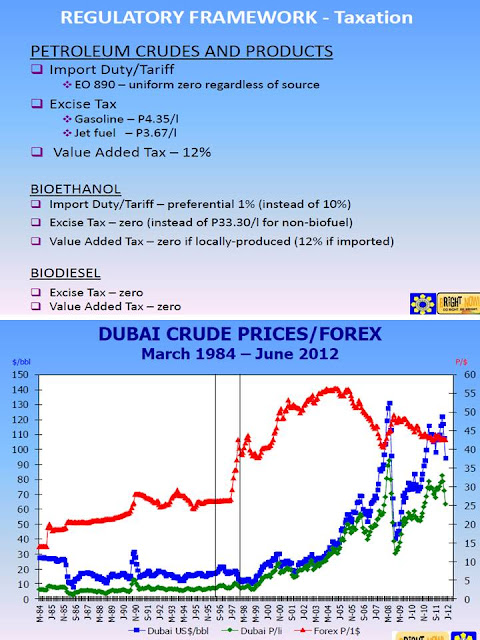
Last July 11, 2012, I attended the “Platts Forum on Oil, Coal and LNG” at Edsa Shangrila Hotel. Among the speakers there was Ms. Zenaida Monzada of the Department of Energy. Below are among the slide presentations she gave in the said forum.
Taxes that contribute to the higher retail prices of petroleum products are (a) excise tax, P4.35 per liter for gasoline, P3.67 per liter for jet fuel, P1.63 per liter for diesel, and (b) value added tax (VAT) 12 percent. This means that for the P54 per liter unleaded gasoline, about P10 of it goes to excise tax and VAT alone. Or the government is directly accountable for expensive oil by about P10 per liter. There are other indirect taxes of course, like corporate income tax, documentary stamp tax, real property tax, etc. of the oil companies, trucking and gas stations.
The lower chart shows that the Pesos per liter retail price has moved along with the world crude oil price, from 1984 onwards.
Below, the same story is shown. From 1999 to June 2012, local gasoline and diesel prices have moved generally in steep with international crude and refined product prices. And world oil prices are dictated by the governments of the major oil exporting countries, both OPEC and non-OPEC member countries.
The conspiracy theory therefore, of oil companies dictating local oil prices to satisfy their greed is standing on a hollow ground.

Below, “prevailing prices” refer to early July 2012 prices. Prices across various oil dealers and retailers are generally similar, with minor price differential that can be attributed to other business costs like land lease or rent, and/or varying profit ratio.
The lower table shows comparative prices across major capital cities, converted into Pesos per liter. Philippine oil prices are not among the highest in the region. The most proximate explanation would be that those countries that have higher oil prices than us have higher taxes and fees, direct and indirect, that are slapped on oil products and oil producers and retailers.

The bottomline is that contrary to common public perception that the oil companies are the main instigator of oil price hikes, it is not. It is more due to the (a) governments of oil exporting countries like those in OPEN-member countries that set the price of crude oil, and (b) governments of net oil importing countries like the Philippines, for the various taxes and fees imposed both on the oil products and the companies that import, refine, transport and retail oil products.
Repeated calls to re-regulate if not nationalize the local oil industry are misguided and wrong. Instead of having more government involvement and intervention in local oil price setting, there should instead be lesser government taxes and involvement. The excise tax on oil products should in fact be abolished, instead of raising it as proposed by some sectors.
----------
See also:
Energy Econ 1: Coal Power, July 24, 2012
Energy Econ 2: Renewable Energy and High Electricity Prices, July 30, 2012
Energy Econ 3: Market Reforms in India's Electricity Sector, July 30, 2012
http://www.thelobbyist.biz/perspectives/less-gorvernment/1345-oil-prices-and-taxes
---------
Local oil prices have significantly jumped the past few days by about P3 per liter. This reflected the upward movement of oil prices in the world market over the past few weeks. As usual, the left-leaning groups raised howl and criticized the oil companies for their “greed” and called on the government to have another round of tax hikes on oil or other products and services.
Last July 11, 2012, I attended the “Platts Forum on Oil, Coal and LNG” at Edsa Shangrila Hotel. Among the speakers there was Ms. Zenaida Monzada of the Department of Energy. Below are among the slide presentations she gave in the said forum.
Taxes that contribute to the higher retail prices of petroleum products are (a) excise tax, P4.35 per liter for gasoline, P3.67 per liter for jet fuel, P1.63 per liter for diesel, and (b) value added tax (VAT) 12 percent. This means that for the P54 per liter unleaded gasoline, about P10 of it goes to excise tax and VAT alone. Or the government is directly accountable for expensive oil by about P10 per liter. There are other indirect taxes of course, like corporate income tax, documentary stamp tax, real property tax, etc. of the oil companies, trucking and gas stations.
The lower chart shows that the Pesos per liter retail price has moved along with the world crude oil price, from 1984 onwards.

Below, the same story is shown. From 1999 to June 2012, local gasoline and diesel prices have moved generally in steep with international crude and refined product prices. And world oil prices are dictated by the governments of the major oil exporting countries, both OPEC and non-OPEC member countries.
The conspiracy theory therefore, of oil companies dictating local oil prices to satisfy their greed is standing on a hollow ground.

Below, “prevailing prices” refer to early July 2012 prices. Prices across various oil dealers and retailers are generally similar, with minor price differential that can be attributed to other business costs like land lease or rent, and/or varying profit ratio.
The lower table shows comparative prices across major capital cities, converted into Pesos per liter. Philippine oil prices are not among the highest in the region. The most proximate explanation would be that those countries that have higher oil prices than us have higher taxes and fees, direct and indirect, that are slapped on oil products and oil producers and retailers.

The bottomline is that contrary to common public perception that the oil companies are the main instigator of oil price hikes, it is not. It is more due to the (a) governments of oil exporting countries like those in OPEN-member countries that set the price of crude oil, and (b) governments of net oil importing countries like the Philippines, for the various taxes and fees imposed both on the oil products and the companies that import, refine, transport and retail oil products.
Repeated calls to re-regulate if not nationalize the local oil industry are misguided and wrong. Instead of having more government involvement and intervention in local oil price setting, there should instead be lesser government taxes and involvement. The excise tax on oil products should in fact be abolished, instead of raising it as proposed by some sectors.
----------
See also:
Energy Econ 1: Coal Power, July 24, 2012
Energy Econ 2: Renewable Energy and High Electricity Prices, July 30, 2012
Energy Econ 3: Market Reforms in India's Electricity Sector, July 30, 2012
Saturday, August 25, 2012
Healthcare Competition 9: Deregulate Further the Supply of Healthcare
This will be more of a discussion outline rather than a paper. I would appreciate readers' comments, especially in the two conceptual analysis that I am introducing below.
A. Consumers of Healthcare
Practically everyone, young and old, men and women, rich and poor.
B. Suppliers of Healthcare
1. National government:
a. Department of Health (DOH) attached hospitals, NCPAM and other agencies; Botika ng Barangay (BnB)
b: Philippine Health Insurance Corporation (PHIC or PhilHealth)
c. UP-Philippine General Hospital (PGH) and other state universities offering health courses
d. Department of National Defense's (DND) AFP Hospital and Veterans Hospital
e. Department of the Interior and Local Government's (DILG) PNP Hospital
f. Other Departments and government corporations providing occasional medical and dental missions.
PCSO and PAGCOR provide limited hospitalization cover, give away ambulances, etc.
2. Local government units (LGUs)
a. City hospitals (Ospital ng Maynila, Ospital ng Makati, Ospital ng Muntinlupa,...)
b. Municipal hospitals
c. Provincial hospitals
d. Barangay health centers and rural health units (RHUs) under the city or municipal governments
3. Private companies and foundations
a. Hospitals under a foundation (St. Lukes, Manila Doctors Hospital, Makati Medical Center, etc.)
b. Other private hospitals, affiliated with the Private Hospitals Association of the Phils. Inc. (PHAPI)
c. Health Maintenance Organizations (HMOs)
d. Pharmaceutical companies, members of PHAP or PCPI
e. Drugstores and pharmacies (Mercury, Watsons, The Generics, members of DSAP)
f. Big companies and offices, schools and universities, usually have their own small medical offices/services
4. Civil society organizations
a. Various NGOs and charity organizations that directly provide health services (Botika Binhi, Alt-Health, PPF, etc.)
b. Rotary Clubs, Lions Clubs, Mason, JCI, etc. that regularly sponsor medical and dental missions, vaccination projects
c. Other NGOs, charity organizations, that indirectly provide health services, or do various healthcare policy advocacies
C. Concept 1: Current Financing of Healthcare
First, HC is divided into outpatient and in-patient or hospital confinement services. Financing for outpatient services are usually done via out of pocket (OOP) for those who have no private health insurance, the HMOs for those who have private health cards, LGU hospitals or LGU guarantees if patients are brought to a private hospital ER.
For hospital confinement, that is the main job of PhilHealth. But since its coverage is limited (eg, only P500 per day for hospital bed), the balance is to be shouldered by those mentioned above as financing the outpatient services. Other government agencies like DSWD, PCSO, also give limited cash cover for the balance.

Question: Is this an appropriate representation of the existing health financing system and schemes?
D. Concept 2: Supply and Demand of Healthcare
Some left-leaning groups and health NGOs are definitely calling for health socialism, that the national government, in coordination with LGUs, should provide free or highly subsidized HC services to the public, from outpatient to inpatient services because "health is a right, not a privilege." This is represented by the graph on the left.
Other groups, well a minority actually, like us in Minimal Government Thinkers and other free market-oriented groups and individuals, want to keep government role in HC to be focused on dealing with infectious or communicable diseases, pediatric diseases, children and adults with physical and mental limitations. The rest should be given free choices and options where to get their health insurance.

I believe in universal healthcare (UHC), that everyone should have some form of health insurance. But I do not believe that only the government, national and local as enumerated above, should provide that universal coverage.
Would greatly appreciate readers' comments at this stage. Meanwhile, here's short but good paper from The Independent Institute,
Competition Based on Quality of Healthcare: Why Does Quality Rise in Free Markets and Decline with Government?
--------
See also:
Healthcare Competition 4: Solving Info Assymetry, September 08, 2010
Healthcare Competition 5: Thailand, September 24, 2010
Healthcare Competition 6: United States, May 05, 2011
Healthcare Competition 7: Moral Hazards in Healthcare Subsidies, May 24, 2011
Healthcare Competition 8: Centralization vs. Deregulation of Healthcare, December 31, 2011
PhilHealth Watch 11: Is PHIC an Insurance Company?, June 12, 2012
Socialized Healthcare 6: Student Debates, Charity Beds and UHC, August 22, 2012
A. Consumers of Healthcare
Practically everyone, young and old, men and women, rich and poor.
B. Suppliers of Healthcare
1. National government:
a. Department of Health (DOH) attached hospitals, NCPAM and other agencies; Botika ng Barangay (BnB)
b: Philippine Health Insurance Corporation (PHIC or PhilHealth)
c. UP-Philippine General Hospital (PGH) and other state universities offering health courses
d. Department of National Defense's (DND) AFP Hospital and Veterans Hospital
e. Department of the Interior and Local Government's (DILG) PNP Hospital
f. Other Departments and government corporations providing occasional medical and dental missions.
PCSO and PAGCOR provide limited hospitalization cover, give away ambulances, etc.
2. Local government units (LGUs)
a. City hospitals (Ospital ng Maynila, Ospital ng Makati, Ospital ng Muntinlupa,...)
b. Municipal hospitals
c. Provincial hospitals
d. Barangay health centers and rural health units (RHUs) under the city or municipal governments
3. Private companies and foundations
a. Hospitals under a foundation (St. Lukes, Manila Doctors Hospital, Makati Medical Center, etc.)
b. Other private hospitals, affiliated with the Private Hospitals Association of the Phils. Inc. (PHAPI)
c. Health Maintenance Organizations (HMOs)
d. Pharmaceutical companies, members of PHAP or PCPI
e. Drugstores and pharmacies (Mercury, Watsons, The Generics, members of DSAP)
f. Big companies and offices, schools and universities, usually have their own small medical offices/services
4. Civil society organizations
a. Various NGOs and charity organizations that directly provide health services (Botika Binhi, Alt-Health, PPF, etc.)
b. Rotary Clubs, Lions Clubs, Mason, JCI, etc. that regularly sponsor medical and dental missions, vaccination projects
c. Other NGOs, charity organizations, that indirectly provide health services, or do various healthcare policy advocacies
C. Concept 1: Current Financing of Healthcare
First, HC is divided into outpatient and in-patient or hospital confinement services. Financing for outpatient services are usually done via out of pocket (OOP) for those who have no private health insurance, the HMOs for those who have private health cards, LGU hospitals or LGU guarantees if patients are brought to a private hospital ER.
For hospital confinement, that is the main job of PhilHealth. But since its coverage is limited (eg, only P500 per day for hospital bed), the balance is to be shouldered by those mentioned above as financing the outpatient services. Other government agencies like DSWD, PCSO, also give limited cash cover for the balance.

Question: Is this an appropriate representation of the existing health financing system and schemes?
D. Concept 2: Supply and Demand of Healthcare
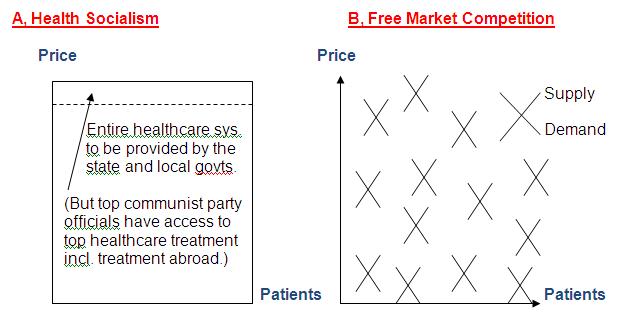
Some left-leaning groups and health NGOs are definitely calling for health socialism, that the national government, in coordination with LGUs, should provide free or highly subsidized HC services to the public, from outpatient to inpatient services because "health is a right, not a privilege." This is represented by the graph on the left.
Other groups, well a minority actually, like us in Minimal Government Thinkers and other free market-oriented groups and individuals, want to keep government role in HC to be focused on dealing with infectious or communicable diseases, pediatric diseases, children and adults with physical and mental limitations. The rest should be given free choices and options where to get their health insurance.
I believe in universal healthcare (UHC), that everyone should have some form of health insurance. But I do not believe that only the government, national and local as enumerated above, should provide that universal coverage.
Would greatly appreciate readers' comments at this stage. Meanwhile, here's short but good paper from The Independent Institute,
Competition Based on Quality of Healthcare: Why Does Quality Rise in Free Markets and Decline with Government?
--------
See also:
Healthcare Competition 4: Solving Info Assymetry, September 08, 2010
Healthcare Competition 5: Thailand, September 24, 2010
Healthcare Competition 6: United States, May 05, 2011
Healthcare Competition 7: Moral Hazards in Healthcare Subsidies, May 24, 2011
Healthcare Competition 8: Centralization vs. Deregulation of Healthcare, December 31, 2011
PhilHealth Watch 11: Is PHIC an Insurance Company?, June 12, 2012
Socialized Healthcare 6: Student Debates, Charity Beds and UHC, August 22, 2012
Rule of Law 16: On the New SC Chief Justice Ma. Lourdes Sereno
From so many lawyers in the Philippines, among them whom I highly respect is Atty. Theodore "Ted" Te. Not only that he was a friend way back in our undergrad days in UP Diliman in the mid-80s, I like the way he speaks frankly on many issues.
 After the announcement of the new Supreme Court (SC) Chief Justice, UP Law Professor Ma. Lourdes Sereno, Ted posted these in his facebook wall. I like his opinions, so I am reposting them here.
---------
"For such a time as this": It is a landmark appointment in two ways--Chief Justice Sereno is the first female to sit as such and, unless sooner removed or resigned, she will also serve for the equivalent of the terms of three Presidents. It is also a nod to the past, specifically to the "deep selection" that the first President Aquino favored, with the Chief Justice bypassing all of her colleagues who were nominated for the same Office.
Chief Justice Sereno was my professor and colleague at the faculty of the University of the Philippines. A deeply prayerful person wont to quote scripture together with legal provisions, her biggest challenge right now is to transform--(a) herself from the Court's dissenter to the Court's leader and consensus builder by showing that she can do more than write courageous and stinging dissents, and (b) her image as the current President's favored one (being the first to be appointed as Associate and the first to be appointed as Chief Justice under his watch) by displaying, if necessary and where appropriate, an unexpected ingratitude to the appointing power. In doing so, she will thereby transform the Court that she now leads.
As I did when I learned of her appointment as Associate Justice (which was the last time I texted her), I offer her now my congratulations for the appointment and my prayers for courage, wisdom,strength and protection in the years ahead. Perhaps the call for her, as Chief Justice, is to not remain silent and hold her peace lest relief and deliverance rise from another place but to appreciate that she has been gifted with high office "for such a time as this." (Esther 4:14)
Population Control 13: Excess People are Liabilities kuno
I saw this facebook wall posting by a health economist and staunch pro-RH ideologue, Oscar Picazo:
I replied that the "unwanted or excess children" that he despises are the family drivers, yayas, helpers, gardeners, carpenters of many rich and middle class people who like him, despise such excess population. These "unwanted children" are also the taxi drivers, bus drivers, construction workers, security guards, office janitors and messengers, salon beauticians, nurses and caregivers, that people hire because they are useful.
If Oscar and other population control advocates do not believe this, they should ask their office messengers and security guards, if they come from one or two children households. Most likely they come from four or more children households, they come from parents with excess or "unwanted children."
People are assets, not liabilities. The liabilities that people dislike -- thieves and plunderers, killers and murderers, rapists and kidnappers, other criminals both from poor and rich families, both in private and government sectors -- that is the role of government to catch and control. Promulgate the rule of law and stop coddling corrupt people and law violators in government itself.
Many rich countries now with ageing population are benefitting from our "surplus population". They prefer to get Filipino caregivers, nurses and other health professionals, rather than have more robots or their own government bureaucrats taking care many of their sick and old people.
If they do not want to pay additional taxes for public education of those "unwanted children", then they can demand that government subsidy for education should be until elementary and/or secondary levels only, privatize all state universities and colleges. Or limit subsidy to science high schools only.
Government has been around for many decades giving education and books for the poor, healthcare and medicines for the poor, housing and relocation for the poor, agrarian reform and tractors for the poor, roads and bridges for the poor, and recently cash transfer for the poor, and poverty persists, so they blame the poor? They do not blame state nannyism and government failures? Who said and enacted laws that there should be government responsibility almost everywhere and have little personal and parental responsibility in society, aren't they government politicians and officials themselves?
"Congestion effects" are caused more by government policies, not the poor. Who disapproves or fails to act on unsolicited private sector proposals to build more trains in Metro Manila? Who creates tricycle route monopoly and jeepney route monopoly and give tricycle and jeepney franchises? It is government, both national and local.
WE ARE ALL IN THIS TOGETHER - I have seen a few FB posts argue that sex and reproduction are PERSONAL matters. Well, the act itself is, but the fruits of that act are very SOCIAL matters:
(a) Unwanted children become a burden not only to the couples who produce them but to society as a whole. I will be paying more in taxes just to educate your excess children in public schools.
(b) The congestion effects of excess fertility are serious, as seen in urban traffic, environmental degradation, sprawling informal settlements, etc. These negative things affect me, not only the couples who over-produced.
(c) The crime and other social pathologies engendered by rampaging population and poverty are real, and affect everybody.
So stop burdening me with your excess fertility. I would rather that the government increase my taxes now so I can help purchase contraceptives for poor people, rather than pay much, much higher taxes in the future for the needs of a burgeoning population. Simple, straight logic.
I replied that the "unwanted or excess children" that he despises are the family drivers, yayas, helpers, gardeners, carpenters of many rich and middle class people who like him, despise such excess population. These "unwanted children" are also the taxi drivers, bus drivers, construction workers, security guards, office janitors and messengers, salon beauticians, nurses and caregivers, that people hire because they are useful.
If Oscar and other population control advocates do not believe this, they should ask their office messengers and security guards, if they come from one or two children households. Most likely they come from four or more children households, they come from parents with excess or "unwanted children."
People are assets, not liabilities. The liabilities that people dislike -- thieves and plunderers, killers and murderers, rapists and kidnappers, other criminals both from poor and rich families, both in private and government sectors -- that is the role of government to catch and control. Promulgate the rule of law and stop coddling corrupt people and law violators in government itself.
Many rich countries now with ageing population are benefitting from our "surplus population". They prefer to get Filipino caregivers, nurses and other health professionals, rather than have more robots or their own government bureaucrats taking care many of their sick and old people.
If they do not want to pay additional taxes for public education of those "unwanted children", then they can demand that government subsidy for education should be until elementary and/or secondary levels only, privatize all state universities and colleges. Or limit subsidy to science high schools only.
Government has been around for many decades giving education and books for the poor, healthcare and medicines for the poor, housing and relocation for the poor, agrarian reform and tractors for the poor, roads and bridges for the poor, and recently cash transfer for the poor, and poverty persists, so they blame the poor? They do not blame state nannyism and government failures? Who said and enacted laws that there should be government responsibility almost everywhere and have little personal and parental responsibility in society, aren't they government politicians and officials themselves?
"Congestion effects" are caused more by government policies, not the poor. Who disapproves or fails to act on unsolicited private sector proposals to build more trains in Metro Manila? Who creates tricycle route monopoly and jeepney route monopoly and give tricycle and jeepney franchises? It is government, both national and local.
Friday, August 24, 2012
On IPR abolition 16: Debate with Teddy Boy Locsin
Patent, copyright, trademark, other forms of intellectual property rights (IPR) remain a thorny issue among many people who either (a) want social or state ownership of many things, physical or intellectual, or (b) consider that all ideas are similar so that both mediocre/idiotic and bright ideas should not enjoy any form of property rights protection.
 Yesterday, I debated Teddy Boy Locsin on twitter. He is a former Congressman, former Presidential Spokesperson (Pres. Cory's time), media personality. He is also a fellow columnist in www.interaksyon.com but he's definitely more famous than a newbie like me, that's why he has more than 23,000 twitter followers.
The subject is about a new rice variety developed by some rice scientists and the gene has been transferred to the International Rice Research Institute (IRRI) in Los Banos, Philippines.
It is not clear from the news report if it was IRRI scientists themselves, or other scientists from other countries or private biotech companies, that developed that new rice seed variety. See the full news report below. These tweets were posted from around 7:20am to 8:28am yesterday.
------------
InterAksyon @interaksyon
Gene breakthrough could boost rice yields by 20 percent http://www.interaksyon.com/article/41177/gene-breakthrough-could-boost-rice-yields-by-20-percent
Teddy Locsin Jr. @teddyboylocsin
@interaksyon Is it patented?
Nonoy Oplas @Noysky
@teddyboylocsin @interaksyon Most revolutionary seed varieties (rice, corn, tomato,..) patented. Inventors spend years & big money for R&D
Teddy Locsin Jr. @teddyboylocsin
@Noysky @interaksyon That's their claim.
Nonoy Oplas @Noysky
@teddyboylocsin @interaksyon If its not costly to develop revolutionary seed varieties, politicians etc shd cheaply do R&D, give seeds free
InterAksyon @interaksyon
@teddyboylocsin @Noysky Good question. Let's ask IRRI. Research seems attributed to them. Does @RiceResearch patent?
Teddy Locsin Jr. @teddyboylocsin
@Noysky @interaksyon Not when seed companies sue right and left, even on seed varieties native to the place that they patented.
Teddy Locsin Jr. @teddyboylocsin
@interaksyon @Noysky @RiceResearch If IRRI has patent, then it is out our pockets and in our pockets again, so okay. IRRI is ours right?
Nonoy Oplas @Noysky
@teddyboylocsin @interaksyon Local seed drought resistant but low yield. Biotech makes drought resistant + high yield, value added, patented
Nonoy Oplas @Noysky
@teddyboylocsin @interaksyon @RiceResearch June 2011 abt 112,000+ diff rice varieties in IRRI seedbank, mostly patnted? http://funwithgovernment.blogspot.com/2011/06/on-intellectual-property-abolition-part_14.html
Teddy Locsin Jr. @teddyboylocsin
@Noysky @interaksyon @RiceResearch I hope IRRI is ours or does it do research and Monsanto steals it?
Nonoy Oplas @Noysky
@teddyboylocsin @interaksyon @RiceResearch I think biotech like Monsanto, PhilRice do own R&D, patent them, IRRI get sampls for its genebank
Teddy Locsin Jr. @teddyboylocsin
@Noysky @interaksyon @RiceResearch o crap
Nonoy Oplas @Noysky
@teddyboylocsin @interaksyon @RiceResearch Most bleeding hearts hate patent, IPR. They want freebies for other people's toil & hard research
Teddy Locsin Jr. @teddyboylocsin
@Noysky @interaksyon @RiceResearch I hardly qualify as a bleeding heart as I am usually heartless.
Teddy Locsin Jr. @teddyboylocsin
@Noysky @interaksyon @RiceResearch Um, where's the hard research by Monsanto when the work is done by Pinoys in IRRI?
Nonoy Oplas @Noysky
@teddyboylocsin @interaksyon @RiceResearch Great. Some heartless people hate patent & IPR, want freebies from other people's toil & hard R&D
Teddy Locsin Jr. @teddyboylocsin
@Noysky @interaksyon @RiceResearch And the heartless are the best kind in a fight for proper compensation for intellectual property use.
Nonoy Oplas @Noysky
@teddyboylocsin @interaksyon @RiceResearch Right, IPR like patents shd be properly respected & compensated. Disrespect IPR encourge copycat
Nonoy Oplas @Noysky
@teddyboylocsin @interaksyon @RiceResearch Interaksyon article posted has zero mention of Monsanto. Not all rice R&D are done by IRRI
--------
Today, IRRI replied to the tweets and here are the exchanges, posted around 8:15 to 9:30am today:
IRRI @RiceResearch
@noysky @teddyboylocsin @interaksyon Thanks for the great conversation! FYI IRRI does not hold any patents - we share all our new...
Teddy Locsin Jr. @teddyboylocsin
@RiceResearch @Noysky @interaksyon Poor you. You do the work, the whites get the money. There is a reason why we are brown.
IRRI @RiceResearch
@noysky @teddyboylocsin @interaksyon For more about who funds our research see http://bit.ly/T0Hmlg
IRRI @RiceResearch
@noysky @teddyboylocsin @interaksyon We work all across the world to share our research to benefit as many farmers as we can :-)
IRRI @RiceResearch
@noysky @teddyboylocsin @interaksyon Here's how we share the rice varieties and info from International Rice Genebank http://bit.ly/O9OSsm
Nonoy Oplas @Noysky
@teddyboylocsin @RiceResearch @interaksyon Rice gene patents owned by PhilRice, UPLB, Syngenta, Bayer... They all share these to IRRI, good.
Nonoy Oplas @Noysky
@RiceResearch @teddyboylocsin @interaksyon 113,000+ rice genes at IRRI genebank, thx to biotech & patent sys, more varieties are invented.
Subscribe to:
Posts (Atom)